

Global Semiconductor Manufacturing Cybersecurity Market Size and Forecast: 2026-2033
The Global Semiconductor Manufacturing Cybersecurity Market is estimated to be valued at USD 3.43 Bn in 2026 and is expected to reach USD 5.95 Bn by 2033, exhibiting a compound annual growth rate (CAGR) of 8.2% from 2026 to 2033.
Key Takeaways of the Semiconductor Manufacturing Cybersecurity Market
- The wafer manufacturing/wafer processing equipment segment leads the market holding an estimated share of 59.4% in 2026.
- The services segment leads the market holding an estimated share of 36.8% in 2026.
- Asia Pacific is estimated to lead the market with a share of 51. 95% in 2026.
- North America, holding a share of 30. 76% in 2026, is projected to be the fastest growing region.
Market Overview
The market is seeing the rising adoption of advanced cybersecurity solutions such as AI-driven threat detection, Blockchain for secure transactions, and IoT security measures integrated into semiconductor manufacturing environments. Also, escalating cyberattacks targeting critical infrastructure and intellectual property theft are prompting manufacturers to invest heavily in robust cybersecurity frameworks, fueling continuous innovation and expansion within the semiconductor manufacturing cybersecurity market.
Current Events and their Impact
Current Events | Description and its impact |
Geopolitical and Trade Developments |
|
Technology & Solution Launches |
|
Segmental Insights
- Current Industry Events of 2026
- Market Size Estimation
- Regional Breakdown
- Competitive Landscape
- Customer Intelligence
- Segmental Analysis
- Pricing Analysis
- Key Market Drivers, Challenges & Future Trends
- Customized Insights Section
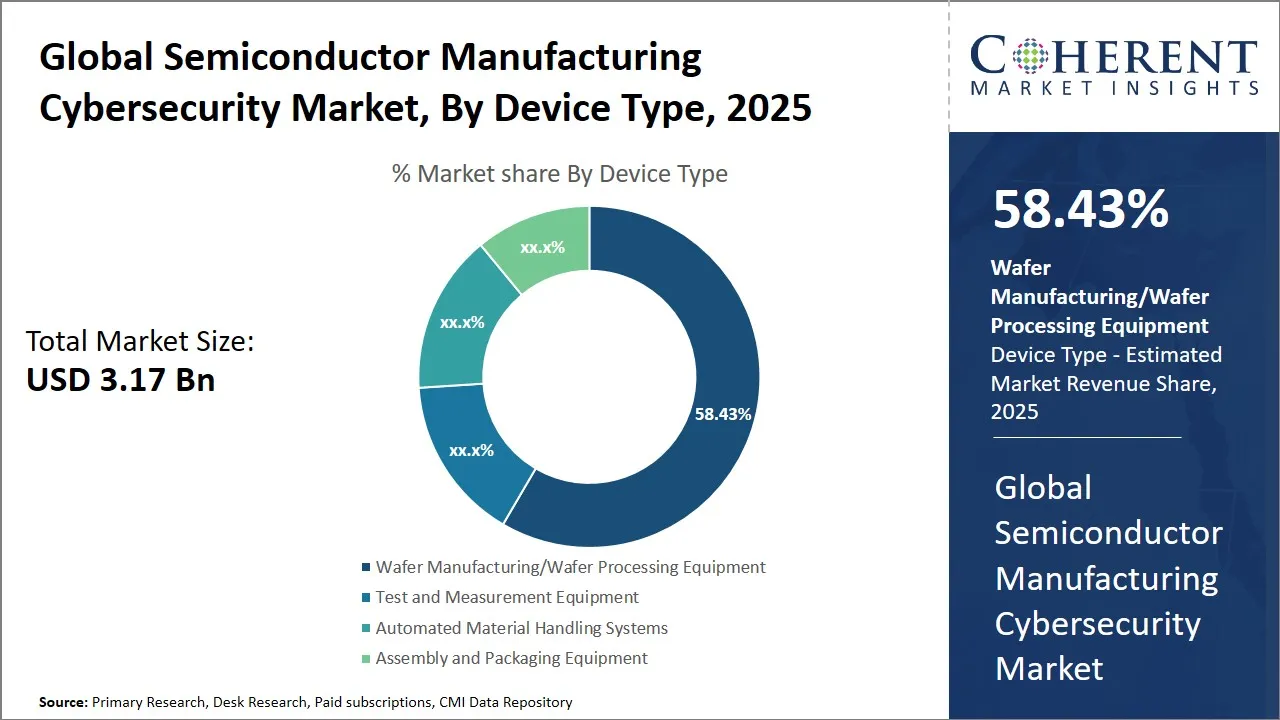
Global Semiconductor Manufacturing Cybersecurity Market Insights, By Device Type – Wafer Manufacturing/Wafer Processing Equipment Leads Due to its Critical Role in the Semiconductor Fabrication Process
Wafer manufacturing/wafer processing equipment, holding an estimated share of 59.4% in 2026, form the foundational stage in semiconductor production. The criticality of these devices stems from their role in manipulating the silicon wafers upon which integrated circuits are formed. Since this process requires extreme precision and involves highly automated machinery, any disruption or security breach could cause significant operational setbacks, yield loss, and compromise intellectual property.
One of the main drivers for cybersecurity growth in wafer manufacturing equipment is the increasing digitalization and automation across fabs (fabrication plants). With the adoption of Industry 4.0 technologies, including IoT-enabled machines and advanced process control systems, these equipment are now interconnected within a complex cyber-physical environment. This interconnectivity expands the attack surface, making the wafer manufacturing segment more vulnerable to cyber threats such as ransomware, espionage, and sabotage. Manufacturers are compelled to invest in robust cybersecurity solutions to protect their sensitive production data, prevent downtime, and ensure process reliability.
Moreover, wafer processing operations involve proprietary recipes and process parameters critical to product differentiation and quality. Any unauthorized access or modification of these parameters can lead to compromised chips or total line shutdowns. This drives the demand for security frameworks tailored to protect industrial control systems embedded within wafer processing equipment.
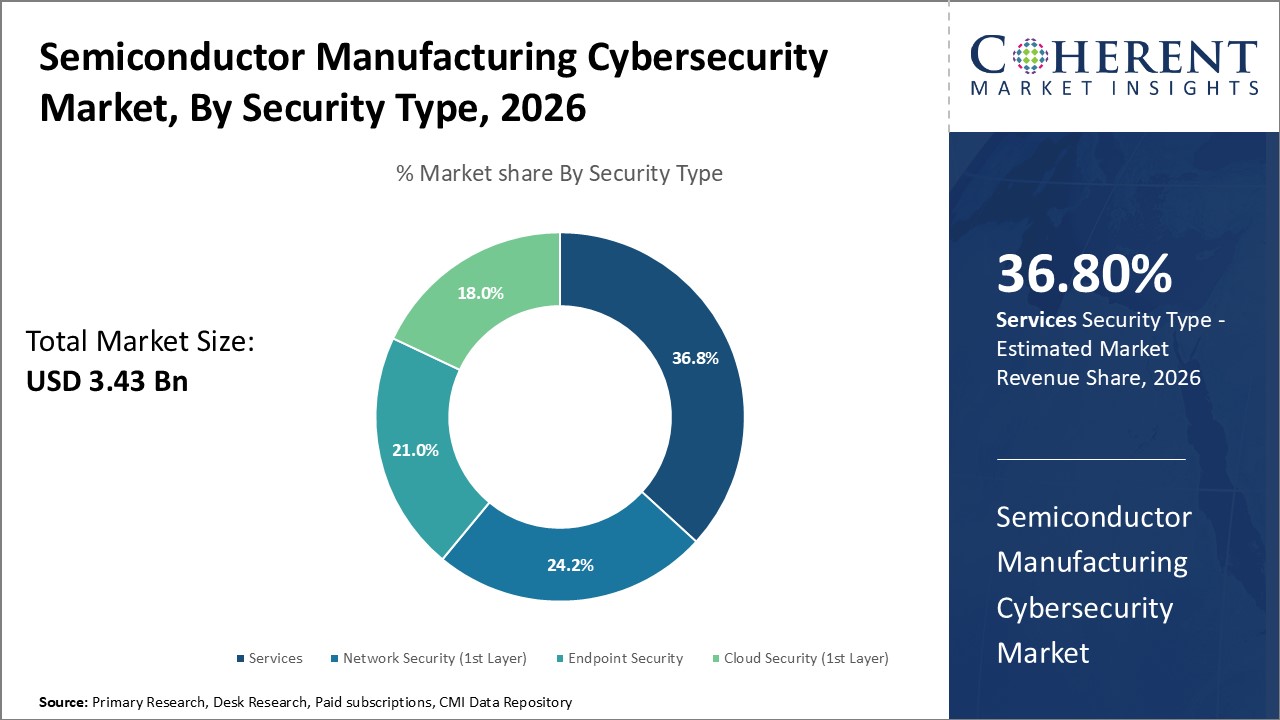
Global Semiconductor Manufacturing Cybersecurity Market Insights, By Security Type – Services Lead Driven By the Growing Demand for Specialized Cybersecurity Expertise And Comprehensive Protection Frameworks
Services, holding an estimated share of 36.8% in 2026, constitute the backbone of defense strategies across semiconductor manufacturing environments. These services encompass consulting, managed security services, threat intelligence, incident response, and risk assessments tailored to the nuanced requirements of semiconductor fabs. The complexity and criticality of semiconductor manufacturing processes necessitate ongoing professional oversight and adaptive security management, driving robust growth within this segment.
A primary factor propelling expansion in cybersecurity services is the scarcity of in-house cybersecurity expertise within semiconductor manufacturers. Given the high stakes involved—protection of proprietary technologies, operational continuity, and compliance with evolving regulations—businesses increasingly rely on specialized third-party providers to design, implement, and manage comprehensive security architectures.
Additionally, semiconductor fabs run heterogeneous environments with legacy equipment, third-party hardware, and newly integrated digital solutions, which compound cybersecurity challenges. Service providers enable seamless integration of security across these disparate systems, offering continuous monitoring, vulnerability assessments, and proactive threat mitigation that are critical to early detection and response.
The rise in cyberattacks targeting critical infrastructure, including semiconductor manufacturing, accelerates demand for incident response services that can quickly mitigate breaches and reduce downtime. Services such as penetration testing and forensic investigations further ensure that vulnerabilities are addressed promptly, reinforcing operational resilience.
Impact of Artificial Intelligence (AI) on Semiconductor Manufacturing Cybersecurity Market
Artificial Intelligence (AI) is transforming cybersecurity strategies in semiconductor manufacturing by enabling proactive threat detection, automated anomaly monitoring, and predictive maintenance of cyber-physical systems. AI-driven security platforms can analyze massive volumes of data from semiconductor fabs in real-time—detecting irregular network activity, suspicious device behavior, or process deviations that may indicate a cyberattack. In highly sensitive fab environments, where downtime or intellectual property theft can cause multimillion-dollar losses, AI enhances incident response speed and accuracy.
Following rising concerns about espionage campaigns targeting Taiwanese fabs, TSMC ramped up its investment in AI-based network traffic analysis and behavioral analytics systems in 2024–2025.
Regional Insights
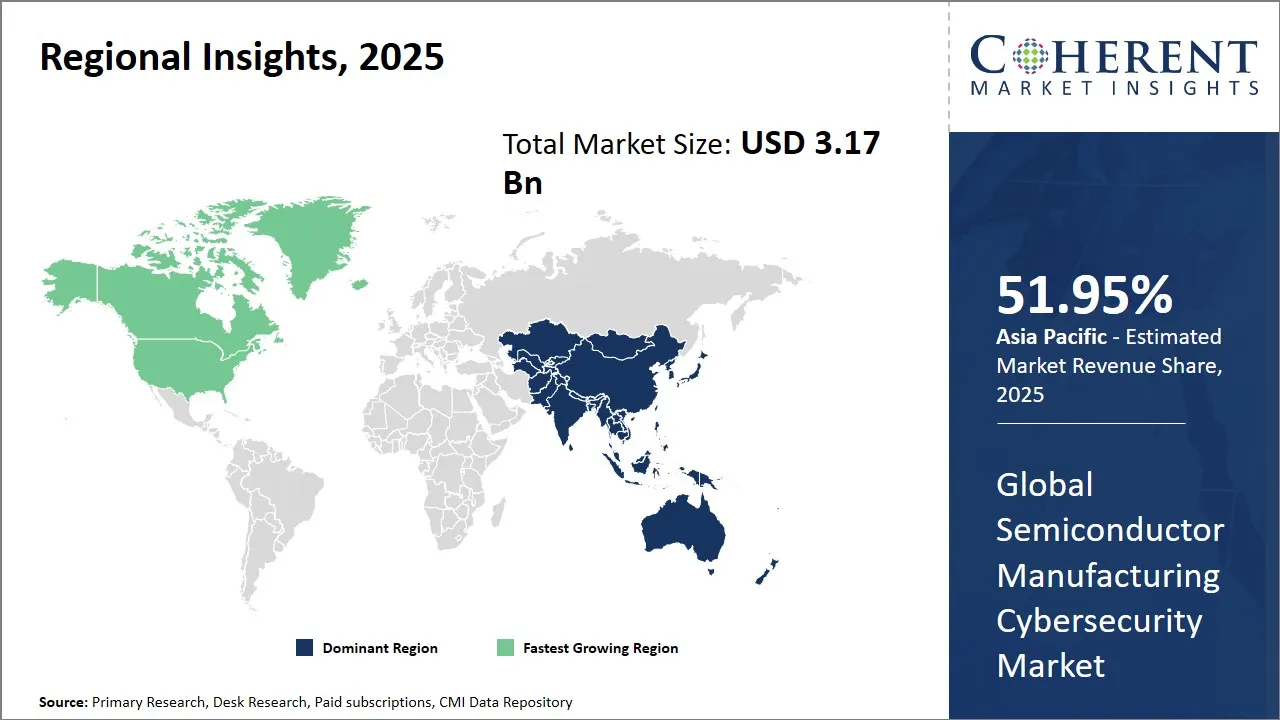
Asia Pacific Semiconductor Manufacturing Cybersecurity Market Analysis and Trends
The Asia Pacific, holding a share of 51.95% in 2026, is expected to dominate the global semiconductor manufacturing cybersecurity market, owing to its rapidly expanding semiconductor manufacturing base, driven by countries like China, South Korea, Taiwan, and Japan. The region is home to some of the world’s largest foundries and memory chip manufacturers such as TSMC, Samsung Electronics, and SK Hynix. This growth surge is also supported by rising government initiatives focused on fostering domestic semiconductor industries and enhancing cybersecurity resilience amid increasing cyber-espionage risks.
For example, China’s Made in China 2026 strategy and South Korea’s robust industrial cybersecurity policies emphasize the strategic importance of securing the semiconductor manufacturing infrastructure. Trade dynamics play a significant role as well, with ongoing shifts in global supply chains and geopolitical tensions prompting manufacturers to strengthen cybersecurity postures.
North America Semiconductor Manufacturing Cybersecurity Market Analysis and Trends
North America, holding a share of 30.76% in 2026, is expected to exhibit the fastest growth, stemming primarily from its established semiconductor manufacturing ecosystem, advanced technological infrastructure, and strong governmental focus on national security and critical infrastructure protection. The U.S., in particular, hosts several leading semiconductor fabrication facilities and design centers, generating a high demand for specialized cybersecurity solutions tailored to protect complex and sensitive manufacturing processes.
Supportive government policies, including increased investments under initiatives like the CHIPS Act, emphasize securing semiconductor supply chains against cyber threats. The presence of major semiconductor manufacturing and equipment companies such as Intel, GlobalFoundries, and Texas Instruments, coupled with cybersecurity experts like Palo Alto Networks and Fortinet, fortifies the market’s growth in this region.
Global Semiconductor Manufacturing Cybersecurity Market Outlook for Key Countries
U.S. Semiconductor Manufacturing Cybersecurity Market Analysis and Trends
The U.S. continues to lead due to its extensive semiconductor manufacturing hubs and significant governmental impetus on cybersecurity and supply chain security. Major companies such as Intel and Analog Devices not only drive semiconductor production but also integrate robust cybersecurity protocols into their manufacturing processes. Strategic investments by federal agencies foster research and development in advanced cybersecurity technologies. Additionally, cybersecurity firms headquartered in the U.S., including CrowdStrike and CyberArk, play critical roles in creating innovative solutions addressing vulnerabilities unique to semiconductor manufacturing.
China Semiconductor Manufacturing Cybersecurity Market Analysis and Trends
China is rapidly evolving, bolstered by vast state-backed efforts to achieve semiconductor self-sufficiency and protect its manufacturing ecosystem from external cyber threats. Leading foundries and producers like SMIC and Yangtze Memory Technologies are major contributors to the domestic landscape. The Chinese government’s stringent cybersecurity regulations for critical industries push companies to adopt comprehensive cybersecurity frameworks, making China a hotbed for emerging cybersecurity technologies tailored for semiconductor fabs. The interplay between industrial expansion and cybersecurity protection continues to shape market dynamics here.
Taiwan Semiconductor Manufacturing Cybersecurity Market Analysis and Trends
Taiwan semiconductor manufacturing cybersecurity market remains critical, given its role as the global leader in semiconductor fabrication through industry giants such as TSMC and UMC. The high value and complexity of wafer fabrication facilities in Taiwan necessitate cutting-edge cybersecurity measures to counteract sophisticated cyber threats targeting production continuity and intellectual property. Local cybersecurity providers cooperate closely with semiconductor firms to ensure tailored defenses. Moreover, the geopolitical significance of Taiwan amplifies the emphasis placed on protecting semiconductor assets through advanced cybersecurity infrastructures.
South Korea Semiconductor Manufacturing Cybersecurity Market Analysis and Trends
South Korea’s semiconductor manufacturing ecosystem is robust, driven predominantly by Samsung Electronics and SK Hynix, which contribute substantially to the global memory chip market. The country’s advanced industrial policies, including cybersecurity frameworks specifically designed for manufacturing, stimulate innovations in safeguarding semiconductor plants from cyber breaches. Collaboration between semiconductor manufacturers and cybersecurity service providers helps address risks arising from digitalization and automation in fabs. Government support emphasizing technological sovereignty and cyber resilience propels the market’s expansion.
Japan Semiconductor Manufacturing Cybersecurity Market Analysis and Trends
Japan semiconductor manufacturing cybersecurity market reflects its tradition of precision manufacturing combined with growing integration of smart manufacturing practices. Notable companies such as Toshiba and Renesas Electronics highlight the importance of securing manufacturing processes against cyber intrusions. The Japanese government encourages the adoption of Industry 4.0 technologies, which increases demand for sophisticated cybersecurity solutions tailored to semiconductor production lines. Partnerships between global cybersecurity firms and domestic manufacturers are increasingly common, aimed at bolstering defenses in this technologically advanced landscape.
Market Players, Key Development, and Competitive Intelligence
Key Developments
- In January 2025, Cadence entered a definitive agreement to acquire Secure-IC, a leading embedded security IP platform provider. The addition of Secure-IC’s talent and portfolio of embedded security IP, security solutions, security evaluation tools and services will augment Cadence’s rapidly expanding portfolio of leading-edge, silicon-proven IP, including interface, memory, AI/ML and DSP solutions.
- In January 2025, onsemi completed its acquisition of the Silicon Carbide Junction Field-Effect Transistor (SiC JFET) technology business, including the United Silicon Carbide subsidiary, from Qorvo for USD 115 million in cash. The addition of SiC JFET technology will complement onsemi’s extensive EliteSiC power portfolio and enable the company to address the need for high energy efficiency and power density in the AC-DC stage in power supply units for AI data centers.
- In January 2025, Ardian, a private investment house, completed the acquisition of Synergie Cad Group, a leading player in the design and manufacture of semiconductor test interface solutions. Synergie Cad specializes in the development of advanced test interface solutions enabling leading semiconductor companies to optimize the testing and validation of their complex chip designs.
- In September 2024, the global association SEMI announced the creation of a strategic roadmap for cybersecurity implementation throughout the industry. The SEMI Semiconductor Manufacturing Cybersecurity Consortium (SMCC) partnered with the National Institute of Standards and Technology (NIST) to develop a semiconductor manufacturing industry profile for NIST Cybersecurity Framework 2.0 (CSF 2.0) that will serve as the foundation for the aforementioned roadmap.
Top Strategies Followed by Semiconductor Manufacturing Cybersecurity Market Players
- Established industry leaders prioritize heavy investment in research and development to drive innovation in high-performance cybersecurity solutions tailored for semiconductor manufacturing environments.
- Intel has announced plans to invest over USD 1 billion in 2025 into AI-powered cybersecurity integration across its global design and fab workflows.
- Mid-level companies in the semiconductor manufacturing cybersecurity market focus on carving out a competitive edge by delivering cost-effective and reliable solutions that balance quality with affordability.
- Quick Heal’s Seqrite (India) launched a fab security suite tailored for mid-sized semiconductor manufacturers in Southeast Asia and India in November 2024.
- Small-scale players operating within the semiconductor manufacturing cybersecurity market distinctively position themselves by focusing on specialized features or niche product innovations that cater to specific needs unmet by larger competitors.
- Exein (Italy, expanding into Asia via MediaTek partnership) focuses exclusively on embedded cybersecurity for chips.
Market Report Scope
Semiconductor Manufacturing Cybersecurity Market Report Coverage
| Report Coverage | Details | ||
|---|---|---|---|
| Base Year: | 2025 | Market Size in 2026: | USD 3.43 Bn |
| Historical Data for: | 2020 To 2024 | Forecast Period: | 2026 To 2033 |
| Forecast Period 2026 to 2033 CAGR: | 8.2% | 2033 Value Projection: | USD 5.95 Bn |
| Geographies covered: |
| ||
| Segments covered: |
| ||
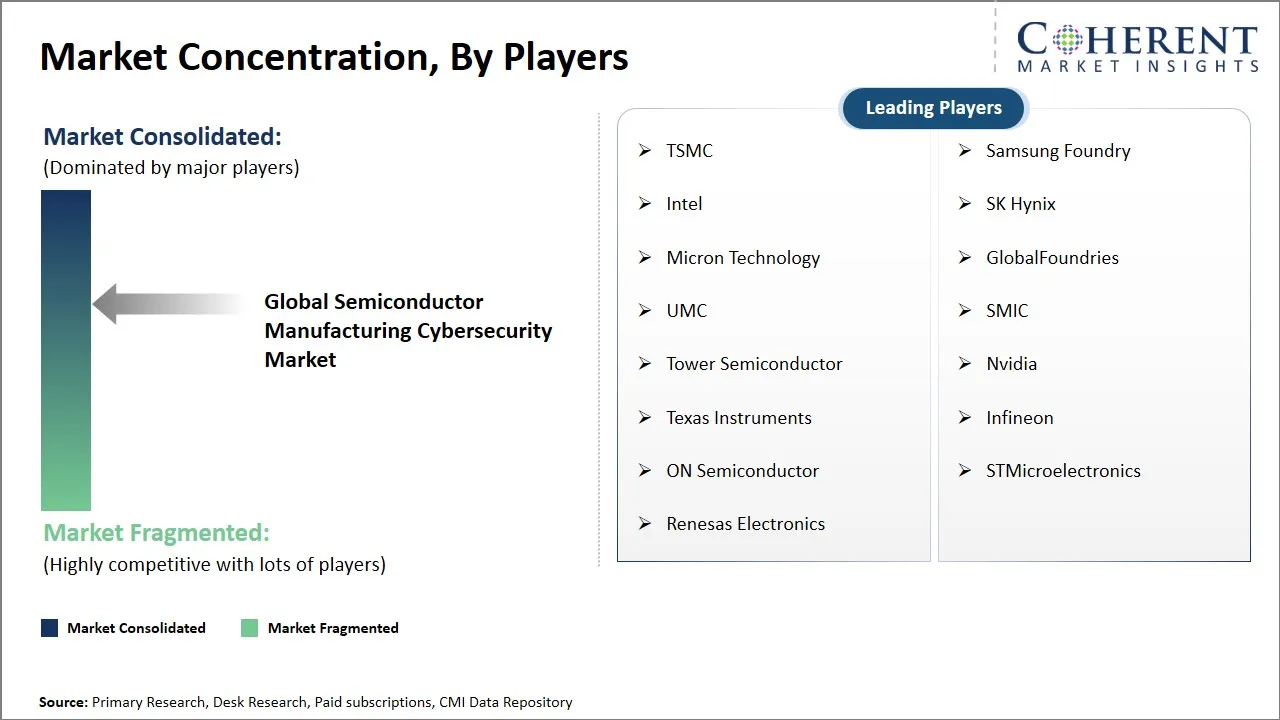
| Companies covered: | TSMC, Samsung Foundry, Intel, SK Hynix, Micron Technology, GlobalFoundries, UMC, SMIC, Tower Semiconductor, Nvidia, Texas Instruments, Infineon, ON Semiconductor, STMicroelectronics, and Renesas Electronics | ||
| Growth Drivers: |
| ||
| Restraints & Challenges: |
| ||
Market Dynamics
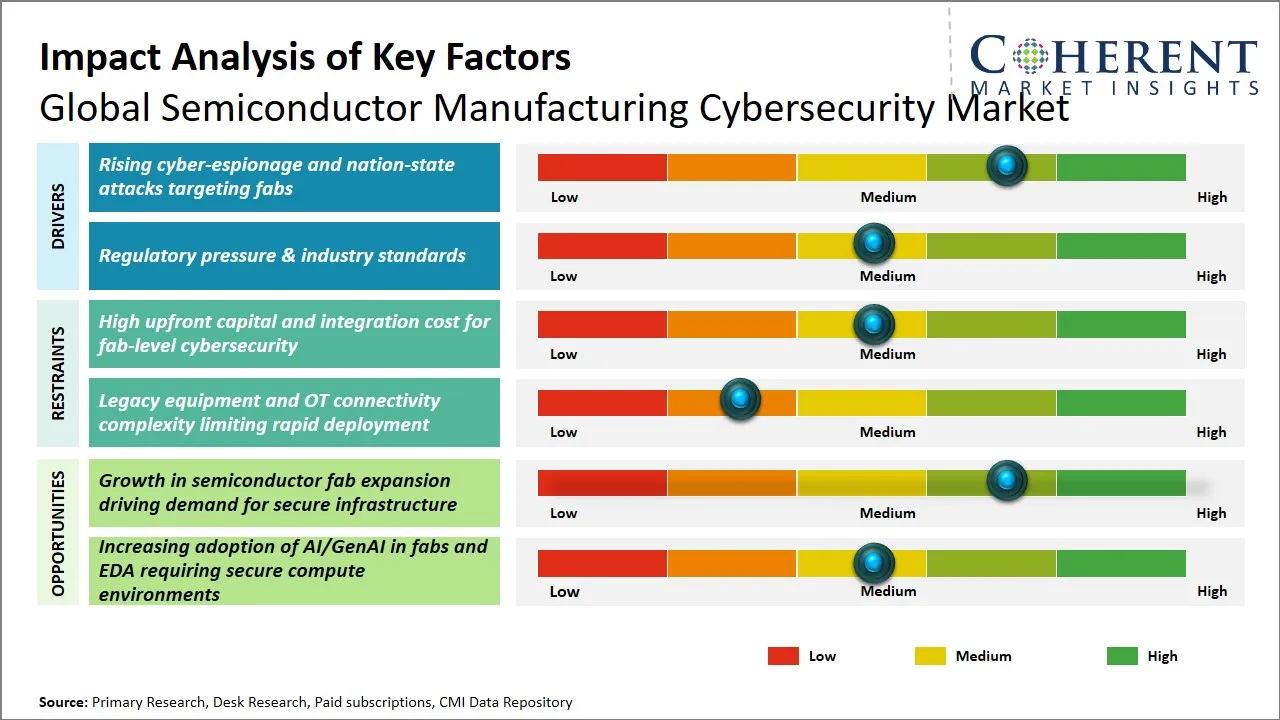
Global Semiconductor Manufacturing Cybersecurity Market Driver - Rising Cyber‑Espionage and Nation-State Attacks Targeting Fabs
The semiconductor manufacturing industry has increasingly become a prime target for sophisticated cyber-espionage and nation-state-sponsored attacks due to its critical role in the global supply chain and national security. Semiconductor fabs house highly sensitive intellectual property, including proprietary chip designs and manufacturing processes, making them attractive targets for adversaries seeking to gain technological advantages or disrupt production capabilities. Between March and June 2025, Proofpoint identified multiple China-aligned threat actors specifically targeting Taiwanese organizations within the semiconductor industry. This included a China-aligned threat actor tracked as UNK_FistBump targeting semiconductor design, manufacturing, and supply chain organizations in employment-themed phishing campaigns resulting in the delivery of Cobalt Strike or the custom Voldemort backdoor.
Nation-state actors, in particular, are investing significant resources to infiltrate these facilities, aiming to exfiltrate valuable data or inject malicious code that could compromise product integrity. The complexity and interconnected nature of semiconductor fabs' operational technology systems make them vulnerable to advanced persistent threats that are difficult to detect and mitigate.
Global Semiconductor Manufacturing Cybersecurity Market Opportunity – Growth in Semiconductor Fab Expansion Driving Demand for Secure Infrastructure
The global semiconductor manufacturing sector is experiencing unprecedented growth, fueled by escalating demand for advanced electronics, automotive applications, and emerging technologies such as AI and IoT. This surge has prompted significant expansion of semiconductor fabrication plants (fabs) worldwide, particularly in countries like the U.S., Taiwan, South Korea, and China, where governments and private entities are investing billions to enhance production capacities and reduce supply chain vulnerabilities. In March 2024, Intel announced it had received USD 8.5 billion from the U.S. CHIPS and Science Act to build four new highly advanced semiconductor fabs in Chandler, Arizona and New Albany, Ohio and upgrade plants in Hillsboro, Oregon and Rio Rancho, New Mexico.
As fabs grow more sophisticated, the complexity and volume of critical data processed increase exponentially, elevating the risk of cyber threats that can disrupt manufacturing operations, compromise intellectual property, and result in costly downtime. Consequently, this rapid fab expansion presents a robust opportunity for the semiconductor manufacturing cybersecurity market to develop and deploy specialized security solutions tailored to the unique needs of semiconductor fabs.
Analyst Opinion (Expert Opinion)
- Regulatory frameworks like the EU Cyber Resilience Act (CRA) and NIST CSF 2.0 are pushing semiconductor manufacturers to adopt end-to-end cybersecurity practices, from chip design to fab operations. These mandates are particularly impacting cross-border supply chains, where compliance is now a prerequisite for accessing global markets.
- With the rise of AI-powered fab automation, regulators are beginning to address AI-generated vulnerabilities, such as synthetic code injection or algorithmic manipulation. As a result, governments and industry bodies (e.g., SEMI’s Cybersecurity Consortium) are updating policy guidance to ensure secure AI integration in fab workflows, signaling a shift from reactive to preventive compliance.
- Countries investing in domestic semiconductor production (e.g., the U.S., India, Japan) are embedding cybersecurity certification requirements into their subsidy and grant frameworks. This trend not only ensures better defense against IP theft and nation-state attacks but also gives rise to a localized compliance ecosystem, benefiting vendors that offer standards-compliant security solutions.
Speak to the analyst
Want personalized insights?
Take the findings above to one of our principal consultants, or have the report rebuilt around the segments, geographies and competitors you actually track.
Market Segmentation
- Device Type Insights (Revenue, USD Bn, 2021 - 2033)
- Wafer Manufacturing/Wafer Processing Equipment
- Test and Measurement Equipment
- Automated Material Handling Systems
- Assembly and Packaging Equipment
- Security Type Insights (Revenue, USD Bn, 2021 - 2033)
- Services
- Network Security (1st Layer)
- Endpoint Security
- Cloud Security (1st Layer)
- Regional Insights (Revenue, USD Bn, 2021 - 2033)
- North America
- U.S.
- Canada
- Latin America
- Brazil
- Argentina
- Mexico
- Rest of Latin America
- Europe
- Germany
- U.K.
- Spain
- France
- Italy
- Russia
- Rest of Europe
- Asia Pacific
- China
- India
- Japan
- Australia
- South Korea
- ASEAN
- Rest of Asia Pacific
- Middle East
- GCC Countries
- Israel
- Rest of Middle East
- Africa
- South Africa
- North Africa
- Central Africa
- North America
- Key Players Insights
- TSMC
- Samsung Foundry
- Intel
- SK Hynix
- Micron Technology
- GlobalFoundries
- UMC
- SMIC
- Tower Semiconductor
- Nvidia
- Texas Instruments
- Infineon
- ON Semiconductor
- STMicroelectronics
- Renesas Electronics
Sources
Primary Research Interviews
Stakeholders
- Semiconductor Foundry Operators (e.g., Fab Managers, Cybersecurity Heads at TSMC, Intel, GlobalFoundries)
- Cybersecurity Solution Providers for OT/ICS (e.g., TXOne Networks, Fortinet, Palo Alto Networks – industrial units)
- Equipment Manufacturers (e.g., ASML, Applied Materials – digital infrastructure and fab tools teams)
- Semiconductor Design and IP Companies (e.g., Cadence, Synopsys – Security Architecture Leads)
- Managed Security Services Providers (e.g., NTT Security, Capgemini, Atos – serving semiconductor fabs)
- Government Cybersecurity Agencies & Policy Bodies (e.g., CERT-In, CISA, ENISA – regulatory insight providers)
- Academia & Research Labs in Secure Semiconductor Design (e.g., MIT CSAIL, IIT-M Secure Fab Lab)
Databases
- FabSecure Global Fab Incident Tracker (2025 Edition)
- APAC Semiconductor Cyber Threat Database (ASCTD)
- Global Semiconductor Infrastructure Registry (GSIR)
- CISA Fab Cyber Breach Reports Archive
- US Semiconductor Industrial Base Database (US-SIBD)
Magazines
- Semiconductor Manufacturing Weekly
- CyberFab Digest
- Microelectronics Security Review
- Secure Silicon Monthly
Journals
- Journal of Semiconductor Manufacturing Cybersecurity (JSMC)
- International Journal of Secure Embedded Systems
- Journal of Operational Technology & Cyber Threats
- IEEE Transactions on Semiconductor Security
Newspapers
- FabTimes Global
- CyberTech Asia Daily
- The Silicon Valley Journal
- The Semiconductor Review (India Edition)
Associations
- Semiconductor Cybersecurity Consortium (SCC)
- Global Semiconductor Alliance (GSA)
- Industrial Cybersecurity Standards Association (ICSA)
- Asia-Pacific Semiconductor Security Forum (APSSF)
- European Semiconductor Security Council (ESSC)
Public Domain Sources
- National Institute of Standards and Technology (NIST)
- European Union Agency for Cybersecurity (ENISA)
- Cybersecurity and Infrastructure Security Agency (CISA – USA)
- Ministry of Electronics and IT (MeitY – India)
- Taiwan Ministry of Economic Affairs – Semiconductor Division
- World Semiconductor Trade Statistics (WSTS)
- ResearchGate
Proprietary Elements
- CMI Data Analytics Tool
- Proprietary CMI Existing Repository of information for last 8 years
Get access to 250+ pages report
Every segment, forecast, competitor profile and data table behind the analysis above — available for instant download.
- ESOMAR Member
- ISO 9001:2015 Certified
- D-U-N-S Registered
- GDPR & CCPA Compliant
Missing comfort of reading report in your local language? Find your preferred language:
Transform your Strategy with Exclusive Trending Reports
Frequently Asked Questions
The global semiconductor manufacturing cybersecurity market is estimated to be valued at USD 3.43 Bn in 2026 and is expected to reach USD 5.95 Bn by 2033.
The CAGR of global semiconductor manufacturing cybersecurity market is projected to be 8.2% from 2026 to 2033.
Rising cyber‑espionage and nation-state attacks targeting fabs and regulatory pressure & industry standards are the major factors driving the growth of the global semiconductor manufacturing cybersecurity market.
High upfront capital and integration cost for fab‑level cybersecurity and legacy equipment and OT connectivity complexity limiting rapid deployment are the major factors hampering the growth of the global semiconductor manufacturing cybersecurity market.
In terms of device type, wafer manufacturing/wafer processing equipment is estimated to dominate the market revenue share in 2026.
TSMC, Samsung Foundry, Intel, SK Hynix, Micron Technology, GlobalFoundries, UMC, SMIC, Tower Semiconductor, Nvidia, Texas Instruments, Infineon, ON Semiconductor, STMicroelectronics, and Renesas Electronics are the major players.
Asia Pacific is expected to lead the global semiconductor manufacturing cybersecurity market in 2026.