

Global Shade Net Market Size and Forecast – 2026-2033
The Global Shade Net Market is estimated to be valued at USD 1.79 Bn in 2026 and is expected to reach USD 3.17 Bn by 2033, exhibiting a compound annual growth rate (CAGR) of 8.5% from 2026 to 2033.
Key Takeaways of the Shade Net Market
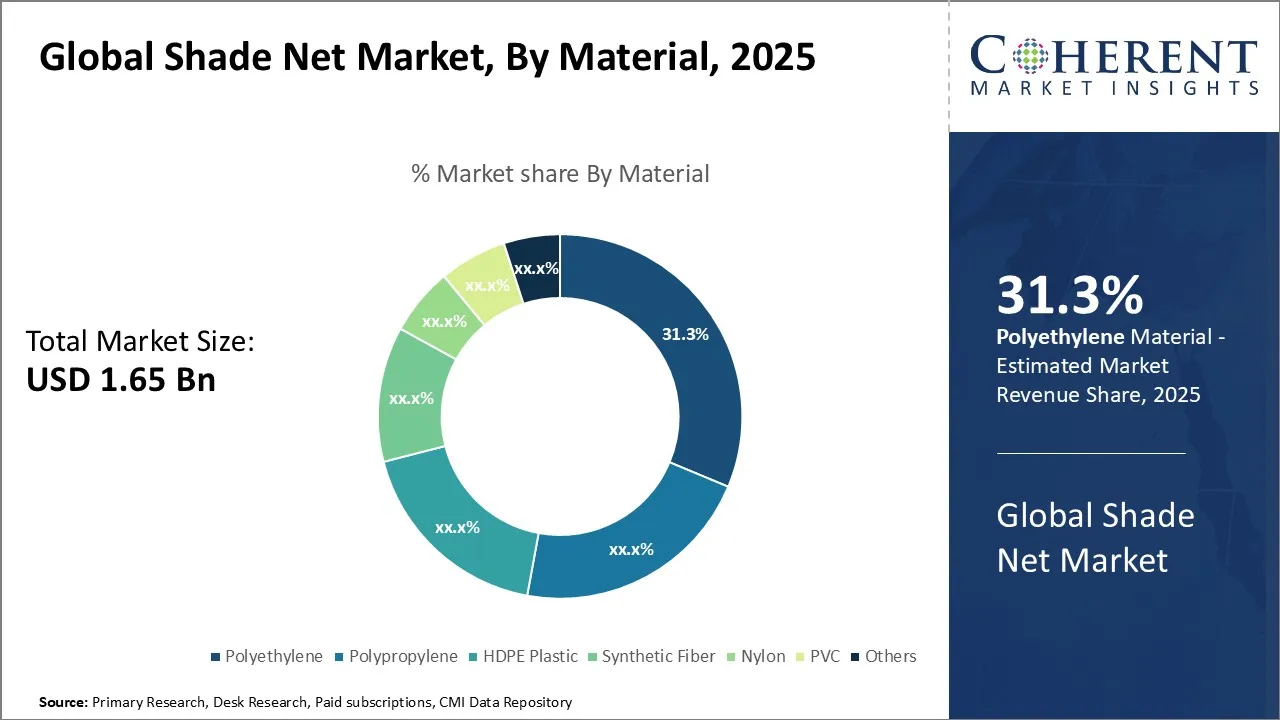
- The polyethylene segment is expected to hold a 32.3% share of the global shade net market in 2026.
- The agriculture segment is expected to hold 29.5% of the global shade net market in 2026.
- Asia Pacific is set to lead the global shade net market in 2026 with a 32. 2% share.
- North America, with a 21. 5% share, will be the fastest-growing region.
Market Overview
The market trend indicates a growing preference for sustainable and innovative shade net solutions, including the integration of UV stabilization and anti-pest features. Additionally, advancements in materials like high-density polyethylene (HDPE) and biodegradable fabrics, recyclable fabrics are gaining traction, aligning with environmental concerns. The rise in greenhouse farming and urban agriculture is also propelling demand, as shade nets prove essential to optimizing light filtration and temperature control for more efficient crop production year-round.
Current Events and Its Impact
Current Events | Description and its impact |
Surge in Protected Cultivation and Modern Farming |
|
Regional Expansion and Developing Markets |
|
Segmental Insights
- Current Industry Events of 2026
- Market Size Estimation
- Regional Breakdown
- Competitive Landscape
- Customer Intelligence
- Segmental Analysis
- Pricing Analysis
- Key Market Drivers, Challenges & Future Trends
- Customized Insights Section
Shade Net Market Insights, By Material – Polyethylene Segment Dominates the Market Due to its Durability and Cost Effectiveness
Polyethylene segment is expected to contribute 32.3% share of the global shade net market in 2026, by material due to a unique combination of properties that cater to diverse applications effectively. Its widespread adoption is primarily driven by its exceptional durability, chemical resistance, and lightweight nature, making it ideal for withstanding various climatic conditions without significant degradation. The robust resistance to ultraviolet (UV) radiation is a critical factor, since shade nets are regularly exposed to direct sunlight, and PE's inherent UV stabilization ensures prolonged lifespan and maintained effectiveness. This reduces replacement frequency, which appeals to cost-conscious end users across multiple industries.
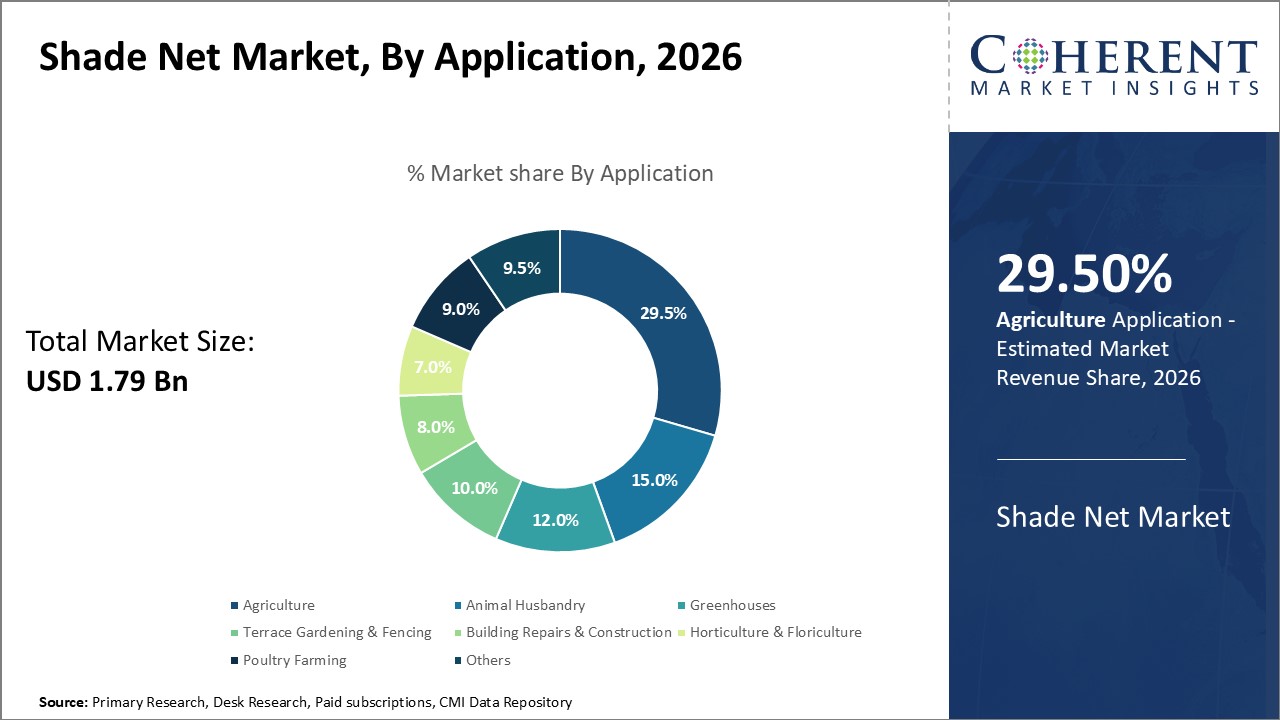
Shade Net Market Insights, By Application - Agriculture Dominates Owing to Increasing Demand for Crop Protection and Yield Enhancement
Agriculture segment contributes the in the 29.5% share of the global shade net market in 2026, due to the essential role that shade nets play in enhancing crop productivity and protecting plants from environmental stresses. The increasing need for sustainable farming practices and better yield management has driven widespread adoption of shade nets among farmers worldwide. By mitigating excessive sunlight, reducing temperature fluctuations, and shielding crops from pests, birds, and wind, shade nets create an optimal microclimate for plant growth.
Regional Insights
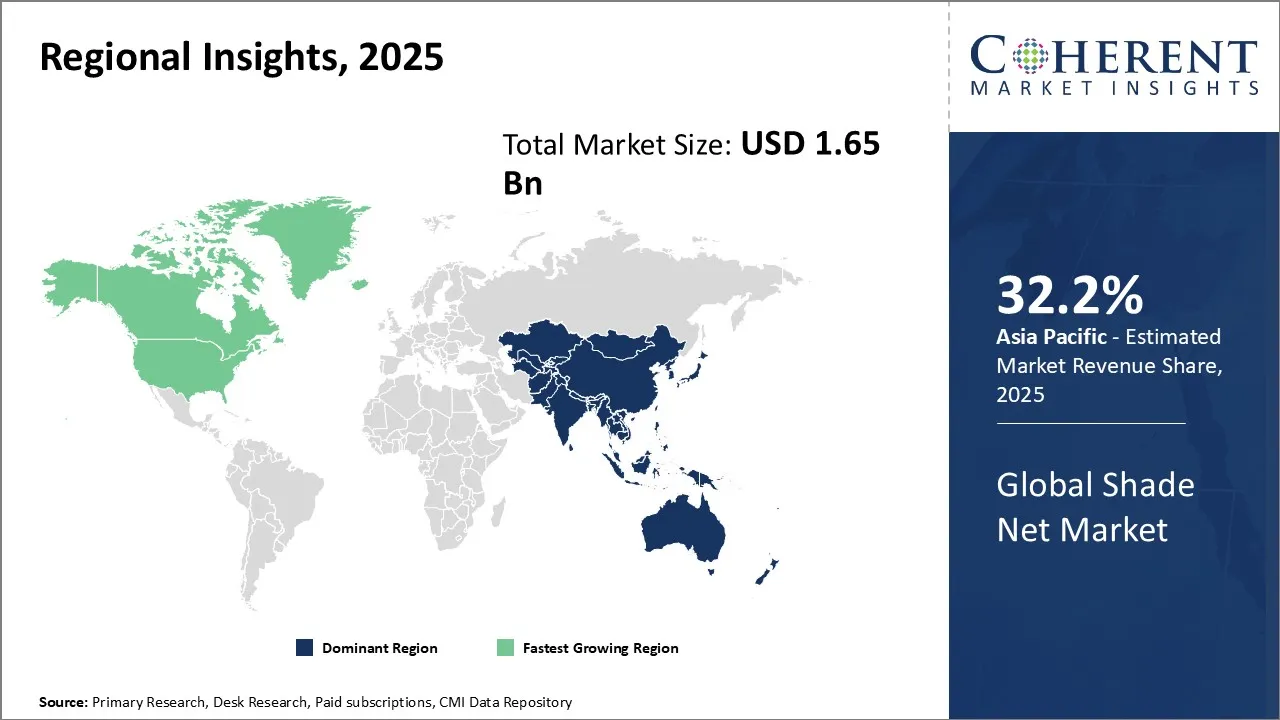
Asia Pacific Shade Net Market Analysis and Trends
The Asia Pacific region is projected to lead the market with a 32.2% share in 2026, driven by the region’s vast agricultural sector and favorable climatic conditions requiring effective crop protection solutions. Countries like China, India, and Japan have well-established greenhouse farming and horticulture industries, boosting demand for shade nets. The presence of a large number of small and medium-scale farmers creates a robust ecosystem for shade net manufacturers and distributors.
Additionally, government initiatives promoting sustainable agriculture and water conservation have accelerated the adoption of shade nets for crop yield improvement and protection against pests and extreme weather. Key local and multinational players, such as Kisan Agri Care in India and Coolaroo in Australia, contribute significantly by innovating products tailored for regional crop types. Efficient supply chains and expanding export activities from countries like China further consolidate Asia Pacific as the leading region in this market.
North America Shade Net Market Analysis and Trends
The North America region is expected to exhibit the fastest growth in the market, contributing 21.5% share in 2026, expanding due to advancements in agricultural technologies and a shift towards sustainable farming. The U.S. and Canada are investing in modern farming methods like greenhouse farming and hydroponics, which require efficient shading solutions. With an increasing focus on organic farming and climate change challenges, the demand for shade nets to protect crops from UV rays and extreme weather is rising. Government incentives for sustainable agriculture and eco-friendly practices are further driving this growth. Companies like Agrinet and Shade Net Solutions are offering innovative, durable shade net products to meet the region's agricultural needs.
Global Shade Net Market Outlook for Key Countries
China Shade Net Market Trends
China's shade net market is characterized by a vast agricultural infrastructure and increasing adoption of high-tech farming solutions. The government’s strong emphasis on modern agriculture and food security has propelled the use of shade nets across various crop segments. Prominent companies such as Hebei Yongkun Metal Products Co., Ltd. and Shangyu Yida specialize in manufacturing diverse shade nets catering to both smallholder farmers and large agribusinesses. Integration with smart farming initiatives and expanding export capacities strengthen China’s influence on the global stage.
India Shade Net Market Trends
India’s shade net market continues to lead owing to its significant agrarian economy and diverse cropping patterns requiring varied shade net applications. Government schemes supporting horticulture development, along with schemes promoting micro-irrigation, have indirectly boosted shade net demand. Companies like Kisan Grow and Ashoka Industries play a pivotal role by introducing durable and affordable nets suited for local climates and crop protection needs. The expanding retail distribution network and growing awareness among farmers are vital market enablers.
Japan Shade Net Market Trends
Japan’s shade net market emphasizes technologically advanced and high-performance shade nets, driven by its strong greenhouse farming segment. Agricultural innovations and stringent quality standards encourage the adoption of specialized nets for pest control and temperature regulation. Leading firms such as Taisei Kogyo and Gunze Limited focus on R&D to improve material longevity and efficiency, setting benchmarks for the Asia Pacific region. Japan’s export activities further contribute to its market stature.
Brazil Shade Net Market Trends
Brazil’s shade net market is defined by the growing shift towards commercial farming and export cultivation. Government efforts to modernize agriculture through subsidies and technical support catalyze shade net utilization, particularly in fruit and vegetable production. Companies like Netafim Brazil focus on integrating irrigation and shading solutions for optimized resource use. The rising middle-class consumption and focus on high-quality crop production strengthen demand dynamics.
Mexico Shade Net Market Trends
Mexico’s shade net market growth is bolstered by increased greenhouse adoption and floriculture expansion, supported by favorable trade policies like USMCA facilitating agricultural trade. Local players and international firms are capitalizing on this trend by offering customized shading solutions that address heat stress and pest control. The presence of strong distribution channels ensures ready availability of shade nets, aiding farmers in enhancing productivity and crop quality.
End User Feedback and Unmet Needs for the Shade Net Market
- In the agricultural sector, a key application for shade nets is in greenhouse farming, where they are utilized for providing crop protection from extreme weather conditions while ensuring optimal sunlight exposure. End users in countries with harsh climates, such as parts of the Middle East and India, have reported significant satisfaction with shade nets' ability to reduce water evaporation and temperature extremes.
- These nets successfully reduced crop damage caused by scorching sun exposure, resulting in increased yields by 15% compared to previous seasons. The feature that stood out was the durability and high UV protection offered by the shade nets, which allowed the greenhouse to maintain optimal environmental conditions, thereby enhancing productivity. End-users appreciated the ease of installation and minimal maintenance required, contributing to overall operational efficiency and reduced downtime.
- The feedback gathered highlights several unmet needs in the shade net market. One of the most pressing is the technological gap in the production of shade nets that offer both higher UV protection and extended durability. Manufacturers often face challenges in creating nets that balance the need for adequate shade with the durability to withstand extreme weather conditions. As climate change leads to more unpredictable weather patterns, users are increasingly seeking shade nets that can adapt to these shifts without losing their effectiveness.
Market Players, Key Development, and Competitive Intelligence
Key Developments
- In February 2025, the Coimbatore corporation initiated the installation of green net shades at major traffic signals to provide relief to motorists from the intense summer heat. The first green net shade was successfully installed at Sivalaya Junction in Selvapuram. Corporation officials announced that similar shades will be implemented at key signals in Gandhipuram, Kavundampalayam, Townhall, and Singanallur, aiming to enhance driver comfort during the approaching summer months.
Top Strategies Followed by Global Shade Net Market Players
- Established market leaders continue to reinforce their dominance by making substantial investments in research and development (R&D). These investments enable them to innovate and introduce high-performance shade net products that meet evolving agricultural and industrial demands, such as enhanced UV protection, durability, and multi-functionality.
- For instance, companies like Sarla Performance Fibers, Garware Technical Fibres Ltd., and Shakti Polyweave are known for proprietary technologies and innovation in UV stabilization, increased product durability, and multifunctional shade nets (combining crop protection with energy conservation or climate control).
- Mid-level players in the shade net market adopt a distinct competitive approach focused primarily on cost-effectiveness and value proposition. These companies target price-sensitive consumer segments, including smallholder farmers and mid-scale agricultural enterprises, who require dependable shade net solutions without incurring premium prices. By carefully balancing quality and affordability, mid-level firms manage to capture market share in both developing and cost-conscious markets.
- For example, Companies like Kwality Nets Manufacturing in India and Tenax Group in Italy focus on making reliable but more affordable shade nets, appealing especially to smallholder farmers and mid-size agricultural enterprises in developing and price-sensitive markets.
- Small-scale players in the global shade net market carve out a competitive niche by concentrating on specialized products or innovative features that differentiate them within localized segments. These firms often incorporate cutting-edge technologies—such as advanced weaving methods or eco-friendly materials—to meet the unique needs of specific customer bases, including specialized agricultural crops or urban horticulture applications.
- For example, small firms, such as Econet Agro and various regional startups in Southeast Asia, focus on niche applications, including eco-friendly shade nets made from biodegradable fibers or products tailored for specific crops or vertical urban gardens.
Market Report Scope
Shade Net Market Report Coverage
| Report Coverage | Details | ||
|---|---|---|---|
| Base Year: | 2025 | Market Size in 2026: | USD 1.79 Bn |
| Historical Data for: | 2020 To 2024 | Forecast Period: | 2026 To 2033 |
| Forecast Period 2026 to 2033 CAGR: | 8.5% | 2033 Value Projection: | USD 3.17 Bn |
| Geographies covered: |
| ||
| Segments covered: |
| ||
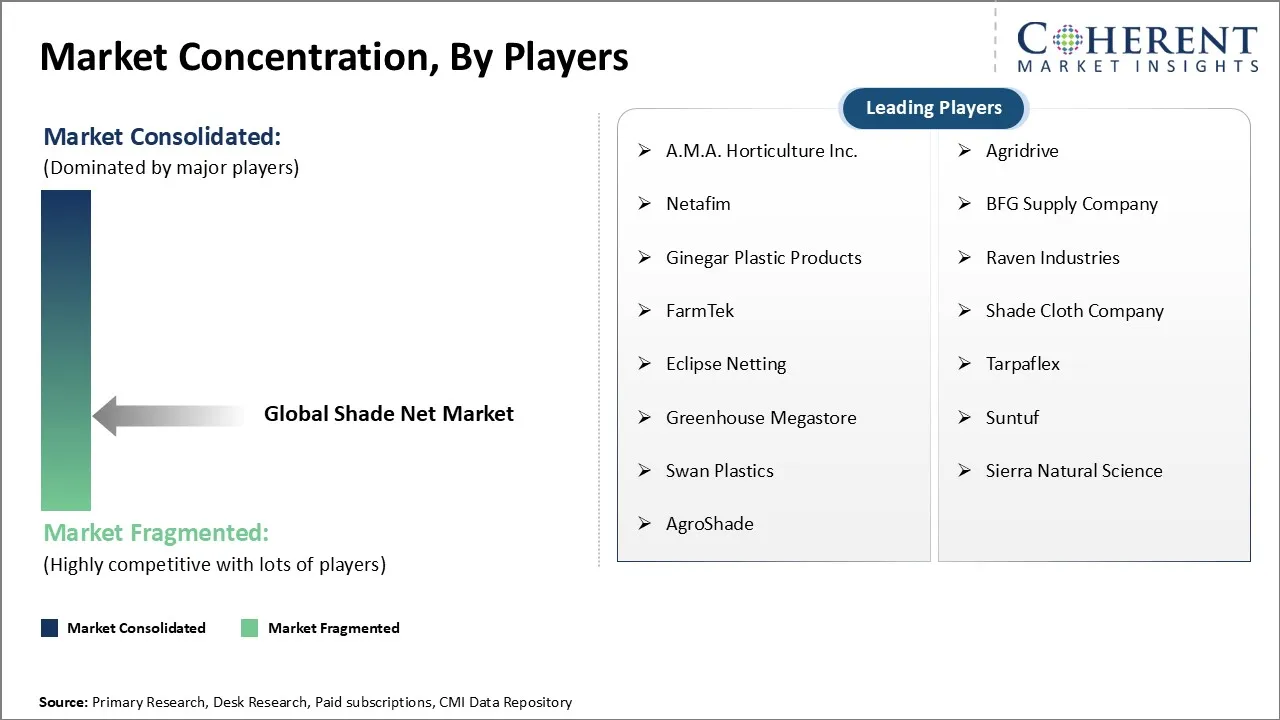
| Companies covered: | A.M.A. Horticulture Inc., Agridrive, Netafim, BFG Supply Company, Ginegar Plastic Products, Raven Industries, FarmTek, Shade Cloth Company, Eclipse Netting, Tarpaflex, Greenhouse Megastore, Suntuf, Swan Plastics, Sierra Natural Science, and AgroShade | ||
| Growth Drivers: |
| ||
| Restraints & Challenges: |
| ||
Shade Net Market Dynamics
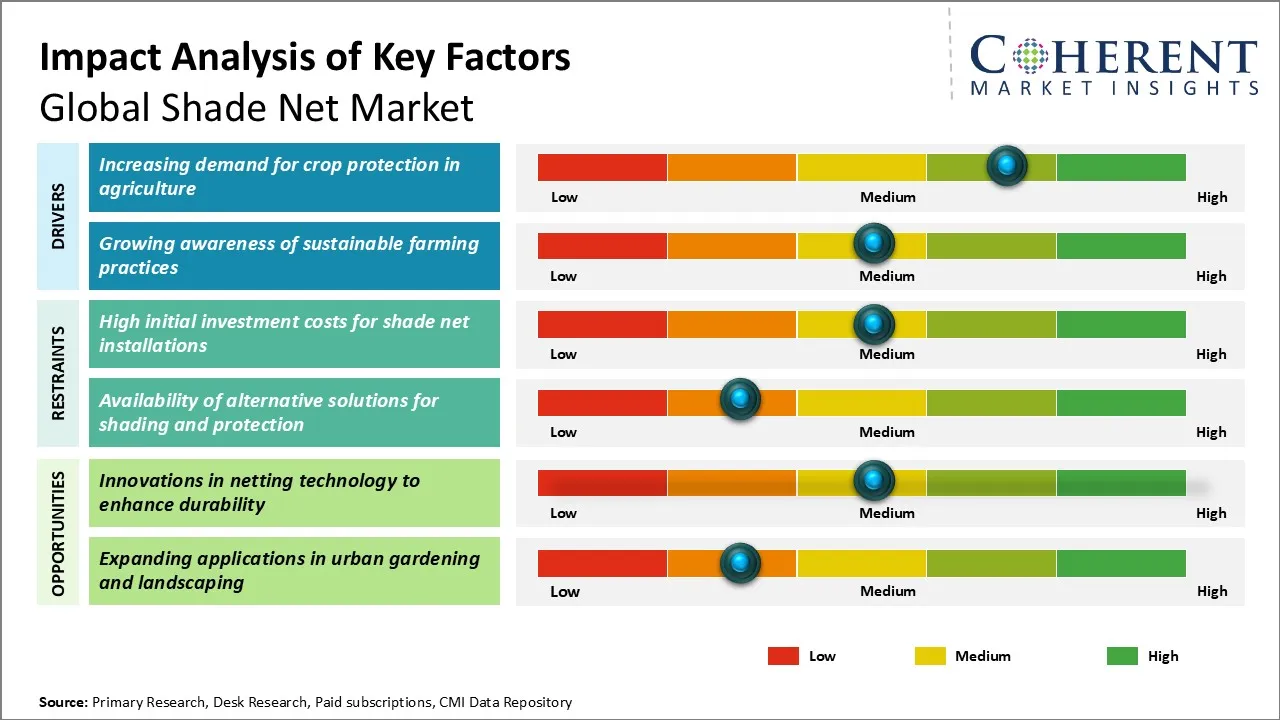
Shade Net Market Driver - Increasing Demand for Crop Protection in Agriculture
The escalating challenges faced by modern agriculture, including adverse weather conditions, pest infestations, and harmful UV exposure, have significantly intensified the demand for efficient crop protection solutions like shade nets. Farmers are increasingly adopting shade nets to create controlled microclimates that help reduce heat stress on plants, moderate humidity levels, and shield crops from direct sunlight, ultimately enhancing crop yield and quality.
As extreme weather events like heatwaves, storms, and droughts become more frequent, shade nets provide a reliable solution. For instance, in India's horticulture sector, farmers in areas like Rajasthan have adopted shade nets to protect crops like tomatoes and cucumbers from excessive heat. The shade nets moderate the temperature beneath the canopy, ensuring plants are shielded from harmful direct sunlight, thereby preventing heat stress and reducing water evaporation.
Shade Net Market Opportunity - Innovations in Netting Technology to Enhance Durability
The global shade net market is poised to benefit significantly from advancements in netting technology aimed at enhancing durability and performance. Traditional shade nets often face challenges such as UV degradation, wear and tear from harsh weather conditions, and limited lifespan, which affect their overall utility in agricultural, horticultural, and construction applications. Innovations leveraging high-density polyethylene (HDPE) combined with UV-stabilizers and antioxidants are extending the durability of shade nets, enabling longer-term protection against ultraviolet rays and other environmental stressors.
For example, Netafim, a global leader in agricultural technology, has introduced "smart" shade nets with embedded nanotechnology that enhances their resistance to fungal and microbial attacks. These nets can help reduce the incidence of diseases in crops and maintain the net’s integrity in humid and wet climates.
Analyst Opinion (Expert Opinion)
- The global shade net market is experiencing significant momentum, driven by the rising demand for agricultural protection and climate resilience. Companies like Berry Global and Netafim are innovating with advanced shade netting solutions that enhance crop yield while minimizing water usage. Recent conferences, such as the International Greenhouse Conference (2023) and the AgriTech Expo (2022), have showcased cutting-edge developments in shade net technology, including UV-resistant materials and customizable shading percentages tailored to specific crops. Presentations highlighted successful case studies where farmers have reported improved growth rates and reduced pest infestations due to the strategic use of shade nets.
- Additionally, the increasing awareness of sustainable agricultural practices is driving investments in shade net solutions that not only protect crops but also contribute to sustainable water management. As climate change continues to impact farming practices, the shade net market is well-positioned for robust growth. The intersection of technological advancement, sustainability initiatives, and rising agricultural productivity demands will be pivotal in shaping the future of this market, making it an essential component of modern agricultural strategies.
Speak to the analyst
Want personalized insights?
Take the findings above to one of our principal consultants, or have the report rebuilt around the segments, geographies and competitors you actually track.
Market Segmentation
- Material Insights (Revenue, USD Bn, 2021 - 2033)
- Polyethylene
- Polypropylene
- HDPE Plastic
- Synthetic Fiber
- Nylon
- PVC
- Others
- Application Insights (Revenue, USD Bn, 2021 - 2033)
- Agriculture
- Animal Husbandry
- Greenhouses
- Terrace Gardening & Fencing
- Building Repairs & Construction
- Horticulture & Floriculture
- Poultry Farming
- Others
- Regional Insights (Revenue, USD Bn, 2021 - 2033)
- North America
- U.S.
- Canada
- Latin America
- Brazil
- Argentina
- Mexico
- Rest of Latin America
- Europe
- Germany
- U.K.
- Spain
- France
- Italy
- Russia
- Rest of Europe
- Asia Pacific
- China
- India
- Japan
- Australia
- South Korea
- ASEAN
- Rest of Asia Pacific
- Middle East
- GCC Countries
- Israel
- Rest of Middle East
- Africa
- South Africa
- North Africa
- Central Africa
- North America
- Key Players Insights
- M.A. Horticulture Inc.
- Agridrive
- Netafim
- BFG Supply Company
- Ginegar Plastic Products
- Raven Industries
- FarmTek
- Shade Cloth Company
- Eclipse Netting
- Tarpaflex
- Greenhouse Megastore
- Suntuf
- Swan Plastics
- Sierra Natural Science
- AgroShade
Sources
Primary Research Interviews
- R&D Director – Leading Shade Net Manufacturer
- Procurement Manager – Major Shade Net Distributor or Retailer
- Product Development Head – Well-Known Shade Net Brand
- Sustainability Manager – Agricultural/Environmental Certification Body
Stakeholders
- Manufacturers
- End-use Sectors:
- Agriculture (Greenhouses, Nursery, Horticulture, Floriculture, Aquaculture)
- Construction (Scaffolding, Safety Netting)
- Consumer (Home Gardening, Urban Landscapes)
- Commercial (Outdoor Cafes, Sports Facilities)
- Regulatory & Certification Bodies:
- National and international standards organizations (IS, ASTM, ISO, BIS, EU)
- E-commerce Platforms and Retailers
- B2B and B2C online sales channels
- Technology Integration Players:
- Providers of smart/innovative shade net materials (nano-tech, UV stabilization, biodegradable polymers)
Databases
- UN Comtrade Database
- India Import Export (EXIM) Database
Magazines
- Agriculture Today – Trends in agricultural infrastructure and shade net usage
- Agri Business Global – Innovations in horticulture materials and protective coverings
- Global Farming Review – Emerging markets and demand drivers for shade nets
- Construction World – Usage of shade nets in construction industry for safety and environmental control
- Greenhouse Management Magazine – Greenhouse technologies, crop protection, and market updates
Journals
- Journal of Agricultural Engineering – Studies on performance, efficiency, and material science of shade nets
- Horticultural Science Journal – Crop yield benefits and horticultural outcomes under various shade net types
- Journal of Textile Science & Engineering – Fabric technologies and advancements in shade net materials
- Biosystems Engineering – Applications and impacts of protective shading systems in agriculture
- Environmental Research Letters – Climate impact, energy efficiency, and eco-friendly solutions for commercial shade systems
Newspapers
- The Economic Times (India) – Market growth, investments in agri-infrastructure in India and globally
- The Guardian – Environmental impacts, sustainability shifts, and regulatory news
- Asia Farming News – Expansion and demand in Asia Pacific region
- European Construction News – Adoption rates and construction applications in Europe
- The New York Times – Urban agriculture trends, home gardening, and consumer interest in green spaces
Associations
- International Greenhouse & Nursery Association
- Protection Textile Manufacturers’ Association
- Agricultural & Horticultural Society of India
- European Textile Association
Public Domain Sources
- Food and Agriculture Organization (FAO) – Reports on protected cultivation, agricultural productivity, and use of shade nets
- World Bank – Infrastructure investment and modernization in agriculture
- European Commission – Directives and regulations around agri-covering and textile products
- OECD – Environmental and trade assessments for agri-inputs
- National Standards Bodies – IS 16008 (India), EN standards (EU), ASTM (US) for construction and safety nets
Proprietary Elements
- CMI Data Analytics Tool, Proprietary CMI Existing Repository of information for the last 8 years
Get access to 250+ pages report
Every segment, forecast, competitor profile and data table behind the analysis above — available for instant download.
- ESOMAR Member
- ISO 9001:2015 Certified
- D-U-N-S Registered
- GDPR & CCPA Compliant
Missing comfort of reading report in your local language? Find your preferred language:
Transform your Strategy with Exclusive Trending Reports
Frequently Asked Questions
The global shade net market is estimated to be valued at USD 1.79 Bn in 2026 and is expected to reach USD 3.17 Bn by 2033.
Shade nets are typically made from materials such as polyethylene, polypropylene, or high-density polyethylene (HDPE), offering UV protection and durability for agricultural and horticultural applications.
Shade netting helps plant growth by reducing the intensity of direct sunlight, preventing sunburn, controlling temperature, and minimizing water evaporation, all of which create a more favorable environment for plants to thrive.
The CAGR of global shade net market is projected to be 8.5% from 2026 to 2033.
Increasing demand for crop protection in agriculture and growing awareness of sustainable farming practices are the major factors driving the growth of the global shade net market.
High initial investment costs for shade net installations and availability of alternative solutions for shading and protection are the major factors hampering the growth of the global shade net market.
In terms of Material, Polyethylene segment is estimated to dominate the market revenue share in 2026.