

Global Smart Container Market Size and Forecast – 2026-2033
Coherent Market Insights estimates that the global smart container market is expected to reach USD 6.5 Bn in 2026 and will expand to USD 30 Bn by 2033, registering a CAGR of 19% between 2026 and 2033.
Key Takeaways of the Smart Container Market
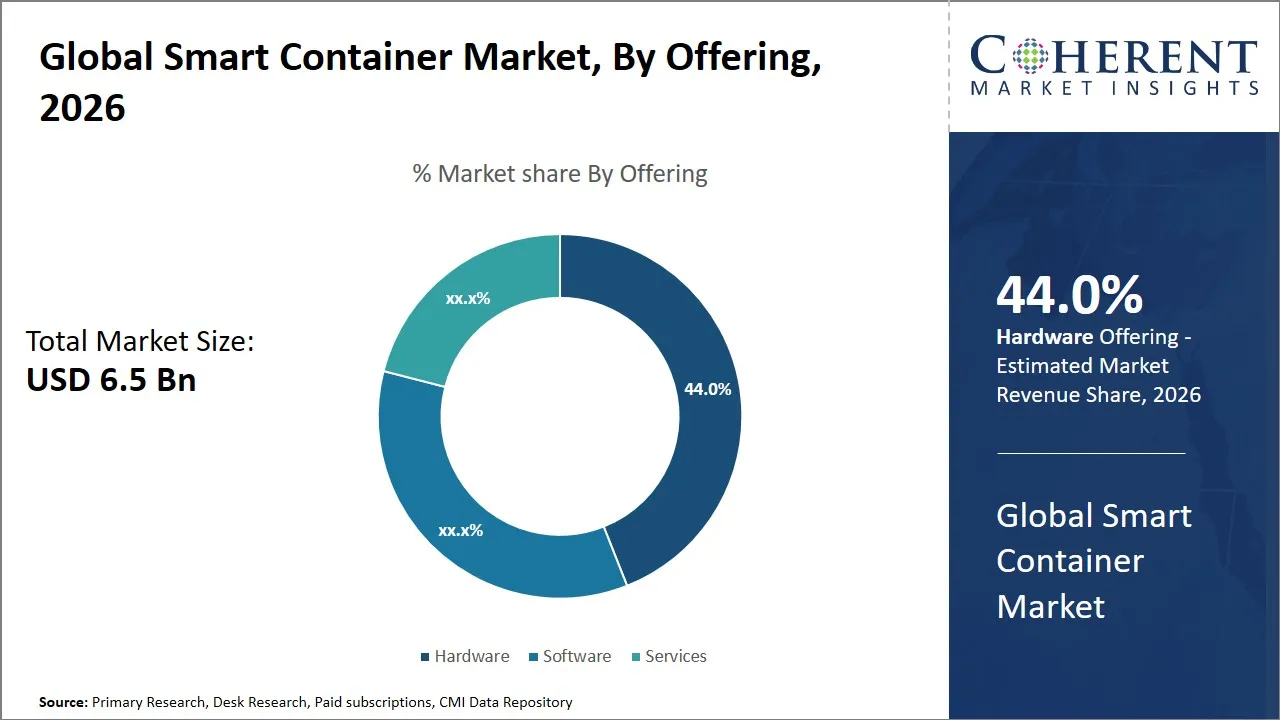
- The hardware segment is expected to account for 44% of the smart container market share in 2026.
- The global positioning system segment is estimated to represent 39% of the market share in 2026.
- The asset tracking and management segment is projected to hold 37% share in 2026.
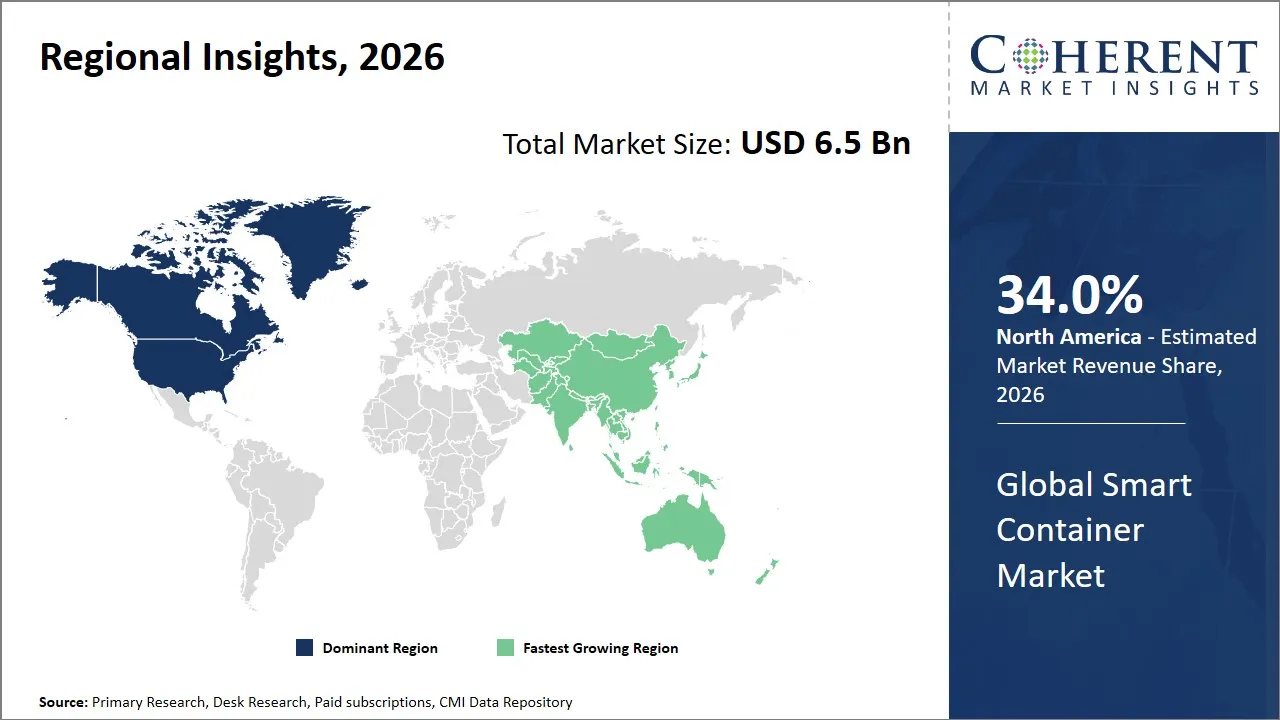
- North America will dominate the smart container market in 2026 with an estimated 34% share.
- Asia Pacific will hold 26% share in 2026 and is expected to record the fastest growth over the forecast period.
Current Events and Its Impact
Current Events | Description and its Impact |
Evergreen Line Adopts ORBCOMM’s Smart Container Technology |
|
Segmental Insights
- Current Industry Events of 2026
- Market Size Estimation
- Regional Breakdown
- Competitive Landscape
- Customer Intelligence
- Segmental Analysis
- Pricing Analysis
- Key Market Drivers, Challenges & Future Trends
- Customized Insights Section
Why Does Hardware Segment Dominate the Global Smart Container Market?
The hardware segment is expected to account for 44.0% of the global smart container market share in 2026. As physical tools are vital to making containers intelligent, progress continues. Starting with sensors, moving through GPS units, including RFID labels - these parts gather live information needed to watch and handle shipping boxes. As IoT spreads across freight systems, stronger gear becomes necessary; built to endure rough weather, sudden shifts, long distances. Performance under pressure matters most when journeys grow unpredictable.
Global Positioning System Segment Dominates the Global Smart Container Market
The global positioning system segment is expected to account for 39.0% of the global smart container market share in 2026. Reliable pinpoint positioning over time drives adoption for GPS. Starting from GPS, modern smart containers reveal complex worldwide shipping networks. When goods travel beyond borders using varied transit methods, knowing exact positions matters greatly. In places where confusion once ruled schedules and paths, understanding now appears.
For instance, on March 18, 2025, ORBCOMM announced that Folk Maritime Services Company has chosen ORBCOMM’s smart container monitoring technology to enable end-to-end supply chain visibility and enhanced cargo protection for their entire container fleet.
(Source: folkmaritime.com)
Why is Asset Tracking and Management the Most Widespread Application in the Smart Container Market?
The asset tracking and management segment is expected to account for 37.0% of the global smart container market share in 2026. Driven by necessity, monitoring containerized assets across their full lifespan has become essential. Efficiency in handling these systems responds to core issues within logistics operations. Visibility into stock levels matters more now due to increased movement across borders. Preventing loss plays a role, as does making better use of available transport units. Costs shape decisions, pushing organizations toward smarter methods. Smart container solutions that provide real-time monitoring of container conditions and precise location help reduce uncertainties, prevent losses, and improve accountability at every stage.
Integration with TMS, ERP & Port Systems
Integration Aspect | Value |
Adoption in Dry Containers | ~40% of dry containers |
Typical Sensor Types Installed | GPS (40%), Temp (34%), Motion (21%), Security (18%) |
Estimated Adoption Growth | ~22% growth in smart container shipments |
Typical TMS/ERP Integration | Yes, integrated |
Real-time Data Frequency | ~every 15 min (IoT units) |
Regional Insights
North America Smart Container Market Analysis and Trends
The North America region is projected to lead the market with a 34% share in 2026. Growth stems largely from an organized market framework, underpinned by sophisticated tech systems alongside dependable transport and distribution links. Major maritime entry points - like Los Angeles and Long Beach - enable broad deployment of intelligent container solutions to refine workflow efficiency. Backed by consistent regulatory support for digital transformation and eco-friendly freight practices, progress gains momentum through programs encouraging IoT integration and lower carbon output. Influential contributors include firms like Maersk Line, IBM, and C.H. Using smart containers equipped with sensors, Robinson improves oversight across shipping routes. Innovation gains speed where technology firms join forces with freight operators throughout the area. These partnerships position North American networks at the leading edge of adopting intelligent cargo systems.
Asia Pacific Smart Container Market Analysis and Trends
The Asia Pacific region is expected to exhibit the fastest growth in the market contributing 26% share in 2026. Industrial expansion, wider production networks, together with growing trade volumes, push advancement forward. In nations including China, India, and South Korea, efforts center on modernizing harbor facilities while moving toward digital industry frameworks - featuring automated cargo oversight and live shipment updates. National strategies, for instance, "Made in China 2025" and Digital India - support embedding connected sensors and intelligent systems into freight movement, encouraging smarter shipping units. A surge in online retail commerce combined with increased cross-border exchange through Asian-Pacific harbors adds pressure for change. Entities such as Huawei, ZTE, and DP World place resources into intelligent container development here, broadening usage while advancing technological capabilities.
Global Smart Container Market Outlook for Key Countries
Why is U.S. Emerging as a Major Hub in the Smart Container Market?
The U.S. relies heavily on embedded smart technologies. Because digital devices were adopted early, improvements in logistics performance have taken root gradually. At key ports and hubs, sensor-driven automation tracks container conditions without human input. Investment by organizations such as IBM and Maersk focuses on predictive maintenance and clearer oversight. Supportive regulations around transportation upgrades help accelerate adoption of new methods.
Is China the Next Growth Engine for the Smart Container Market?
Across the Asia Pacific region, China leads in smart container technology. Because of high manufacturing output, cargo movement thrives at major ports. Ongoing state investment ensures transportation networks evolve steadily. Companies such as Huawei and COSCO Shipping focus on units equipped with networked sensors along with secure blockchain records. Progress unfolds gradually, shaped by strategic investment rather than rapid disruption. This ecosystem fosters growth without relying on external incentives. At swiftly upgrading hubs like Shanghai and Shenzhen, intelligent container systems are now standard practice. Efficiency gains emerge naturally through consistent digital upgrades.
Germany Smart Container Market Analysis and Trends
Germany stands out due to its robust manufacturing sector alongside steady progress in digital infrastructure. Government-backed efforts aimed at greener transport methods have helped shape conditions favorable to intelligent shipping solutions. Firms such as Siemens and Deutsche Bahn contribute through projects focused on real-time freight visibility. Because of its geographic role in continental supply chains, consistent oversight across borders becomes essential - something advanced container tech helps fulfill.
India Smart Container Market Analysis and Trends
A shift in freight handling methods has begun across India, driven by wider transport upgrades and official backing through campaigns such as “Make in India” and “Digital India.” Rather than relying on legacy systems, companies - ranging from new tech ventures to long-standing enterprises like Tata Consultancy Services - are turning toward embedded sensors and remote monitoring via online networks. Major coastal hubs, among them Mumbai and Chennai, now show higher usage rates due to mounting volumes of cross-border and local commerce.
South Korea Smart Container Market Analysis and Trends
With proximity to major sea lanes, South Korea supports advanced port infrastructures that strengthen automated monitoring in regional and global logistics chains. Innovation advances through government-supported programs targeting integrated freight technologies, creating a receptive environment for smart container solutions. Entities such as Samsung SDS and Hyundai Merchant Marine propel adoption, employing AI-driven sensors to alter data transmission methods throughout shipment journeys. This evolution unfolds within a framework where digital oversight gains importance due to strategic location and infrastructure investment.
Sensor Stack & Data Granularity Differentiation
Sensor / Data Type | % of Smart Containers Equipped | Typical Data Granularity |
GPS (Location) | ~40% of deployed containers | ~Every 10–15 min coordinate updates |
Temperature Sensors | ~34% | ±0.5 °C real-time interval readings |
Motion / Shock Sensors | ~21% | Event-triggered shock magnitude & timestamp |
Door / Seal Security Sensors | ~18% | Binary open/close events + timestamps |
Satellite Connectivity Add-on | Deployed in ~10–20% on long-haul routes | Position & telemetry via LEO/MEO networks |
Market Players, Key Development, and Competitive Intelligence
Key Developments
- On September 10, 2025, Roambee rebranded to Decklar with a shift toward AI‑powered decision platforms for supply chain visibility and introduced an AI‑driven global trade lane risk planning platform designed to help enterprises evaluate logistics risk in volatile trade lanes.
- On February 27, 2025, the Smart Container Alliance was launched to promote smart containers and enhance trade security. The Smart Container Alliance is dedicated to advancing industry standards, advocating for policy change, and fostering collaboration between technology providers, shipowners, customs authorities, and international government bodies, such as the European Union and the World Customs Organization.
Top Strategies Followed by Global Smart Container Market Players
- Competition shapes the worldwide smart container sector, with companies at various levels pursuing unique paths to grow presence and gain advantage. While leading firms focus on deep R&D spending, they aim to refresh offerings regularly through performance improvements aligned with shifting user needs. Because innovation flows steadily within these organizations, capabilities like live tracking, networked sensors, and stronger protection become standard in their systems, often defining what others later follow. Despite differing approaches, advancement in functionality remains central to maintaining position amid rising rivals.
- Among those operating in the middle segment of the smart container industry, focus shifts toward economical offerings where reliability meets accessible pricing. Price considerations often guide buyers such as SMEs or markets with tighter financial limits, shaping demand patterns accordingly. Efficiency gains emerge through refined manufacturing approaches alongside carefully chosen adaptable systems. Performance remains stable even when expenses are reduced, thanks to strategic design choices. What results is a restrained yet functional alternative shaped by practical trade-offs.
- A few smaller firms claim unique spaces within the worldwide smart container sector through targeted solutions tailored to distinct demands. Rather than broad appeal, these organizations emphasize novel designs - like containers managed via machine learning systems, sensor networks powered by sunlight, or sustainable construction elements. Despite tighter budgets, their quick response to change and dedication to new methods helps maintain relevance alongside larger rivals.
Market Report Scope
Smart Container Market Report Coverage
| Report Coverage | Details | ||
|---|---|---|---|
| Base Year: | 2025 | Market Size in 2026: | USD 6.5 Bn |
| Historical Data for: | 2020 To 2024 | Forecast Period: | 2026 To 2033 |
| Forecast Period 2026 to 2033 CAGR: | 19% | 2033 Value Projection: | USD 30 Bn |
| Geographies covered: |
| ||
| Segments covered: |
| ||
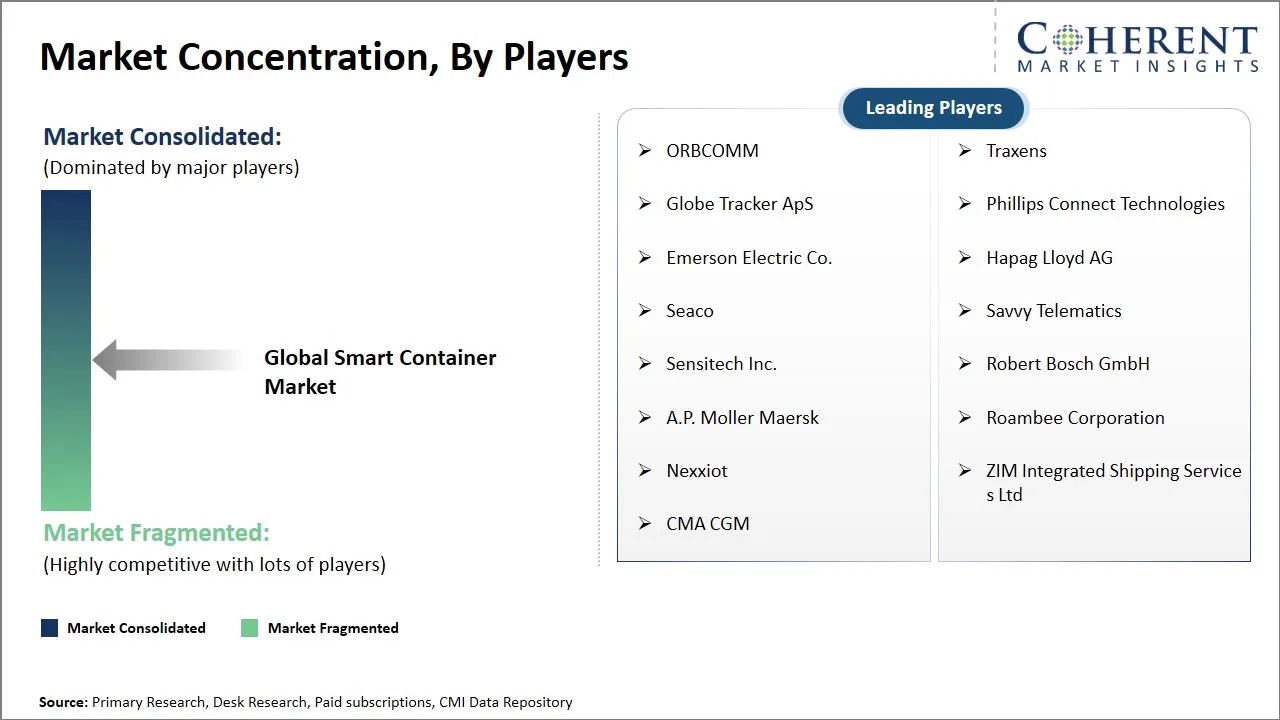
| Companies covered: | ORBCOMM, Traxens, Globe Tracker ApS, Phillips Connect Technologies, Emerson Electric Co., Hapag Lloyd AG, Seaco, Savvy Telematics, Sensitech Inc., Robert Bosch GmbH, A.P. Moller Maersk, Roambee Corporation, Nexxiot, ZIM Integrated Shipping Services Ltd, and CMA CGM | ||
| Growth Drivers: |
| ||
| Restraints & Challenges: |
| ||
Global Smart Container Market Dynamics
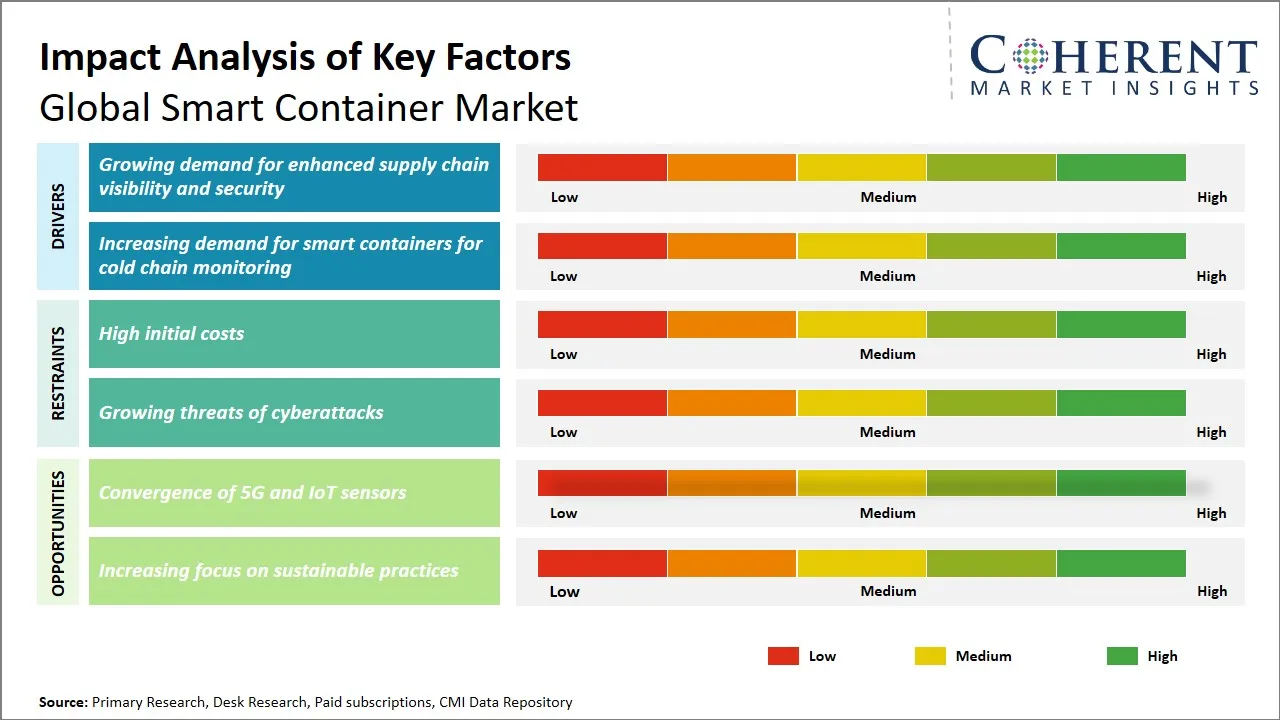
Global Smart Container Market Driver - Growing Demand for Enhanced Supply Chain Visibility and Security
With supply networks growing more intricate worldwide, clarity and protection now demand greater attention, prompting wider use of intelligent shipping units. As companies operate farther apart geographically, knowing exactly where goods are at any moment matters greatly - for staying on schedule while reducing risks like unauthorized access or exposure to harsh conditions. Devices inside these advanced containers gather constant updates about position, climate, motion - not simply reporting but allowing responses before issues escalate. Information flows without pause, shaping choices that prevent delays rather than react to them.
For instance, on May 5, 2025, A.P. Moller - Maersk announce that it is taking a significant step in digital innovation with the deployment of its next-generation IoT connectivity platform across 450 vessels. This includes all Maersk-owned vessels and more than 100 time-chartered vessels in the fleet. The platform is designed to meet the increasing demand for real-time data transmission and provide advanced IoT capabilities.
(Source: maersk.com)
Global Smart Container Market Opportunity - Convergence of 5G and IoT Sensors
The advancement of 5G infrastructure and IoT sensors has enabled new openings emerge in the worldwide market for smart shipping units. Real-time tracking and instant data flow matter greatly when managing connected freight systems. Because these containers depend on constant updates during transit, the rapid response and wide network reach of 5G improve performance noticeably. Instead of delays, information moves swiftly across linked devices inside each unit, measuring conditions like moisture levels, position changes, structural status, and surrounding heat. Though older networks struggled, today's infrastructure supports continuous exchange among sensor-equipped cargo boxes. This shift allows more precise oversight from departure to arrival points. Where previous limitations slowed progress, updated connections now support steady coordination between distributed components.
For instance, on December 3, 2025, Myriota announced the General Availability of its HyperPulse network, a global, highly scalable connectivity platform that makes it simple for industry partners to build, deploy and scale IoT solutions anywhere on Earth.
(Source: myriota.com)
Analyst Opinion (Expert Opinion)
- Change marks the worldwide smart container sector, now moving beyond trial phases into broader use. Demand grows for live tracking, safer shipments, continuous condition checks across international commerce. Digital logistics systems take hold more quickly as cold storage networks spread. Rules that require full traceability push progress forward, especially noticeable within medicine transport, perishable items, valuable freight. Growth gains momentum where accountability matters most.
- Future expansion hinges on lower sensor pricing, longer power performance, also tighter links to networked systems plus logistics data tools. Although initial expenses stay elevated and uniform data formats lag behind, intelligent shipping units should shift toward essential infrastructure instead of limited-use tools, particularly because distribution networks emphasize reliability together with openness.
Speak to the analyst
Want personalized insights?
Take the findings above to one of our principal consultants, or have the report rebuilt around the segments, geographies and competitors you actually track.
Market Segmentation
- Offering Insights (Revenue, USD Billion, 2021 - 2033)
- Hardware
- Software
- Services
- Technology Insights (Revenue, USD Billion, 2021 - 2033)
- Global Positioning System
- Cellular
- Long Range Wide Area Network
- Bluetooth Low Energy
- Application Insights (Revenue, USD Billion, 2021 - 2033)
- Asset Tracking and Management
- Supply Chain Optimization
- Safety and Security
- Others
- End User Insights (Revenue, USD Billion, 2021 - 2033)
- Food and Beverages
- Pharmaceuticals
- Oil and Gas
- Chemicals
- Others
- Regional Insights (Revenue, USD Billion, 2021 - 2033)
- North America
- U.S.
- Canada
- Latin America
- Brazil
- Argentina
- Mexico
- Rest of Latin America
- Europe
- Germany
- U.K.
- Spain
- France
- Italy
- Russia
- Rest of Europe
- Asia Pacific
- China
- India
- Japan
- Australia
- South Korea
- ASEAN
- Rest of Asia Pacific
- Middle East
- GCC Countries
- Israel
- Rest of Middle East
- Africa
- South Africa
- North Africa
- Central Africa
- North America
- Key Players Insights
- ORBCOMM
- Traxens
- Globe Tracker ApS
- Phillips Connect Technologies
- Emerson Electric Co.
- Hapag Lloyd AG
- Seaco
- Savvy Telematics
- Sensitech Inc.
- Robert Bosch GmbH
- P. Moller Maersk
- Roambee Corporation
- Nexxiot
- ZIM Integrated Shipping Services Ltd
- CMA CGM
Sources
Primary Research Interviews
- Smart container technology providers and manufacturers
- Logistics and supply chain management executives
- Port authorities and terminal operators
- Cold chain logistics specialists
Databases
- International Trade Centre (ITC) Market Analysis and Research
- Global Trade Atlas by IHS Markit
- Euromonitor International Industrial Database
- Lloyd's List Intelligence
Magazines
- Container Management Magazine
- Supply Chain Management Review
- Logistics Management Magazine
- Maritime Logistics Professional
- Cargo Systems Magazine
Journals
- International Journal of Logistics Management
- Journal of Business Logistics
- Transportation Research Part E: Logistics and Transportation Review
Newspapers
- Lloyd's List
- The Journal of Commerce
- American Shipper
- Maritime Executive
- Trade Winds
Associations
- International Container Bureau (BIC)
- World Shipping Council (WSC)
- International Association of Ports and Harbors (IAPH)
- Global Cold Chain Alliance (GCCA)
- Container Owners Association (COA)
Public Domain Sources
- World Trade Organization (WTO) reports
- United Nations Conference on Trade and Development (UNCTAD)
- International Maritime Organization (IMO) publications
- Port authority annual reports and statistics
- Government maritime and trade department publications
Proprietary Elements
- CMI Data Analytics Tool
- Proprietary CMI Existing Repository of information for last 8 years
Get access to 250+ pages report
Every segment, forecast, competitor profile and data table behind the analysis above — available for instant download.
- ESOMAR Member
- ISO 9001:2015 Certified
- D-U-N-S Registered
- GDPR & CCPA Compliant
Missing comfort of reading report in your local language? Find your preferred language:
Transform your Strategy with Exclusive Trending Reports
Frequently Asked Questions
The global smart container market stood at USD 6.5 Bn in 2026 and is expected to reach USD 30 Bn by 2033.
The CAGR of global smart container market is projected to be 19% from 2026 to 2033.
Growing demand for enhanced supply chain visibility and security and increasing demand for smart containers for cold chain monitoring are the major factors driving the growth of the global smart container market.
High initial costs and growing threats of cyberattacks are the major factors hampering the growth of the global smart container market.
In terms of offering, hardware is estimated to dominate the market revenue share in 2026.
They reduce delays, losses, and manual checks by providing continuous data throughout transit.
Yes, they are widely used to monitor temperature and humidity for cold chain shipments.