

Global Smart Home Payments Market and Forecast – (2026-2033)
The global smart home payments market is estimated to be valued at USD 103.02 Bn in 2026 and is expected to reach USD 395.77 Bn by 2033, exhibiting a compound annual growth rate (CAGR) of 21.2% from 2026 to 2033.
Key Takeaways of the Smart Home Payments Market
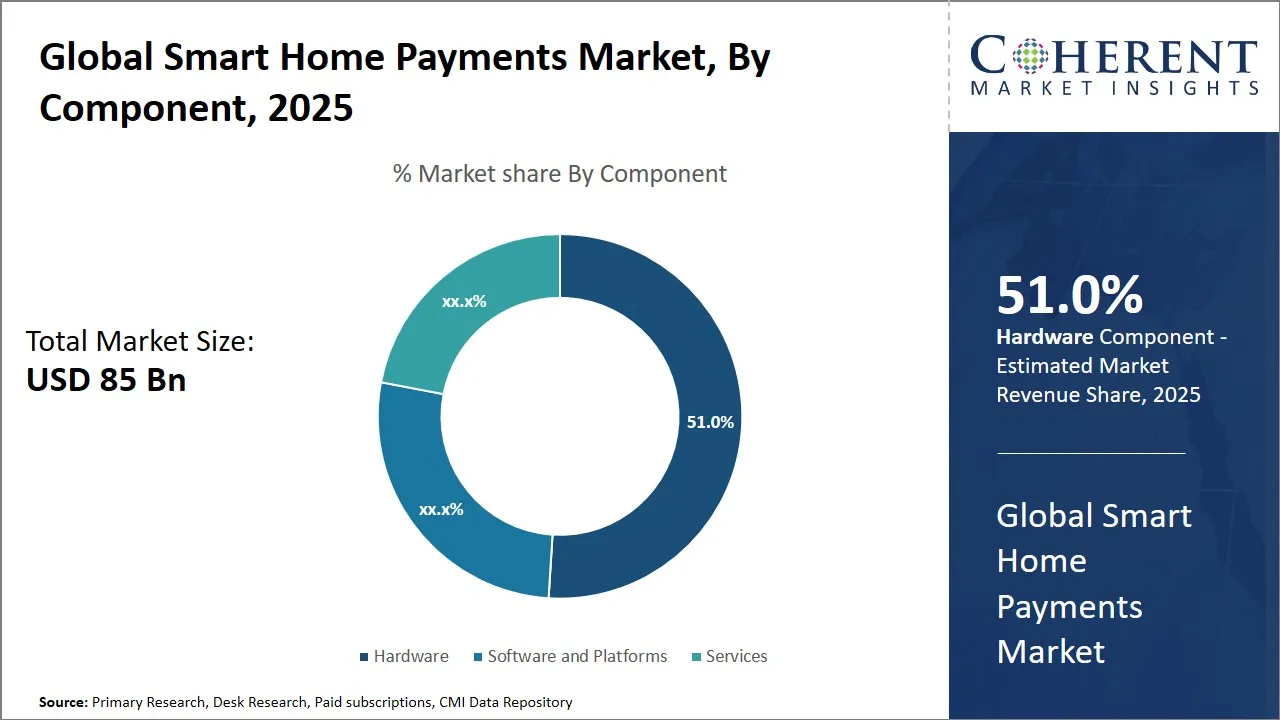
- The hardware segment is expected to account for 52% of the smart home payments market share in 2026.
- The voice-enabled payments segment is projected to capture 38% of the market share in 2026.
- The e-commerce and retail purchases segment is expected to command 33% share in 2026.
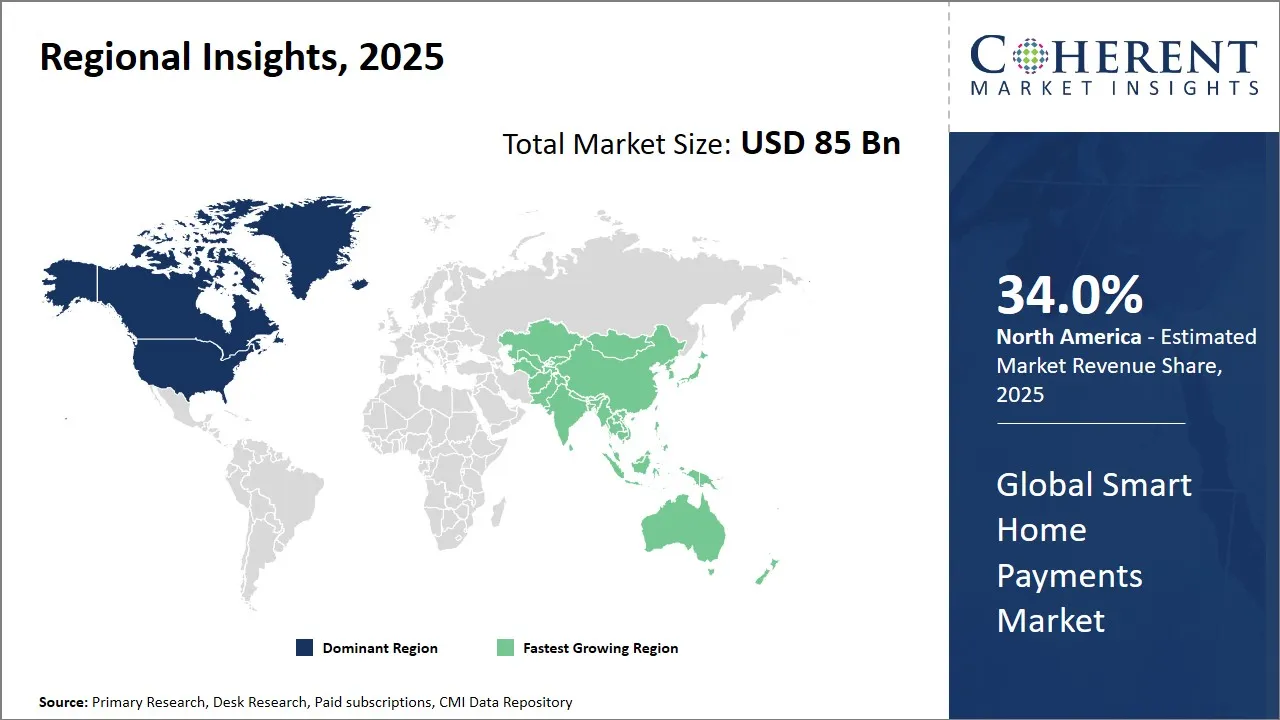
- North America will dominate the smart home payments market in 2026 with an estimated 34%
- Asia Pacific will hold 26% share in 2026 and record the fastest growth.
Currents Events and Its Impact
Current Events | Description and its Impact |
Circle New Platform Launch |
|
Segmental Insights
- Current Industry Events of 2026
- Market Size Estimation
- Regional Breakdown
- Competitive Landscape
- Customer Intelligence
- Segmental Analysis
- Pricing Analysis
- Key Market Drivers, Challenges & Future Trends
- Customized Insights Section
Why Does Hardware Segment Dominate the Global Smart Home Payments Market in 2026?
The hardware segment is expected to hold 52% of the global smart home payments market share in 2026. The rise is linked to consumers favoring smooth, connected gadgets that allow safe and simple payments at home. As more IoT devices enter households, better tech parts are needed, like voice assistants, payment tools, fingerprint scanners, or contactless appliances, to make paying easier through different links working together.
A main reason behind hardware taking the lead is the growing use of smart home centers that support payment features. These systems act as central points, linking different gadgets while allowing payments through voice or biometrics - using face or fingerprint scans. Advancements in sensors like touch-based readers and visual ID tools have strengthened how securely transactions are verified on physical devices. On top of this, more people now own contactless-ready products - from fridges with embedded NFC chips to digital door locks - which keeps pushing up the need for specialized equipment.
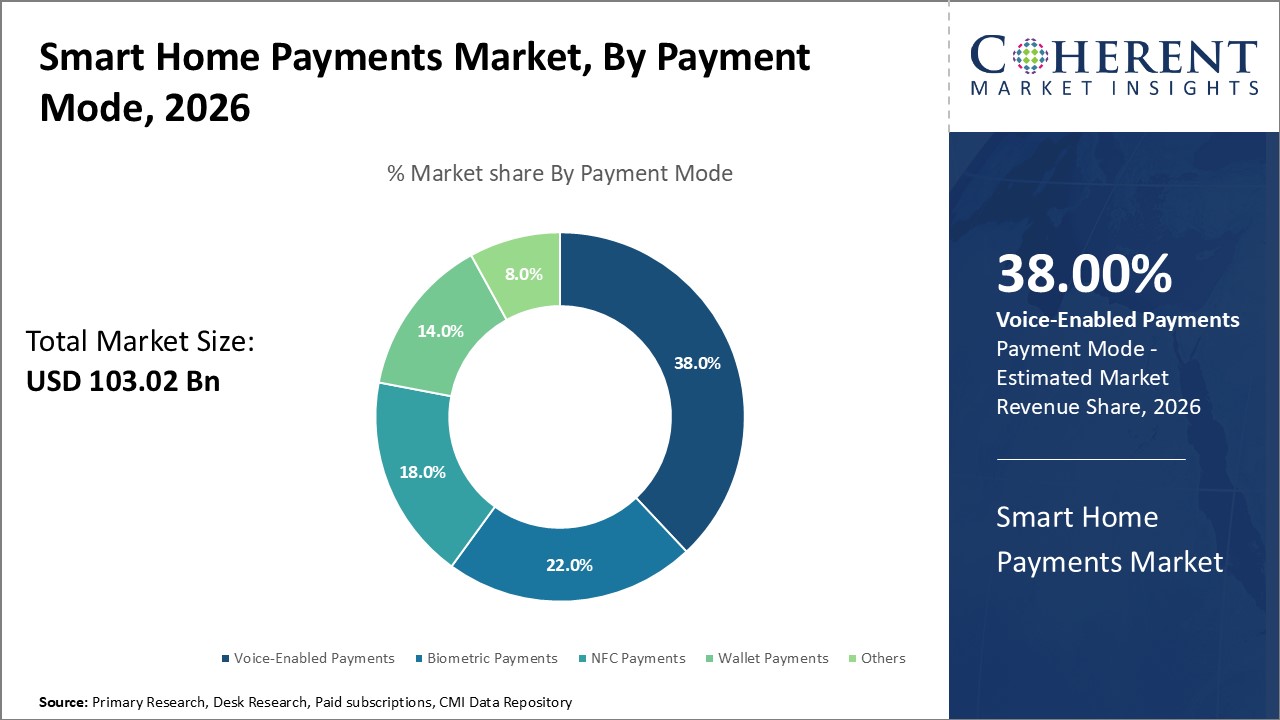
Voice-Enabled Payments Segment Dominates the Global Smart Home Payments Market
The voice-enabled payments segment is expected to hold 38% of the global smart home payments market share in 2026. The rise mostly comes from more people using voice assistant gadgets - also because users now favor transactions without touching devices. Owing to better understanding of everyday speech, tools such as Alexa, Google Assistant, or Siri have changed how folks control smart homes; this shift made voice payments popular.
Convenience drives the growing use of voice payments. Since people avoid touching screens, actions such as purchasing meals or updating subscriptions feel smoother. With busier schedules, a hands-free approach aligns better with demand for speed and touchless solutions. As a result, demand rises where speed matters the most
Why are E-commerce and Retail Purchases the Most Widespread Application in the Smart Home Payments Market?
The e-commerce and retail purchases segment is expected to hold 33% of the global smart home payments market share in 2026. The rise comes from booming e-commerce along with modernized digital payment systems in stores. Inside homes, gadgets now act like shopping hubs, owing to features allowing quick, secure transactions shaped around individual needs. Adapting automatically through learning patterns over time further simplifies how people purchase goods digitally.
The primary cause of expansion comes from individuals increasingly buying goods through internet platforms at home. Because of this, users rely on smartphones or similar gadgets to make quick purchases using voice prompts or preset setups storing personal data. As a result, repeated typing is no longer necessary. Owing to such ease, customers feel more satisfied and tend to use these smart payment methods again when buying goods online.
Security Protocol Impact on Adoption
Security Protocol/Feature | Adoption Rate (%) |
Households enabling MFA for IoT accounts | ~28% |
Smart home apps lacking MFA support | ~41% |
Users reusing passwords (security risk) | ~63% |
Consumer confidence increase if stronger security adopted | ~64% |
Regional Insights
North America Smart Home Payments Market Analysis and Trends
The North America region is projected to lead the market with a 34% share in 2026. The regional growth stems from an advanced digital payment setup along with broad use of smart home gadgets. This area gains strength through solid tech foundations while users show clear preference for connected digital tools.
Public programs supporting smart energy networks together with IoT applications boost demand across markets. Major companies like Amazon, through Alexa Payments, as well as Google offering Pay within smart homes, or Apple enabling Apple Pay in HomeKit spaces, shape user habits by delivering smooth transactions that balance safety with ease. On top of this, rising fintech ventures alongside trusted payment firms drive fresh ideas and trust in automated household payments.
Asia Pacific Smart Home Payments Market Analysis and Trends
Asia Pacific is expected to exhibit the fastest growth in the market contributing 26% share in 2026. The growth stems from fast city expansion, more smartphone use, yet growing personal earnings. Countries such as India or those in Southeast Asia adopt smart home tech quickly - backed by state rules promoting digital money transfers instead of cash.
A wider online shopping scene fuels need for connected payment setups at home. Firms like Alibaba - with Alipay plus linked gadgets; Xiaomi - offering homesystems that pay bills; and Samsung via SmartThings - all drive progress here. Global trade flows through major production zones help lower prices while improving access to these internet-connected, payment-ready appliances.
Global Smart Home Payments Market Outlook for Key Countries
Why is the U.S. Emerging as a Major Hub in the Smart Home Payments Market?
The U.S. smart home payments market shows advanced technology use, where people quickly adopt smart home gadgets. Even though Amazon dominates with Echo and Alexa Pay, voice transactions flow smoothly. Despite competition from Google and Apple, their payment platforms connect across multiple smart gadgets. Since authorities prioritize safety and data protection, secure options earn user confidence. Thus, this nation turns into a trial space for innovative voice-activated and biometric payment tech inside networked households.
Is China the Next Growth Engine for the Smart Home Payments Market?
China's smart home payment sector grows fast owing to connected tech merging with major mobile wallets. Instead of traditional methods, Alipay by Alibaba and WeChat Pay from Tencent now power tap-free transactions within intelligent homes. National strategies supporting digital currency use push this shift forward quickly. On top of that, firms such as Xiaomi and Huawei go beyond making gadgets - they build in payment features directly, boosting how people interact daily. Owing to efficient local production networks and millions of users, customized solutions thrive - shaped around what households actually want.
Germany Smart Home Payments Market Analysis and Trends
Germany stands as a developed European hub for smart home payments, driven by the widespread use of automated household systems alongside rising comfort with online banking tools. Rules focused on privacy - such as GDPR - influence how confident users feel when adopting such tech.
Major firms including Bosch and Deutsche Telekom contribute significantly through linking safe transaction methods to connected devices via unified networks. A solid industrial foundation enables progress in built-in payment mechanisms, while teamwork across banks and tech developers helps expand the overall infrastructure.
India Smart Home Payments Market Analysis and Trends
India's smart home payments market is growing fast, owing to government programs like Digital India and efforts to reduce cash usage. Cheap smartphones along with low-cost smart gadgets boost uptake across regions. Firms including Reliance Jio and Tata Group back smart home systems, whereas services such as Paytm or Google Pay introduce UPI-linked features for automated homes. A vibrant startup scene develops targeted fixes for everyday user issues, pushing broader adoption forward.
Japan Smart Home Payments Market Analysis and Trends
Japan's smart home payment sector grows owing to strong tech foundations and skilled users. Because of government backing for urban innovation, digital payments fit smoothly into automated homes. Firms like Sony are pushing ahead, linking transaction tools directly into household devices through platform ecosystems. Meanwhile, existing e-payment frameworks blend well with new smart setups, offering secure, hassle-free interactions. Older demographics further drive demand, favoring intuitive in-home financial actions that boost the sector’s relevance.
Market Players, Key Development, and Competitive Intelligence
Key Developments
- On July 8, 2025, The National Payments Corporation of India (NPCI) announced they are developing an IoT-ready UPI 3.0, an upgrade to allow smart devices (watches, cars, TVs, appliances) to initiate automated payments, expanding beyond phones for seamless, context-based transactions.
- On May 15, 2025, Mastercard and MoonPay announced a partnership to enable people and businesses to pay and be paid using stablecoins across global markets. Enterprises will be able to leverage Mastercard branded cards linked to users stablecoin balances, empowering cardholders to spend their stablecoins.
Top Strategies Followed by Global Smart Home Payments Market Players
Player Type | Strategic Focus | Example |
Established Market Leaders | Business Collaboration | On January 27, 2025, Nayax Ltd. and SECO S.p.A. announced a partnership with the intention to embed Nayax-powered payments directly within SECO products, starting with a payment-enabled smart screen designed as a convenient all-in-one solution for the next generation of intelligent vending machines, micro markets, smart coolers, and automated self-service retail machines. |
Mid-Level Players | Business Agreement | On January 13, 2025, Wisetack, the leading platform for embedded pay-over-time options for in-person services, announced the addition of U.S. Bank as a new lending partner to provide affordable and transparent financing for home services. |
Small-Scale Players | Product Launch | On February 27, 2025, Sadad announced its strategic collaboration with Mastercard to introduce a new digital payment gateway platform, powered by Mastercard Gateway. Through this partnership, Sadad will deploy state-of-the-art payment solutions to enhance the customer experience for its merchants in the market. |
Market Report Scope
Global Smart Home Payments Market Report Coverage
| Report Coverage | Details | ||
|---|---|---|---|
| Base Year: | 2025 | Market Size in 2026: | USD 103.02 Bn |
| Historical Data for: | 2020 To 2024 | Forecast Period: | 2026 To 2033 |
| Forecast Period 2026 to 2033 CAGR: | 21.2% | 2033 Value Projection: | USD 395.77 Bn |
| Geographies covered: |
| ||
| Segments covered: |
| ||
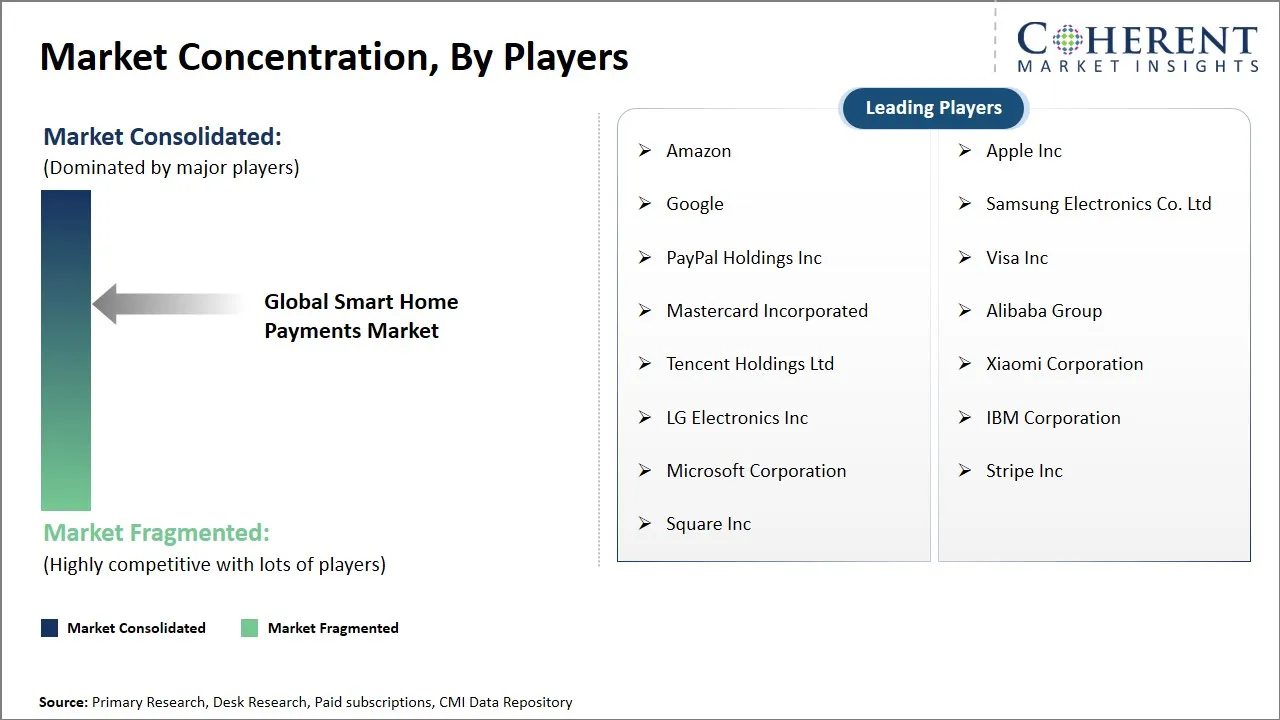
| Companies covered: | Amazon, Apple Inc, Google, Samsung Electronics Co. Ltd, PayPal Holdings Inc, Visa Inc, Mastercard Incorporated, Alibaba Group, Tencent Holdings Ltd, Xiaomi Corporation, LG Electronics Inc, IBM Corporation, Microsoft Corporation, Stripe Inc, and Square Inc | ||
| Growth Drivers: |
| ||
| Restraints & Challenges: |
| ||
Market Dynamics
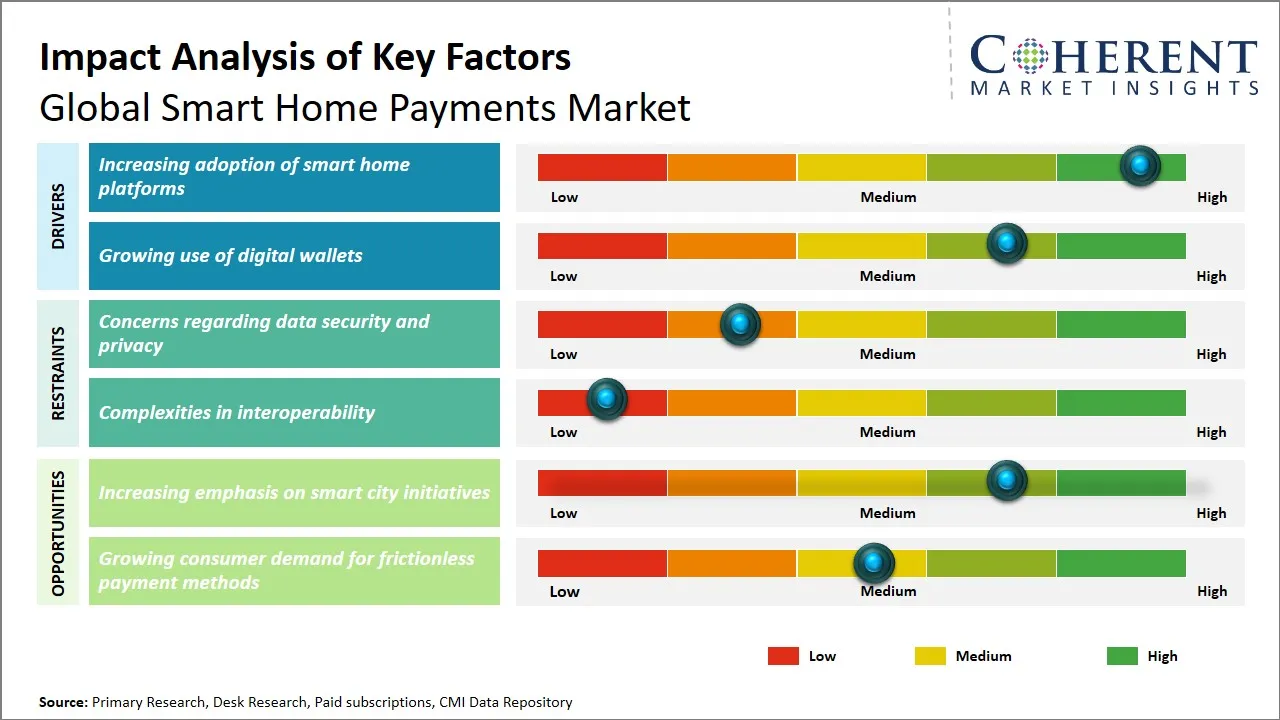
Global Smart Home Payments Market Driver - Increasing Adoption of Smart Home Platforms
The growing use of smart home technologies is boosting interest in better payment options for them. Because more people now prefer homes filled with connected tech, ease of access and smooth operation push the need for built-in ways to pay, without hassle. Tasks like buying groceries automatically or covering energy bills and subscriptions happen right inside these networks, turning smart setups into key spots for handling regular costs securely.
In addition, when gadgets from different brands work together on one platform, it leads to flexible payment tools serving many uses at once, improving how users interact. The rising interest from users in voice commands or mobile apps boosts demand for smart home payment options - making payments fast, quiet, and dependable. As a result, wider use of connected home systems plays a key role in driving changes within the worldwide market for these digital transactions.
For instance, on December 18, 2025, Samsung announced it will showcase a new range of AI‑connected home appliances under its Bespoke series at CES 2026. At CES, the company will highlight a series of improvements in home living that merge AI-powered customized care and powerful hardware-supported performance.
Global Smart Home Payments Market Opportunity - Increasing Emphasis on Smart City Initiatives
The rising interest in smart cities opens strong potential for growth in home-based digital payments. While cities invest in modern technologies to boost services and living standards, connecting homes with electronic payment tools supports smoother urban operations. Authorities spend large amounts on city upgrades involving connected devices, power efficiency, and online financial systems which fuels the need for touch-free pay options, automatic invoicing, and protected money transfer channels inside residences. Such programs create joint ventures between state bodies and private firms, along with financing paths that help roll out these residential payment methods faster.
Moreover, city planning now focuses more on eco-friendliness and ease of use, motivating households and companies to shift toward self-operated, non-cash exchanges trackable instantly from remote locations. As cities grow and more people use connected gadgets, linking smart home payments with wider urban systems is now essential, allowing easier access to utilities, security plans, or buying intelligent appliances. Owing to this connection, companies involved, from developers to service managers, can design better payment methods that match fast-paced city living, opening doors to new users while improving everyday experiences.
For instance, on September 25, 2025, Toyota Motor Corporation and Woven by Toyota, Inc. announced the official launch of Toyota Woven City, first unveiled at CES 2020 and jointly developed by the two companies. Woven City is a real‑world smart city test course designed to explore future mobility, robotics, and urban life systems.
Analyst Opinion (Expert Opinion)
- The global smart home payments sector should expand significantly in 10 years - boosted by wider use of linked gadgets, voice-based helpers, or mobile wallets. Specialists point out frictionless transactions built right into common household tech may lead this rise. North America likely stays advanced because many already own such devices; meanwhile, the Asia Pacific region could surge ahead owing to more phones online, increased app-based payment usage, along with growing installation of intelligent homes.
- Technology drivers such as AI, IoT protocols including Matter, or cloud systems are essential to boost uptake. Trust from users, safety measures, also ease of use stand out, since smooth yet protected payment methods shape interaction levels. Generally, experts view smart home transactions as one piece of a wider shift toward built-in payments, with purchases smoothly woven into gadgets and everyday activities, opening up a hundreds-of-billions-dollar potential across the coming 10 years.
Speak to the analyst
Want personalized insights?
Take the findings above to one of our principal consultants, or have the report rebuilt around the segments, geographies and competitors you actually track.
Market Segmentation
- Component Insights (Revenue, USD Bn, 2021 - 2033)
- Hardware
- Software and Platforms
- Services
- Payment Mode Insights (Revenue, USD Bn, 2021 - 2033)
- Voice-Enabled Payments
- Biometric Payments
- NFC Payments
- Wallet Payments
- Others
- Application Insights (Revenue, USD Bn, 2021 - 2033)
- E-commerce and Retail Purchases
- Utility Bill Payments
- Subscription Services
- Food and Grocery Orders
- Travel and Ticketing
- Others
- Regional Insights (Revenue, USD Bn, 2021 - 2033)
- North America
- U.S.
- Canada
- Latin America
- Brazil
- Argentina
- Mexico
- Rest of Latin America
- Europe
- Germany
- U.K.
- Spain
- France
- Italy
- Russia
- Rest of Europe
- Asia Pacific
- China
- India
- Japan
- Australia
- South Korea
- ASEAN
- Rest of Asia Pacific
- Middle East
- GCC Countries
- Israel
- Rest of Middle East
- Africa
- South Africa
- North Africa
- Central Africa
- North America
- Key Players Insights
- Amazon
- Apple Inc
- Samsung Electronics Co. Ltd
- PayPal Holdings Inc
- Visa Inc
- Mastercard Incorporated
- Alibaba Group
- Tencent Holdings Ltd
- Xiaomi Corporation
- LG Electronics Inc
- IBM Corporation
- Microsoft Corporation
- Stripe Inc
- Square Inc
Sources
Primary Research Interviews
- Smart home device manufacturers and OEMs
- Payment technology providers and fintech companies
- Smart home platform developers and ecosystem providers
- Home automation retailers and distributors
Databases
- Euromonitor Passport
Magazines
- Smart Home Magazine
- Payment Journal
- IoT World Today
- Connected Home Magazine
Journals
- Journal of Payment Strategy & Systems
- International Journal of Smart Home
- IEEE Internet of Things Journal
Newspapers
- Financial Times
- The Wall Street Journal
- TechCrunch
- Reuters Technology News
- Forbes Technology
Associations
- Connected Home over IP (Matter/Thread Group)
- Smart Home Association
- Electronic Transactions Association (ETA)
- Connectivity Standards Alliance
- Internet of Things Consortium
Public Domain Sources
- Federal Communications Commission (FCC) reports
- European Central Bank digital payment studies
- National Institute of Standards and Technology (NIST)
- International Telecommunication Union (ITU)
- World Bank financial inclusion databases
Proprietary Elements
- CMI Data Analytics Tool
- Proprietary CMI Existing Repository of information for last 8 years
Get access to 250+ pages report
Every segment, forecast, competitor profile and data table behind the analysis above — available for instant download.
- ESOMAR Member
- ISO 9001:2015 Certified
- D-U-N-S Registered
- GDPR & CCPA Compliant
Missing comfort of reading report in your local language? Find your preferred language:
Transform your Strategy with Exclusive Trending Reports
Frequently Asked Questions
The global smart home payments market is estimated to be valued at USD 103.02 Bn in 2026 and is expected to reach USD 395.77 bn by 2033.
The CAGR of global smart home payments market is projected to be 21.2% from 2026 to 2033.
Increasing adoption of smart home platforms and growing use of digital wallets are the major factors driving the growth of the global smart home payments market.
Concerns regarding data security and privacy and complexities in interoperability are the major factors hampering the growth of the global smart home payments market.
In terms of component, hardware is estimated to dominate the market revenue share in 2026.
Amazon, Apple Inc, Google, Samsung Electronics Co. Ltd, PayPal Holdings Inc, Visa Inc, Mastercard Incorporated, Alibaba Group, Tencent Holdings Ltd, Xiaomi Corporation, LG Electronics Inc, IBM Corporation, Microsoft Corporation, Stripe Inc, and Square Inc are the major players.
North America is expected to lead the global smart home payments market in 2026