

Global Space Medical Service Market Size and Forecast – 2026 to 2033
The Global Space Medical Service Market is estimated to be valued at USD 1,076.8 Mn in 2026 and is expected to reach USD 1,749.2 Mn by 2033, exhibiting a compound annual growth rate (CAGR) of 10% from 2026 to 2033. This gradual growth reflects the niche yet essential role of space medical services in supporting human health during space missions, catering to both governmental space programs and private space exploration initiatives. The increasing investments in space exploration are likely to sustain steady market expansion.
Key Takeaways of the Global Space Medical Service Market
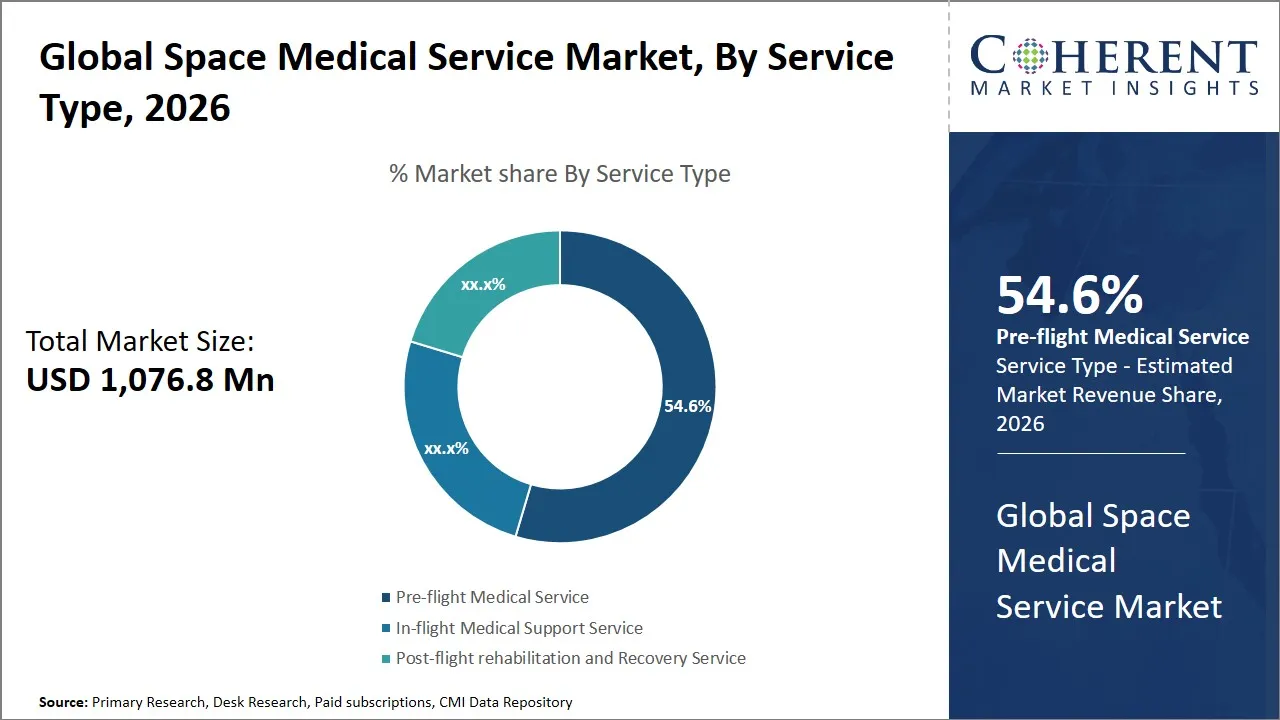
- Pre-flight medical service segment is expected to lead the space medical service market, capturing 54.6% share in 2026.
- Audiology segment is estimated to represent 25.2% of the space medical service market share in 2026.
- Private segment is projected to dominate with 79.3% of the global space medical service market share in 2026.
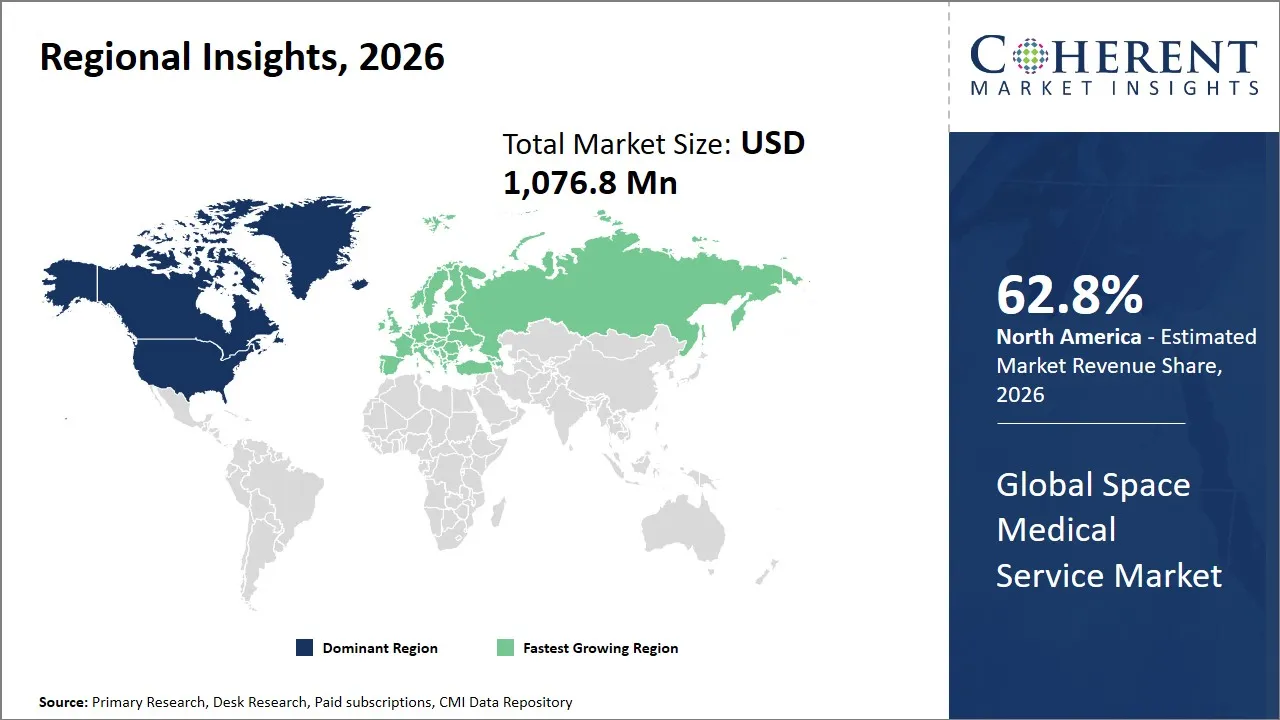
- North America is expected to lead the market, holding a share of 62.8% in 2026. Europe is anticipated to be the fastest-growing region, with 17.7% share in 2026.
Market Overview
- Global space medical services are shifting from a niche support function to mission-critical infrastructure as commercial human spaceflight and private astronaut programs scale up.
- Technology adoption is accelerating around portable diagnostics (especially ultrasound), continuous monitoring wearables, remote clinical guidance, and early-stage AI decision support for more autonomous care
- The market is being pushed by more commercial human spaceflight missions, longer-duration programs, and higher safety expectations. At the same time, continuous monitoring wearables and portable diagnostics are becoming standard, which increases the demand for integrated medical services and support.
- Opportunities are concentrated in scalable medical readiness frameworks for private missions, autonomous care and AI decision-support for delayed-communication scenarios, and qualification/testing services for space-rated medicines and medical devices.
Currents Events and their Impact
Current Events | Description and its Impact |
Increase in private astronaut missions and commercial human spaceflight cadence |
|
More diverse astronaut profiles (age, nationality, health history) entering flight programs |
|
Segmental Insights
- Current Industry Events of 2026
- Market Size Estimation
- Regional Breakdown
- Competitive Landscape
- Customer Intelligence
- Segmental Analysis
- Pricing Analysis
- Key Market Drivers, Challenges & Future Trends
- Customized Insights Section
Why Does the Pre-flight Medical Service Segment Dominate the Global Space Medical Service Market in 2026?
The pre-flight medical service segment is expected to hold the largest market share of 54.6% in 2026, owing to its critical role in ensuring astronaut health and mission safety. Pre-flight medical services encompass comprehensive health assessments, screenings, and conditioning protocols designed to prepare astronauts physically and psychologically for the extreme conditions of space travel. Such services are indispensable since the special environmental factors experienced in space, including microgravity and radiation exposure, cramped space, and others, require strict pre-mission health assessments to reduce the risk and improve performance.
For instance, in August 2025, the Federal Aviation Administration (FAA) published Guidance for Medical Screening of Commercial Aerospace Passengers, a direct pre-flight medical services reference used by commercial human spaceflight operators to structure screening and risk disclosure before flight.
The Audiology Segment Dominates the Global Space Medical Service Market
The audiology segment is expected to hold the largest market share of 25.2% in 2026, due to the unique challenges posed by spaceflight on the human auditory system and balance mechanisms. The astronauts experience a change in the gravitational forces and the ambient noise levels, which are also leading to a lot of strain on the auditory and the vestibular system. This increases the significance of special audiological tests and pre-mission, in-mission, and post mission audiological tests and observation.
The urgent necessity to examine and treat space-induced dysfunctions in the vestibular apparatus that influence balance, spatial orientation, and susceptibility to motion sickness is one of the key growth determinants. The occurrence of space motion sickness and disorientation related to space missions has always been reported, and this has brought the formulation of audiology-based testing that has been able to predict individual vulnerability and monitor auditory well-being. Frequent audiometric tests should be taken to detect any hearing loss or inner ear issues that may compromise communication or performance in space where auditory signals are crucial.
The Private Segment Dominates the Global Space Medical Service Market
The private segment is expected to hold the largest market share of 79.3% in 2026, as commercial space missions now depend heavily on specialized private operators for astronaut health monitoring, medical training, mission support, and in-flight care planning. Growth in private astronaut missions, expanding low Earth orbit activity, and rising demand for mission-specific medical readiness are pushing more responsibility toward commercial providers with integrated operational and clinical capabilities.
A clear example is KBR’s support for Axiom Mission 4 in 2025, where it provided ISS systems and medical training for the private astronaut crew, followed by NASA awarding KBR a major human health and performance contract in August 2025 for astronaut health, occupational health, and risk-reduction research. This shows that private players are no longer peripheral vendors; they are becoming core infrastructure in space medical service delivery.
Telemedicine in Space: Remote Healthcare for Astronaut Safety and Long-Duration Missions
- Practices in space telemedicine systems have enabled astronauts to have space missions guided by doctors on earth. With the help of communication connections, portable diagnostic equipment, and health monitoring, astronauts can check their health, and specialists can analyze the data and give instructions remotely. This system assists in controlling the possible medical conditions in space where there is no medical facility.
- Telemedicine is entering a higher-growth phase as mission durations extend and commercial human spaceflight scales, shifting demand from basic remote consultation to integrated clinical support systems. Market development is being driven by portable diagnostics, continuous health monitoring, and software platforms that enable standardized remote decision-making and clinical documentation. These capabilities improve in-mission risk management and reduce reliance on immediate ground intervention, strengthening the medical readiness model for higher-cadence Low Earth Orbit (LEO) operations and future long-duration lunar and Mars missions.
Regional Insights
North America Space Medical Service Market Analysis and Trends
The North America region is projected to lead the market with a 62.8% share in 2026, driven primarily by a robust aerospace and defense ecosystem, backed by strong governmental support and significant private sector investment. The availability of major government agencies like NASA and department of defense, and the efforts that are being made to ensure the exploration of the space and the health research of the astronauts encourage innovation of the space medical services. The space agencies and the major universities work very closely with cutting-edge research institutions, which will provide a fruitful avenue of sophisticated medical solutions that are customized to space missions.
The industry players, such as Medtronic, Teleflex and Honeywell Aerospace, take advantage of the technological infrastructure in North America to create integrated space medical systems, such as telemedicine, health monitoring, and emergency medical response services, which are specifically developed to be used in space. The changing policies of trade favoring the export of aerospace medical technologies enhance the competitive edge of North America.
For instance, in August 2025, NASA selected KBR Wyle Services for its second Human Health and Performance contract to support astronaut health, occupational health, and research at Johnson Space Center, a direct indicator of continued large-scale spending on space medical services in North America.
Europe Space Medical Service Market Analysis and Trends
The Europe region is expected to exhibit the fastest growth in the space medical service market, contributing 17.7% share in 2026, due to rapidly advancing space programs, coupled with growing investments in healthcare infrastructure and technology. European Space Agency (ESA) is the center of the space medical service market in Europe primarily due to its operation of astronaut health support since its formation with selection and training of astronauts all the way to in-flight medical support and recovery after the flight. Europe is developing additional medical capacity and trained experts to assist additional missions and enhanced collaboration with commercial spaceflight, not the government-led astronaut programs.
For instance, in August 2025, ESA opened applications for its Space Physician Training Course (SPTC) 2026 at the European Astronaut Centre (EAC) in Cologne, Germany. This is a direct Europe-market instance because it expands the trained space-medicine workforce and standardizes clinical readiness for European astronaut and mission-support operations, strengthening Europe’s operational space medical service capability.
Global Space Medical Service Market Outlook for Key Countries
How is the U.S. Helping in the Growth of the Space Medical Service Market?
The U.S. has been on the forefront of the market of space medical services with its own large network of research institutions and commercial space business ventures. The Human Research Program of NASA and liaison with biotech companies permit the innovative development of astronaut healthcare and the concentration on life support systems, telemedicine, and diagnostics based on telemetry.
Firms such as Medtronic and Northrop Grumman are engaged in the design of medical equipment and health monitoring equipment that supports the long duration space missions. In addition, the U.S. enjoys an effective regulatory environment, as well as an active venture capital infrastructure that boosts innovations and commercialization of space medical technology.
How is China Helping in the Growth of the Space Medical Service Market?
The market of space medical services in China is characterized by a high-rate development which is supported by the grandiose space exploration plans and state-funded investment initiatives. The China National Space Administration (CNSA) incorporates medical studies in space missions in areas of astronaut health and biomedical experiments.
Organizations such as the Shanghai Aerospace Medical Research Center are now very important in coming up with new medical procedures and equipment that are suited to the space missions in China. Besides, increasing reliance on local technology development and more frequent cooperation with foreign participants facilitate the creation of a more diverse and competitive market environment in China.
Key Drivers for the Growth of the India Space Medical Service Market
India is also becoming a big competitor in the space healthcare service business with the growing space projects of Indian Space Research Organisation (ISRO) and their concern in the health and safety of astronauts. The biomedical division of ISRO leads in the investigation of the consequences of microgravity on human physiology, which allows the prevention of such effects and the provision of telemedicine services to the space traveler. The space medical space is also being approached by Indian startups and medical technology companies with the help of government incentives and collaboration with academic institutions. All these causes an active market environment that can embrace fast innovation and implementation.
Germany Space Medical Service Market Trends
Germany’s strong medical technology capabilities and well-developed aerospace industry significantly contribute to Europe’s overall expertise in space medical services. German Aerospace center (Deutsches Zentrum für Luft- und Raumfahrt) (DLR) puts a lot of money in the research on the spaceflight physiology, telemedicine devices, and astronauts’ health monitors. The leading corporations, such as Siemens Healthineers and Carl Zeiss Meditec, offer state-of-the-art diagnostic solutions and cooperate on the projects of the European Space Agency (ESA). Germany has the advantage of favorable government research funding and a unified healthcare ecosystem which drives ongoing innovation of space-adapted healthcare technologies.
Space Medicine R&D and In-Space Telemedicine: Building Mission-Ready Healthcare Systems
- Funding R&D of space medicine has become more and more associated with exploration preparedness rather than scholarly interest. The Human Research Program of NASA conducts focused research in the ISS, analogs, and ground laboratories to minimize the major health hazards and make crews safe and effective during even longer missions. Massive multi-year service contracting in the area of human health and performance is another indicator that medical support and risk-reduction research is now been considered as a mission-critical infrastructure.
- Systems of telemedicine in space are no longer changing to call Earth, but to manage more here in space as deep-space missions have communication delays and restricted access to specialist help immediately. Shared-care medical guidelines and telemedical workflows have been developed on the ISS, and the next step is onboard clinical decision support, like the Crew Medical Officer Digital Assistant concept of NASA and Google to future missions of the Moon and Mars.
Market Players, Key Developments, and Competitive Intelligence
Key Developments
- In September 2025, Axiom Space and Burjeel Holdings reported that commonly used diabetes-management tools were capable of supporting end-to-end health monitoring from space to ground and back to space. The development highlights growing potential for chronic-condition monitoring in commercial astronaut medical services and reinforces the viability of remote care models for future space missions.
- In June 2025, Axiom Space said its fourth private astronaut mission to the International Space Station (ISS) would carry more than 60 experiments, including research designed to open space travel to people with diabetes and support advanced health monitoring in orbit. This is relevant because it expands the commercial use case for in-flight medical monitoring and astronaut health services in private missions.
- In April 2025, Kellogg Brown & Root (KBR, Inc.) secured a NASA contract valued at up to USD 3.6 billion to support astronaut health and performance, covering areas such as astronaut health services, occupational health, and research activities aimed at reducing human health and performance risks across space missions.
Top Strategies Followed by Global Space Medical Service Market Players
Player Type | Strategic Focus | Examples |
Established Market Leaders | Established leaders stay on top by funding mission specific R&D, locking in partnerships with space operators and OEM ecosystems, and then scaling delivery through global networks as more countries and private programs fly humans. | NASA awarded KBR a major Human Health and Performance contract to deliver astronaut health support, occupational health services, and health risk research across programs like ISS, Commercial Crew, and Artemis, showing how incumbents secure long-run positioning through funded R&D-led service delivery tied directly into the broader human spaceflight ecosystem. |
Mid-Level Players | Mid-level competitors win by packaging reliable, mission-ready medical capabilities at a lower cost point, prioritizing “good enough to fly” performance over expensive, long-cycle in-house R&D. They extend capability through partnerships with tech providers and manufacturing or clinical partners, which helps them add features, scale production, and land new customers without burning cash. | Axiom Space partnered with Burjeel Holdings on the Suite Ride initiative to fly and operate a suite of diabetes monitoring capabilities on an ISS private mission, showing a collaboration-led path to add specialized medical capability and credibility without building every component in-house. |
Small-Scale Players | Small-scale players win by going narrow and deep: one standout capability (AI clinical decision support, ultra-mini sensors, or telemedicine modules) that solves a specific spaceflight health gap. They then scale faster through local partnerships with universities, labs, and regional manufacturers instead of trying to match big players on breadth. | NASA and Google tested an AI-powered “Crew Medical Officer Digital Assistant” concept to support remote clinical decision-making for astronauts, showing how niche, software-led innovation can plug into space medical operations without the scale of a full-service prime. |
Market Report Scope
Space Medical Service Market Report Coverage
| Report Coverage | Details | ||
|---|---|---|---|
| Base Year: | 2025 | Market Size in 2026: | USD 1,076.8 Mn |
| Historical Data for: | 2020 To 2024 | Forecast Period: | 2026 To 2033 |
| Forecast Period 2026 to 2033 CAGR: | 10% | 2033 Value Projection: | USD 1,749.2 Mn |
| Geographies covered: |
| ||
| Segments covered: |
| ||
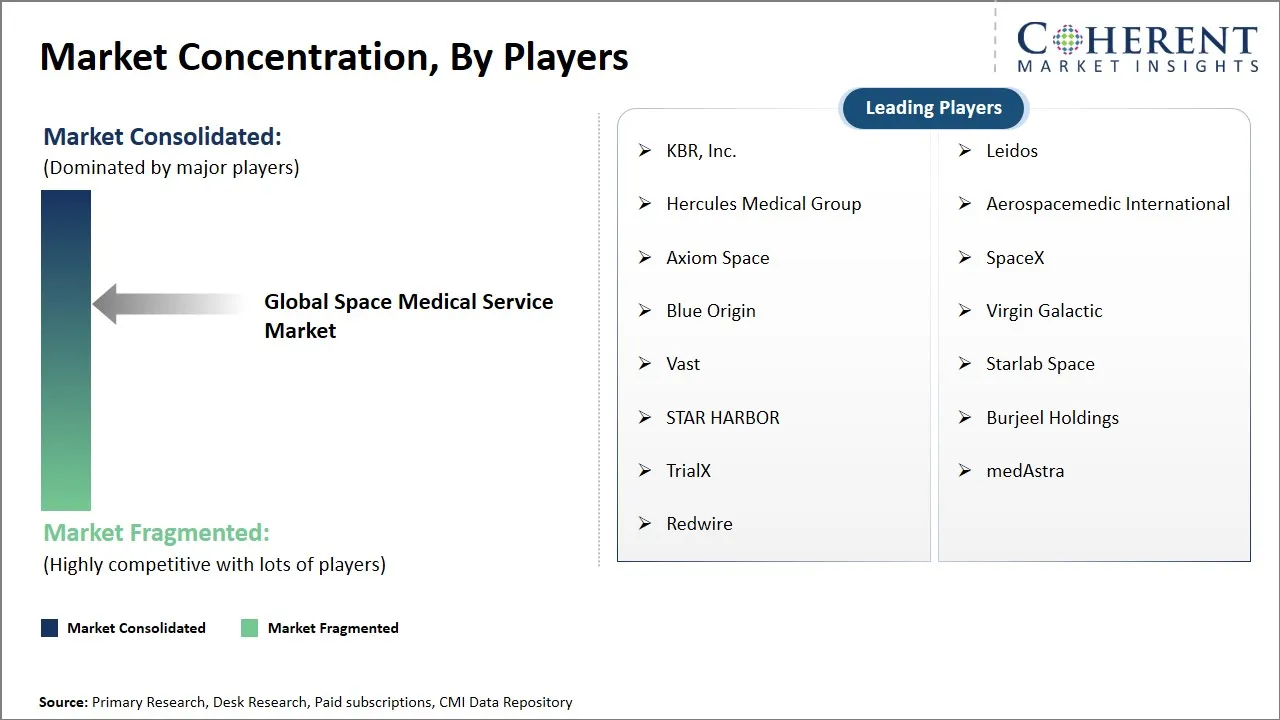
| Companies covered: | KBR, Inc., Leidos, Hercules Medical Group, Aerospacemedic International, Axiom Space, SpaceX, Blue Origin, Virgin Galactic, Vast, Starlab Space, STAR HARBOR, Burjeel Holdings, TrialX, medAstra, and Redwire | ||
| Growth Drivers: |
| ||
| Restraints & Challenges: |
| ||
Global Space Medical Service Market Dynamics
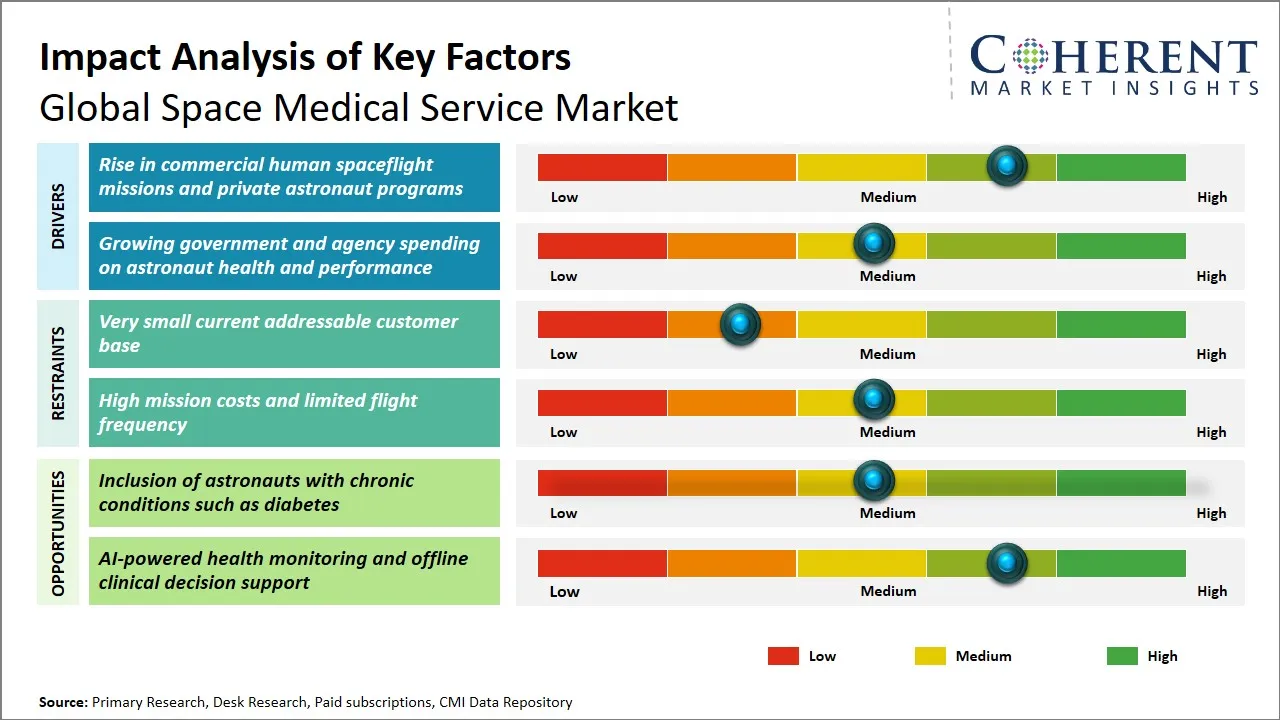
Global Space Medical Service Market Driver - Rise in Commercial Human Spaceflight Missions and Private Astronaut Programs
The growing number of commercial spaceflight missions and the growth of the astronaut programs in the private sector are also largely driving the demand in space medical services. With the rise of the number of people visiting space due to the exploration by individual companies outside governmental control, there is an urgent necessity to provide a well-developed medical care to the individuals facing the peculiarities of space conditions. Such missions frequently require spending long periods in microgravity that subjects astronauts to bone density loss, muscle atrophy, and radiation which require sophisticated medical surveillance and intervention systems. Moreover, the health and safety of participants are also of top priority in the programs of the private astronauts to achieve the success of missions and protect its members, which contributed to creating and implementing a number of space medical technologies and services.
For instance, on January 30, 2026, NASA announced a new agreement with Axiom Space for the fifth private astronaut mission to the International Space Station, targeted for launch no earlier than January 2027. The mission will allow a privately-trained crew to spend about two weeks aboard the orbiting laboratory, contributing to research, technology testing, and commercial activities in space. The initiative demonstrates the accelerating role of private astronaut programs in building a sustainable commercial space economy and expanding human access to space beyond traditional government-led missions.
Global Space Medical Service Market Opportunity - Inclusion of Astronauts with Chronic Conditions such as Diabetes
The increasing space missions to last longer such as lunar bases and Mars missions have presented a great opportunity in the global space medical service market by the incorporation of astronauts with chronic ailments like diabetes. Historically, the space programs have been biased towards candidates who are in the optimum physical condition with no chronic illnesses because of the fear of medical complications in the remote and resource-limited environment of space.
This however is being quickly overturned by the developments in the field of medical technology, continuous monitoring systems and enhanced spaceflight life support systems that have made management of chronic diseases in space a safe affair. This change would significantly increase the number of potential astronauts and would require the provision of specifically focused medical services to manage chronic disease, such as glucose monitoring, insulin administration, and emergency response plans in microgravity environments.
For instance, in June 2025, Axiom Space astronauts conducted the “Suite Ride” experiment aboard the International Space Station to study glucose behavior in microgravity. The research involved monitoring astronauts’ glucose levels using continuous glucose monitoring systems to understand how metabolism changes in space. The findings are expected to help redefine medical eligibility criteria for astronauts and could open future space missions to individuals with diabetes and other chronic conditions.
Analyst Opinion (Expert Opinion)
- The global space medical service market is growing because commercial human spaceflight is becoming routine and upcoming missions are longer, which demands continuous medical readiness rather than basic contingency support. Growth is being driven by better onboard sensing and remote monitoring, tighter operational standards for human spaceflight, and expanding multi-year funding for astronaut health and performance services. The strongest opportunities sit in integrated telemedicine and mission medical operations, standardized medical kits and clinical protocols for commercial missions, and high-value specialties such as radiation health and human performance. Key constraints remain limited emergency intervention capability in orbit, small clinical datasets for validation, and a tight pipeline of trained space-medicine talent.
- Recent forums shaping the sector include the International Astronautical Congress (IAC) 2023–2025 editions, the Aerospace Medical Association (AsMA) annual meetings, and dedicated space medicine summits. These events matter because they bring operators, clinicians, and medtech vendors into the same room to align on safety and medical readiness expectations, share evidence from in-flight and analog studies, and showcase emerging solutions in monitoring, diagnostics, and remote-care workflows that can be operationalized for future missions.
Speak to the analyst
Want personalized insights?
Take the findings above to one of our principal consultants, or have the report rebuilt around the segments, geographies and competitors you actually track.
Market Segmentation
- Service Type Insights (Revenue, USD Mn, 2021 - 2033)
- Pre-flight Medical Service
- In-flight Medical Support Service
- Post-flight rehabilitation and Recovery Service
- Test Type Insights (Revenue, USD Mn, 2021 - 2033)
- Audiology
- Cardiopulmonary
- Gastroenterology
- Dermatology
- Musculoskeletal
- Behavioral Health
- Reproductive Health
- Laboratory Testing
- Ophthalmology Optometry
- Service Provider Insights (Revenue, USD Mn, 2021 - 2033)
- Private
- Public
- End User Insights (Revenue, USD Mn, 2021 - 2033)
- Astronauts
- Aircraft Operations Division (AOD) Flight Crew members
- Others
- Regional Insights (Revenue, USD Mn, 2021 - 2033)
- North America
- U.S.
- Canada
- Latin America
- Brazil
- Argentina
- Mexico
- Rest of Latin America
- Europe
- Germany
- U.K.
- Spain
- France
- Italy
- Russia
- Rest of Europe
- Asia Pacific
- China
- India
- Japan
- Australia
- South Korea
- ASEAN
- Rest of Asia Pacific
- Middle East
- GCC Countries
- Israel
- Rest of Middle East
- Africa
- South Africa
- North Africa
- Central Africa
- North America
- Key Players Insights
- KBR, Inc.
- Leidos
- Hercules Medical Group
- Aerospacemedic International
- Axiom Space
- SpaceX
- Blue Origin
- Virgin Galactic
- Vast
- Starlab Space
- STAR HARBOR
- Burjeel Holdings
- TrialX
- medAstra
- Redwire
Sources
Primary Research Interviews
Industry Stakeholders
- Space medicine physicians / flight surgeons
- Astronaut health & performance program leads
- Mission operations medical officers
- Space biomedical engineering leads
- Telemedicine platform program managers for crew health
- Space radiation health / countermeasure researchers
End Users
- Professional astronauts (LEO missions)
- Commercial spaceflight crew members
- Spaceflight participants (suborbital)
- Analog mission crews (e.g., HERA / HI-SEAS–type programs)
- Space station medical operations staff
- Post-mission rehabilitation clinicians supporting returning crew
Government and International Databases
- NASA Life Sciences Data Archive (LSDA) / NASA Life Sciences Portal (NLSP)
- NASA Technical Reports Server (NTRS)
- FAA Office of Commercial Space Transportation (AST) resources
- ESA European Astronaut Centre (EAC) medical/space medicine resources
- WHO Global Health Observatory (GHO)
- UN Office for Outer Space Affairs (UNOOSA) resources
Trade Publications
- SpaceNews
- Aviation Week Network
- Via Satellite
- Payload
- The Space Review
- NASA Spinoff
Academic Journals
- Aerospace Medicine and Human Performance
- Acta Astronautica
- npj Microgravity
- Life Sciences in Space Research
- Aviation, Space, and Environmental Medicine
- Journal of Space Safety Engineering
Reputable Newspapers
- The Wall Street Journal
- Financial Times
- The New York Times
- The Washington Post
- The Guardian
Industry Associations
- Aerospace Medical Association (AsMA)
- International Academy of Aviation and Space Medicine (IAASM)
- International Astronautical Federation (IAF)
- American Institute of Aeronautics and Astronautics (AIAA)
- Space Generation Advisory Council (SGAC)
- International Society for Gravitational Physiology (ISGP)
Public Domain Resources
- ClinicalTrials.gov
- arXiv
- Directory of Open Access Journals (DOAJ)
- data.gov
- EU CORDIS
Proprietary Elements
- CMI Data Analytics Tool: Proprietary analytics tool to analyze real-time market trends, consumer behavior, and technology adoption in market
- Proprietary CMI Existing Repository of Information for Last 8 Years
Get access to 250+ pages report
Every segment, forecast, competitor profile and data table behind the analysis above — available for instant download.
- ESOMAR Member
- ISO 9001:2015 Certified
- D-U-N-S Registered
- GDPR & CCPA Compliant
Missing comfort of reading report in your local language? Find your preferred language:
Transform your Strategy with Exclusive Trending Reports
Frequently Asked Questions
The global space medical service market is estimated to be valued at USD 1,076.8 Mn in 2026 and is expected to reach USD 1,749.2 Mn by 2033.
The CAGR of the global space medical service market is projected to be 10% from 2026 to 2033.
Highest pull is for crew health monitoring, occupational health support, and human-performance / risk-mitigation research tied to long-duration missions (LEO operations plus Moon/Mars programs). This is reflected in NASA’s large, multi-year contracting for astronaut health and performance support.
Commercial spaceflight is tightening focus on medical screening to reduce in-flight medical emergencies (and ensure crew/passenger safety). The FAA’s medical screening guidance for commercial aerospace (spaceflight participants) is commonly referenced in industry processes because it frames how operators assess risk before flight.
Rise in commercial human spaceflight missions and private astronaut programs and growing government and agency spending on astronaut health and performance are the major factors driving the growth of the global space medical service market.
Very small current addressable customer base and high mission costs and limited flight frequency are the major factors hampering the growth of the global space medical service market.
In terms of service type, pre-flight medical service is estimated to dominate the market revenue share in 2026.