

Global Stationery Products Market Size and Forecast – 2026 to 2033
The Global Stationery Products Market is estimated to be valued at USD 129.86 Bn in 2026 and is expected to reach USD 183.95 Bn by 2033, exhibiting a compound annual growth rate (CAGR) of 5.1% from 2026 to 2033.
Key Takeaways of the Stationery Products Market
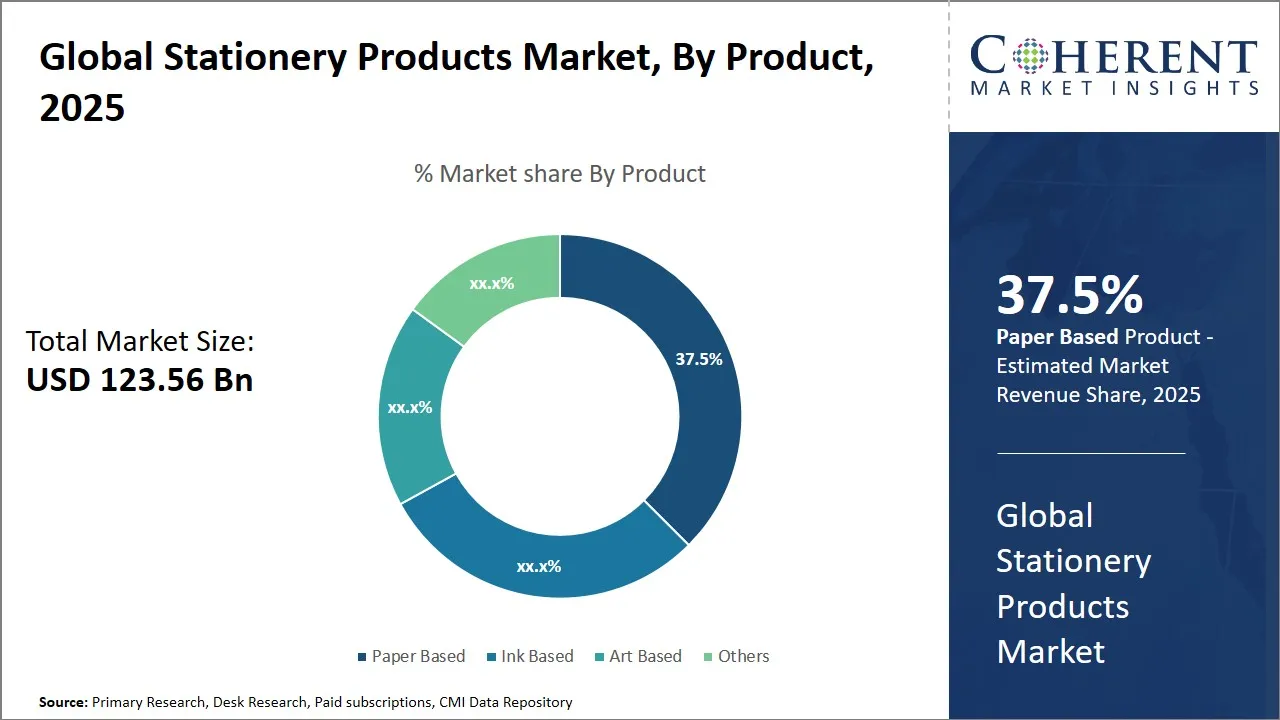
- The Paper-Based segment is expected to hold 38.5% of the global stationery market in 2026.
- The Educational Institutes segment is projected to hold 49.8% of the global stationery market in 2026.
- Asia Pacific will dominate the global stationery products market in 2026 with an estimated 38.2% share.
- Latin America will hold 18.3% share in 2026 and record the fastest growth.
Market Overview
- The prevailing trends in the market show that there is a drastic change of eco-friendly and sustainable stationery products in the market as consumers are increasingly becoming aware of their environmental impact.
- Smart stationeries and digital integration and enhancement of features used in writing and taking notes like digital pens and notebook are becoming a trend.
- Also, personalized stationery and customization are gaining more popularity and addressing the consumer need for unique and creative products.
Currents Events and Its Impacts
Current Events | Description and its impact |
Supply Chain and Trade Realignment (Tariffs & Production Shifts) |
|
Sustainability and Eco‑friendly Demand Shift |
|
Segmental Insights
- Current Industry Events of 2026
- Market Size Estimation
- Regional Breakdown
- Competitive Landscape
- Customer Intelligence
- Segmental Analysis
- Pricing Analysis
- Key Market Drivers, Challenges & Future Trends
- Customized Insights Section
Why Does Paper Based Dominate the Stationery Products Market in 2026?
Paper Based segment is expected to hold 38.5% share of the global stationery products market in 2026, due to its basic nature of use in daily educational and professional functions. Written documents such as notebooks, writing pads, printing papers, and envelopes remain essential despite the increasing online substitutes. Handwritten tasks have the tactile and cognitive advantages that form one of the most important conditions that contribute to the rise in demand for paper-based stationery. Various researches indicate that handwriting boosts learning memory and creativity, which guarantees a high inclination towards paper within the learning institutions and also among the innovative members of society.
Besides, paper stationery is flexible and convenient and cannot be fully replaced by digital tools. As an example, paper is still the most popular tool used to take notes, brainstorm, and sketch something on and cannot be substituted in classrooms and offices. This segment is also reinforced by the increasing trend in individualized stationery products such as custom notebooks and planners since customers are looking to use and purchase personally tailored and aesthetically pleasing paper items to use both functionally and ornamentally.

Educational Institutes Dominate the Stationery Products Market
The Educational Institutes segment is set to hold 49.8% share within the global stationery products market in 2026, primarily because stationery items are critical to the day-to-day academic functions. Moreover, educational institutions of various levels, starting with primary schools, all the way to universities, use stationery in teaching, learning, and examination processes to a large extent.
Stationery products are important resources both to the students and teachers to enable them to take notes, give assignments, projects, and classroom tasks. The growing need to have better literacy levels and education enrollment in the world has led to a constant demand for stationery materials. The initiative of governments and private sector to increase access to quality education will directly impact the strength of this segment as more and more students will be translated into increased demand for most basic educational tools including notebooks, writing tools, and art supplies.
Regional Insights

Asia Pacific Stationery Products Market Analysis and Trends
The Asia Pacific region is projected to lead the market with a 38.2% share in 2026, driven by a well-established manufacturing ecosystem, abundant raw material availability, and a vast consumer base encompassing students, professionals, and corporate sectors. The region is also enjoying supportive government policies that have increased the exporting capacities and fostered the development of industries particularly in such nations as China, Japan, and India.
Pilot Corporation, Pentel, and Kokuyo are some of the major industry players in Asia Pacific that take the advantage of advanced R&D centers and effective supply chain to retain their leadership in the market. The market penetration and product accessibility in various economies are further boosted by trade dynamics such as strong intra-regional exports and the continuous increase in e-commerce penetration.
Latin America Stationery Products Market Analysis and Trends
The Latin America region is expected to exhibit the fastest growth in the market contributing 18.3% share in 2026. This is attributed to rising education enrollments, urbanization, and expanding retail and distribution networks. The governments of countries such as Brazil and Mexico are focusing more on educational reforms and development of infrastructures, which increases the demand for quality educational and office supplies. The diversification of products and high-end segmentation are also facilitated by the regions that have increasing middle-class population and buying capacity.
The industry is becoming increasingly localized, with the presence of multinational corporations such as Faber-Castell and BIC increasing their manufacturing. The trade policies that are geared towards facilitating importation and exportation coupled with the enhancement of logistics infrastructure allow faster penetration and growth in the Latin American market.
Stationery Products Market Outlook for Key Countries
China Stationery Products Market Trends
China’s market for stationery products is rapidly expanding as it is a major producer and consumer of stationery products. The role of leading Chinese companies such as Deli Group and M&G Stationery in the market growth has been significant with their innovative product portfolios to meet the needs of the domestic and international markets.
The Made in China 2026 programs by the government encourage technological improvements of the manufacturing process, which will make the products better and more efficient. A large network of distribution territories in China, as well as the presence of digital stores, provides a large number of stationery products. Competitive labor costs and the availability of raw materials in the country attract investment and drive creative innovation in stationery product manufacturing, maintaining its dominance.
Is Japan’s Stationery Products Market Fueled by Innovation and Sustainability?
Japan has maintained the stationery products market by keeping it to its reputation of precise manufacturing and product development of high quality. Market giants such as Pilot Corporation and Pentel pay much attention to the process of innovation and sustainability, including in their products materials of green nature and contemporary design ideas.
The presence of strong demand is anchored on the strong consumer preference for quality and specialized stationeries reinforced by existing retailing chains and online shopping systems. Government policies that promote environmental responsibility affect the development of stationery products, which compel companies towards biodegradable and recycled materials. The industry’s appearance in Japan is characterized by the cooperation between classical artistry and latest technologies that allow to maintain competitiveness on the international level.
India Stationery Products Market Trends
The stationery products market within India is distinguished by a fast grown consumer segment. A dynamic increase in the number of young people as well as the efforts of the government to enhance literacy and educational systems support the market growth. Companies such as Camlin and Luxor have a key role in offering low-cost locally manufactured stationery goods that can serve various consumers, including students and professionals.
Recent policies focused on encouraging Make in India have led to increased manufacturing development in the country and decreased reliance on imports. The increase in organized retailing and e-commerce avenues has enhanced access to products even in tier-2 and -3 cities. Also, there are increasing needs for stationery products in innovative and premium ranges, which promote creativity and product diversification.
Is Brazil’s Stationery Products Market Positioned for Growth Amid Economic Diversification?
As the economy is diversifying, increased spending on education and demand from offices influence Brazil stationery products market. The main market segments include Faber-Castell and Lyra that have built powerful manufacturing and distribution networks that cater to local tastes and introduce international standards of quality.
The Brazilian government is focusing on education reforms and supporting local industries, which drives market development. Trade policies that facilitate import-export processes also help multinational companies expand their reach. Additionally, the growing presence of organized retail, supermarkets, and online platforms boosts market penetration. Meanwhile, consumer trends are shifting towards the use of eco-friendly and sustainable stationery products.
Germany Stationery Products Market Trends
The advantages that Germany’s stationery products market enjoys are its high level of industrial base, developed supply chains, and attention to quality and design. Companies like Staedtler and Pelikan which have made a name in regard to innovative, long-lasting and environmentally friendly products dominate the market. The European Union provides trade openness that enables the exportation of German stationery products which have increased its reach in the region.
Child-Friendly Safety Fields
For child use, the dataset usually encodes compliance and design safeguards.
- Safety Certification Flags: EN‑71, ASTM F963, REACH, etc. (1/0 per product).
- Choking / Mechanical Safety: Ventilated caps, cap length thresholds, absence of detachable small parts.
- Chemical Safety: Non‑toxic ink, low VOC, washable, allergen/odor ratings.
- Age Grading: 3+, 6+, 12+ mapped to regulatory and ergonomic assumptions (grip diameter vs hand size, force required, etc.).
Digital Substitution Impact
- Use Context: Exam/assessment, quick office notes, creative art, calligraphy, planner/journaling, early learning. Contexts like exams and young children tend to be more resilient to digital substitution than casual note-taking.
- Substitution Exposure Index: For each use case, an assessment of how often a digital alternative is already adopted (e.g., tablets for art, stylus note-taking, digital whiteboards).
- Differentiation vs Digital: Flags or scores for features that digital tools cannot replicate easily: tactile writing feel, special pigments/metallics, handcraft aesthetics, sensory/learning benefits for kids.
Market Players, Key Development, and Competitive Intelligence

Key Developments
- In November 2025, Cello World secured 'Cello' brand rights for stationery products; expects to clock USD 2.41 Mn in 2026. Cello World will operate the stationery and writing instruments portfolio under two brands, namely, Cello and Unomax.
- In May 2024, bioQ launched the world's first 100% biodegradable pen in India. It features a non-toxic ink, recycled paper refill, and options for a metal, paper, or bamboo exterior to reduce plastic waste.
Top Strategies Followed by Global Stationery Products Market Players
Player Type | Strategic Focus | Example |
Established Market Leaders | Heavy investment in R&D and innovation | Frixion’ pen (Pilot line with a set of erasable pens utilizing thermosensitive ink has proved to be very successful with its convenience and environmental sustainability. |
Mid-Level Players | Cost-effective solutions with balanced quality | BIC is credited with a high variety of cheap but high-quality pens, pencils, and markers which are sold to average consumers and schools. Its products are cheaper than the high-end brands such as Montblanc yet it has a great reputation of being reliable and affordable. |
Small-Scale Players | Niche specialization & innovative variants | Nuuna has been noted to develop quality and eco-friendly notebooks with distinct designs that environmentally conscious consumers would love to buy. |
Market Report Scope
Stationery Products Market Report Coverage
| Report Coverage | Details | ||
|---|---|---|---|
| Base Year: | 2025 | Market Size in 2026: | USD 129.86 Bn |
| Historical Data for: | 2020 To 2024 | Forecast Period: | 2026 To 2033 |
| Forecast Period 2026 to 2033 CAGR: | 5.1% | 2033 Value Projection: | USD 183.95 Bn |
| Geographies covered: |
| ||
| Segments covered: |
| ||
| Companies covered: | Faber-Castell, 3M, STAEDTLER SE, Maped, MUJI INDIA., Artline India., Fullmark Pte Ltd., Reynolds Pens, Linc Pens & Plastics Ltd., Mead | ||
| Growth Drivers: |
| ||
| Restraints & Challenges: |
| ||
Stationery Products Market Dynamics
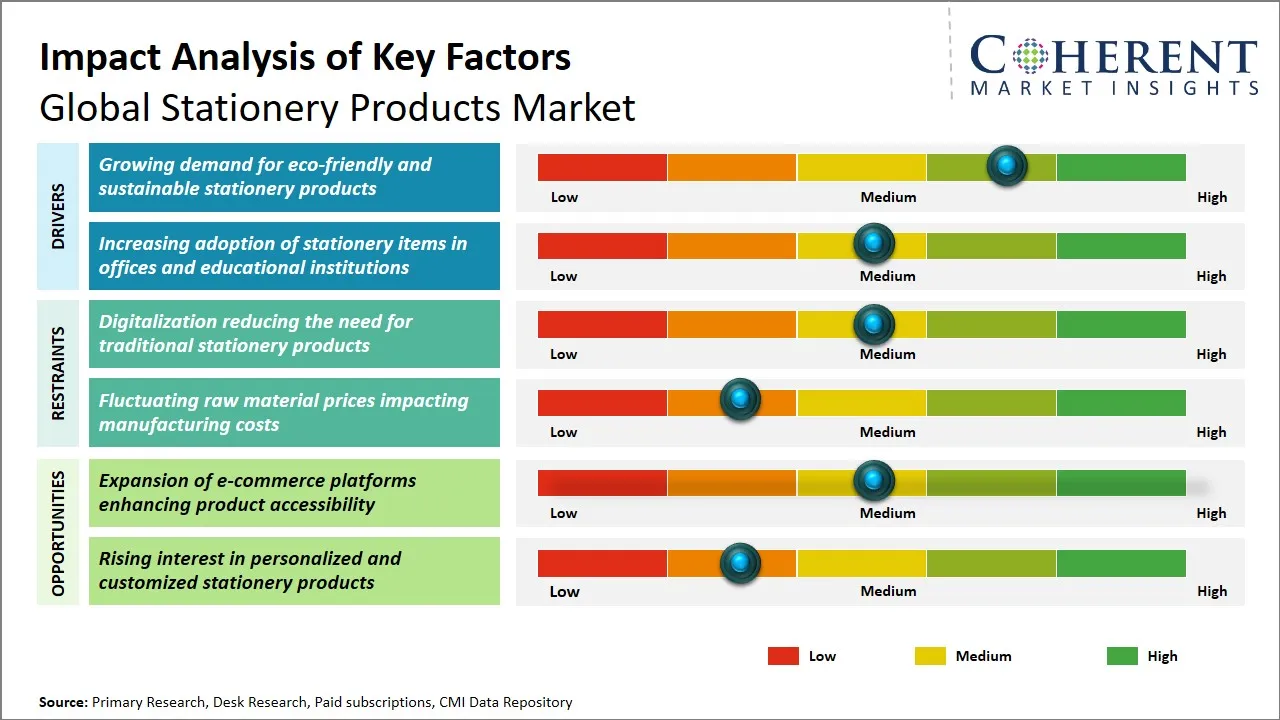
Stationery Products Market Driver - Growing Demand for Eco-friendly and Sustainable Stationery Products
Growing international consciousness on the subject of environmental concerns has strongly affected consumers’ taste in stationery products, leading to a rise in demand for eco-friendly and sustainable solutions. Consumers, in particular millennials and Gen Z, are also in search of products made of recycled, biodegradable, or renewable, sustainable materials. Firms are also turning to the creation of stationery products (notebooks, pens, and packaging made of renewable materials, like recycled paper, bamboo, plant-based plastics) not only to reduce environmental impact but also to appeal to the values of eco-conscious consumers.
For example, Pilot Corporation has diversified its product to accommodate pens that are made of recycled materials and biodegradable materials. Good example of how the stationery industry is moving to green practices is the Pilot Bottle to Pen initiative of the company that reuses recycled plastic bottles to make pens.
Stationery Products Market Opportunity - Expansion of E-Commerce Platforms Enhancing Product Accessibility
The rapid growth of online shopping platforms presents a significant opportunity for the global stationery market. These platforms allow products to reach consumers at an unprecedented scale, ensuring greater availability and access. As the internet service and smartphones penetrate the world, more so in emerging economies, online channels have become one of the primary marketplaces where consumers learn about and acquire stationery products. Internet shopping sites allow manufacturers and stockists to display more product lines, such as niche and novel stationery products not necessarily found in high street shops.
For example, Amazon has become a significant competitor in the stationery industry with an extensive assortment of sustainable, personalized, and unique stationery products that cannot be found in the bricks and mortar stores. Having such a broad international presence, consumers have access to products of smaller and independent brands specialized in unique or specialized stationery products, further facilitating access to a wide variety of products.
Analyst Opinion (Expert Opinion)
- The stationery products market worldwide is experiencing a stable growth prompted by renewed attention to creative pursuits, remote working tendencies, and the timeless popularity of the traditional writing tool. The National Stationery Show (2023) and the International Paper and Stationery Expo (2022) provided a good understanding of trends in the field of innovations, and companies such as Pilot Pen Corporation and Staples are the pioneers in product diversity and sustainability.
- The recent introduction of eco-friendly pens created by Pilot of recycled material is a good example of how the industry has reacted to growing consumer need. The theme of personalization and customization of stationeries (particularly with the young consumers and professionals) in need of unique solutions to their needs was highly discussed during these conferences.
- The digitalization of workspaces and threat of alternative applications that are tech-oriented were among the most common obstacles to growth mentioned. Finally, the development of the stationery products market will depend on its capacity to respond to the changing consumer preferences and innovate in a more digitalized environment.
Speak to the analyst
Want personalized insights?
Take the findings above to one of our principal consultants, or have the report rebuilt around the segments, geographies and competitors you actually track.
Market Segmentation
- Product Insights (Revenue, USD Bn, 2021 - 2033)
- Paper Based
- Ink Based
- Art Based
- Others
- Application Insights (Revenue, USD Bn, 2021 - 2033)
- Educational Institutes
- Corporates
- Others
- Regional Insights (Revenue, USD Bn, 2021 - 2033)
- North America
- U.S.
- Canada
- Latin America
- Brazil
- Argentina
- Mexico
- Rest of Latin America
- Europe
- Germany
- U.K.
- Spain
- France
- Italy
- Russia
- Rest of Europe
- Asia Pacific
- China
- India
- Japan
- Australia
- South Korea
- ASEAN
- Rest of Asia Pacific
- Middle East
- GCC Countries
- Israel
- Rest of Middle East
- Africa
- South Africa
- North Africa
- Central Africa
- North America
- Key Players Insights
- Faber-Castell
- 3M
- STAEDTLER SE
- Maped
- MUJI INDIA.
- Artline India.
- Fullmark Pte Ltd.
- Reynolds Pens
- Linc Pens & Plastics Ltd.
- Mead
Sources
Primary Research Interviews
- CEO – Leading Stationery Manufacturer (e.g., BIC or Newell Brands equivalent)
- Supply Chain Director – Major Office Supplies Distributor
- Production Lead – Specialty Paper and Writing Instruments Producer
- Sustainability Officer – Stationery Certification Authority (e.g., FSC for paper products)
Stakeholders
- Manufacturers
- End-use Sectors
- Education (Schools, Universities)
- Office Supplies (Corporate, Home Offices)
- Art & Craft (Artists, Hobbyists)
- Regulatory & Certification Bodies (e.g., FSC for sustainable paper, REACH compliance in EU for inks)
- E-commerce Platforms and Retailers (Amazon, Staples, Alibaba)
- Technology Integration Players: Smart stationery and digital-hybrid notebook producers
Databases
- UN Comtrade Database
- India Import Export (EXIM) Database
- USITC Trade Data (Stationery Products)
- Eurostat Trade Statistics for Paper and Office Supplies
Magazines
- Office Products International – Trends in stationery supply
- Stationery Trends – Innovations in writing instruments
- Printweek – Paper and stationery manufacturing
- Gifts & Decorative Accessories – Art supply market dynamics
- Education Week – Stationery demand in education
Journals
- Journal of Marketing Research – Consumer behavior in stationery purchases
- Resources Policy – Global paper supply chain analysis
- Journal of Cleaner Production – Environmental impact of stationery production
- Packaging Technology and Science – Sustainable materials in stationery
- International Journal of Consumer Studies – Trends in office products
Newspapers
- The Wall Street Journal – Global demand for office supplies
- The Guardian – Sustainability in paper and stationery
- Business Standard (India) – Stationery imports and Asia market growth
- Financial Times – Supply chain disruptions in consumer goods
- Reuters – Price volatility in paper products
Associations
- International Stationery Association
- Office Products Association
- National Stationery Show Organizers
- European Paper Recycling Council
- Forest Stewardship Council (FSC)
- Sustainable Packaging Coalition
Public Domain Sources
- EPA – Guidelines for paper product handling
- European Commission – REACH regulations on stationery chemicals
- World Health Organization – Safety standards for art materials
- USGS – Paper and pulp statistics (related inputs)
- OECD – Consumer goods trade and sustainability reports for stationery
Proprietary Elements
- CMI Data Analytics Tool
- Proprietary CMI Existing Repository of information for last 8 years.
Get access to 250+ pages report
Every segment, forecast, competitor profile and data table behind the analysis above — available for instant download.
- ESOMAR Member
- ISO 9001:2015 Certified
- D-U-N-S Registered
- GDPR & CCPA Compliant
Missing comfort of reading report in your local language? Find your preferred language:
Transform your Strategy with Exclusive Trending Reports
Frequently Asked Questions
The global stationery products market is estimated to be valued at USD 129.86 Bn in 2026 and is expected to reach USD 183.95 Bn by 2033.
The CAGR of global stationery products market is projected to be 5.1% from 2026 to 2033.
Growing demand for eco-friendly and sustainable stationery products and increasing adoption of stationery items in offices and educational institutions are the major factors driving the growth of global stationery products market.
Pricing varies by material quality, brand equity, sustainability claims, and bulk/education contracts. Premium and eco‑friendly lines command higher margins.
Digitalization reducing the need for traditional stationery products and fluctuating raw material prices impacting manufacturing costs are the major factors hampering the growth of global stationery products market.
In terms of Product, Paper Based is estimated to dominate the market revenue share in 2026.
Faber-Castell, 3M, STAEDTLER SE, Maped, MUJI INDIA., Artline India., Fullmark Pte Ltd., Reynolds Pens, Linc Pens & Plastics Ltd., and Mead are the major players.