

Tax Management Software Market Size and Trends Forecast: 2026 - 2033
The tax management software market is estimated to be valued at USD 27.80 Bn in 2026 and is expected to reach USD 56.72 Bn by 2033, exhibiting a compound annual growth rate (CAGR) of 10.7% from 2026 to 2033.
Key Takeaways of the Tax Management Software Market
- The software segment is expected to lead the market, holding an estimated share of 72.9% in 2026.
- Based on deployment mode, the cloud segment is projected to dominate, due to its flexibility and scalability, holding a share of 65.3% in 2026.
- The indirect taxes segment is estimated to lead the market, holding a share of 58.8% in 2026.
- North America is projected to dominate the market with a share of 38. 6% in 2026.
Market Overview
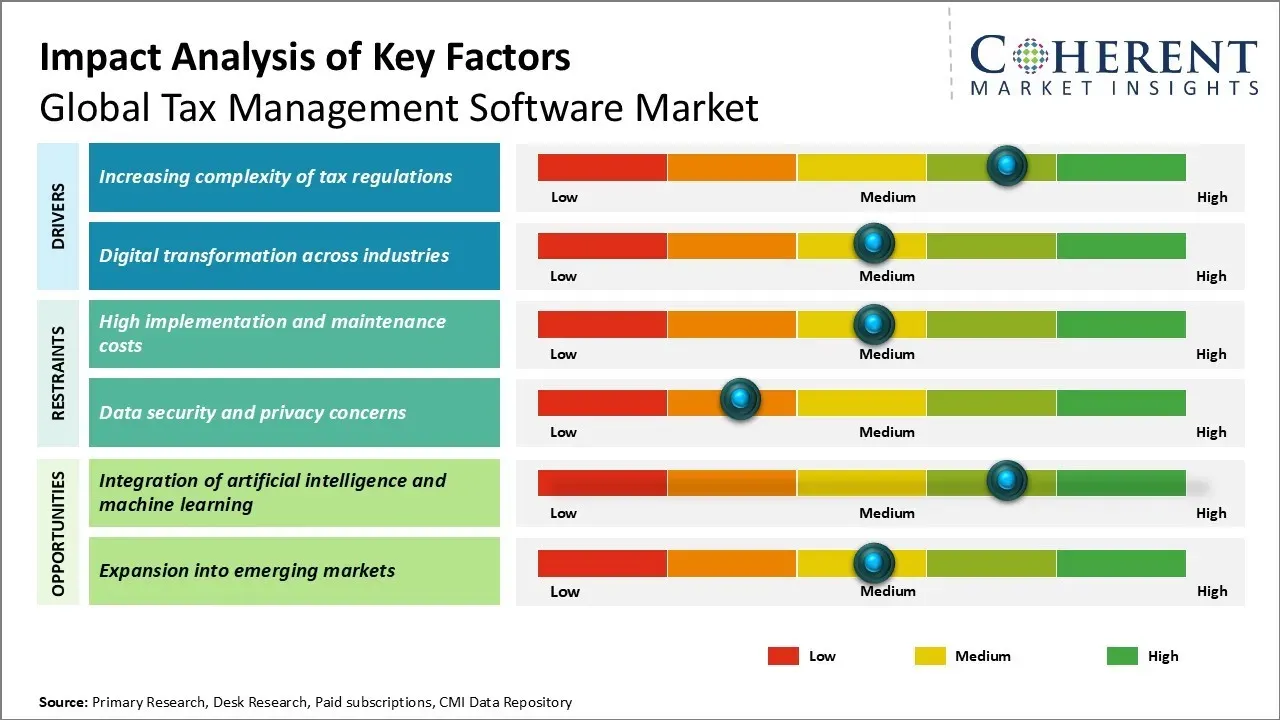
The tax management software market is expected to witness significant growth over the forecast period. Growing digitalization and rising need for automating tax filing process are some key factors driving the adoption of tax management software by various organizations globally. In addition, the development of advanced technologies, such as artificial intelligence and machine learning, are helping tax management software providers to integrate more intelligent capabilities in their offerings, thus augmenting their demand.
However, challenges such as data security and privacy concerns may hinder market growth.
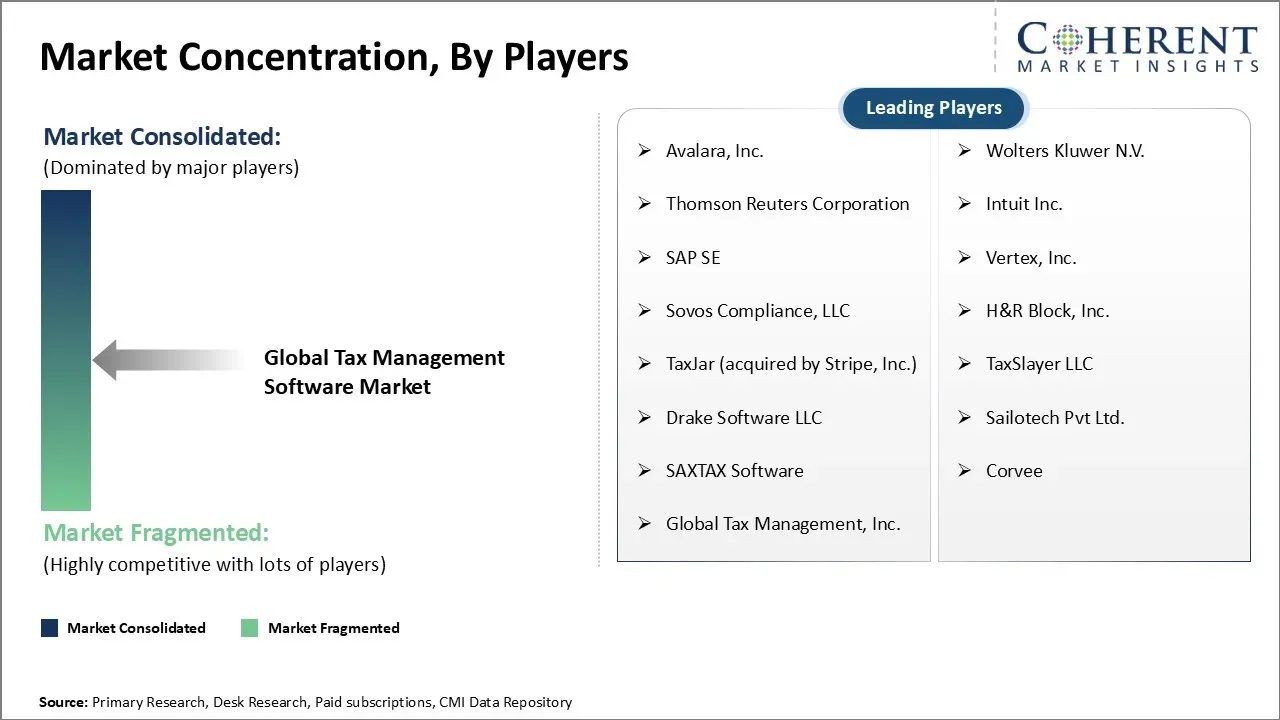
Market Concentration and Competitive Landscape
Current Events and their Impact on the Tax Management Software Market
Current Events | Description and its Impact |
European Union (EU) Digital Reporting and E-Invoicing Mandates |
|
China’s Nationwide e-Fapiao Transition |
|
- Current Industry Events of 2026
- Market Size Estimation
- Regional Breakdown
- Competitive Landscape
- Customer Intelligence
- Segmental Analysis
- Pricing Analysis
- Key Market Drivers, Challenges & Future Trends
- Customized Insights Section
Market Trends
Expansion of Cloud-Based Tax Management Solutions
The expansion of cloud-based tax management solutions is significantly propelling the advancement of the tax management software market by revolutionizing how businesses and governments handle tax compliance and reporting. Traditionally, tax management involved complex, manual processes fraught with risks of errors, delays, and regulatory non-compliance. However, the advent of cloud technologies has introduced scalable, flexible, and real-time tax management platforms that streamline these processes.
For instance, according to a report published by the Wolters Kluwer, in June 2024, 38% of European businesses use cloud-based financial software.
Segmental Insights
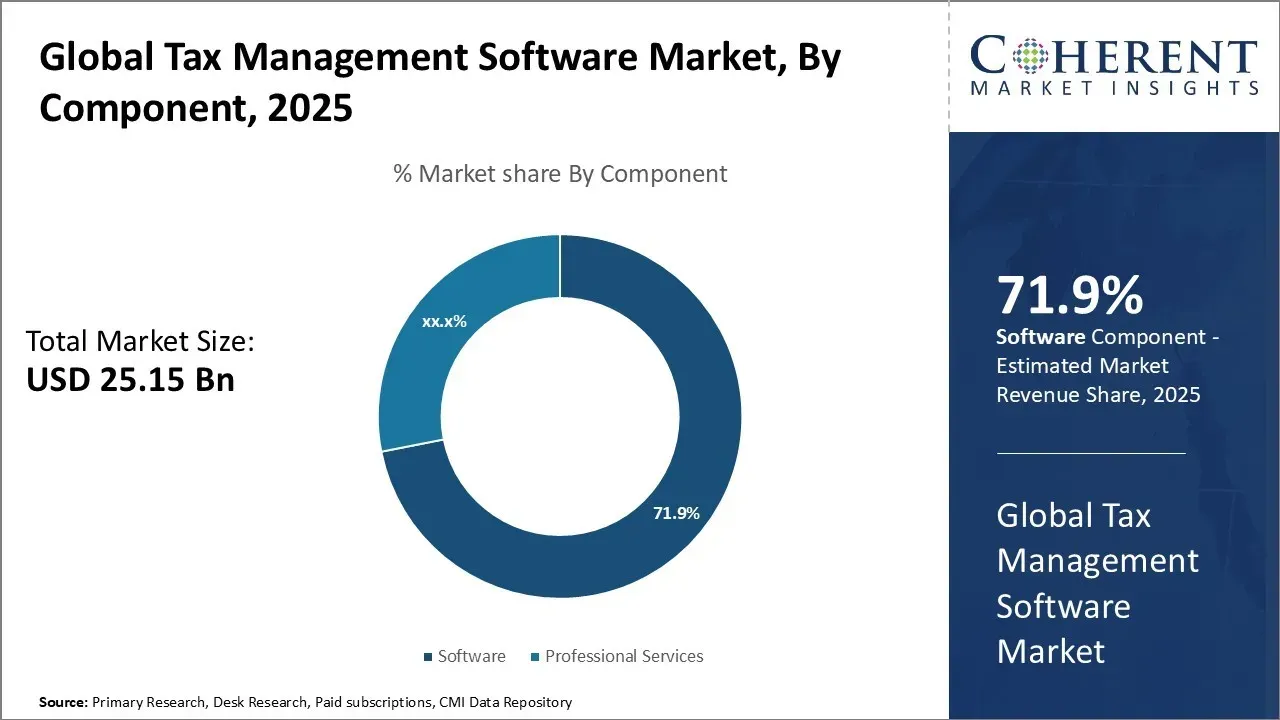
Tax Management Software Market Insights, By Component: Software Dominates the Tax Management Market, Due to Demand for Stand-alone Products
In terms of component, the software segment is expected to contribute the highest share of 72.9% in the market in 2026, owing to its increasing demand as a stand-alone product.
Tax management software offers a centralized platform for companies to file tax returns, stay compliant with dynamic regulations, and streamline tax processes. It automates manual tasks like data collection, calculations, record keeping, e-filing and payment tracking, saving companies significant time, and costs compared to traditional spreadsheet-based systems. Software products also regularly undergo upgrades and additions of new features to address evolving compliance needs.
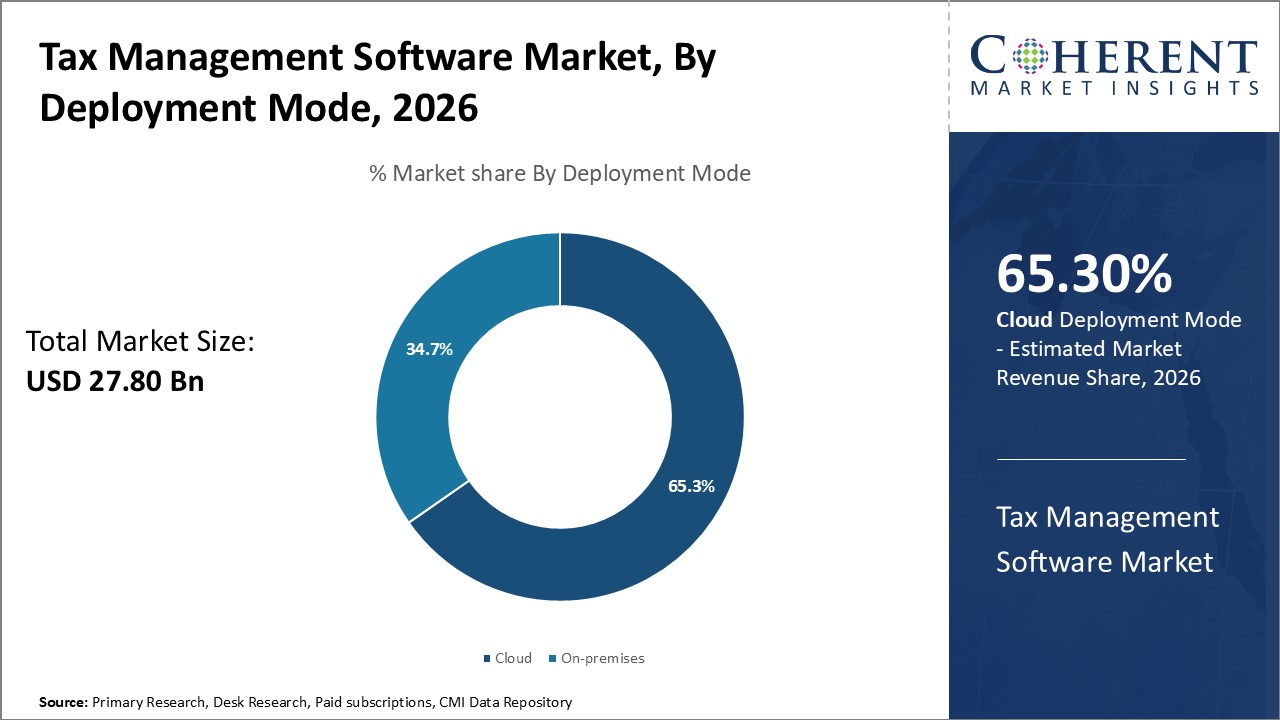
Tax Management Software Market Insights, By Deployment Mode: The Cloud Segment Leads Due to its Flexibility
In terms of deployment mode, the cloud segment is expected to contribute the highest share of 65.3% in the market in 2026, owing to compelling advantages it provides over on-premises solutions.
Cloud deployments eliminate upfront capital costs and facilitate fast, scalable implementation. They free companies from burdens of hardware procurement, maintenance, and environment management. Using tax software via the cloud, businesses can securely access applications from anywhere on any device. This enhances productivity of remote and mobile workforces.
Tax Management Software Market Insights, By Tax Type: Indirect Tax Generates Higher Complexities, Creating Demand for Management Software
In terms of tax type, the indirect taxes segment is expected to contribute the highest share of 58.8% in the market in 2026, owing to its ballooning compliance intricacies faced by businesses.
Calculating, tracking, and filing indirect taxes like VAT, GST, and sales tax involves dealing with multiple jurisdictions and tax rates that vary by products, regions, and customer categories. Companies have to stay on top of frequent rate changes and comply with diverse reporting norms across locations. In contrast, direct taxes like income tax have relatively stable global compliance procedures.
Emerging Innovations in the Tax Management Software Market
- The Incorporation of Robotic Process Automation (RPA)
- RPA automates repetitive tax functions such as tax form completion, filing, and reporting processes. By minimizing manual intervention, RPA significantly improves accuracy while freeing tax professionals to focus on strategic decision-making and compliance advisory.
- Enhanced Integration Capabilities
- Modern tax management software is designed to seamlessly connect with Enterprise Resource Planning (ERP) systems, accounting software, payroll systems, and government tax portals. This interoperability ensures smooth data flow, reduces redundancies, and streamlines tax calculation and filing processes. API-first designs and open architectures have accelerated this integration trend, empowering organizations to build comprehensive tax ecosystems.
Impact of Artificial Intelligence (AI) on the Tax Management Software Market
As tax regulations grow increasingly complex and data volumes expand, AI-powered solutions are becoming essential tools for businesses and tax professionals worldwide. This transformation is evident through AI integration in the industry, targeted use case applications, and innovative company-level implementations.
- Intuit, the creator of TurboTax, incorporates AI-driven tools that automatically identify inconsistencies and optimize tax deductions for users. By analyzing past returns and current financial data, Intuit’s AI system flags potential errors or audit risks before submission, drastically increasing filing accuracy and user confidence. This use case highlights AI’s ability to enhance functionality by automating traditionally manual, error-prone processes.
- Thomson Reuters, a global provider of tax and accounting software, has integrated AI across its tax platform, ONESOURCE. Its AI-powered tax research tool leverages natural language processing (NLP) to analyze vast regulatory databases quickly, enabling tax professionals to access relevant rulings and updates effortlessly. This integration not only streamlines workflows but also reduces human error in interpreting complex tax codes.
Regional Insights
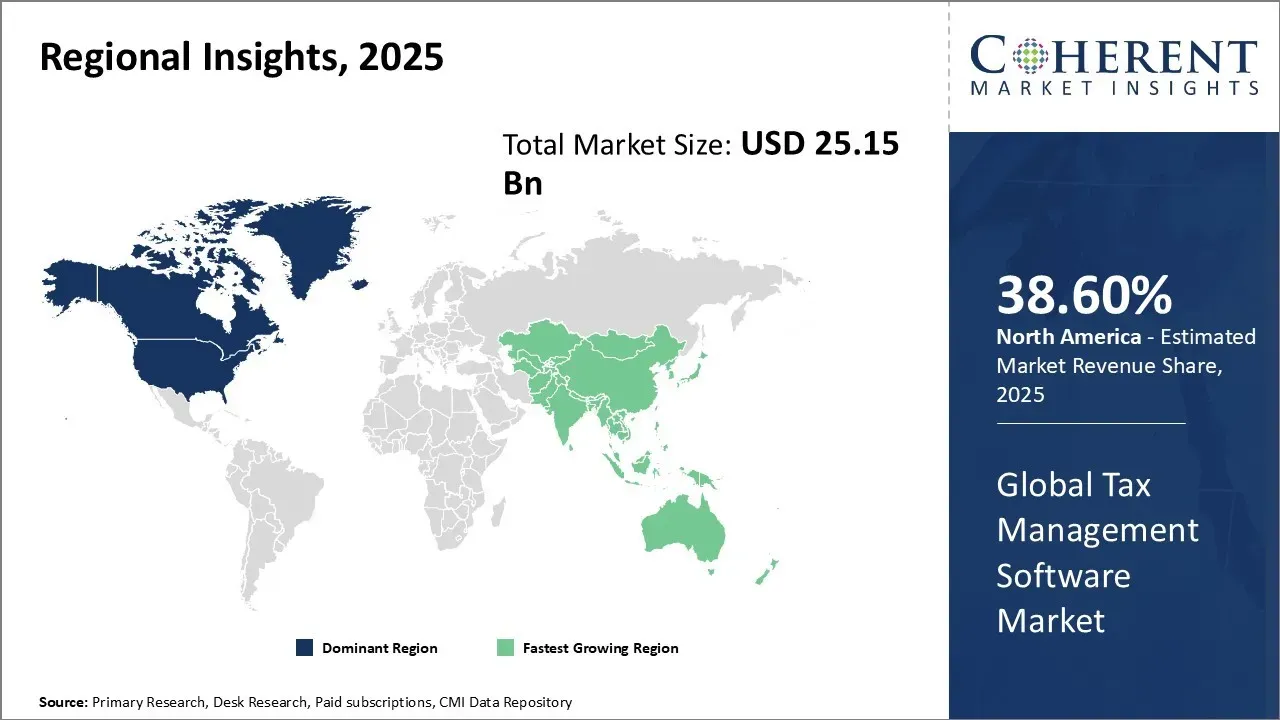
North America Tax Management Software Market Analysis and Trends
North America is expected to dominate the market with a share of 38.60% in 2026. The region’s dominance in the tax management software market can be attributed to its developed IT infrastructure and widespread technology adoption among businesses. Additionally, the presence of major players like Vertex, Sovos, and Avalara have helped drive accessibility and awareness of tax management solutions in the region.
For instance, GOBankingRates 2023 tax survey of 1,002 Americans reveals that 44% of overall respondents plan to use tax software. In contrast, just about 18% will work with a CPA to file their tax returns.
Asia Pacific Tax Management Software Market Analysis and Trends
The Asia Pacific region, holding a share of 26.4% in 2026, is expected to exhibit the fastest growth, led by countries like China, India, and Japan. The growth here stems from governments focusing on strengthening tax and revenue collection systems. Several incentives are motivating enterprises in Asia Pacific to invest in automated tax compliance tools to avoid penalties.
Tax Management Software Market Outlook for Key Countries
U.S. Tax Management Software Market Analysis and Trends
The U.S. tax management software market is characterized by frequent changes in tax legislation, compelling businesses to adopt advanced digital solutions for compliance. The growing complexity of federal, state, and local tax laws has led to an increasing reliance on software solutions that ensure accuracy, minimize audit risks, and automate tax calculations. Major vendors, such as Intuit, Avalara, and Thomson Reuters, frequently update their platforms to keep pace with new tax rules and regulatory requirements.
China Tax Management Software Market Analysis and Trends
China tax management software market is expanding rapidly, fueled by the country's economic growth, digital transformation, and evolving tax policies. The Chinese government has been actively reforming tax regulations, including VAT reforms, e-invoicing mandates, and digital taxation measures, pushing businesses to upgrade their tax management systems. Local players like Kingdee, UFIDA (Yonyou), and Baiwang Cloud are leading the market by offering customized tax compliance tools that integrate seamlessly with China's Golden Tax System.
India Tax Management Software Market Analysis and Trends
India tax management software market is experiencing rapid growth, driven by ongoing reforms in the Goods and Services Tax (GST) system and increasing digital adoption. The Indian government’s efforts to simplify and standardize tax regulations have created significant opportunities for tax software providers. Leading players, such as Tally Solutions, ClearTax, and Zoho, have developed AI-powered GST solutions that assist businesses in accurate tax calculations, return filing, and compliance tracking.
Japan Tax Management Software Market Analysis and Trends
Japan continues to be a leader in tax technology adoption, driven by its complex tax framework and corporate emphasis on efficiency. The country's tax environment requires businesses to navigate multiple tax categories, including corporate tax, consumption tax (JCT), and local taxes, making automation essential. Japan's leading software providers, such as MJS (Misuzu), TKC Corporation, and OBIC, have integrated AI and machine learning capabilities into their platforms to enhance tax automation.
Pricing Analysis of the Tax Management Software Market
- Large enterprises are willing to allocate substantial budgets, often ranging from tens to hundreds of thousands of USD annually for tax management software, driven by the complexity and scale of their compliance and reporting requirements.
- SMBs and mid-sized organizations tend to opt for subscription models between USD 500 and USD 10,000 annually, balancing cost and functionality.
- Individual taxpayers show high price sensitivity, preferring free or low-cost solutions (USD 0-USD 200 per filing).
Market Report Scope
Tax Management Software Market Report Coverage
| Report Coverage | Details | ||
|---|---|---|---|
| Base Year: | 2025 | Market Size in 2026: | USD 27.80 Bn |
| Historical Data for: | 2020 To 2024 | Forecast Period: | 2026 To 2033 |
| Forecast Period 2026 to 2033 CAGR: | 10.7% | 2033 Value Projection: | USD 56.72 Bn |
| Geographies covered: |
| ||
| Segments covered: |
| ||
| Companies covered: | Avalara, Inc., Wolters Kluwer N.V., Thomson Reuters Corporation, Intuit Inc., SAP SE, Vertex, Inc., Sovos Compliance, LLC, H&R Block, Inc., TaxJar (acquired by Stripe, Inc.), TaxSlayer LLC, Drake Software LLC, Sailotech Pvt Ltd., SAXTAX Software, Corvee, and Global Tax Management, Inc. | ||
| Growth Drivers: |
| ||
| Restraints & Challenges: |
| ||
Tax Management Software Industry News
- In July 2025, Thomson Reuters launched two AI-driven tax solutions—Ready to Advise and Ready to Review—built on its agentic AI platform and powered by CoCounsel, its professional-grade AI assistant. Ready to Advise automates complex tax planning workflows, synthesizing client data and IRS guidance to generate tailored strategy recommendations with guided implementation. Ready to Review, expected in Q4, streamlines tax return preparation by intelligently extracting, processing, and populating return details for human review—all with built-in accuracy checks, transparency, and accountability.
- In June 2025, Nakisa IWMS introduced advanced functionality, that included AI Agent for analytics, multiple lease components management, enhanced tax management, and many more.
- In May 2025, Avalara, Inc. introduced CRUSH on Tour, a new, free, one-day event series bringing Avalara's latest innovations directly to customers.
- In June 2025, Karbon launched a new features to automate end-to-end tax workflows, and Practice Intelligence, its bold vision for AI-powered firm operations. The initiative was made during Karbon Next, the company’s customer event where 150 senior leaders from top global firms gathered to explore the future of modern accounting.
Analyst View
- The tax management software market is witnessing robust momentum driven by increasing complexities in tax regulations and the growing need for automation in tax-related processes. Companies are seeking efficient solutions to ensure compliance, reduce manual errors, and streamline tax filing, which significantly fuels demand.
- Additionally, the rising adoption of cloud-based tax management platforms is enhancing accessibility and scalability, attracting small and medium enterprises alongside large corporations.
- However, stringent data privacy regulations and concerns over data security pose certain challenges, potentially restraining market growth. Integration issues with existing enterprise systems can also hinder seamless deployment, impacting user experience. Despite these obstacles, the market holds substantial opportunities, particularly with advancements in AI and machine learning that enable predictive analytics and real-time tax optimization.
- Regionally, North America dominates due to the well-established financial infrastructure and high technology adoption rates in the corporate sector. Meanwhile, the Asia Pacific region is emerging as the fastest-growing market, supported by digital transformation initiatives, regulatory reforms, and increasing awareness among businesses about the benefits of automated tax solutions.
Market Segmentation
- Component Insights (Revenue, USD Bn, 2021 - 2033)
- Software
- Professional Services
- Deployment Mode Insights (Revenue, USD Bn, 2021 - 2033)
- Cloud
- On-premises
- Tax Type Insights (Revenue, USD Bn, 2021 - 2033)
- Indirect Taxes
- Direct Taxes
- Regional Insights (Revenue, USD Bn, 2021 - 2033)
- North America
- U.S.
- Canada
- Latin America
- Brazil
- Argentina
- Mexico
- Rest of Latin America
- Europe
- Germany
- U.K.
- Spain
- France
- Italy
- Russia
- Rest of Europe
- Asia Pacific
- China
- India
- Japan
- Australia
- South Korea
- ASEAN
- Rest of Asia Pacific
- Middle East
- GCC Countries
- Israel
- Rest of Middle East
- Africa
- South Africa
- North Africa
- Central Africa
- North America
- Key Players Insights
- Avalara, Inc.
- Wolters Kluwer N.V.
- Thomson Reuters Corporation
- Intuit Inc.
- SAP SE
- Vertex, Inc.
- Sovos Compliance, LLC
- H&R Block, Inc.
- TaxJar (acquired by Stripe, Inc.)
- TaxSlayer LLC
- Drake Software LLC
- Sailotech Pvt Ltd.
- SAXTAX Software
- Corvee
- Global Tax Management, Inc.
Sources
Primary Research Interviews
- Tax Software Developers
- Financial Advisors & Consultants
- Corporate Tax Departments
- Small and Medium Business Owners
- Others
Magazines
- Tax Adviser Magazine
- Accounting Today
- CFO Magazine
- Forbes Tax Section
- Others
Journals
- Journal of Taxation
- International Journal of Accounting Information Systems
- Tax Notes
- Others
Newspapers
- The Wall Street Journal
- Financial Times
- The Economic Times
- Bloomberg
- Others
Associations
- American Institute of CPAs (AICPA)
- National Association of Tax Professionals (NATP)
- The Tax Institute at H&R Block
- International Fiscal Association (IFA)
- Others
Public Domain Sources
- Internal Revenue Service (IRS) Publications
- SEC Filings
- Government Tax Authority Websites (e.g., HMRC, CRA)
- World Bank Open Data
- Others
Proprietary Elements
- CMI Data Analytics Tool – Tax Management Software Market
- CMI Existing Repository of Information for the Last 8 Years
*Definition: The tax management software market encompasses enterprise-grade software platforms and professional services designed to automate and manage tax compliance, reporting, planning, and e-filing for both direct taxes (such as income and corporate tax) and indirect taxes (including VAT, GST, sales, excise, customs). These solutions are offered via cloud-based and on-premise deployment models, serving organizations of all sizes—from large enterprises (which currently lead adoption) to SMEs—across industries like banking, financial services, insurance, retail, healthcare, and manufacturing.
Get access to 250+ pages report
Every segment, forecast, competitor profile and data table behind the analysis above — available for instant download.
- ESOMAR Member
- ISO 9001:2015 Certified
- D-U-N-S Registered
- GDPR & CCPA Compliant
Missing comfort of reading report in your local language? Find your preferred language:
Transform your Strategy with Exclusive Trending Reports
Frequently Asked Questions
The global tax management software market is estimated to be valued at USD 25.15 Bn in 2025 and is expected to reach USD 50.59 Bn by 2032.
The CAGR of the global tax management software market is projected to be 10.5% from 2025 to 2032.
Increasing complexity of tax regulations and digital transformation across industries are the major factors driving the growth of the global tax management software market.
High implementation and maintenance costs and data security and privacy concerns are the major factors hampering the growth of the global tax management software market.
In terms of component, the software segment is estimated to dominate the market revenue share in 2025.
Avalara, Inc., Wolters Kluwer N.V., Thomson Reuters Corporation, Intuit Inc., SAP SE, Vertex, Inc., Sovos Compliance, LLC, H&R Block, Inc., TaxJar (acquired by Stripe, Inc.), TaxSlayer LLC, Drake Software LLC, Sailotech Pvt Ltd., SAXTAX Software, Corvee, and Global Tax Management, Inc. are the major players in the tax management software market.
North America is expected to lead the global tax management software market in 2025, holding a share of 38.6%.