

Global Automated Storage and Retrieval System Market Size and Share Analysis – Growth Trends and Forecasts (2026-2033)
The automated storage and retrieval system market is estimated to be valued at USD 10.85 Bn in 2026 and is expected to reach USD 18.72 Bn by 2033, growing at a compound annual growth rate (CAGR) of 8.1% from 2026 to 2033.
Key Takeaways
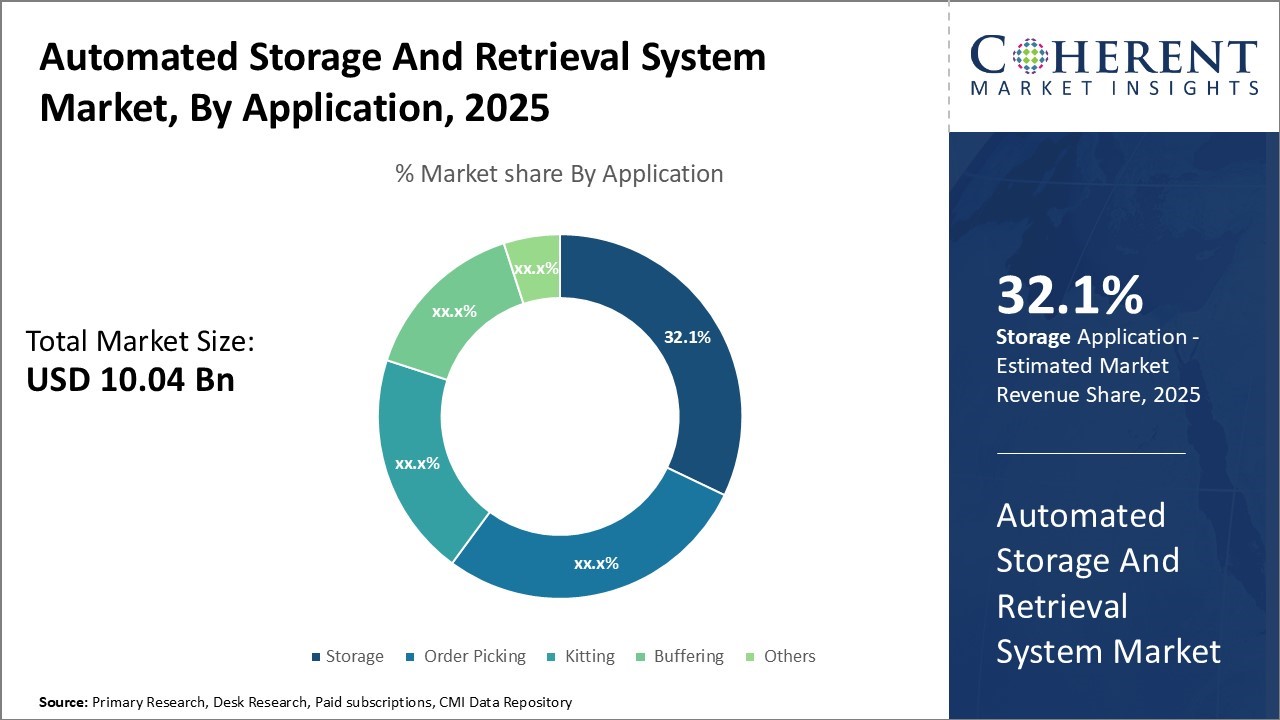
- Based on Application, Storage Segment holds 33.1% market share in 2026. This is due to its critical role in maintaining adequate product inventory levels.
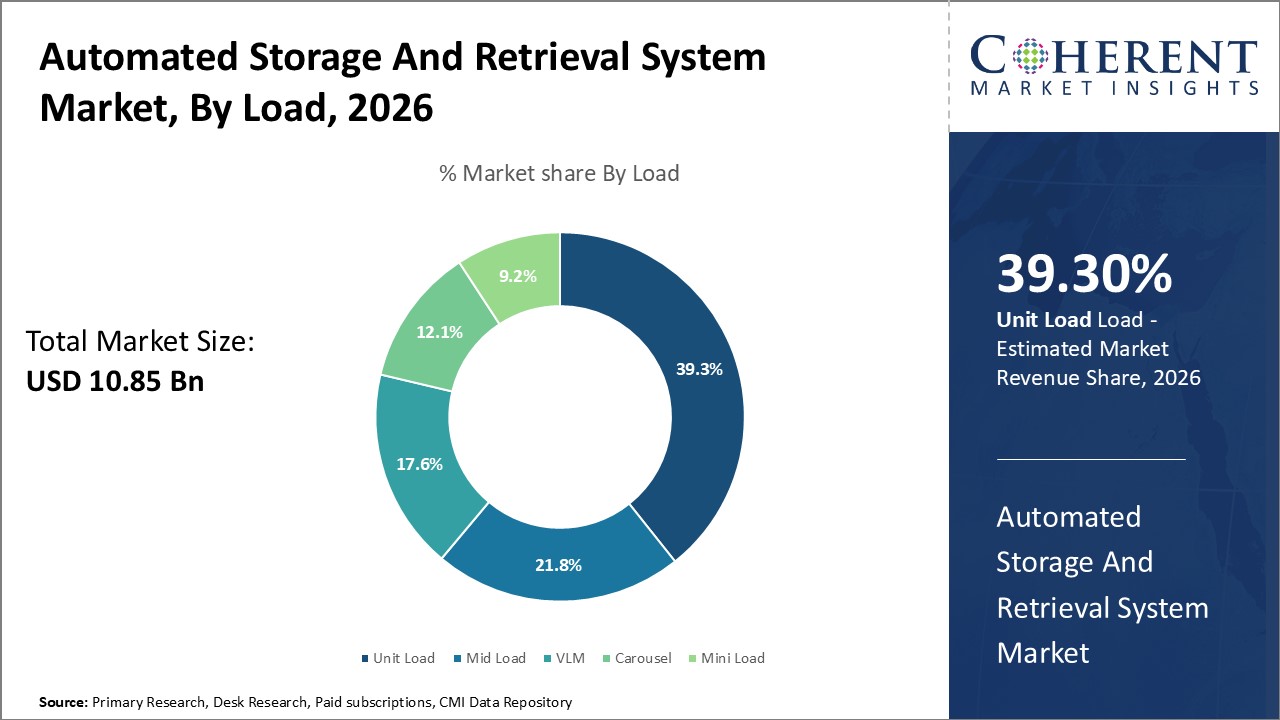
- Based on Load, Unit Load Systems Segment generates the highest revenue of 39.3% in 2026. This is due to their focus on utilizing every inch of space when storing pallets.
- Based on End Use, General Manufacturing and Logistics Segment holds 24.9% market share in 2026. This is due to significant warehousing activity.
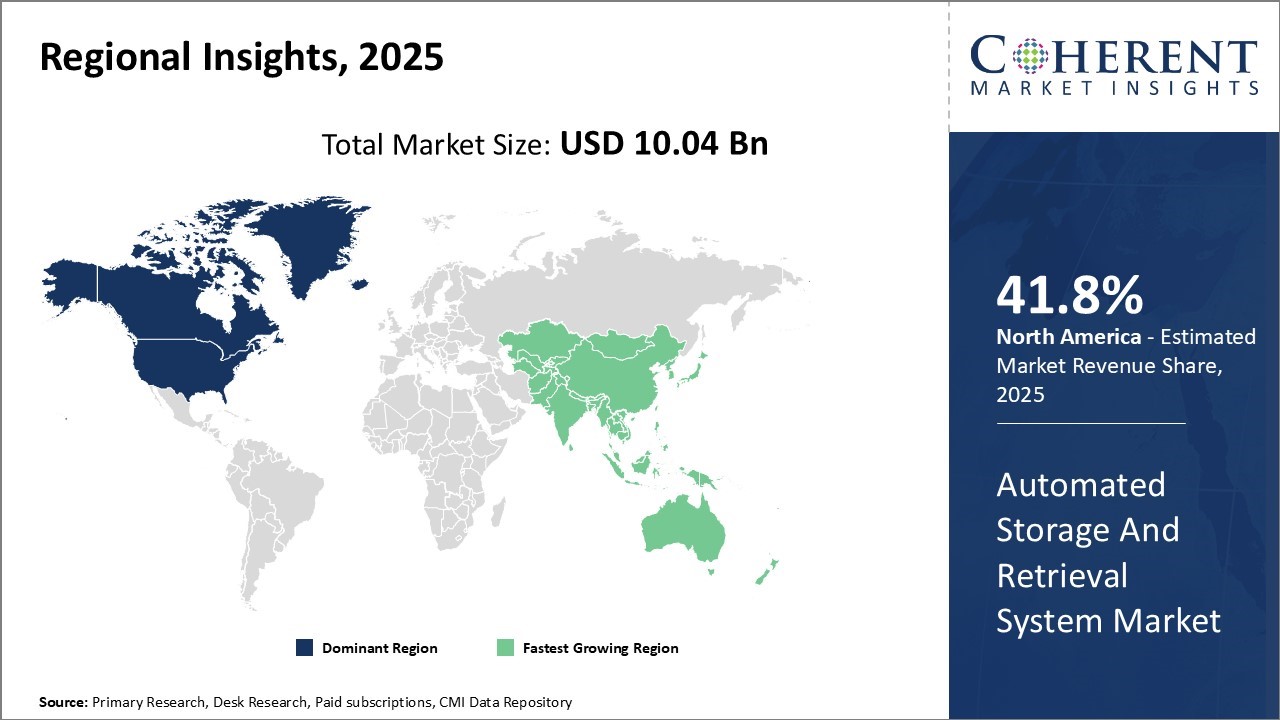
- North America region dominates the global automated storage and retrieval system market with 41.8% market share in 2026. This is due to strong presence of major players across various end-use industries.
Market Overview
The advent of Industry 4.0 and the increasing focus on warehouse robotics are expected to drive the demand for AS/RS. Other factors such as growth in the e-commerce industry and demand for faster delivery of goods are also contributing to the growth of the automated storage and retrieval system market. Increasing labor costs are also prompting industries to invest in automated warehousing equipment for improved operational efficiency. Advancements in robotics and integration of automated guided vehicles with AS/RS are expected to provide growth opportunities during the forecast period.
Current Events and Its Impact on Automated Storage and Retrieval System Market
Current Events | Description and its impact |
GreenBox Systems to develop automated warehouse in Georgia |
|
Instock Inc. Unveils Modular AS/RS System Supported by Amazon
|
|
Pricing Analysis
The cost structure of Automated Storage and Retrieval Systems (AS/RS) is highly differentiated depending on system category, complexity, load handling, and degree of automation. AS/RS solutions may vary from simple vertical lift modules (VLMs) and horizontal carousels, which cost between $50,000 and $200,000, to high-end unit-load systems and crane-based systems that may cost over $1 million, depending on whether they are integrated with warehouse management software (WMS) and robotic subsystems.
Critical cost drivers are customization needs, storage capacity, and complexity of integration with current warehouse operations. High-throughput industries like e-commerce, automotive, and pharmaceutical tend to need high-speed, scalable solutions that drive up installation costs. Site preparation, maintenance, and training also contribute to the overall cost of ownership.
Geographically, Western Europe and North America face higher prices as a result of higher labor costs and demand for high-end technologies, whereas Asia-Pacific economies, especially India and China, are witnessing increasing adoption of cost-efficient AS/RS solutions promoted by increasing industrial automation.
Although the initial investment is high, the long-term ROI from AS/RS is positive because of considerable return in terms of space utilization, lower labor costs, and better inventory accuracy. The decreasing cost of robotics, sensors, and software is increasingly positioning AS/RS within the reach of medium-sized businesses. Competitive pressures and advances in modular and standardized systems during the forecast period are likely to further rationalize pricing and accelerate adoption across a wide range of industry verticals.
- Current Industry Events of 2026
- Market Size Estimation
- Regional Breakdown
- Competitive Landscape
- Customer Intelligence
- Segmental Analysis
- Pricing Analysis
- Key Market Drivers, Challenges & Future Trends
- Customized Insights Section
The Role of Technology Development in the Automated Storage and Retrieval System (AS/RS) Market
Technology development is central to propelling the evolution and expansion of the Automated Storage and Retrieval System (AS/RS) market. Advances in robotics, artificial intelligence (AI), machine learning (ML), and the Internet of Things (IoT) are greatly improving the AS/RS solution's functionality, accuracy, and productivity.
Current AS/RS systems become more and more integrated with intelligent sensors, vision systems, and real-time data analysis, which facilitate predictive maintenance, quicker item retrieval, and enhanced inventory control. These intelligent systems are able to self-optimize themselves depending on demand patterns, reducing downtime and power consumption. The integration of AS/RS with Warehouse Management Systems (WMS) and Enterprise Resource Planning (ERP) platforms facilitates smooth coordination among warehouse operations and wider supply chain operations.
Technological innovations in robotics and automation, including the creation of high-speed, light-weight shuttles and picking robots, have increased the range of items and order profiles that can be managed by AS/RS. Additionally, the compatibility of Automated Guided Vehicles (AGVs) and Autonomous Mobile Robots (AMRs) with AS/RS is transforming intralogistics by allowing dynamic and expandable warehouse planning.
Edge computing and cloud-based automated storage and retrieval systems solutions are also more cost-effective as well as flexible, particularly for medium and small-sized businesses. Technology is, therefore, not only enhancing operational efficiency but also increasing access to markets.
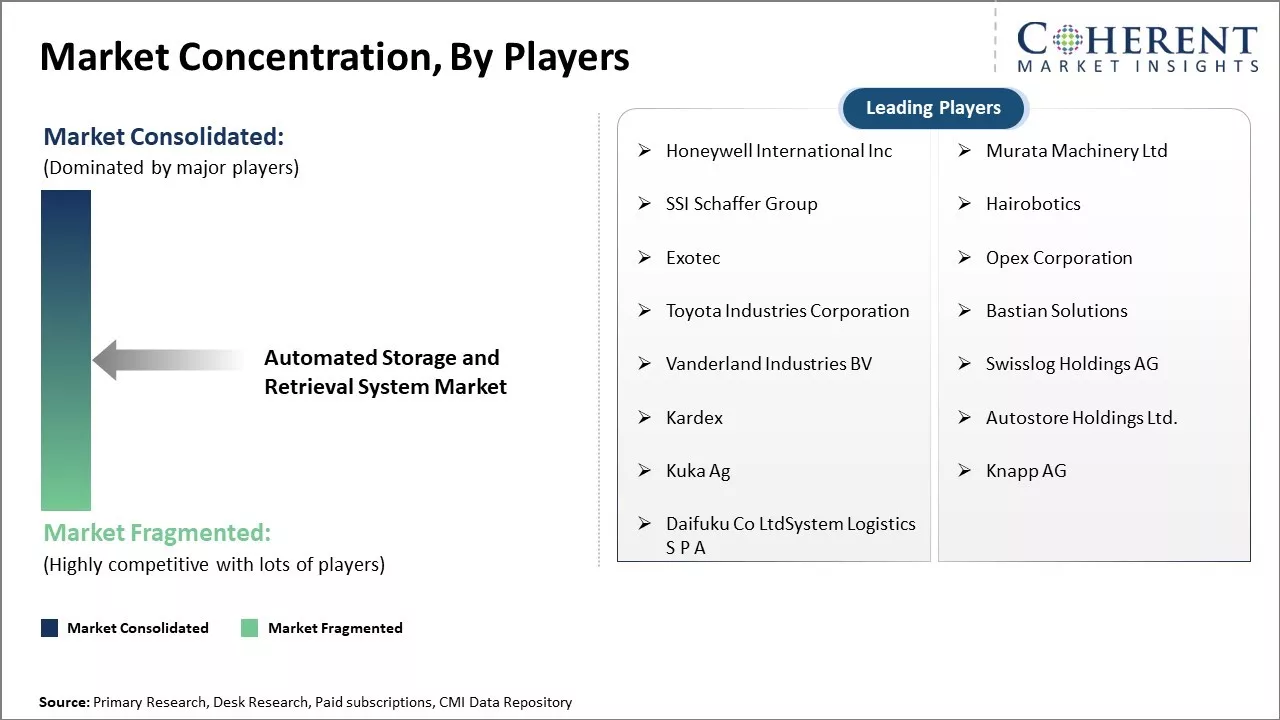
Market Concentration and Competitive Landscape
Market Driver
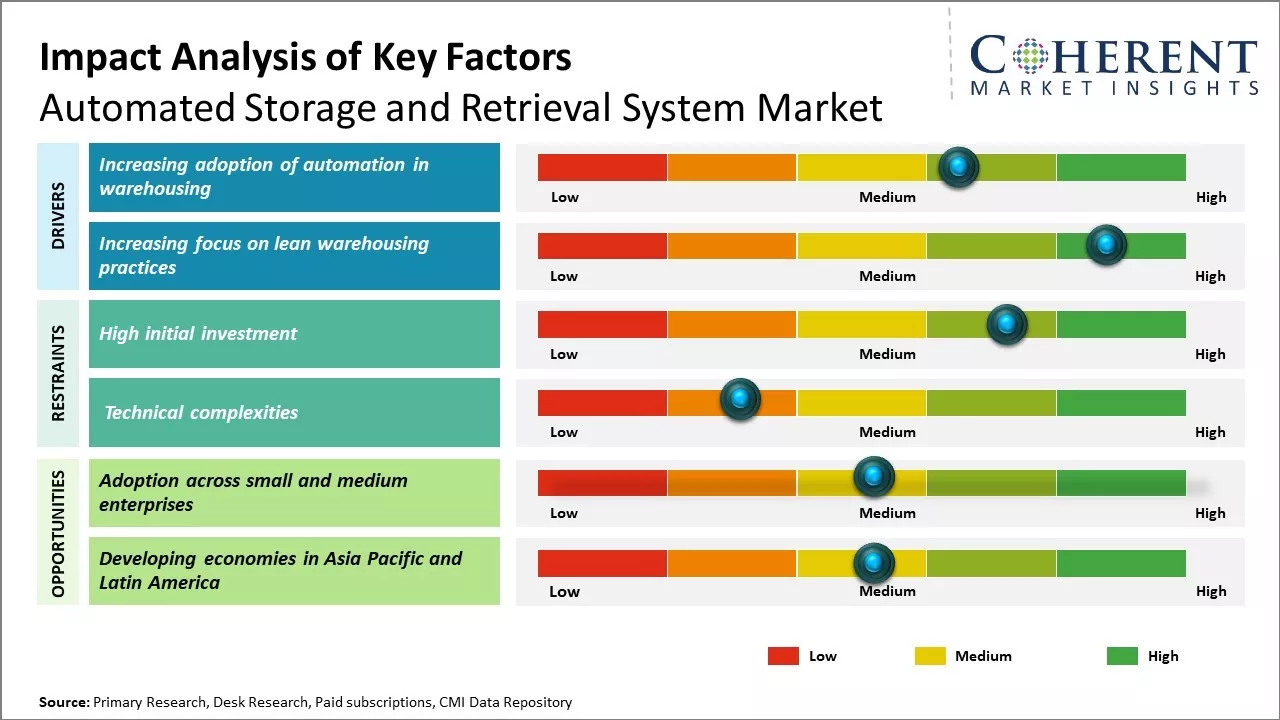
- Increasing adoption of automation in warehousing
With the rise of e-commerce and online shopping, warehousing operations have become more complex than ever. Companies are dealing with increasing order volumes, dynamic inventory needs, and competitive pressures of delivering items to customers faster. In this environment, relying only on manual labor is no longer a viable option.
Vertical lift automated storage and retrieval systems offer a solution to improve efficiency and optimize operations. The fixed routing and guided vehicle transport of AS/RS combined with tote-based storage and picking allows companies to store and retrieve high volumes of items much faster than traditional shelving handled by forklifts and workers.
In 2025, Ocado Group, a leading UK online grocery retailer, expanded its highly automated warehouse in Andover by integrating advanced Automated Storage and Retrieval Systems (AS/RS) combined with autonomous mobile robots (AMRs). The system uses tote-based storage with robotic shuttles that navigate fixed routes to quickly pick and transport items, enabling the facility to handle a surge in order volumes driven by rising e-commerce demand.
Rather than expand building footprints, companies can upgrade to AS/RS to boost throughput without adding new square footage. For companies operating multiple distribution centers, a centralized warehouse managed by AS/RS allows better load balancing across locations. Automated solutions also help alleviate labor shortages, which many industries now face.
With fewer workers needed to handle same or higher throughputs, AS/RS reduce dependency on finding and retaining human workers. While upfront costs are higher versus traditional shelving, AS/RS prove their value through higher productivity, reduced labor costs and ability to scale up or down operations through software control. As logistics networks grow more complex globally, AS/RS will continue gaining popularity for their power to rationalize inventory storage and handling sample copy.
- Increasing focus on lean warehousing practices
As corporations and Third-party Logistics operators strive for maximal efficiency within their logistics networks, implementing lean practices has become indispensable. Techniques from Toyota Production System is a unique manufacturing system developed by Toyota Motor Corporation. such as just-in-time manufacturing, continuous flow processes, single-piece flow, and pull systems are now equally relevant to warehousing operations.
Companies realize tremendous benefits organizing materials and information flow to minimize waste of space, time, money, and resources throughout their distribution centers. One critical lean initiative involves creating space by consolidating and reorganizing inventory into designated locations.
Traditional shelving storage with haphazard positioning of fast and slow-moving products prevents this consolidation. On the other hand, AS/RS utilize every cubic inch of wall-to-wall and floor-to-ceiling spaces for dense and organized product storage.
Market Opportunities: Adoption across small and medium enterprises
With the growing e-commerce industry and demand for faster order processing, automated solutions provide means to achieve unprecedented efficiency. They allow 24/7 operations, minimizing seasonal fluctuations. Such systems also address current issues of labor shortages and help improve workplace safety. With technological advancements reducing costs, payback periods are getting shorter. This will drive wider adoption across industries aimed at optimization.
Segmental Insights
Automated Storage and Retrieval System Market Insights, By Application
Within the application segment of the automated storage and retrieval system market owing 33.1% in 2026, storage accounts for the largest share due to its critical role in maintaining adequate product inventory levels. Storage systems allow companies to maximize the use of existing warehouse space which has become increasingly important as supply chain networks grow in complexity.
By automating storage processes, more products can be housed in the same physical footprint which boosts inventory capacity. This enables companies to store greater volumes and varieties of stock on site to meet unpredictable changes in demand. Storage systems also improve picking rates by consolidating products from across the warehouse onto discrete racks. This compaction of inventory streamlines the order fulfilment process and shortens processing times.
The ability of storage systems to optimize space utilization while maintaining high product availability is invaluable for industries like consumer goods retail where uptime is paramount. These systems ensure warehouses never run out of fast-moving items by keeping replenishment cycles tightly aligned with demand patterns.
Their dynamic storage capabilities let companies store product overflow or unexpected shipment volumes without disrupting operations. This flexibility protects revenue by fulfilling orders reliably during seasonal peaks or unexpected windfalls. Storage systems are therefore a mainstream application that raises inventory turns, satisfies customer expectations, and futureproofs warehouses against fluctuations in the marketplace.
Automated Storage and Retrieval System Market Insights, By Load
Within the load segment, unit load systems generate the highest revenue owing 39.3% in 2026 due to their focus on utilizing every inch of space when storing pallets. These systems are well suited to industries that depend on palletized transport and outbound shipments like general manufacturing, construction materials, and chemicals/bulk goods.
Unit load racks can layer pallets deeply from floor to ceiling which is crucial for operations handling large volumes on pallets. Their dense storage cells minimize empty voids between loads to squeeze extra pallets into a given floor area. This optimizes space and pallet throughput within the four walls of the warehouse.
For manufacturers reliant on outbound pallet shipments, maximizing pallet storage density directly improves transportation efficiencies. Unit load systems consolidate more pallets onto fewer truck trailers and shipping containers to reduce loadouts. They help manufacturers deliver more product per load to customers scattered across wide geographies. Fewer partly full trucks on the road in turn curtails carbon emissions and transport costs.
Furthermore, unit loads enable rapid pallet retrievals through their organized, multi-tiered storage formation. Speedy order processing and loading is a huge competitive edge for manufacturers supplying retail partners or project sites with tight delivery windows. Fast throughput maintains high service levels that lock in customer relationships. Overall, unit loads are unparalleled for pallet-centric operations needing to store the maximum number of pallets indoors.
Automated Storage and Retrieval System Market Insights, By End Use
Within the end use segment, general manufacturing as well as retail and logistics claim the biggest slices owing 24.9% market share in 2026 due to significant warehousing activity. For these sectors, maximizing worker productivity through automation is paramount. Automated systems like shuttle-based solutions are perfectly suited as they consolidate inventory from across vast warehouses, accelerating order picking.
Their sophisticated routing guidance directs pickers swiftly to needed locations while optimizing travel paths to boost productivity 2-3x. Similarly for retail distribution centers, these systems streamline order sorting by sequencing shipments efficiently for loading onto delivery trucks. This shaves hours off labor-intensive sorting processes each day.
Greater worker productivity translates directly to higher throughput and order volumes for manufacturing plants. It allows them to fulfill rising customer demands from existing warehouses before considering costlier expansion projects. For retailers and 3PLs, accelerated order processing supports ambitious one or two-day delivery promises. Time savings from automation can be reallocated to extra delivery runs each day, enhancing customer service and retention.
Overall, general manufacturing and logistics rely on optimizing people, processes and tools to continuously improve operational efficiencies. Automated systems address this pressing need by turbocharging workflows in storage, order picking, sorting and more. No other technology boosts productivity and capacity like these systems.
Automated Storage and Retrieval System Market - Regional Insights
North America Automated Storage and Retrieval System Market Analysis and trends
North America region currently dominates the global automated storage and retrieval system market. This region accounts for over 41.8% in 2026 of the total market share due to strong presence of major players across various end-use industries. The U.S. alone contributes to more than 70.5% of the regional market owing to high demand from industries such as e-commerce, automotive, food & beverage etc.
These industries are undergoing rapid modernization to enhance operational efficiency. This has led to significant adoption of AS/RS across different facilities to handle large inventory and fulfill material movement needs.
Besides strong infrastructure to support manufacturing sector, the region also emphasizes on technological innovation. North American players are investing heavily in research activities to develop advanced AS/RS solutions tailored as per needs of specific applications.
Many new startups are also entering the market with focus on Industry 4.0 technologies like Internet of Things (IoT), big data, 3D printing, etc. This has fueled the development of smart automated warehouses. Rising demand for smaller inventory sizes combined with highly fluctuating order profiles is encouraging industries to integrate AS/RS for better space utilization. International trade between Mexico and the U.S. also contributes significantly to regional market growth.
Asia Pacific Automated Storage and Retrieval System Market Analysis and trends
Asia Pacific is considered as one of the fastest growing markets for automated storage and retrieval systems globally. The growth can be attributed to rapid industrialization and expansion of warehousing facilities across Southeast Asian countries like China, India, and Japan to accommodate growing import-export activities. As a major trade partner for North America and Europe, Asia Pacific is emerging as a production powerhouse catering to global supply chains. Different economic policies adopted by governments to boost "Make in India" and "China Manufacturing 2026" initiatives have created immense potential for material handling equipment market like AS/RS in the region.
Countries in Asia Pacific also display price sensitivity compared to their European or American counterparts. This has fueled local manufacturing of affordable AS/RS and emergence of new regional players. Ongoing trade wars have further accelerated the regional transition towards self-reliance in terms of production. Major industries spearheading adoption of AS/RS include electronics, automotive, consumer goods, pharmaceuticals among others. Rapid urbanization is also catalyzing growth of e-commerce sector which extensively leverages automated warehouses for superior order management.
United States Automated Storage and Retrieval System Market and Analysis
The U.S. is a significant leader in the AS/RS market, fueled by the strong presence of advanced manufacturing, presence of large e-commerce companies such as Amazon, and extensive use of warehouse automation. Enhanced labor costs and a need for effective fulfillment operations drive ongoing investment in advanced AS/RS solutions.
Germany Automated Storage and Retrieval System Market and Analysis
Germany dominates the AS/RS industry in Europe, due to its technologically developed industrial base, mainly in the automotive and engineering industries. It hosts world automation leaders and is supported by the strong government backing of Industry 4.0, providing a focus for intelligent warehouse technology.
Japan Automated Storage and Retrieval System Market and Analysis
Japan has always been a leader in automation and robotics, and this goes to its warehousing and logistics industries as well. Japanese companies utilize small and precise AS/RS solutions to make the most out of limited space and deliver high efficiency levels, especially in electronics and automotive manufacturing sectors.
China Automated Storage and Retrieval System Market and Analysis
China is quickly becoming an important AS/RS market with its booming e-commerce growth, increasing labor costs, and government policies encouraging smart manufacturing. Local and foreign players are increasing their footprint, and it has become one of the fastest-growing markets in the world.
South Korea Automated Storage and Retrieval System Market and Analysis
South Korea is a technologically developed market with high demand for high-speed, compact AS/RS systems, particularly in electronics, retail, and pharmaceuticals. A strong infrastructure and focus on digital innovation also make it a pioneer in warehouse automation in Asia.
Market Report Scope
Automated Storage and Retrieval System Market Report Coverage
| Report Coverage | Details | ||
|---|---|---|---|
| Base Year: | 2025 | Market Size in 2026: | USD 10.85 Bn |
| Historical Data for: | 2020 To 2024 | Forecast Period: | 2026 To 2033 |
| Forecast Period 2026 to 2033 CAGR: | 8.1% | 2033 Value Projection: | USD 18.72 Bn |
| Geographies covered: |
| ||
| Segments covered: |
| ||
| Companies covered: | Honeywell International Inc, Murata Machinery Ltd, SSI Schaffer Group, Hairobotics, Exotec, Opex Corporation, Toyota Industries Corporation, Bastian Solutions, Vanderland Industries BV, Swisslog Holdings AG, Kardex, Autostore Holdings Ltd., Kuka Ag, Knapp AG, and Daifuku Co LtdSystem Logistics S P A | ||
| Growth Drivers: |
| ||
| Restraints & Challenges: |
| ||
Automated Storage and Retrieval System Industry News
- In May 2024, ABB launched its OmniVance FlexBuffer fully automated AS/RS robotic system at its instrumentation factory in Ossuccio, Italy. The new system improved logistics efficiency by 90% and reduced package assembly time by 30%, showing dramatic operational benefits from the integration of AS/RS into manufacturing processes.
- In July 2024, Rapyuta Robotics, based in Japan, introduced its AI-powered AS/RS solution into the U.S. market. The platform features multi-agent coordination algorithms and modular architecture that optimizes picking velocity and stock management along with quick scalability.
Analyst View
- The automated storage and retrieval system (AS/RS) industry showcases strong growth fueled by the fast-paced digitalization in manufacturing and warehousing industries. E-commerce growth continues to be the key driver, as organizations look for effective solutions to manage growing order volumes and minimize fulfillment times. Developed economies' lack of labor further magnifies demand for automated systems, with organizations being forced to invest in technology-centric warehouse operations.
- Supply chain disruptions have underscored the paramount importance of having robust, automated stock management systems, making AS/RS a vital pillar for contemporary logistics. Interfacing artificial intelligence and machine learning functions for advanced system efficiency, predictive maintenance, and optimized inventory positioning makes AS/RS an even more indispensable integral component of logistics.
- But immense capital investment needs represent major hindrances, especially for small and medium companies in search of automation systems. Technical sophistication and integration issues with current warehouse management systems provide other implementation roadblocks that can diminish adoption levels.
- Market activity is led by the Asia-Pacific area, driven by accelerating industrialization, widening bases of manufacturing, and rising e-commerce penetration in emerging economies. Regional growth is led by China and India, backed by the industrial automation and smart manufacturing-favoring initiatives of governments.
Market Segmentation
- Application Insights (Revenue, USD Bn, 2021 - 2033)
- Storage
- Order Picking
- Kitting
- Buffering
- Others
- Load Insights (Revenue, USD Bn, 2021 - 2033)
- Unit Load
- Mid Load
- VLM
- Carousel
- Mini Load
- End Use Insights (Revenue, USD Bn, 2021 - 2033)
- Automotive
- Semiconductor and Electronics
- General Manufacturing
- Retail and Warehousing Logistics
- Aviation
- Chemicals
- Rubber and Plastics
- Healthcare
- Food and Beverage
- Regional Insights (Revenue, USD Bn, 2021 - 2033)
- North America
- U.S.
- Canada
- Latin America
- Brazil
- Argentina
- Mexico
- Rest of Latin America
- Europe
- Germany
- U.K.
- France
- Italy
- Russia
- Rest of Europe
- Asia Pacific
- China
- India
- Japan
- Australia
- South Korea
- ASEAN
- Rest of Asia Pacific
- Middle East & Africa
- GCC Countries
- South Africa
- Rest of Middle East & Africa
- Key Players Insights
- Honeywell International Inc.
- Murata Machinery Ltd.
- SSI Schaffer Group
- Hairobotics
- Exotec
- Opex Corporation
- Toyota Industries Corporation
- Bastian Solutions
- Vanderland Industries BV
- Swisslog Holdings AG
- Kardex
- Autostore Holdings Ltd.
- Kuka Ag
- Knapp AG
- Daifuku Co LtdSystem Logistics S P A
Sources
Primary Research Interviews
- Data Center Managers and IT Directors
- Storage System Integrators and Solution Providers
- Cloud Service Providers and Storage Vendors
- Enterprise IT Procurement Managers
- Others
Databases
- IDC Storage Tracker Database
- Gartner Magic Quadrant Database
- Bloomberg Terminal Database
- Others
Magazines
- Storage Magazine
- Data Center Knowledge
- Information Week
- Enterprise Storage Forum
- Others
Journals
- IEEE Transactions on Computers
- Journal of Network and Computer Applications
- ACM Transactions on Storage
- Others
Newspapers
- The Wall Street Journal
- Financial Times
- Reuters Technology News
- TechCrunch
- Others
Associations
- Storage Networking Industry Association (SNIA)
- Data Management Association International (DAMA)
- Information Storage and Management Association
- Cloud Storage Alliance
- Others
Public Domain Sources
- SEC Filings (10 K, 10 Q reports)
- Company Annual Reports and Investor Presentations
- Government Technology Procurement Reports
- Industry White Papers and Research Publications
- Others
Proprietary Elements
- CMI Data Analytics Tool
- Proprietary CMI Existing Repository of information for last 8 years
Get access to 250+ pages report
Every segment, forecast, competitor profile and data table behind the analysis above — available for instant download.
- ESOMAR Member
- ISO 9001:2015 Certified
- D-U-N-S Registered
- GDPR & CCPA Compliant
Missing comfort of reading report in your local language? Find your preferred language:
Transform your Strategy with Exclusive Trending Reports
Frequently Asked Questions
The Automated Storage and Retrieval System Market size is estimated to be valued at USD 10.85 Bn in 2026, and is expected to reach USD 18.72 Bn by 2033.
The CAGR of the Automated Storage and Retrieval System Indsutry is projected to be 8.1% from 2026 to 2033.
The primary types of research antibodies are monoclonal, which are identical antibodies targeting a single epitope; polyclonal, which are a mixture of antibodies recognizing multiple epitopes on the same antigen; and recombinant antibodies, which are engineered for high specificity and consistency using DNA technology.
Criteria for selecting a host animal include the species’ immune response capability, ease of antibody production, compatibility with the antigen, and the purpose of the antibody, with common hosts being mice, rabbits, goats, and llamas
Increasing adoption of automation in warehousing and increasing focus on lean warehousing practices are the major factors driving the growth of the automated storage and retrieval system industry.
High initial investment and technical complexities are the major factors hampering the growth of the global market.
In terms of application, storage is estimated to dominate the market revenue share in 2026.