

Global Trans Resveratrol Market Size and Forecast – 2026 To 2033
The Global Trans Resveratrol Market is estimated to be valued at USD 296.7 Mn in 2026 and is expected to reach USD 511.8 Mn by 2033, exhibiting a compound annual growth rate (CAGR) of 8.1% from 2026 to 2033. Market growth is supported by the use of trans resveratrol in healthy-aging supplements, functional foods and beverages, antioxidant skincare products, and research-oriented pharmaceutical formulations. Suppliers are also investing in delivery technologies that improve the compound’s solubility, stability, absorption, and application flexibility.
In February 2026, ClinicalTrials.gov updated a Phase 1 randomized study conducted by researchers at Mansoura University evaluating a resveratrol-loaded nanoparticle gel as a localized treatment for Stage III periodontitis. The study demonstrates how advanced delivery systems are extending resveratrol beyond conventional supplements into specialized therapeutic research, creating opportunities for high-purity ingredient manufacturers, formulation developers, and pharmaceutical research suppliers.
Key Takeaways of the Global Trans Resveratrol Market
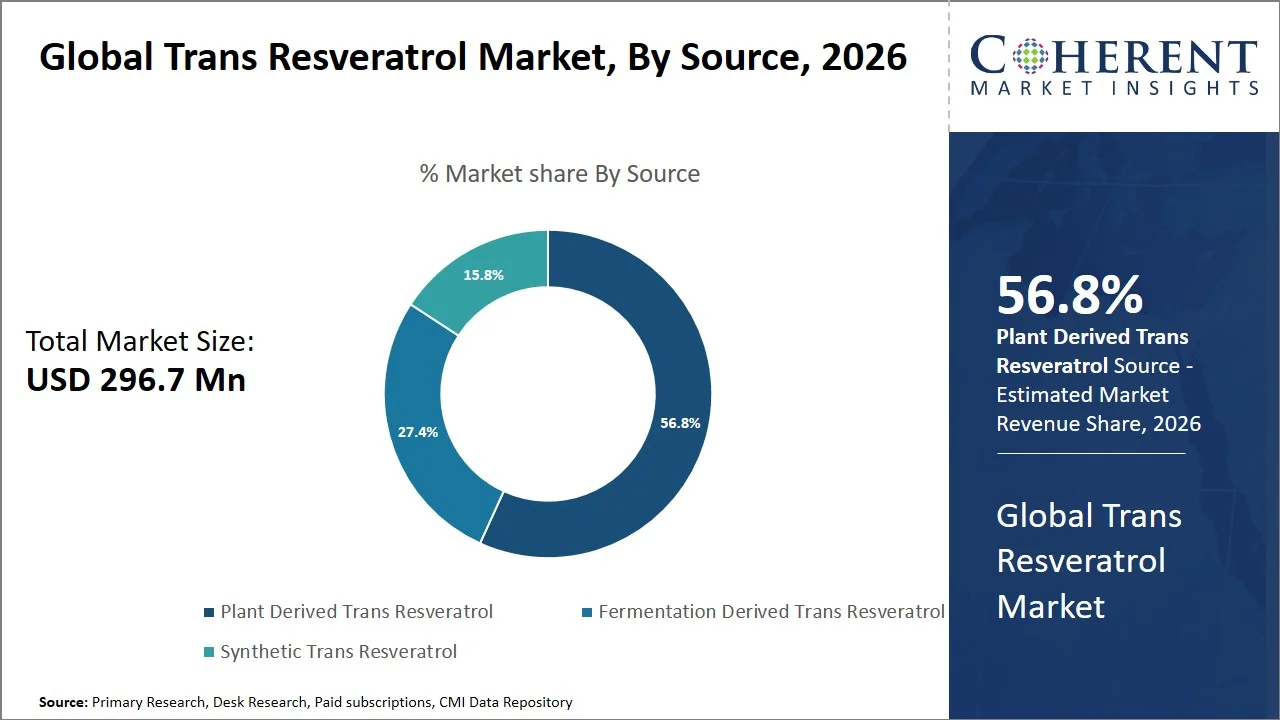
- Plant-derived trans resveratrol is expected to hold 56.8 % of the market share in 2026 because botanical provenance supports clean-label positioning, familiar Japanese knotweed and grape sourcing, and premium supplement narratives. In June 2026, Life Extension listed an NMN formula containing trans-resveratrol sourced from Japanese knotweed root, demonstrating continued commercial integration of botanical resveratrol into healthy-aging products.
- The 98% and above segment is expected to account for 62.6 % of the global trans resveratrol market in 2026, as precise assays, lower impurity exposure, consistent dosing, and certificate-of-analysis requirements matter to supplement, pharmaceutical, and cosmetic formulators. In August 2024, NOW Foods reported independent HPLC and HPTLC testing in which most sampled resveratrol extracts exceeded 98% purity, reinforcing verification as a purchasing criterion.
- Powder is expected to capture 68.4 % of the market share in 2026 because it fits capsule filling, tableting, dry blending, bulk shipment, inventory control, and flexible dose development better than liquid formats. In January 2024, EUR-Lex published a consolidated Union novel-food list defining microbial trans-resveratrol as an off-white to slight-yellow powder, illustrating how standardized powder specifications support regulatory documentation and industrial handling.
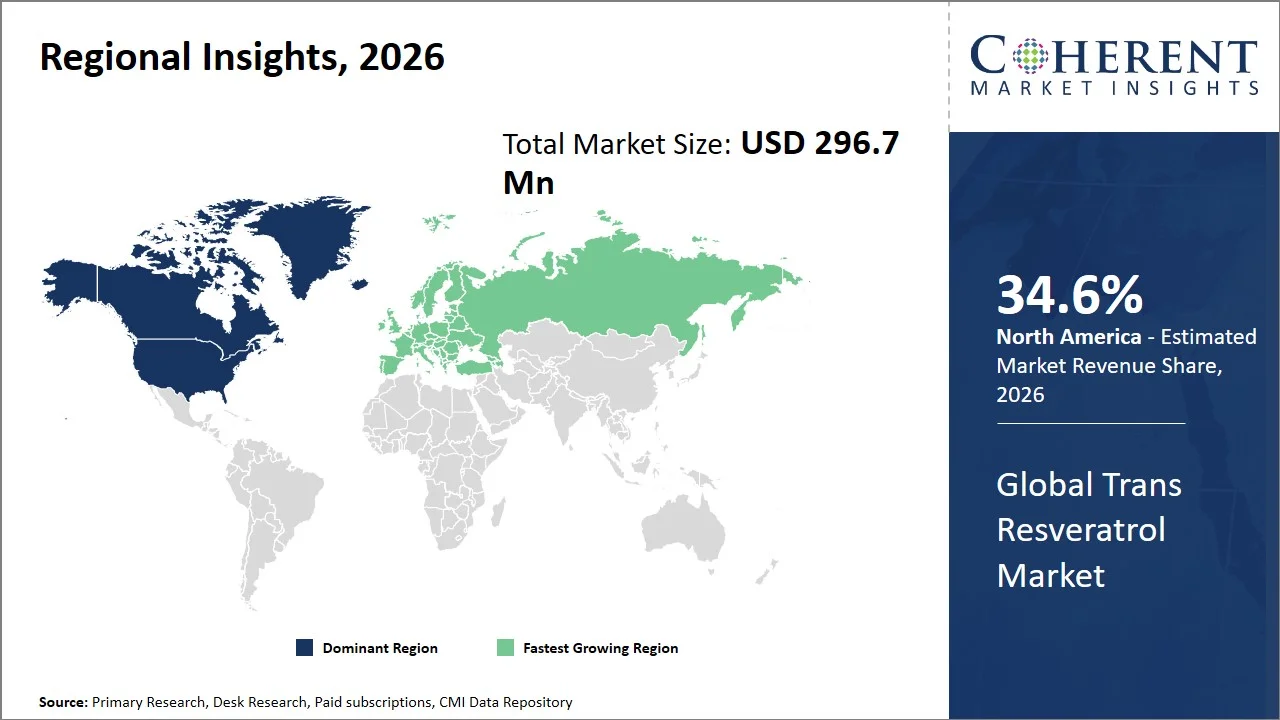
- North America is expected to account for 34.6 % of the global trans resveratrol market in 2026, supported by established dietary-supplement channels, contract manufacturing capacity, ingredient testing, and consumers accustomed to premium longevity formulations. In August 2024, Health Canada issued a formal resveratrol assessment for supplemented foods, highlighting the region’s structured safety review and compliance requirements for commercial product development.
- Europe is expected to represent 29.8 % of the market share in 2026 and remain the fastest-growing region as novel-food frameworks, preventive-health research, premium nutraceutical demand, and university-industry translation widen credible applications. In November 2024, the NIHR Leicester Biomedical Research Centre announced that purified resveratrol would be evaluated within the Cancer Research UK-funded COLO-PREVENT trial led from the University of Leicester.
- Bioavailability-led formulation innovation to strengthen product differentiation and premium market positioning: Resveratrol suppliers are shifting competition from ingredient availability toward delivery performance. Microencapsulation, lipid carriers, hydrogel matrices, micronization, and sustained-release systems can improve formulation stability and absorption positioning while enabling differentiated finished products. Companies that pair trans-isomer purity with credible delivery evidence may secure stronger brand partnerships, defend premium pricing, and reduce the risk that customers treat resveratrol as an interchangeable commodity.
- End-to-end traceability and quality documentation emerging as key supplier differentiators: Buyers are placing greater emphasis on botanical identity, manufacturing route, contaminant control, assay consistency, and documentation that follows each batch. This changes supplier selection from price-led procurement to qualification-led partnerships. Producers with transparent sourcing, validated analytical methods, and dependable certificates of analysis can shorten customer approval cycles, strengthen regulatory readiness, and gain preferred-supplier status across supplements, cosmetics, functional foods, and research applications.
Segmental Insights
Why Does Plant Derived Trans Resveratrol Dominate the Global Trans Resveratrol Market?
Plant derived trans resveratrol is expected to account for 56.8% of the global trans resveratrol market in 2026. Its dominance reflects buyers’ preference for recognizable botanical inputs, particularly grape derivatives and Japanese knotweed, which support natural-origin positioning across dietary supplements, functional nutrition, and premium personal care. Established extraction expertise, scalable feedstocks, and opportunities to recover stilbenes from processing residues strengthen supply economics. Manufacturers can further differentiate through solvent controls, emodin management, traceability, and standardized trans-isomer content. In May 2026, researchers affiliated with Université Lyon 1 and CNRS published a review examining sustainable methods for extracting and purifying trans-resveratrol from grape pomace. The study identified winemaking residue as a promising feedstock for producing resveratrol-rich fractions and purified compounds suitable for food, nutraceutical, pharmaceutical, and sustainable bioproduct applications. The findings reinforce the commercial potential of combining botanical sourcing with waste valorization and resource-efficient recovery methods.
- Current Industry Events of 2026
- Market Size Estimation
- Regional Breakdown
- Competitive Landscape
- Customer Intelligence
- Segmental Analysis
- Pricing Analysis
- Key Market Drivers, Challenges & Future Trends
- Customized Insights Section
Why Does 98% and Above Represent the Largest Purity Segment in the Global Trans Resveratrol Market?
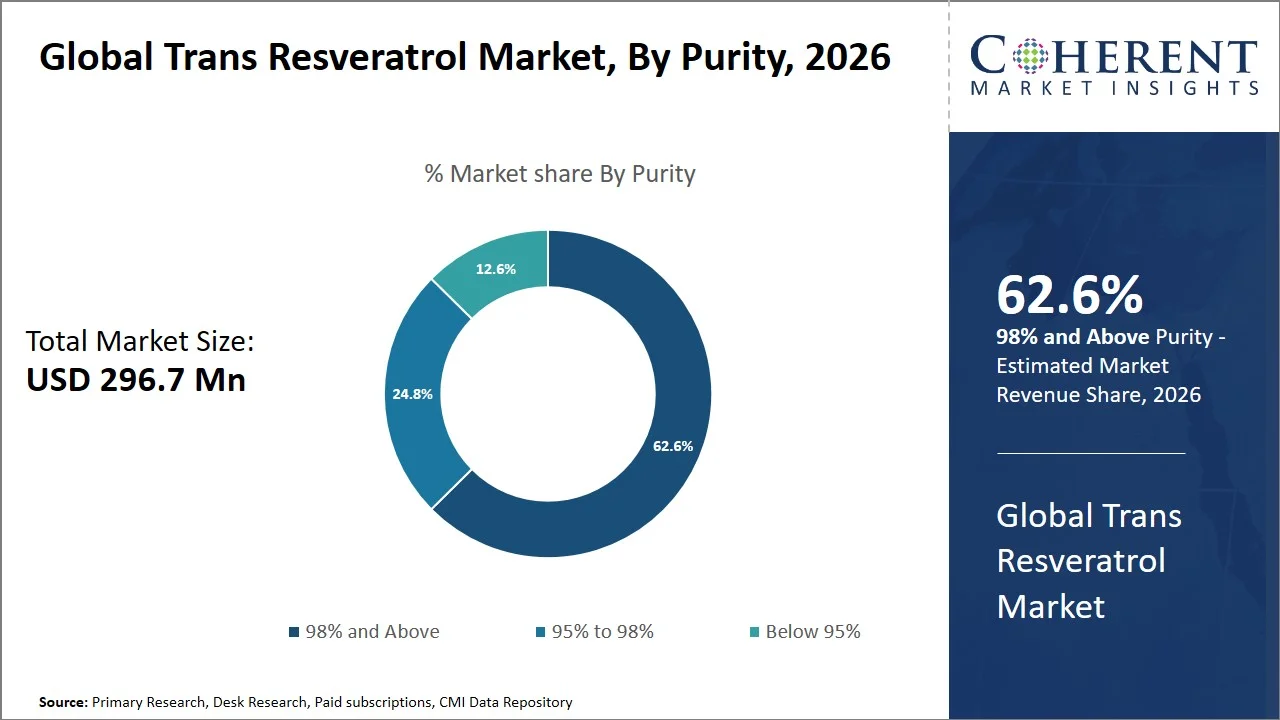
The 98% and above segment is expected to represent 62.6% of the global trans resveratrol market in 2026. High assay levels enable accurate dosing, reduce variability from cis-resveratrol and unrelated constituents, and simplify formulation calculations for clinical nutrition, premium supplements, research products, and advanced cosmetics. Procurement teams also favor grades supported by validated chromatography, impurity limits, stability records, and batch-specific certificates of analysis. These requirements give qualified producers stronger pricing resilience and create entry barriers for loosely standardized extracts. In July 2026, Frontiers in Nutrition published a randomized, placebo-controlled human study that administered capsules containing 250 mg of more than 98% pure synthetic trans-resveratrol. The use of a tightly specified ingredient in controlled research illustrates why high-purity material remains preferred where reproducibility and analytical accountability are essential. Manufacturers investing in robust quality systems can therefore serve both branded consumer products and evidence-oriented development programs.
Why Does Powder Dominate the Form Segment of the Global Trans Resveratrol Market?
Powder is expected to hold 68.4% of the global trans resveratrol market in 2026 because it aligns with established ingredient-handling and finished-dose manufacturing systems. Dry material supports economical bulk transportation, longer inventory management, precise weighing, capsule filling, tableting, premix production, and flexible incorporation into sachets or functional blends. Compared with liquids, powder also reduces packaging weight and leakage risk while allowing formulators to select excipients or delivery technologies at the application stage. In August 2024, U.S. patent application US20240261412A1 was published for a nutraceutical composition that included a trans-resveratrol powder formulation evaluated through a randomized crossover bioavailability design. The filing demonstrates continued technical investment in converting hydrophobic trans-resveratrol into commercially usable dry delivery systems. Powder suppliers that optimize particle size, dispersibility, light protection, and moisture control can address mainstream supplement manufacturing while supporting higher-value bioavailability-enhanced products.
Current Events and their Impact
Current Event | Description and Its Impact |
U.S. FDA Resveratrol Labeling Enforcement – September 2025 |
|
Australian Pure Resveratrol Medicine Listing – February 2024 |
|
Brazilian Supplement Regularization Guidance Updated – January 2025 |
|
Global Trans Resveratrol Market Dynamics
Key Market Drivers
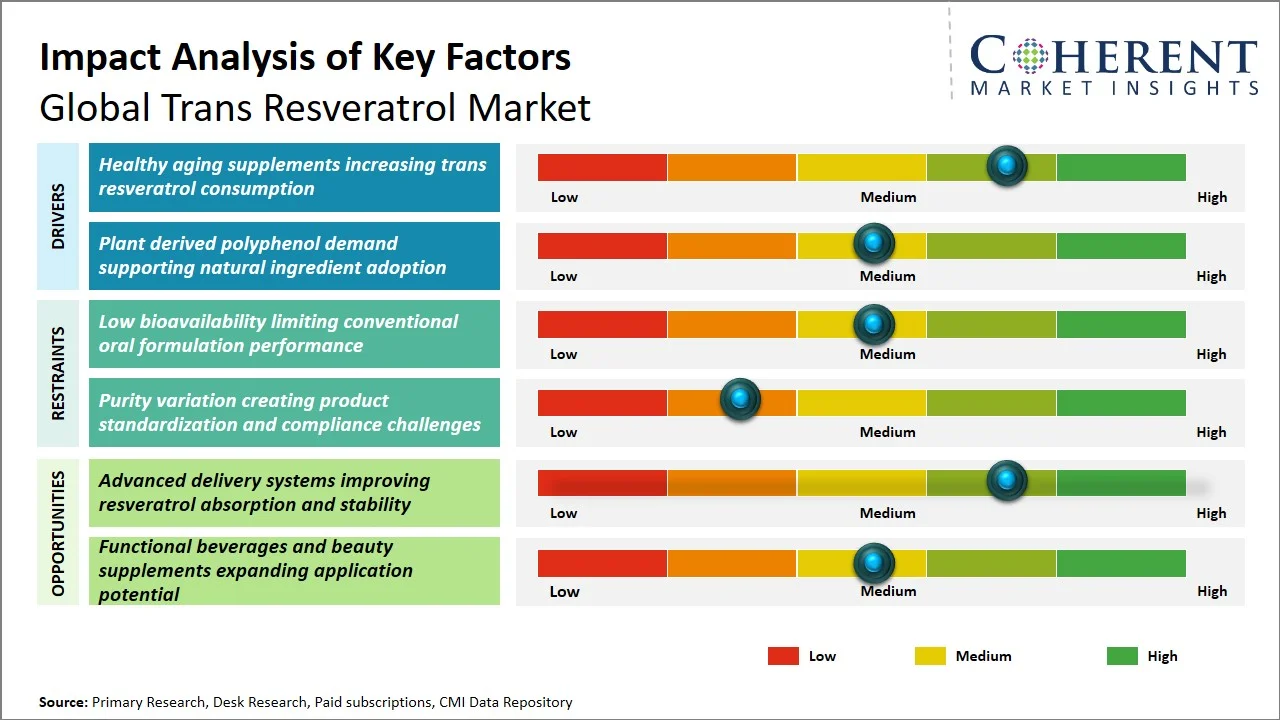
- Healthy-aging protocols are expanding trans resveratrol consumption: Healthy-aging supplementation is expanding trans resveratrol consumption because consumers increasingly build daily regimens around cellular energy, vascular function, metabolic resilience, and age-related performance rather than basic vitamin replacement. This purchasing model favors trans-resveratrol within coordinated formulations containing NAD+ precursors, mitochondrial cofactors, and complementary polyphenols. Supplement brands, contract manufacturers, high-purity ingredient suppliers, practitioner channels, and direct-to-consumer platforms benefit as customers accept premium pricing for clinically framed, convenient protocols. The commercial effect extends beyond unit demand by encouraging higher assay specifications, combination-product development, subscription sales, and stronger educational support. In May 2026, INSTYTUTUM launched a longevity formula combining liposomal NMN with micronized trans-resveratrol alongside an at-home biological-age test. The bundled offering illustrates how resveratrol is being incorporated into broader healthy-aging systems rather than marketed only as a standalone antioxidant.
- Plant-derived polyphenol positioning is strengthening natural ingredient adoption: Preference for plant-derived polyphenols supports trans resveratrol adoption by aligning ingredient sourcing with botanical identity, recognizable raw materials, and clean-label product architecture. Red grape cells, grape skins, and Japanese knotweed provide brand owners with a clearer natural-origin narrative than purely synthetic alternatives, while vertically integrated cultivation or plant-cell platforms can improve batch consistency and reduce seasonal exposure. Botanical extractors, grape-processing companies, specialist nutraceutical suppliers, beverage formulators, and premium wellness brands are positioned to benefit. The strategic value lies in moving resveratrol from a commodity assay toward a differentiated plant matrix, provenance claim, or application-specific blend. In December 2025, BioHarvest Sciences launched VINIA Blood Flow Hydration in the U.S., using red-grape-cell-derived Piceid resveratrol with naturally sourced electrolytes. The launch demonstrates how plant-based polyphenol platforms can open adjacent functional beverage applications and support value-added consumer positioning.
Emerging Market Trends
- Condition-specific positioning is replacing general antioxidant marketing: Trans resveratrol products are shifting toward targeted benefits such as vascular health, cognitive support, metabolic balance, women’s healthy aging, skin longevity, and exercise recovery. Brands must align dosage, co-ingredients, delivery format, and evidence with specific use cases. Suppliers offering application guidance and targeted technical dossiers will gain influence, while generic capsule products may face pricing pressure and weaker customer retention.
- Compliance localization is reshaping market-entry strategies: Trans resveratrol suppliers increasingly need market-specific evidence, labeling, source documentation, use-limit compliance, and claim support. Regulatory differences across jurisdictions are raising the importance of localized dossiers and experienced distribution partners. Suppliers offering ready-to-file safety, stability, impurity, and traceability records will be better positioned than bulk powder sellers with limited documentation, influencing product launches, route-to-market decisions, and geographic expansion.
Regional Insights
Why Does North America Dominate the Global Trans Resveratrol Market?
North America is expected to command 34.6% of the global trans resveratrol market in 2026 because the region combines mature dietary-supplement retail, premium healthy-aging positioning, contract formulation capacity, and strong clinical-development infrastructure. Brand owners can commercialize resveratrol through pharmacies, mass retailers, practitioner channels, and e-commerce while using documented purity, stability, and delivery performance to differentiate products. Regulatory scrutiny also favors suppliers capable of providing consistent trans-isomer assays, traceability, and manufacturing documentation. The region’s research ecosystem expands the addressable market beyond conventional antioxidant supplements toward specialized bioavailability-enhanced candidates. In May 2026, Florida-based Jupiter Neurosciences announced that enrollment was underway in the Phase 2a RESET study evaluating JOTROL, an investigational trans-resveratrol micellar formulation, at clinical sites in Washington, D.C., Maryland, and Virginia. This activity illustrates North America’s ability to connect ingredient science with higher-value clinical applications.
Why is Europe Emerging as the Fastest-Growing Region in the Global Trans Resveratrol Market?
Europe is expected to hold 29.8% of the global trans resveratrol market in 2026 and emerge as the fastest-growing region. Expansion is supported by strict ingredient documentation, premium nutraceutical and dermocosmetic demand, cross-border distribution networks, and interest in fermentation-derived bioactives with traceable production routes. European buyers typically require clear specifications covering identity, purity, contaminants, stability, and permitted use, creating an advantage for suppliers with dossier-ready products and reliable technical support. The region also provides commercialization pathways through pharmacies, specialist supplement brands, beauty formulators, and contract manufacturers serving multiple national markets. In September 2023, Swiss biotechnology company, Evolva signed an agreement with LEHVOSS to distribute fermentation-produced Veri-te trans resveratrol in more than a dozen European countries for dietary-supplement applications. The arrangement expanded technical sales coverage and local market access, illustrating how specialized regional distribution can accelerate the adoption of documented, high-purity resveratrol ingredients.
Global Trans Resveratrol Market Outlook for Key Countries
Why is the U.S. a Key Market for the Global Trans Resveratrol Market?
The U.S. is a key market because trans resveratrol fits established consumer categories spanning healthy-aging supplements, cellular-health formulas, sports nutrition, and premium antioxidant products. National mass retail, pharmacy chains, direct-to-consumer brands, and subscription platforms give suppliers several routes to scale, while contract manufacturers support capsules, tablets, powders, and combination formulations. Commercial success increasingly depends on substantiated label language, transparent dosing, third-party testing, and differentiation through absorption or delivery systems rather than ingredient presence alone. The country’s biotechnology and clinical-research ecosystem also creates potential for pharmaceutical and research-grade uses, supporting higher-value specifications. In July 2024, Bayer’s One A Day brand launched Age Factor Cell Defense in the U.S., combining resveratrol with omega-3 fatty acids, astaxanthin, vitamins, and olive polyphenols. Its availability through online and mass-retail channels demonstrates how a mainstream consumer-health company can place resveratrol within accessible cellular-aging product architecture.
Why is India Important in the Global Trans Resveratrol Market?
India is important to the global trans resveratrol market because it combines a large nutraceutical manufacturing base, cost-efficient formulation services, expanding digital wellness retail, and strong capabilities in botanical extraction and pharmaceutical processing. Domestic manufacturers can address capsules, powders, functional blends, and research-grade requirements, although consistent access to high-purity trans-isomer material remains essential for premium positioning. Growth opportunities are the strongest for suppliers that provide analytical documentation, stability support, and smaller commercial lot sizes suited to emerging brands. India’s medical and academic institutions also broaden the scientific visibility of resveratrol and may encourage formulation development beyond general antioxidant claims. In July 2026, the Indian Journal of Medical Research published an AIIMS Raipur-led laboratory study evaluating curcumin and resveratrol for foetal-haemoglobin induction in sickle cell disease models. The findings were preclinical, but the work demonstrates India’s capacity to investigate resveratrol in translational biomedical applications and build locally relevant scientific evidence.
Why Does China Support Growth in the Global Trans Resveratrol Market?
China supports growth in the global trans resveratrol market through its integrated botanical-extract, fine-chemical, formulation, and export-manufacturing capabilities. Producers can serve international supplement and cosmetic customers while supplying domestic brands that compete on purity, cost, dosage flexibility, and delivery performance. The country is particularly relevant for plant-derived material, scalable powder processing, and formulation technologies intended to address resveratrol’s limited water solubility and bioavailability. Competitive positioning is shifting from bulk ingredient supply toward validated complexes, encapsulated systems, and finished-format development supported by analytical testing. In July 2025, Scientific Reports published a randomized crossover pharmacokinetic study in healthy Chinese subjects using two resveratrol solid-beverage formulations developed by Qingdao Chenlan Pharmaceutical. The modified formulation achieved stronger absorption performance than the comparator. This development shows how Chinese companies and clinical partners are moving downstream from ingredient production into human-tested delivery optimization, which can improve export credibility and support higher-margin commercial offerings.
Why is Germany a Strategic Country in the Global Trans Resveratrol Market?
Germany is a strategic country for the global trans resveratrol market because its nutraceutical, pharmacy, personal-care, and specialty-ingredient sectors place substantial emphasis on quality documentation and formulation performance. German technical suppliers connect ingredient science with commercial product development under demanding European compliance expectations. This favors high-purity trans resveratrol supported by impurity profiles, batch traceability, stability data, and application guidance. Premium skincare and healthy-aging channels also create opportunities for resveratrol positioned as a differentiated antioxidant active rather than a low-cost commodity. In May 2024, Germany-based AQUANOVA’s official publications platform highlighted a peer-reviewed study examining in vivo predictive dissolution of trans-resveratrol and other lipophilic phytochemicals. The development is commercially relevant because dissolution and delivery evidence can help formulators address resveratrol’s poor water compatibility, select suitable dosage formats, and justify investment in advanced formulations. Germany therefore serves as both a quality-sensitive demand center and a technical base for bioavailability-oriented product engineering.
Why is Brazil an Important Growth Market for the Global Trans Resveratrol Market?
Brazil is an important growth market for trans resveratrol because its pharmacy-led consumer-health sector, beauty culture, digital supplement sales, and domestic grape-processing base create multiple demand pathways. The country can support products positioned around healthy aging, antioxidant supplementation, skin care, and functional nutrition, while regional distributors provide access to the wider Latin American market. Commercial development nevertheless depends on Portuguese-language education, responsible claims, professional guidance, and reliable imported or locally processed high-purity ingredients. Suppliers that combine traceable sourcing with dosage support and regulatory documentation are better placed to serve established pharmacies and emerging wellness brands. In April 2026, Hospital Israelita Albert Einstein updated consumer guidance explaining resveratrol’s food sources, antioxidant role, limited absorption, and the need for medical or nutritional supervision when supplements are used. This balanced communication strengthens category awareness while encouraging evidence-led purchasing and professionally guided consumption rather than unsupported therapeutic positioning.
Technology Adoption Landscape in the Global Trans Resveratrol Market
Technology | Adoption Level | Key Application Area | Business Impact |
Hydroalcoholic Botanical Extraction | High | Recovery of resveratrol from Japanese knotweed, grape skins, and related plant feedstocks | Supports established plant-derived production but requires solvent control, botanical authentication, and impurity removal. |
Precision Fermentation | Medium | Production of standardized trans-resveratrol using engineered microbial systems | Reduces dependence on agricultural cycles and can deliver consistent purity at commercial scale. |
Preparative Chromatography and Controlled Crystallization | High | Purification of botanical, fermented, and synthetic resveratrol | Improves assay consistency and removes cis-isomers, residual compounds, and process-related impurities. |
Cyclodextrin Inclusion Complexation | Medium | Improving dispersibility in oral, beverage, and topical formulations | Expands formulation flexibility and allows suppliers to offer higher-value application-ready ingredients. |
Spray Drying with Protective Carrier Systems | Medium | Production of stable powders for sachets, capsules, premixes, and beverage bases | Simplifies downstream handling while improving protection against moisture, oxidation, and light exposure. |
HPLC/UPLC Isomer Quantification | High | Batch release, purity verification, stability testing, and certificate-of-analysis preparation | Strengthens regulatory compliance, detects trans-to-cis conversion, and reduces customer rejection risk. |
How are Application-Ready Beverage Systems Creating New Growth Opportunities in the Global Trans Resveratrol Market?
Functional foods and beverages represent an underdeveloped growth opportunity for the global trans resveratrol market because conventional bulk powder is difficult to disperse, protect from light, and maintain through aqueous processing and shelf life. Commercial capture will depend on application-ready systems that control bitterness, sedimentation, oxidation, and dose uniformity in stick packs, shots, hydration mixes, dairy alternatives, and premium wellness beverages. Ingredient companies can build value by supplying dispersible concentrates, protective matrices, stability data, sensory guidance, and regulatory support rather than selling neat trans-resveratrol alone. The opportunity is particularly relevant to beverage brands, sports-nutrition companies, healthy-aging platforms, contract formulators, and pharmacy-led wellness labels seeking formats beyond capsules. Participation requires pilot-scale application laboratories, packaging-compatibility testing, validated analytical methods, and close collaboration with flavor and emulsion specialists. Specialists with delivery expertise may gain the earliest advantage, while established suppliers can scale faster through beverage-industry partnerships. Companies should avoid treating the category as a simple powder-to-liquid conversion, as formulation failure could undermine consumer confidence and retailer acceptance.
Market Players, Key Development, and Competitive Landscape
Key Developments
- In May 2026, Regenix Labs introduced a healthy-aging supplement containing trans-resveratrol alongside NMN, TMG, apigenin, PQQ, and black pepper extract. This is important for the Global Trans Resveratrol Market because it reflects the movement toward multi-ingredient cellular-wellness formulations in which trans-resveratrol functions as part of a coordinated pathway-support strategy, expanding opportunities for high-purity suppliers and specialized contract manufacturers.
- In February 2026, SIRT Lab announced that its proprietary glycosylated resveratrol technology had received patents in Japan, the U.S., and Europe. The technology binds sugar molecules to trans-resveratrol to improve water solubility and light stability. This is important for the global trans resveratrol market because broader intellectual-property protection can support licensing, international cosmetic partnerships, and development of more stable water-based formulations.
- In March 2024, Amruth Group commercialized an anti-aging cream using dendrimer-enabled trans-resveratrol delivery technology developed with expertise from the Medical College of Wisconsin. The delivery system was designed to improve resveratrol stability, water compatibility, and skin permeation. This is important because it demonstrates commercial translation of advanced delivery science into a finished cosmetic product and broadens demand beyond conventional oral supplements.
Competitive Landscape
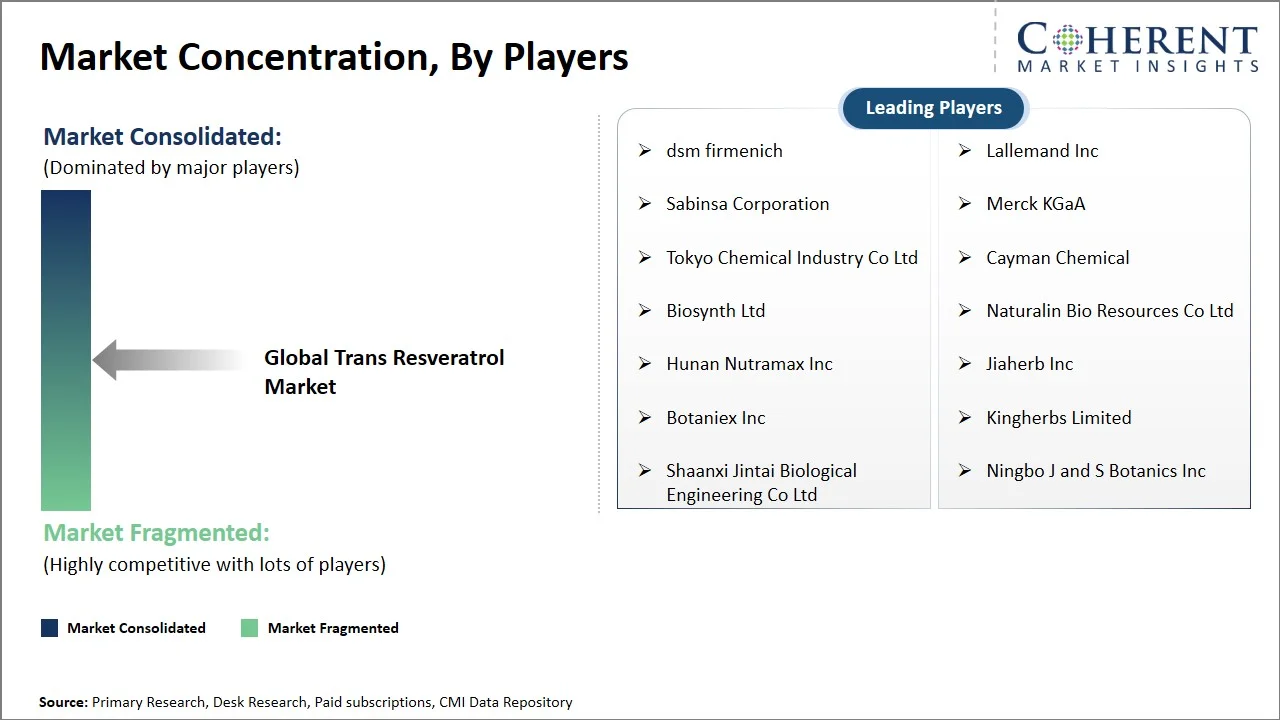
The global trans resveratrol market is moderately fragmented, with competition spanning botanical extract manufacturers, fermentation biotechnology companies, synthetic fine-chemical suppliers, branded ingredient developers, supplement formulators, cosmetic active producers, and regional distributors. Market leadership is determined less by production volume alone and more by the ability to combine reliable purity, source documentation, application support, regulatory readiness, and secure supply. Specialist companies can defend attractive positions through proprietary processing or delivery systems, while regional suppliers compete through pricing, flexible order quantities, and customer proximity. Contract manufacturers and private-label partners also influence supplier selection because they control formulation feasibility and finished-product commercialization.
Key focus areas include
- Purity and isomer control: Buyers increasingly assess trans-resveratrol assay, cis-resveratrol exposure, residual solvents, heavy metals, microbial quality, and batch consistency.
- Source differentiation: Plant-derived, fermentation-derived, and synthetic producers compete through distinct narratives involving natural origin, consistency, scalability, and cost.
- Application support: Suppliers offering solubility, stability, sensory, dosage-form, and packaging guidance can move closer to customers’ product-development decisions.
- Supply reliability: Dual sourcing, feedstock security, manufacturing redundancy, and dependable lead times are important for multinational supplement and cosmetics customers.
- Regulatory documentation: Novel-food files, compositional data, certificates of analysis, botanical identity records, and country-specific labeling support reduce customer approval time.
- Intellectual property: Protected extraction, glycosylation, delivery, crystallization, or formulation technologies can provide differentiation beyond standard ingredient specifications.
- Channel access: Distributor relationships, practitioner networks, e-commerce capabilities, pharmacy access, and contract-manufacturing partnerships influence commercial reach.
- Pricing discipline: Commodity suppliers remain vulnerable to price competition, whereas validated branded ingredients can defend margins through evidence and technical service.
Market Report Scope
Trans Resveratrol Market Report Coverage
| Report Coverage | Details | ||
|---|---|---|---|
| Base Year: | 2025 | Market Size in 2026: | USD 296.7 Mn |
| Historical Data for: | 2020 To 2024 | Forecast Period: | 2026 To 2033 |
| Forecast Period 2026 to 2033 CAGR: | 8.1% | 2033 Value Projection: | USD 511.8 Mn |
| Geographies covered: |
| ||
| Segments covered: |
| ||
| Companies covered: | dsm firmenich, Lallemand Inc, Sabinsa Corporation, Merck KGaA, Tokyo Chemical Industry Co Ltd, Cayman Chemical, Biosynth Ltd, Naturalin Bio Resources Co Ltd, Hunan Nutramax Inc, Jiaherb Inc, Botaniex Inc, Kingherbs Limited, Shaanxi Jintai Biological Engineering Co Ltd, and Ningbo J and S Botanics Inc | ||
| Growth Drivers: |
| ||
| Restraints & Challenges: |
| ||
Analyst Opinion (Expert Opinion)
- The global trans resveratrol market leadership is likely to migrate from companies selling assay-defined ingredients toward suppliers offering complete commercialization platforms. These platforms will combine validated specifications, formulation modules, regulatory documentation, stability support, and defensible consumer positioning. Buyers will increasingly reward suppliers that shorten development cycles and reduce launch risk, making technical service and dossier ownership nearly as important as manufacturing economics.
- Crop-independent production could materially change the competitive structure of the market. Fermentation and controlled plant-cell systems may reduce exposure to feedstock variability while enabling consistent molecular profiles and scalable production. Traditional botanical extractors could face pressure unless they strengthen provenance, sustainability, and full-spectrum positioning. Biotechnology specialists and vertically integrated producers are likely to benefit most from this structural shift.
- Participants should prioritize validated absorption performance, multicounty regulatory capabilities, photostability, dual-source supply plans, and application-specific grades. Practitioner channels, functional beverages, premium skincare, and focused healthy-aging protocols warrant greater attention than undifferentiated capsules. Companies should protect margins through technical differentiation rather than unsupported therapeutic claims and avoid excessive investment in commodity capacity before securing long-term customers or differentiated distribution.
Speak to the analyst
Want personalized insights?
Take the findings above to one of our principal consultants, or have the report rebuilt around the segments, geographies and competitors you actually track.
Market Segmentation
- Source Insights (Revenue, USD Mn, 2021 - 2033)
- Plant Derived Trans Resveratrol
- Fermentation Derived Trans Resveratrol
- Synthetic Trans Resveratrol
- Purity Insights (Revenue, USD Mn, 2021 - 2033)
- 98% and Above
- 95% to 98%
- Below 95%
- Form Insights (Revenue, USD Mn, 2021 - 2033)
- Powder
- Liquid
- Encapsulated
- Application Insights (Revenue, USD Mn, 2021 - 2033)
- Dietary Supplements
- Functional Foods and Beverages
- Cosmetics and Personal Care
- Pharmaceuticals and Research
- Others
- Regional Insights (Revenue, USD Mn, 2021 - 2033)
- North America
- U.S.
- Canada
- Latin America
- Brazil
- Argentina
- Mexico
- Rest of Latin America
- Europe
- Germany
- U.K.
- Spain
- France
- Italy
- Russia
- Rest of Europe
- Asia Pacific
- China
- India
- Japan
- Australia
- South Korea
- ASEAN
- Rest of Asia Pacific
- Middle East
- GCC Countries
- Israel
- Rest of Middle East
- Africa
- South Africa
- North Africa
- Central Africa
- North America
- Key Players Insights
- dsm firmenich
- Lallemand Inc
- Sabinsa Corporation
- Merck KGaA
- Tokyo Chemical Industry Co Ltd
- Cayman Chemical
- Biosynth Ltd
- Naturalin Bio Resources Co Ltd
- Hunan Nutramax Inc
- Jiaherb Inc
- Botaniex Inc
- Kingherbs Limited
- Shaanxi Jintai Biological Engineering Co Ltd
- Ningbo J and S Botanics Inc
Sources
Primary Research Interviews
- Trans resveratrol manufacturers, botanical extract producers, fermentation technology companies, synthetic ingredient suppliers, distributors, and contract manufacturers
- Dietary supplement, functional food and beverage, pharmaceutical, research chemical, cosmetics, and personal care product manufacturers
- R&D, procurement, production, quality assurance, regulatory affairs, formulation, marketing, and sales executives
- Nutritionists, pharmacists, dermatologists, researchers, contract laboratories, and industry consultants
Stakeholders
- Plant-derived, fermentation-derived, and synthetic trans resveratrol manufacturers
- Japanese knotweed, grape skin, grape seed, and other botanical raw-material suppliers
- Nutraceutical ingredient distributors, private-label supplement companies, CDMOs, and formulation specialists
- Encapsulation, micronization, liposomal delivery, cyclodextrin complexation, and spray-drying technology providers
- Importers, exporters, pharmacies, specialty nutrition retailers, cosmetic stores, supermarkets, and e-commerce platforms
End-use Sectors
- Dietary supplements, healthy-aging formulations, antioxidant products, cardiovascular wellness, metabolic health, and sports nutrition
- Functional foods, functional beverages, hydration powders, wellness shots, capsules, tablets, and sachets
- Cosmetics, anti-aging skincare, serums, creams, dermatological formulations, and personal care products
- Pharmaceutical research, laboratory studies, clinical research, reference standards, and analytical applications
Regulatory & Government Bodies
- U.S. Food and Drug Administration, Federal Trade Commission, European Commission, and European Food Safety Authority
- UK Food Standards Agency, Health Canada, Canadian Food Inspection Agency, and Australia’s Therapeutic Goods Administration
- Food Safety and Standards Authority of India, China State Administration for Market Regulation, and National Health Commission of China
- Japan Ministry of Health, Labour and Welfare, Consumer Affairs Agency, Brazil ANVISA, and Food Standards Australia New Zealand
- National customs authorities, food-safety agencies, pharmaceutical regulators, and consumer-protection bodies
Databases
- UN Comtrade, ITC Trade Map, WTO Statistics, Eurostat, and USITC DataWeb
- FAOSTAT, World Bank, OECD, China Customs, India DGCI&S, and Brazil Comex Stat
- PubMed, ClinicalTrials.gov, EU Clinical Trials Information System, WHO ICTRP, and national clinical trial registries
- Company filings, patent databases, product registrations, ingredient specifications, certificates of analysis, pricing records, and retail listings
- Scientific publication, nutraceutical formulation, pharmaceutical research, cosmetics ingredient, and consumer-review databases
Magazines and Journals
- Nutraceuticals World, Nutrition Insight, FoodNavigator, Natural Products Insider, and CosmeticsDesign
- Nutrients, Molecules, Antioxidants, Food Chemistry, and Journal of Functional Foods
- Phytochemistry, International Journal of Pharmaceutics, European Journal of Pharmaceutics and Biopharmaceutics, and Journal of Agricultural and Food Chemistry
- Clinical Nutrition, Frontiers in Nutrition, Scientific Reports, and Journal of Dietary Supplements
Associations
- Council for Responsible Nutrition
- International Alliance of Dietary/Food Supplement Associations
- American Herbal Products Association
- Natural Products Association
- Institute of Food Technologists
- International Society for Nutraceuticals and Functional Foods
- European Federation of Associations of Health Product Manufacturers
- Personal Care Products Council
Public Domain Sources
- Food-safety, dietary supplement, pharmaceutical, cosmetics, nutrition-labeling, trade, customs, and consumer-protection authorities
- Clinical trial registries, patent offices, peer-reviewed research repositories, and government scientific databases
- Company annual reports, investor presentations, product catalogues, ingredient specifications, certificates, safety data sheets, and press releases
- Pharmacy, specialist supplement, cosmetics, supermarket, distributor, contract-manufacturer, and online marketplace listings
- Product labels, botanical source declarations, purity specifications, dosage information, packaging formats, and pricing records
Key Standards and Regulations
- U.S. Federal Food, Drug, and Cosmetic Act, Dietary Supplement Health and Education Act, and 21 CFR Part 111 dietary supplement cGMP requirements
- U.S. nutrition labeling, structure–function claim, allergen, adverse-event reporting, botanical identity, and ingredient safety requirements
- EU General Food Law, Novel Food Regulation, Food Information to Consumers Regulation, and Nutrition and Health Claims Regulation
- European requirements covering novel-food authorization, ingredient specifications, maximum use levels, labeling, contaminants, and product claims
- Codex standards covering food hygiene, additives, contaminants, nutrition labeling, traceability, and good manufacturing practices
- India FSSAI Health Supplements and Nutraceutical Regulations, labeling requirements, food-product standards, and permitted ingredient provisions
- China GB 2760, GB 7718, GB 28050, new food raw-material requirements, health-food registration, and filing provisions
- Japan Foods with Function Claims, Foods for Specified Health Uses, food labeling, and health-food ingredient requirements
- Brazil ANVISA food supplement regulations, ingredient authorization, permitted claims, notification, labeling, and safety requirements
- Health Canada supplemented-food and natural health product requirements, FSANZ food standards, and Australian listed-medicine requirements
- Applicable USP, Food Chemicals Codex, ISO, HACCP, GMP, organic, non-GMO, gluten-free, stability, purity, residual-solvent, microbial, and heavy-metal standards
Proprietary Elements
- CMI Data Analytics Tool, Proprietary CMI Existing Repository of information for last 10 years.
Get access to 250+ pages report
Every segment, forecast, competitor profile and data table behind the analysis above — available for instant download.
- ESOMAR Member
- ISO 9001:2015 Certified
- D-U-N-S Registered
- GDPR & CCPA Compliant
Missing comfort of reading report in your local language? Find your preferred language:
Transform your Strategy with Exclusive Trending Reports
Frequently Asked Questions
The CAGR of the global trans resveratrol market is projected to be 8.1% from 2026 to 2033.
The global trans resveratrol market is estimated to be valued at USD 296.7 million in 2026 and is expected to reach USD 511.8 million by 2033.
Europe is expected to emerge as the fastest-growing region due to expanding nutraceutical demand, strict quality standards, and growing use of premium antioxidant ingredients.
The 98% and above purity segment leads the market because it offers consistent dosing, lower impurity levels, and suitability for supplements, pharmaceuticals, cosmetics, and research applications.
Dietary supplements generate the highest demand, supported by healthy-aging, cardiovascular wellness, metabolic health, and antioxidant formulations.
Low bioavailability limiting conventional oral formulation performance and purity variation creating product standardization and compliance challenges are the major factors hampering the growth of the global trans resveratrol market.
In terms of source, plant derived trans resveratrol is estimated to dominate the market revenue share in 2026.