

Dextrin Market Size and Forecast: 2026-2033
The Dextrin Market is anticipated to grow at a CAGR of 9.3% with USD 14.2 Bn share in 2026 and is expected to reach USD 23.4 Bn in 2033. Growth in the dextrin market is fueled by its increasing use in food processing for thickening and binding, expanding applications in pharmaceuticals and adhesives, and a rising preference for eco-friendly, biodegradable materials.
Key Takeaways
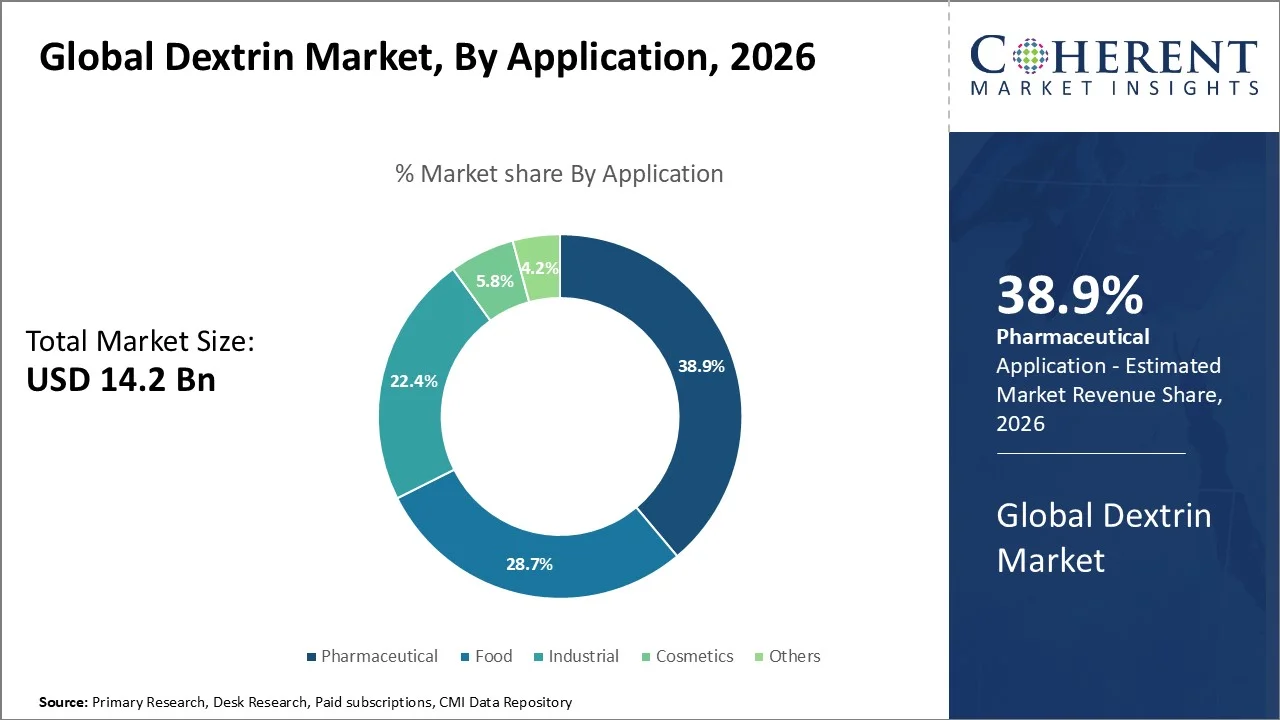
- Pharmaceutical hold the largest market share of 38.9% in 2026 owing to the functional role as pharmaceutical excipients. In pharmaceuticals, dextrin is used as a tablet binder, disintegrant, and encapsulating agent, with PubMed studies confirming its safety and digestive compatibility.
- Cyclodextrin expected to hold largest market share of 42.2% in 2026 owing to its increasing demand for advanced drug delivery systems. According to our research, the advanced drug delivery systems industry will surpass 432 Bn by 2033.
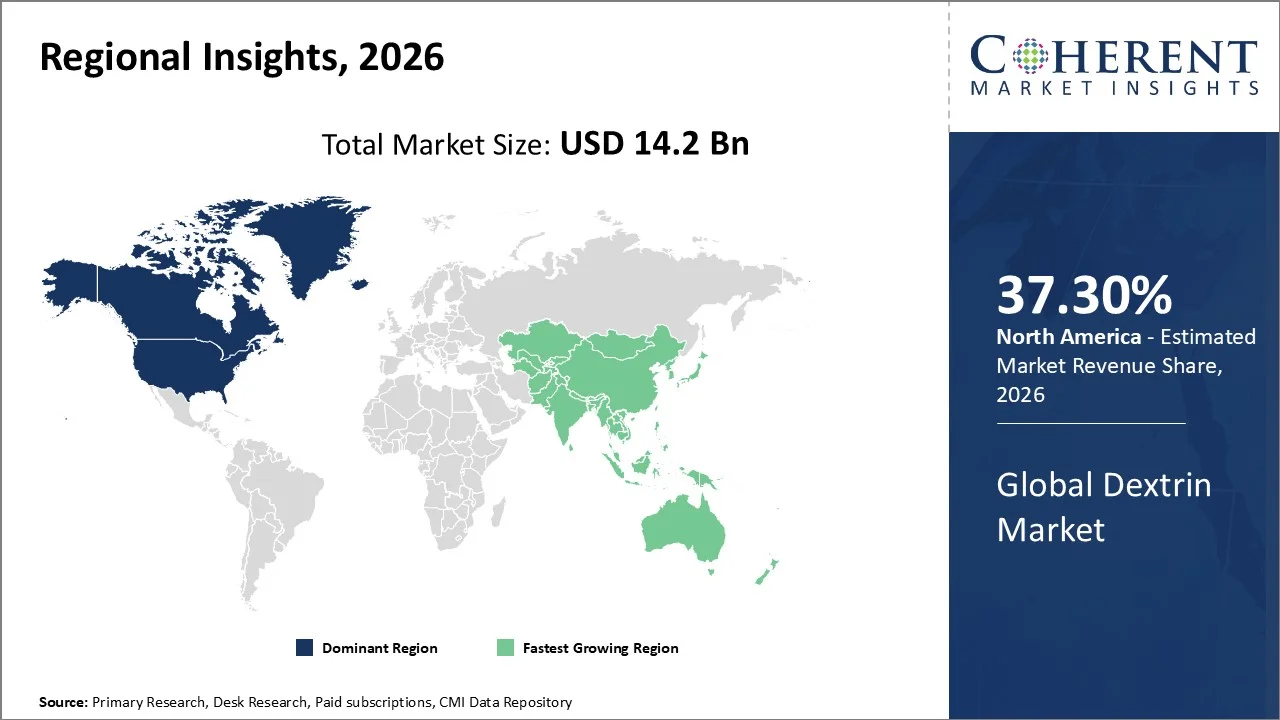
- By Region, North America is expected to acquire the dominant share of 37.30% in 2026 owing to the strong pharmaceutical and healthcare industry. Pharma represents over $19.1 billion in planned investment, with 12 companies announcing USD 1.1 billion in new projects across U.S. states.
Current Events and Their Impact on the Dextrin Market
Current Event | Description and its Impact |
EU Deforestation Regulation (EUDR) Compliance Rules |
|
India’s 20% Ethanol Blending Target in 2026 |
|
Segmental Insights
- Current Industry Events of 2026
- Market Size Estimation
- Regional Breakdown
- Competitive Landscape
- Customer Intelligence
- Segmental Analysis
- Pricing Analysis
- Key Market Drivers, Challenges & Future Trends
- Customized Insights Section
Why is Pharmaceutical Acquiring the Largest Market Share?
Pharmaceuticals hold the largest market share of 38.9% in 2026, owing to innovation in drug formulation technologies. The pharmaceutical segment drives the dextrin market through its extensive use of dextrin as an excipient in drug formulations, where it acts as a binder, filler, and stabilizer. Manufacturers use dextrins to improve solubility, enhance bioavailability, and enable controlled drug release in modern therapies. Increasing chronic disease prevalence, affecting nearly 1 in 3 adults globally, continues to drive higher drug consumption and excipient demand across oral solid dosage forms.
Additionally, over 60% of newly developed oral drugs now incorporate advanced excipient systems, including starch derivatives like dextrin, to improve formulation performance. Growth in nutraceuticals is also strong, with global demand rising at over 7% annually, supporting wider adoption of plant-based and clean-label excipients. Furthermore, controlled-release formulations account for more than 25% of total oral drug products in developed markets, further strengthening dextrin usage in pharmaceutical applications.
Cyclodextrin holds the Largest Market Share
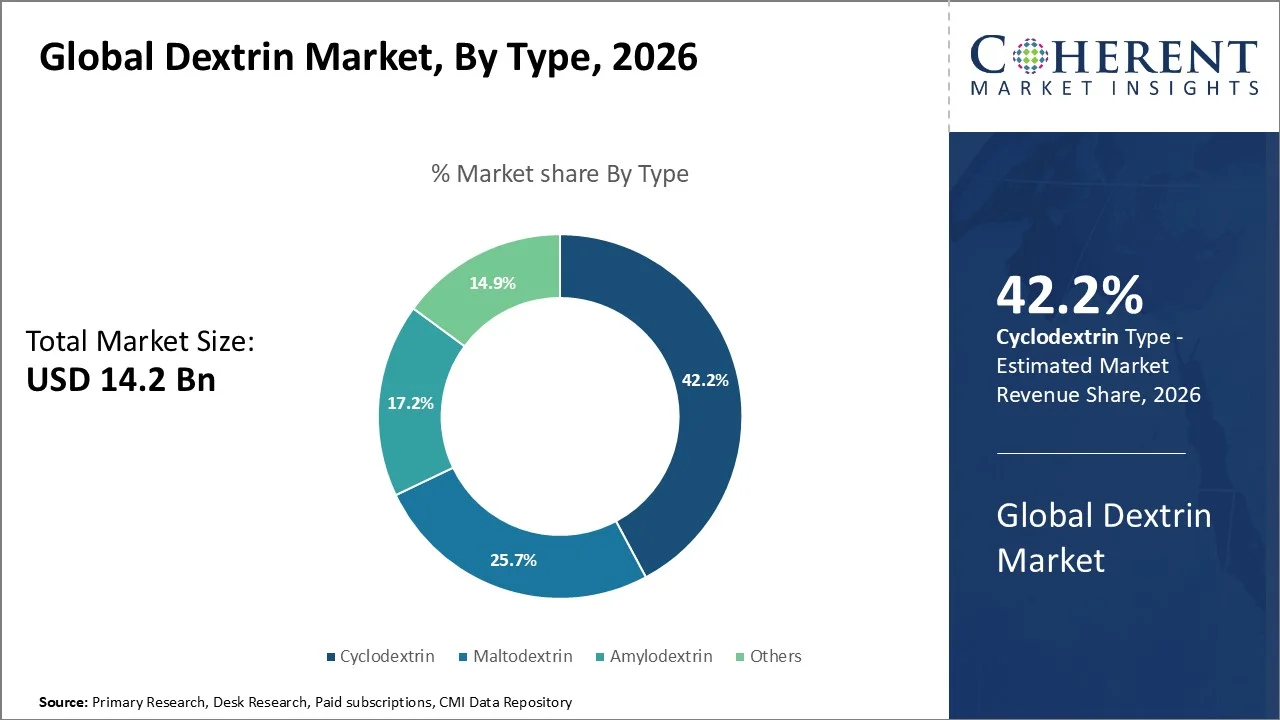
Cyclodextrin is expected to hold the largest market share of 42.2% in 2026. The cyclodextrin segment drives the dextrin market through its wide application in pharmaceutical and specialty fields. It enhances drug solubility, stability, and bioavailability by forming inclusion complexes, which supports modern drug delivery systems. Manufacturers apply cyclodextrins in nutraceuticals, food, and cosmetics to stabilize flavors, mask unpleasant tastes, and protect active ingredients.
Statistically, over 35% of new drug formulations in advanced pharmaceutical markets now utilize cyclodextrin-based excipient systems to improve delivery efficiency and therapeutic performance. In addition, more than 50% of poorly water-soluble drug candidates in development pipelines are being evaluated with cyclodextrin inclusion technology to enhance bioavailability. The global demand for functional excipients in nutraceuticals is also rising at around 6–8% annually, further supporting cyclodextrin adoption in dietary supplements and fortified foods.
Dextrin Market Trends
- Rising demand for minimally invasive procedures such as MIGS and microincisional surgeries improves safety, reduces complications, and shortens recovery time, increasing the use of dextrin-based pharmaceutical formulations. Globally, minimally invasive surgeries account for over 60% of total surgical procedures in developed markets, reflecting strong growth in advanced drug-assisted perioperative care and recovery formulations.
- Femtosecond laser-assisted and precision drug delivery technologies expand, encouraging the use of high-performance excipients such as dextrin for improved stability and controlled release. In ophthalmology alone, femtosecond laser-assisted procedures are used in more than 50% of LASIK and cataract surgeries in developed countries, driving demand for precision drug formulations.
- Supportive healthcare infrastructure and insurance coverage policies improve access to advanced treatments, increasing pharmaceutical manufacturing activities and accelerating dextrin adoption across drug formulation processes. In OECD countries, over 80% of healthcare costs are covered through public or private insurance systems, enabling higher uptake of advanced medicines and excipient-intensive formulations.
Regional Insights
North America dominates owing to Strong demand from adhesives and packaging industries
North America is expected to acquire the dominant market share of 37.30% in 2026. The region drives the dextrin market through strong demand from the pharmaceutical, food, and packaging industries. Manufacturers use dextrin extensively in drug formulations as a binder, stabilizer, and solubility enhancer, supported by advanced healthcare infrastructure and ongoing pharmaceutical innovation.
Statistically, North America accounts for nearly 45% of global pharmaceutical R&D spending, reinforcing its leadership in advanced drug formulation and excipient innovation. The region also represents over 30% of global functional food and nutraceutical consumption, supporting rising demand for resistant dextrin in dietary and health products. In the packaging sector, e-commerce growth has increased packaging material demand by over 25% in the last few years, significantly boosting usage of dextrin-based adhesives in corrugated boxes and paper packaging solutions.
Additionally, more than 70% of consumers in the U.S. prefer clean-label and plant-based ingredients, accelerating adoption of natural starch derivatives like dextrin across food and beverage applications. Strong regulatory frameworks from agencies such as the FDA further support the use of safe, biodegradable excipients, reinforcing dextrin’s role across pharmaceutical, food, and industrial applications in the region.
Asia Pacific Dextrin Market Trends
The Asia Pacific region drives the dextrin market through strong expansion in the food and beverage, pharmaceutical, and industrial sectors. Manufacturers widely apply dextrin in processed foods, pharmaceuticals, and adhesives because of its versatility and cost-effectiveness. Rapid urbanization, rising disposable incomes, and changing dietary habits increase demand for convenience and functional foods. Growing pharmaceutical production and greater adoption of plant-based ingredients further support growth. Strong industrialization and rising e-commerce packaging demand also boost dextrin consumption across the region.
United States Dextrin Market Trends
The United States drives the dextrin market through strong demand from the pharmaceutical, food, and industrial sectors. Manufacturers extensively use dextrin in drug formulations as a binder, stabilizer, and solubility enhancer, supported by advanced pharmaceutical research and production capabilities. Rising consumption of functional foods and dietary supplements increases demand for resistant dextrin. Growth in the packaging industry, driven by e-commerce expansion, further boosts usage. Consumers prefer clean-label, plant-based ingredients, and strong regulatory standards support widespread adoption across applications.
Japan Dextrin Market Trends
Japan drives the dextrin market through strong demand from the pharmaceutical, food, and cosmetics industries. Manufacturers widely use dextrin in drug formulations to improve stability, solubility, and controlled release. In the food sector, they apply it to develop functional and low-calorie products, while in cosmetics it enhances texture and improves ingredient delivery. An aging population increases demand for advanced healthcare products, raising pharmaceutical use. Over 10% of Japan’s population is now aged 80 or above, making it the country with the world’s oldest demographic. This is significantly affecting its economy, labor force, and society. Strong innovation focus, high quality standards, and preference for safe, natural ingredients further support dextrin adoption across applications.
Who are the Major Companies in Dextrin Industry
Some of the major key players in Dextrin Market are Archer Daniels Midland Company, Cargill, Inc., Tate & Lyle, Roquette Frères S.A, Ingredion Incorporated, American Key Products, Inc., Meelunie B.V, Agridient Inc., Emsland Group, and Avebe.
Key News
- In August 2025, Ekkovision has launched the first flavor of its bulk carbohydrate supplement, Cyclic Dextrin, which contains only premium Cluster Dextrin, a highly branched cyclic dextrin, as its primary ingredient.
Market Report Scope
Dextrin Market Report Coverage
| Report Coverage | Details | ||
|---|---|---|---|
| Base Year: | 2025 | Market Size in 2026: | USD 14.2 Bn |
| Historical Data for: | 2020 To 2024 | Forecast Period: | 2026 To 2033 |
| Forecast Period 2026 to 2033 CAGR: | 9.3% | 2033 Value Projection: | USD 23.4 Bn |
| Geographies covered: |
| ||
| Segments covered: |
| ||
| Companies covered: | Cargill, Incorporated, Archer Daniels Midland (ADM), Tate & Lyle, Ingredion Incorporated, Roquette Frères, Avebe U.A., Emsland Group, Matsutani Chemical Industry Co., Ltd. | ||
Analyst Opinion
- Dextrin demand is not being “driven” by consumer preference shifts, it is structurally forced by global food reformulation economics. The starch processing ecosystem exceeds ~100 million tonnes of annual output globally, and a growing share is being diverted into functional derivatives like dextrin because formulators are actively redesigning products around cost, stability, and labeling constraints rather than taste innovation. The real pressure point is fiber deficiency: multiple nutrition assessments consistently show that most populations consume well below the recommended 25–30 g/day of dietary fiber, which is pushing manufacturers to embed soluble fibers like resistant dextrin directly into high-frequency consumption categories such as beverages, bakery, and dairy analogs.
- Pharmaceutical usage of dextrin is quietly non-substitutable in high-throughput drug manufacturing, particularly oral solid dosage forms. The global pharmaceutical industry produces tens of billions of tablets and capsules annually, and dextrin-based excipients are deeply embedded in binder and filler systems due to their compressibility, neutral taste profile, and predictable disintegration behavior. In practical formulation terms, once a tablet line is validated, even minor excipient changes can trigger full re-approval cycles, which makes dextrin “sticky” in manufacturing systems far beyond its raw material value.
Speak to the analyst
Want personalized insights?
Take the findings above to one of our principal consultants, or have the report rebuilt around the segments, geographies and competitors you actually track.
Market Segmentation
- By Application (Revenue, USD Bn, 2021-2033)
- Food
- Pharmaceutical
- Industrial
- Cosmetics
- Others
- By Type (Revenue, USD Bn, 2021-2033)
- Maltodextrin
- Cyclodextrin
- Amylodextrin
- Others
- By Region (Revenue, USD Bn, 2021-2033)
- North America
- U.S.
- Canada
- Latin America
- Brazil
- Mexico
- Argentina
- Rest of Latin America
- Europe
- Germany
- U.K.
- France
- Italy
- Spain
- Russia
- Rest of Europe
- Asia Pacific
- China
- India
- Japan
- Australia
- South Korea
- ASEAN
- Rest of Asia Pacific
- Middle East
- GCC
- Israel
- Rest of Middle East
- Africa
- South Africa
- Central Africa
- North Africa
- North America
- Key Players
- Cargill, Incorporated
- Archer Daniels Midland (ADM)
- Tate & Lyle
- Ingredion Incorporated
- Roquette Frères
- Avebe U.A.
- Emsland Group
- Matsutani Chemical Industry Co., Ltd.
Sources
Primary Research Interviews
- Industry experts from starch and sweetener manufacturing units
- Procurement managers from food & beverage companies
- R&D professionals in carbohydrate and polysaccharide processing
- Distribution channel partners and raw material suppliers
- Quality control and regulatory compliance officers
Databases
- Government trade and agriculture databases
- International trade statistics portals
- Food additives and ingredients classification databases
- Export-import shipment tracking databases
- Company financial and product databases (public filings and disclosures)
Magazines
- Food processing and ingredients industry magazines
- Agro-processing trade publications
- Industrial chemical and biotechnology magazines
- Packaging and formulation-focused trade magazines
Journals
- Food chemistry and carbohydrate science journals
- Industrial biotechnology research journals
- Starch and polysaccharide research publications
- Nutrition and functional ingredients science journals
Newspapers
- Business newspapers covering commodity and agro-markets
- Financial newspapers reporting food ingredient pricing trends
- National and regional newspapers covering manufacturing and exports
- Trade-focused economic news publications
Associations
- Starch and carbohydrate industry associations
- Food ingredient and additive industry bodies
- Agricultural processing and export promotion councils
- Biotechnology and biochemical engineering associations
- Food safety and regulatory standard organizations
Public Domain Sources
- Government agriculture and food processing ministry reports
- International trade organization publications
- Regulatory authority guidelines and notifications
- Census and industrial production reports
- University research repositories and open-access papers
Proprietary Elements
- CMI Data Analytics Tool
- Proprietary CMI Existing Repository of information for last 10 years
Get access to 250+ pages report
Every segment, forecast, competitor profile and data table behind the analysis above — available for instant download.
- ESOMAR Member
- ISO 9001:2015 Certified
- D-U-N-S Registered
- GDPR & CCPA Compliant
Missing comfort of reading report in your local language? Find your preferred language:
Transform your Strategy with Exclusive Trending Reports
Frequently Asked Questions
The Dextrin Market is anticipated to grow at a CAGR of 9.3% with USD 14.2 Billion in 2026 and is expected to reach USD 23.4 Billion in 2033.
Increasing health consciousness consumer base can help to boost the market growth in upcoming years.
Rising awareness about the medical advantages of dextrin can boost the market growth worldwide.
There are various side effects of dextrin such as rapid breathing, low blood phosphate, and loss of consciousness which can hampered the market.
Major players operating in the market include Alcon Inc., Johnson & Johnson Vision (J&J Vision), Carl Zeiss Meditec AG, Bausch + Lomb, Glaukos Corporation, HOYA Corporation, NIDEK Co., Ltd., Topcon Corporation, and STAAR Surgical Company.