

U.S. Independent Medical Evaluation Service Market Size and Forecast – 2026 To 2033
The U.S. independent medical evaluation service market is expected to grow from USD 10,692.9 Mn in 2026 to USD 32,631.0 Mn by 2033, registering a compound annual growth rate (CAGR) of 17.3% from 2026 to 2033. The U.S. independent medical evaluation service market is poised for significant expansion, fueled by the increasing volume of workers' compensation, disability, and personal injury claims which mandate an objective medical assessment in order to adjudicate and determine return to work.
According to the U.S. Bureau of Labor Statistics (BLS), private industry employers reported 2.6 million nonfatal workplace injuries and illnesses in 2023, including 946,500 cases involving days away from work. Nonfatal injuries resulting in days away from work occurred at a rate of 0.9 cases per 100 full-time workers, underscoring the continued need for independent medical evaluation services to support claim assessments, disability determinations, and return-to-work decisions.
(Source: U.S. Bureau of Labor Statistics)
Key Takeaways of the U.S. Independent Medical Evaluation Service Market
- Federal is projected to hold 52.1 % of the U.S. independent medical evaluation service market share in 2026, making it the dominant customer type segment, due to the extensive use of independent medical assessments in federal disability determination and public benefits programs. The segment continues to benefit from the growing demand for objective medical evidence in disability adjudication. For instance, the U.S. Social Security Administration (SSA) utilizes Consultative Examinations (CEs) conducted by independent physicians when available medical evidence is insufficient to determine disability eligibility. The CE program is administered through state Disability Determination Services (DDS) offices nationwide. (Source: U.S. Social Security Administration) The continued reliance on independent physician assessments supports the demand for IME services across federal agencies.
- Examination-based IME services are projected to hold 36.9 % of the U.S. independent medical evaluation service market share in 2026, making it the dominant service type segment, due to their critical role in resolving disputes related to injury causation, impairment, treatment necessity, and return-to-work status. The segment continues to benefit from regulatory requirements for independent physician evaluations. For instance, the California Division of Workers' Compensation (DWC) operates a Qualified Medical Evaluator (QME) program under which certified physicians perform independent medical examinations to resolve disputed workers' compensation claims. (Source: State of California) Such regulatory frameworks reinforce the adoption of examination-based IME services across the U.S.
- Workers' compensation is projected to hold 17.0 % of the U.S. independent medical evaluation service market share in 2026, making it the dominant case type segment, due to the substantial number of disputed occupational injury claims requiring independent medical review. The segment is further supported by state-level workers' compensation regulations mandating objective medical assessments. For instance, the Texas Department of Insurance, Division of Workers' Compensation (TDI-DWC) administers the Designated Doctor Program, whereby independent physicians evaluate maximum medical improvement (MMI), impairment ratings, extent of injury, and work capacity in disputed claims. (Source: Texas Department of Insurance) The use of designated independent evaluations directly supports demand for workers' compensation-related IME services.
- Increasing Workers' Compensation Insurance Claims Requiring Medical Review: High worker compensation claims volume in U.S. continues to fuel the demand for Independent Medical Evaluation (IME) in an effort to prove injury cause, the need of treatment, the extent of the impairment and the possibility of work re-entrance. In workers' compensation, Independent Medical Evaluation (IME) has been frequently utilized by insurance companies as an additional measure in handling disputed claims and substantiating the justification of benefit. With both the employer and insurance companies emphasize on mitigating loss from the claim and avoiding any litigation issues, Independent Medical Evaluation (IME) service providers may see a stable and continuous rise in demands.
- Expansion of Virtual and Hybrid IME Models: The growing utilization of telehealth technologies paves the way for hybrid and virtual independent medical evaluation services, as medical examiners continue to explore ways to automate the medical record review process, use virtual systems for case management and leverage online capabilities to conduct remote evaluations that facilitate quicker turnaround times, particularly for underserved areas with a limited supply of specialist examiners.
Segmental Insights
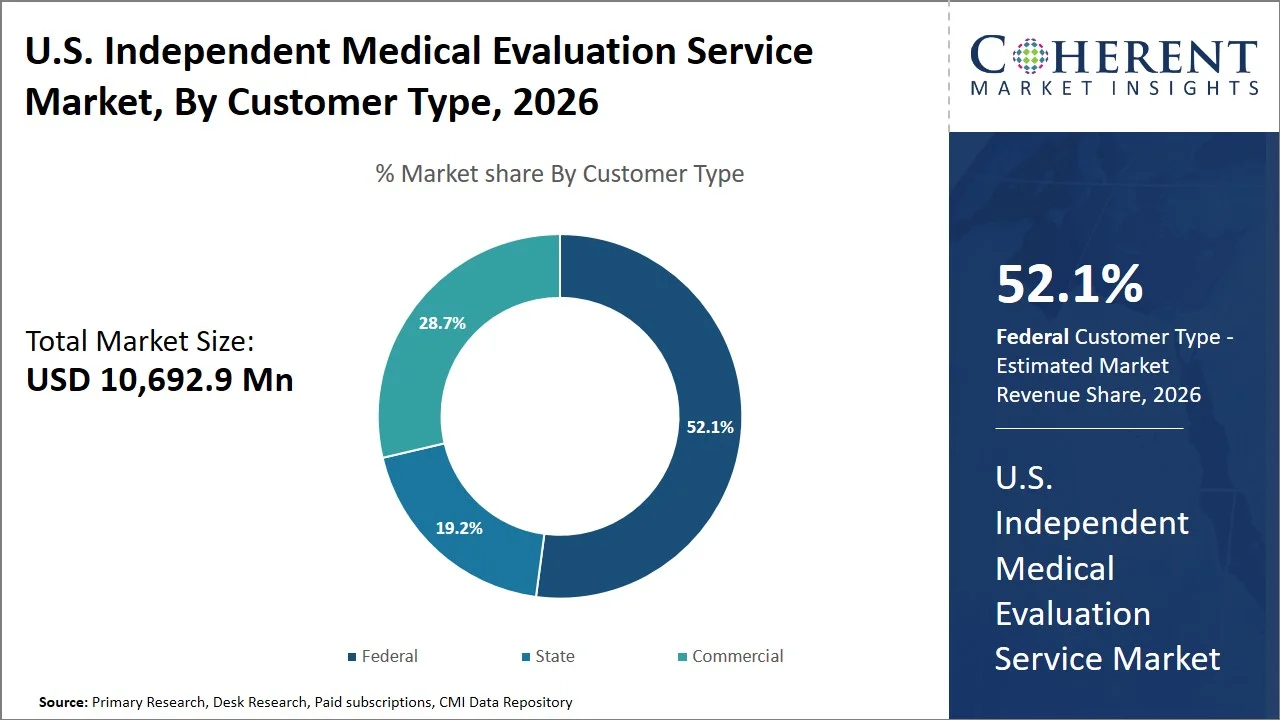
Why Does Federal Dominate the U.S. Independent Medical Evaluation Service Market?
Federal is projected to hold a market share of 52.1% in 2026, as many disability, injury, and compensation claims processed via federal benefit plans require impartial medical review. These independent medical reviews are routinely conducted to assess cause and effect, degree of disability, physical capability and medical eligibility for continuing claims. The volume of federally managed claims programs guarantees a steady stream of demand for physician’s review and medical-legal assessment services. For instance, the Office of Workers' Compensation Programs (OWCP) within the U.S. Department of Labor operates under the Federal Employees' Compensation Act (FECA) that provides workers' compensation to millions of federal workers and stipulates a second opinion or referee medical exam be conducted if there is a dispute or insufficient evidence, as it supports adjudicating claims and benefit delivery. (Source: U.S. Department of Labor)
- Current Industry Events of 2026
- Market Size Estimation
- Regional Breakdown
- Competitive Landscape
- Customer Intelligence
- Segmental Analysis
- Pricing Analysis
- Key Market Drivers, Challenges & Future Trends
- Customized Insights Section
Why Do Examination-Based IME Services Represent the Largest Service Type Segment in the U.S. Independent Medical Evaluation Service Market?
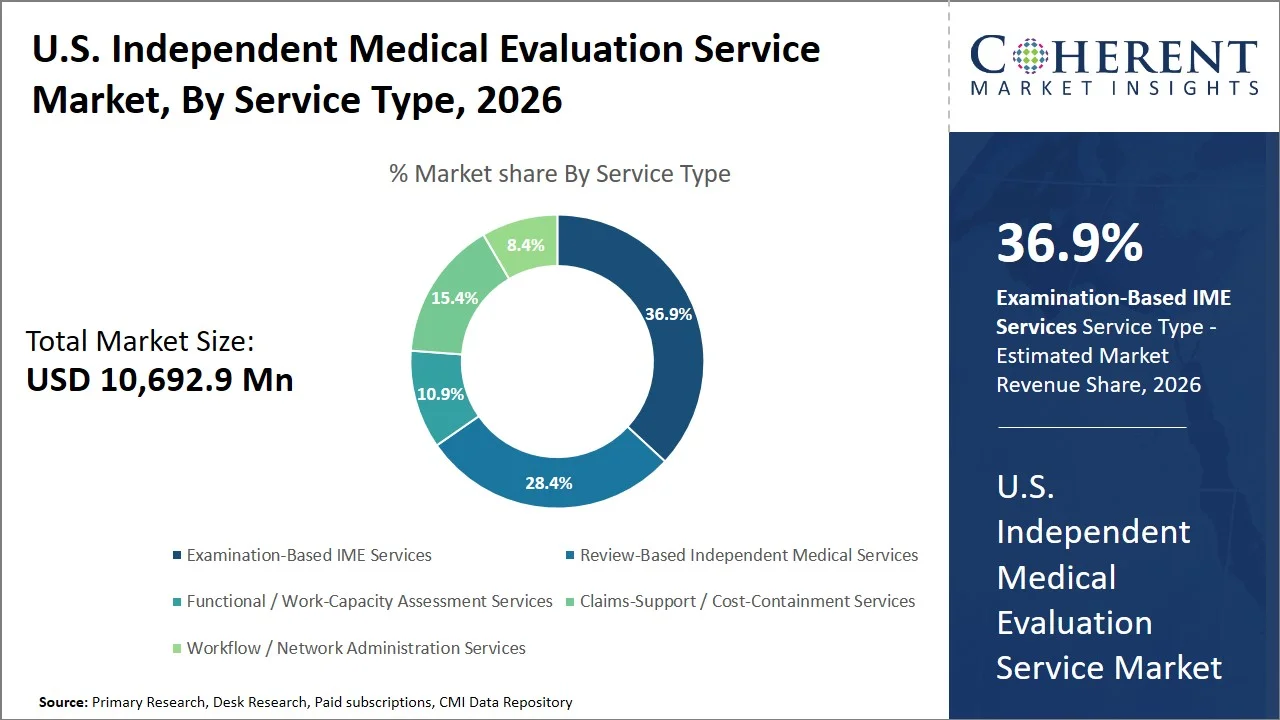
Examination-based IME services are projected to hold 36.9% of the market share in 2026, as they offer the "gold standard" in independent medical evidence, including a direct physician evaluation of a claimant's medical status, functional capabilities, impairment and work restrictions. Examination-based IMEs are predominantly used in workers' compensation, disability, liability and personal injury claims when an in-person evaluation is needed to dispute medical issues and establish benefits. For instance, the New York Workers' Compensation Board mandates that IME providers obtain the necessary accreditation, which underscores the emphasis on standardized, physician-driven examination services within workers' compensation claim administration. The mandate of accreditation demonstrates the continued reliance on IME based upon examination services for claims adjudication and medical dispute resolution. (Source: Utilization Review Accreditation Commission)
Workers' Compensation Segment Dominates the U.S. Independent Medical Evaluation Service Market
The workers' compensation segment is expected to hold 17.0% of the U.S. independent medical evaluation service market share in 2026, as occupational injuries often need independent medical evaluations to help determine causality, severity, treatment suitability, impairment, and work capabilities. Objective medical opinions are vital to employers, insurers and the workers compensation boards in dispute resolution and claim support. The rigidly controlled, formalistic system produces a continuous need for independent medical evaluation services. For instance, in May 2025, New York introduced legislation designed to enhance medical care access for injured workers, and allow injured workers more access to care under NY's workers' compensation system, by encouraging provider acceptance and ensuring access to care. The anticipated result of the legislation is a rise in medically managed claims that require review, treatment review, and resolution of disputes, fostering increased demand for IME services. (Source: rescuemeds)
Currents Events and their Impact
Current Events | Description and its Impact |
Centers for Medicare & Medicaid Services (CMS) Electronic Prior Authorization Acceleration Initiative (May 2026) |
|
Social Security Administration Brings Medical Continuing Disability Reviews (CDRs) In-House (March 2026) |
|
(Source: Centers for Medicare & Medicaid Services, Social Security Administration)
U.S. Independent Medical Evaluation Service Market Dynamics
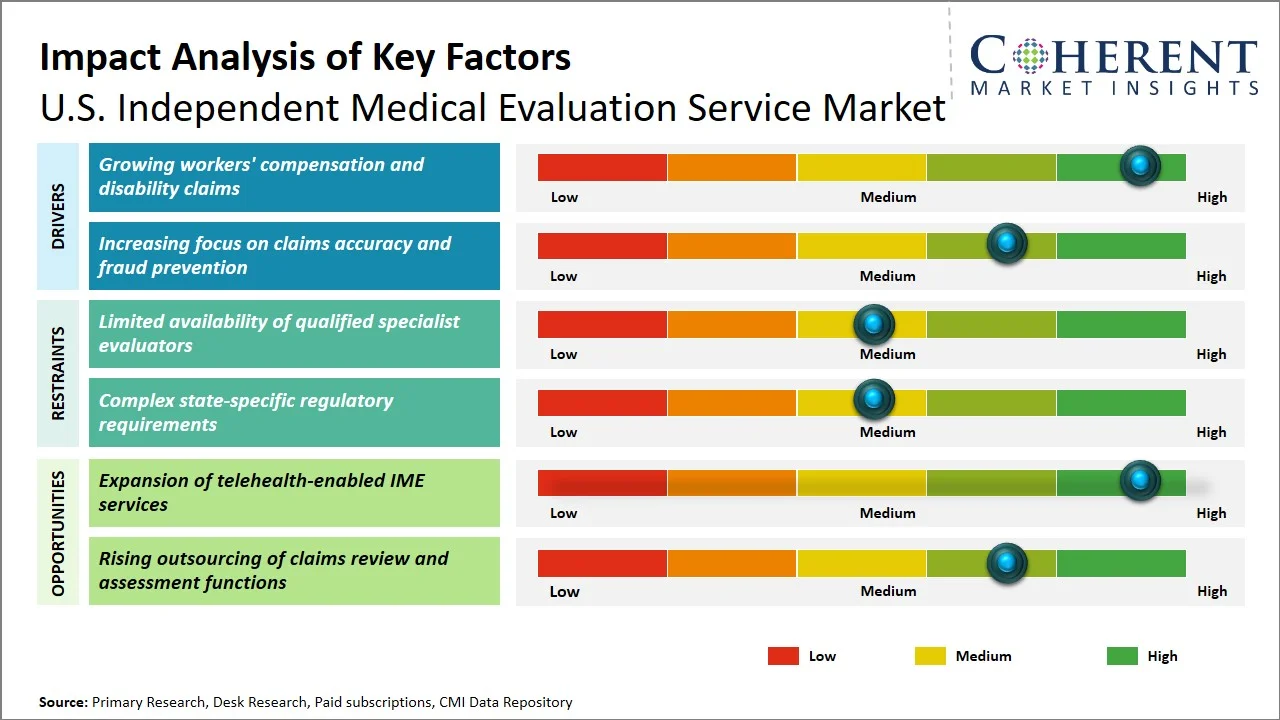
Market Drivers
- Growing workers' compensation and disability claims: The rising volume of workers' compensation and disability claims in the U.S. is leading to greater demand for independent medical exams to determine injury severity and physical limitations, the necessity for specific treatment, and the extent of benefits to be awarded. As government agencies and insurance companies rely on independent medical evaluation providers for an independent medical assessment, they are increasingly incorporating independent medical evaluation services into their decision-making processes to obtain a non-biased medical opinion regarding a claimant's claim in order to determine and award the appropriate benefits. For instance, the Office of the Inspector General (OIG) of the Social Security Administration reported that processing times by the Disability Determination Services (DDS) rose from 121 days during FY 2019 to 219 days in FY 2023 with about 1.9 million disability determination cases processed during the same period. (Source: Office of the Inspector General)
- Increasing focus on claims accuracy and fraud prevention: In an era of increased awareness regarding fraudulent claim prevention and increased claim adjudication accuracy, the demand for independent medical reviews within workers compensation, disability and liability insurance lines is rising. Independent medical evaluation service present claims adjudicators with independent medical opinion in relation to the nature of the injury and appropriateness of the treatment, aiding in reducing unjustified claim payments. For instance, in June 2024, the U.S. Department of Justice announced the 2024 National Health Care Fraud Enforcement Action, which led to the arrest of 193 individuals accused of perpetuating health care fraud totaling approximately USD 2.75 billion in intended losses. (Source: U.S. Department of Justice) The persistent federal focus on fraud detection and claim verification is reassuring payers and insurers to strengthen independent medical review processes and medical documentation requirements.
Emerging Trends
- Growing Adoption of Records-Only and Peer Review Evaluations: Due to increasing health care expenditures insurers and third-party administrators are using records-only reviews and peer review services more than ever to judge medical necessity, medical appropriateness and guideline compliance without a physical exam. This will help lower costs, reduce decision time on a claim and create more efficient claim processing.
- Increasing Demand for Specialty-Focused IME Services: The demand for specialty-specific medical examinations is rising due to complexity in disability, neurological, psychiatric, pain management and work injury claims. Independent medical evaluation vendors have increased access to board-certified specialists to provide better examinations and assist in the evidentiary resolution of claim.
Key Regulatory Programs and Claim Adjudication Frameworks Influencing the U.S. Independent Medical Evaluation Service Market
Governing Body | Program / Framework | Key Requirement | Impact on Market |
Social Security Administration (SSA) | Consultative Examination (CE) Program | Independent physicians conduct evaluations when medical evidence is insufficient for disability determinations | Drives demand for federal disability-related IME services |
California Division of Workers' Compensation (DWC) | Qualified Medical Evaluator (QME) Program | Certified physicians perform medical-legal evaluations in disputed workers' compensation claims | Supports high utilization of examination-based IMEs |
Texas Department of Insurance (TDI-DWC) | Designated Doctor Program | Independent physicians assess MMI, impairment ratings, and work capacity | Increases demand for workers' compensation IME services |
Centers for Medicare & Medicaid Services (CMS) | Medicare Secondary Payer (MSP) Rules | Requires medical documentation and injury-related claim validation | Expands need for independent medical reviews |
Occupational Safety and Health Administration (OSHA) | Workplace Injury Reporting Requirements | Standardized reporting of occupational injuries and illnesses | Supports growth in workers' compensation and occupational health evaluations |
How is the expansion of telehealth-enabled IME services creating new growth opportunities in the U.S. independent medical evaluation service market?
The increase in telehealth acceptance presents independent medical evaluation providers with the ability to perform remote medical record reviews, psychological exams, follow-ups, and specialist consultations. As the desire for efficient and prompt claim processing becomes increasingly important to stakeholders, telehealth independent medical evaluation service will be the standard for disability, workers' compensation and liability claims. For instance, in February 2023, the Division of Workers' Compensation (DWC) of California established Qualified Medical Evaluator (QME) Telehealth Regulations pursuant to California Code of Regulations, title 8. Formalizing the rules under which QME evaluations may be provided by telehealth, adding telehealth to the system of medical-legal evaluation in California and opening new avenues for virtual evaluation service to IME providers. (Source: Department of Industrial Relations)
Market Players, Key Development, and Competitive Intelligence
Key Developments
- In January 2026, MDpanel announced the acquisition of independent medical examination and peer review company, Media Referral based in New York. This acquisition broadens MDpanel's network of physicians, service offering and regional capabilities in the Northeast U.S. The sale signals the trend of consolidation in the U.S. independent medical evaluation service market where companies look to cover a greater geographic area, deliver a more extensive level of service, and build relationships with insurers, employers, and claims administrators.
- In July 2025, The IMA Group acquired the New York-based provider of independent medical examinations and associated assessment services (Medical Research Network—MRN). This acquisition has widened IMA Group's physician network, geographical reach, and case management expertise, thus giving IMA Group a firmer foothold in the U.S. independent medical evaluation service market. This move was in sync with the prevailing trend of consolidation within the independent medical evaluation service market, where service providers consolidate to gain wider service distribution and better meet insurer and claims administrator demands.
Competitive Landscape
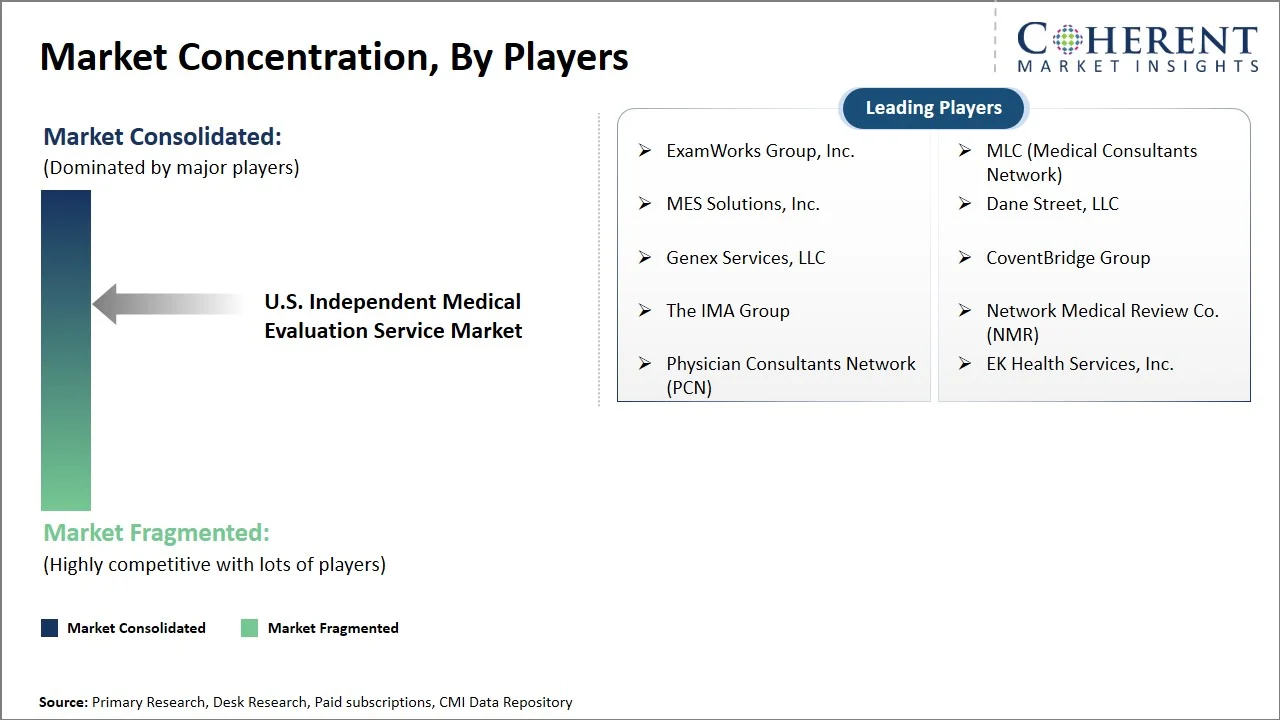
The U.S. independent medical evaluation service market is highly competitive, characterized by national and regional vendors differentiating on physician network size, scope of specialty services offered, processing turnaround time, regulatory and statutory knowledge, and technology-enhanced case management abilities. Market participants continue to be committed to growing their independent physician networks, improving digital case management solutions, and forging and maintaining strong alliances with insurers, employers, government entities, and third-party administrators. Key focus areas include:
- Expansion of nationwide physician and specialist evaluator networks
- Adoption of digital case management, scheduling, and medical record review platforms
- Strengthening workers' compensation, disability, and liability claims assessment capabilities
- Integration of virtual and hybrid IME service delivery models
- Strategic acquisitions and partnerships to expand geographic reach and service offerings
- Enhancing turnaround times, compliance management, and claims decision support services
Market Report Scope
U.S. Independent Medical Evaluation Service Market Report Coverage
| Report Coverage | Details | ||
|---|---|---|---|
| Base Year: | 2025 | Market Size in 2026: | USD 10,692.9 Mn |
| Historical Data for: | 2020 To 2024 | Forecast Period: | 2026 To 2033 |
| Forecast Period 2026 to 2033 CAGR: | 17.3% | 2033 Value Projection: | USD 32,631.0 Mn |
| Segments covered: |
| ||
| Companies covered: | ExamWorks Group, Inc., MLC (Medical Consultants Network), MES Solutions, Inc., Dane Street, LLC, Genex Services, LLC, CoventBridge Group, The IMA Group, Network Medical Review Co. (NMR), Physician Consultants Network (PCN), and EK Health Services, Inc. | ||
| Growth Drivers: |
| ||
| Restraints & Challenges: |
| ||
Analyst Opinion (Expert Opinion)
- The future of the U.S. independent medical evaluation service market will be dominated by the rise in demand for independent medical opinions to handle the claims process for Workers' Comp, Disability, Liability, and insurance claim investigations and judgments. The industry anticipates the growing use of digital case management systems, virtual review programs, and the use of objective and fact-based decision making for claims investigation to streamline and shorten the cycle for closing claims. Furthermore, the increasing scrutiny on claims adjudication and attention towards cost reduction is expected to boost the demand for independent medical evaluation providers.
- The maximum growth opportunity lies within the workers' compensation applications, specifically in examination-based IMEs and occupational health examinations. The escalating claims frequency for workers' compensation injuries, return-to-work exams, impairment ratings and disputed medical claims will keep demand for independent physician reviews strong. Federal disability programs and insurer driven medical necessity reviews are also exciting areas of growth.
- In order to create an advantage for themselves, the competitors should endeavor to develop their networks of specialty physicians, further refine their digital capabilities in case scheduling and management, and shorten turnaround times of medical reports. The companies that manage to effectively utilize virtual assessment solutions, bolster their regulatory compliance knowledge, and establish long-term relationships with insurers, employers and government organizations will seize the majority of market share.
Speak to the analyst
Want personalized insights?
Take the findings above to one of our principal consultants, or have the report rebuilt around the segments, geographies and competitors you actually track.
Market Segmentation
- Customer Type Insights (Revenue, USD Mn, 2021 - 2033)
- Federal
- State
- Commercial
- Service Type Insights (Revenue, USD Mn, 2021 - 2033)
- Examination-Based IME Services
- Review-Based Independent Medical Services
- Functional / Work-Capacity Assessment Services
- Claims-Support / Cost-Containment Services
- Workflow / Network Administration Services
- Case Type Insights (Revenue, USD Mn, 2021 - 2033)
- Workers' Compensation
- Disability Claims
- Auto and Personal Injury Claims
- Liability and Litigation Cases
- Group Health and Medical Necessity Reviews
- Occupational Health / Fitness for Duty
- Government Benefit Claims
- Delivery Mode Insights (Revenue, USD Mn, 2021 - 2033)
- In-Person Examination
- Records-Only Review
- Hybrid Exam + File Review
- Telehealth / Virtual Review Support
- Specialty Type Insights (Revenue, USD Mn, 2021 - 2033)
- Orthopedic and Musculoskeletal
- Neurology
- Psychiatry and Psychology
- Occupational and Physical Medicine
- Internal Medicine
- Other Specialties
- Key Players Insights
- ExamWorks Group, Inc.
- MLC (Medical Consultants Network)
- MES Solutions, Inc.
- Dane Street, LLC
- Genex Services, LLC
- CoventBridge Group
- The IMA Group
- Network Medical Review Co. (NMR)
- Physician Consultants Network (PCN)
- EK Health Services, Inc.
Sources
Primary Research Interviews
- Independent Medical Examiners (Orthopedics, Neurology, Psychiatry, Occupational Medicine) – IME volume trends, impairment ratings, causation assessments, and return-to-work evaluations
- Medical Directors of Workers' Compensation Insurance Carriers – claim adjudication practices, medical necessity reviews, and IME utilization trends
- Disability Determination Services (DDS) Consultants and Physicians – disability evaluation processes and federal benefit assessments
- Third-Party Administrators (TPAs) and Claims Managers – claim management workflows, dispute resolution, and IME outsourcing trends
- Occupational Health Physicians and Case Managers – fitness-for-duty assessments, work restrictions, and workplace injury management
- Medical-Legal Consultants and Workers' Compensation Attorneys – litigation support, medico-legal reporting, and expert medical opinion requirements
Stakeholders
- Independent Medical Evaluation Service Providers (e.g., ExamWorks, Dane Street, MES Solutions, The IMA Group, MLC)
- Workers' Compensation Insurance Carriers
- Disability Insurance Providers
- Third-Party Administrators (TPAs)
- Self-Insured Employers
- Government Disability and Benefit Agencies
- End-use Sectors
- Workers' Compensation Programs
- Disability Determination Services
- Auto and Personal Injury Claims Organizations
- Liability and Litigation Support Services
- Occupational Health and Employer Risk Management Programs
- Federal and Public Benefit Programs
- Regulatory & Health Bodies
- U.S. Department of Labor (DOL)
- U.S. Social Security Administration (SSA)
- Centers for Medicare & Medicaid Services (CMS)
- Occupational Safety and Health Administration (OSHA)
- California Division of Workers' Compensation (DWC)
- Texas Department of Insurance – Division of Workers' Compensation (TDI-DWC)
Databases
- U.S. Bureau of Labor Statistics (BLS) – workplace injury and occupational illness statistics
- Social Security Administration (SSA) – disability claims and consultative examination data
- National Council on Compensation Insurance (NCCI) – workers' compensation claims and medical cost trends
- Centers for Medicare & Medicaid Services (CMS) – healthcare utilization and reimbursement data
- OSHA Injury Tracking Application (ITA) – workplace safety and injury reporting data
- ClinicalTrials.gov – studies related to disability assessment, occupational health, and functional capacity evaluation
Magazines
- Claims Magazine – claims management and insurance industry developments
- Risk & Insurance – workers' compensation and disability management trends
- WorkCompCentral – workers' compensation regulatory and claims updates
- Insurance Journal – insurance claims and risk management developments
Journals
- Journal of Occupational and Environmental Medicine (JOEM)
- Journal of Occupational Rehabilitation
- Disability and Rehabilitation
- American Journal of Industrial Medicine
- Journal of Insurance Medicine
Newspapers
- The Wall Street Journal – healthcare policy, insurance industry developments, and employer risk management
- The New York Times – disability benefits, healthcare regulations, and workplace injury coverage
- USA Today – healthcare access, occupational health, and insurance-related developments
- The Washington Post – federal disability programs, labor policies, and healthcare legislation
- Los Angeles Times – workers' compensation reforms, healthcare regulations, and medical-legal issues
Associations
- American College of Occupational and Environmental Medicine (ACOEM)
- International Association of Industrial Accident Boards and Commissions (IAIABC)
- National Association of Disability Examiners (NADE)
- American Association of Independent Medical Examiners (AAIME)
- Disability Management Employer Coalition (DMEC)
Public Domain Sources
- U.S. Bureau of Labor Statistics (BLS) – workplace injury and illness statistics
- U.S. Social Security Administration (SSA) – disability determination and consultative examination programs
- Occupational Safety and Health Administration (OSHA) – workplace safety and injury data
- Centers for Medicare & Medicaid Services (CMS) – healthcare utilization and reimbursement information
- National Council on Compensation Insurance (NCCI) – workers' compensation system insights
- California Division of Workers' Compensation (DWC) – QME and workers' compensation medical evaluation data
Proprietary Elements
- CMI Data Analytics Tool, Proprietary CMI Existing Repository of information for last 10 years.
Get access to 250+ pages report
Every segment, forecast, competitor profile and data table behind the analysis above — available for instant download.
- ESOMAR Member
- ISO 9001:2015 Certified
- D-U-N-S Registered
- GDPR & CCPA Compliant
Missing comfort of reading report in your local language? Find your preferred language:
Transform your Strategy with Exclusive Trending Reports
Frequently Asked Questions
The U.S. independent medical evaluation service market is estimated to be valued at USD 10,692.9 Mn in 2026 and is expected to reach USD 32,631.0 by 2033.
Federal dominates due to the extensive use of independent medical assessments in federal disability determination, veterans' benefits, and public-sector claims programs that require objective medical evidence for benefit eligibility and adjudication.
An Independent Medical Evaluation (IME) is an objective medical assessment conducted by a qualified physician to evaluate a patient's medical condition, disability status, treatment appropriateness, or work capacity for claims and legal purposes.
The CAGR of the U.S. independent medical evaluation service market is projected to be 17.3% from 2026 to 2033.
A Qualified Medical Evaluator (QME) is a state-certified physician authorized to perform independent medical evaluations and issue medical-legal reports in disputed workers' compensation cases.
Maximum Medical Improvement (MMI) is the point at which an injured individual's medical condition has stabilized and is not expected to substantially improve with further treatment.
Growing workers' compensation and disability claims, and increasing focus on claims accuracy and fraud prevention are the major factors driving the growth of the U.S. independent medical evaluation service market.