

Global Vacuum Cleaner Bags Market Size and Forecast: 2026-2033
The Global Vacuum Cleaner Bags Market is estimated to be valued at USD 3.53 Bn in 2026 and is expected to reach USD 4.81 Bn by 2033, exhibiting a compound annual growth rate (CAGR) of 4.5% from 2026 to 2033.
Key Takeaways of the Vacuum Cleaner Bags Market
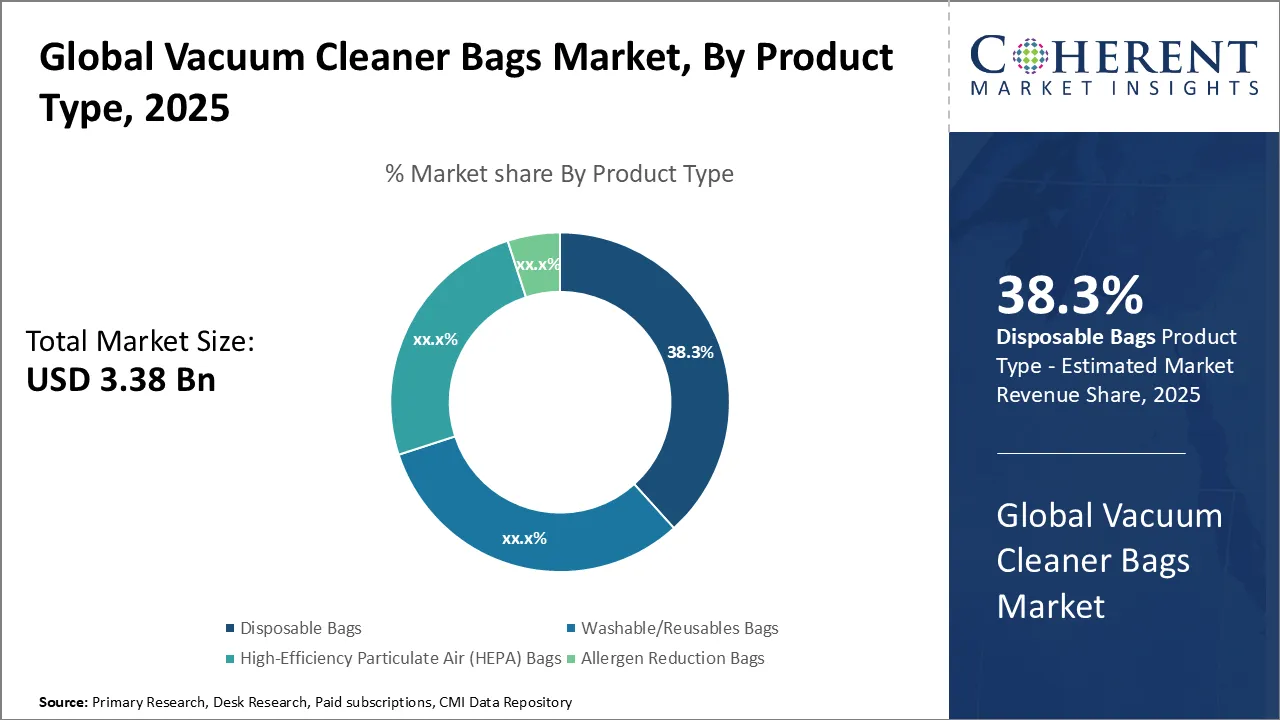
- The disposable bags segment is expected to capture 39.3% of the market in 2026.
- The paper bags segment is projected to hold a 29.5% share of the market in 2026.
- The residential segment is expected to account for 30.7% of the vacuum cleaner bags market in 2026.
- Asia Pacific is set to lead the global vacuum cleaner bags market in 2026 with a 33. 2% share. Europe, with a 21.5% share, will be the fastest-growing region.
Market Overview
A prominent trend in the vacuum cleaner bags market is the shift towards eco-friendly and biodegradable materials as manufacturers respond to growing environmental concerns and the increasing need for plastic waste management. Additionally, advancements in filtration technology are enhancing product performance by improving dust retention and reducing allergens, contributing to the effectiveness of cleaning products. Moreover, the increasing popularity of automated vacuum cleaners that require specialized bags is driving market innovation, while emerging economies present new growth opportunities due to rising urbanization and increasing disposable incomes.
Currents Events and their Impact
Current Events | Description and its impact |
Increasing Product and Technology Innovation (2025) |
|
Competition from Bagless Vacuum Cleaner Systems |
|
Segmental Insights
- Current Industry Events of 2026
- Market Size Estimation
- Regional Breakdown
- Competitive Landscape
- Customer Intelligence
- Segmental Analysis
- Pricing Analysis
- Key Market Drivers, Challenges & Future Trends
- Customized Insights Section
Vacuum Cleaner Bags Market Insights, By Product Type - Disposable Bags Segment Dominates the Market due to their Unmatched Convenience and Hygiene Benefits
Disposable bags segment is expected to hold 39.3% share of the market in 2026, because they offer unparalleled ease of use and superior sanitation compared to reusable options. These bags are designed for one-time use, allowing consumers to simply remove and discard the full bag, eliminating the need for cleaning or maintenance. This convenience appeals especially to busy households and commercial spaces where time efficiency is paramount. Furthermore, disposable bags reduce the risk of cross-contamination and allergen exposure since users avoid direct contact with dust and debris during bag changes. Hygiene concerns have intensified in recent years, prompting increased consumer preference for disposable solutions in vacuum cleaners.
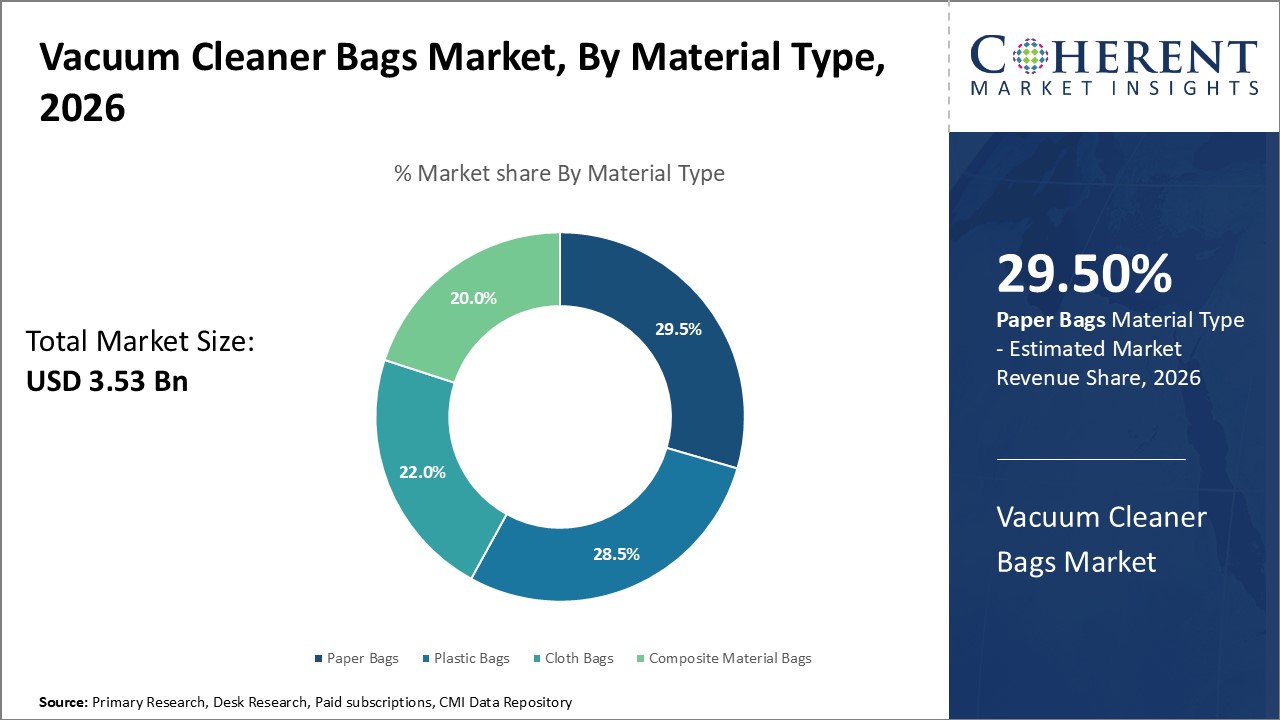
Vacuum Cleaner Bags Market Insights, By Material Type - Paper Bags Segment Dominates the Market Driven by Cost-effectiveness and Strong Filtration Capabilities
Paper bags segment is expected to command 29.5% share of the market in 2026, due to their affordability and excellent filtration properties. Paper bags are manufactured from specialized cellulose fibers designed to trap dust, dirt, and fine particulate matter efficiently while maintaining breathability to ensure optimal airflow within the vacuum. This material provides an effective balance between filtration efficiency and suction performance, contributing to the sustained popularity of paper bags among both residential and commercial consumers.
Cost considerations play a significant role in the prominence of paper bags within the material segmentation. Compared to cloth or composite materials, paper bags are generally less expensive to produce and purchase, making them an attractive option for price-sensitive buyers. Their wide availability and compatibility with most standard vacuum cleaner brands further reinforce their market presence. Additionally, paper bags are typically disposable, aligning with consumer preferences for convenience and hygiene without incurring premium costs associated with washable or reusable variants.
Vacuum Cleaner Bags Market Insights, By End User – Residential Segment Leads due to the Growing Emphasis on Household Cleanliness and Allergy Prevention
The residential segment is projected to hold 30.7% share of the vacuum cleaner bags market in 2026, driven by heightened consumer focus on maintaining clean and healthy living environments. Increased awareness regarding indoor air quality and its impact on health has motivated homeowners to invest in effective vacuum solutions that not only remove visible dirt but also capture microscopic allergens and pollutants. This trend has propelled the demand for efficient vacuum cleaner bags that integrate allergen-reduction technologies, making the residential segment a critical growth driver.
Modern lifestyles, characterized by busy schedules and heightened cleanliness standards, have encouraged consumers to opt for convenient and disposable vacuum cleaner bags that simplify household maintenance. The rising number of dual-income families means less time for extensive cleaning, thereby favoring vacuum solutions that require minimal effort for upkeep. Additionally, the widespread adoption of central vacuum systems and advanced vacuum models in homes is boosting the need for compatible, high-quality vacuum bags.
Regional Insights
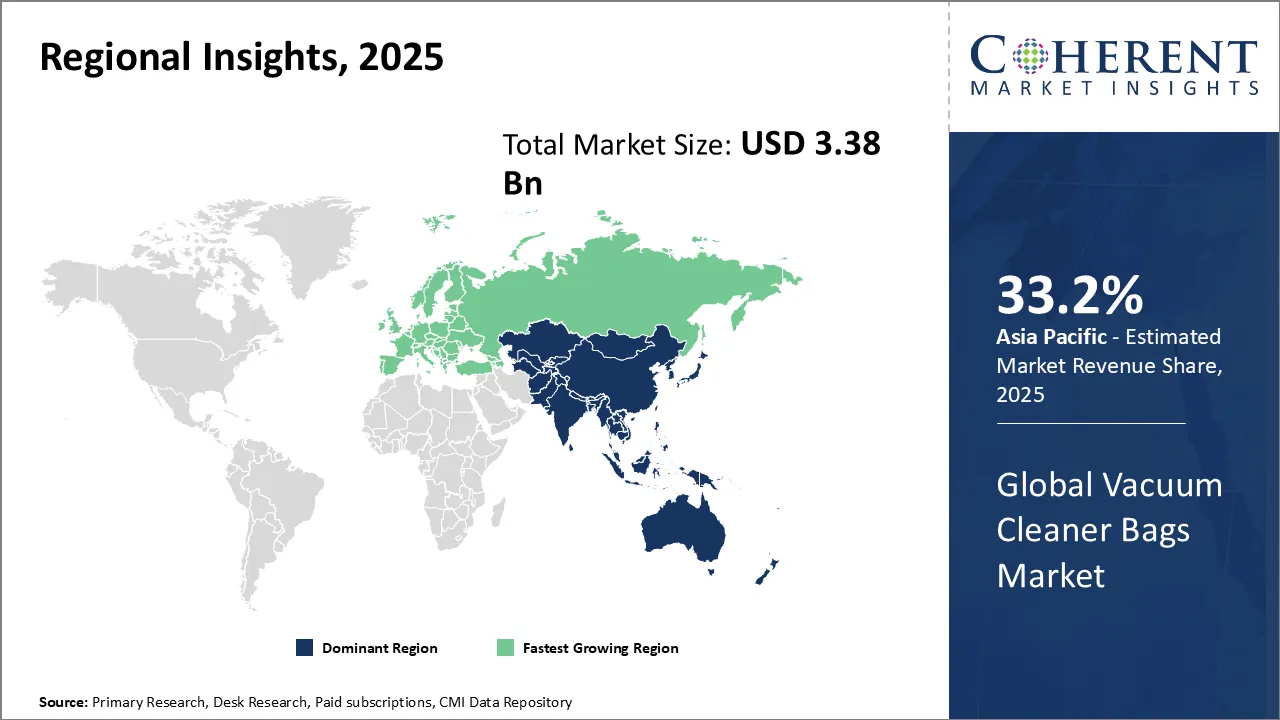
Asia Pacific Vacuum Cleaner Bags Market Analysis and Trends
The Asia Pacific region is projected to lead the market with a 33.2% share in 2026, propelled by expanding urbanization, rising disposable incomes, and increasing awareness about hygiene and cleanliness. The region’s rapidly growing middle-class population is driving demand for household cleaning appliances and related consumables such as vacuum cleaner bags. Governments in countries like China, India, and Japan are focusing on enhancing living standards and supporting domestic manufacturing under initiatives such as “Made in China 2026” and “Make in India,” boosting local industry presence.
Furthermore, large multinational corporations such as Panasonic, Hitachi, and Electrolux have expanded their market presence via partnerships and localized production, making vacuum cleaner bags more accessible and affordable. Trade policies promoting export and import flexibility also enhance product availability and competitive pricing, contributing to the region’s dynamic growth.
Europe Vacuum Cleaner Bags Market Analysis and Trends
The Europe region is expected to exhibit the fastest growth in the market contributing 21.5% share in 2026, driven by the well-established manufacturing infrastructure, stringent environmental regulations, and high consumer awareness regarding indoor air quality. The region benefits from a mature market ecosystem where both demand and supply chains are sophisticated and well-connected. European governments actively promote sustainable household products, encouraging the adoption of efficient vacuum cleaner bags that comply with environmental standards such as REACH and RoHS.
Additionally, the presence of key industry players with strong research and development capabilities—such as Nilfisk, Miele, and Bosch—bolsters the region’s leadership by offering innovative and high-quality vacuum cleaner bags engineered for various vacuum models. Trade dynamics also favor Europe due to strong intra-regional trade agreements and easy access to neighboring markets, further solidifying its dominance.
Global Vacuum Cleaner Bags Market Outlook for Key Countries
U.S. Vacuum Cleaner Bags Market Trends
The U.S. vacuum cleaner market is characterized by high consumer demand for smart and energy-efficient vacuum cleaning solutions, creating a steady need for compatible vacuum cleaner bags. The U.S. benefits from a diverse distribution network comprising major retail chains, e-commerce platforms, and specialty stores. Key players, such as 3M and Hoover, have significant market shares due to their focus on innovation, sustainability, and product variety. The country’s regulatory framework and consumer emphasis on indoor air quality further drive demand for HEPA-filter capable vacuum bags, pushing manufacturers to develop advanced filtration materials.
Germany Vacuum Cleaner Bags Market Trends
Germany’s vacuum cleaner market is shaped by its industrial excellence and stringent environmental standards. German consumers prioritize quality and durability, leading to strong demand for premium vacuum cleaner bags. Local players like Miele, along with subsidiaries of international brands such as Bosch, invest heavily in research to improve bag filtration and eco-friendliness. Government incentives for household energy conservation also influence product development and consumer purchasing behavior. Additionally, Germany’s central location in Europe facilitates export logistics, supporting the regional supply chain's strength.
China Vacuum Cleaner Bags Market Trends
China’s vacuum cleaner market is expanding rapidly due to urban migration and rising middle-class spending on household appliances. The government’s focus on industrial modernization has helped domestic manufacturers improve product quality and output. Local companies such as Haier and TCL play a crucial role by integrating vacuum cleaner bag production with their vacuum cleaner manufacturing, ensuring compatibility and affordability. Furthermore, the increasing penetration of e-commerce allows consumers across urban and semi-urban areas to access a variety of products, accelerating market growth. Trade policies facilitating raw material imports also support manufacturing scalability.
India Vacuum Cleaner Bags Market Trends
India's vacuum cleaner market opportunity is driven by increasing urbanization and a growing awareness of home cleanliness standards. The market is also influenced by government initiatives to boost domestic manufacturing, such as “Make in India,” which encourages local production of vacuum cleaner bags and related accessories. Companies like Eureka Forbes dominate the market, offering a range of vacuum cleaner bags tailored for local consumer needs. Rising adoption of online retail channels is significant, providing expanded reach into smaller cities and towns. Affordability remains a vital factor, shaping manufacturers' product strategies.
Japan Vacuum Cleaner Bags Market Trends
Japan continues to lead in innovation and quality assurance, which directly impacts the vacuum cleaner bags market. Established companies like Panasonic and Hitachi have robust product lines that emphasize technological advancements in filtration efficiency and material durability. Japanese consumers tend to prioritize compact, highly efficient consumer products, pushing manufacturers to tailor vacuum cleaner bags accordingly. Stringent regulations around waste management and air quality encourage advancements in biodegradable and recyclable bag materials.
The Macro and Micro Factors Impacting the Vacuum Cleaner Bags Market
Macro Factors
- Rising awareness of indoor air quality and hygiene: Increasing consumer concern about allergens, dust, and respiratory health is driving demand for high-filtration vacuum cleaner bags, especially HEPA and multi-layer filtration types that capture microscopic particles such as pollen, dust mites, and bacteria.
- Urbanization and demographic shifts: Growth in urban populations, especially in Asia Pacific, expands the customer base for vacuum cleaners and replacement bags.
- Environmental and regulatory pressures: Growing environmental concerns and stricter government regulations require manufacturers to adopt sustainable, eco-friendly, and biodegradable bag materials, affecting production processes and costs.
- Economic factors like GDP growth and disposable income: Rising disposable income, particularly in emerging markets, boosts market expansion.
- Increasing product innovation: Technological advances improve filtration efficiency, bag capacity, and reusable or biodegradable materials to meet consumer demand for quality and sustainability.
- Competition from bagless vacuum cleaners: The popularity of bagless systems, which avoid bag replacement and reduce waste, challenges the traditional vacuum cleaner bags market.
Micro Factors
- Consumer preferences by end-use: Residential users favor medium-sized, HEPA-compatible, and eco-friendly bags for allergy and hygiene concerns. Commercial users require high-capacity, durable bags with advanced filtration for offices, hospitals, and cleaning services.
- Product segmentation by size and filtration type: Large bags for industrial use focus on capacity and durability, medium bags for home and office balance convenience and filtration, and small bags serve handheld and robotic vacuums emphasizing portability and efficiency.
- Manufacturer strategies: Leading companies innovate with multilayer materials, antimicrobial coatings, and filtration improvements to gain competitive advantages in quality-conscious markets.
- Supply chain and production concentration: Major manufacturing hubs like Guangdong, China, support both local demand and exports globally.
Market Players, Key Development, and Competitive Intelligence
Key Developments
- On May 26, 2025, Dyson introduced the world's thinnest wireless vacuum cleaner, PencilVac. Boasting a sleek design with a diameter of just 38 mm, the PencilVac integrates Dyson's latest cutting-edge technology. This marks a significant innovation for the company, as the vacuum is the first to feature the new FluppyCones head, equipped with four conical nylon brushes for enhanced cleaning performance.
Top Strategies Followed by Global Vacuum Cleaner Bags Market Players
- Established companies dominate the industry through significant investments in research and development (R&D), continuously innovating high-performance vacuum cleaner bags that enhance filtration efficiency, durability, and compatibility with a wide range of vacuum models. Additionally, they aggressively expand their global footprint by broadening distribution networks, focusing particularly on emerging markets in Asia Pacific, Latin America, and Africa, thereby capitalizing on rising consumer demand driven by increasing urbanization, rising awareness about indoor air quality, and growing disposable incomes.
- For e`xample, Philips, which has expanded its distribution network in India and China, where rising urbanization and an increasing focus on indoor air quality are driving demand for superior vacuum cleaner products. By tapping into these high-growth regions, they aim to capitalize on increasing disposable incomes and the demand for premium, long-lasting cleaning solutions.
- Mid-level players in the vacuum cleaner bags market primarily adopt cost-effective strategies that position their products as affordable yet reliable alternatives to premium offerings. These companies focus on producing bags that balance quality and price, appealing especially to price-sensitive customer segments in both developed and developing regions. To enhance their competitiveness, mid-tier manufacturers often enter into collaborations and joint ventures with technology providers or larger firms to improve production efficiencies and upgrade their technological capabilities.
- For example, Electrolux offers a variety of vacuum bags that are designed for affordability but still ensure reliable performance. These manufacturers often form partnerships and joint ventures with larger players or technology providers to boost production efficiency and integrate advanced features.
- Small-scale players in the vacuum cleaner bags market carve out niches by concentrating on specialized and innovative product features that distinguish them from larger competitors. They often focus on unique value propositions such as eco-friendly materials, advanced odor control, or bags tailored for specific vacuum cleaner models that may be overlooked by mainstream manufacturers. To remain competitive, these smaller entities adopt cutting-edge technologies, including automation in manufacturing and smart packaging solutions, which help them improve product consistency and appeal to tech-savvy buyers.
Market Report Scope
Vacuum Cleaner Bags Market Report Coverage
| Report Coverage | Details | ||
|---|---|---|---|
| Base Year: | 2025 | Market Size in 2026: | USD 3.53 Bn |
| Historical Data for: | 2020 To 2024 | Forecast Period: | 2026 To 2033 |
| Forecast Period 2026 to 2033 CAGR: | 4.5% | 2033 Value Projection: | USD 4.81 Bn |
| Geographies covered: |
| ||
| Segments covered: |
| ||
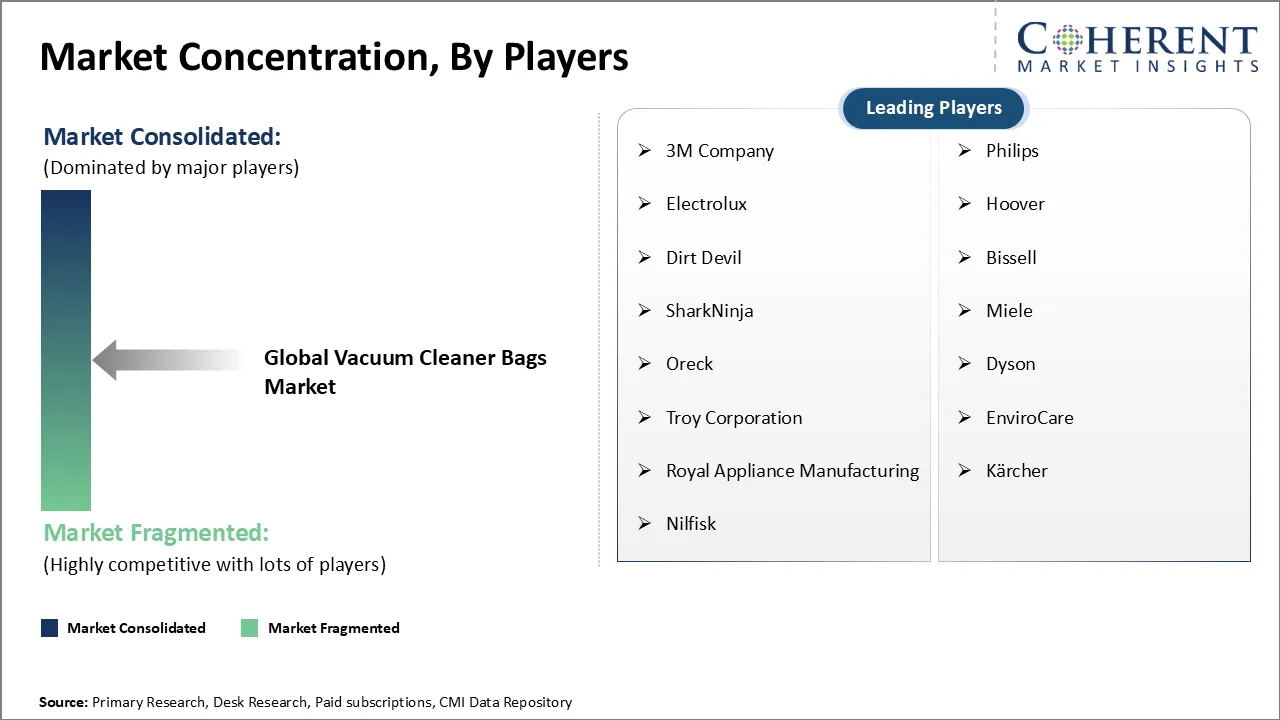
| Companies covered: | 3M Company, Philips, Electrolux, Hoover, Dirt Devil, Bissell, SharkNinja, Miele, Oreck, Dyson, Troy Corporation, EnviroCare, Royal Appliance Manufacturing, Kärcher, and Nilfisk | ||
| Growth Drivers: |
| ||
| Restraints & Challenges: |
| ||
Vacuum Cleaner Bags Market Dynamics
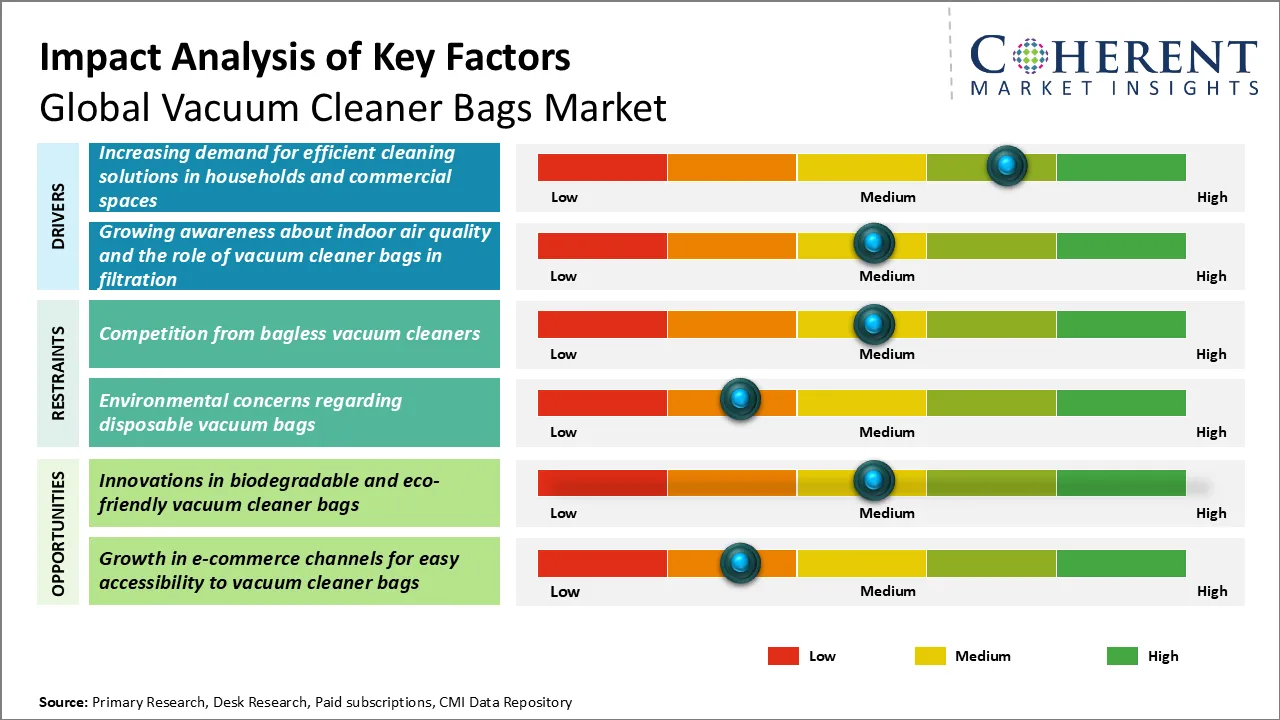
Vacuum Cleaner Bags Market Driver - Increasing Demand for Efficient Cleaning Solutions in Households and Commercial Spaces
The global vacuum cleaner bags market is experiencing a significant boost driven by the increasing emphasis on maintaining cleanliness and hygiene in both residential and commercial environments. As consumers become more health-conscious and aware of the negative impacts of dust, allergens, and pollutants, there is a growing preference for cleaning tools that offer superior filtration and dust containment. Vacuum cleaner bags play a critical role in ensuring that dust particles are effectively trapped and not released back into the environment, making them essential for achieving thorough cleaning results.
In commercial spaces, such as hotels, offices, and hospitals, there is an increasing preference for vacuum cleaners that offer enhanced dust containment to minimize cross-contamination and improve hygiene. The U.S. Environmental Protection Agency (EPA) has also emphasized the importance of effective dust filtration systems in maintaining healthy indoor environments, further driving the demand for vacuum cleaner bags with higher filtration capabilities.
Vacuum Cleaner Bags Market Opportunity - Innovations in Biodegradable and Eco-Friendly Vacuum Cleaner Bags
The global vacuum cleaner bags market stands to benefit significantly from the growing consumer demand for sustainable and environment-friendly products, presenting a promising opportunity through innovations in biodegradable and eco-friendly vacuum cleaner bags. With rising environmental awareness and increasing regulatory pressures to reduce plastic waste, manufacturers are investing in the development of bags made from natural fibers, recyclable materials, and other biodegradable components that decompose more efficiently than traditional plastic-based bags.
Companies like Miele have introduced biodegradable bags made from natural materials that maintain superior filtration efficiency while decomposing within 12-18 months under proper composting conditions. Similarly, manufacturers are exploring bio-based polymers derived from agricultural waste, creating vacuum bags that offer comparable durability and suction performance to conventional alternatives while dramatically reducing environmental impact. According to the European Environment Agency's 2022 report on waste generation, household cleaning equipment accessories, including vacuum bags, account for approximately 2.3 million tons of annual waste across EU member states, with less than 15% currently being recycled or composted, highlighting the substantial opportunity for biodegradable alternatives to capture market share.
Analyst Opinion (Expert Opinion)
- The global vacuum cleaner bags market is poised for noteworthy growth, spurred by increasing consumer awareness of indoor air quality and the rising demand for efficient cleaning solutions. Insights from the International Housewares Association Show (2023) and the Clean Show (2022) underscored the trend towards high-efficiency particulate air (HEPA) filter bags, with brands like Dyson and Miele leading the charge in innovation.
- Dyson's recent introduction of a washable vacuum bag that minimizes waste while maintaining superior filtration exemplifies the shift towards sustainability. Additionally, discussions at these conferences emphasized the importance of compatibility with various vacuum models, as consumers seek versatile options that fit their cleaning needs.
- The market is also witnessing a growing focus on biodegradable materials, aligning with the broader trend of eco-conscious consumerism. Companies that invest in R&D to enhance bag durability and filtration efficiency will likely capture a larger market share. As health and environmental concerns continue to shape purchasing decisions, the future of the vacuum cleaner bags market will depend on innovation, consumer education, and a commitment to sustainability.
Speak to the analyst
Want personalized insights?
Take the findings above to one of our principal consultants, or have the report rebuilt around the segments, geographies and competitors you actually track.
Market Segmentation
- Product Type Insights (Revenue, USD Bn, 2021 - 2033)
- Disposable Bags
- Washable/Reusables Bags
- High-Efficiency Particulate Air (HEPA) Bags
- Allergen Reduction Bags
- Material Type Insights (Revenue, USD Bn, 2021 - 2033)
- Paper Bags
- Plastic Bags
- Cloth Bags
- Composite Material Bags
- End User Insights (Revenue, USD Bn, 2021 - 2033)
- Residential
- Commercial
- Industrial
- Others
- Distribution Channel Insights (Revenue, USD Bn, 2021 - 2033)
- Online
- Offline
- Regional Insights (Revenue, USD Bn, 2021 - 2033)
- North America
- U.S.
- Canada
- Latin America
- Brazil
- Argentina
- Mexico
- Rest of Latin America
- Europe
- Germany
- U.K.
- Spain
- France
- Italy
- Russia
- Rest of Europe
- Asia Pacific
- China
- India
- Japan
- Australia
- South Korea
- ASEAN
- Rest of Asia Pacific
- Middle East
- GCC Countries
- Israel
- Rest of Middle East
- Africa
- South Africa
- North Africa
- Central Africa
- North America
- Key Players Insights
- 3M Company
- Philips
- Electrolux
- Hoover
- Dirt Devil
- Bissell
- SharkNinja
- Miele
- Oreck
- Dyson
- Troy Corporation
- EnviroCare
- Royal Appliance Manufacturing
- Kärcher
- Nilfisk
Sources
Primary Research Interviews
- R&D Director – Leading Vacuum Cleaner Accessories Manufacturer
- Procurement Manager – Major Home Appliance Retailer
- Product Development Head – Well-Known Vacuum Cleaner Brand
- Sustainability Manager – Home Appliance Certification Body
Stakeholders
- Manufacturers
- End-use Sectors
- Household Cleaning Appliance Brands (including vacuum cleaner OEMs)
- Commercial Cleaning Service Providers
- Regulatory & Certification Bodies (appliance standards and safety)
- E-commerce Platforms and Retailers
- Technology Integration Players Smart appliance and filtration technology providers
Databases
- UN Comtrade Database
- India Import Export (EXIM) Database
Magazines
- Home Appliance Magazine – Trends in cleaning technology and consumables
- Cleaning Industry Review – Innovations in vacuum cleaner accessories
- Global Home Tech Insights – Consumer appliance usage and market updates
- Appliance Business Journal – Market updates for household cleaning tools
- The Cleaning Guide – Industry trends and supply chain updates for vacuum cleaner consumables
Journals
- Journal of Home Appliance Science & Engineering – Innovations in cleaner bag materials and filtration
- Journal of Consumer Technology – Product innovation and adoption trends
- International Journal of Indoor Air Quality – Impact of vacuum cleaner bags on air filtration
- Journal of Cleaning Science – Efficiency and environmental impact of disposable vs reusable bags
- Applied Appliance Research – Usage and lifecycle of cleaner bags in domestic and commercial settings
Newspapers
- The Financial Times – Market growth for household cleaning accessories
- The Guardian – Consumer trends in cleaning products and appliances
- Asia Home Tech Journal – Appliance consumable growth in Asia-Pacific
- European Appliance News – Regulation and market policy overview for cleaner accessories
- The New York Times – Shift in consumer preferences toward eco-friendly cleaning solutions
Associations
- Association of Home Appliance Manufacturers (AHAM)
- International Cleaning Equipment Association
- European Committee for Standardization (CEN) – Household appliance standards
- Clean Label Project
- Environmental Working Group (EWG)
- Sustainable Appliance Coalition
Public Domain Sources
- U.S. FDA – Consumer product safety guidelines for household goods
- European Commission – Appliance standards and waste management policy
- World Health Organization – Indoor air quality and health guidelines
Proprietary Elements
- CMI Data Analytics Tool, Proprietary CMI Existing Repository of information for last 8 years.
Get access to 250+ pages report
Every segment, forecast, competitor profile and data table behind the analysis above — available for instant download.
- ESOMAR Member
- ISO 9001:2015 Certified
- D-U-N-S Registered
- GDPR & CCPA Compliant
Missing comfort of reading report in your local language? Find your preferred language:
Transform your Strategy with Exclusive Trending Reports
Frequently Asked Questions
The global vacuum cleaner bags market is estimated to be valued at USD 3.53 Bn in 2026 and is expected to reach USD 4.81 Bn by 2033.
Choose vacuum cleaner bags based on your vacuum model, bag type (disposable or reusable), and the specific filtration needs, such as HEPA for allergens.
Vacuum cleaner bags typically last 1 to 3 months, depending on usage and the type of debris collected.
The CAGR of global vacuum cleaner bags market is projected to be 4.5% from 2026 to 2033.
Increasing demand for efficient cleaning solutions in households and commercial spaces and growing awareness about indoor air quality and the role of vacuum cleaner bags in filtration are the major factors driving the growth of the global vacuum cleaner bags market.
Competition from bagless vacuum cleaners and environmental concerns regarding disposable vacuum bags are the major factors hampering the growth of the global vacuum cleaner bags market.
In terms of product type, disposable bags are estimated to dominate the market revenue share in 2026.