

Global Vehicle Roadside Assistance Market Size and Share Analysis - 2026 to 2033
The vehicle roadside assistance market is estimated to be valued at USD 28.67 Bn in 2026 and is expected to reach USD 41.98 Bn by 2033, growing at a compound annual growth rate (CAGR) of 5.6% from 2026 to 2033.
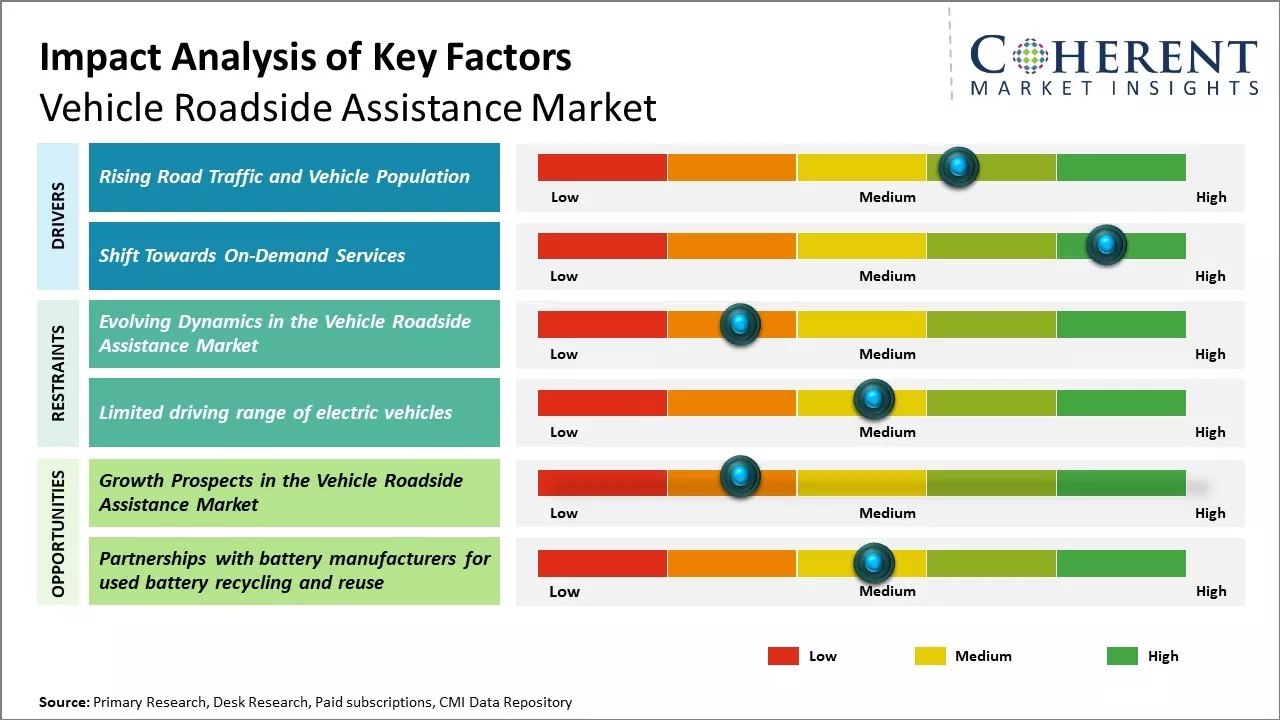
Key Takeaways
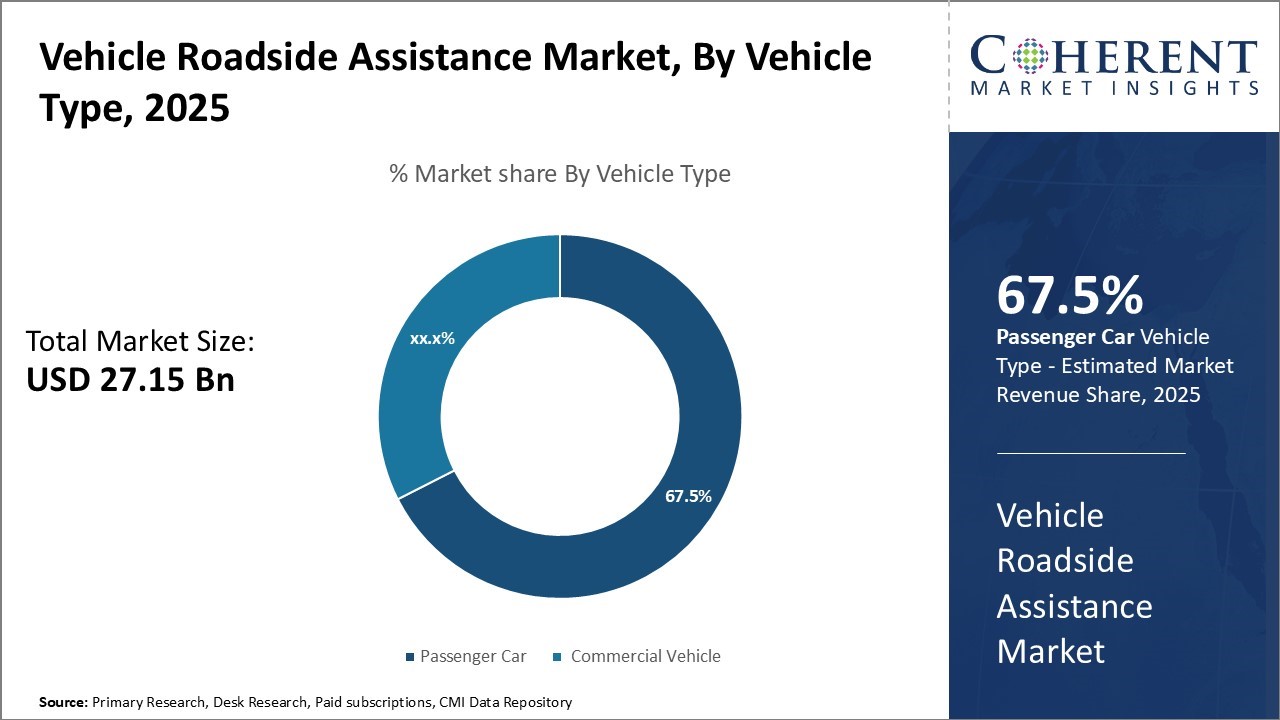
- In terms of Vehicle Type, Passenger Car Division contributes the highest share of 68.5%in 2026 in the market. This is due to the convenience and safety it offers customers.
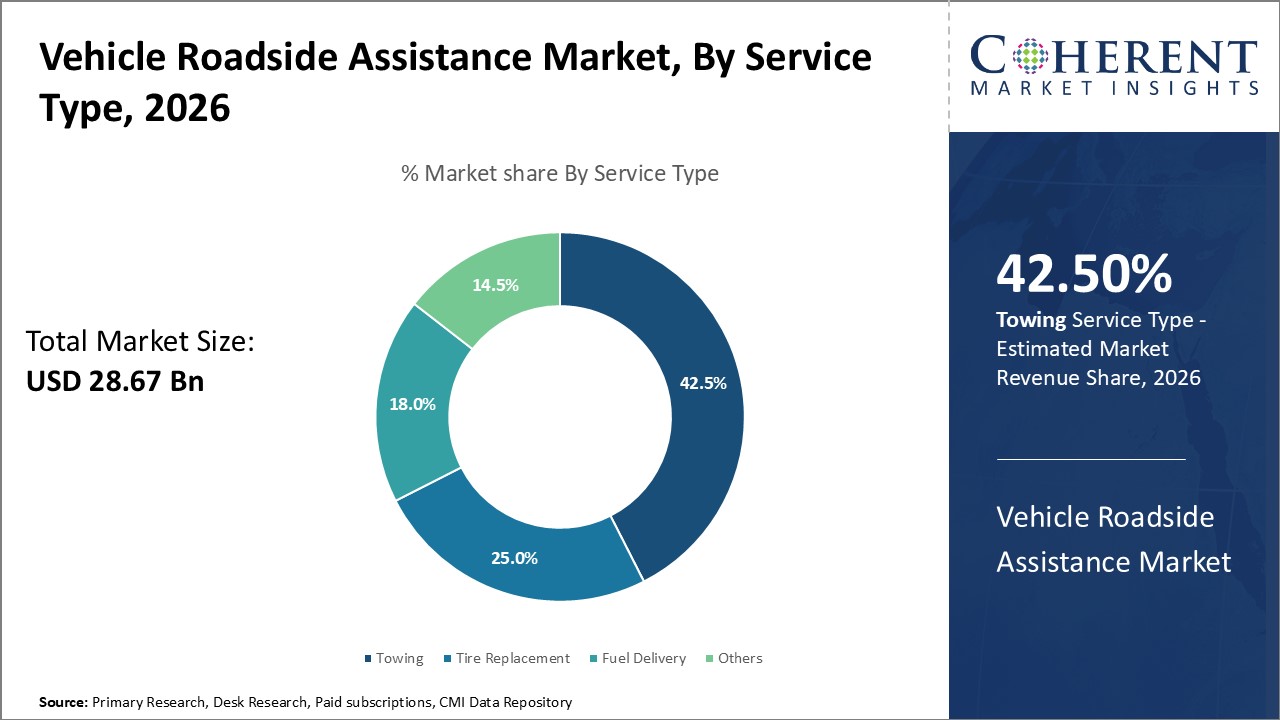
- In terms of Service Type, Towing Contributes Segment the highest share 42.5%in 2026 of the market. This is due to the crucial support it provides commercial vehicles.
- In terms of Providers, Motor Insurance Type contributes the highest share of 32.5%in 2026 of the market. This is owing to its bundling of coverage.
- North America holds dominant position with 29.5% market share for vehicle roadside assistance services.
Market Overview
The vehicle roadside assistance market is driven by factors such as increasing traffic volumes leading to higher chances of breakdowns, the proliferation of automotive subscription plans that bundle roadside services, and growth in advanced services such as accident assistance, winching, and car rental. Yet, the advent of autonomous cars and car-sharing might decrease demand for conventional roadside service in the long term.
Current Events and Its Impacts on Vehicle Roadside Assistance Market
Current Events | Description and its impact |
AANT Deploys Mobile EV Charging Van in Darwin |
|
GoMechanic Introduces 'Top Assist' Roadside Assistance in India |
|
Emergence of New Technologies in Vehicle Roadside Assistance Market
The car roadside assistance business is evolving very quickly with the implementation of advanced technologies that improve the efficiency of services, security, and customer satisfaction. The most applicable technology development is the use of artificial intelligence (AI) and machine learning algorithms to improve dispatching and forecast vehicle breakdowns in advance. AI platforms examine real-time data from car telematics and traffic feeds to dispatch help more quickly and precisely, lowering response time and operating expenses.
The second significant innovation is the application of Internet of Things (IoT) embedded devices in vehicles. These sensors continuously track important parameters like tire pressure, battery condition, and engine diagnosis and provide early intimation to drivers and roadside assistance centers about likely faults. Early maintenance in this way reduces the risk of breakdown and allows for faster service intervention on fault detection.
Mobile applications and online websites have also revolutionized roadside assistance by enabling customers to request assistance, track the location of service vehicles in real-time, and receive live updates on estimated arrival times. High-technology GPS and geofencing technology provides precise tracking by location, which is particularly useful when driving through remote or new areas.
- Current Industry Events of 2026
- Market Size Estimation
- Regional Breakdown
- Competitive Landscape
- Customer Intelligence
- Segmental Analysis
- Pricing Analysis
- Key Market Drivers, Challenges & Future Trends
- Customized Insights Section
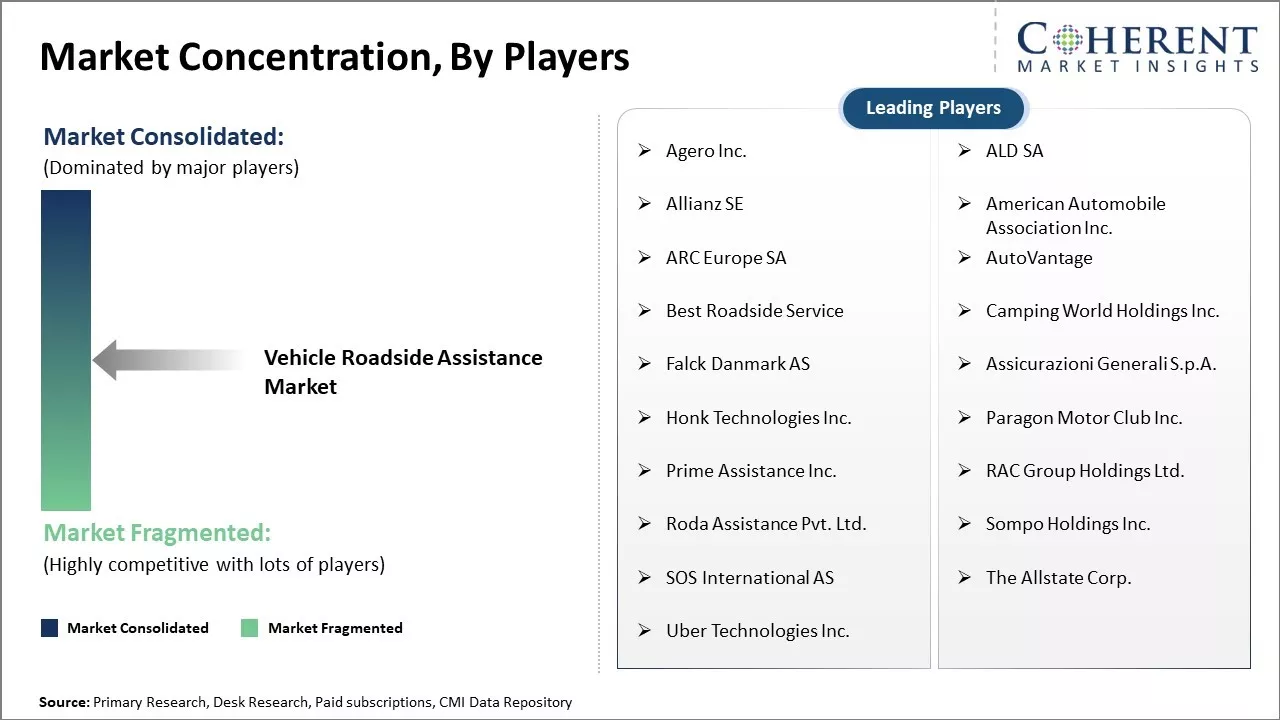
Market Concentration and Competitive Landscape
Market Drivers
- Rising Road Traffic and Vehicle Population
As vehicle ownership continues to increase rapidly across both developed and developing nations, so does the frequency of roadside complications like accidents, breakdowns, flat tires, and others. With ever more cars, trucks, motorcycles, and other vehicles traveling busy road networks each day, the chances of something going wrong along the way inevitably rise.
Many modern vehicles have become more computerized and electronically intricate under their hoods as well, meaning minor issues could potentially disable a vehicle if not addressed promptly. The surge in vehicle populations strains infrastructure and increases traffic congestion too, compounding accident and malfunction risks in some cases. Drivers realize they need a helping hand they can depend on to tow, jumpstart, or fix their vehicles whenever emergencies strike, sparing them potential costs and consequences of being stranded by the roadside.
Roadside assistance providers aim to fulfill this vital and growing demand. The NRMA (formerly National Roads and Motorists' Association) recorded a 17% YoY increase in roadside assistance memberships by 2025, reaching 3.4 million members across Australia.
- Shift towards On-demand Services
Consumers' preferences are clearly evolving towards on-demand, app-based services that deliver speed, convenience, and value. Ride-hailing apps showed how a modern, tech-enabled approach could revolutionize transportation. Now, even industries like roadside assistance are being disrupted as tech-savvy operators launch digital platforms empowering drivers with immediate assistance at the touch of a button.
Drivers stuck in a jam or broke down in an unfamiliar location appreciate the quick response and transparency these new programs provide. Their standardized, consistent nationwide coverage also gives peace of mind whether at home or traveling abroad. Over time, drivers may become accustomed to the simplicity and advantages of digital roadside services over traditional phone-based models. This disruption encourages both legacy operators and startups to digitize and customize their offerings, remaining competitive in a dynamic marketplace where convenience is king.
Vehicle Roadside Assistance Market Opportunities
- Growth Prospects in the Vehicle Roadside Assistance Market
There are still significant growth opportunities in this market. As more drivers use their vehicles for long distance travelling, the potential need for roadside assistance away from home increases. Advanced connected cars with telematics systems will also drive the integration of roadside services.
Segmental Insights
Vehicle Roadside Assistance Market Insights, By Vehicle Type
In terms of vehicle type, passenger car contributes the highest share of 68.5% in 2026 in the market owing to the convenience and safety it offers customers. With busy work schedules and long commutes becoming commonplace, vehicle breakdowns can lead to significant hassles and delays.
Roadside assistance services give passenger car owners peace of mind by providing on-call support for any issues while traveling. Whether it is a flat tire, empty automotive fuel tank, dead battery, or mechanical failure, calling a single number allows one to get the problem addressed quickly without any stress. This convenient one-stop solution is a key reason for its popularity among private vehicle users.
Safety is another important factor, as being stranded on the road alone can be risky, especially at night. Immediate towing or repair assistance ensures passengers reach their destination safely. For many families with elderly parents or young children, this added security of having roadside help just a phone call away makes passenger cars a more reliable option than other modes of transportation. Insurance packages and automobile association memberships frequently bundle such coverage, further increasing accessibility for the mass market of passenger vehicle drivers.
Vehicle Roadside Assistance Market Insights, By Service Type
In terms of service type, towing contributes the highest share 42.5% in 2026 of the market due to the crucial support it provides commercial vehicles. Large freight trucks, trailers, buses, and other commercial fleet operations have zero downtime tolerances as delays directly impact timelines and productivity. Breakdowns not only stall operations but can also block traffic on highways posing a hazard. 24/7 on-call towing teams ensure that flat tires, engine failures, or accidents are addressed instantly to clear the road and get vehicles back in operation without loss of time.
Heavy freight requires special heavy duty tow trucks with capabilities to haul massive loads safely. Timely assistance is even more critical for long-haul trucks far away from bases. Towing contracts minimize disruption and losses and are an indispensable cost for commercial transportation services. Similarly, public transit agencies rely on towing assistance to minimize delays during rush hours. The infrastructure and equipment required to handle a range of commercial vehicles at short notice makes towing the most critical roadside service category for commercial operations.
Vehicle Roadside Assistance Market Insights, By Providers
In terms of providers, motor insurance contributes the highest share of 32.5% in 2026 of the market owing to its bundling of coverage. Unlike automobile clubs requiring annual subscriptions, insurance policies are a mandatory ongoing expenditure for commercial and private vehicle owners. Leveraging existing policyholder relationships and billing infrastructure, insurers can offer roadside services as value-added coverage with negligible incremental costs.
This bundled offering is highly convenient for customers as a single renewal takes care of multiple needs. Insurers also benefit from increased customer stickiness and opportunities for cross-selling other products. With assistance bundled as a policy add-on, coverage adoption becomes effortless. Additionally, insurers have large databases that enable dispatch of the nearest assistance provider swiftly for fastest response times. The synergy of existing motor insurance penetration and bundling strategy has made insurance the dominant provider channel for vehicle roadside services.
Regional Insights
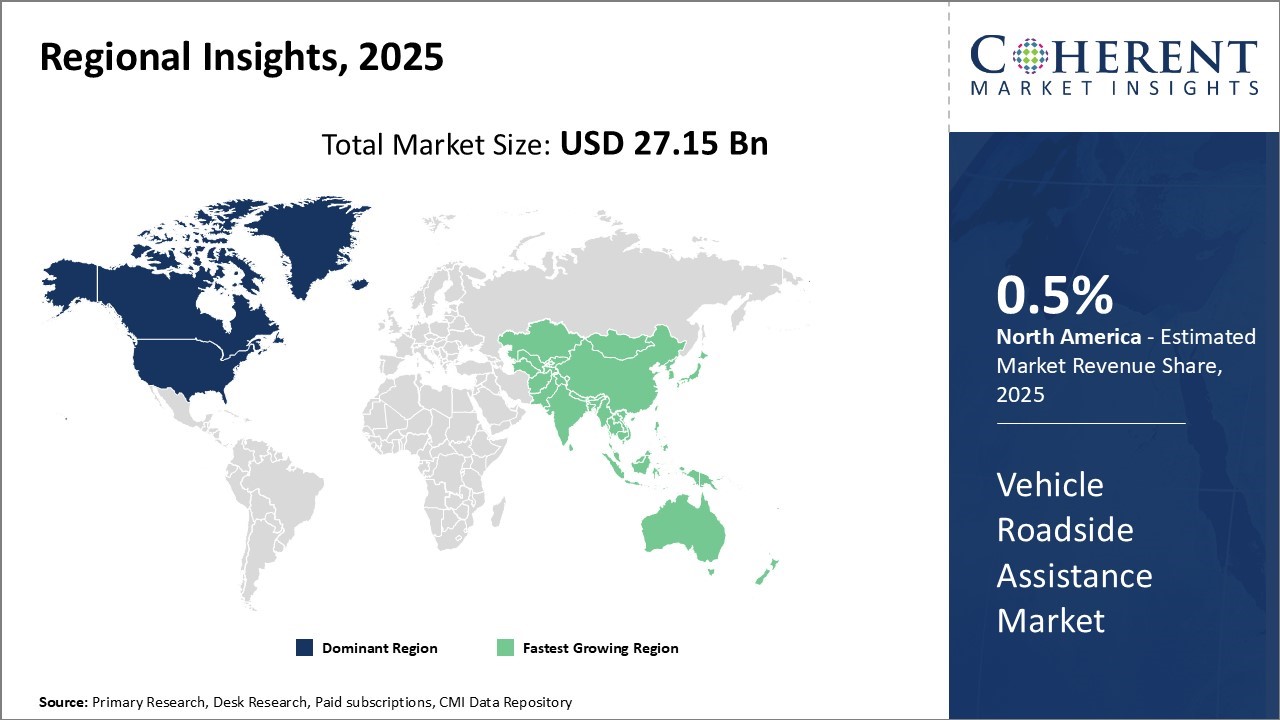
North America Vehicle Roadside Assistance Market Analysis and Trends
North America has established itself as the dominant regional market for vehicle roadside assistance services. The large size of the vehicle consisting of over 250 million vehicles has necessitated robust roadside assistance infrastructure in the region. Further bolstering market growth is the highly developed road networks spanning over 6 million miles that see heavy traffic. This exposes vehicles to a higher chance of breakdowns requiring roadside assistance providers.
The presence of leading global roadside assistance players, such as AAA, Allstate Roadside Services, and Agero, have created a saturated market structure. Years of market penetration have led to entrenched brand recognition and recall amongst drivers. Service operators leverage advanced technologies like automatic vehicle location for quick dispatch of assistance vehicles. The connectivity allows real-time tracking of road incidents. Insurers also offer roadside assistance add-ons, driving the need for a large network of service providers.
Asia Pacific Vehicle Roadside Assistance Market Analysis and Trends
Asia Pacific has emerged as the fastest growing marketplace for vehicle roadside assistance. Rapid motorization rates accompanied by improving economic conditions have boosted vehicle ownership in densely populated countries like China and India. As per capita incomes rise across the region, road infrastructure expansion is attempting to keep up with this growth in road usage. However, inadequate access to timely breakdown support persists, representing untapped market potential.
Vehicle Roadside Assistance Market Dominating Countries
United States Vehicle Roadside Assistance Market Analysis and Trend
The US is the leader in the vehicle roadside assistance market due to its huge vehicle fleet and robust automotive service network. Robust consumer awareness, high subscription-based services penetration, and advanced telematics integration drive demand. The market also gets a boost from the presence of robust players like AAA and OnStar, coupled with mandatory automobile safety regulations.
Germany Vehicle Roadside Assistance Market Analysis and Trend
Germany dominates the roadside assistance market in Europe with the help of a spread commercial vehicle fleet and a strong automotive industry. Brands like ADAC dominate through extensive roadside cover. Germany's focus on technology and premium vehicle ownership drives the uptake of high-tech assistance services.
Market Report Scope
Vehicle Roadside Assistance Market Report Coverage
| Report Coverage | Details | ||
|---|---|---|---|
| Base Year: | 2025 | Market Size in 2026: | USD 28.67 Bn |
| Historical Data for: | 2020 To 2024 | Forecast Period: | 2026 To 2033 |
| Forecast Period 2026 to 2033 CAGR: | 5.6% | 2033 Value Projection: | USD 41.98 Bn |
| Geographies covered: |
| ||
| Segments covered: |
| ||
| Companies covered: | Agero Inc., ALD SA, Allianz SE, American Automobile Association Inc., ARC Europe SA, AutoVantage, Best Roadside Service, Camping World Holdings Inc., Falck Danmark AS, Assicurazioni Generali S.p.A., Honk Technologies Inc., Paragon Motor Club Inc., Prime Assistance Inc., RAC Group Holdings Ltd., Roda Assistance Pvt. Ltd., Sompo Holdings Inc., SOS International AS, The Allstate Corp., and Uber Technologies Inc. | ||
| Growth Drivers: |
| ||
| Restraints & Challenges: |
| ||
Vehicle Roadside Assistance Market Industry News
- In January 2025, Allianz Partners India was granted a patent for its 20 kW Portable Mobile Charger (PMC), CCS and CHAdeMO compatible. The system, installed in key cities such as Delhi, Mumbai, Pune, Bengaluru, and Hyderabad, charges EVs on the roadside and even maintains two-wheeler EVs.
- In December 2024, Motive introduced its AI-powered roadside assistance platform, delivering 24/7/365 support for commercial fleets. With advanced analytics and telematics integration, the platform dispatches at peak efficiency and simplifies remote breakdown management.
Analyst View
- The vehicle roadside assistance market is witnessing significant growth, primarily driven by increasing vehicle ownership, rising passenger vehicle sales in emerging nations, and growing consumer awareness regarding convenience and vehicle safety. Additionally, the expanding urbanization trend combined with greater vehicle density enhances the demand for immediate roadside support services. Furthermore, an aging vehicle fleet and a rise in vehicle breakdowns significantly contribute to market demand, providing further stimulus for market growth.
- However, despite these promising growth drivers, challenges related to high operational costs and service infrastructure requirements pose restraints to market development. Limited awareness and low adoption rates of roadside assistance services in rural regions and certain developing countries also hinder market penetration. Moreover, the presence of local unauthorized service vendors offering low-priced alternatives creates competitive pressures that may restrict revenue growth for established roadside assistance providers.
- Collaborations and partnerships between automotive manufacturers, insurance providers, and technology companies also open new channels for customer acquisition and expansion. Regionally, North America continues to dominate the roadside assistance market, supported by a robust automotive market, developed infrastructure, and consumer preference for subscription-based services.
Market Segmentation
- Vehicle Type (Revenue, USD Bn, 2021 - 2033)
- Passenger Car
- Commercial Vehicle
- Service Type (Revenue, USD Bn, 2021 - 2033)
- Towing
- Tire Replacement
- Fuel Delivery
- Others
- Providers
- Auto Manufacturers
- Motor Insurance
- Independent Warranty
- Automotive Clubs
- Regional
- North America
- U.S.
- Canada
- Latin America
- Brazil
- Argentina
- Mexico
- Rest of Latin America
- Europe
- Germany
- U.K.
- Spain
- France
- Italy
- Russia
- Rest of Europe
- Asia Pacific
- China
- India
- Japan
- Australia
- South Korea
- ASEAN
- Rest of Asia Pacific
- Middle East
- GCC Countries
- Israel
- Rest of Middle East
- Africa
- South Africa
- North Africa
- Central Africa
- Key Players Insights
- Agero Inc.
- ALD SA
- Allianz SE
- American Automobile Association Inc.
- ARC Europe SA
- AutoVantage
- Best Roadside Service
- Camping World Holdings Inc.
- Falck Danmark AS
- Assicurazioni Generali S.p.A.
- Honk Technologies Inc.
- Paragon Motor Club Inc.
- Prime Assistance Inc.
- RAC Group Holdings Ltd.
- Roda Assistance Pvt. Ltd.
- Sompo Holdings Inc.
- SOS International AS
- The Allstate Corp.
- Uber Technologies Inc.
Sources
Primary Research Interviews
- Senior Executives from Roadside Assistance Providers
- Industry Experts in Automotive Services
- Representatives of Automotive Insurance Companies
- Professionals from Vehicle Telematics Solutions Providers
- Others
Magazines
- Automotive News
- AutoTech Review
- Aftermarket Business World
- Motor Trend
- Others
Journals
- International Journal of Automotive Technology
- Journal of Transport Economics and Policy
- SAE International Journal of Automotive Engineering
- Others
Newspapers
- The Wall Street Journal
- Automotive Industry News
- Financial Times
- Business Standard
- Others
Associations
- American Automobile Association (AAA)
- International Road Federation (IRF)
- Automotive Aftermarket Suppliers Association (AASA)
- European Automobile Manufacturers Association (ACEA)
- Others
Public Domain Sources
- Organization for Economic Co-operation and Development (OECD)
- World Bank Data
- National Highway Traffic Safety Administration (NHTSA)
- Federal Motor Carrier Safety Administration (FMCSA)
- Others
Proprietary Elements
- CMI Data Analytics Tool
- Proprietary CMI Existing Repository of information for last 8 years
Get access to 250+ pages report
Every segment, forecast, competitor profile and data table behind the analysis above — available for instant download.
- ESOMAR Member
- ISO 9001:2015 Certified
- D-U-N-S Registered
- GDPR & CCPA Compliant
Missing comfort of reading report in your local language? Find your preferred language:
Transform your Strategy with Exclusive Trending Reports
Frequently Asked Questions
The Vehicle Roadside Assistance Market size is estimated to be valued at USD 28.67 Bn in 2026, and is expected to reach USD 41.98 Bn by 2033.
The CAGR of the Vehicle Roadside Assistance Market is projected to be 5.6% from 2026 to 2033.
Rising road traffic and vehicle population and shift towards on-demand services are the major factors driving the growth of the market.
Evolving dynamics in the vehicle roadside assistance market and limited driving range of electric vehicles are the major factors hampering the growth of the market.
In terms of vehicle type, passenger car is estimated to dominate the market revenue share in 2026.
Agero Inc., ALD SA, Allianz SE, American Automobile Association Inc., ARC Europe SA, AutoVantage, Best Roadside Service, Camping World Holdings Inc., Falck Danmark AS, Assicurazioni Generali S.p.A., Honk Technologies Inc., Paragon Motor Club Inc., Prime Assistance Inc., RAC Group Holdings Ltd., Roda Assistance Pvt. Ltd., Sompo Holdings Inc., SOS International AS, The Allstate Corp., and Uber Technologies Inc. are the major players.
North America is expected to lead the global market in 2026.