

Global Water Dispenser Market Size and Forecast: 2026-2033
The Global Water Dispenser Market is estimated to be valued at USD 3.33 Bn in 2026 and is expected to reach USD 4.72 Bn by 2033, exhibiting a compound annual growth rate (CAGR) of 5.1% from 2026 to 2033.
Key Takeaways of the Water Dispenser Market
- The bottled water dispensers segment leads the market holding an estimated share of 71.4% in 2026.
- North America is estimated to lead the market with a share of 37. 6% in 2026.
- Asia Pacific, holding a share of 24. 4% in 2026, is projected to be the fastest growing region.
Market Overview
Market trends indicate a strong shift towards energy-efficient and smart water dispensers equipped with advanced filtration technologies. Consumers are increasingly prioritizing hygienic water dispensing options, pushing manufacturers to innovate with touchless operation and IoT connectivity. Sustainability is also gaining traction, with eco-friendly designs and materials becoming key differentiators, signaling the market’s evolution toward combining convenience, safety, and environmental consciousness.
Current Events and their Impact
Current Events | Description and its impact |
Geopolitical and Trade Developments |
|
Economic and Infrastructure Trends |
|
Segmental Insights
- Current Industry Events of 2026
- Market Size Estimation
- Regional Breakdown
- Competitive Landscape
- Customer Intelligence
- Segmental Analysis
- Pricing Analysis
- Key Market Drivers, Challenges & Future Trends
- Customized Insights Section
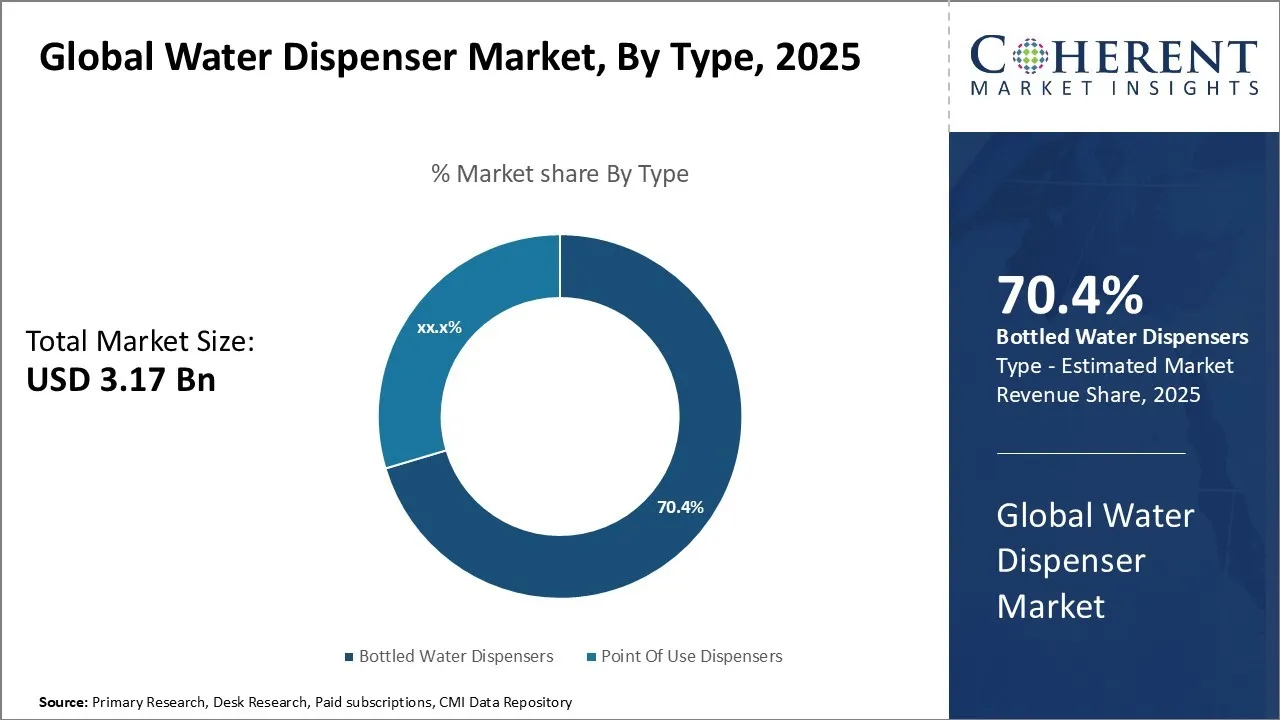
Global Water Dispenser Market Insights, By Type – Convenience and Accessibility are Fueling Growth of Bottled Water Dispensers
Bottled water dispensers are expected to contribute the highest share of 71.4% in the market in 2026. One of the primary reasons for the dominance of bottled water dispensers is their ability to provide purified drinking water without the need for direct plumbing connections. This makes them particularly attractive in environments where installation of fixed water lines is either impractical or costly, such as in small offices, rental spaces, outdoor events, and residential areas lacking water infrastructure.
The convenience factor is further enhanced by the portability of bottled water dispensers, which allows users to easily switch locations or replace empty water bottles with minimal effort. This flexibility appeals both to end consumers and businesses looking for hassle-free hydration solutions. Additionally, bottled water dispensers often come with options for hot and cold water, meeting diverse preferences and needs with a single appliance.
An increasing emphasis on health and safety also supports the popularity of this segment. Consumers are more conscious about water quality and tend to trust bottled water over tap water, which aligns well with the functionality offered by bottled water dispensers. These dispensers provide a controlled environment that ensures water remains uncontaminated until consumption, enhancing user confidence.
Furthermore, the availability of a wide range of bottled water options—from spring to mineral-enriched waters—enables tailored consumer choice, supporting premiumization trends within the segment. This breadth of choice is complemented by advancements in dispenser technology, including improved filtration systems and energy-efficient cooling and heating mechanisms, making bottled water dispensers more appealing and cost-effective over time.
Price Analysis of the Water Dispenser Market
Segment | Estimated Average Price per Unit (USD) |
Bottled Water Dispensers | USD 350 |
Bottle‑less (POU) Dispensers | USD 450 |
Regional Insights
North America Water Dispenser Market Analysis and Trends
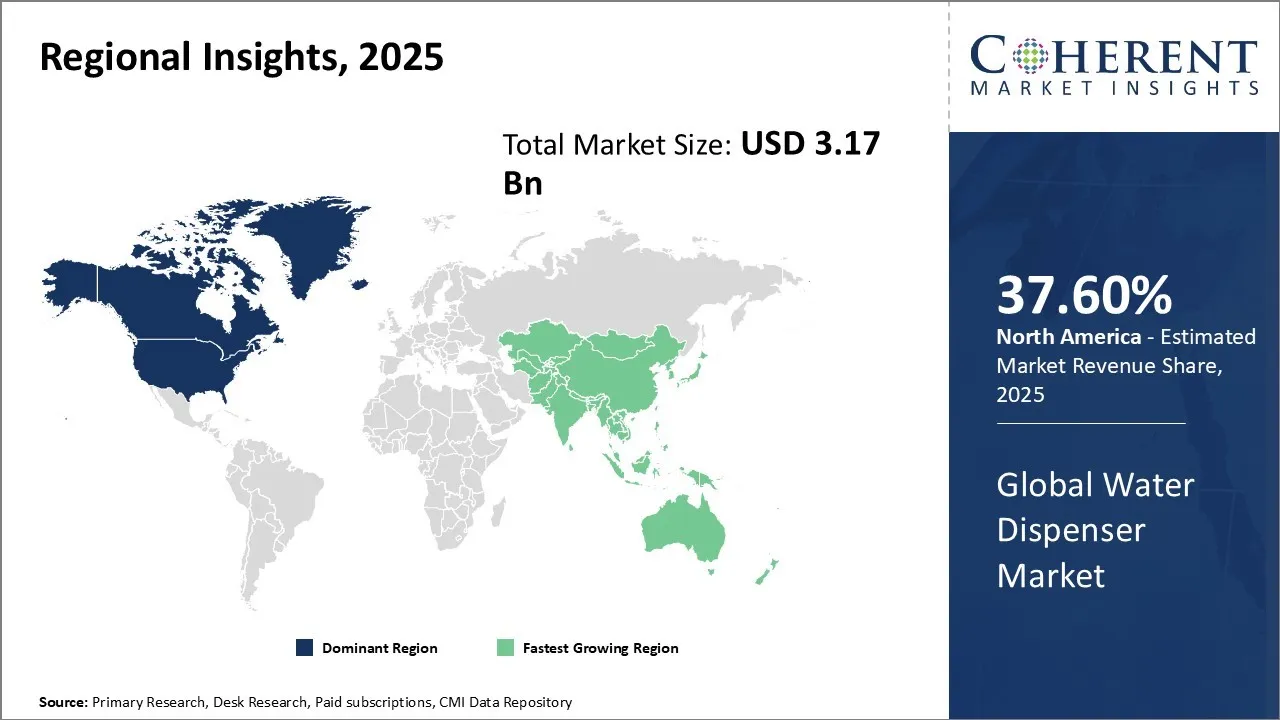
North America, holding a share of 37.60% in 2026, is expected to dominate in the global water dispenser market, driven by a well-established market ecosystem characterized by advanced infrastructure, strong consumer awareness, and widespread adoption of hydration solutions in both residential and commercial spaces. The region benefits from stringent government regulations and health standards that encourage the use of purified and filtered water solutions, thereby fostering the demand for water dispensers. The presence of major industry players such as Culligan, Primo Water Corporation, and Avalon contributes to continuous innovation in product design and functionality, catering to diverse consumer preferences. Additionally, North America’s efficient trade logistics and distribution channels ensure product availability across multiple retail and online platforms, consolidating its leadership position in the market.
Asia Pacific Water Dispenser Market Analysis and Trends
The Asia Pacific region, holding a share of 24.4% in 2026, is expected to exhibit the fastest growth in the global water dispenser market, supported by rapidly urbanizing populations, increasing disposable incomes, and rising awareness around water quality and health. Governments across countries such as China and India have been actively promoting clean drinking water initiatives, which indirectly boost water dispenser adoption. The region’s expanding commercial sector—from offices to hospitality and healthcare—adds to the demand for convenient water dispensing solutions. Moreover, Asia Pacific hosts a variety of domestic and multinational companies like Midea Group, Blue Star, and Kent RO Systems, which innovate extensively to meet local consumer needs, including affordable and energy-efficient dispensers. Trade dynamics favor regional manufacturing hubs with lower production costs, enhancing the availability and affordability of these products.
Global Water Dispenser Market Outlook for Key Countries
U.S. Water Dispenser Market Analysis and Trends
The U.S. is marked by high consumer preference for technologically advanced and eco-friendly water dispensers, including smart and touchless models. Major players such as Avalon and Primo Water emphasize product innovation backed by extensive distribution networks across retail giants and online platforms. Government awareness campaigns about water quality and health safety further stimulate demand, alongside a robust commercial infrastructure that supports large-scale adoption.
China Water Dispenser Market Analysis and Trends
China water dispenser market benefits significantly from the government’s strong focus on water purification and safe drinking water initiatives. Leading domestic manufacturers like Midea Group and Haier leverage their manufacturing scale and R&D capabilities to introduce innovative, cost-effective products tailored to diverse consumer needs. Urbanization trends and the rise of commercial establishments propel the market’s expansion, while export-oriented manufacturing boosts trade growth in the sector.
India Water Dispenser Market Analysis and Trends
India is driven by increasing health consciousness and government programs aimed at ensuring access to safe drinking water. Companies such as Kent RO Systems and Blue Star have carved significant market shares by offering affordable water dispensers with built-in purification systems adapted to local water conditions. The growing middle class and expanding corporate and educational institutions fuel demand across both residential and commercial segments.
Germany Water Dispenser Market Analysis and Trends
Germany continues to lead the Europe water dispenser market due to rigorous environmental standards and consumer preference for sustainable and energy-efficient appliances. Local and regional players, including Grohe and Kärcher, focus on integrating eco-friendly technologies and enhancing product durability. The country’s mature distribution networks and stable economic environment create a strong marketplace for premium and innovative water dispensing solutions.
Brazil Water Dispenser Market Analysis and Trends
Brazil is witnessing notable growth due to increasing urbanization and rising awareness about water contamination issues. The presence of regional manufacturers and importers facilitates a growing product variety for consumers. Companies such as IBBL and Brastemp play a vital role in catering to Brazil’s diverse consumer needs, emphasizing affordable solutions suited to both urban and semi-urban settings. Government efforts to improve water quality indirectly support water dispenser adoption, especially in residential households.
Market Players, Key Development, and Competitive Intelligence
Key Developments
- In July 2025, ANGEL, a water purifier brand from China, announced a significant partnership with two Thai entities: Mazuma and HomePro. This collaboration aims to develop innovative water purification technologies, enhance accessibility to products, and elevate service standards in Thailand.
- In April 2025, Elkay launched its new residential bottle filling station: the Liv EZ Built-in Filtered Water Dispenser. Ideal for remodel projects, the Liv EZ redefines convenience with its user-friendly design and hassle-free installation.
- In March 2025, Culligan International, the global leader in water transformation, announced a multi-year partnership as Supporting Sponsor of the Bank of America Chicago Distance Series. Culligan provides filtered water in sustainable aluminum bottles at the finish line and via refilling stations at the three Chicago Distance Series events which include the Bank of America Shamrock Shuffle, the Bank of America Chicago 13.1 and the Bank of America Chicago Marathon.
- In November 2024, Primo Brands Corporation announced the successful completion of the merger of Primo Water Corporation and an affiliate of BlueTriton Brands, Inc., creating Primo Brands, a branded beverage company in North America with a focus on healthy hydration.
Top Strategies Followed by Water Dispenser Market Players
- Established market leaders heavily invest in research and development (R&D) to continuously innovate and introduce high-performance, feature-rich water dispensers that meet evolving consumer demands for convenience, efficiency, and health benefits.
- Culligan International (USA) launched advanced touchless water dispensers integrated with UV-C LED sterilization and IoT tracking systems in 2024, investing in smart hydration systems to enhance hygiene and remote monitoring capabilities.
- Mid-level market players, meanwhile, adopt strategies centered on delivering cost-effective water dispensers that strike a balance between quality and affordability, appealing primarily to price-sensitive consumer segments such as small businesses, educational institutions, and middle-income households.
- Voltas Limited (India) introduced a budget-friendly line of bottled and bottle-less water dispensers aimed at mass-market Indian households and small offices in 2023–24, focusing on affordability without compromising essential features.
- Small-scale players in the water dispenser market adopt highly specialized and niche-focused strategies to remain competitive amidst larger rivals.
- Bluewater Group focuses on eco-friendly, premium dispensers with advanced reverse osmosis tech for marine and outdoor use in Southeast Asia, targeting niche consumers seeking off-grid or portable hydration systems.
Market Report Scope
Water Dispenser Market Report Coverage
| Report Coverage | Details | ||
|---|---|---|---|
| Base Year: | 2025 | Market Size in 2026: | USD 3.33 Bn |
| Historical Data for: | 2020 To 2024 | Forecast Period: | 2026 To 2033 |
| Forecast Period 2026 to 2033 CAGR: | 5.1% | 2033 Value Projection: | USD 4.72 Bn |
| Geographies covered: |
| ||
| Segments covered: |
| ||
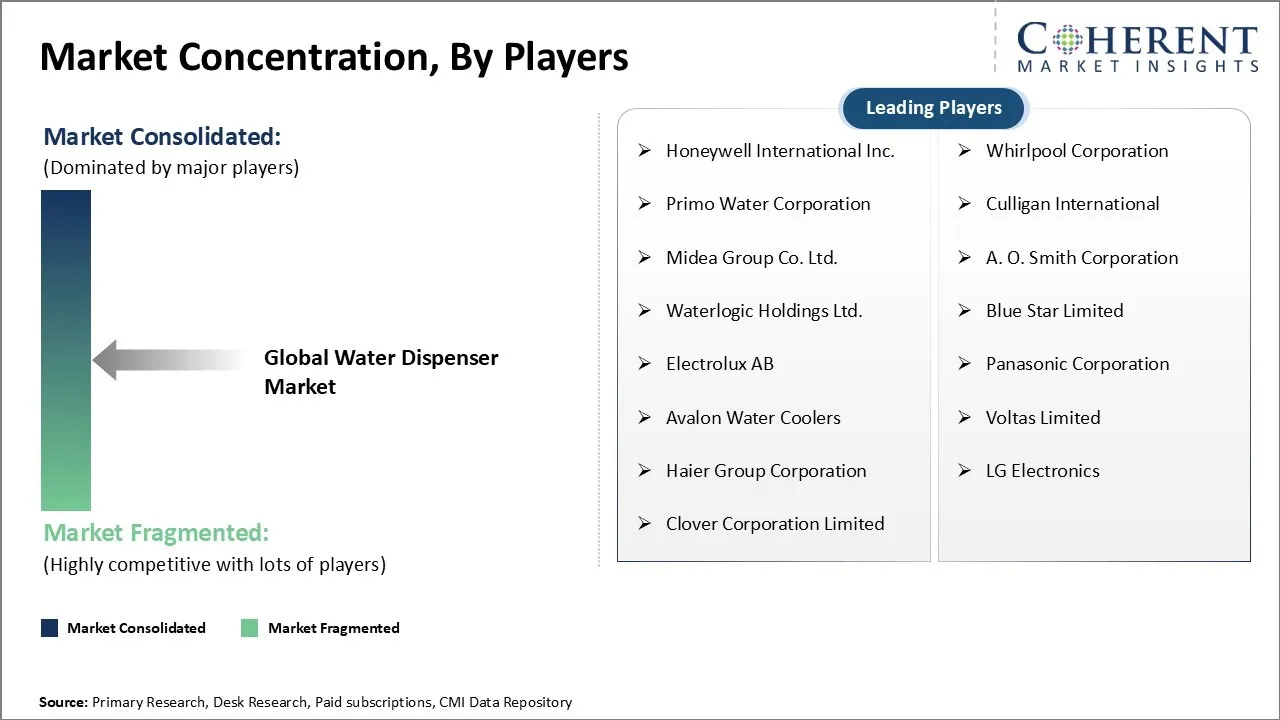
| Companies covered: | Honeywell International Inc., Whirlpool Corporation, Primo Water Corporation, Culligan International, Midea Group Co. Ltd., A. O. Smith Corporation, Waterlogic Holdings Ltd., Blue Star Limited, Electrolux AB, Panasonic Corporation, Avalon Water Coolers, Voltas Limited, Haier Group Corporation, LG Electronics, and Clover Corporation Limited | ||
| Growth Drivers: |
| ||
| Restraints & Challenges: |
| ||
Market Dynamics
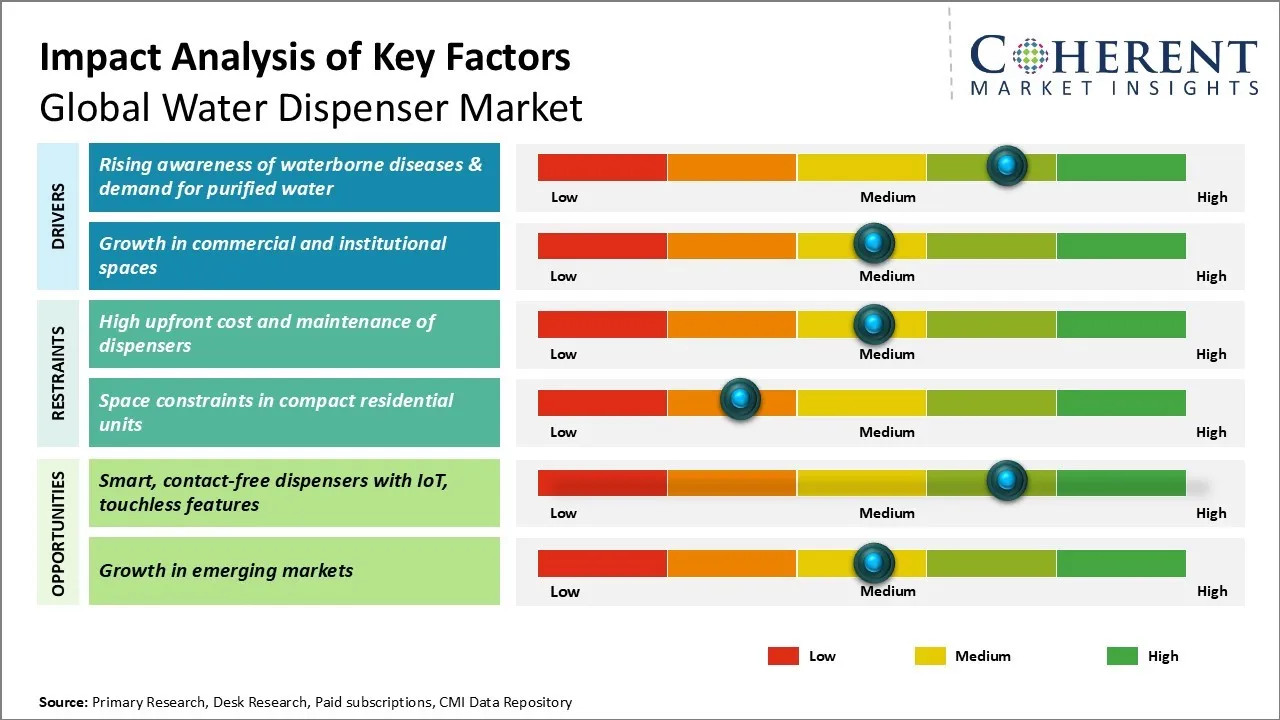
Global Water Dispenser Market Driver - Rising Awareness of Waterborne Diseases & Demand for Purified Water
As information about the health risks associated with contaminated drinking water spreads through public health campaigns and digital media, consumers and institutions alike are prioritizing access to safe, purified water. This heightened consciousness is pushing households, workplaces, and public spaces to invest in advanced water dispensing systems equipped with filtration technologies that effectively remove pathogens, bacteria, and other harmful impurities. Primo Water Corporation reported increased demand for its bottled water delivery and filtration dispenser services across North America and Europe in 2024, citing consumer health concerns post-COVID and rising awareness about contaminants in municipal water systems.
Additionally, growing concerns about the quality of municipal water supplies and incidents of contamination have reinforced the need for reliable purification methods, making water dispensers an essential appliance for ensuring health and safety. The preference for hygienic, convenient access to clean water is shaping purchasing behaviors, especially in urban and semi-urban regions where the risk of exposure to pollutants is more pronounced.
Global Water Dispenser Market Opportunity – Adoption of Smart, Contact-Free Water Dispensers with IoT and Touchless Features
Increasing awareness about hygiene and the need to minimize physical contact, especially in public and commercial spaces, has accelerated the adoption of touchless water dispensing solutions. IoT-enabled dispensers offer enhanced convenience through remote monitoring, usage analytics, and predictive maintenance, allowing businesses and consumers to optimize water usage and ensure uninterrupted supply.
These dispensers can be seamlessly integrated with smart home and office ecosystems, providing real-time alerts on water level, filter status, and temperature control via mobile apps. Midea Group (China) introduced a new line of AI-powered, touchless water dispensers in 2025, featuring motion-sensor activation, Wi-Fi connectivity, and app-based filter health monitoring.
Additionally, the growing emphasis on energy efficiency and sustainability drives the development of smart dispensers that intelligently manage power consumption and reduce wastage. The COVID-19 pandemic has further pushed consumers and organizations to prioritize contactless technologies, making smart water dispensers a preferred choice in healthcare facilities, corporate offices, educational institutions, and hospitality sectors.
Analyst Opinion (Expert Opinion)
- Governments across regions—particularly in Europe, North America, and parts of Asia Pacific—are enforcing tighter guidelines on drinking water quality and purification standards (e.g., NSF/ANSI certifications). This is pushing manufacturers to integrate multi-stage filtration systems, UV sterilization, and sensor-based monitoring to ensure compliance, positioning advanced dispensers as essential rather than optional.
- Sustainability-focused regulations (e.g., bans on single-use plastics and energy efficiency mandates) are incentivizing the transition to bottle-less, point-of-use (POU) dispensers. Regulatory pressure is fostering innovation in plumbing-integrated, IoT-enabled solutions, particularly in public institutions, airports, and corporate environments.
- With the rise of connected devices, regulatory frameworks like the EU Cyber Resilience Act and U.S. IoT security guidelines are influencing how smart water dispensers are designed—ensuring secure data handling, privacy protection, and firmware transparency. Companies integrating touchless and AI-driven features must now align with both consumer safety and cybersecurity standards, creating a new layer of compliance complexity.
Speak to the analyst
Want personalized insights?
Take the findings above to one of our principal consultants, or have the report rebuilt around the segments, geographies and competitors you actually track.
Market Segmentation
- Type Insights (Revenue, USD Bn, 2021 - 2033)
- Bottled Water Dispensers
- Point Of Use Dispensers
- Regional Insights (Revenue, USD Bn, 2021 - 2033)
- North America
- U.S.
- Canada
- Latin America
- Brazil
- Argentina
- Mexico
- Rest of Latin America
- Europe
- Germany
- U.K.
- Spain
- France
- Italy
- Russia
- Rest of Europe
- Asia Pacific
- China
- India
- Japan
- Australia
- South Korea
- ASEAN
- Rest of Asia Pacific
- Middle East
- GCC Countries
- Israel
- Rest of Middle East
- Africa
- South Africa
- North Africa
- Central Africa
- North America
- Key Players Insights
- Honeywell International Inc.
- Whirlpool Corporation
- Primo Water Corporation
- Culligan International
- Midea Group Co. Ltd.
- O. Smith Corporation
- Waterlogic Holdings Ltd.
- Blue Star Limited
- Electrolux AB
- Panasonic Corporation
- Avalon Water Coolers
- Voltas Limited
- Haier Group Corporation
- LG Electronics
- Clover Corporation Limited
Sources
Primary Research Interviews
Stakeholders
- Water Dispenser Manufacturers (e.g., Product Managers, R&D Heads)
- Foodservice Equipment Distributors and Retailers
- Facility Managers (corporate offices, hospitals, schools)
- Building Technology Integrators (specializing in water systems)
- Commercial Real Estate Developers
- Environmental Health and Safety (EHS) Officers
- Smart Appliance and IoT Device Manufacturers
Databases
- National Hydration Infrastructure Survey (NHIS)
- U.S. Census Bureau – Appliance & Equipment Data Series
- Water Utility & Filtration Equipment Statistics (WUFES)
- Asia-Pacific Urban Water Access Database
- EU Water Tech Equipment Reports – 2024
Magazines
- Appliance Today
- Smart Home Living Magazine
- Hospitality Facilities Review
- Office Technology Monthly
- DrinkTech Journal
Journals
- Journal of Water Purification & Filtration Systems
- Journal of Smart Appliance Engineering
- Indoor Air & Water Quality Research Journal
- International Journal of Sustainable Building Utilities
- Water and Wastewater Equipment Journal
Newspapers
- The Water Tech Gazette
- Asia-Pacific Daily Business News
- The Hydration Times (North America)
- IoT in Daily Use – News Desk
- The Economic Observer (Asia)
Associations
- International Water Dispenser Alliance (IWDA)
- Global Drinking Water Appliance Council (GDWAC)
- North American Hydration Equipment Association (NAHEA)
- Asia-Pacific Water Purification Forum
- Smart Building Appliance Manufacturers Association (SBAMA)
Public Domain Sources
- U.S. Census Bureau
- EUROSTAT
- World Bank – Safe Drinking Water Access Reports
- United Nations Environment Programme (UNEP)
- ResearchGate
Proprietary Elements
- CMI Data Analytics Tool, Proprietary CMI Existing Repository of information for last 8 years
Get access to 250+ pages report
Every segment, forecast, competitor profile and data table behind the analysis above — available for instant download.
- ESOMAR Member
- ISO 9001:2015 Certified
- D-U-N-S Registered
- GDPR & CCPA Compliant
Missing comfort of reading report in your local language? Find your preferred language:
Transform your Strategy with Exclusive Trending Reports
Frequently Asked Questions
The global water dispenser market is estimated to be valued at USD 3.33 Bn in 2026 and is expected to reach USD 4.72 Bn by 2033.
The CAGR of global water dispenser market is projected to be 5.1% from 2026 to 2033.
Rising awareness of waterborne diseases & demand for purified water and growth in commercial and institutional spaces are the major factors driving the growth of the global water dispenser market.
High upfront cost and maintenance of dispensers and space constraints in compact residential units are the major factors hampering the growth of the global water dispenser market.
In terms of type, bottled water dispensers are estimated to dominate the market revenue share in 2026.
Honeywell International Inc., Whirlpool Corporation, Primo Water Corporation, Culligan International, Midea Group Co. Ltd., A. O. Smith Corporation, Waterlogic Holdings Ltd., Blue Star Limited, Electrolux AB, Panasonic Corporation, Avalon Water Coolers, Voltas Limited, Haier Group Corporation, LG Electronics, and Clover Corporation Limited are the major players.
North America is expected to lead the global water dispenser market in 2026.