

Global Wide Body Aircraft Market and Forecast: 2026 to 2033
The global wide body aircraft market is estimated to be valued at USD 123.14 Bn in 2024 and is expected to reach USD 170.97 Bn by 2031, exhibiting a compound annual growth rate (CAGR) of 4.8% from 2026 to 2033.
Key Takeaways of the Global Wide Body Aircraft Market
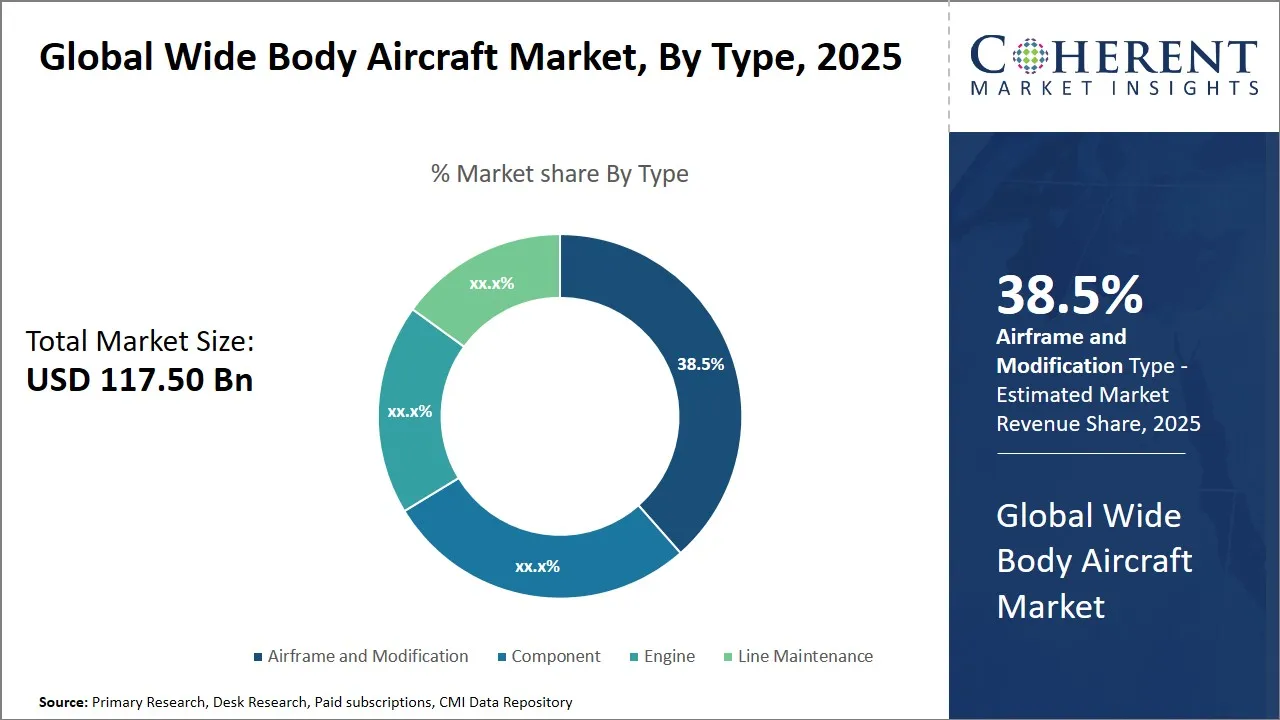
- The airframe and modification segment is expected to lead the market holding a share of 39.5% in 2026.
- The maintenance services segment is projected to hold a prominent market share of 38.7% in 2026.
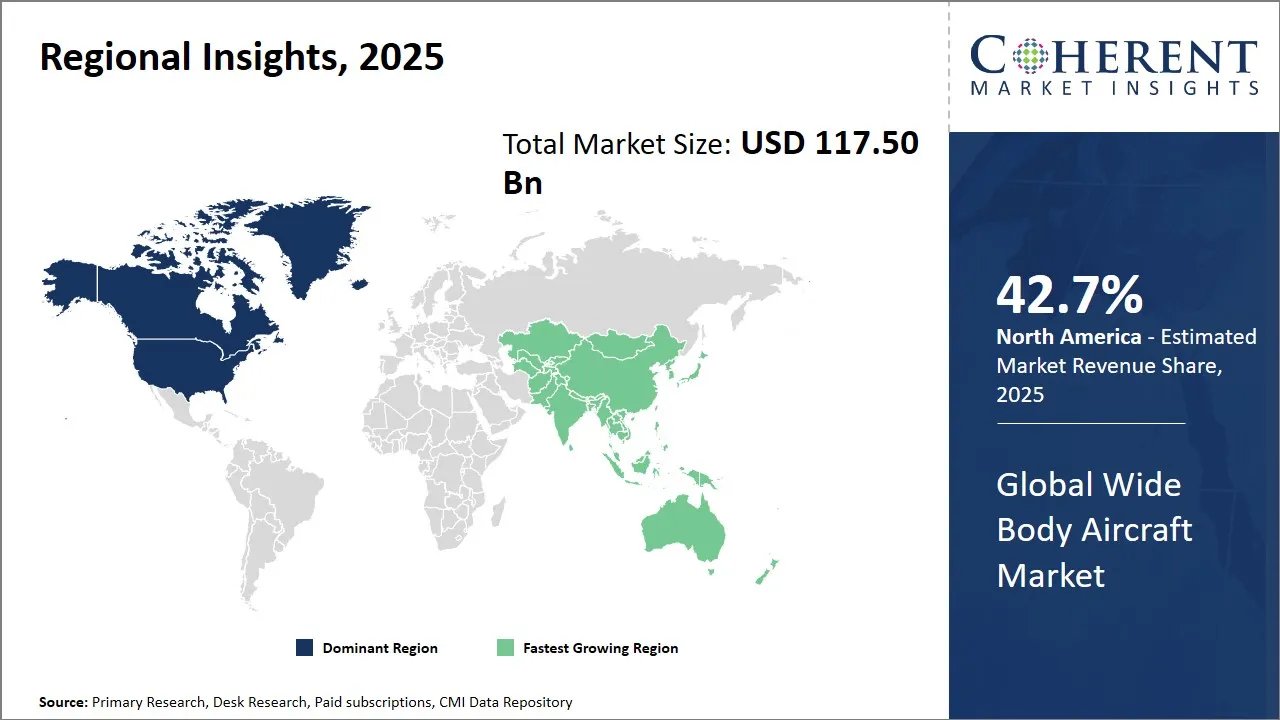
- North America, expected to hold a share of 42.7% in 2026, dominates the market.
- Asia Pacific is expected to be the fastest growing regional market with a share of 24.6% in 2026.
Market Overview
The continuous growth of the wide body aircraft market comes from more people wanting better aircraft technology and growing numbers of travelers worldwide. Carriers are spending significantly on wide body aircrafts to improve energy use plus ride quality, which helps grow the industry through the projection years.
A major force behind changes in the wide body aircraft sector is a stronger focus on eco-friendly designs and better fuel use. Manufacturers are using new materials that weigh less alongside improved airflow features. At the same time, carriers aim to modernize planes to handle more global passengers and freight needs and not just expansion but shifting travel patterns too. Growth gains strength from rising economies where middle-income groups are larger and these regions are boosting overall demand steadily. Meanwhile technological upgrades like smart systems or smoother cabin services reshape what travelers expect day by day, helping keep industry activity active.
Current Events and Its Impact
Current Events | Description and its Impact |
Development of New Wide Body Variants |
|
Airbus Delivery |
|
Segmental Insights
- Current Industry Events of 2026
- Market Size Estimation
- Regional Breakdown
- Competitive Landscape
- Customer Intelligence
- Segmental Analysis
- Pricing Analysis
- Key Market Drivers, Challenges & Future Trends
- Customized Insights Section
Global Wide Body Aircraft Market Insights, By Type – Airframe and Modification Contributes the Highest Market Share Owing to Increasing Demand for Aircraft Customization and Structural Upgrades
The airframe and modification segment is expected to account for 39.5% of the market share in 2026. The lead held by the airframe and modification sector in the global wide-body aircraft market stems from growing demand for customized upgrades. Because airlines aim to boost efficiency, they’re focusing more on retrofitting frames which improves functionality while meeting updated safety rules. Since these planes handle busy, long-distance flights, refining their structural design helps cut fuel use and elevate traveler experience, factors that influence profit margins.
A major factor behind rising activity here is the need to upgrade older planes. Because airline markets keep changing, companies tend to modify airframes instead of buying new jets to save money while keeping operations running. Typical updates involve adding winglets for better airflow, strengthening body parts, or redesigning cabins with updated seats and digital entertainment options. These changes cut fuel use while helping carriers offer a more attractive travel experience.
For instance, on May 30, 2025, Airbus reached a key step at its Broughton facility by completing the initial wing set for the new A350 freighter model (A350F). Since the A350F’s wings mirror those of the standard A350, they’re produced on the same assembly line - this enables smoother operations and better efficiency. While design similarities reduce complexity, shared production boosts output without extra costs.
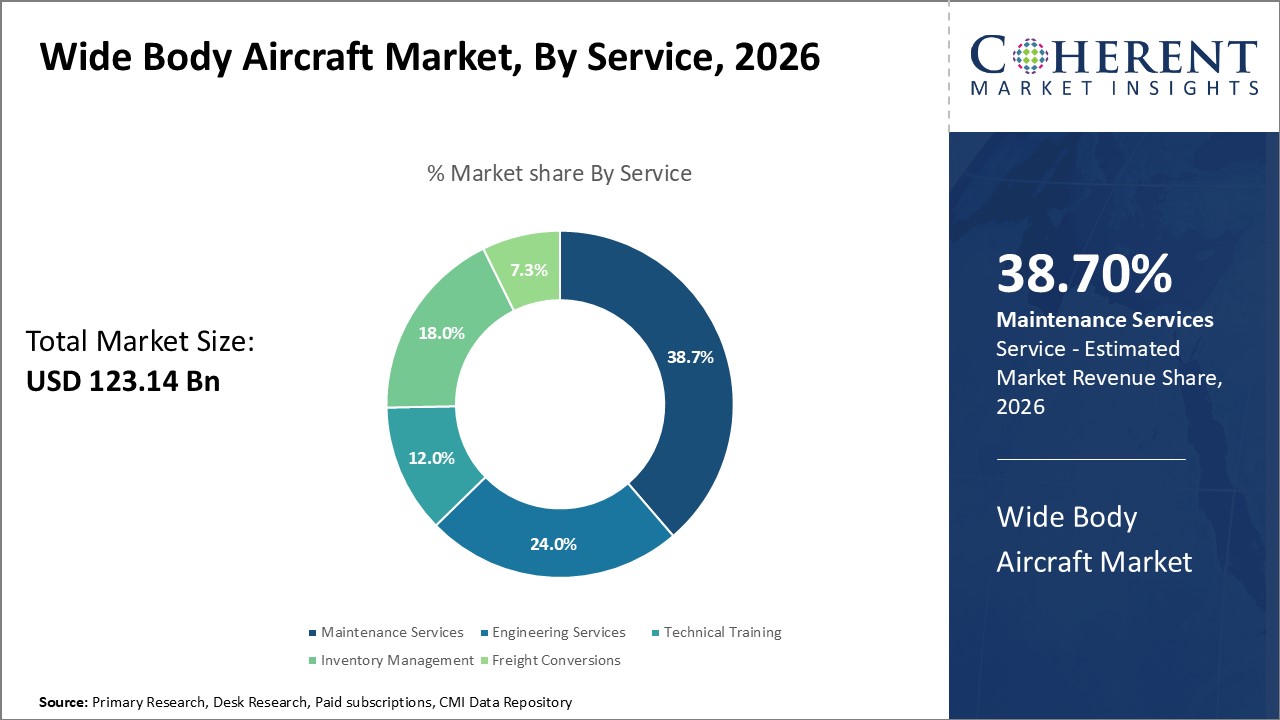
Global Wide Body Aircraft Market Insights, By Service – Maintenance Services Lead Driven by Critical Operational Reliability and Regulatory Compliance
Maintenance services hold a projected 38.7% share of the global wide body aircraft market share in 2026. This rise is due to their key part in maintaining plane safety, uptime, and durability. Because wide-body jets fly long, usually global routes, they must follow strict servicing timelines which reduces delays while keeping travelers secure. For this reason, carriers invest heavily in thorough upkeep plans designed specifically for big planes.
Modern wide body planes are getting harder to maintain, so expert technicians and intricate tools are needed more than ever. Due to advanced electronics and detailed engine setups, routine servicing requires specific expertise. Because systems inside these aircraft are highly interconnected, standard methods no longer work well. As a result, trained teams using precise diagnostics have become essential across the industry.
Operational Cost & Fuel Efficiency Benchmarking – Legacy Aircrafts
Model | Seating Capacity | Approx. Fuel Burn (L/Hour) | Approx. Operational Cost/ Flight Hour (USD) |
Boeing 777-200ER | 314 | 7,000 | 14,000–17,000 |
Airbus A330-200 | 247 | 5,600 | 11,000–13,000 |
Boeing 777-300ER | 365 | 7,500 | 15,000–18,500 |
Airbus A330-300 | 300 | 6,000 | 12,000–14,000 |
Boeing 747-400 | 416 | 10,500 | 20,000–25,000 |
Operational Cost & Fuel Efficiency Benchmarking – Next-Gen Aircrafts
Model | Seating Capacity | Approx. Fuel Burn (L/Hour) | Approx. Operational Cost/ Flight Hour (USD) |
Boeing 787-8 | 242 | 5,400 | 11,000–13,000 |
Boeing 787-9 | 290 | 5,800 | 12,000–14,000 |
Airbus A350-900 | 320 | 5,900 | 12,000–14,000 |
Airbus A350-1000 | 366 | 6,400 | 14,000–16,000 |
Boeing 787-10 | 330 | 6,200 | 13,000–15,000 |
Backlog & Delivery Pipeline
Model | Approx. Backlog | Recent Deliveries / Production Rate | Expected Delivery Timeline |
Airbus A350 | 765 | 90 A350s delivered in 2024-2025 | Delivery Not Specified 9-10/Month production ramp up plans by 2026 |
Airbus A330neo | 236 | 3-4 Deliveries/Month | Delivery Not Specified No Ramp up announced |
Boeing 787 Dreamliner | 1048 | 7 Productions/Month | 10/Month production ramp up plans by 2026 |
Boeing 777X | 473 | No Deliveries Yet | Latest Delivery Plans Delayed to 2027 |
Regional Insights
North America Wide Body Aircraft Market Analysis and Trends
North America is the leader in the global wide body aircraft market with an estimated share of 42.7% in 2026. In North America, strong growth in the global wide body aircraft market comes from a well-developed aerospace sector, backed by steady public funding and solid facilities. Major producers including Boeing and Lockheed Martin shape regional strength, owing to deep research resources along with efficient supplier links. Policies that push defense upgrades, airline network growth, or tech progress help create favorable conditions for building and buying large aircraft.
Meanwhile, carriers such as American Airlines and Delta maintain ongoing need for new wide-body planes, keeping activity high. Agreements and alliances with international parts makers also boost North America’s leading role in this field.
Asia Pacific Wide Body Aircraft Market Analysis and Trends
Asia Pacific wide body aircraft market is expected to exhibit the fastest growth and hold a market share of 24.6% in 2026. The growth comes from fast urbanization, a rising middle class, while air travel expands thanks to stronger economies. Government efforts boost local aerospace production; at the same time, spending on domestic aviation facilities pushes market gains. Nations like China and India upgrade airports, renew fleets which in turn boosts need for large aircraft. Regional companies such as COMAC and Mitsubishi Aircraft play major roles in reshaping Asia Pacific’s sector. Also, looser trade rules together with partnerships involving Western firms speed up regional progress.
Global Wide Body Aircraft Market Outlook for Key Countries
U.S. Wide Body Aircraft Market Analysis and Trends
The U.S. holds a leading position, driven by Boeing's base and major production facilities located there. Because of big airlines operating domestically, demand stays high for updating and growing wide-body fleets. Government-backed programs in defense and space push tech progress that spills into civilian aircraft development. A well-established network of suppliers combined with trained workers helps maintain an edge in both new designs and efficient output.
China Wide Body Aircraft Market Analysis and Trends
China's market growth comes from building local large-plane production via COMAC while facing rising airline needs. Instead of relying on overseas makers, state plans push homegrown aerospace output. Upgraded airports along with more global flights fuel demand for bigger jets. Partnerships plus knowledge sharing with international firms help speed up China’s goal to enter the worldwide big-aircraft race.
Japan Wide Body Aircraft Market Analysis and Trends
Japan remains at the forefront of precise production and airframe systems, actively supporting major international wide-body plane projects. Thanks to firms such as Mitsubishi Heavy Industries, which deliver key elements while advancing domestic mid-sized jet models. Backed by state initiatives that promote technical progress and joint ventures with overseas aviation leaders, access to worldwide demand is maintained. By prioritizing durable, top-grade components, Japan strengthens its essential position in this sector.
India Wide Body Aircraft Market Analysis and Trends
India's market grows quickly due to rising local and global flight demand, along with state efforts like the UDAN program that boost regional links. Boosted by government policies and training projects, its developing aerospace production draws overseas capital and tech partnerships. Carriers such as Air India are updating their planes - adding larger models - to handle more travelers and expand overseas operations.
France Wide Body Aircraft Market Analysis and Trends
France hosts Airbus, staying key in wide body aircraft production and technological progress. Wide-body jets from Airbus play a major role in national aviation efforts, backed by state support that boosts R&D along with exports. A solid network of suppliers together with trained workers helps France stay ahead. Local carriers use home-built big planes to strengthen overseas flights, underlining the nation's standing in this area
Market Players, Key Development, and Competitive Intelligence
Key Developments
- On November 18, 2025, Etihad Airways announced a significant expansion of its Airbus widebody fleet by placing a firm order for six A330-900s, becoming the latest A330neo customer. In addition, the airline has disclosed an order for seven additional A350-1000s (increasing its total for the type to 27) and three A350F (bringing the airline’s A350F commitment to 10 aircraft).
- On April 25, 2024, IndiGo, India’s leading airline, committed to a firm order for 30 Airbus A350-900 jets, a move that will support wider international expansion and broader global connectivity from major Indian cities. These aircraft will be equipped with Rolls-Royce Trent XWB engines.
Top Strategies Followed by Wide Body Aircraft Market Players
- The global wide body aircraft market features intense competition, so top firms push ahead using new tech, partnerships, or international growth. Major corporations stay in control by spending big on R&D - aiming to launch powerful planes that fit changing needs around fuel savings, space, and eco-friendliness. They prioritize adding modern solutions like strong but light composites, economical motors, or updated navigation systems - to boost fleet capability while lowering running expenses.
- On March 3, 2025, in a significant shift for its production strategy, Boeing officially concluded repair operations at its dedicated 787 Dreamliner rework facility, redirecting its skilled mechanics to bolster the 777X production program.
- Mid-tier firms in the wide body aircraft market establish niche positions through affordable options that don’t sacrifice core performance. Instead of chasing top-end buyers, they target budget-conscious clients like local airlines or new operators needing dependable planes at lower prices than big-name makers offer. Rather than going it alone, these manufacturers team up with aviation partners, tech developers, and parts specialists to strengthen output capacity and modernize technical skills. Thanks to such alliances, they cut expenses across design and assembly phases while lifting overall build standards and consistency.
- On October 29, 2024, Safran unveiled a plan to invest over Euro 1 billion, aimed at expanding its worldwide MRO operations - to meet rising demand from LEAP-powered large aircraft. While boosting service capacity, the move strengthens support networks across regions experiencing fleet growth. Funding will target facility upgrades rather than new builds in key locations. This effort aligns with increasing engine deliveries expected through 2030.
- Smaller companies rely on focused strategies to stand out among industry giants. Instead of broad offerings, they target specific needs through tailored designs - like quieter cabins or adaptable layouts - that meet particular client expectations. By prioritizing innovation, these businesses integrate eco-conscious systems or fuel-saving structures into their models. Despite tighter budgets, they make use of modern software, automation methods, and strong yet light composites to boost performance while reducing costs.
Market Report Scope
Wide Body Aircraft Market Report Coverage
| Report Coverage | Details | ||
|---|---|---|---|
| Base Year: | 2025 | Market Size in 2026: | USD 123.14 Bn |
| Historical Data for: | 2020 To 2024 | Forecast Period: | 2026 To 2033 |
| Forecast Period 2026 to 2033 CAGR: | 4.8% | 2033 Value Projection: | USD 170.97 Bn |
| Geographies covered: |
| ||
| Segments covered: |
| ||
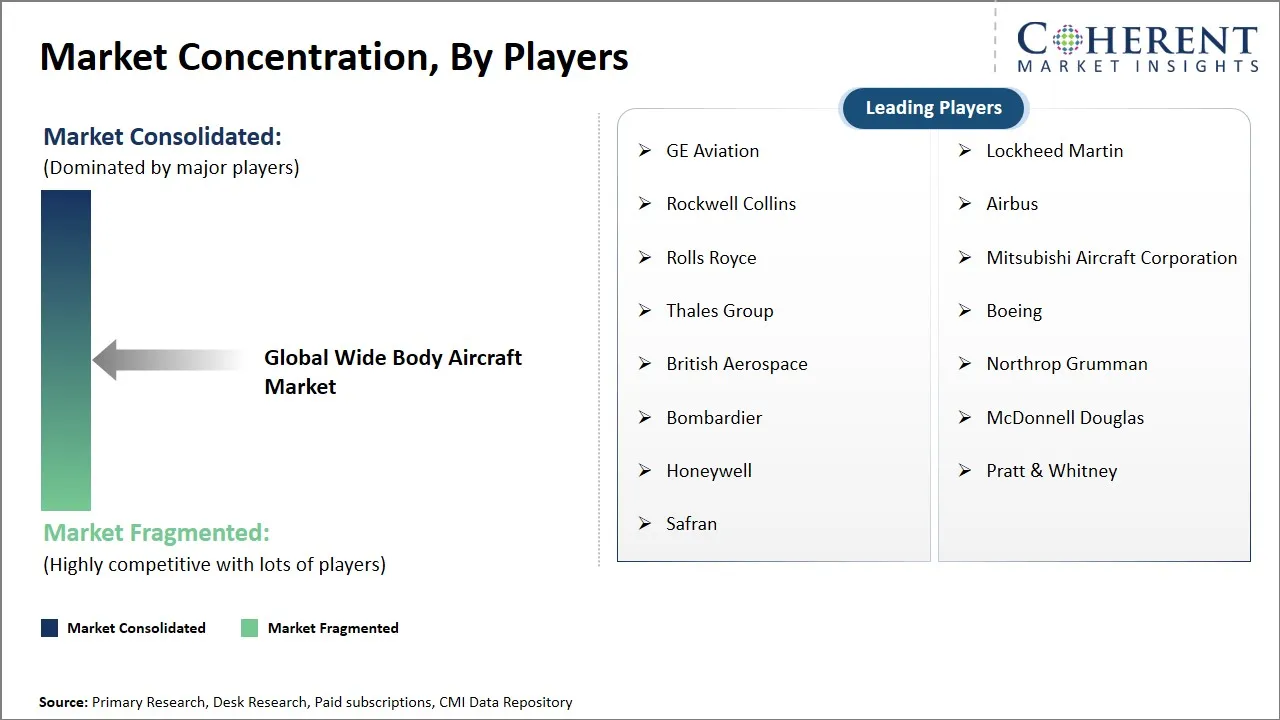
| Companies covered: | GE Aviation, Lockheed Martin, Rockwell Collins, Airbus, Rolls Royce, Mitsubishi Aircraft Corporation, Thales Group, Boeing, British Aerospace, Northrop Grumman, Bombardier, McDonnell Douglas, Honeywell, Pratt & Whitney, and Safran | ||
| Growth Drivers: |
| ||
| Restraints & Challenges: |
| ||
Market Dynamics
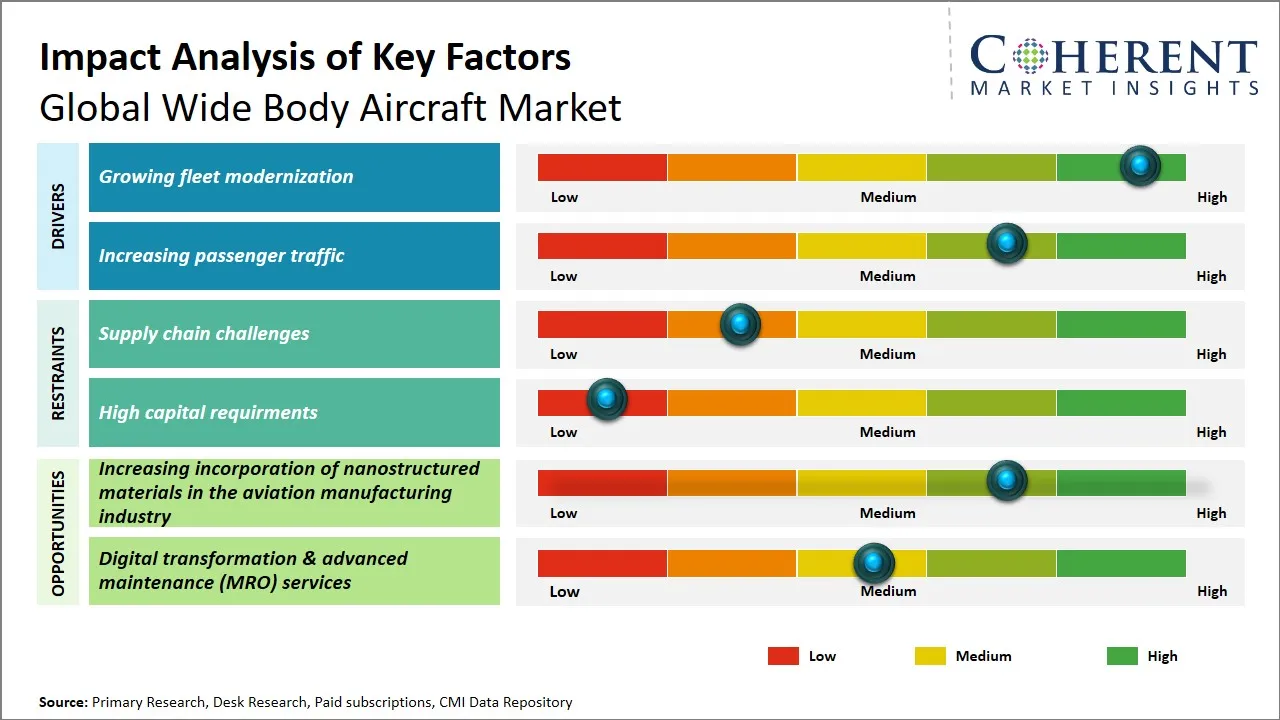
Global Wide Body Aircraft Market Driver - Growing Fleet Modernization
Airlines across the globe now focus more on updating their fleet management to boost performance, lower upkeep expenses, while complying with tough eco rules. Older planes are swapped out for new wide-body versions featuring better fuel economy, improved airflow design, or innovative engine systems. These updated wide-body jets cut down on fuel use while also enhancing traveler experience and carrying heavier loads, which benefits extended flights and busy corridors. In addition, growing emphasis on greener travel pushes airlines toward large cabins powered by advanced motors combined with lighter construction materials, supporting worldwide efforts to slash emissions. This shift gains momentum from changing traveler expectations like smart cabin features or seamless internet access which pushes airlines to renew planes just to keep up. Together, these trends support consistent interest in larger jets, as operators aim to improve efficiency, satisfy passengers, better meet tighter eco-regulations.
For instance, on December 9, 2024, Air India announced its purchase of 10 A350 widebody aircrafts along with 90 A320 Family narrow-body jets. Furthermore, the airline chose Airbus’ FHS-C support package to maintain its expanding A350 fleet.
Global Wide Body Aircraft Market Opportunity - Increasing Incorporation of Nanostructured Materials in the Aviation Manufacturing Industry
The increasing use of nanostructured materials in global wide-body airplanes opens strong chances for makers and suppliers wanting better performance at lower expense. Alongside carbon nanotubes, nanoparticles also deliver stronger mechanics - like improved weight-strength balance, longer wear life, plus greater heat tolerance versus standard options. Because of this, planes become lighter; hence they burn less fuel and release fewer emissions, meeting tough air travel eco rules.
Also, using such modern substances helps build parts that last longer and need less servicing, cutting total ownership expenses over time. This chance grows stronger thanks to steady progress in nanotechnology - cutting production expenses while making large-scale methods possible for full-size plane parts. On top of that, makers now focus more on fresh solutions to respond to requests for better efficiency and eco-friendly designs, speeding up use of advanced nano materials. Joint efforts between tech startups and aviation leaders are boosting R&D momentum through shared goals, pushing new models toward real-world use faster. With air travel changing rapidly, these innovative substances play a vital role in shaping long-term success and edge in the worldwide big-aircraft industry.
Analyst Opinion (Expert Opinion)
- The wide body aircraft market is starting a phase of refresh and growth, fueled largely by rising long-distance flights, solid interest from airlines in the Asia Pacific region - alongside faster upgrades to fleets. Carriers now favor fuel-saving models including the A350 and 787 to lower expenses while complying with stricter emission rules; at the same time, outdated types such as first-gen 777s and A330ceos are slowly phased out.
- The market’s structure is changing, driven by moves toward adaptability and greener operations. Instead of specialized models, carriers now prefer wide-body aircrafts that handle busy hubs or sparse long-haul routes, matching updated flight networks after the pandemic. Meanwhile, cargo demand continues pushing expansion, fueled partly by online shopping trends as well as calls for better-performing freight planes.
Speak to the analyst
Want personalized insights?
Take the findings above to one of our principal consultants, or have the report rebuilt around the segments, geographies and competitors you actually track.
Market Segmentation
- Type Insights (Revenue, USD Bn, 2021 - 2033)
- Airframe and Modification
- Component
- Engine
- Line Maintenance
- Service Insights (Revenue, USD Bn, 2021 - 2033)
- Maintenance Services
- Engineering Services
- Technical Training
- Inventory Management
- Freight Conversions
- Regional Insights (Revenue, USD Bn, 2021 - 2033)
- North America
- U.S.
- Canada
- Latin America
- Brazil
- Argentina
- Mexico
- Rest of Latin America
- Europe
- Germany
- U.K.
- Spain
- France
- Italy
- Russia
- Rest of Europe
- Asia Pacific
- China
- India
- Japan
- Australia
- South Korea
- ASEAN
- Rest of Asia Pacific
- Middle East
- GCC Countries
- Israel
- Rest of Middle East
- Africa
- South Africa
- North Africa
- Central Africa
- North America
- Key Players Insights
- GE Aviation
- Lockheed Martin
- Rockwell Collins
- Airbus
- Rolls Royce
- Mitsubishi Aircraft Corporation
- Thales Group
- Boeing
- British Aerospace
- Northrop Grumman
- Bombardier
- McDonnell Douglas
- Honeywell
- Pratt & Whitney
- Safran
Sources
Primary Research Interviews
- Aircraft Manufacturers (Boeing, Airbus representatives)
- Airlines Operations Directors and Fleet Planning Managers
- Aircraft Leasing Companies Executives
- Aviation Industry Consultants and Analysts
Databases
- Aviation Week Intelligence Network (AWIN)
- FlightGlobal's FleetData
- Ascend by Cirium Database
- International Civil Aviation Organization (ICAO) Database
Magazines
- Aviation Week & Space Technology
- Flight International
- Airline Business Magazine
- Aircraft Technology Engineering & Maintenance
Journals
- Journal of Air Transport Management
- Aerospace Science and Technology
- International Journal of Aviation Management
Newspapers
- Financial Times (Aviation Section)
- The Wall Street Journal (Aerospace & Defense)
- Reuters Aviation News
- Bloomberg Aerospace & Defense
- Aviation Daily
Associations
- International Air Transport Association (IATA)
- Aerospace Industries Association (AIA)
- Airlines for America (A4A)
- International Association of Aviation Personnel Schools (IAAPS)
Public Domain Sources
- Federal Aviation Administration (FAA) Reports
- European Aviation Safety Agency (EASA) Publications
- Boeing Commercial Market Outlook
- Airbus Global Market Forecast
- International Civil Aviation Organization (ICAO) Publications
Proprietary Elements
- CMI Data Analytics Tool
- Proprietary CMI Existing Repository of information for last 8 years
Get access to 250+ pages report
Every segment, forecast, competitor profile and data table behind the analysis above — available for instant download.
- ESOMAR Member
- ISO 9001:2015 Certified
- D-U-N-S Registered
- GDPR & CCPA Compliant
Missing comfort of reading report in your local language? Find your preferred language:
Transform your Strategy with Exclusive Trending Reports
Frequently Asked Questions
The global wide body aircraft market is estimated to be valued at USD 123.14 Bn in 2026 and is expected to reach USD 170.97 Bn by 2033.
The CAGR of the global wide body aircraft market is projected to be 4.8 % from 2026 to 2033.
Growing fleet modernization and increasing passenger traffic are the major factors driving the growth of the global wide body aircraft market.
Supply chain challenges and high capital requirements are the major factors hampering the growth of the global wide body aircraft market.
In terms of type, airframe and modification is estimated to dominate the market revenue share in 2026
GE Aviation, Lockheed Martin, Rockwell Collins, Airbus, Rolls Royce, Mitsubishi Aircraft Corporation, Thales Group, Boeing, British Aerospace, Northrop Grumman, Bombardier, McDonnell Douglas, Honeywell, Pratt & Whitney, and Safran are the major players.
North America is expected to lead the global wide body aircraft market in 2026