

Global Full Flight Simulator Market Size and Forecast – 2026-2033
The global full flight simulator market is estimated to be valued at USD 7.35 Bn in 2026 and is expected to reach USD 11.05 Bn by 2033, exhibiting a compound annual growth rate (CAGR) of 6.0% from 2026 to 2033.
Key Takeaways of the Global Full Flight Simulator Market
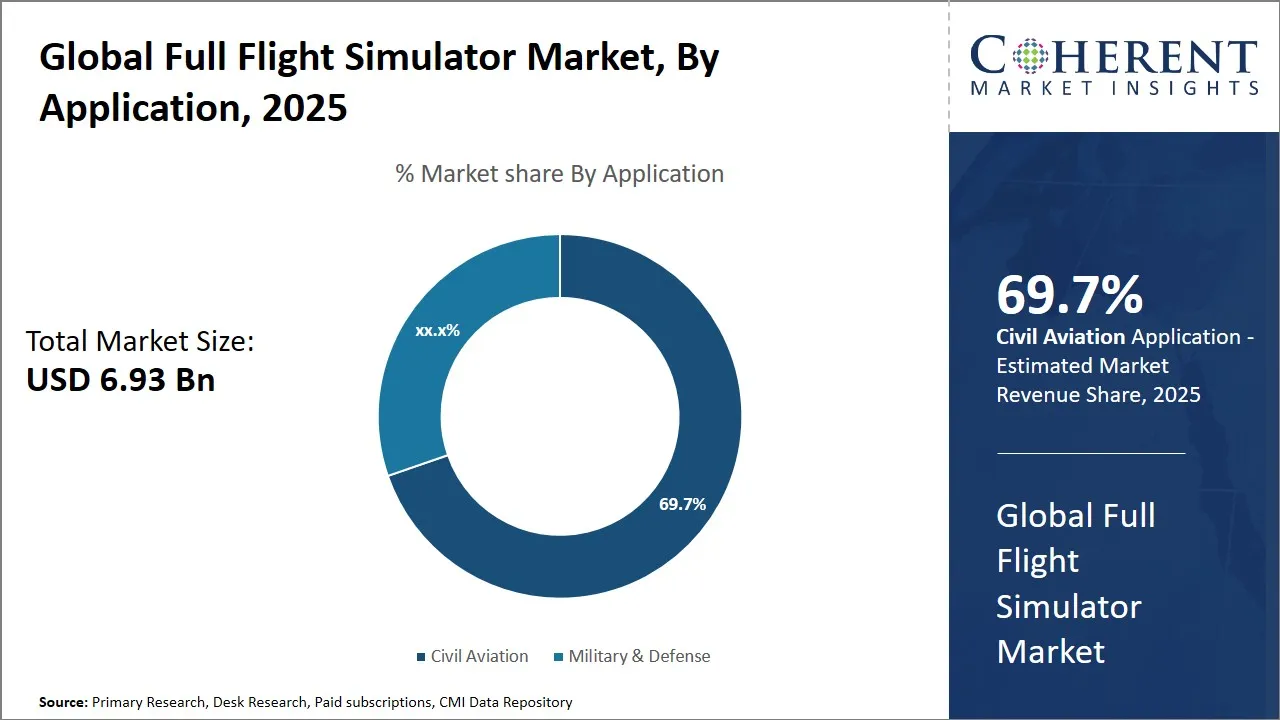
- The civil aviation segment lead the market holding an estimated share of 70.7 % in 2026.
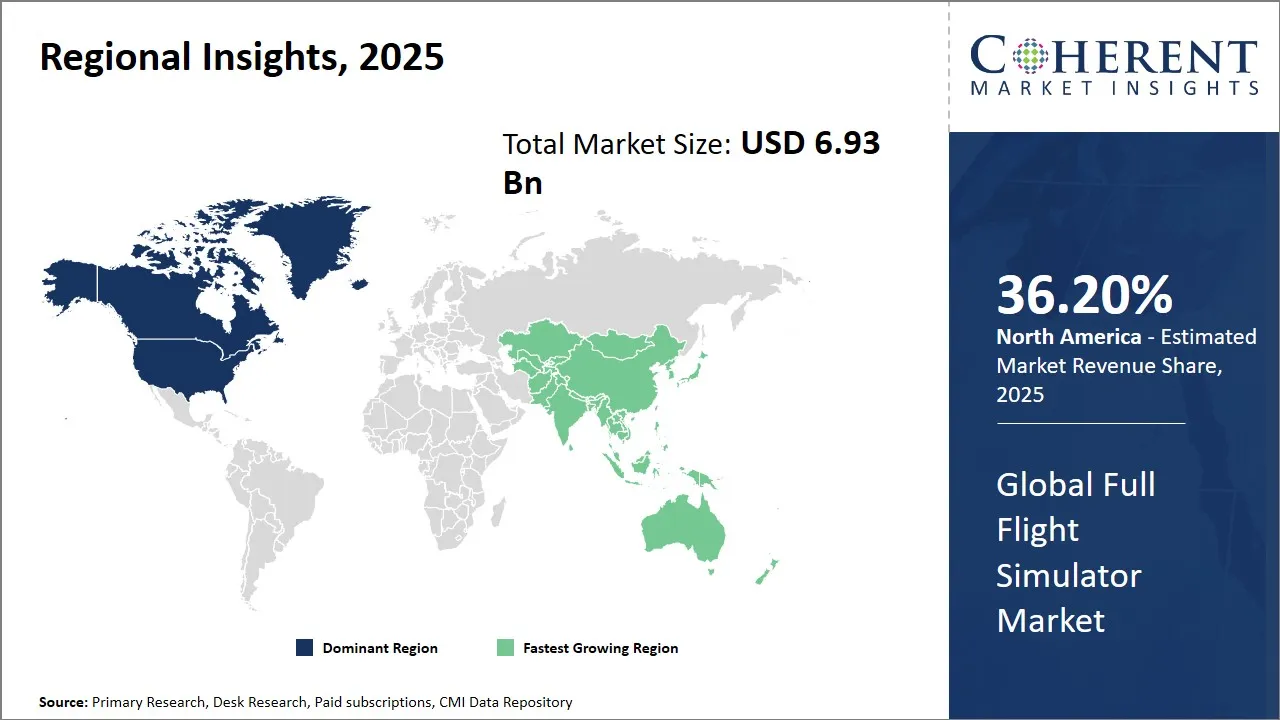
- North America is estimated to lead the market with a share of 36.2% in 2026.
- Asia Pacific, holding an estimated share of 26.4% in 2026, and it is projected to be the fastest growing region.
Market Overview
The market is seeing the use of advanced technologies such as Artificial Intelligence (AI) and Virtual Reality (VR) in full flight simulators, improving realism and training effectiveness. Also, there is a growing focus on sustainability, with manufacturers making simulators that reduce energy consumption and environmental impact. The increasing need for remote and cloud-based simulation solutions is also shaping the market, enabling flexible training options amid evolving operational challenges within the aviation sector.
Current Events and Its Impact
Current Events | Description and its Impact |
Geopolitical and Trade Developments |
|
Economic and Infrastructure Trends |
|
Segmental Insights
- Current Industry Events of 2026
- Market Size Estimation
- Regional Breakdown
- Competitive Landscape
- Customer Intelligence
- Segmental Analysis
- Pricing Analysis
- Key Market Drivers, Challenges & Future Trends
- Customized Insights Section
Global Full Flight Simulator Market Insights, by Application – Rising Demand for Pilot Training and Safety Enhancement in Civil Aviation Segment Propels the Growth
The civil aviation segment is projected to account for 70.7% share in 2026. The market is seeing increasing demand for highly advanced pilot training solutions as commercial airlines increase their fleets and routes to meet the growing air travel demand globally. Full flight simulators give a realistic, risk-free environment for pilots to practice and hone their skills, which is important for managing complex aircraft systems and emergency scenarios without putting passengers or crew at risk. Regulatory mandates for pilot certification and recurrent training also play a big role. Aviation authorities worldwide require rigorous training and frequent assessments for pilots, pushing airlines and training centers to invest in state-of-the-art full flight simulators that replicate real flight conditions with high fidelity.
Also, the rising focus on flight safety adds to adoption. Full flight simulators are important tools for scenario-based training, allowing pilots to feel and respond to difficult weather, mechanical failures, and other critical situations. In 2023, Singapore Airlines expanded its pilot training program to accommodate the rapid growth of its fleet, including Airbus A350 and Boeing 787 aircraft. The airline adopted multiple CAE full flight simulators to give highly realistic, scenario-based training to both new and recurrent pilots.
Technological advancements further drive the civil aviation segment. Also, improvements in simulator realism, such as motion systems, visual displays, and interactive controls, have added to training effectiveness and reduced operational costs. Moreover, the expansion of low-cost carriers and rise in air passenger traffic, especially in emerging economies, make demand for pilot training and, by extension, full flight simulators. Airlines have to scale up their pilot training infrastructure fast to ensure timely onboarding of new pilots, adding to the segment’s demand.
Impact of AI on the Full Flight Simulator Market
Artificial Intelligence (AI) is improving both training realism and operational efficiency in the market. Modern AI algorithms can dynamically adjust weather conditions, aircraft behavior, and emergency scenarios in real time, making training sessions that closely mimic real-world flying environments. This helps instructors customize exercises for each pilot’s skill level, making learning curves faster while improving safety outcomes. AI-driven analytics also help training centers track pilot performance more precisely, seeing strengths and weaknesses that make possible targeted practice and certification readiness.
For example, CAE’s AI-powered “Rise” training system uses machine learning to monitor pilot actions and provide automated, data-driven feedback during simulator sessions.
Regional Insights
North America Full Flight Simulator Market Analysis and Trends
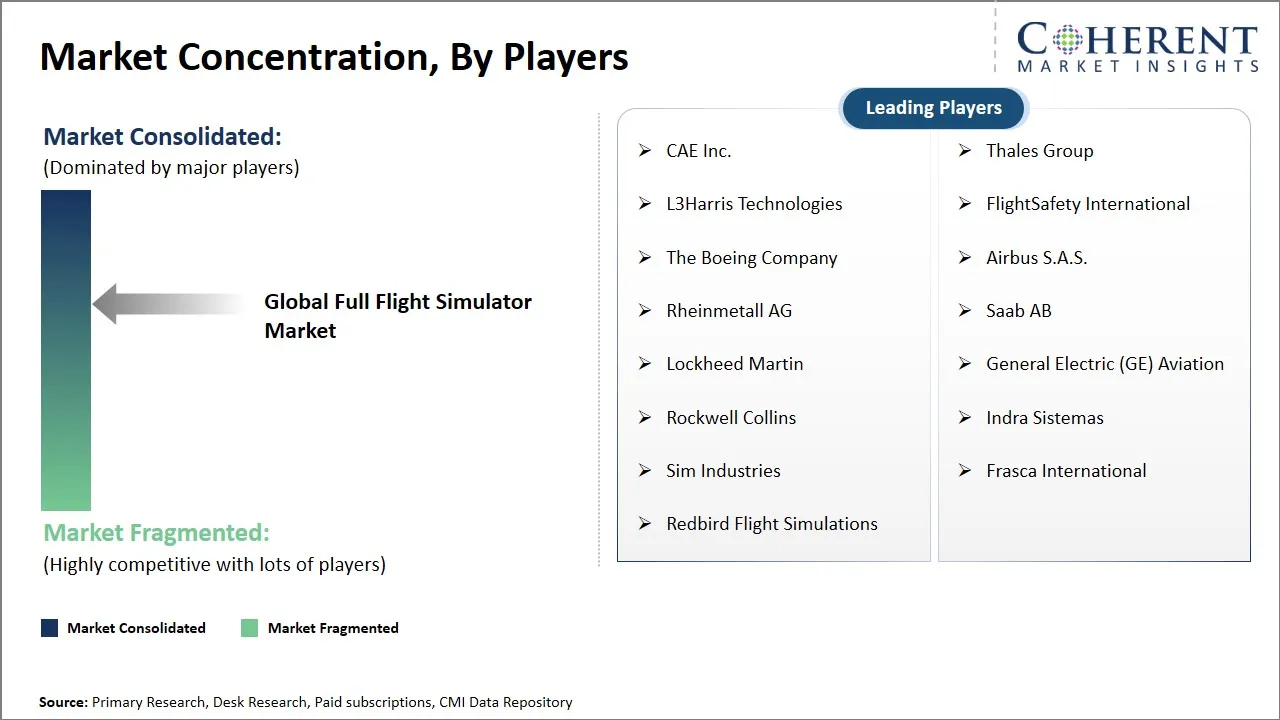
North America, holding a projected share of 36.2% in 2026, the full flight simulator market dominates because of its well-established aviation ecosystem that includes military, commercial, and general aviation sectors. The presence of major aerospace and defense companies such as CAE Inc., L3Harris Technologies, and FlightSafety International adds a lot to the market's maturity and innovation. Additionally, strong government support, particularly from the U.S. Department of Defense and the Federal Aviation Administration (FAA), supports advanced pilot training initiatives and strict certification standards, making demand for sophisticated flight simulators.
The region's focus on safety and technological advancements, including virtual reality and artificial intelligence integration, adds to its leading position. Trade dynamics support North America because of its strategic partnerships and export-focused simulation manufacturers that supply simulators worldwide.
Asia Pacific Full Flight Simulator Market Analysis and Trends
The Asia Pacific region, holding a share of 26.4% in 2026, exhibits the fastest growth because of the expanding commercial aviation and increasing defense expenditure in countries like China, India, Japan, and South Korea. Rapid urbanization and rising middle-class populations are accelerating air travel demands, prompting airlines and training centers to invest heavily in flight simulators to ensure pilot proficiency and safety. Governments in this region are progressively emphasizing aviation infrastructure development and strengthening regulatory frameworks that encourage adoption of modern training methods.
In addition to domestic manufacturers, global players such as CAE, Thales Group, and Boeing are intensifying their presence through partnerships and joint ventures, catering to local market requirements. Trade liberalization and favorable policies have also made technology transfer and collaborations easier, making Asia Pacific a fast-expanding market for full flight simulators.
Full Flight Simulator Market Outlook for Key Countries
U.S. Full Flight Simulator Market Analysis and Trends
The U.S. is most influential market in full flight simulation because of the convergence of strong defense spending and a strong commercial aviation industry. Major players like L3Harris, Boeing, and FlightSafety International, headquartered or extensively operational here, invest a lot in R&D to deliver next-generation simulators equipped with cutting-edge avionics and realistic environments. The country’s strict pilot training mandates and FAA certification requirements add to the demand for high-fidelity simulators, making the U.S. a hub for technology innovation and simulator manufacturing.
China Full Flight Simulator Market Analysis and Trends
China is expanding rapidly due to substantial defense modernization efforts and the world’s largest commercial aviation fleet growth. Domestic companies such as AVIC and AMST play big roles alongside international players like CAE and Thales, developing region-specific simulation solutions. The government’s supportive policies focused on local manufacturing and advanced aviation infrastructure are very important, making a competitive environment that pushes innovation and system localization. Also, China’s strategic interest in pilot training facilities and simulation academies shows rising market demand.
India Full Flight Simulator Market Analysis and Trends
India’s growing aviation sector, alongside increasing defense budgets, key government initiatives, and expanding pilot training requirements intensify the demand for full flight simulators. Global entities like CAE and FlightSafety International have made partnerships with Indian aviation training centers, while domestic enterprises focus on meeting domestic simulator demands aligned with Make in India policies.
U.K. Full Flight Simulator Market Analysis and Trends
The U.K. continues to lead in Europe full flight simulator market because of the presence of prominent companies such as Thales UK and BAE Systems. Its strong aerospace and defense sectors, combined with government investments in pilot training programs and simulator certification, add to the country’s competitiveness.
Japan Full Flight Simulator Market Analysis and Trends
Japan sees technological sophistication and a well-established commercial aviation industry. Key players like Mitsubishi Heavy Industries and companies partnering with Boeing and CAE contribute to the simulation market with innovative solutions tailored to domestic and regional needs. Government policies focus on aviation safety and pilot training standardization, adding to simulator upgrades. Also, Japan’s focus on using advanced simulation technology in real-world training scenarios shows its commitment to maintaining high standards in pilot proficiency.
Market Players, Key Development, and Competitive Intelligence
Key Developments
- In March 2025, L3Harris Technologies completed the previously announced sale of its Commercial Aviation Solutions (CAS) business to an affiliate of TJC L.P. for USD 800 million. The entire USD 800 million cash purchase price was paid to L3Harris at the closing of the transaction. CAS specializes in commercial flight training, flight data analytics, commercial avionics and other capabilities. The business was formerly part of L3Harris’ Integrated Missions Systems segment.
- In January 2025, Bohemia Interactive Simulations (BISim), a wholly-owned subsidiary of BAE Systems, Inc., and renowned provider of advanced simulation and training software solutions, and Rheinmetall AG, a leader in defense and security technologies, announced the start of a strategic collaboration. This cooperation aims to promote the development of innovative simulation solutions that are crucial for modern combat training. BISim’s VBS4 and Blue IG products will be integrated for the first time in the "Heavy Infantry Weapons Carrier" project by developing state-of-the-art firing and combat simulators to train the German Army's Medium Forces.
- In November 2023, FlightSafety International was awarded a contract from Delta Air Lines for the design, development, and manufacture of a new full flight simulator (FFS) for the Airbus A350 aircraft. The state-of-the-art simulator was scheduled for delivery to Delta’s training center located in Atlanta, Georgia, U.S. during the fourth quarter of 2024.
- In November 2022, Thales entered into a long-term agreement with Epic Games, creator of Unreal Engine, an open and advanced 3D creation tool. Unreal Engine 5, the latest version of Epic’s cutting edge real-time technology, offers significant new potential for the simulation industry and has proven to be successful for simulation and training applications, as it offers the ability to quickly incorporate real-world scenarios into actionable training environments in days.
Top Strategies Followed by Full Flight Simulator Market Players
- Leading players dominate because of large investments in research and development, continuously innovating to produce high-performance, realistic flight simulators that meet strict regulatory and training standards.
- In 2021, CAE Inc., invested over USD 724.4 million (CAD 1 billion) in its multi-year innovation program, resulting in the CAE 7000XR Series Full-Flight Simulator, which offers higher-fidelity motion systems and integrated AI analytics adopted by airlines such as Singapore Airlines for advanced pilot training.
- Mid-level market players adopt slightly different tactics aligned with their resource constraints and market positioning.
- TRU Simulation + Training offers its TRU Odyssey H series with a modular design that reduces manufacturing and maintenance costs, making full-flight simulators more affordable for emerging-market airlines and regional training centers.
- Small-scale players in the full flight simulator market navigate competition by embracing specialization and innovation tailored to specific user needs.
- Frasca International offers custom Level-D helicopter simulators for operators like Air Methods, addressing the specialized requirements of emergency medical service pilots and carving out a strong presence in the rotorcraft training segment.
Market Report Scope
Full Flight Simulator Market Report Coverage
| Report Coverage | Details | ||
|---|---|---|---|
| Base Year: | 2025 | Market Size in 2026: | USD 7.35 Bn |
| Historical Data for: | 2020 To 2024 | Forecast Period: | 2026 To 2033 |
| Forecast Period 2026 to 2033 CAGR: | 6.0% | 2033 Value Projection: | USD 11.05 Bn |
| Geographies covered: |
| ||
| Segments covered: |
| ||
| Companies covered: | CAE Inc., Thales Group, L3Harris Technologies, FlightSafety International, The Boeing Company, Airbus S.A.S., Rheinmetall AG, Saab AB, Lockheed Martin, General Electric (GE) Aviation, Rockwell Collins, Indra Sistemas, Sim Industries, Frasca International, and Redbird Flight Simulations | ||
| Growth Drivers: |
| ||
| Restraints & Challenges: |
| ||
Market Dynamics
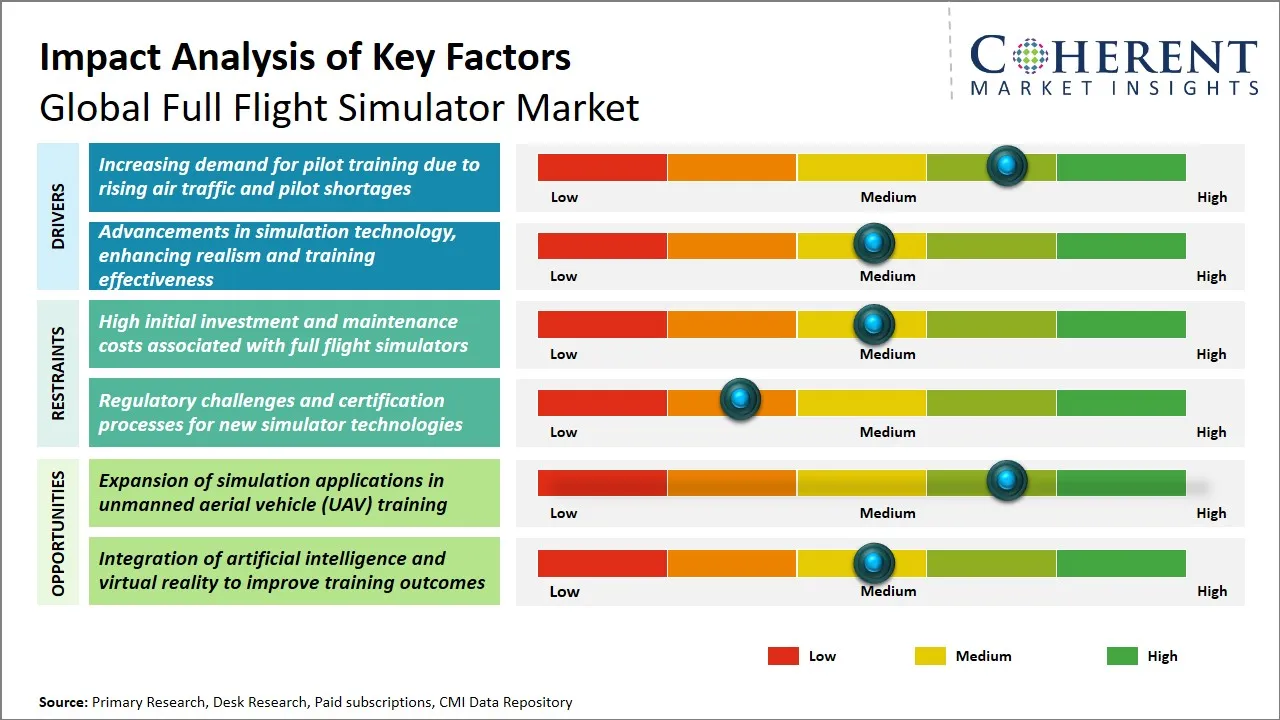
Global Full Flight Simulator Market Driver – Increasing Demand for Pilot Training due to Rising air Traffic and Pilot Shortages
The rising volume of global air traffic has created need for comprehensive pilot training programs, adding to the demand for full flight simulators. As commercial aviation grows, airlines are facing pilot shortages, made worse by retirements and the lengthy time required to train new pilots. Full flight simulators give a safe, cost-effective, and highly realistic environment where trainee pilots can practice different scenarios, including emergency procedures and adverse weather conditions, without the risks associated with actual flying.
Also, the simulator-based training helps airlines optimize pilot schedules and reduce downtime, making it useful in addressing both pilot scarcity and the increasing complexity of modern aircraft systems. In 2024, United committed to training 5,000 new pilots by 2030 to address the global pilot shortage. To meet this target, the airline ordered additional CAE 7000XR full flight simulators for Boeing and Airbus fleets.
Global Full Flight Simulator Market Opportunity – Expansion of Simulation Applications in Unmanned Aerial Vehicle (UAV) Training
The global full flight simulator market is seeing a big growth opportunity through the expansion of simulation applications in Unmanned Aerial Vehicle (UAV) training. UAV operators require comprehensive training to handle complex flight scenarios, mission-specific operations, and emergency responses, all of which can be effectively delivered through full flight simulators.
Also, as UAV technology becomes more sophisticated, using artificial intelligence and autonomous flight capabilities, the complexity of required training also increases. Full flight simulators give a scalable and customizable platform to simulate different UAV models, sensor payloads, and mission environments, making possible improved pilot skill development and decision-making expertise.
In 2023, General Atomics Aeronautical Systems partnered with CAE USA to deliver a certified Predator Mission Trainer (PMT) for MQ-9 Reaper drone operators. Also, the growth of UAV applications in sectors like agriculture, logistics, surveillance, and disaster management gives a broad range of use cases where simulation-based training can reduce operational errors and optimize mission outcomes.
Analyst Opinion (Expert Opinion)
- Artificial intelligence is helping simulators automatically tailor flight scenarios based on a trainee’s performance in real time. This improves training efficiency and gives airlines and military operators detailed performance analytics for certification and safety audits.
- The use of virtual and augmented reality with high-resolution 360° dome displays is creating ultra-realistic environments. These advances reduce the need for expensive in-air training hours and improving pilot preparedness for complex weather and emergency situations.
- Cloud computing allows remote access to high-fidelity simulation data and real-time updates in multiple training centers. This makes possible distributed pilot training programs, supports global airlines with standardized curricula, and lowers infrastructure costs for operators expanding into new regions.
Speak to the analyst
Want personalized insights?
Take the findings above to one of our principal consultants, or have the report rebuilt around the segments, geographies and competitors you actually track.
Market Segmentation
- Application Insights (Revenue, USD Bn, 2021 - 2033)
- Civil Aviation
- Military & Defense
- Regional Insights (Revenue, USD Bn, 2021 - 2033)
- North America
- U.S.
- Canada
- Latin America
- Brazil
- Argentina
- Mexico
- Rest of Latin America
- Europe
- Germany
- U.K.
- Spain
- France
- Italy
- Russia
- Rest of Europe
- Asia Pacific
- China
- India
- Japan
- Australia
- South Korea
- ASEAN
- Rest of Asia Pacific
- Middle East
- GCC Countries
- Israel
- Rest of Middle East
- Africa
- South Africa
- North Africa
- Central Africa
- North America
- Key Players Insights
- CAE Inc.
- Thales Group
- L3Harris Technologies
- FlightSafety International
- The Boeing Company
- Airbus S.A.S.
- Rheinmetall AG
- Saab AB
- Lockheed Martin
- General Electric (GE) Aviation
- Rockwell Collins
- Indra Sistemas
- Sim Industries
- Frasca International
- Redbird Flight Simulations
Sources
Primary Research Interviews
Stakeholders
- Civil Aviation Training Academies
- Aircraft Manufacturers and OEMs
- Simulator Hardware & Software Developers
- Airline Pilot Recruitment & Training Managers
- Defense Aviation Authorities & Military Training Commanders
- Aviation Regulatory Bodies
- Technology Vendors specializing in AI/VR for simulation
Databases
- International Air Transport Association (IATA) Traffic and Pilot Demand Data
- U.S. Federal Aviation Administration (FAA) Civil Airmen Statistics
- Eurocontrol Aviation Data Portal
- OECD Aviation and Technology Outlook
- ICAO (International Civil Aviation Organization) Data Sets
Magazines
- Aviation Week & Space Technology
- Flight International
- Air Transport World (ATW)
- Aerospace & Defense Technology
- Pilot Training & Flight Simulation Review
Journals
- Journal of Aviation/Aerospace Education & Research
- The International Journal of Aerospace Psychology
- Simulation Modelling Practice and Theory
- Journal of Air Transport Management
- Human Factors in Aviation Safety Journal
Newspapers
- The Wall Street Journal (Aviation & Aerospace Section)
- Financial Times (Transport & Aerospace)
- The Economic Times (India) – Aviation Focus
- The Guardian (UK) – Business & Aviation
- Nikkei Asia – Aerospace Industry Reports
Associations
- International Civil Aviation Organization (ICAO)
- Aircraft Owners and Pilots Association (AOPA)
- International Federation of Air Line Pilots’ Associations (IFALPA)
- European Cockpit Association (ECA)
- Flight Simulation Training Device Manufacturers Association (FSTDMA)
Public Domain Sources
- World Bank Aviation and Transport Data
- United Nations Economic Commission for Europe (UNECE) Transport Statistics
- U.S. Department of Transportation – Bureau of Transportation Statistics
- EUROSTAT – Aviation & Pilot Training Indicators
- ResearchGate – Academic Papers on Flight Simulation Technology
Proprietary Elements
- CMI Data Analytics Tool, Proprietary CMI Existing Repository of information for last 8 years
Get access to 250+ pages report
Every segment, forecast, competitor profile and data table behind the analysis above — available for instant download.
- ESOMAR Member
- ISO 9001:2015 Certified
- D-U-N-S Registered
- GDPR & CCPA Compliant
Missing comfort of reading report in your local language? Find your preferred language:
Transform your Strategy with Exclusive Trending Reports
Frequently Asked Questions
The global full flight simulator market is estimated to be valued at USD 7.35 billion in 2026 and is expected to reach USD 11.05 billion by 2033.
The CAGR of the global full flight simulator market is projected to be 6.0% from 2026 to 2033.
Increasing demand for pilot training due to rising air traffic and pilot shortages and advancements in simulation technology, enhancing realism and training effectiveness are the major factors driving the growth of the global full flight simulator market.
High initial investment and maintenance costs associated with full flight simulators and regulatory challenges and certification processes for new simulator technologies are the major factors hampering the growth of the global full flight simulator market.
In terms of application, the civil aviation segment is estimated to dominate the market revenue share in 2026.
A full flight simulator is a high-fidelity training system that replicates an aircraft’s cockpit, motion, and visuals for pilot training and certification.
AI enables adaptive training scenarios and real-time performance analytics for more effective pilot instruction.