

Africa Injectable Drugs Market Size and Forecast – 2026 to 2033
The Africa Injectable Drugs Market is estimated to be valued at USD 674.3 Bn in 2026 and is expected to reach USD 1,176.6 Bn by 2033, exhibiting a compound annual growth rate (CAGR) of 8.3% from 2026 to 2033.
Key Takeaways
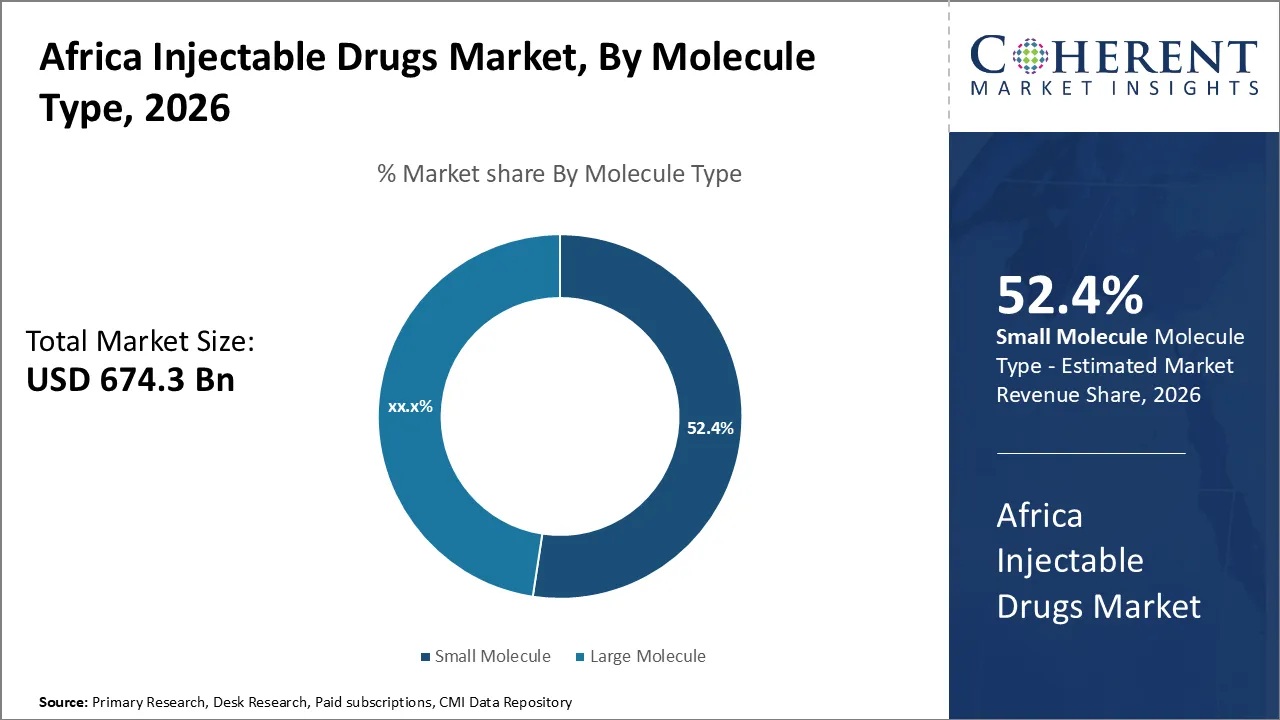
- By Molecule Type, Small Molecule hold the largest market share of 52.4% in 2026 owing to its high burden of infectious diseases.
- By Route of Administration, Intravenous expected to hold largest market share of 41.2% in 2026 owing to the rapid therapeutic action in emergency & critical care.
- By End User, Hospitals acquired the prominent market share of 39.6% in 2026 owing to the increasing number of surgical procedures.
- By Country, South Africa dominates the overall market with an estimated share of 41.5% in 2026 owing to the rising burden of chronic diseases.
Market Overview
Healthcare systems across Africa are driving steady growth in the injectable drugs market by responding to the rising burden of infectious diseases, the increasing prevalence of chronic conditions, and ongoing expansion of healthcare infrastructure. Hospitals actively use injectable drugs for rapid therapeutic action, especially in emergency care, surgical procedures, and the treatment of severe infections. Governments and international organizations are strengthening demand through healthcare initiatives, vaccination programs, and medical support. At the same time, improvements in hospital capacity, pharmaceutical manufacturing, and access to advanced therapies are further advancing the injectable drugs market across Africa.
Current Events and their Impact on the Africa Injectable Drugs Market
Current Events | Description and its impact |
Geopolitical Stability and Regulatory Changes in Africa |
|
Economic and Healthcare Infrastructure Developments |
|
Technological Innovations and Local Manufacturing Initiatives |
|
Segmental Insights
- Current Industry Events of 2026
- Market Size Estimation
- Regional Breakdown
- Competitive Landscape
- Customer Intelligence
- Segmental Analysis
- Pricing Analysis
- Key Market Drivers, Challenges & Future Trends
- Customized Insights Section
Africa Injectable Drugs Market Insights, By Molecule Type: Small Molecule contribute the highest share of the market owing to its cost advantage and manufacturing simplicity.
Small Molecule hold the largest market share of 52.4% in 2026. Healthcare providers across Africa are driving the growth of small molecule drugs in the injectable drugs market by widely using them to treat acute and infectious conditions in hospitals and clinical settings. Medical professionals prefer these drugs because they deliver rapid action, allow reliable dosing, and suit emergency and inpatient care. Increasing demand for injectable antibiotics, analgesics, and antimalarial treatments further supports market expansion. Additionally, pharmaceutical companies supply cost-effective small molecule formulations and generic versions, enabling public healthcare systems and government treatment programs to adopt them more broadly.
Africa Injectable Drugs Market Insights, By Route of Administration: Intravenous contribute the highest share of the market owing to its growth in IV fluid therapy and nutritional support.
Intravenous expected to hold largest market share of 41.2% in 2026. Healthcare providers across Africa are expanding the use of intravenous drug delivery to meet the growing need for immediate treatment in critical and hospital-based care. Medical professionals administer medications through intravenous routes to achieve rapid absorption and accurate dosing during emergencies, surgeries, and intensive care procedures. Hospitals are also treating a rising number of patients with severe infections and chronic diseases, which increases demand for IV therapies. Additionally, clinicians widely use IV fluids for hydration, nutritional support, and postoperative recovery, further driving the adoption of intravenous administration in healthcare facilities.
Africa Injectable Drugs Market Insights, By End User: Hospitals contribute the highest share of the market owing to its requirement for professional drug administration.
Hospitals acquired the prominent market share of 39.6% in 2026. Hospitals across Africa are driving the injectable drugs market by acting as key centers for administering injectable therapies. Medical staff deliver medications in sterile environments, ensuring safe and precise dosing. Rising hospital admissions for infectious diseases, chronic illnesses, and surgical procedures are increasing demand for injectable drugs. Investments in hospital infrastructure, expansion of critical care units, and a stronger focus on emergency and intensive care services are further reinforcing hospitals’ pivotal role in promoting the widespread use of injectable medications throughout the region.
Regional Insights
South Africa Injectable Drugs Market Trends
South Africa dominates the overall market with an estimated share of 41.50% in 2026. Healthcare providers in South Africa are advancing the injectable drugs market by increasingly adopting advanced therapies and hospital-administered treatments. Rising numbers of patients with infectious and chronic diseases are boosting demand for intravenous, intramuscular, and specialty injectables. Hospitals and clinics are expanding critical care services, including ICUs and surgical procedures, to meet growing patient needs. Government health programs, vaccination campaigns, and enhanced pharmaceutical manufacturing are improving accessibility, while the shift toward cost-effective small molecule injectables and broader use of generics is enabling wider patient reach and treatment coverage.
Central Africa Injectable Drugs Market Trends
Healthcare providers in Central Africa are driving the injectable drugs market by expanding access to hospital and clinic-based treatments. The high prevalence of infectious diseases is prompting medical professionals to use intravenous and intramuscular therapies for rapid and effective patient care. Investments in healthcare infrastructure, including new hospitals and upgraded emergency and critical care units, are improving the delivery of injectable medications. At the same time, government health programs, vaccination campaigns, and the availability of affordable generics are enabling wider adoption of injectable drugs throughout the region.
End-User Feedback and Unmet Needs in the Africa Injectable Drugs Market
- Hospital Feedback on Accessibility: Hospitals report challenges in maintaining a consistent supply of injectable drugs, particularly in rural and under-resourced areas. Stockouts and delays disrupt treatment schedules, forcing medical staff to seek alternative therapies. Improving distribution networks and local manufacturing could address accessibility issues and ensure timely availability for critical patient care.
- Clinician Feedback on Safety and Administration: Healthcare professionals highlight the need for safer, easier-to-administer injectable formulations. Complex preparation procedures and risk of contamination increase the workload and limit efficient use. Streamlined packaging, prefilled syringes, and ready-to-use formulations could reduce errors and enhance safety during administration, especially in busy hospital and clinic settings.
- Patient Feedback on Treatment Experience: Patients express concerns about pain, multiple injections, and treatment frequency, which affect adherence and satisfaction. There is demand for long-acting or less frequent injectable therapies to reduce discomfort and improve compliance. Patient-centered approaches, including smaller needles and reduced dosing schedules, could significantly enhance treatment experiences.
Africa Injectable Drugs Market Trend
Expansion of Hospital and Clinic-Based Care
Healthcare facilities across Africa are expanding their capacity to deliver injectable therapies, particularly in urban centers and regional hospitals. Rising patient volumes, increasing surgical procedures, and the demand for emergency care are encouraging hospitals to invest in critical care units and specialized injection services. This expansion supports broader access to intravenous, intramuscular, and specialty injectables, enabling timely treatment for infectious and chronic diseases while strengthening hospital-based delivery as a key driver in the injectable drugs market.
Growing Demand for Intravenous and Rapid-Action Therapies
Medical professionals increasingly rely on intravenous and other rapid-onset injectable therapies to treat severe infections, trauma cases, and chronic conditions. IV administration ensures precise dosing and faster therapeutic outcomes, particularly in emergency rooms and intensive care units. This trend reflects the clinical preference for injectable drugs that provide immediate patient response, reducing hospital stays and improving survival rates while positioning intravenous therapies as a primary focus of market growth across African healthcare facilities.
Africa Injectable Drugs Market Opportunity
Growth in Infectious Disease Treatment Programs
Infectious diseases such as HIV, tuberculosis, and malaria remain prevalent across the continent. Governments and international health organizations are investing heavily in treatment programs requiring injectable medications. Manufacturers and distributors can capitalize on this by supplying affordable, high-quality antibiotics, antivirals, and antimalarials. Strengthening partnerships with public health programs and expanding hospital and clinic coverage provides opportunities to meet the consistent and critical demand for injectable therapies across Africa.
Market Report Scope
Africa Injectable Drugs Market Report Coverage
| Report Coverage | Details | ||
|---|---|---|---|
| Base Year: | 2025 | Market Size in 2026: | USD 674.3 Bn |
| Historical Data for: | 2020 To 2024 | Forecast Period: | 2026 To 2033 |
| Forecast Period 2026 to 2033 CAGR: | 8.3% | 2033 Value Projection: | USD 1,176.6 Bn |
| Geographies covered: |
| ||
| Segments covered: |
| ||
| Companies covered: | Apotex Inc., Fresenius Kabi India Pvt. Ltd., Hikma Pharmaceuticals PLC, Pfizer Inc., Bristol-Myers Squibb Company, Gland Pharma Limited, hameln pharma gmbh, Merck & Co., Inc., AbbVie Inc., Sun Pharmaceutical Industries Ltd., Aurobindo Pharma, and PANPHARMA S.A. | ||
| Growth Drivers: |
| ||
| Restraints & Challenges: |
| ||
Africa Injectable Drugs Market News
- In February 2026, Zimbabwe has begun administering Lenacapavir, the first twice-yearly injectable pre-exposure prophylaxis (PrEP) for HIV, providing a highly effective, long-acting alternative to daily oral pills.
- In February 2024, the Zambia Ministry of Health has introduced a PrEP injectable, known as long-acting cabotegravir (CAB-LA), which delivers approximately two months of HIV protection to users.
Analyst Opinion (Expert Opinion)
- The current trajectory of the Africa injectable drugs landscape reflects a sharp divergence between enduring market needs and structural constraints, such that demand is largely dictated by public health imperatives rather than pure commercial dynamics. Infectious diseases still dominate clinical priorities across the continent, with injectable antiretrovirals and vaccines forming the backbone of national treatment protocols in high‑burden settings. Long‑acting HIV prevention injections such as lenacapavir are being introduced in countries like Zimbabwe and South Africa, offering twice‑yearly dosing that could materially improve adherence compared with daily oral regimens; yet supply remains constrained relative to population need, with initial distribution covering only tens of thousands of individuals despite high HIV prevalence.
- Parallel to infectious disease imperatives, the evolving burden of non‑communicable diseases is reshaping injectable demand structures. In South Africa, for example, GLP‑1 based therapies originally developed for diabetes have rapidly gained traction, tripling the market value of injectable weight‑loss and diabetes treatments within 18 months and capturing over half of the segment’s share in early 2026. The accelerated adoption of these therapies signals a broader shift: injectables are no longer the preserve of acute care and vaccination campaigns but now intersect with lifestyle and chronic disease management. However, the high cost of such breakthrough therapies exposes deep inequities, especially where public systems cannot subsidize access at scale.
- On the supply side, the push toward localized manufacturing and regulatory harmonization represents a watershed opportunity that could recalibrate Africa’s dependency on imports. Initiatives by regional producers and partnerships—exemplified by voluntary licensing agreements to manufacture generic long‑acting HIV injections—underscore a strategic pivot toward capacity building in pharmaceuticals. These moves are complemented by continental regulatory efforts aimed at reducing fragmentation and accelerating approvals, potentially smoothing pathways for both global and indigenous injectable products entering the market.
Speak to the analyst
Want personalized insights?
Take the findings above to one of our principal consultants, or have the report rebuilt around the segments, geographies and competitors you actually track.
Market Segmentation
- By Molecule Type
- Large Molecule
- Small Molecule
- By Route of Administration
- Intravenous
- Intramuscular
- Sub-cutaneous
- Others
- By End User
- Hospitals
- Specialty Clinics
- Others
- By Region
- South Africa
- North Africa
- Central Africa
- Key Players Insights
- Apotex Inc.
- Fresenius Kabi India Pvt. Ltd.
- Hikma Pharmaceuticals PLC
- Pfizer Inc.
- Bristol-Myers Squibb Company
- Gland Pharma Limited
- hameln pharma gmbh
- Merck & Co., Inc.
- AbbVie Inc.
- Sun Pharmaceutical Industries Ltd.
- Aurobindo Pharma
- PANPHARMA S.A.
Sources
Primary Research interviews
- Interviews with infectious disease specialists and public health officials involved in HIV PrEP and injectable rollout programs across Southern and East Africa (e.g., implementing lenacapavir and cabotegravir programs).
- Interviews with harm reduction programme managers focused on injection safety and HIV prevention among people who inject drugs.
- Discussions with public sector procurement leads in ministries of health regarding sterile injectable supply chain challenges.
Databases
- PubMed (scientific publications on HIV incidence and injectable drug use risk in Africa).
- Global Health Observatory (World Health Organization database for HIV/AIDS and injectable-related statistics).
- UNAIDS country datasets on HIV treatment modalities and long‑acting injectable uptake.
Magazines
- ETHealthworld / Economic Times coverage of rollout of twice‑yearly HIV prevention injections in South Africa, Eswatini and Zambia.
- Africa Health Magazine (features on pharmaceutical developments and healthcare delivery challenges in Africa).
Journals
- African Journal of AIDS Research (peer‑reviewed analyses relevant to HIV treatment and prevention strategies).
- BMC Infectious Diseases studies on long‑acting injectable antiretroviral treatment experiences in Uganda.
- Harm Reduction Journal articles on injection practices and their impacts on HIV transmission risk.
Newspapers
- AP News reporting on Eswatini as the first African country receiving twice‑yearly HIV prevention shots.
- Reuters coverage on South African efforts to localize production of long‑acting HIV injectable drugs.
- AP News reporting on South Africa’s HIV prevention jab supply limitations and funding context.
Associations
- UNAIDS (United Nations Programme on HIV/AIDS) data and policy statements on injectable PrEP rollout.
- Africa CDC (Africa Centres for Disease Control and Prevention) surveillance and guidance on injectable therapy implementation.
- PEPFAR (U.S. President’s Emergency Plan for AIDS Relief) programmatic reports on funding and key injectable interventions.
Public Domain sources
- WHO guidance and reports on injectable antiretroviral drugs and PrEP strategies in Africa.
- National health ministry treatment guidelines publicly available for long‑acting injectable regimens.
- Open access epidemiological studies on injection drug use and HIV risk across Africa.
Proprietary Elements
- CMI Data Analytics Tool
- Proprietary CMI Existing Repository of information for last 8 years
Get access to 250+ pages report
Every segment, forecast, competitor profile and data table behind the analysis above — available for instant download.
- ESOMAR Member
- ISO 9001:2015 Certified
- D-U-N-S Registered
- GDPR & CCPA Compliant
Missing comfort of reading report in your local language? Find your preferred language:
Transform your Strategy with Exclusive Trending Reports
Frequently Asked Questions
The Africa Injectable Drugs Market is estimated to be valued at USD 674.3 Bn in 2026 and is expected to reach USD 1176.6 Bn by 2033.
Factors such as an increase in the prevalence of chronic disease and number of manufacturing facilities are expected to drive the market growth during the forecast period.
Small molecule is the leading molecule type segment and is expected to hold a major market share during the forecast period.
The major factors hampering the growth of the market include the lack of funding for manufacturing injectable products.
Major players operating in the market include Apotex Inc., Fresenius Kabi India Pvt. Ltd., Hikma Pharmaceuticals PLC, Pfizer Inc., Bristol-Myers Squibb Company, Gland Pharma Limited, hameln pharma gmbh, Merck & Co., Inc., AbbVie Inc., Sun Pharmaceutical Industries Ltd., Aurobindo Pharma, and PANPHARMA S.A.