

Anti-Suicide Drugs Market Analysis & Forecast: (2025-2033)
Anti suicide drugs market is estimated to be valued at USD 4.11 Bn in 2026 and is expected to reach USD 5.00 Bn in 2033, exhibiting a compound annual growth rate (CAGR) of 2.8% from 2026 to 2033.
Key Takeaways
- Based on Drug Class, the Anti‑depressants & anti‑anxiety drugs segment is expected to hold 42.7% share of the market in 2026.
- Based on Application, the Hospitals segment is expected to lead the market with 47% share in 2026.
- Based on Region, North America is set to lead the anti-suicide drugs market with 39.2% share in 2026. While, Asia Pacific is anticipated to be the fastest growing region.
Market Overview
Depression is one of the major healthcare burdens worldwide leading to lower productivity and in severe cases leading to suicidal tendencies. Anti-depressant and anti-psychotic drugs are especially high in demand during economic crisis and social negligence. These drugs also serve as a therapy for preventing suicidal thoughts and attempts. However, overdose of these drugs can be fatal and therefore, needs to be administered under the direction of a physician. Extensive research related to suicide treatment is expected to provide a better solution to the global population during the latter half of the forecast period. This would improve the outlook of global anti-suicide drugs market and would help in reducing deaths due to suicide.
Current Event and Its Impacts on the Anti-Suicide Drugs Market
Current Event | Description and its Impact |
Regulatory Breakthroughs and Drug Approvals |
|
Technological Innovation in Mental Health Treatment |
|
Why Are So Many Young Lives Lost to Suicide?
Statistic | Insight |
Over 700,000 people die by suicide annually worldwide (WHO, 2025) | Highlights the global scale and urgency of suicide prevention efforts |
Suicide is the 4th leading cause of death among 15–29-year-olds globally | Indicates a critical need for targeted youth mental health interventions |
75% of suicides occur in low- and middle-income countries | Emphasizes the disparity in access to mental health care and the need for scalable solutions |
- Current Industry Events of 2026
- Market Size Estimation
- Regional Breakdown
- Competitive Landscape
- Customer Intelligence
- Segmental Analysis
- Pricing Analysis
- Key Market Drivers, Challenges & Future Trends
- Customized Insights Section
Segmental Insights
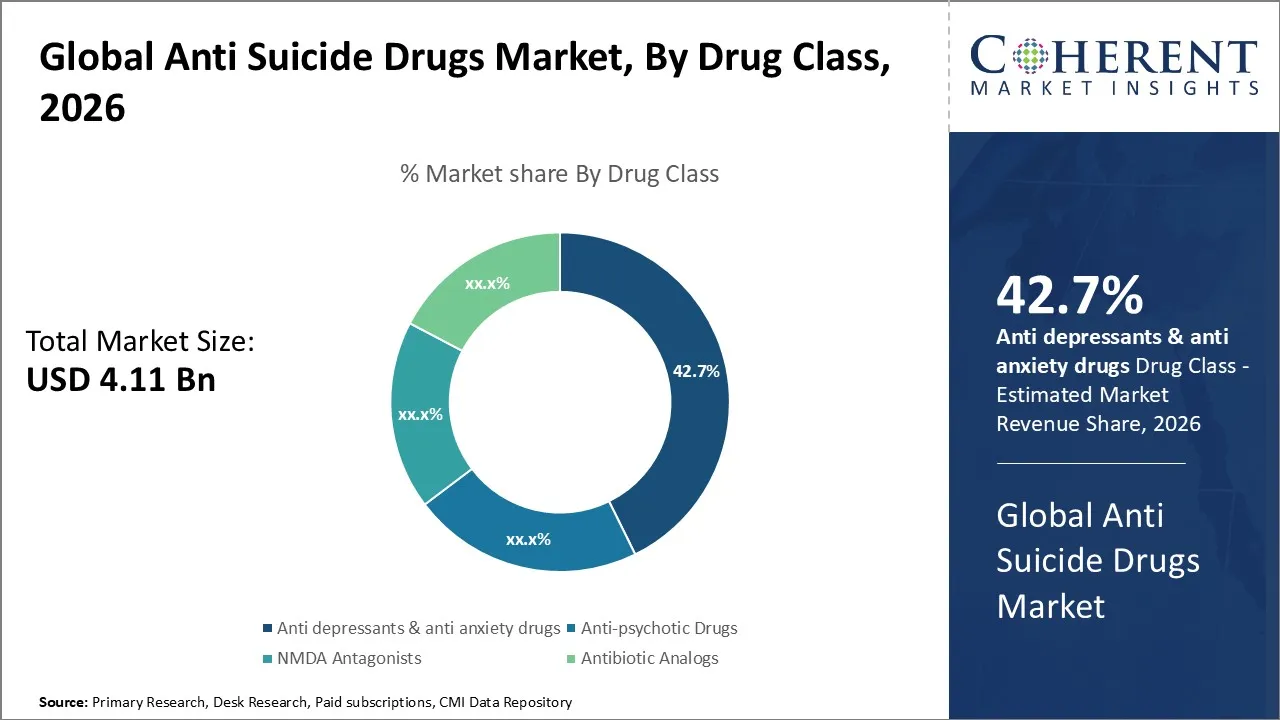
Why do anti‑depressants and anti‑anxiety drugs dominate the therapeutic class?
In terms of drug class, the anti‑depressants and anti‑anxiety drugs segment is expected to dominate in 2026, accounting for 42.7% of the market. Their dominance stems from widespread prescription as first‑line therapy, established clinical efficacy, and accessibility across regions. Supported by global guidelines, they remain the cornerstone of suicide prevention pharmacotherapy despite emerging alternatives.
For instance, in January 2026, Johnson & Johnson announced new depression research at the 2026 ACNP Annual Meeting, reinforcing its leadership in mental health innovation. The findings highlight advances in anti‑depressant and anti‑anxiety drug development, supporting their role as first‑line therapies.
Why do hospitals lead distribution channels in 2026 in anti-suicide drugs market?
In terms of distribution channel, the hospitals segment is expected to lead in 2026 with 47% share, driven by their role in acute crisis management. They serve as the primary setting for initiating therapy, monitoring high‑risk patients, and delivering emergency interventions. Strong infrastructure, immediate access to specialists, and integration with suicide prevention programs reinforce their market dominance.
For instance, in August 2025, A ketamine ‑based drug has received FDA fast‑track designation for treating suicidal ideation, marking a major advance in hospital‑based anti‑suicide therapies. As an NMDA antagonist, it offers rapid relief in acute crises.
Regional Insights

North America Anti-Suicide Drugs Market Analysis & Trends
North America is expected to dominate the anti-suicide drugs market with 39.20% share in 2026, driven by high prevalence of depression and anxiety, advanced healthcare infrastructure, and strong awareness programs. Hospitals dominate distribution, supported by FDA fast‑track approvals for innovative NMDA antagonists.
For instance, in October 2025, The American Foundation for Suicide Prevention announced an USD 8.5 million investment in research on genetics, neurobiology, therapies, and interventions. This funding supports innovative approaches to understanding and preventing suicide, strengthening North America’s leadership in mental health research and advancing development of new treatments to reduce suicidal ideation and improve care.
Asia Pacific Anti-Suicide Drugs Market Analysis & Trends
Asia Pacific is anticipated to be the fastest growing region, due to increasing suicide rates, growing mental health awareness, and expanding healthcare infrastructure. Government initiatives, urbanization, and digital health platforms improve access to therapies. Rising affordability and online pharmacies further drive adoption.
For instance, in November 2025, Zydus gained NMPA approval in China for venlafaxine extended‑release capsules, a key antidepressant used to reduce suicidal ideation. This milestone expands hospital‑based distribution, and enhances access to advanced therapies, reinforcing regional momentum in mental health treatment and pharmaceutical innovation for 2026.
Anti-Suicide Drugs Market Outlook Country-Wise
The U.S. Anti-Suicide Drugs Market Trends
In 2026, the U.S. anti‑suicide drugs market is highly demanding due to rising suicide rates, strong hospital infrastructure, and FDA approvals of innovative therapies like NMDA antagonists. Government funding, public awareness campaigns, and advanced psychiatric care drive adoption, reinforcing North America’s dominance in global suicide prevention treatments.
For instance, in November 2025, Johnson & Johnson announced FDA approval of Caplyta (lumateperone) for major depressive disorder, offering new hope for remission in adults. This milestone expands treatment options, resets expectations in psychiatric care, and addresses urgent needs in depression management and suicide prevention.
China Anti-Suicide Drugs Market Trends
China’s anti-suicide drugs market in 2026 is driven by rising mental health awareness, government initiatives, and growing prevalence of depression and anxiety. Expanding healthcare infrastructure, increased investment in pharmaceuticals, and innovation in drug therapies further fuel demand, making China a key growth region for this sector.
For instance, in November 2025, CSPC Pharmaceutical Group’s SYH‑2056 has been cleared to enter clinical trials in China for depression treatment. This development strengthens Asia‑Pacific’s role in the anti‑suicide drugs market, expanding innovation and hospital‑based distribution. It highlights China’s growing demand for advanced psychiatric therapies, supporting regional momentum in suicide prevention and mental health care.
Market Report Scope
Anti-Suicide Drugs Market Report Coverage
| Report Coverage | Details | ||
|---|---|---|---|
| Base Year: | 2025 | Market Size in 2026: | USD 4.11 Bn |
| Historical Data for: | 2020 To 2024 | Forecast Period: | 2026 To 2033 |
| Forecast Period 2026 to 2033 CAGR: | 2.8% | 2033 Value Projection: | USD 5.00 Bn |
| Geographies covered: |
| ||
| Segments covered: |
| ||
| Companies covered: | Pfizer, Inc., AstraZeneca plc, Eli Lilly and Company, Allergan plc, GlaxoSmithKline plc, Merck & Co., Inc., H. Lundbeck A/S, NeuroRx, Inc., and Johnson & Johnson. | ||
| Growth Drivers: |
| ||
| Restraints & Challenges: |
| ||
Anti-Suicide Drugs Market Driver
Rising Mental Health Awareness
The growing recognition of suicide as a major public health crisis has significantly increased the demand for effective drug therapies. Governments, NGOs, and healthcare providers are investing in awareness campaigns to reduce stigma and encourage treatment. This shift has boosted patient willingness to seek medical help, thereby expanding the anti-suicide drugs market share globally. As more individuals acknowledge mental health as essential to overall well-being, pharmaceutical companies are seeing rising opportunities for innovative drug development.
For instance, in January 2026, Boise State Athletics launched Mental Health Awareness Games in partnership with BroncoBOLD to promote mental wellness. Events during the winter sports season aim to raise awareness, reduce stigma, and encourage support-seeking behaviors among students and fans, reinforcing the university’s commitment to mental health advocacy through athletics and community engagement.
Increasing Prevalence of Depression & Anxiety
Worldwide, the rising prevalence of psychiatric disorders such as depression and anxiety is fueling the need for anti-suicide medications. Stressful lifestyles, economic pressures, and social isolation are contributing to higher rates of mental illness. This trend has directly increased the anti-suicide drugs market demand, as more patients require pharmacological interventions alongside therapy. Pharmaceutical firms are responding with advanced drug pipelines, ensuring accessibility and effectiveness, which positions the market for sustained growth in both developed and emerging economies.
Over one billion people globally live with mental health conditions, according to WHO. The organization urges urgent scaling up of mental health services, especially in low- and middle-income countries, where access remains limited. Investment, integration into primary care, and community-based support are essential to address this growing global health crisis.
Anti-Suicide Drugs Market Opportunity
Next-Generation NMDA Antagonists
Next-generation NMDA antagonists represent a transformative opportunity in the anti-suicide drugs market forecast. Unlike ketamine, which requires clinical supervision and carries dissociative side effects, newer compounds aim for safer, more targeted modulation of glutamate pathways. Oral formulations like KETAMIR-2 and ST-901 are in development to offer rapid antidepressant effects without ketamine’s neurotoxicity. These innovations could expand access to fast-acting treatments for suicidal ideation, especially in outpatient settings, and are expected to significantly drive market growth through 2035.
Analyst Opinion (Expert Opinion)
- The market for anti-suicide drugs is broad considering mental health problems, especially mood and depressive disorders that raise the risk of suicide, are common around the world. In 2023, antidepressants and anti-anxiety drugs made up about 35% of the therapeutic mix. This made them the most commonly used class of drugs to prevent suicide, with patterns of use linked to managing depressive symptoms and stabilizing mood. About 30% of the drugs used were antipsychotics, which are used to treat complicated mental illnesses like schizophrenia and bipolar disorder, which are also linked to a higher risk of suicide. About 20% of the drug mix is made up of NMDA antagonists, which are becoming more popular because they quickly reduce acute suicidal thoughts. The rest of the drugs are from other therapeutic classes.
- North America is a major contributor to regional performance, thanks to its advanced healthcare infrastructure and widespread use of prescriptions. Europe had a significant share as suicide risk-reducing drugs were widely used in clinical settings. The Asia-Pacific region, on the other hand, showed a lot of potential for growth as more people became aware of and had access to mental health care. Hospitals are still the main way to get medicine, making up about half of all therapeutic administration. Retail and online pharmacies are other ways to get medicine.
- Clinical trends show that greater resources are going into fast-acting formulations and combination therapies that are meant to help people with treatment-resistant depression and a high risk of suicide. At the same time, broader mental health initiatives are affecting how doctors prescribe drugs. There are still problems with complicated rules and uneven access to care in developing areas, but new drug mechanisms, like glutamate modulation, are changing the way we think about the value of drugs for preventing suicide.
Speak to the analyst
Want personalized insights?
Take the findings above to one of our principal consultants, or have the report rebuilt around the segments, geographies and competitors you actually track.
Recent Developments
- In December 2025, Syremis Therapeutics is developing ST-901, a novel NMDA receptor antagonist for mood disorders. While not directly aimed at suicide prevention, NMDA antagonists like ketamine have shown rapid anti-suicidal effects. Thus, ST-901 is indirectly related to anti-suicide treatments through its drug class, though it’s still in early development.
Market Segmentation
- By Drug Class
- Anti‑depressants & anti‑anxiety drugs
- Anti‑psychotic drugs
- NMDA antagonists
- Antibiotic analogs
- By Application
- Hospitals
- Retail Pharmacies
- Online Pharmacies
- By Region
- North America
- U.S.
- Canada
- Latin America
- Brazil
- Argentina
- Mexico
- Rest of Latin America
- Europe
- Germany
- U.K.
- Spain
- France
- Italy
- Russia
- Rest of Europe
- Asia Pacific
- China
- India
- Japan
- Australia
- South Korea
- ASEAN
- Rest of Asia Pacific
- Middle East & Africa
- GCC Countries
- Israel
- Rest of Middle East & Africa
- North America
- Anti-Suicide Drugs Market Companies
- Pfizer, Inc.
- AstraZeneca plc
- Eli Lilly and Company
- Allergan plc
- GlaxoSmithKline plc
- Merck & Co., Inc.
- Lundbeck A/S
- NeuroRx, Inc.
- Johnson & Johnson
Sources
Primary Research Interviews
- Psychiatrists & Clinical Psychologists
- Neuropsychiatric Drug Manufacturers
- Hospital & Mental Health Clinic Pharmacists
- Clinical Research Organizations (CROs)
- Mental Health Policy & Public Health Experts
- Suicide Prevention Program Coordinators
- Others
Databases
- Bloomberg Terminal
- Thomson Reuters Eikon
- IQVIA MIDAS & Pharmascope
- Others
Magazines
- Psychiatric Times
- Nature Reviews Drug Discovery
- Pharmaceutical Executive
- Drug Development & Delivery
- Mental Health Today
- Others
Journals
- The American Journal of Psychiatry
- The Lancet Psychiatry
- Journal of Clinical Psychiatry
- Neuropsychopharmacology
- Journal of Affective Disorders
- Suicide and Life-Threatening Behavior
- Others
Newspapers
- The New York Times
- Financial Times
- The Wall Street Journal
- Reuters
- Bloomberg News
- Others
Associations
- World Health Organization (WHO) – Mental Health Programme
- American Psychiatric Association (APA)
- International Association for Suicide Prevention (IASP)
- National Alliance on Mental Illness (NAMI)
- European Psychiatric Association (EPA)
- Others
Public Domain Sources
- World Health Organization (WHO)
- U.S. Food and Drug Administration (FDA) – Drug Databases
- National Institute of Mental Health (NIMH)
- Centers for Disease Control and Prevention (CDC)
- European Medicines Agency (EMA)
- National Institutes of Health (NIH)
- Others
Proprietary Elements
- CMI Data Analytics Tool
- Proprietary CMI Existing Repository of Information for the Last 8 Years
Get access to 250+ pages report
Every segment, forecast, competitor profile and data table behind the analysis above — available for instant download.
- ESOMAR Member
- ISO 9001:2015 Certified
- D-U-N-S Registered
- GDPR & CCPA Compliant
Missing comfort of reading report in your local language? Find your preferred language:
Transform your Strategy with Exclusive Trending Reports
Frequently Asked Questions
The anti-suicide drugs market is estimated to be valued at USD 4.11 Bn in 2026, and is expected to reach USD 5.00 Bn by 2033.
Major players operating in the global anti-suicide drugs market include Pfizer, Inc., AstraZeneca plc, Eli Lilly and Company, Allergan plc, GlaxoSmithKline plc, Merck & Co., Inc., H. Lundbeck A/S, NeuroRx, Inc., and Johnson & Johnson.
Among drug class, anti depressants and anti anxiety drugs segment in the global anti-suicide drugs market is estimated to be growing faster post its FDA approval and commercialization.
Rising mental health awareness and increasing prevalence of depression & anxiety is one of the major factors that is expected to propel growth of the market over the forecast period.
The global anti-suicide drugs market is estimated to exhibit a CAGR of 2.8% during the forecast period
Among regions, North America is expected to gain significant traction during the latter half of the forecast period, with the launch of anti-suicidal drugs.