

Benign Prostatic Hyperplasia Surgical Devices Market Size and Forecast – 2026 to 2033
The Benign Prostatic Hyperplasia Surgical Devices Market is anticipated to grow at a CAGR of 8.4% with USD 22.9 Bn share in 2026 and is expected to reach USD 38.7 Bn in 2033. The growing aging male population, continuous advancements in laser and robotic surgeries, and increasing awareness of early diagnosis and treatment options are driving the adoption of advanced surgical devices in the Benign Prostatic Hyperplasia surgical devices market globally.
Key Takeaways
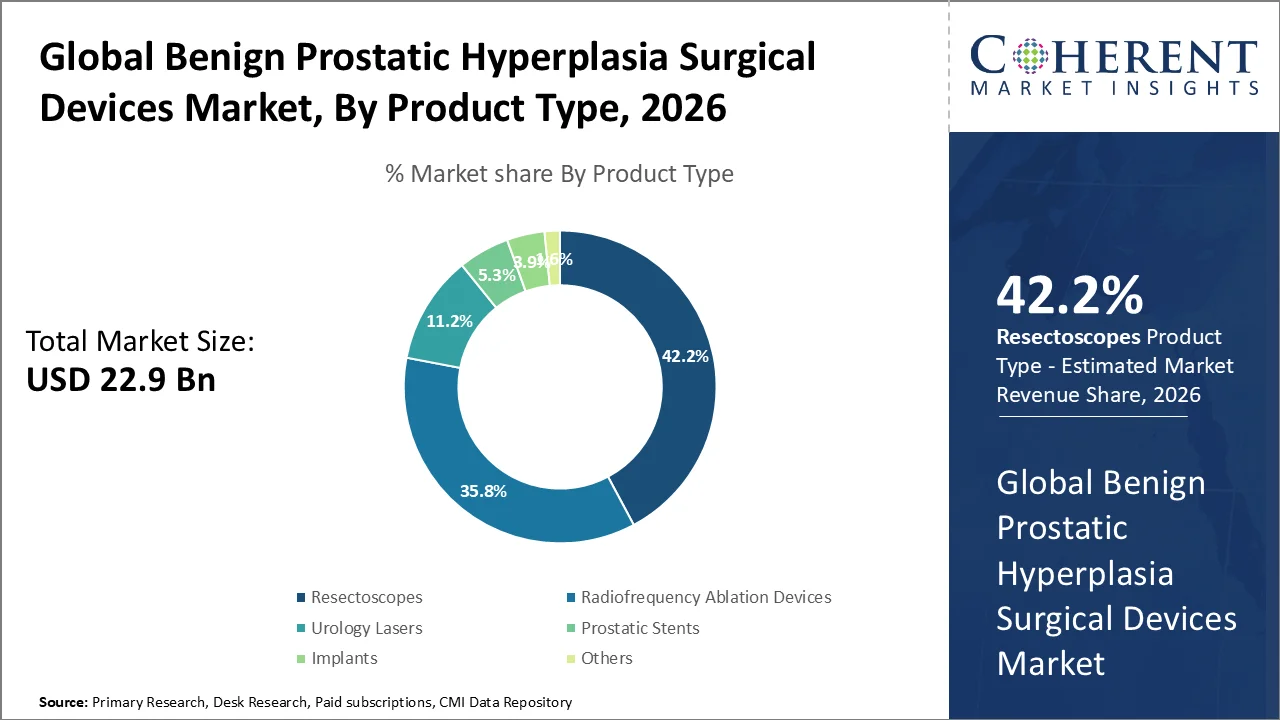
- Resectoscopes hold the largest market share of 42.2% in 2026 owing to the growing aging male population. India’s elderly population aged 60 and above is projected to reach 173 million, with men accounting for nearly half of this group.
- Ambulatory Surgery Centers expected to hold largest market share of 53.3% in 2026 owing to its shift toward minimally invasive BPH procedures.
- North America is expected to acquire the dominant share of 39.20% in 2026 owing to its strong adoption of minimally invasive procedures.
Current Events and Their Impact on the Benign Prostatic Hyperplasia Surgical Devices Market
Current Event | Description and its Impact |
FDA Quality Management System Regulation Becomes Effective in the U.S. |
|
New Implant-Based BPH Device Receives FDA Post-Approval Study Tracking |
|
Segmental Insights
- Current Industry Events of 2026
- Market Size Estimation
- Regional Breakdown
- Competitive Landscape
- Customer Intelligence
- Segmental Analysis
- Pricing Analysis
- Key Market Drivers, Challenges & Future Trends
- Customized Insights Section
Why is Resectoscopes Acquiring the Largest Market Share?
Resectoscopes hold the largest market share of 42.2% in 2026. Healthcare providers continue to drive demand for resectoscopes in the Benign Prostatic Hyperplasia surgical devices market by widely adopting transurethral resection of the prostate (TURP) as an effective treatment for moderate-to-severe BPH. The rising prevalence of BPH among aging men and the growing preference for minimally invasive procedures further support market expansion. Manufacturers are enhancing bipolar and plasma resectoscope technologies to improve visualization, increase surgical precision, and reduce bleeding risks. In addition, surgeons actively prefer resectoscope-based procedures because of their familiarity, reliability, and strong clinical outcomes in hospitals and urology centers. For instance, Corinth MedTech has begun evaluating its FDA-cleared Veloxion System, the first single-use resectoscope for treating BPH symptoms, for use in TURP procedures.
Which End User segment dominates the market?
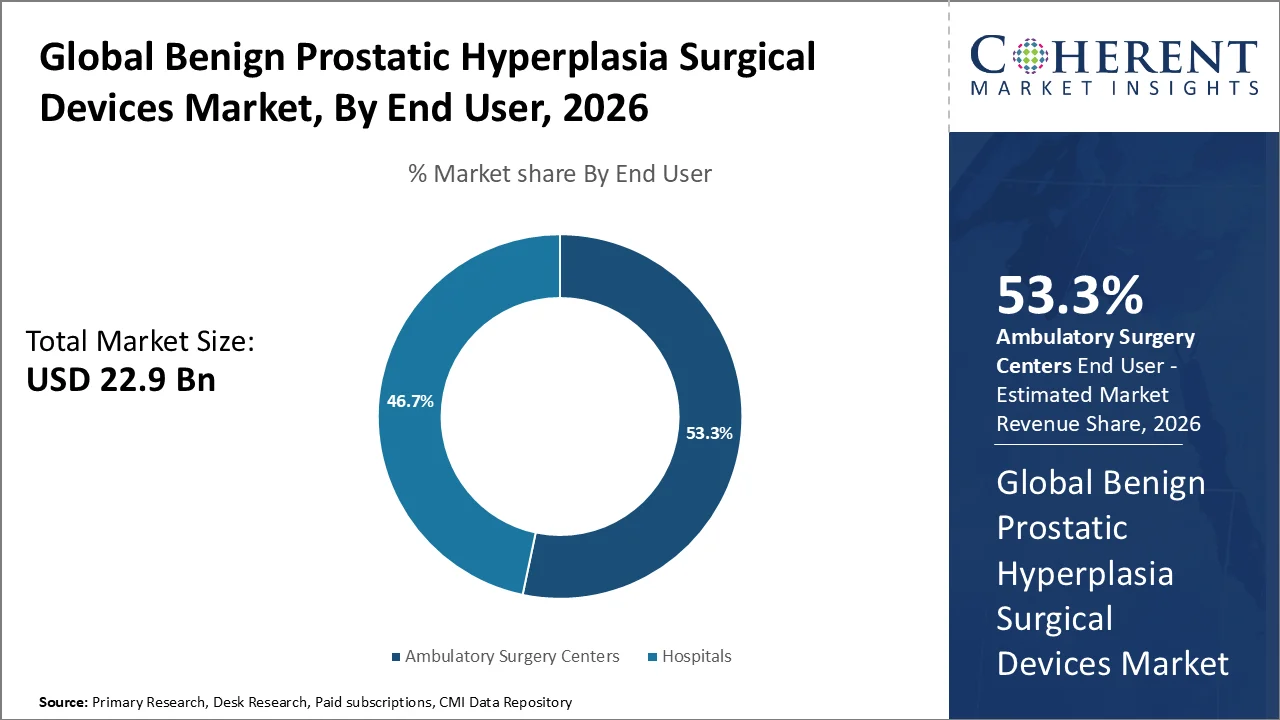
Ambulatory Surgery Centers expected to hold largest market share of 53.3% in 2026 owing to its favorable reimbursement policies. Ambulatory Surgery Centers are accelerating growth in the Benign Prostatic Hyperplasia surgical devices market by increasingly performing minimally invasive and outpatient BPH procedures. Patients and healthcare providers favor ASCs for reducing hospital stays, speeding recovery, lowering treatment costs, and improving procedural convenience. Device manufacturers continue to advance laser therapies, water vapor therapy, and other minimally invasive technologies, making outpatient treatment more efficient and accessible. In addition, healthcare systems are expanding reimbursement support, optimizing surgical workflows, and establishing specialized urology centers, which further increases ASC adoption for BPH treatmentBoston Scientific Corporation and ATRIUM Surgical Centre have named Dr. Jonathan E. Chan, MD, as a Centre of Excellence for Rezūm Water Vapor Therapy, a minimally invasive treatment for benign prostatic hyperplasia (BPH).
Benign Prostatic Hyperplasia Surgical Devices Market Trends
- Rising adoption of minimally invasive BPH procedures such as UroLift, Rezūm, Aquablation, and laser therapies is improving patient safety, reducing catheter use, and supporting faster recovery. NICE states that UroLift does not involve cutting or removing tissue and can be performed as a day-case or outpatient procedure, which may reduce hospital stays and postoperative catheterization time. NICE also reported a 2.9% urinary tract infection rate and a 13.6% five-year reintervention rate for UroLift in clinical evidence.
- Increasing use of advanced surgical technologies such as robotic-assisted waterjet systems, bipolar resectoscopes, and high-precision laser devices is improving procedural accuracy and lowering perioperative risks. The 2026 EAU guideline states that HoLEP offers a more favorable perioperative profile than TURP, with shorter catheterization and hospitalization times, reduced blood loss, and fewer transfusions. The guideline strongly recommends HoLEP as an alternative to TURP or open prostatectomy for moderate-to-severe LUTS/BPH obstruction.
- Growing preference for outpatient and ambulatory surgical center-based BPH treatment is supported by U.S. Medicare payment policy. In November 2025, CMS finalized the CY 2026 OPPS/ASC rule, covering about 4,000 hospitals and 6,000 ASCs. CMS finalized a 2.6% ASC payment update and added 289 procedures to the ASC Covered Procedures List, supporting broader movement of suitable urology procedures into outpatient care settings.
Regional Insights
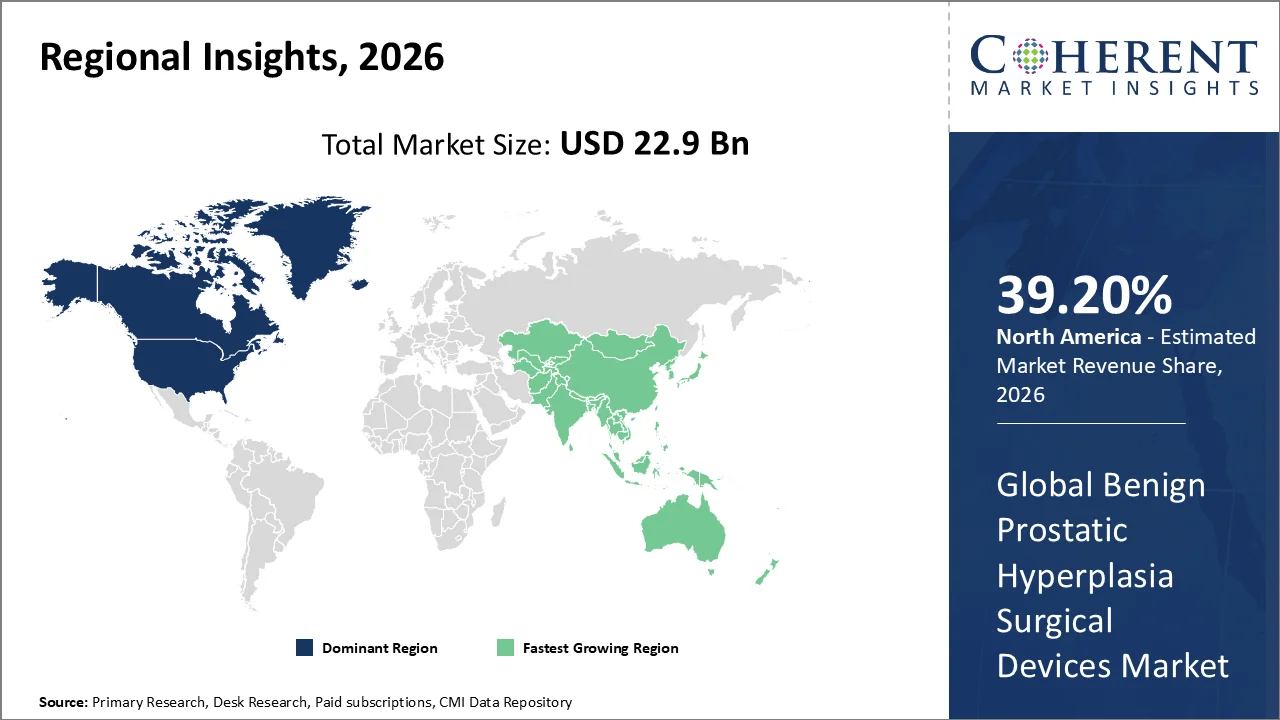
North America dominates owing to favorable reimbursement policies
North America is expected to acquire the dominant share of 39.20% in 2026. The North America benign prostatic hyperplasia surgical devices market is driven by a growing aging male population and the rising occurrence of urinary disorders that require medical intervention. Healthcare providers increasingly prefer minimally invasive procedures, while advances in laser and robotic-assisted surgical technologies further boost adoption. The shift toward outpatient treatment settings strengthens demand. Strong healthcare systems, improved patient awareness, and the wide availability of skilled urologists support market growth. Continuous innovation in device design and better clinical outcomes also promote wider acceptance across hospitals and specialty clinics. For instance, in May 2026, Butterfly Medical has raised $21 million in an oversubscribed Series C funding round to support U.S. regulatory review and commercialization of its minimally invasive BPH treatment device.
Asia Pacific Benign Prostatic Hyperplasia Surgical Devices Market Trends
The Asia Pacific benign prostatic hyperplasia surgical devices market demonstrates strong trends as healthcare providers rapidly adopt minimally invasive surgical techniques and increasingly favor outpatient procedures. Hospitals and clinics expand the use of laser-based and robotic-assisted systems to enhance precision and shorten recovery time. Growing investments in healthcare infrastructure and rising awareness of early diagnosis drive device adoption. Manufacturers advance urology instruments through continuous innovation to improve treatment efficiency. An expanding aging male population and improved access to advanced urological care further strengthen market growth across the region. For instance, Teleflex has launched the UroLift System in India to treat benign prostatic hyperplasia (BPH), or enlarged prostate. The company designed the minimally invasive system for same-day outpatient procedures.
United States Benign Prostatic Hyperplasia Surgical Devices Market Trends
The aging male population and increasing cases of urinary disorders drive steady growth in the United States benign prostatic hyperplasia surgical devices market. Healthcare providers increasingly prefer minimally invasive techniques such as laser therapy, aquablation, and prostatic urethral lift procedures, which enhance recovery and improve outcomes. Hospitals and urology specialty centers actively adopt advanced surgical systems, including resectoscopes and laser-based devices. Technological advancements, rising outpatient procedures, and better diagnosis rates continue to shape market adoption trends. For instance, Rivermark Medical has enrolled the first participant in the pivotal RAPID III trial (NCT06849258), which is evaluating the safety and effectiveness of the FloStent System in patients with LUTS due to benign prostatic hyperplasia (BPH).
China Benign Prostatic Hyperplasia Surgical Devices Market Trends
The rapidly aging male population and rising prevalence of urinary disorders drive steady growth in the China benign prostatic hyperplasia surgical devices market. Hospitals and specialty urology centers increasingly adopt minimally invasive surgical techniques such as laser therapy, transurethral resection, and prostatic urethral lift procedures to enhance treatment outcomes. Growing healthcare awareness and improved access to advanced medical technologies support demand. Continuous advancements in surgical systems and a stronger preference for outpatient procedures actively shape overall market development.
Who are the Major Companies in Benign Prostatic Hyperplasia Surgical Devices Industry
Some of the major key players in Benign Prostatic Hyperplasia Surgical Devices are Olympus Corporation, Boston Scientific Corporation, Medifocus Inc., KARL STORZ SE & Co. KG, NxThera, Inc., ProArc Medical, Lisa Laser Products OHG, and Richard Wolf Gmbh.
Key News
- In May 2026, Andera Partners has led a $20 million Series D financing round for urology device company Rivermark Medical, alongside existing investors and an unnamed strategic investor. Rivermark Medical is using the funding to advance its FloStent platform for treating benign prostatic hyperplasia (BPH).
Market Report Scope
Benign Prostatic Hyperplasia Surgical Devices Market Report Coverage
| Report Coverage | Details | ||
|---|---|---|---|
| Base Year: | 2025 | Market Size in 2026: | USD 22.9 Bn |
| Historical Data for: | 2020 To 2024 | Forecast Period: | 2026 To 2033 |
| Forecast Period 2026 to 2033 CAGR: | 8.4% | 2033 Value Projection: | USD 38.7 Bn |
| Geographies covered: |
| ||
| Segments covered: |
| ||
| Companies covered: | Olympus Corporation, Boston Scientific Corporation, Medifocus Inc., KARL STORZ SE & Co. KG, NxThera, Inc., ProArc Medical, Lisa Laser Products OHG, and Richard Wolf Gmbh. | ||
Analyst Opinion
- Benign Prostatic Hyperplasia (BPH) surgical device demand is fundamentally driven by clinical necessity rather than elective adoption. Clinical evidence suggests that nearly 50% of men over the age of 50 show histological signs of BPH, and this prevalence increases to around 80–90% in men above 70, directly sustaining long-term procedural demand for surgical intervention when pharmacological therapy fails.
- Transurethral Resection of the Prostate (TURP) continues to act as the clinical benchmark, accounting for a large share of surgical management worldwide. However, real-world hospital data shows a consistent shift toward minimally invasive laser-based procedures such as Holmium Laser Enucleation of the Prostate (HoLEP), which demonstrates lower retreatment rates of roughly 2–6% compared to higher recurrence levels seen in older techniques, reinforcing procedural preference among urologists.
- Device innovation is strongly influenced by measurable patient outcome advantages. For example, Aquablation therapy has shown significant symptom score reduction (IPSS improvements exceeding 15 points in many clinical studies) while maintaining low rates of sexual dysfunction, which remains a key concern in up to 60% of traditional surgical cases. This outcome-driven differentiation is accelerating adoption of next-generation surgical platforms in high-volume urology centers.
Speak to the analyst
Want personalized insights?
Take the findings above to one of our principal consultants, or have the report rebuilt around the segments, geographies and competitors you actually track.
Market Segmentation
- By Product Type (Revenue, USD Bn, 2021-2033)
- Resectoscopes
- Radiofrequency Ablation Devices
- Urology Lasers
- Prostatic Stents
- Implants
- Others
- By End User (Revenue, USD Bn, 2021-2033)
- Hospitals
- Ambulatory Surgery Centers
- By Region (Revenue, USD Bn, 2021-2033)
- North America
- U.S.
- Canada
- Latin America
- Brazil
- Mexico
- Argentina
- Rest of Latin America
- Europe
- Germany
- U.K.
- France
- Italy
- Spain
- Russia
- Rest of Europe
- Asia Pacific
- China
- India
- Japan
- Australia
- South Korea
- ASEAN
- Rest of Asia Pacific
- Middle East
- GCC
- Israel
- Rest of Middle East
- Africa
- South Africa
- Central Africa
- North Africa
- North America
Sources
Primary Research Interviews
- Urologists and endourologists practicing minimally invasive and robotic urology
- Hospital procurement managers and surgical department heads
- Medical device distributors specializing in urology equipment
- Ambulatory surgical center (ASC) administrators
- Biomedical engineers involved in surgical device evaluation
Databases
- PubMed Central (PMC)
- National Library of Medicine (NLM) database
- World Health Organization (WHO) Global Health Observatory
- National Institutes of Health (NIH) datasets
- ClinicalTrials.gov registry
- OECD Health Statistics database
Magazines
- Urology Practice Journal publications
- Medical Device & Diagnostic Industry (MD+DI) articles
- European Urology Focus magazine
- Journal of Endourology updates and features
- Healthcare Technology Report magazines
Journals
- The Journal of Urology
- European Urology
- BJU International (British Journal of Urology International)
- International Journal of Urology
- Journal of Endourology and Kidney Diseases
- Urology Annals
Newspapers
- The New York Times (Health section)
- The Guardian (Health & Science coverage)
- The Hindu (Science & Health section)
- The Times of India (Health updates)
- Financial Times (Healthcare industry coverage)
Associations
- American Urological Association (AUA)
- European Association of Urology (EAU)
- World Urological Oncology Federation (WUOF)
- International Continence Society (ICS)
- Urological Society of India (USI)
- Society of Urologic Oncology (SUO)
Public Domain Sources
- World Health Organization (WHO) reports on urological diseases
- U.S. Food and Drug Administration (FDA) device approvals database
- European Medicines Agency (EMA) medical device approvals
- National health ministry portals (India, UK, US, EU countries)
- Census and national health survey reports
- Open-access hospital discharge and procedure statistics
Proprietary Elements
- CMI Data Analytics Tool
- Proprietary CMI Existing Repository of information for last 10 years
Get access to 250+ pages report
Every segment, forecast, competitor profile and data table behind the analysis above — available for instant download.
- ESOMAR Member
- ISO 9001:2015 Certified
- D-U-N-S Registered
- GDPR & CCPA Compliant
Missing comfort of reading report in your local language? Find your preferred language:
Transform your Strategy with Exclusive Trending Reports
Frequently Asked Questions
The global benign prostatic hyperplasia surgical devices market is estimated to surpass USD 38.7 Bn by 2033.
Major players operating in the global benign prostatic hyperplasia surgical devices market include Olympus Corporation, Boston Scientific Corporation, Medifocus Inc., KARL STORZ SE & Co. KG, NxThera, Inc., ProArc Medical, Lisa Laser Products OHG, and Richard Wolf Gmbh.
Among end user, ambulatory surgery centers segment is expected to hold dominant position in the market, owing to development of minimally invasive therapies, which do not require hospitalization of the patients.
Increasing demand for minimally invasive therapies is one of the major factors that is expected to propel growth of the market over the forecast period
The global benign prostatic hyperplasia surgical devices market is estimated to exhibit a CAGR of 7.5% over the forecast period.
Among regions, North America is expected to hold dominant position in the market over the forecast period.