

Burn Care and Wound Care Market Size and Forecast: 2026-2033
The Burn Care and Wound Care Market is estimated to be valued at USD 2.8 Bn in 2026 and is expected to reach USD 4.5 Bn by 2033, exhibiting a compound annual growth rate (CAGR) of 6.1% from 2026 to 2033.
Key Takeaways:
- By Product Type, Topical Agents hold the largest market share of 35.7% in 2026 owing to the increasing incidence of burns and chronic wounds.
- By Application, Wound Type expected to hold largest market share of 41.1% in 2026 owing to its increasing incidence of burn injuries.
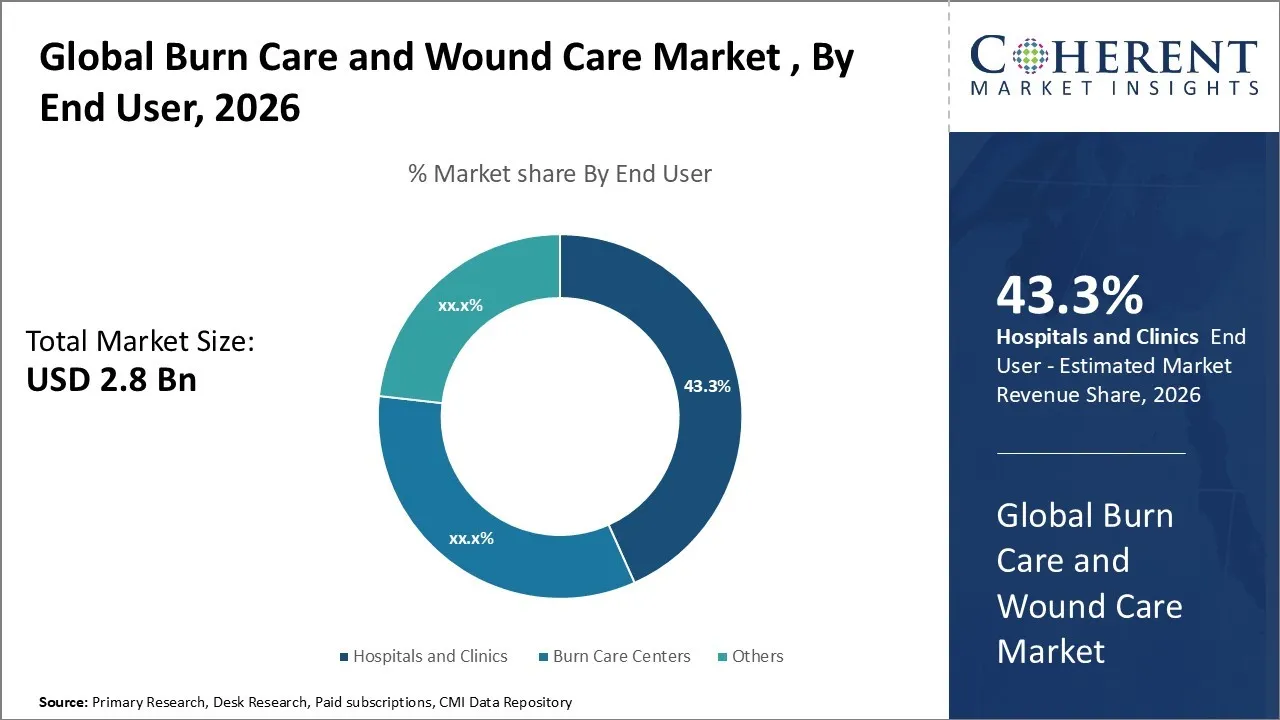
- By End User, Hospitals and Clinics acquired the prominent market share of 43.3% in 2026 owing to the advances in medical technology and wound care treatment.
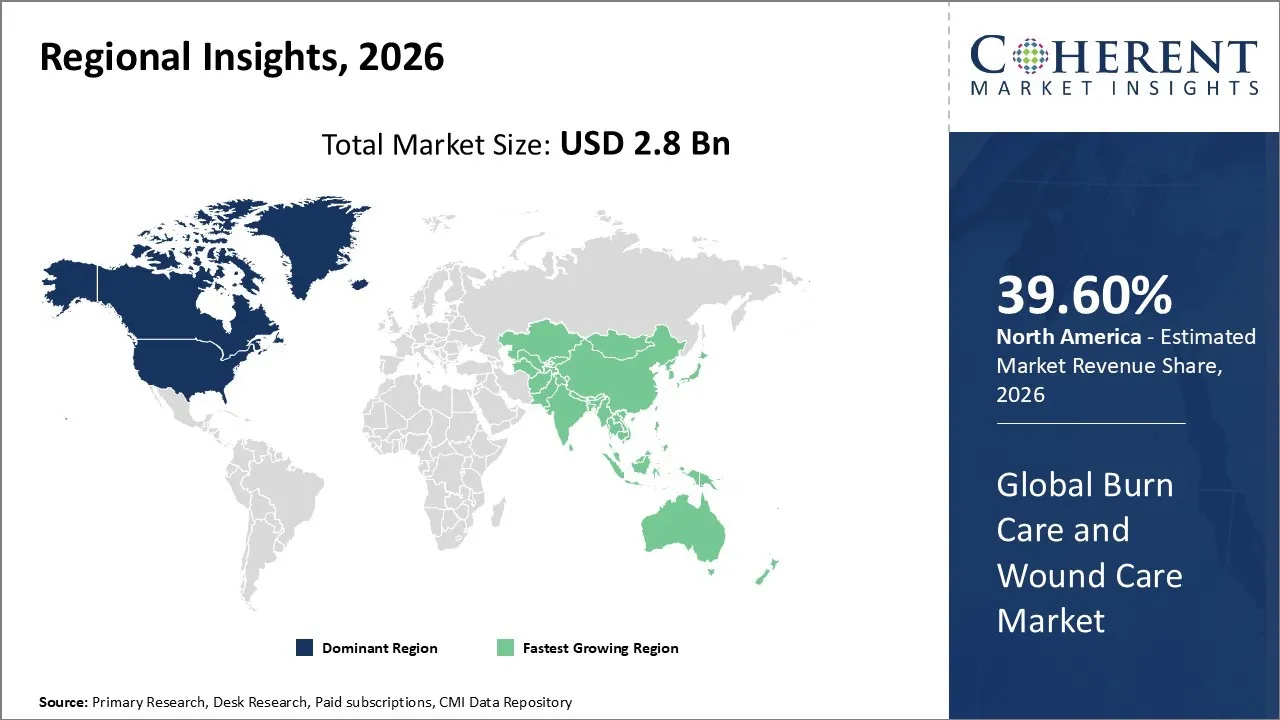
- By Region, North America dominates the overall market with an estimated share of 39.6% in 2026 owing to the aging population and chronic disease prevalence.
Market Overview
The increasing incidence of burn injuries, chronic wounds, and an aging population drive the Burn Care and Wound Care Market. Technological advancements in wound care products, such as advanced dressings, skin substitutes, and antimicrobial agents, are transforming treatment options. A growing emphasis on infection prevention, patient education, and specialized care in hospitals, clinics, and home settings further boosts market growth. Additionally, rising awareness of chronic wound management and cosmetic concerns fuels the demand for innovative wound care solutions.
Current Events and their Impact on the Burn Care and Wound Care Market
Current Events | Description and its impact |
Geopolitical and Conflict-Driven Events |
|
Economic and Healthcare Policy Trends |
|
Regulatory and Standards Developments |
|
Segmental Insights
- Current Industry Events of 2026
- Market Size Estimation
- Regional Breakdown
- Competitive Landscape
- Customer Intelligence
- Segmental Analysis
- Pricing Analysis
- Key Market Drivers, Challenges & Future Trends
- Customized Insights Section
Burn Care and Wound Care Market Insights, By End User - Hospitals & Clinics contribute the highest share of the market owing to its increasing awareness and prevention of wound infections
Hospitals and Clinics acquired the prominent market share of 43.3% in 2026. Hospitals and clinics drive the growth of the Burn Care and Wound Care Market as the number of burn injuries and chronic wound cases rises. The demand for specialized care, including advanced wound healing technologies, has led these institutions to adopt cutting-edge treatments. Improved healthcare infrastructure, better access to care, and a focus on infection prevention are also boosting wound care services. Furthermore, rising patient awareness and the growing need for timely, effective treatments are contributing to the market's expansion. For instance, in December 2025, Holland Hospital expanded its wound healing and hyperbaric medicine program, providing West Michigan patients with access to advanced treatments for chronic and complex wounds.
Burn Care and Wound Care Market Insights, By Product Type - Topical Agents contribute the highest share of the market owing to its preference for non-invasive treatments
Topical Agents hold the largest market share of 35.7% in 2026. The demand for topical agents in the Burn Care and Wound Care Market is rising as they promote healing and prevent infection. Innovations in formulations, including antimicrobial, anti-inflammatory, and growth factor-based agents, are enhancing treatment outcomes for both acute burns and chronic wounds. Their convenience, effectiveness, and non-invasive nature make topical treatments ideal for patient care. Additionally, increasing awareness of scar prevention, infection control, and self-care is driving the growing preference for topical wound management solutions. For instance, in April 2025, SKNV, a leader in dermatologic innovation, has launched Kefunova Cream (Fluorouracil 5% / Calcipotriene 0.005%), a prescription-only topical therapy designed to meet dermatologists’ needs in treating actinic keratosis (AK) and superficial basal cell carcinoma (sBCC).
Burn Care and Wound Care Market Insights, By Application - Wound Type contribute the highest share of the market owing to its increased focus on prevention and early intervention
Wound Type expected to hold largest market share of 41.1% in 2026. The growing prevalence of conditions like burns, diabetic ulcers, pressure ulcers, and surgical wounds is driving the wound type segment in the Burn Care and Wound Care Market. Each wound type demands specific treatments, which increases the need for specialized care solutions. The rise in chronic diseases, aging populations, and traumatic injuries further fuels the demand for targeted wound care. Additionally, advanced wound care technologies and increasing healthcare awareness are enhancing the management and outcomes of various wound types. For instance, in November 2025, the Department of Atomic Energy (DAE) unveiled two key scientific breakthroughs in healthcare and rare-earth research. In partnership with Cologenesis Pvt. Ltd., DAE introduced ColoNoX, India’s first nitric-oxide-releasing wound dressing for diabetic foot ulcers (DFU), developed by Bhabha Atomic Research Centre (BARC) and approved by DCGI after Phase II and III trials.
Regional Insights
North America Burn Care and Wound Care Market Trends
North America dominates the overall market with an estimated share of 39.60% in 2026. Technological advancements in treatments like bioactive dressings, skin substitutes, and negative pressure wound therapy are driving significant growth in the North America Burn Care and Wound Care Market. Healthcare providers are adopting more specialized care due to the rising prevalence of chronic wounds, burns, and traumatic injuries. Growing awareness of scar prevention and infection control, along with improved healthcare infrastructure and insurance coverage, is fueling demand for advanced wound care treatments in hospitals, clinics, and home care settings. For instance, in August 2025, Imbed Biosciences Inc., a leader in advanced wound care technology, launched SAM™ PainGuard™ with Lidocaine, a new addition to its acute care portfolio of fully synthetic, antimicrobial, and biocompatible wound matrices.
Asia Pacific Burn Care and Wound Care Market Trends
The Asia Pacific Burn Care and Wound Care Market is growing rapidly as healthcare access improves and the incidence of burns, chronic wounds, trauma, and an aging population increases. Healthcare providers are adopting advances in wound care technology, such as hydrocolloid dressings, biological skin substitutes, and antimicrobial agents. Growing awareness of wound care management, better patient education, and government efforts to improve healthcare infrastructure are all driving the region's rising demand for advanced burn and wound care treatments. For instance, in June 2025, Cipla Health launched its campaign ‘Cipladine – Aapka Fast Aid Expert’, featuring actress Neena Gupta. The campaign positions Cipladine as India’s trusted solution for cuts, wounds, burns, and infections, providing fast and effective healing when it matters most.
United States Burn Care and Wound Care Market Trends
The United States Burn Care and Wound Care Market is growing rapidly as burn injuries, chronic wounds, and trauma-related cases rise. Healthcare providers are increasingly adopting advanced wound care technologies, including collagen-based dressings, negative pressure wound therapy, and biologic treatments, which are transforming patient care. A greater focus on infection prevention, scar management, and patient-centered care is driving further demand. Additionally, improved healthcare infrastructure, expanded insurance coverage, and heightened awareness of wound care are all contributing to the market's growth. For instance, in September 2024, Solventum launched the V.A.C. Peel and Place Dressing, an integrated dressing and drape that applies in under two minutes and can stay on for up to seven days. Traditional negative pressure wound therapy dressings take longer to apply, require multiple steps, and often need changing several times a week.
India Burn Care and Wound Care Market Trends
The India Burn Care and Wound Care Market is growing as burn injuries, chronic wounds, and traumatic accidents increase. Healthcare providers are adopting advanced wound care solutions like antimicrobial dressings, hydrocolloid bandages, and bioengineered skin grafts, which are enhancing patient outcomes. Improved healthcare access, particularly in rural areas, is boosting the demand for more effective treatments. Government efforts to strengthen healthcare infrastructure, coupled with rising awareness of proper wound care practices, are further driving the market’s growth across the country.
End-user Feedback and Unmet Needs in the Burn Care and Wound Care Market
- End-User Feedback on Treatment Efficacy: Patients and healthcare providers report positive feedback on advanced wound care solutions, particularly in terms of faster healing and reduced infection risks. However, there is a demand for more cost-effective treatments that maintain the same level of efficacy, especially for chronic wound management in resource-limited settings.
- Challenges in Pain Management: End-users express the need for more effective pain management options in burn and wound care. Many patients experience significant discomfort during dressing changes or wound cleaning. There's a growing demand for treatments that offer long-lasting pain relief without side effects, enabling better overall patient experience and healing.
- Need for Personalized Wound Care Solutions: A significant unmet need exists for personalized wound care treatments tailored to individual patient needs. Healthcare providers seek more customized solutions for wound healing, especially for patients with underlying conditions like diabetes or vascular issues, to improve outcomes and minimize complications.
Burn Care and Wound Care Market Trend
Adoption of Advanced Wound Care Technologies
The Burn Care and Wound Care Market is seeing a shift towards advanced wound care products such as bioactive dressings, hydrocolloids, and negative pressure wound therapy (NPWT). These technologies are revolutionizing wound healing by promoting faster recovery and reducing the risk of infections. Their increasing adoption across hospitals, clinics, and home care settings reflects a broader trend of prioritizing effective, non-invasive treatment methods that provide better outcomes for burn and chronic wound patients.
Shift Toward Personalized Wound Care
Personalization in wound care is gaining momentum as healthcare providers recognize the importance of tailored treatments. With advancements in bioengineering and genetic research, clinicians are increasingly offering solutions specific to a patient’s wound type, underlying conditions, and overall health. This trend is helping improve outcomes for complex burns and chronic wounds, particularly in diabetic and geriatric patients, who require more specialized and effective wound management protocols for better healing and reduced complications.
Burn Care and Wound Care Market Opportunity
Emerging Markets and Rural Healthcare Expansion
The expansion of healthcare infrastructure in emerging markets and rural areas presents a vast opportunity for the Burn Care and Wound Care Market. As these regions experience better access to healthcare facilities and wound care treatments, the demand for affordable, high-quality solutions is increasing. Companies can capitalize on this growth by introducing cost-effective, innovative products tailored to local needs, including basic wound care kits and antimicrobial dressings, to cater to underserved populations.
Market Report Scope
Burn Care and Wound Care Market Report Coverage
| Report Coverage | Details | ||
|---|---|---|---|
| Base Year: | 2025 | Market Size in 2026: | USD 2.8 Bn |
| Historical Data for: | 2020 To 2024 | Forecast Period: | 2026 To 2033 |
| Forecast Period 2026 to 2033 CAGR: | 6.1% | 2033 Value Projection: | USD 4.5 Bn |
| Geographies covered: |
| ||
| Segments covered: |
| ||
| Companies covered: | Smith & Nephew Plc, Johnson & Johnson, ConvaTec Inc., Medtronic Plc, Medline Industries, Inc., 3M, Baxter International Inc., Cardinal Health, Mölnlycke Health Care AB, Integra LifeSciences, B. Braun Melsungen AG, DeRoyal Industries, Inc., Coloplast A/S, Advancis Medical, Essity Aktiebolag (publ), Schweitzer-Mauduit International, Inc., Medtrade Products Limited, Advanced Medical Solutions Group plc., Beiersdorf, and L&R Medical UK Ltd | ||
| Growth Drivers: |
| ||
| Restraints & Challenges: |
| ||
Burn Care and Wound Care Market News
- In August 2025, The TR Pro+ launch taps into the growing Australia–New Zealand wound care market. Powered by the company’s proprietary beta-glucan molecule Glucoprime and supported by extensive scientific and clinical research, the product positions itself as a potential new standard in post-procedure care.
Analyst Opinion (Expert Opinion)
- The Burn Care and Wound Care market is undergoing a profound transformation, largely driven by the relentless pursuit of innovative treatment modalities and the rising burden of chronic wounds. The growing prevalence of conditions such as diabetes and vascular diseases, combined with the aging population, is exacerbating the demand for specialized wound care solutions. For instance, chronic wounds, which affect an estimated 6.5 million Americans, account for a significant portion of healthcare costs, often exceeding $50 billion annually. This underscores the critical need for solutions that not only address the clinical symptoms but also improve long-term patient outcomes.
- The surge in technological advancements, particularly in the realm of bioengineered skin and negative pressure wound therapy (NPWT), is reshaping the care paradigm. These therapies, which have demonstrated significant efficacy in promoting wound healing, are rapidly being adopted across healthcare settings, from hospitals to home care environments. NPWT, for example, has proven to be instrumental in reducing wound infection rates and promoting faster healing, making it a preferred choice in burn units globally. Yet, despite these advancements, the adoption remains inconsistent, particularly in resource-constrained settings where cost and access barriers persist. The gap between cutting-edge treatments and their accessibility in rural or underdeveloped regions continues to be a major hurdle.
- Furthermore, there is a growing need for personalized wound care solutions that go beyond standard dressings. The trend toward tailored treatments such as those designed specifically for diabetic ulcers or post-burn care is gaining momentum. The efficacy of these solutions, supported by advancements in biomaterials and genomic medicine, holds immense potential in improving patient outcomes, particularly among populations with unique healing challenges.
- However, while the market for burn and wound care has expanded, there is an undeniable challenge in the affordability and accessibility of advanced treatments. Despite the availability of biologic skin substitutes and antimicrobial dressings, their high costs create a significant barrier, particularly in low-income settings or for uninsured patients. The financial burden on healthcare systems both public and private is considerable, and the industry must find ways to balance innovation with cost-efficiency.
Speak to the analyst
Want personalized insights?
Take the findings above to one of our principal consultants, or have the report rebuilt around the segments, geographies and competitors you actually track.
Market Segmentation
- By Product Type
- Topical Agents
- Antibiotics
- Antiseptic
- Antifungal
- Others (Chlorhexidine, among others)
- Wound Therapy Device
- Negative Pressure Therapy Device
- Hyperbaric Oxygen Equipment
- Pressure Relief Devices
- Others (Electrical Stimulation Devices)
- Surgical Wound Care Products
- Sutures
- Staplers
- Others (Tissue Adhesives, Sealants and Glues)
- Skin Grafts
- Split-thickness Grafts
- Full-thickness Grafts
- Composite Grafts
- Advanced Dressing
- Foam Dressing
- Collagen Dressing
- Hydrogel Dressing
- Others (Hydrocolloid, Alginate, among others)
- Traditional Burn Care
- Medical Tapes
- Dressings
- Cleansing Agents
- Topical Agents
- By Application
- Burn Degree
- First Degree
- Second Degree
- Third Degree
- Fourth Degree
- Wound Type
- Surgical Wounds
- Ulcers
- Pressure Ulcers
- Diabetic Foot Ulcers
- Arterial and Venous Ulcers
- Traumatic Wounds
- Others (Microbial Infection, among others)
- Burn Degree
- By End User
- Hospitals and Clinics
- Burn Care Centers
- Others (Home Care, among others)
- By Regional Insights
- North America
- U.S.
- Canada
- Latin America
- Brazil
- Argentina
- Mexico
- Rest of Latin America
- Europe
- Germany
- U.K.
- Spain
- France
- Italy
- Russia
- Rest of Europe
- Asia Pacific
- China
- India
- Japan
- Australia
- South Korea
- ASEAN
- Rest of Asia Pacific
- Middle East
- GCC Countries
- Israel
- Rest of Middle East
- Africa
- South Africa
- North Africa
- Central Africa
- North America
- Key Players Insights
- Smith & Nephew Plc
- Johnson & Johnson
- ConvaTec Inc.
- Medtronic Plc
- Medline Industries, Inc.
- 3M
- Baxter International Inc.
- Cardinal Health
- Mölnlycke Health Care AB
- Integra LifeSciences
- Braun Melsungen AG
- DeRoyal Industries, Inc.
- Coloplast A/S
- Advancis Medical
- Essity Aktiebolag (publ)
- Schweitzer-Mauduit International, Inc.
- Medtrade Products Limited
- Advanced Medical Solutions Group plc.
- Beiersdorf
- L&R Medical UK Ltd
Sources
Primary Research Interviews
- Interviews with healthcare professionals, including burn care specialists, wound care nurses, and hospital administrators.
- Discussions with product manufacturers and suppliers in the burn and wound care sector.
- Conversations with healthcare policy makers and insurance providers to understand reimbursement dynamics and coverage.
- Interviews with patients and caregivers for insights into treatment preferences and outcomes.
Databases
- PubMed
- ClinicalTrials.gov
- WHO Global Health Observatory
- U.S. National Library of Medicine
- National Institutes of Health (NIH) databases
Magazines
- Wound Care Advisor
- The Journal of Burn Care & Research
- Wounds International
- Wound Management & Prevention
- Health Management Technology
Journals
- Journal of Wound Care
- Burns: Journal of the International Society for Burn Injuries
- The Journal of Dermatological Treatment
- Advances in Wound Care
- International Wound Journal
Newspapers
- The New York Times (Health Section)
- The Wall Street Journal (Healthcare Industry)
- The Washington Post (Healthcare Policy)
- The Guardian (Global Health News)
- Economic Times (Indian Healthcare News)
Associations
- World Health Organization (WHO)
- American Burn Association (ABA)
- European Wound Management Association (EWMA)
- National Pressure Injury Advisory Panel (NPIAP)
- Wound Care Education Institute (WCEI)
Public Domain Sources
- U.S. Food and Drug Administration (FDA)
- Centers for Disease Control and Prevention (CDC)
- National Institutes of Health (NIH)
- European Medicines Agency (EMA)
- U.S. Department of Health and Human Services (HHS)
Proprietary Elements
- CMI Data Analytics Tool
- Proprietary CMI Existing Repository of information for last 8 years
Get access to 250+ pages report
Every segment, forecast, competitor profile and data table behind the analysis above — available for instant download.
- ESOMAR Member
- ISO 9001:2015 Certified
- D-U-N-S Registered
- GDPR & CCPA Compliant
Missing comfort of reading report in your local language? Find your preferred language:
Transform your Strategy with Exclusive Trending Reports
Frequently Asked Questions
The Burn Care and Wound Care Market is estimated to be valued at USD 2.8 Bn in 2026 and is expected to reach USD 4.5 Bn by 2033.
Rising number of cases of burns as well as wounds and rapid research and development activities for the development of novel burn care and wound care products are expected to drive the market growth over the forecast period.
Wound type segment is expected to hold the major market share in the market.
North America holds the largest market share in the market.
Major factors hampering growth of the market include product recalls.
Major players operating in the market include Smith & Nephew Plc, Johnson & Johnson, ConvaTec Inc., Medtronic Plc, Medline Industries, Inc., 3M, Baxter International Inc., Cardinal Health, Mölnlycke Health Care AB, Integra LifeSciences, B. Braun Melsungen AG, DeRoyal Industries, Inc., Coloplast A/S, Advancis Medical, Essity Aktiebolag (publ), Schweitzer-Mauduit International, Inc., Medtrade Products Limited, Advanced Medical Solutions Group plc., Beiersdorf, and L&R Medical UK Ltd