

Calcium Hydroxylapatite (CaHA) Fillers Market Size and Share Analysis: (2026-2033)
The Calcium Hydroxylapatite (CaHA) Fillers Market size is anticipated to grow at a CAGR of 12.04% with USD 1,010 Mn in 2026 and is expected to reach USD 2,230 Mn in 2033. The primary drivers are largely defined by rising demand for minimally invasive aesthetic procedures, facial contouring, and long-lasting dermal filler solutions across dermatology clinics, medical spas, and cosmetic surgery centers. Some other factors include increasing use in jawline, cheek, chin, and hand rejuvenation procedures, preference for collagen-stimulating fillers, and growing consumer demand for non-surgical anti-aging treatments. U.S. FDA identifies calcium hydroxylapatite as an approved dermal filler material, used in products such as Radiesse for correcting facial wrinkles and folds.
Key Takeaways
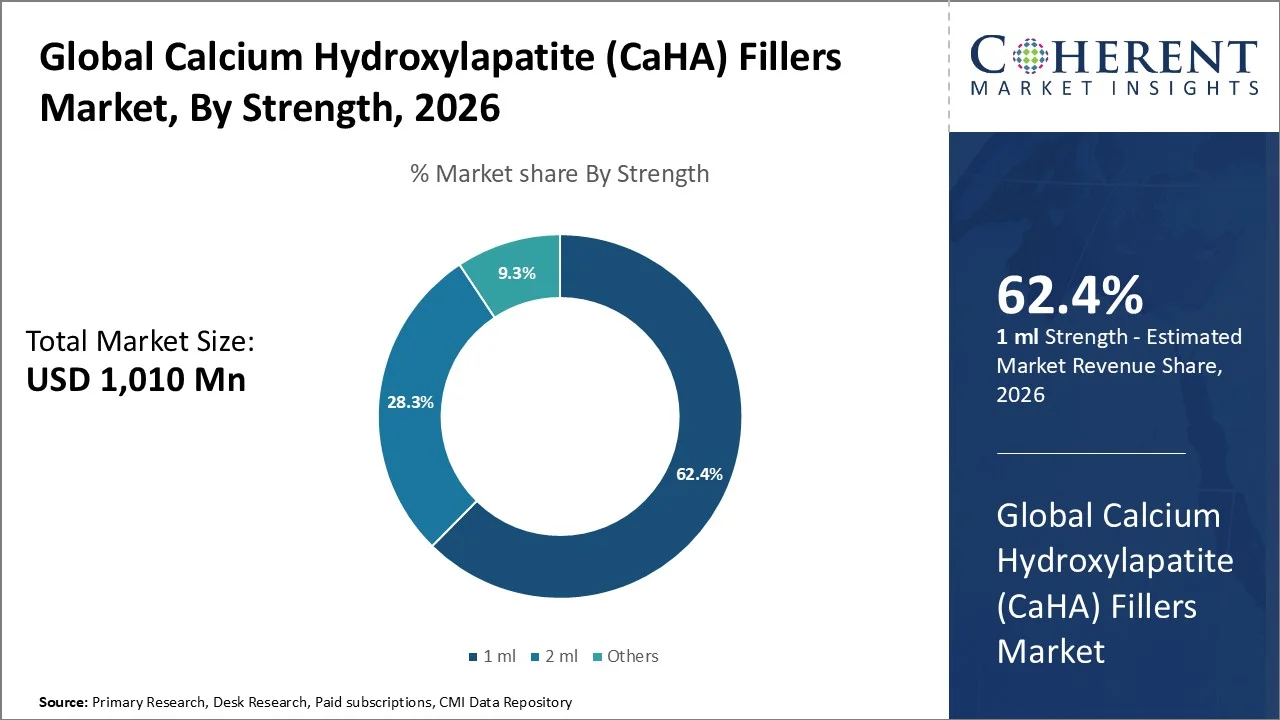
- The 1 ml segment is likely to dominate the market with 62.40% in 2026. The segment’s growth is owing to its suitability for single-session facial contouring, wrinkle correction, and lower product wastage in aesthetic clinics. The survey from ISAPS reported approximately 418,173 calcium hydroxylapatite procedures globally.
- The wrinkles segment is set to lead with 48.60% in 2026. The segment’s growth is owing to the rising demand for long-lasting dermal fillers that restore facial volume, smooth deep folds, and stimulate collagen production.
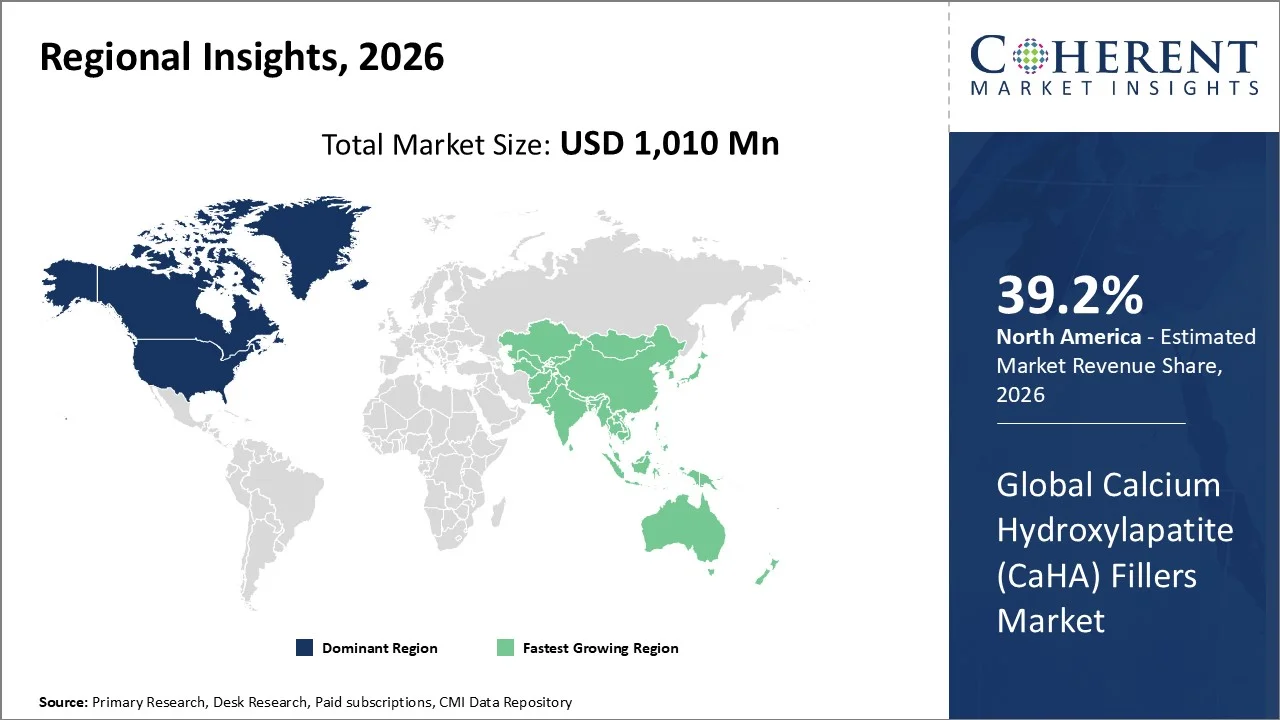
- North America is expected to acquire the prominent share of 39.20% in 2026. The region’s growth is owing to the high adoption of minimally invasive aesthetic procedures, strong dermatology clinic networks, and growing consumer preference for non-surgical facial rejuvenation. ASPS reported 15.8 million minimally invasive cosmetic procedures in the U.S. in 2023.
Segmental Insights
Why is 1 ml Acquiring the Largest Share?
On the basis of strength, the 1 ml segment is projected to account for the largest Calcium Hydroxylapatite (CaHA) Fillers Market share of 62.0% in 2026. The segment’s growth is owing to its use in controlled, area specific correction where physicians prefer smaller fill volumes for nasolabial folds, chin lines, jawline refinement, and hand rejuvenation.
FDA labeling states that Radiesse contains CaHA particles of 25 to 45 microns and is injected with a 25 to 27 gauge needle, supporting precise administration. ClinicalTrials.gov also lists a Radiesse study for nasolabial folds using 117 subjects in the pivotal trial, where 79% showed superior improvement on the Radiesse treated side through 6 months.
In January 2026, FDA recorded PMA supplement P050052/S174 for Radiesse injectable implant, Radiesse Hands, Radiesse Plus Lidocaine, and jawline indication, strengthening the product’s regulated aesthetic use.
- Current Industry Events of 2026
- Market Size Estimation
- Regional Breakdown
- Competitive Landscape
- Customer Intelligence
- Segmental Analysis
- Pricing Analysis
- Key Market Drivers, Challenges & Future Trends
- Customized Insights Section
Wrinkles hold the Largest Market Share
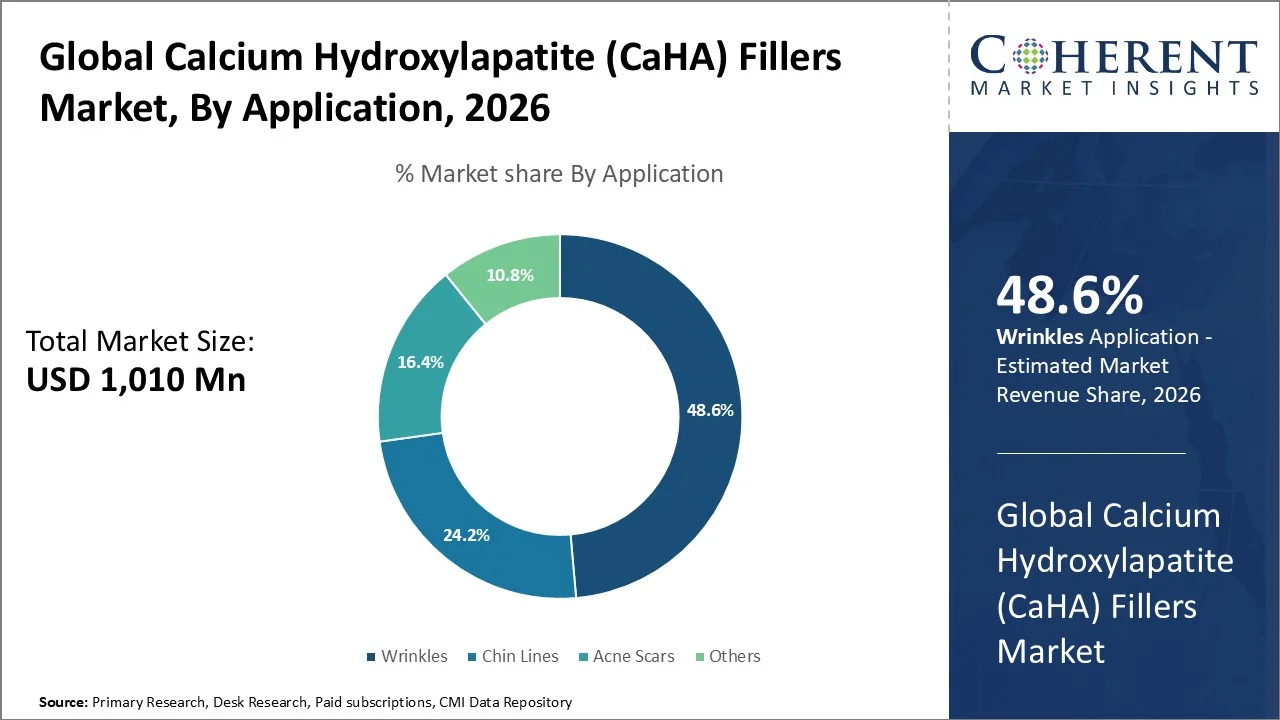
On the basis of application, the wrinkles segment lead with a major 48.6% share in 2026. The segment’s growth is owing to the rising demand for minimally invasive anti-aging treatments that correct facial wrinkles, folds, and age-related volume loss without surgery.
Official registry data indicates that around 350,000 CaHA dermal filler injections are performed globally each year for wrinkle correction and facial volume restoration. In addition, the International Society of Aesthetic Plastic Surgery (ISAPS) recorded around 344,624 CaHA-based non-surgical procedures worldwide, thereby showing the strong procedure adoption.
To capture this demand, the firms are expanding advanced hybrid filler approaches. A key development includes the commercial rollout of formulations combining calcium hydroxylapatite-carboxymethyl cellulose with cohesive polydensified matrix-hyaluronic acid. These dual-action products provide immediate fold correction while CaHA microspheres support the long-term neocollagenesis, thereby strengthening their relevance in the wrinkle treatment.
Market Drivers
Rising Demand for Minimally Invasive Aesthetic Procedures is Transforming the Calcium Hydroxylapatite (CaHA) Fillers Market in the US
The rising demand for minimally invasive aesthetic procedures is strengthening the U.S. Calcium Hydroxylapatite fillers market. The patients today prefer injectable contouring, wrinkle correction, and collagen stimulating treatments over surgical facial rejuvenation.
The American Society of Plastic Surgeons reported nearly 25,442,640 cosmetic minimally invasive surgeries in 2023, up 7% from 2022, thereby showing strong procedural momentum for injectables. The non-hyaluronic acid fillers including Radiesse reached 924,549 procedures in 2023, thereby increasing by 8% year on year.
In September 2021, the U.S. FDA approved the Radiesse Plus through a supplemental PMA for improving moderate to severe loss of jawline contour in adults over 21 years. It added a defined lower face contouring indication beyond facial folds and hand augmentation.
This approval supports wider physician use of CaHA fillers in minimally invasive facial shaping. The key advantages supporting the improved aesthetic treatment outcomes include durability, safety, and biostimulatory collagen response.
Expansion From Filler to Regenerative Biostimulator: A Major Breakthrough in the Calcium Hydroxylapatite (CaHA) Fillers Market
The Calcium Hydroxylapatite (CaHA) Fillers Market is evolving from traditional volume correction toward regenerative aesthetic treatment. The CaHA fillers are valued for immediate contour restoration and also for their ability to stimulate extracellular matrix remodeling over time.
The U.S. Food and Drug Administration evaluated multi-center clinical trial data showed that nearly 77.9% of patients achieved substantial aesthetic improvement in structural contours at 12 weeks after treatment, while 62.9% maintained therapeutic response through 48 weeks. These outcomes strengthen the CaHA’s role as a long-lasting biostimulatory filler.
In line with this shift, the ClinicalTrials.gov registered study NCT07202117 was launched to compare CaHA with Poly-L-Lactic Acid for advanced face and body rejuvenation. This development reflects growing clinical interest in CaHA’s ability to support collagen, elastin, and proteoglycan regeneration. It also strengthens CaHA’s position as a regenerative biostimulator in aesthetic medicine.
Current Events and Their Impact on the Calcium Hydroxylapatite (CaHA) Fillers Market
Current Event | Description and its Impact |
FDA Review of Dermal Filler Safety and Labeling in the U.S. |
|
Tightening Regulation of Injectable Aesthetic Procedures in India and the U.K.
|
|
Calcium Hydroxylapatite (CaHA) Fillers Market Trends
- The rising preference for minimally invasive aesthetic procedures is boosting the CaHA filler adoption, thereby offering facial contouring, wrinkle correction, and low-downtime treatment benefits. An estimated 3.41 million soft tissue filler injections were performed in the United States in 2020.
- The growing demand for natural-looking facial rejuvenation is supporting the CaHA fillers, as they provide immediate volume correction and stimulate collagen production.
- The increasing use of CaHA fillers for jawline, chin, cheek, and hand rejuvenation is expanding the applications beyond traditional wrinkle correction.
- The aging populations and higher aesthetic awareness are strengthening the demand for dermal fillers globally. The ISAPS reported nearly 35 million surgical and non-surgical aesthetic procedures in 2023, with non-surgical treatments continuing to gain popularity.
- The regulatory approvals and physician-led treatment adoption are also supporting the market growth. Radiesse, a leading CaHA filler, is FDA-approved for correction of facial wrinkles and folds such as nasolabial folds, thereby strengthening the clinical confidence and wider commercial use.
Regional Insights
North America Dominates Owing to the High Aesthetic Procedure Adoption and FDA-Regulated CaHA Product Maturity
The North America region accounts for 39.2% of the market share in 2026. The region’s growth is owing to the aesthetic procedure adoption, FDA regulated product pathways, and clinical use of CaHA fillers.
The growth is supported by injector availability and demand for longer lasting biostimulatory correction. ASPS reported 932,861 non hyaluronic acid filler procedures in 2024, including products such as Radiesse, indicating a U.S. base for collagen stimulating injectables.
FDA safety and effectiveness data further state that Radiesse has been registered in over 73 countries and that more than 10 million units of the Radiesse family have been sold worldwide since its initial U.S. approval, reinforcing commercial maturity led by North America.
In April 2026, Merz Aesthetics announced FDA approval of RADIESSE for the treatment of wrinkles in the décolleté area for adults aged 22 years and older. This approval expanded the product's clinical utility and strengthened its position as a regenerative biostimulator in aesthetic medicine.
Asia Pacific Calcium Hydroxylapatite (CaHA) Fillers Market Trends
Asia Pacific is expected to witness strong growth in Calcium Hydroxylapatite (CaHA) Fillers Market over the forecast period. The region’s growth is owing to the rising acceptance of injectable facial rejuvenation, wider clinic based aesthetic adoption, and increasing preference for collagen stimulating fillers over temporary volume correction.
ISAPS reported 418,173 calcium hydroxylapatite procedures worldwide in 2024, up 13.7% from 2023, showing clear movement toward CaHA based biostimulation. In Asia Pacific, Japan recorded 286,800 injectable procedures and India recorded 169,960 injectable procedures in 2024, supporting a strong regional base for dermal filler adoption.
A major development came in December 2025, when Merz Aesthetics launched RADIESSE in China, expanding access to a CaHA biostimulator in one of the region’s most active aesthetic medicine markets. This launch supports physician training, product availability, and faster uptake of regenerative aesthetic protocols across China and nearby markets, especially among urban patients seeking natural, longer lasting outcomes.
Rising Validation for Jawline Contouring is Accelerating the Calcium Hydroxylapatite (CaHA) Fillers Market in United States
In the U.S., growth is driven by FDA backed expansion of CaHA from wrinkle correction to structural soft tissue augmentation. FDA’s safety and effectiveness review for RADIESSE (+) reported that 75.6% of treated patients achieved at least a one point improvement on the Merz Jawline Assessment Scale at Week 12, compared with 8.8% in the control group.
In March 2026, FDA approved Merz North America’s implementation of a Green Sieve System used to manufacture CaHA particles for final RADIESSE and RADIESSE (+) devices.
China Calcium Hydroxylapatite (CaHA) Fillers Market Trends
In the China, growth in the Calcium Hydroxylapatite (CaHA) Fillers Market is driven by rising acceptance of regulated biostimulatory injectables for nasolabial fold correction and facial soft tissue augmentation. NMPA’s CMDE review of Radiesse reported 83.33% WSRS responders at week 24 in the test group, supporting clinical durability for wrinkle correction.
In February 2025, Shanghai Moyom Biotechnology’s Aphranel obtained NMPA Class III medical device registration, becoming China’s first approved CaHA injectable for facial soft tissue filling. This approval is expected to improve physician confidence, legal channel sales, and premium clinic adoption across China’s aesthetic market.
Who are the Major Companies in Calcium Hydroxylapatite (CaHA) Fillers Industry
Some of the major key players in Calcium Hydroxylapatite (CaHA) Fillers Market are Regan Scientific Instruments, Inc, Allergan plc, Galderma Laboratories, L.P, Merz Pharma GmbH & Co. KGaA, Cynosure Inc, Prollenium Medical Technologies, Inc, Dr. Korman Laboratories Ltd, Luminera , CG Bio Co., Ltd, Medyglobal, and Teoxane SA.
Key News
- In February 2026, CGBio launched official sales of DCLASSY CaHA filler in Indonesia. This launch marked the firm's global aesthetic market expansion and strengthened the DCLASSY’s positioning as a calcium hydroxylapatite based filler that strengthens the skin regeneration and collagen production.
- In August 2025, Shanghai Moyom Biotechnology launched Aphranel Magiccrystal, China’s first injectable calcium hydroxylapatite microsphere-based dermal filler. This launch supported China’s entry into the CaHA filler segment and strengthened the company’s global expansion in the dermal filler market.
- In July 2025, Daewoong Pharmaceutical introduced its K-Aesthetic Total Solution in Indonesia through a launch symposium in Jakarta. The rollout included Nabota, DCLASSY HA and CaHA fillers, and PDO lifting threads, strengthening Daewoong’s position in combination aesthetic procedures and supporting wider adoption of CaHA-based treatments in Indonesia.
Market Report Scope
Calcium Hydroxylapatite (CaHA) Fillers Market Report Coverage
| Report Coverage | Details | ||
|---|---|---|---|
| Base Year: | 2025 | Market Size in 2026: | USD 1,010 Mn |
| Historical Data for: | 2020 To 2024 | Forecast Period: | 2026 To 2033 |
| Forecast Period 2026 to 2033 CAGR: | 12.04% | 2033 Value Projection: | USD 2,230 Mn |
| Geographies covered: |
| ||
| Segments covered: |
| ||
| Companies covered: | Regan Scientific Instruments, Inc, Allergan plc, Galderma Laboratories, L.P, Merz Pharma GmbH & Co. KGaA, Cynosure Inc, Prollenium Medical Technologies, Inc, Dr. Korman Laboratories Ltd, Luminera , CG Bio Co., Ltd, Medyglobal, and Teoxane SA. | ||
| Growth Drivers: |
| ||
| Restraints & Challenges: |
| ||
Analyst Opinion
- Calcium Hydroxylapatite CaHA fillers are driven by the growing aesthetic need. The global aesthetic procedures reached nearly 38 million in 2024, showing that the market is not only growing because of beauty trends, it is growing because people want safer, faster, and less invasive anti aging treatments.
- Dermal fillers are one of the largest injectable aesthetic procedures worldwide. The ISAPS recorded 6.33 million hyaluronic acid filler procedures in 2024, thereby showing strong patient acceptance of wrinkle correction, facial volume restoration, chin enhancement, as well as contouring treatments.
- CaHA fillers are gaining significant traction because they provide immediate volume correction along with collagen stimulation. FDA documents describe RADIESSE as a synthetic calcium hydroxylapatite injectable implant used for facial soft tissue correction, supporting wider adoption across dermatology clinics and aesthetic centers.
- Rising male participation, growing medical spa penetration, and broader physician adoption are likely to support sustained double digit growth. Long term market opportunities will be strongest among companies investing in regenerative technologies, clinical evidence generation, and physician education programs.
Speak to the analyst
Want personalized insights?
Take the findings above to one of our principal consultants, or have the report rebuilt around the segments, geographies and competitors you actually track.
Market Segmentation
- Strength Insights (Revenue, USD Mn, 2026-2033)
- 1 ml
- 2 ml
- Others
- Application Insights (Revenue, USD Mn, 2026-2033)
- Wrinkles
- Chin Lines
- Acne Scars
- Others
- Regional Insights (Revenue, USD Mn, 2026 - 2033)
- North America
- U.S.
- Canada
- Latin America
- Brazil
- Argentina
- Mexico
- Rest of Latin America
- Europe
- U.K.
- Germany
- Italy
- France
- Russia
- Spain
- Rest of Europe
- Asia Pacific
- China
- India
- Japan
- ASEAN
- Australia
- South Korea
- Rest of Asia Pacific
- Middle East
- GCC
- Israel
- Rest of Middle East
- Africa
- North Africa
- Central Africa
- South Africa
- North America
- Key Players Insights
- Regan Scientific Instruments, Inc
- Allergan plc
- Galderma Laboratories, L.P
- Merz Pharma GmbH & Co. KGaA
- Cynosure Inc
- Prollenium Medical Technologies, Inc
- Korman Laboratories Ltd
- Luminera
- CG Bio Co., Ltd
- Medyglobal
- Teoxane SA
Sources
Primary Research Interviews
- Aesthetic Dermatology Clinics
- Dermal Filler Manufacturers
- Cosmetic Injectable Product Distributors
- Plastic Surgeons & Dermatologists
- Medical Aesthetics Consultants
- Others
Databases
- Bloomberg Terminal
- Thomson Reuters Eikon
- Global Trade Tracker
- Others
Magazines
- Dermatology Times
- Aesthetic Medicine Magazine
- Practical Dermatology
- MedEsthetics Magazine
- Others
Journals
- Journal of Cosmetic Dermatology
- Dermatologic Surgery Journal
- Aesthetic Surgery Journal
- Clinical, Cosmetic and Investigational Dermatology
- Others
Newspapers
- Financial Times
- The Wall Street Journal
- Reuters
- Bloomberg News
- Others
Associations
- American Academy of Dermatology (AAD)
- American Society for Dermatologic Surgery (ASDS)
- International Society of Aesthetic Plastic Surgery (ISAPS)
- American Society of Plastic Surgeons (ASPS)
- Others
Public Domain Sources
- U.S. FDA – Medical Devices Database
- European Medicines Agency (EMA)
- National Library of Medicine
- World Health Organization (WHO)
- U.S. Census Bureau
- Others
Proprietary Elements
- CMI Data Analytics Tool
- Proprietary CMI Existing Repository of Information for the Last 10 Years
Get access to 250+ pages report
Every segment, forecast, competitor profile and data table behind the analysis above — available for instant download.
- ESOMAR Member
- ISO 9001:2015 Certified
- D-U-N-S Registered
- GDPR & CCPA Compliant
Missing comfort of reading report in your local language? Find your preferred language:
Transform your Strategy with Exclusive Trending Reports
Frequently Asked Questions
The Calcium Hydroxylapatite (CaHA) Fillers Market is expected to reach USD 2,230 Mn in 2033.
Major players operating in the global Calcium Hydroxylapatite (CaHA) Fillers Market include Regan Scientific Instruments, Inc, Allergan plc, Galderma Laboratories, L.P, Merz Pharma GmbH & Co. KGaA, Cynosure Inc, Prollenium Medical Technologies, Inc, Dr. Korman Laboratories Ltd, Luminera , CG Bio Co., Ltd, Medyglobal, and Teoxane SA.
The high treatment costs, strict regulatory barriers, strong competition from reversible alternatives, and significant material risks such as nodule formation and vascular occlusion are the key factors hampering growth of the market.
The rising demand for minimally invasive cosmetic procedures and the material's ability to stimulate natural collagen production for longer-lasting anti-aging results is boosting the demand for Calcium Hydroxylapatite (CaHA) Fillers.
The Calcium Hydroxylapatite (CaHA) Fillers Market is anticipated to grow at a CAGR of 12.04% between 2026 and 2033.
Among regions, Asia Pacific is expected to account for a largest market share in the global Calcium Hydroxylapatite (CaHA) Fillers Market over the forecast period.