

Dental Prosthetics Market Size and Trends - 2026 to 2033
The Dental Prosthetics Market is estimated to be valued at USD 9 Bn in 2026 and is expected to reach USD 15.0 Bn by 2033, growing at a compound annual growth The rate (CAGR) of 7.6% from 2026 to 2033.
Key Takeaways
- Based on Product Type, the Fixed Dental Prosthetic segment is expected to lead the market with 48.20% share in 2026, due to strong demand for crowns & implants.
- Based on Material Type, the Ceramics segment is expected to hold 41.90% share of the market in 2026 reflecting strong preference for aesthetic, durable dental prosthetic materials.
- Based on End User, the Hospitals & Clinics segment is expected to hold 53.30% share of the market in 2026 reflecting the majority of prosthetic procedures performed in institutional and private clinical settings.
- Based on Region, North America is set to lead the market with 39.40% share in 2026. While, Asia Pacific is anticipated to be the fastest growing region.
Market Overview
The dental prosthetics market is advancing significantly, driven by the rising demand for biocompatible materials and digitally driven restorative solutions in the geriatric and cosmetic dentistry industries. The growing patient awareness about oral longevity and a strategic shift away from traditional manual casting toward digital workflows is expected to drive market growth over the forecast period.
Dental prosthetics including crowns, bridges, and implants, are increasingly derived from advanced materials like zirconia and high-performance ceramics, which serve as potent, durable alternatives to conventional alloys. This makes these materials a vital component in modern health and wellness formulations, particularly as the prevalence of dental caries and age-related loss increases globally.
Current Events and Its Impacts on the Dental Prosthetics Market
Current Event | Description and the Impact |
Technological Advancements in Digital Dentistry |
|
Shifts in Consumer Demographics and Preferences |
|
Regional Regulatory Changes in North America and Europe |
|
Role of Artificial intelligence (AI) in Dental Prosthetics Market
The use of artificial intelligence in dental prosthetics marks a major change from hand-made work to a digital workflow that is more accurate and consistent. The primary impact of AI is evident in automated CAD/CAM design, where software autonomously generates anatomically correct crowns, bridges, and veneers. These systems can identify preparation margins and tooth boundaries more reliably than manual tracing by utilizing deep learning algorithms. This ensures a superior fit while minimizing the risk of secondary decay. AI simplifies the planning of complex treatments in removable and implant prosthodontics. In the case of partial dentures, design automation assists clinicians in selecting optimal support structures tailored to the unique oral anatomy of each patient. Artificial intelligence (AI)-powered surgical guides use digital impressions and bone density data to pinpoint the precise placement trajectory for implants.
For instance, in November 2025, Voyager Dental has unveiled its automated full-arch prosthetic system, created to provide restorative care that is faster, more precise, and more predictable. This AI-powered all-on-X design platform addresses the ongoing shortage of dental lab technicians as well as aims to alleviate clinical bottlenecks.
- Current Industry Events of 2026
- Market Size Estimation
- Regional Breakdown
- Competitive Landscape
- Customer Intelligence
- Segmental Analysis
- Pricing Analysis
- Key Market Drivers, Challenges & Future Trends
- Customized Insights Section
Segmental Insights
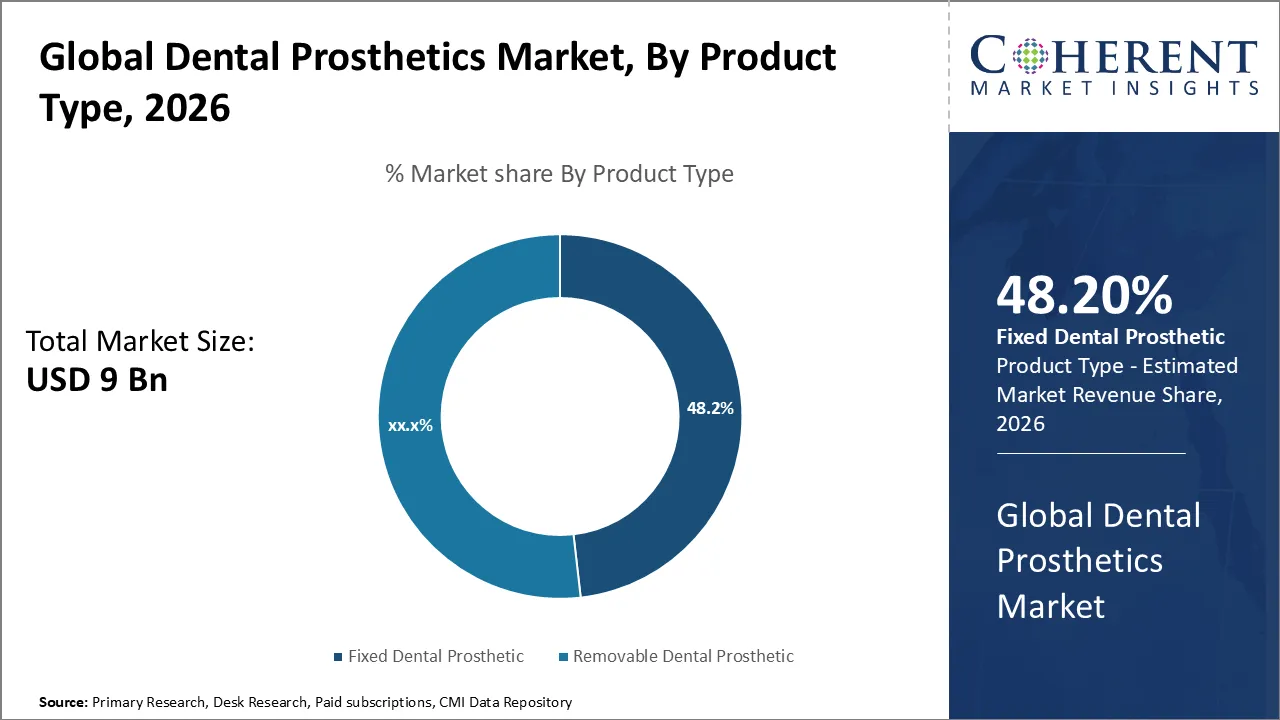
Dental Prosthetics Market Insights, By Product Type – Fixed Dental Prosthetic Leads Due to Strong Demand for Crowns & Implants
In terms of product type, the fixed dental prosthetic segment contributes the highest share of 48.20% in 2026 of the dental prosthetics market. The growth is owing to a growing global preference for permanent, high-stability solutions over removable alternatives. This segment includes crowns, bridges, and inlays. The segment’s growth is also due to the widespread adoption of CAD/CAM technology. These digital workflows allow for rapid, high-precision fabrication, which assists in reducing patient wait times and improving long-term clinical outcomes. In addition, the rising incidence of dental caries and the increasing popularity of all on x implant procedures, which utilize fixed bridges to restore full dental arches, have solidified the segment’s growth. The fixed prosthetics hold the largest share of the market revenue in developed and emerging economies. This is fueled by the patient’s increasing prioritization for comfort and a natural feel that nearly mimics original teeth.
Dental Prosthetics Market Insights, By Material Type – Ceramics Leads Due its Strong Preference for Aesthetic, Durable Dental Prosthetic Materials
In terms of material type, the ceramics segment contributes the highest share of 41.90% in the dental prosthetics market in 2026. The growth is owing to its exceptional aesthetics and strong biocompatibility profile. The emergence of high-performance ceramics like zirconia and lithium disilicate allows for restorations that balance natural appearance with exceptional mechanical strength. The shift toward metal-free dentistry solutions is owing to the growing awareness regarding material safety and a stronger focus on aesthetic authenticity. The ceramics are also resistant to wear and corrosion, ensuring long-term durability for the sewer.
For instance, in March 2025, Cybermed Inc., a global leader in digital dental technology, is poised to transform the dental prosthesis industry with the introduction of REON Ceramic C&V, an advanced ceramic 3D printing material.
Dental Prosthetics Market Insights, By End User – Hospitals & Clinics Leads Due its Majority of Procedures Performed in Institutional and Private Clinical Settings
In terms of end user, the hospitals & clinics segment contributes the highest share of 53.30% in the dental prosthetics market in 2026. The hospitals & clinics segment acts as the primary touchpoint for complex dental restorative procedures. The increase in patient volumes combined with the availability of specialized clinicians like prosthodontists and oral surgeons is propelling the growth in these facilities. The hospitals and larger clinic chains are equipped with expensive digital infrastructure like intraoral scanners and 3D printers. In addition, the increasing trend of dental tourism often directs international patients toward established clinical centers that offer comprehensive, one-stop shop services. The hospitals and clinics maintain their market leadership through collaborative environments and advanced technological suites that consolidate complex dental services under one roof.
Regional Insights
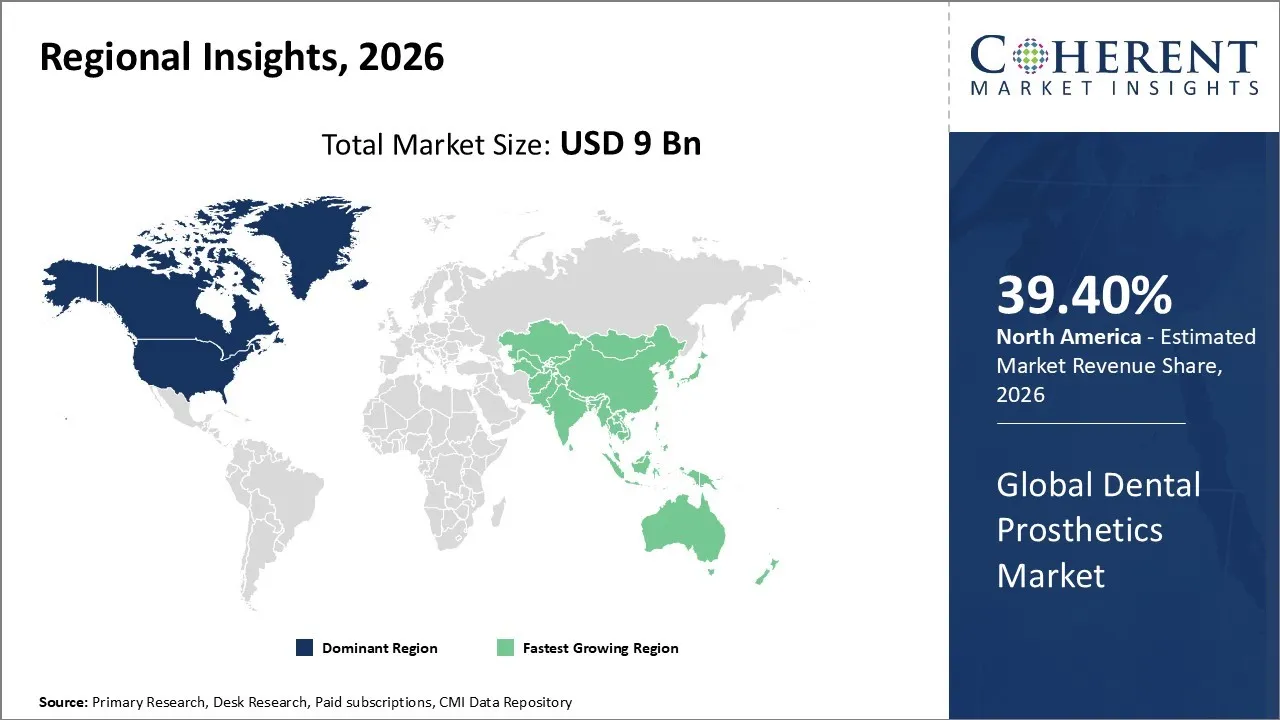
North America Dental Prosthetics Market Analysis & Trends
North America has remained the dominant region with 39.40% in 2026 of the global dental prosthetics market over the past decade. This growth is owing to the increasing aging demographic in the US and Canada, alongside an increasing prevalence of dental disorders like edentulism and periodontal disease. As the baby boomer generation enters its senior years, the demand for reliable, long-term restorative solutions like crowns, bridges, and dentures has reached an all-time high. The technological innovation serves as the secondary engine of this market. The widespread incorporation of digital dentistry, particularly CAD/CAM technology and 3D printing, has transformed the fabrication process. These innovations allow for same-day dentistry, allowing patients to receive highly precise, customized prosthetics much more quickly than traditional methods.
In addition, there is a growing consumer preference for aesthetic excellence, thereby leading to increased popularity of materials like zirconia over traditional metal alloys. The US remains the dominant force in the region, supported by a high concentration of specialized dental clinics and market leaders like Dentsply Sirona and the Straumann Group. Consequently, the market is evolving from a craft-based industry into a high-tech manufacturing sector focused on biocompatibility, patient comfort, and visual naturalism.
For instance, in July 2025, Dandy, America’s fully digital dental lab, introduced the first premium denture solution designed specifically for government health plans. Featuring a streamlined two-appointment workflow and a turnaround time of less than 10 days, Dandy’s Reimbursement-Aligned Denture Suite significantly enhances patient access while allowing dentists to make better use of their chair time.
Asia Pacific Dental Prosthetics Market Analysis & Trends
The Asia Pacific region is the fastest-growing market for dental prosthetics. The growth is owing to a massive demographic shift and the rising disposable incomes. The region has become the leading destination for dental tourism. The urban centers in China and India are witnessing an increase in private dental clinics adopting advanced digital workflows. The integration of CAD/CAM technology and 3D printing has been transformative, thus allowing for more precise and faster production of custom prosthetics, which is critical in high-volume markets.
The competitive landscape is a dynamic mix of global giants like Dentsply Sirona and Straumann Group alongside powerful regional players such as South Korea's Osstem Implant and China's Angelalign. The government's initiatives, such as India's National Oral Health Program, aim to expand access to dental care. This effort helps maintain the region as a key player in the global dental prosthetics industry.
For instance, in January 2025, the Amrita School of Dentistry has established a state-of-the-art Digital Dentistry Centre within its Prosthodontics Department. This facility has a CAD-CAM laboratory along with 3D printing and extended reality technologies. These advancements facilitate a fully digital workflow for manufacturing dental prostheses, providing exceptional accuracy, quicker production times, and better patient outcomes.
Dental Prosthetics Market Outlook Country-Wise
The US Dental Prosthetics Market Trends
In the US, the market is shaped by the widespread consolidation of private practices into large dental groups and a heavy emphasis on aesthetic perfection. These large organizations utilize their scale to integrate advanced technologies like chairside milling, which allows patients to receive permanent prosthetics in a single visit. There is a strong cultural demand for smile makeovers, where prosthetics like veneers and high translucency bridges are used for both functional and cosmetic improvements. In addition, the integration of artificial intelligence in the design process has minimized human error and improved the precision fit for complex restorations. This trend is moving toward minimally invasive procedures and biocompatible materials that mimic the natural appearance of teeth more closely than ever before.
For instance, in October 2024, HeyGears introduced its Multi-Material Fusion resin 3D printed one-piece dentures at LMT LAB DAY Chicago 2025 in the US. capturing significant attention throughout the industry.
China Dental Prosthetics Market Trends
The Chinese dental prosthetics market is undergoing a significant shift toward greater clinical accessibility and increased domestic manufacturing independence. Government initiatives have successfully lowered the financial barriers for restorative procedures, allowing a much larger portion of the aging population to seek out implants and crowns. This surge in volume has encouraged local clinics to adopt digital scanning and 3D printing at a rapid pace to handle the increased flow of patients. The competitive edge of international brands in the high-end segment is increasingly under pressure owing to Chinese manufacturers that pair rising quality standards with enduring structural cost advantages. Consequently, the focus has moved from basic extractions to sophisticated long-term restorative care powered by a growing network of high-tech dental laboratories.
For instance, in July 2025, Yuhan Corp. and Shinhung, a dental company, signed a commercial agreement to establish a joint venture in the implant industry. The two companies aim to develop a comprehensive framework for cooperation that encompasses joint planning, marketing, and sales of dental medical devices and pharmaceuticals. They plan to launch the "Yuhan Evertis" implant, with Shinhung manufacturing dental implants under the Evertis brand name.
Market Report Scope
Dental Prosthetics Market Report Coverage
| Report Coverage | Details | ||
|---|---|---|---|
| Base Year: | 2025 | Market Size in 2026: | USD 9 Bn |
| Historical Data for: | 2020 To 2024 | Forecast Period: | 2026 To 2033 |
| Forecast Period 2026 to 2033 CAGR: | 7.6% | 2033 Value Projection: | USD 15.0 Bn |
| Geographies covered: |
| ||
| Segments covered: |
| ||
| Companies covered: | Polident D.O.O., Amt Medical SRL, Ivoclar Vivadent, VITA Zahnfabrik H. Rauter GmbH & Co. KG., Merz Dental GmbH, 3D Diagnostix Inc., Medical Precision Implants, FSM Dental Medikal Mak. San. Tic. Ltd. Sti., Yamahachi Dental Mfg., Co., Glidewell, Anthogyr SAS, Dentsply Sirona, 3Shape, Zimmer Biomet, SprintRay Inc., Thommen Medical AG, Institut Straumann AG, and Henry Schein, Inc. | ||
| Growth Drivers: |
| ||
| Restraints & Challenges: |
| ||
Dental Prosthetics Market Drivers
Rising interest in cosmetic dentistry and aesthetic restorations
The global increase in the dental prosthetics market is owing to a cultural shift toward cosmetic dentistry and aesthetic restorations. The increasing focus on physical appearance and social media presence encourages patients to seek elective procedures. This high demand for aesthetic-driven results has repositioned procedures like veneers and premium crowns as lifestyle choices rather than purely medical interventions. The technology breakthroughs have all sped up this trend by making natural-looking results more achievable. The development of high-translucency materials and all-ceramic systems allows for restorations that mimic the light-reflecting properties of real teeth. In addition, the growing use of CAD/CAM digital workflows ensures that these aesthetic procedures are designed with a level of precision and speed that was previously impossible. This synergy between patient desire and manufacturing innovation continues to broaden the market’s reach.
Analyst Opinion (Expert Opinion)
The Dental Prosthetics Market demonstrates strong structural momentum, supported by measurable clinical demand, technology adoption, and demographic trends. Epidemiological data indicates a high prevalence of tooth loss and untreated dental conditions among aging populations, particularly in developed economies, reinforcing sustained demand for restorative and replacement solutions. Prosthetic procedures such as crowns, bridges, dentures, veneers, and implants continue to form a core component of routine and elective dental care worldwide.
Product-level analysis highlights dental implants and fixed prosthetics as key revenue contributors, driven by higher procedure volumes and longer treatment lifecycles. Material trends show continued dominance of biocompatible metals, while ceramic and zirconia-based prosthetics are gaining adoption due to superior aesthetics and wear resistance. From a workflow perspective, the penetration of digital dentistry tools—including CAD/CAM systems, intraoral scanners, and 3D printing—has exceeded half of global dental laboratories, improving fabrication accuracy, turnaround time, and cost efficiency.
Regionally, North America maintains leadership due to high dental expenditure per capita, insurance penetration, and advanced clinical infrastructure. Meanwhile, Asia Pacific is experiencing accelerated procedure volumes, supported by rising disposable incomes, expanding private dental networks, and cross-border dental tourism.
Overall, the market is transitioning from conventional, labor-intensive manufacturing toward digitally enabled, precision-driven prosthetic solutions, positioning it as a technologically resilient and clinically essential segment within the broader oral healthcare industry.
Speak to the analyst
Want personalized insights?
Take the findings above to one of our principal consultants, or have the report rebuilt around the segments, geographies and competitors you actually track.
Dental Prosthetics Industry News
- In September 2025, Carbon has introduced FP3D, a new flexible, removable partial denture resin. This is the first dental resin to utilize Carbon's dual-cure chemistry, marking a significant advancement in dental materials. FP3D provides lifelike aesthetics, enhances patient fit, and offers cost savings compared to traditional fabrication methods. Additionally, it boasts exceptional durability, translucency, dimensional accuracy, and flexibility.
- In June 2025, ClearChoice Dental Implant Center unveiled Endura Elite, the most advanced full-arch dental restoration to date. Endura Elite is designed to replicate the natural beauty of real teeth. It delivers a smile that is both strong and confident by combining cutting-edge technology with expert craftsmanship.
- In January 2025, Stratasys announced that its TrueDent-D™ resin, classified as a CE Mark Class I medical device, is now available for sale in Europe. This achievement allows for the sale of its TrueDent™ monolithic multi-shade digital denture solution in European countries that mandate CE marking.
- In October 2022, SprintRay Inc. launched OnX Tough, a next-generation hybrid ceramic resin designed specifically for 3D printing dental prosthetics. This innovative resin provides exceptional durability and lifelike translucency, allowing for high-quality, same-day smiles. It utilizes SprintRay's proprietary NanoFusion™ technology.
Market Segmentation
- Product Type Insights (Revenue, USD Bn, 2026 - 2033)
- Fixed Dental Prosthetic
- Crown
- Bridges
- Inlays and Onlays
- Composites
- Removable Dental Prosthetic
- Dentures
- Partial Dentures
- Dental Implants
- Veneers
- Fixed Dental Prosthetic
- Material Type Insights (Revenue, USD Bn, 2026 - 2033)
- Ceramics
- Cement
- Composites
- Noble Metals
- Base Metals
- End User Insights (Revenue, USD Bn, 2026 - 2033)
- Hospitals & Clinics
- Dental Laboratory
- Others
- Regional Insights (Revenue, USD Bn, 2026 - 2033)
- North America
- U.S.
- Canada
- Latin America
- Brazil
- Argentina
- Mexico
- Rest of Latin America
- Europe
- Germany
- U.K.
- France
- Italy
- Russia
- Rest of Europe
- Asia Pacific
- China
- India
- Japan
- Australia
- South Korea
- ASEAN
- Rest of Asia Pacific
- Middle East & Africa
- GCC Countries
- South Africa
- Rest of Middle East & Africa
- North America
- Key Players Insights
- Polident D.O.O.
- Amt Medical SRL
- Ivoclar Vivadent
- VITA Zahnfabrik H. Rauter GmbH & Co. KG.
- Merz Dental GmbH
- 3D Diagnostix, Inc.
- Medical Precision Implants
- FSM Dental Medikal Mak. San. Tic. Ltd. Sti.
- Yamahachi Dental Mfg., Co.
- Glidewell
- Zimmer Biomet
- SprintRay Inc.
- Thommen Medical AG
- Institut Straumann AG
- Henry Schein, Inc.
Sources
Primary Research Interviews
- Dental Prosthetics Manufacturers
- Dental Implant & Crown System Providers
- Dental Laboratories & CAD/CAM Service Providers
- Prosthodontists & Oral Surgeons
- Dental Material Scientists & Biomedical Engineers
- Hospital & Dental Clinic Procurement Heads
- Others
Databases
- Bloomberg Terminal
- Thomson Reuters Eikon
- IHS Markit
- Euromonitor International
- Others
Magazines
- Dental Tribune International
- Inside Dentistry
- Dentistry Today
- Compendium of Continuing Education in Dentistry
- Others
Journals
- Journal of Prosthetic Dentistry
- International Journal of Prosthodontics
- Journal of Dental Research
- Clinical Oral Implants Research
- Journal of Oral Rehabilitation
- Others
Newspapers
- Financial Times
- The Wall Street Journal
- Reuters
- Bloomberg News
- Others
Associations
- American Dental Association (ADA)
- International Association for Dental Research (IADR)
- International College of Prosthodontists (ICP)
- European Prosthodontic Association (EPA)
- World Dental Federation (FDI)
- Others
Public Domain Sources
- World Health Organization (WHO) – Oral Health Program
- Centers for Disease Control and Prevention (CDC) – Oral Health Division
- National Institutes of Health (NIH) – NIDCR
- OECD Health Statistics
- World Bank Open Data
- Others
Proprietary Elements
- CMI Data Analytics Tool
- Proprietary CMI Existing Repository of Information for the Last 8 Years
Definition: The dental prosthetics market includes the development and sales of restorative dental solutions aimed at replacing missing or damaged teeth and improving oral health outcomes. The market includes a wide array of restorative solutions as well as removable solutions. It serves a diverse patient base seeking to address tooth loss caused by aging, trauma, or chronic dental diseases. The sector is experiencing a major transition toward digital dentistry, which is utilizing advanced imaging and automated manufacturing to create highly precise, custom-fitted replacements. The modern biocompatible materials like zirconia and specialized ceramics provide durable, natural-looking results that improve a patient’s quality of life and overall dental health.
Get access to 250+ pages report
Every segment, forecast, competitor profile and data table behind the analysis above — available for instant download.
- ESOMAR Member
- ISO 9001:2015 Certified
- D-U-N-S Registered
- GDPR & CCPA Compliant
Missing comfort of reading report in your local language? Find your preferred language:
Transform your Strategy with Exclusive Trending Reports
Frequently Asked Questions
The Dental Prosthetics Market is estimated to be valued at USD 9 Bn in 2026, and is expected to reach USD 15.0 Bn by 2033.
The CAGR of the Dental Prosthetics Market is projected to be 7.6% from 2026 to 2033.
Increasing strategies adopted by key market players such as product launches is one of the major factors driving the growth of the Dental Prosthetics Market.
The increasing number of product recalls by regulatory authorities such as the U.S. Food and Drug Administration are the major factors hampering the growth of the Dental Prosthetics Market.
In terms of product type, the fixed dental prosthetic segment is estimated to dominate the market revenue share in 2026.
Polident D.O.O., Amt Medical SRL, Ivoclar Vivadent, VITA Zahnfabrik H. Rauter GmbH & Co. KG., Merz Dental GmbH, 3D Diagnostix Inc., Medical Precision Implants, FSM Dental Medikal Mak. San. Tic. Ltd. Sti., Yamahachi Dental Mfg., Co., Glidewell, Anthogyr SAS, Dentsply Sirona, 3Shape, Zimmer Biomet, SprintRay Inc., Thommen Medical AG, Institut Straumann AG, and Henry Schein, Inc. are the major players.
North America is expected to lead the Dental Prosthetics Market in 2026.