

Digestive Drugs Market Analysis & Forecast: 2026-2033
Digestive Drugs Market is estimated to be valued at USD 66,174.8 Mn in 2026 and is expected to reach USD 99,897.3 Mn in 2033, exhibiting a compound annual growth rate (CAGR) of 6.1% from 2026 to 2033.
Key Takeaways
- Based on Type, the Generic segment is projected to account for the 64.4% share of the market in 2026, driven by cost-effectiveness, patent expirations, and growing consumer adoption.
- Based on Drug Class, the Antacids segment is expected to capture the highest share of the market in 2026, driven by high GERD prevalence, OTC availability, and rising gastrointestinal disorder awareness.
- Based on Route of Administration, the oral segment is projected to hold the maximum share in 2026, driven by convenience, cost-effectiveness, and widespread use for gastrointestinal disorders.
- Based on Application, the Gastroesophageal Reflux Disease (GERD) segment is expected to capture the biggest share of the market in 2026, due to its high global prevalence and effective treatment options.
- Based on Distribution Channel, the Retail Pharmacies segment is expected to account the greatest share of the market in 2026, due to their accessibility, convenience, and trusted role in dispensing medications.
- Based on Region, North America is projected to dominate the global digestive drugs market in 2026 with a 38% share. While, Asia Pacific is expected to be the fastest growing region.
Market Overview
The Digestive Drugs Market is witnessing steady growth, driven by rising prevalence of gastrointestinal disorders, including acid reflux, ulcers, and irritable bowel syndrome. Increasing geriatric population, lifestyle changes, and expanding healthcare access fuel demand. Pharmaceutical companies are investing in novel formulations and combination therapies to improve patient outcomes, boosting the Digestive Drugs Market demand globally.
Current Events and their Impact on the Digestive Drugs Market
Current Event | Description and Its Impact |
Biosimilar Market Revolution and Competitive Dynamics |
|
Regulatory Innovation and New Treatment Paradigms |
|
End-User Feedback & Unmet Needs in the Digestive Drugs Market
- Need for Faster Relief: Patients seek medications that provide rapid and long-lasting relief from heartburn, acid reflux, and bloating.
- Preference for Natural/Herbal Alternatives: Growing demand for digestive solutions with fewer side effects and natural ingredients.
- Affordability and Accessibility: High costs and limited availability of prescription drugs in some regions create gaps in treatment access.
- Personalized Treatment Options: Patients desire therapies tailored to specific gastrointestinal conditions, such as IBS subtypes or chronic GERD.
- Improved Formulations: There is demand for easier-to-administer forms like chewables, liquids, or fast-dissolving tablets for better compliance.
- Current Industry Events of 2026
- Market Size Estimation
- Regional Breakdown
- Competitive Landscape
- Customer Intelligence
- Segmental Analysis
- Pricing Analysis
- Key Market Drivers, Challenges & Future Trends
- Customized Insights Section
Segmental Insights
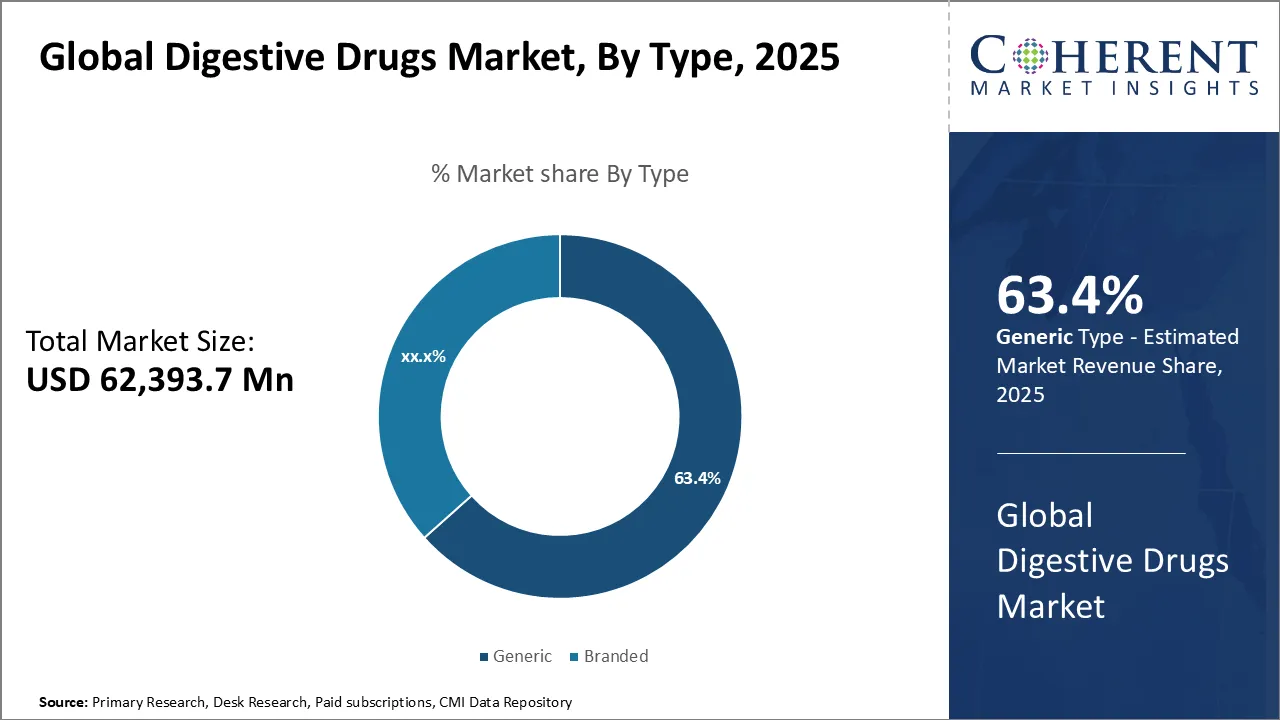
Digestive Drugs Market Insights, By Type: Generic Dominance is Driven by Cost-Effectiveness, Patent Expirations, and Growing Consumer Adoption
In terms of type, the generic segment is projected to hold 64.4% share of the market in 2026, due to its cost-effectiveness, growing consumer awareness, and patent expirations of key branded drugs. Generic medications enable wider access to treatments for gastrointestinal disorders like acid reflux, ulcers, and IBS. Their rapid adoption, especially in emerging markets, positions generics as the leading segment globally.
For instance, in August 2026, Dr Reddy's Laboratories introduced Colozo, a generic version of the USFDA-approved drug Linaclotide, to treat chronic idiopathic constipation (CIC), irritable bowel syndrome with constipation (IBS-C) in adults, and functional constipation in children aged 6–17. This launch strengthens the company's gastrointestinal portfolio, following the introduction of BixiBat in India last year.
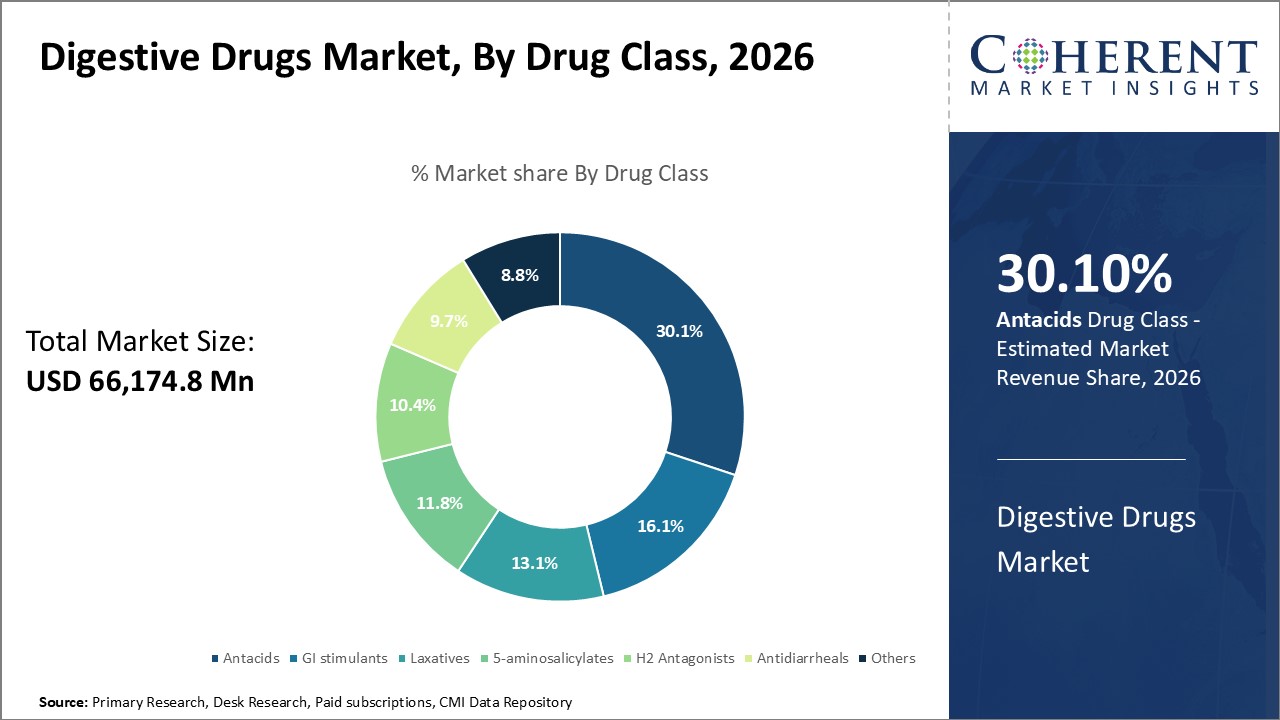
Digestive Drugs Market Insights, By Drug Class: Antacids are Dominance is Driven by High GERD Prevalence, OTC Availability, And Rising Gastrointestinal Disorder Awareness
In terms of drug class, the antacids segment is projected to account for the highest share of the market in 2026, due to their widespread use in treating GERD, heartburn, and acid-related disorders. Rising prevalence of gastrointestinal conditions, easy over-the-counter availability, and growing consumer awareness drive their demand. Other segments, such as Laxatives and 5-Aminosalicylates, are also growing, showing strong market potential.
For instance, in July 2026, Abbott introduced Digene Insta On The Go in India, a water-free antacid solution offering relief from acidity, heartburn, and indigestion within 2 seconds. Packaged in single-use 10 ml mint-flavoured sachets, it’s priced at ₹50 for a five-sachet pack.
Digestive Drugs Market Insights, By Route of Administration: Oral is Surging Driven by Convenience, Cost-Effectiveness, And Widespread Use for Gastrointestinal Disorders
In terms of route of administration, the oral segment is expected to lead the market in 2026, due to its convenience, cost-effectiveness, and widespread patient preference. Oral formulations, including tablets, capsules, and liquids, are extensively used to treat gastrointestinal disorders such as acid reflux, ulcers, and irritable bowel syndrome. Intravenous and other routes hold smaller shares, primarily used in acute or specific treatment scenarios.
For instance, in July 2026, Dr. Reddy’s has struck a non-exclusive patent-licensing deal with Takeda to introduce Vonoprazan tablets, an oral acid-blocker in India under the brand name VONO™. Available in 10 mg and 20 mg doses, the drug aims to treat reflux esophagitis and other acid-peptic conditions, affecting nearly 37-39% of Indians aged 18-59.
Digestive Drugs Market Insights, By Application: Gastroesophageal Reflux Disease (GERD) Leading Due To Its High Global Prevalence and Effective Treatment Options
In terms of application, the Gastroesophageal Reflux Disease (GERD) segment is projected to hold the biggest share of the market in 2026. This is due to the high prevalence of GERD globally and the availability of effective treatments, such as proton pump inhibitors (PPIs) and H2 receptor antagonists. These factors contribute to GERD's significant market share within the digestive drugs sector.
For instance, in July 2026, the FDA approved vonoprazan (brand name Voquezna) for daily use to relieve heartburn in adults with non-erosive GERD. Clinical trials showed it significantly increases heartburn-free days vs placebo, and its safety profile includes typical side effects like nausea, abdominal pain, and constipation.
Digestive Drugs Market Insights, By Distribution Channel Retail Pharmacies is Dominating Due to Their Accessibility, Convenience, and Trusted Role in Dispensing Medications
In terms of distribution channel, the Retail Pharmacies segment is expected to capture the greatest share of the market in 2026, due to their wide accessibility, convenience, and established role in dispensing medications. Patients prefer retail pharmacies for prescription refills, consultations with pharmacists, and reliable access to digestive drugs, making them the primary distribution channel and a key contributor to the market’s overall demand and growth.
For instance, in March 2026, Eli Lilly launched Mounjaro, its weight-loss and type-2 diabetes injection, in India after receiving approval from the country’s drug regulator. The medicine, administered once weekly, works by slowing digestion and increasing feelings of fullness. It will be available via pharmacies with 2.5 mg and 5 mg doses priced at approximately ₹3,500 and ₹4,375 respectively.
Regional Insights
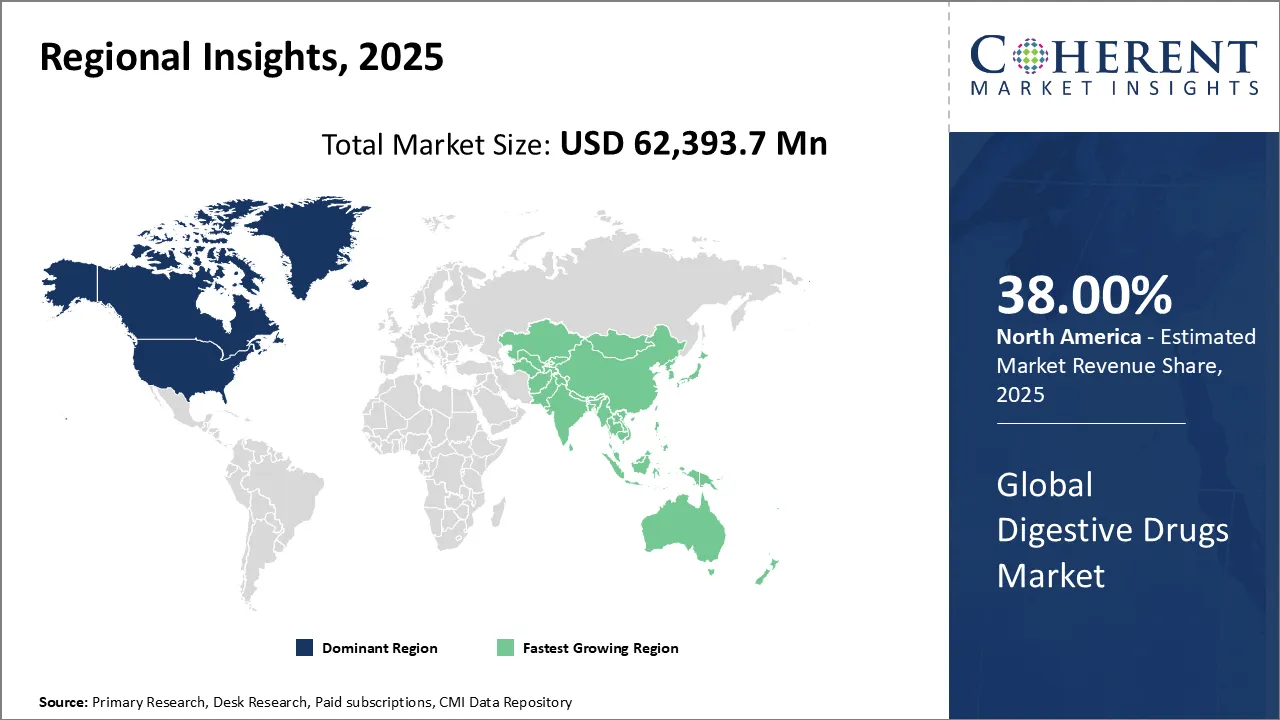
North America Digestive Drugs Market Analysis & Trends
North America dominates the digestive drugs market in 2026, holding about 38% of global share. This leadership is supported by high prevalence of gastrointestinal disorders, advanced healthcare infrastructure, and widespread access to innovative therapies. Strong pharmaceutical R&D, rapid adoption of branded drugs, and favorable reimbursement policies further reinforce North America’s leading position in this market.
For instance, in February 2026, Sandoz launched Pyzchiva® (ustekinumab-ttwe), a biosimilar to Stelara®, in the US, expanding treatment options for around 12 million patients. The drug targets chronic inflammatory conditions such as plaque psoriasis, psoriatic arthritis, Crohn’s disease and ulcerative colitis.
Asia Pacific Digestive Drugs Market Analysis & Trends
Asia-Pacific is the fastest-growing region in the digestive drugs market, driven by expanding healthcare access, increasing prevalence of digestive diseases, and growing middle-class populations. Rapid pharmaceutical infrastructure development, government-backed healthcare initiatives, and rising demand for cost-effective generics accelerate regional growth. Countries like China and India play a key role in fueling the market’s expansion across Asia-Pacific.
For instance, in June 2024, Akums Drugs & Pharmaceuticals introduced Rabeprazole + Levosulpiride SR Capsules, a novel, DCGI-approved treatment for gastrointestinal disorders in India. The formulation combines rabeprazole (40 mg) and levosulpiride (75 mg) to ease GERD symptoms, improve digestive motor function, and offer faster relief with fewer side effects.
Digestive Drugs Market Outlook Country-Wise
The U.S. Digestive Drugs Market Trends
The United States holds a significant share in the digestive drugs market, driven by the high prevalence of gastrointestinal disorders such as GERD, IBS, and ulcers. Advanced healthcare infrastructure, widespread access to both prescription and over-the-counter drugs, and strong adoption of innovative therapies further support demand. Additionally, consumer awareness of digestive health contributes to sustained market growth.
For instance, in March 2026, U.S. FDA approved Tremfya (guselkumab) for adults with moderately to severely active Crohn’s disease. It is the first IL-23 inhibitor in the U.S. to offer both subcutaneous and intravenous induction treatment options. The approval follows Phase 3 trials showing Tremfya’s effectiveness even in patients who failed or were intolerant to conventional or biologic therapies.
China Digestive Drugs Market Trends
China is expected to lead the global digestive drugs market in 2026. This growth is driven by a rapidly expanding middle class, heightened awareness of digestive health, and a rising prevalence of gastrointestinal disorders such as GERD, IBS, and acid reflux. Increasing healthcare access and adoption of both prescription and over-the-counter therapies further support market demand.
For instance, in June 2026, Ecnoglutide, a novel GLP-1 weight-loss drug developed by China's Sciwind Biosciences, has shown promising results in Phase 3 trials. Participants lost up to 15% of their body weight over 48 weeks, with nearly 93% achieving at least a 5% reduction. The drug also demonstrated significant reductions in liver fat.
Market Report Scope
Digestive Drugs Market Report Coverage
| Report Coverage | Details | ||
|---|---|---|---|
| Base Year: | 2025 | Market Size in 2026: | USD 66,174.8 Mn |
| Historical Data for: | 2020 To 2024 | Forecast Period: | 2026 To 2033 |
| Forecast Period 2026 to 2033 CAGR: | 6.1% | 2033 Value Projection: | USD 99,897.3 Mn |
| Geographies covered: |
| ||
| Segments covered: |
| ||
| Companies covered: | GlaxoSmithKline plc, AbbVie Inc. (Allergan), Takeda Pharmaceutical Company Limited, Pfizer Inc, AstraZeneca plc, Marksans Pharma, Tillotts Pharma AG, Salix Pharmaceuticals, Otsuka Pharmaceutical Co., Ltd., Merck & Co., Inc., Lexicon Pharmaceuticals, Inc., Bayer AG, Cadila Healthcare Ltd. | ||
| Growth Drivers: |
| ||
| Restraints & Challenges: |
| ||
Global Digestive Drugs Market Drivers
Key players operating in the market are getting approval to new digestive drugs
Key players in the Digestive Drugs Market are actively expanding their portfolios by obtaining approvals for new digestive drugs, including advanced formulations for GERD, IBS, and other gastrointestinal disorders. These approvals enable companies to meet growing patient demand, enhance therapeutic efficacy, and strengthen their market presence, contributing significantly to the overall Digestive Drugs Market size and revenue growth.
Increasing prevalence of gastrointestinal disorders
The rising prevalence of gastrointestinal disorders, including GERD, irritable bowel syndrome (IBS), and acid reflux, is a key driver for the Digestive Drugs Market growth. An aging population, changing dietary habits, sedentary lifestyles, and stress contribute to increased digestive health issues. This growing patient base boosts demand for both prescription and over-the-counter digestive medications globally.
Global Digestive Drugs Market Opportunities
Expansion of OTC Digestive Products – Rising consumer awareness about digestive health presents opportunities for over-the-counter (OTC) medications, dietary supplements, and herbal remedies, allowing companies to tap into preventive care and self-medication trends in both developed and emerging markets.
Emerging Markets Growth – Increasing healthcare access, rising disposable incomes, and growing prevalence of gastrointestinal disorders in countries like India, China, and Brazil offer significant opportunities for market expansion and higher adoption of digestive drugs.
Analyst Opinion (Expert Opinion)
The digestive drugs market value is undergoing a significant transformation, driven by a confluence of factors that are reshaping its landscape. A notable trend is the increasing integration of artificial intelligence (AI) in drug development and diagnostics. AI's ability to analyze vast datasets accelerates the identification of novel therapeutic targets and the development of personalized treatment regimens, enhancing the efficacy of digestive disorder interventions.
In the realm of product innovation, the market is witnessing a surge in the development of combination therapies that address multiple gastrointestinal issues simultaneously. For instance, the emergence of dual-action medications that combine proton pump inhibitors with prokinetic agents offers a comprehensive approach to managing conditions like gastroesophageal reflux disease (GERD) and delayed gastric emptying. This innovation not only improves patient compliance but also optimizes treatment outcomes.
Speak to the analyst
Want personalized insights?
Take the findings above to one of our principal consultants, or have the report rebuilt around the segments, geographies and competitors you actually track.
Recent Developments
- In June 2025, Danish pharmaceutical company Novo Nordisk launched its weight-loss drug Wegovy in India, aiming to compete with Eli Lilly's Mounjaro, which entered the Indian market three months earlier. Wegovy, a once-weekly injection, is priced between ₹17,345 and ₹26,015 per month, aligning with Mounjaro's pricing. Both drugs are GLP-1 receptor agonists, targeting the rising obesity and diabetes rates in India.
- In July 2024, Pfizer announced the advancement of its once-daily oral GLP-1 receptor agonist, danuglipron, for chronic weight management. Following positive pharmacokinetic results from an ongoing study, the company has selected its preferred modified release formulation. Pfizer plans to conduct dose optimization studies in the second half of 2024 to inform registration-enabling trials.
Market Segmentation
- Global Digestive Drugs Market, By Type (Revenue, USD Mn, 2021 - 2033)
- Branded
- Generic
- Global Digestive Drugs Market, By Drug Class (Revenue, USD Mn, 2021 - 2033)
- 5-aminosalicylates
- GI stimulants
- Laxatives
- Antacids
- H2 Antagonists
- Antidiarrheals
- Others
- Global Digestive Drugs Market, By Route of Administration (Revenue, USD Mn, 2021 - 2033)
- Oral
- Intravenous
- Others
- Global Digestive Drugs Market, By Application (Revenue, USD Mn, 2021 - 2033)
- Gastroesophageal Reflux Disease (GERD)
- Irritable Bowel Syndrome
- Ulcerative Colitis
- Others (Chronic diarrhoea, constipation etc.)
- Global Digestive Drugs Market, By Distribution Channel (Revenue, USD Mn, 2021 - 2033)
- Hospital Pharmacies
- Retail Pharmacies
- Online Pharmacies
- Global Digestive Drugs Market, By Region (Revenue, USD Mn, 2021 - 2033)
- North America
- U.S.
- Canada
- Latin America
- Brazil
- Argentina
- Mexico
- Rest of Latin America
- Europe
- Germany
- U.K.
- Spain
- France
- Italy
- Russia
- Rest of Europe
- Asia Pacific
- China
- India
- Japan
- Australia
- South Korea
- ASEAN
- Rest of Asia Pacific
- Middle East
- GCC Countries
- Israel
- Rest of Middle East
- Africa
- South Africa
- North Africa
- Central Africa
- North America
- Digestive Drugs Market Companies
- GlaxoSmithKline plc
- AbbVie Inc. (Allergan)
- Takeda Pharmaceutical Company Limited
- Pfizer Inc
- AstraZeneca plc
- Marksans Pharma
- Tillotts Pharma AG
- Salix Pharmaceuticals
- Otsuka Pharmaceutical Co., Ltd.
- Merck & Co., Inc.
- Lexicon Pharmaceuticals, Inc.
- Bayer AG
- Cadila Healthcare Ltd.
Sources
Primary Research Interviews from the following stakeholders
Stakeholders
- Interviews with gastroenterologists, pharmacists, hospital procurement heads, nutritionists, and pharmaceutical distributors across leading global markets.
Specific stakeholders
- Gastrointestinal specialists and clinical leads at hospitals and clinics
- Pharmacists and pharmacy chain managers
- Procurement and supply chain managers at pharmaceutical distributors
- Clinical trial coordinators and research lead at hospitals and research institutes
- Nutritionists and dietitians prescribing digestive drugs in hospitals and wellness centers
- Product managers and R&D lead at pharmaceutical and biotech companies producing digestive drugs
Databases
- World Health Organization (WHO) Global Health Observatory
- United Nations Comtrade Database
- Ministry of Health and Family Welfare (India)
- S. Food and Drug Administration (FDA) Drug Databases
- European Medicines Agency (EMA) Database
- China National Medical Products Administration (NMPA)
- Japan Pharmaceuticals and Medical Devices Agency (PMDA)
- Korea Ministry of Food and Drug Safety (MFDS)
Magazines
- Pharmaceutical Technology
- PharmaVOICE
- Drug Development & Delivery
- Pharmaceutical Executive
- The Medicine Maker
- European Pharmaceutical Review
- Clinical Trials Arena
Journals
- Journal of Gastroenterology and Hepatology
- Alimentary Pharmacology & Therapeutics
- World Journal of Gastroenterology
- Digestive Diseases and Sciences
- Journal of Clinical Gastroenterology
- Gut (BMJ Journal)
Newspapers
- The Wall Street Journal – Health & Pharmaceuticals
- The Economic Times – Healthcare & Pharma
- The Hindu Business Line – Pharmaceuticals & Healthcare
- Financial Times – Life Sciences
- Nikkei Asia – Healthcare & Pharma Supply Chain
- South China Morning Post – Healthcare & Pharmaceuticals
Associations
- American Gastroenterological Association (AGA)
- European Society for Gastroenterology & Endoscopy
- International Society for Pharmacoeconomics and Outcomes Research (ISPOR)
- Indian Pharmacological Society (IPS)
- Asia-Pacific Association of Gastroenterology (APAGE)
- World Gastroenterology Organisation (WGO)
Public Domain Sources
- Ministry of Health & Family Welfare (Government of India)
- National Institutes of Health (NIH), U.S.
- S. Food and Drug Administration (FDA)
- European Medicines Agency (EMA)
- Japan Ministry of Health, Labour and Welfare (MHLW)
- Korea MFDS – Drug Statistics
- WHO – Global Health and Drug Reports
- NITI Aayog – Healthcare & Pharma Reports
Proprietary Elements
- CMI Data Analytics Tool, and Proprietary CMI Existing Repository of information for last 8 years
Get access to 250+ pages report
Every segment, forecast, competitor profile and data table behind the analysis above — available for instant download.
- ESOMAR Member
- ISO 9001:2015 Certified
- D-U-N-S Registered
- GDPR & CCPA Compliant
Missing comfort of reading report in your local language? Find your preferred language:
Transform your Strategy with Exclusive Trending Reports
Frequently Asked Questions
The Digestive Drugs Market is estimated to be valued at USD 66,174.8 Mn in 2026, and is expected to reach USD 99,897.3 Mn by 2033.
The CAGR of the Digestive Drugs Market is projected to be 6.1% from 2026 to 2033.
Factors such as increasing development of new digestive drugs and increasing engagement of business development strategies such as collaboration by key market players are expected to drive the market.
Generic segment is expected to hold a major market share during the forecast period in the type segment.
The major factor hampering growth of the market include side effects associated with gastrointestinal drugs.
Major players operating in the market includes GlaxoSmithKline plc, AbbVie Inc. (Allergan), Takeda Pharmaceutical Company Limited, Pfizer Inc, AstraZeneca plc, Marksans Pharma, Tillotts Pharma AG, Salix Pharmaceuticals, Otsuka Pharmaceutical Co., Ltd., Merck & Co., Inc., Lexicon Pharmaceuticals, Inc., Bayer AG, Cadila Healthcare Ltd.