

Fruit Packaging Market Size and Forecast — 2026 - 2033
Fruit Packaging Market Size and Forecast – 2025 – 2032
The Global Fruit Packaging Market size is estimated to be valued at USD 7.5 billion in 2025 and is expected to reach USD 12.3 billion by 2032, exhibiting a compound annual growth rate (CAGR) of 7.2% from 2025 to 2032.
Overview
Fruit packaging products are designed to protect fresh produce during storage, transportation, and retail display while maintaining freshness and minimizing damage. These products include crates, cartons, clamshells, punnets, and flexible packaging made from plastic, paperboard, or biodegradable materials. Fruit packaging solutions focus on ventilation, moisture control, cushioning, and visibility to preserve quality and extend shelf life. Many modern fruit packaging products also incorporate eco-friendly materials and designs to reduce environmental impact.
Key Takeaways
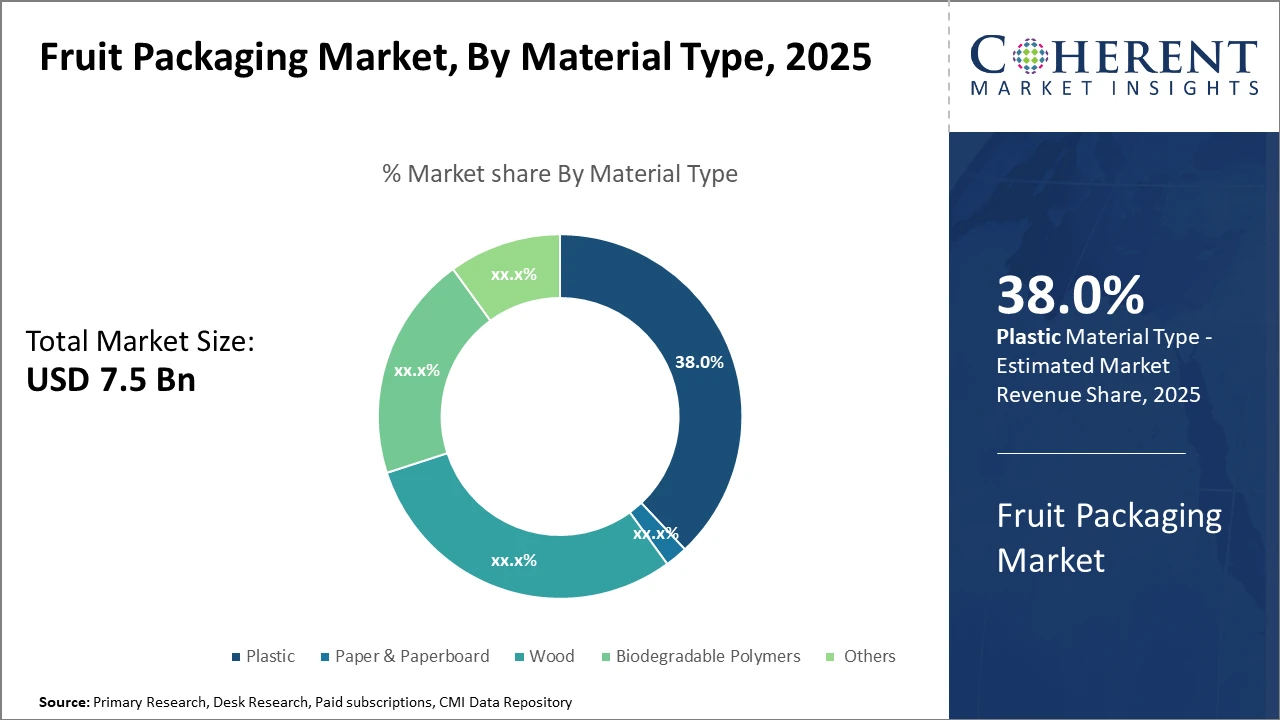
The plastic segment dominates the Fruit Packaging market share, accounting for 38%, majorly due to its versatility and cost-effectiveness in various packaging types.
The fresh fruit application segment is key to market revenue generation, supported by expanding organic fruit consumption and improved shelf-life technologies within packaging solutions.
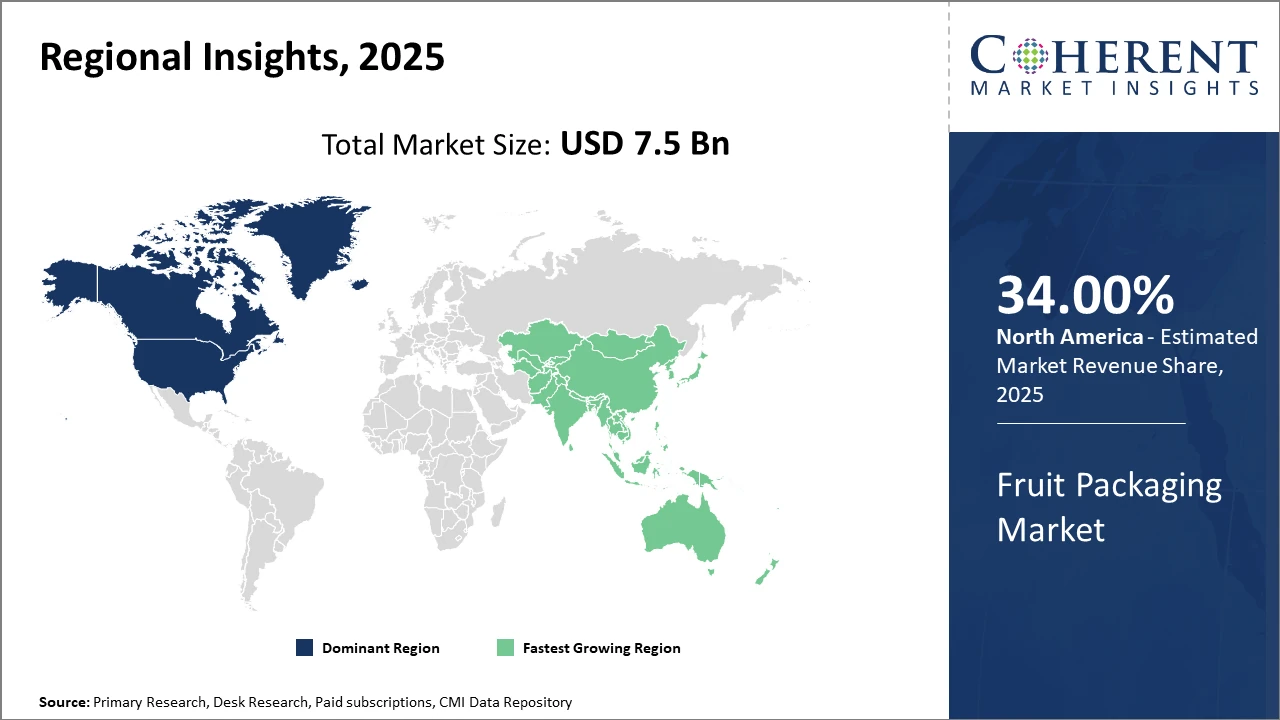
Europe leads in adoption of sustainable packaging solutions owing to stringent eco-regulations, representing the largest regional market share globally.
In contrast, Asia Pacific demonstrates the fastest CAGR due to rapid urbanization, rising disposable income, and increasing export activities in countries like China and India.
Fruit Packaging Market Segmentation Analysis
Fruit Packaging Market Insights, By Material Type
Plastic dominate the market share with 38%. Plastic remains dominant primarily due to its unmatched durability, flexibility, and cost advantages in preserving fresh fruit quality during storage and transit. Plastics like polyethylene and polypropylene are commonly used for clamshells and films, offering customizable barrier properties. Biodegradable Polymers represent the fastest growing subsegment, driven by rising regulatory pressures and environmental consciousness, enabling compostable and eco-friendly packaging alternatives that reduce carbon footprints. Paper & Paperboard provide a sustainable but less durable alternative, widely used for secondary packaging and trays but requiring innovation to increase barrier properties.
Fruit Packaging Market Insights, By Packaging Type
Clamshells dominate the market share due to their protective design that minimizes damage while enabling consumer visibility, favored in fresh fruit retail and supermarkets globally. The fastest growing subsegment is Wraps & Films, boosted by developments in biodegradable cling films and active packaging that extend shelf life and reduce spoilage. Trays & Containers hold a substantial portion, often used in export-grade packaging to stack and protect fruits. Bags & Pouches are increasing in use for dried and processed fruit, offering convenience and portion control.
Fruit Packaging Market Insights, By Application
Fresh Fruit dominates the market share comprehensively, reflecting global shifts to convenience packaging solutions that maintain fruit freshness and safety from harvest to retail. This segment’s growth is anchored by rising organic fresh fruit consumption and increasing packaged fruit sales through e-commerce platforms. The fastest growing subsegment is Processed Fruit, which is leveraging innovative packaging to extend shelf life and appeal to convenience-seeking consumers, such as ready-to-eat fruit cups and purees. Dried Fruit packaging is growing steadily with advancements in moisture barrier films and resealable pouches that enhance product longevity.
Fruit Packaging Market Trends
The increasing integration of advanced packaging that leverages sensor technologies is transforming supply chain transparency and reducing spoilage rates significantly, as demonstrated by a 20% decrease in loss in select U.S. pilot projects in 2024.
Secondly, the shift toward eco-conscious packaging materials, especially biodegradable polymers, has accelerated in response to tightening global regulations, spurring a 22% CAGR in Europe’s sustainable packaging segment since 2023.
Besides this, the digitalization of distribution networks, propelled by e-commerce growth, has driven demand for modular and impact-resistant packaging designed to sustain the rigors of logistics and prolong fruit freshness.
Fruit Packaging Market Insights, By Geography
North America Fruit Packaging Market Analysis and Trends
In North America, the dominance in the market is attributed to continuous innovation, substantial investments in cold chain facilities, and regulatory incentives favoring eco-friendly materials. The U.S. market benefits from mature infrastructure, a robust retail sector, and technology adoption, ensuring a significant industry share. Notably, companies like Amcor and Sealed Air have enhanced their regional prominence by launching sustainable packaging products that comply with stringent FDA and EPA requirements.
Asia Pacific Fruit Packaging Market Analysis and Trends
Meanwhile, Asia Pacific exhibits the fastest growth, underpinned by rapid urbanization and increasing consumption of packaged fruit driven by a growing middle class. Countries like China and India are witnessing double-digit growth rates in packaged fruit consumption, catalyzing demand for innovative packaging solutions that improve shelf life under challenging climatic conditions. The region’s rising export volumes further support market expansion despite logistical and material cost challenges.
Fruit Packaging Market Outlook for Key Countries
USA Fruit Packaging Market Analysis and Trends
The USA's market thrives on technological advancement and consumer preference for convenience and sustainability. With rigorous food safety regulations and an extensive cold storage network, the US market champions adoption of smart packaging with RFID and temperature-monitoring technologies. Leading companies such as Sealed Air and Amcor have pioneered antimicrobial and biodegradable packaging products tailored for fresh and organic fruit segments. The growth of online grocery sales, which accounted for over 20% of fresh fruit retail volume in 2025, has pushed demand for protective and eco-friendly packaging innovations that reduce waste and enhance delivery efficiency.
Brazil Fruit Packaging Market Analysis and Trends
Brazil’s fruit packaging market is fueled by its status as a major global fruit exporter, notably for tropical fruits such as mangoes and pineapples. The country’s burgeoning agro-industry is adopting advanced plastic and biodegradable packaging solutions to meet export quality standards and reduce product loss during transit. Recent government initiatives promoting sustainable agriculture and packaging have accelerated investments, with a reported 18% increase in biodegradable packaging usage from 2023 to 2025. Players like Klabin and Bemis Company have strengthened local partnerships to tailor packaging products that address Brazil’s unique climatic challenges and extended supply chains.
Analyst Opinion
Growing Demand for Sustainable Packaging: One of the most impactful drivers for market revenue is the increasing shift towards biodegradable and recyclable fruit packaging materials. Recent years have seen a 15% rise in the adoption of sustainable packaging in North America alone, influenced by regulatory mandates and consumer preference towards eco-friendly products. For instance, in 2024, European fruit exporters reported a 12% reduction in packaging waste due to new bio-based packaging protocols, which directly boosts market share within the sustainable segment.
Expansion of E-commerce and Cold Chain Infrastructure: The exponential growth of online grocery sales has necessitated innovative fruit packaging solutions that ensure product integrity during transit. 2025 data indicate that over 30% of packaged fruit in Asia Pacific is distributed via e-commerce channels, propelling the demand for specialized packaging with enhanced durability and temperature control. This surge correlates with the increase in cold chain investments by logistics companies, strengthening the overall market size and market revenue stream.
Technological Integration Driving Market Growth: Smart packaging solutions embedded with sensors and RFID tags are gaining traction, significantly impacting market analysis by enabling better inventory management and freshness tracking. In 2024, pilot projects in the U.S. demonstrated a 20% decrease in spoilage rates when smart packaging was deployed across selected fruit supply chains, validating the positive effect on market growth and future potential.
Price Sensitivity and Raw Material Volatility: Despite advancements, the market growth strategies are tempered by fluctuations in raw material costs, including paper, plastic resins, and biopolymers. Recent pricing trends showed a 6% increase in packaging material costs in Latin America during early 2025, which has necessitated dynamic pricing models by market players to maintain competitive market share without compromising profitability.
- Current Industry Events of 2026
- Market Size Estimation
- Regional Breakdown
- Competitive Landscape
- Customer Intelligence
- Segmental Analysis
- Pricing Analysis
- Key Market Drivers, Challenges & Future Trends
- Customized Insights Section
Market Scope
| Report Coverage | Details | ||
|---|---|---|---|
| Base Year: | 2025 | Market Size in 2025: | USD 7.5 billion |
| Historical Data for: | 2020 To 2024 | Forecast Period: | 2025 To 2032 |
| Forecast Period 2025 to 2032 CAGR: | 7.2% | 2032 Value Projection: | USD 12.3 billion |
| Geographies covered: |
| ||
| Segments covered: |
| ||
| Companies covered: | Winpak Ltd., International Paper Company, ProAmpac, Huhtamaki Oyj,DS Smith Plc, Oji Holdings Corporation, GRAPHIC Packaging Holding Company,Uflex Ltd.,Futamura Chemical Company, and Reynolds Group Holdings. | ||
| Growth Drivers: |
| ||
Fruit Packaging Market Growth Factors
The rise of organic fruit consumption worldwide is strongly influencing market dynamics, with consumer preferences shifting towards packaging that guarantees product safety and natural freshness. A WHO report in 2025 emphasized organic fruit demand grew by 9% annually, which directly expands the market scope for sustainable product lines. Government incentives promoting biodegradable packaging—especially prominent in Europe and parts of Asia Pacific—are reducing the market restraints commonly faced due to higher costs of eco-friendly materials. Technological innovation, such as antimicrobial additives and modified atmosphere packaging (MAP), is improving shelf life and reducing spoilage, significantly driving business growth and market revenue. Lastly, urbanization and increasing disposable incomes in emerging countries continue to fuel processed and packaged fruit consumption, marking these regions as lucrative areas for market players investing in scalability.
Fruit Packaging Market Development
In March 2024, Kelpi partnered with Waitrose and Blue Skies to develop and prototype seaweed-derived, plastic-free packaging for fresh-cut fruit. The collaboration focused on replacing conventional plastic with compostable, marine-safe materials, with successful trials paving the way for a full commercial launch planned for 2025, supporting retailers’ sustainability and plastic-reduction commitments.
In late 2025, Metsä Spring introduced Muoto punnets, a wood fiber–based alternative to plastic packaging for berries and soft fruits. Developed from renewable wood fibers, the solution aims to deliver strength, recyclability, and reduced environmental impact, with market testing scheduled to begin in January 2026 as part of Metsä Group’s push toward scalable fiber-based packaging innovations.
Key Players
Leading Companies of the Market
Winpak Ltd.
International Paper Company
ProAmpac
Huhtamaki Oyj
DS Smith Plc
Oji Holdings Corporation
GRAPHIC Packaging Holding Company
Uflex Ltd.
Futamura Chemical Company
Reynolds Group Holdings
Several market players have recently embraced digital transformation and sustainability agendas as key competitive strategies. For example, Amcor PLC’s launch of fully recyclable fruit packaging in 2024 resulted in a 10% increase in market penetration within the European fresh fruit sector. Similarly, Mondi Group’s partnership with cold chain logistics firms to develop temperature-resistant packaging improved shipment safety, expanding its footprint in North America by 7% in 2025.
Fruit Packaging Market Future Outlook
The future outlook for the fruit packaging market is positive, driven by increasing consumption of fresh fruits and rising global trade volumes. Demand for packaging solutions that enhance shelf life, reduce food waste, and support sustainable practices is expected to grow. Innovations in biodegradable materials, smart packaging, and modified atmosphere packaging will shape product development. Additionally, stricter food safety regulations and retailer requirements will encourage adoption of high-performance packaging solutions. Expansion of organized retail and cold-chain infrastructure in emerging markets will further support long-term market growth.
Fruit Packaging Market Historical Analysis
The fruit packaging market developed as global fruit production and trade increased, creating the need for effective protection during handling, storage, and transportation. Early packaging solutions focused primarily on containment and basic protection, offering limited control over ventilation and moisture. As supply chains became longer and more complex, packaging designs evolved to include improved airflow, cushioning, and stackability. The expansion of cold-chain logistics and export-oriented fruit trade significantly influenced packaging standards. Over time, packaging became a critical component in maintaining fruit quality, reducing spoilage, and extending shelf life, supporting steady market growth.
Sources
Primary Research Interviews:
Produce Exporters
Packaging Designers
Cold Chain Managers
Retail Buyers
Food Safety Consultants
Databases:
FAO Fruit Trade Data
UN Comtrade
World Bank Agriculture Data
Magazines:
Fresh Produce Journal
Packaging Europe
Food Packaging Forum
Produce Business
Packaging World
Journals:
Postharvest Biology & Technology
Food Packaging & Shelf Life
Journal of Food Engineering
Packaging Technology & Science
Food Control
Associations:
International Fresh Produce Association
Food and Agriculture Organization
Global Cold Chain Alliance
International Packaging Association
Sustainable Food Trade Association
Get access to 250+ pages report
Every segment, forecast, competitor profile and data table behind the analysis above — available for instant download.
- ESOMAR Member
- ISO 9001:2015 Certified
- D-U-N-S Registered
- GDPR & CCPA Compliant
Missing comfort of reading report in your local language? Find your preferred language:
Transform your Strategy with Exclusive Trending Reports
Frequently Asked Questions
The market is primarily led by companies such as Amcor PLC, Berry Global, Mondi Group, and Sealed Air Corporation, which collectively drive innovation and hold significant market share.
The Fruit Packaging market is expected to grow from USD 7.5 billion in 2025 to USD 12.3 billion by 2032, with a CAGR of 7.2%, driven by sustainability and technological innovation.
The fresh fruit segment presents the largest growth opportunity, bolstered by rising organic fruit consumption and the demand for packaging that extends shelf life.
Trends will increasingly focus on intelligent, biodegradable packaging, and customization for e-commerce platforms, significantly impacting market revenue streams.
The market is competitive with a focus on innovation for sustainability and technology, facing challenges such as raw material price volatility and regulatory compliance.
Market players focus on partnerships, product innovation, expansion into emerging regions, and aligning with environmental regulations to capitalize on market share.