

Gamma Probe Device Market Size and Forecast — 2026-2033
The Global Gamma Probe Device Market size is estimated to be valued at USD 451.1 million in 2026 and is expected to reach USD 808.9 million by 2033, exhibiting a compound annual growth rate (CAGR) of 8.7% from 2026 to 2033.
Overview
Gamma probe devices are handheld surgical instruments used to detect gamma radiation emitted from radiolabeled tracers during procedures like sentinel lymph node biopsies. These products consist of a scintillation detector, a photomultiplier tube, and an ergonomic probe tip, often integrated with audio and visual feedback for real-time guidance. Gamma probes are compatible with various isotopes, including technetium-99m, and are used to enhance surgical precision, reduce tissue removal, and improve diagnostic accuracy. Advanced devices may offer directional sensitivity, adjustable thresholds, and wireless connectivity for better intraoperative use.
Key Takeaways
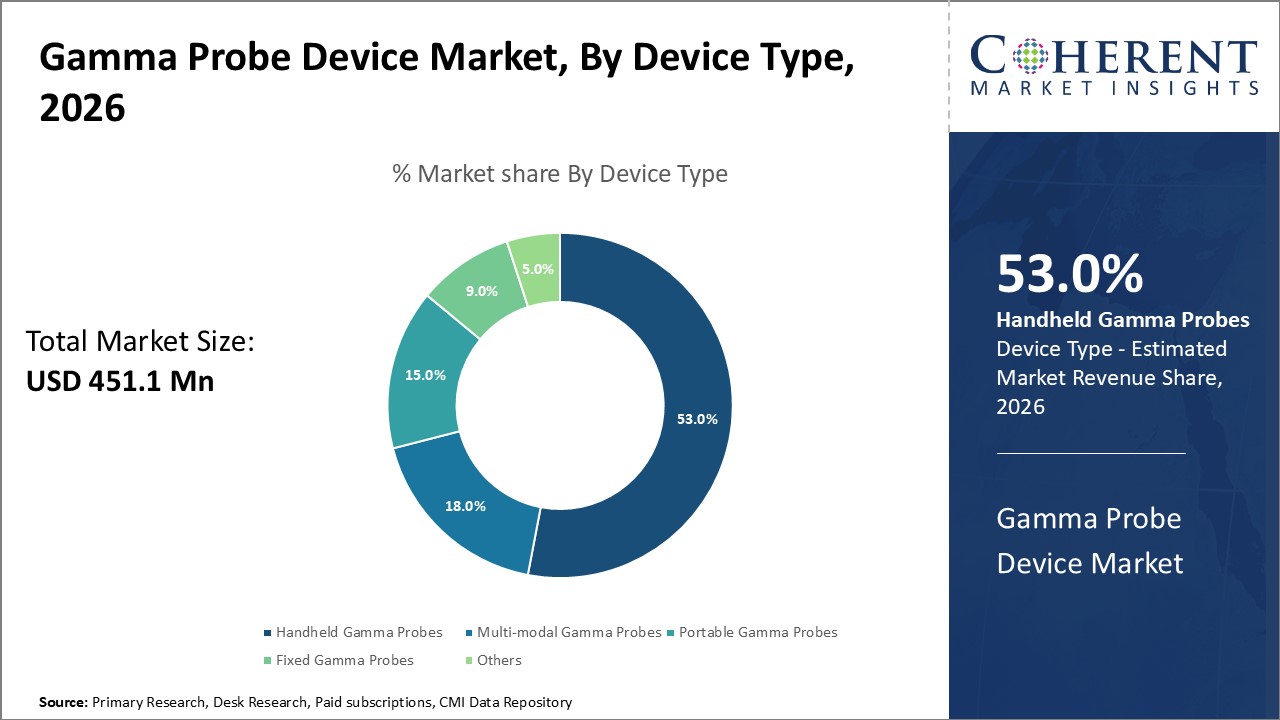
The Handheld Gamma Probes segment dominates market share owing to their portability and ease of integration during surgeries, marking them as the preferred equipment across clinical settings.
Oncology applications contribute the largest industry share, driven by rising cancer incidence and enhanced clinical protocols for radioguided surgeries.
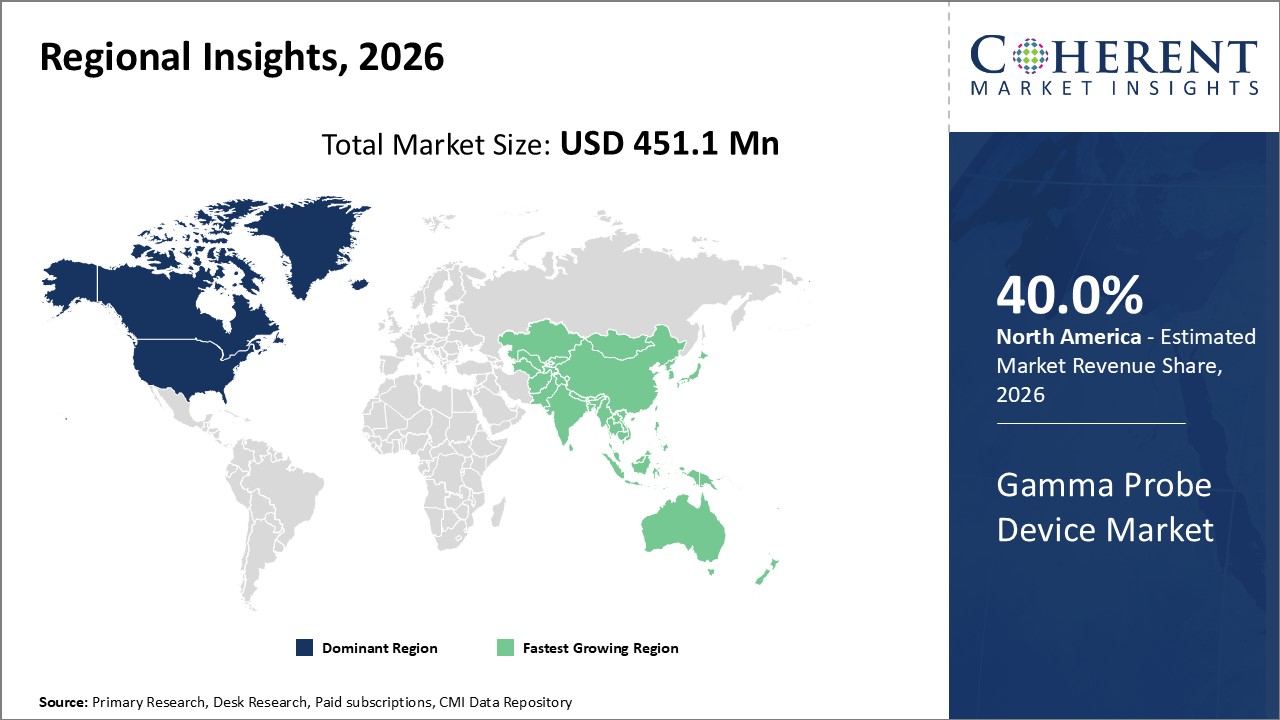
North America remains the leading regional market due to a mature healthcare ecosystem and high adoption of cutting-edge surgical tools, accounting for more than 40% of the total market share.
Asia Pacific emerges as the fastest-growing region, supported by government investments in healthcare infrastructure, with a CAGR exceeding 10%, unlocking vast business growth opportunities.
Gamma Probe Device Market Segmentation Analysis
Gamma Probe Device Market Insights, By Device Type
In terms of device type, Handheld Gamma Probes dominate the market share at 53%. Handheld devices remain the focal technology due to their ease of use during surgeries, real-time feedback, and reliability, making them standard equipment for radioguided interventions. The fastest growing subsegment—Multi-modal Gamma Probes—combines gamma detection with other imaging modalities, enhancing surgical precision and capturing a growing market share due to rising demand for comprehensive diagnostic solutions. Portable Gamma Probes facilitate usage in remote and ambulatory settings and are gaining traction, especially in emerging markets, expanding the product ecosystem.
Gamma Probe Device Market Insights, By Application
Oncology dominates the market share significantly. Growth here is fueled by the increasing global cancer burden, with radioguided surgeries becoming essential for sentinel lymph node biopsy and tumor localization. The fastest growing subsegment in this category is Cardiovascular applications, which are gradually incorporating gamma probe technology for precise detection of vascular anomalies and plaque, reflecting innovation beyond traditional oncology uses. Orthopedics and Others remain niche segments offering potential expansion as device capabilities improve.
Gamma Probe Device Market Insights, By End-User
In terms of end-users, Hospitals dominate the market share due to their comprehensive surgical facilities and high patient volumes. Hospitals continue to be the largest buyers of gamma probe devices, driven by the volume of oncological and specialized surgeries. The fastest growing subsegment is Ambulatory Surgical Centers, which are increasingly equipped with compact and portable probes to support outpatient surgeries, reflecting a shift towards cost-effective and faster procedures.
Gamma Probe Device Market Trends
Recent industry trends in the Gamma Probe Device market emphasize the convergence of imaging technologies with AI, boosting detection accuracy by over 11% as verified by leading clinical trials in 2025.
Portable devices designed for outpatient settings are gaining traction, facilitating faster surgeries and reducing hospital stays.
For example, Hologic’s launch of a portable multi-modal probe in early 2026 expanded access to the technology in ambulatory centers considerably.
Gamma Probe Device Market Insights, By Geography
North America Gamma Probe Device Market Analysis and Trends
In North America, the dominance in the Gamma Probe Device market is propelled by the U.S., which benefits from a vast ecosystem of leading medical device manufacturers, extensive clinical trials, and high healthcare expenditure. The presence of key players and hospitals equipped with cutting-edge surgical technology sustains a healthy market revenue and steady demand.
Asia Pacific Gamma Probe Device Market Analysis and Trends
Meanwhile, the Asia Pacific exhibits the fastest growth, led by countries such as India and China, where increasing cancer incidence and expanding healthcare infrastructure boost device adoption. Favorable government initiatives and private investment improve market access, supported by rising awareness and affordability of minimally invasive surgical procedures.
Gamma Probe Device Market Outlook for Key Countries
USA Gamma Probe Device Market Analysis and Trends
The USA's Gamma Probe Device market is a significant contributor, representing nearly 35% of global revenue in 2025. High cancer diagnosis rates, coupled with advanced healthcare infrastructure, create substantial demand. Medtronic and BD’s extensive market presence and continuous innovation ensure dominance, with strategic distribution networks facilitating swift product rollout.
India Gamma Probe Device Market Analysis and Trends
India's market is rapidly emerging as a key growth hub, propelled by rising oncology procedures and the integration of government-funded cancer screening initiatives. The expanding private healthcare segment has led companies to introduce affordable, portable gamma probe devices tailored for outpatient and tier 2, 3 cities. Partnerships between local and global players have increased accessibility, further accelerating market growth.
Analyst Opinion
The increasing production capacity of gamma probe devices is a strong supply-side driver influencing market share. Data from 2025 indicates a 13% increase in manufacturing output from key industry hubs, correlating with an 12% rise in market revenue in the same period. This expansion capability signals readiness to meet growing clinical demands globally.
From the demand perspective, the increased number of oncological surgeries using radioguided techniques surged by 16% in 2025 compared to the previous year. This trend reflects a rising use case diversity and confirms the crucial role these devices play in improving surgical accuracy, directly impacting market growth metrics.
Pricing strategies have evolved, with a trend toward value-based pricing observed in 2026 clinical frameworks. Hospitals and surgical centers in developed countries negotiated better pricing models without compromising quality, stimulating adoption rates by approximately 10%, as reported in hospital procurement data.
Micro-indicators such as regional adoption rates reveal that Asia Pacific accounted for more than 25% of global market revenue in 2025, driven by strong healthcare infrastructure investments and increasing cancer screenings. This geographical growth supports an overall positive market scope and dynamic expansion beyond traditional markets.
- Current Industry Events of 2026
- Market Size Estimation
- Regional Breakdown
- Competitive Landscape
- Customer Intelligence
- Segmental Analysis
- Pricing Analysis
- Key Market Drivers, Challenges & Future Trends
- Customized Insights Section
Market Scope
| Report Coverage | Details | ||
|---|---|---|---|
| Base Year: | 2025 | Market Size in 2026: | USD 451.1 million |
| Historical Data for: | 2020 To 2024 | Forecast Period: | 2026 To 2033 |
| Forecast Period 2026 to 2033 CAGR: | 8.7% | 2033 Value Projection: | USD 808.9 million |
| Geographies covered: |
| ||
| Segments covered: |
| ||
| Companies covered: | Medtronic Plc, BD (Becton, Dickinson and Company), Hologic Inc., CMR Naviscan Corporation, EuroMedical Imaging, Neoprobe Corporation, Gamma Medica Inc., Gamma Surgical Inc., Oncovision, Lymphoseek (Quest Diagnostics), Surgiogle | ||
| Growth Drivers: |
| ||
Gamma Probe Device Market Growth Factors
The Gamma Probe Device market growth is primarily fueled by the escalating prevalence of cancer worldwide, with WHO data reporting a 19% increase in new cancer cases between 2023 and 2026. Innovations in device technology, especially the development of portable and multi-modal probes, have allowed better intraoperative decision-making, significantly enhancing market revenue. Additionally, increasing government healthcare funding in emerging economies like India and China has expanded access to advanced oncology diagnostics, driving market growth strategies. Lastly, a rising preference for minimally invasive surgeries globally, supported by hospitals aiming to reduce patient recovery times and costs, substantially augments demand for gamma probe devices.
Gamma Probe Device Market Development
In May 2022, KUBTEC® Medical Imaging unveiled its GammaPRO® wireless gamma probe system at the American Society of Breast Surgeons (ASBrS) 2022 Annual Meeting. Designed to enhance precision in sentinel lymph node localization, GammaPRO® introduces an advanced wireless and collimator-free technology that delivers higher sensitivity and accuracy in detecting radio-labeled tissues, even in anatomically complex surgical cases.
In January 2021, Lightpoint Medical received CE Mark approval for its SENSEI® robotic gamma probe, marking the first commercially available robotic gamma detection system for cancer surgery in Europe. The SENSEI® device leverages advanced molecular imaging to detect cancer metastases and sentinel lymph nodes via the lymphatic system, offering high spatial precision and automated maneuverability.
Key Players
Leading market companies include
Medtronic Plc
BD (Becton, Dickinson and Company)
Hologic Inc.
CMR Naviscan Corporation
EuroMedical Imaging
Gamma Medica Inc.
Gamma Surgical Inc.
Oncovision
Lymphoseek (Quest Diagnostics)
Surgiogle
Competitive strategies such as product innovation and strategic collaborations have been key—for instance, Medtronic’s partnership with regional distributors in Asia Pacific led to a 10% revenue increase in 2025. Similarly, BD introduced miniaturized handheld gamma probes in 2026, resulting in expanded market penetration in North America and Europe. These moves emphasize market players' intent to enhance device precision and widen application scopes.
Gamma Probe Device Market Future Outlook
Future developments in gamma probe technology are expected to focus on increased precision, wireless connectivity, and compatibility with robotic-assisted surgery platforms. The use of hybrid imaging systems that combine gamma detection with optical or infrared visualization could enhance surgical accuracy even further. As personalized medicine continues to expand, gamma probes will likely be integrated into targeted radiotherapy and diagnostic workflows. Their applications are anticipated to grow beyond oncology into other domains such as cardiology and nuclear diagnostics, supported by advances in detector materials, artificial intelligence, and compact digital imaging systems.
Gamma Probe Device Market Historical Analysis
Gamma probe devices have played an essential role in improving the precision of cancer surgeries, particularly in procedures involving sentinel lymph node detection. Initially, these instruments were bulky and limited in sensitivity, but advancements in nuclear medicine and miniaturization transformed them into compact, handheld tools. Over the past few decades, gamma probes have become integral in oncology for mapping radiolabeled tissues and guiding surgical excision, significantly improving patient outcomes. Early designs focused on basic radiation detection, while modern probes now feature ergonomic designs, enhanced signal discrimination, and integration with digital systems for real-time surgical guidance.
Sources
Primary Research interviews:
Surgical Oncologists
Nuclear Medicine Physicians
Operating Room Nurses
Medical Device Engineers
Databases:
PubMed / NCBI
FDA Medical Device Databases
MedTech Intelligence Reports
Magazines:
Medical Device Network
Surgical Technology Magazine
Oncology Times
MedTech Insight
Journals:
Journal of Nuclear Medicine
Surgical Oncology
European Journal of Surgical Oncology
Annals of Surgical Oncology
Newspapers:
The New York Times (Health/Medicine)
The Guardian (Science)
The Lancet News (editorial coverage)
The Financial Times (Healthcare)
Associations:
Society of Nuclear Medicine & Molecular Imaging (SNMMI)
American College of Surgeons (ACS)
European Association of Nuclear Medicine (EANM)
Association of Surgical Technologists
Get access to 250+ pages report
Every segment, forecast, competitor profile and data table behind the analysis above — available for instant download.
- ESOMAR Member
- ISO 9001:2015 Certified
- D-U-N-S Registered
- GDPR & CCPA Compliant
Missing comfort of reading report in your local language? Find your preferred language:
Transform your Strategy with Exclusive Trending Reports
Frequently Asked Questions
Leading companies such as Medtronic Plc, BD, Hologic, and EuroMedical Imaging dominate the market by leveraging innovation and strategic partnerships that have expanded their regional footprints and product portfolios.
The market size is forecasted to grow from USD 451.1 million in 2026 to approximately USD 808.9 million by 2033, reflecting a CAGR of 8.7%.
Hospitals represent the largest end-user segment due to the high volume of oncological surgeries and the necessity for advanced surgical devices like gamma probes.
Market trends indicate increased adoption of AI-enabled gamma probe devices, expansion into minimally invasive surgical procedures, and enhanced regional penetration, especially in emerging economies.
The competitive landscape is characterized by rapid technological innovation and strategic collaborations. Market challenges include pricing pressures and regulatory hurdles which companies address through product differentiation and compliance excellence.
Companies emphasize product innovation, strategic partnerships, regional expansion, and tailored pricing models to optimize market share and revenue growth.