

Global Caprolactam Market Analysis & Forecast: 2026-2033
Global Caprolactam Market is estimated to be valued at USD 21,820.8 Mn in 2026 and is expected to reach USD 34,515.6 Mn in 2033, exhibiting a compound annual growth rate (CAGR) of 6.77% from 2026 to 2033.
Key Takeaways
- Based on Raw Material, the Cyclohexane/Benzene segment is expected to contribute the largest share of the market in 2026, due to their cost-efficiency, wide availability, and established industrial processes.
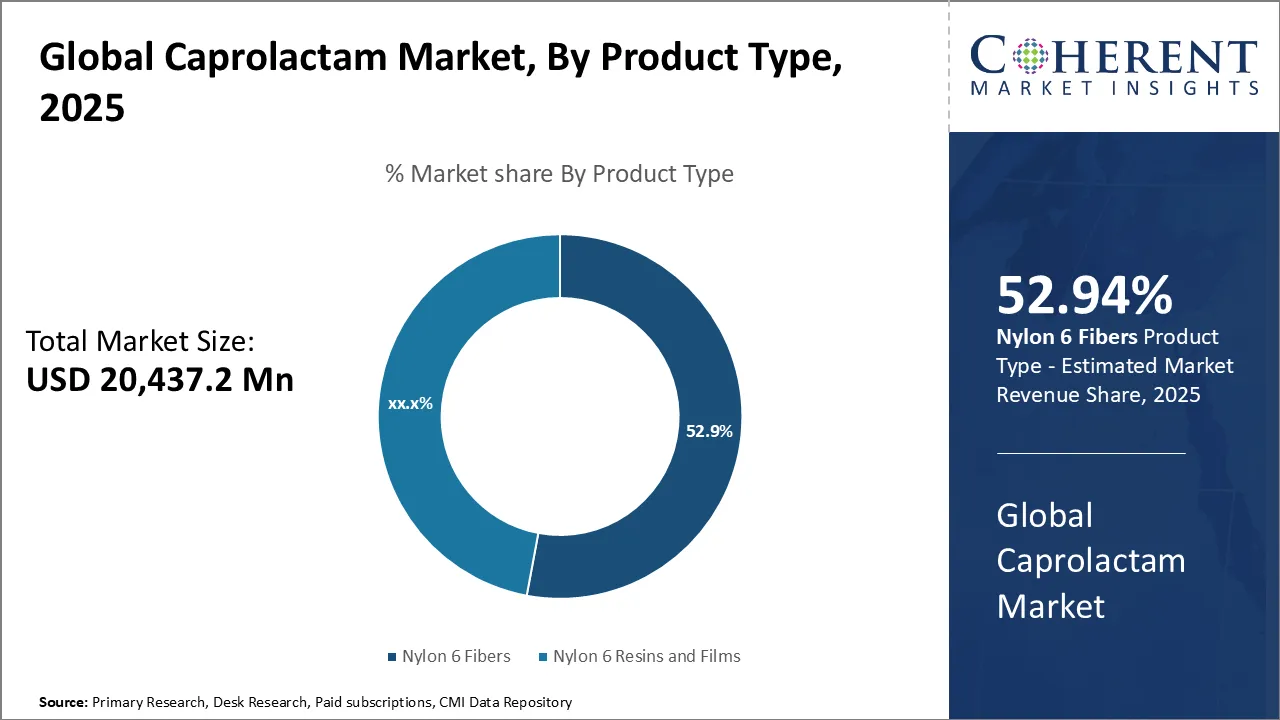
- Based on Product Type, the Nylon 6 Fiber segment is projected to capture 53.9 % share of the market in 2026, due to their widespread application across multiple industries.
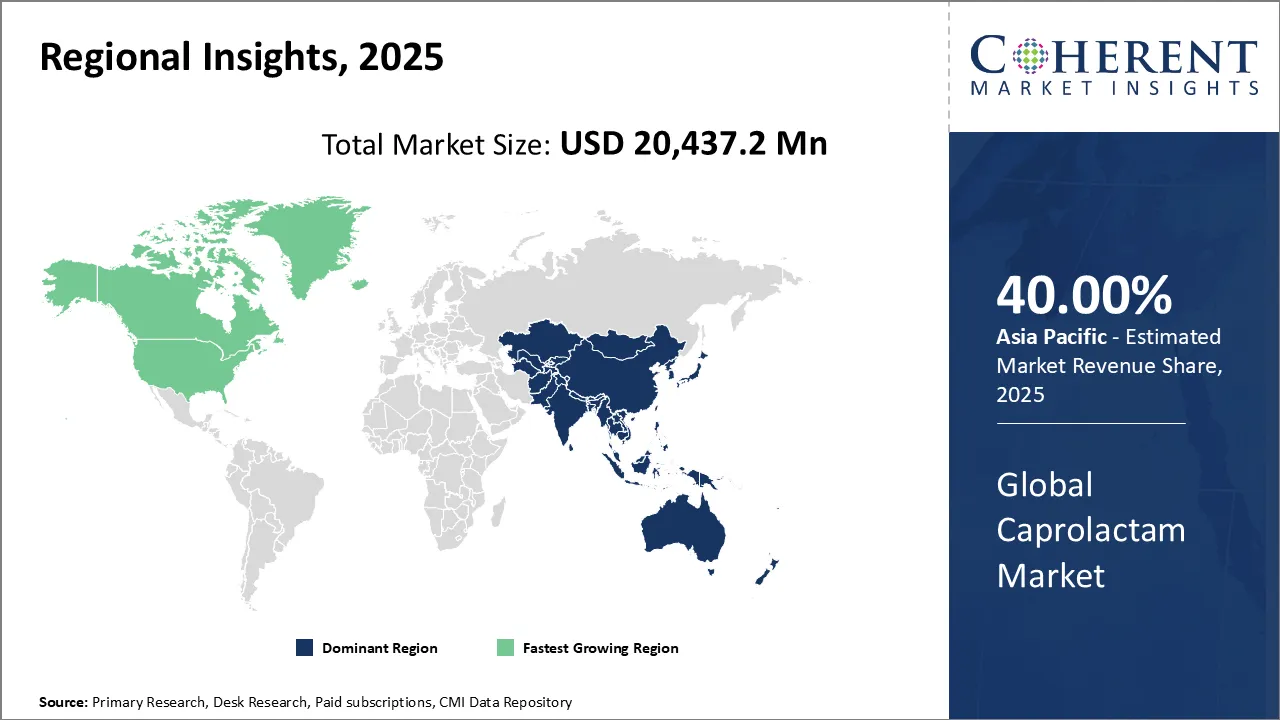
- Based on Region, Asia Pacific is set to lead the market with 40% share in 2026. While, North America is expected to be the fastest growing region.
Market Overview
The Global Caprolactam Market will grow in 2026 because more nylon 6 is being used in the packaging, textile, and automotive industries. The Asia-Pacific region's rapid industrialization, along with the growth of infrastructure and consumer goods, drives production. The market is changing because of new bio-based caprolactam products and stricter rules for the environment. They are making it more important to be good for the environment and cost-effective.
Current Events and Its Impact
Current Event | Description and its Impact |
Raw Material Cost Volatility and Energy Price Fluctuations |
|
Evolving Environmental Regulations and Sustainability Requirements |
|
Segmental Insights
- Current Industry Events of 2026
- Market Size Estimation
- Regional Breakdown
- Competitive Landscape
- Customer Intelligence
- Segmental Analysis
- Pricing Analysis
- Key Market Drivers, Challenges & Future Trends
- Customized Insights Section
Caprolactam Market Insights, By Product Type - Nylon 6 Fibers Dominates Due To Their Extensive Use in Textiles, Carpets, And Industrial Applications Requiring Strength and Durability
In terms of product type, the Nylon 6 Fibers segment is dominating the market with the 53.9% caprolactam market share in 2026, due to their widespread application across multiple industries. In the textile sector, they are favored for producing garments, activewear, and hosiery thanks to their lightweight nature and excellent stretch recovery. Carpets and rugs benefit from nylon 6’s resilience and stain resistance, making it a popular choice for both residential and industrial flooring. In industrial settings, nylon 6 fibers are used in high-strength yarns for ropes, nets, and tire cords, where durability and abrasion resistance are critical. The growing demand for stylish, functional, and long-lasting materials in fashion, home décor, and infrastructure projects continues to drive the expansion of nylon 6 fiber applications globally.
For instance, in August 2025, Invista announced to invest USD 500 million in its nylon fiber portfolio, focusing on next-gen performance fabrics under the Cordura brand. The move supports growth in apparel markets including outdoor, workwear, and military sectors. The company retains ownership of its nylon business, citing long-term value across global manufacturing sites.
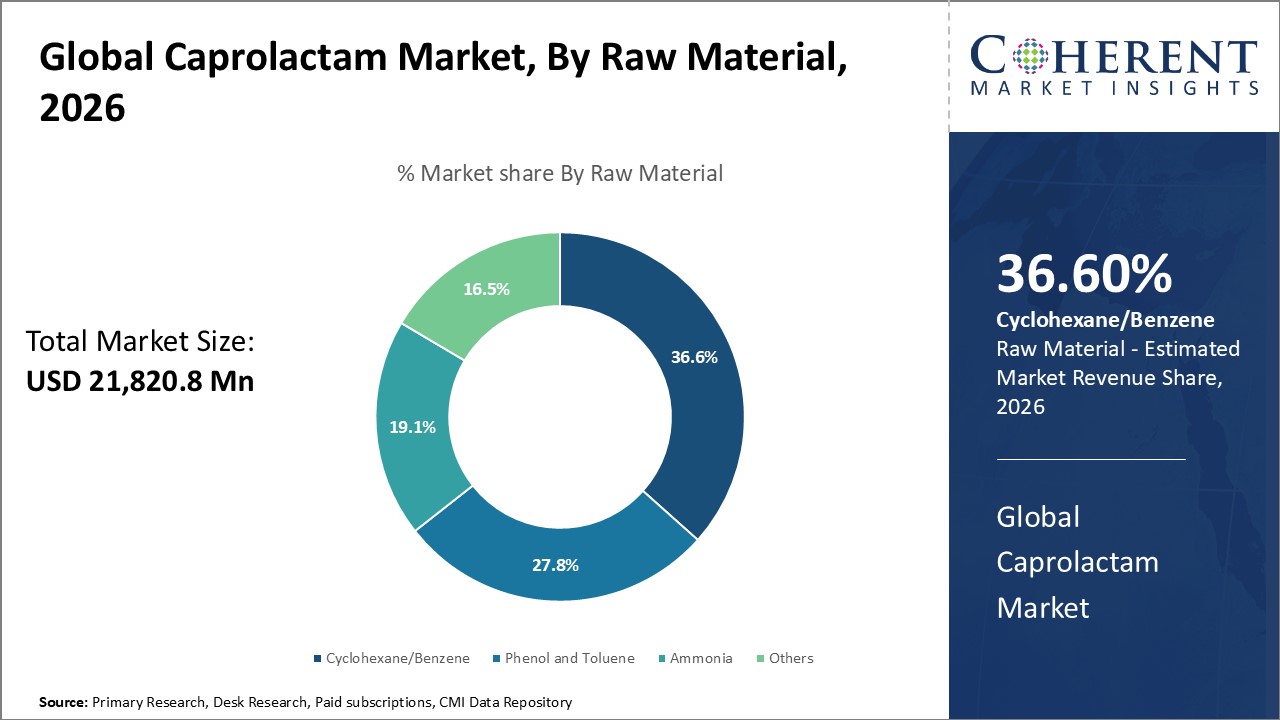
Caprolactam Market Insights, By Raw Material - Cyclohexane/Benzene Lead Caprolactam Production as Cost-Effective, Widely Available Feedstocks Essential for Nylon 6 Used in Textiles and Automotive Industries
In terms of raw material, the Cyclohexane/Benzene segment is leading the market with the largest share in 2026, due to their cost-efficiency, wide availability, and established industrial processes. These feedstocks are essential for producing nylon 6, which dominates downstream applications. Their dominance is reinforced by large-scale manufacturing facilities and consistent demand from textile and automotive sectors.
Regional Insights
Asia Pacific Caprolactam Market Analysis & Trends
Asia-Pacific region is leading the caprolactam market in 2026, with a 40% share due to rapid industrialization, a booming textile sector, and expanding infrastructure projects. Countries like China, India, and South Korea are major producers and consumers of nylon 6, which is derived from caprolactam. Nylon 6 fibers are widely used in garments, carpets, and industrial yarns, while nylon resins serve critical roles in automotive, electronics, and packaging applications. The region benefits from lower production costs, abundant raw materials, and growing investments in sustainable technologies such as bio-based caprolactam. These factors collectively contribute to the rising Caprolactam Market size and reinforce Asia-Pacific’s leadership in global consumption and manufacturing.
For instance, in September 2026, Samsara Eco launched its inaugural recycling facility for nylon 66 and polyester in Jerrabomberra, Australia. The plant uses enzymatic technology to break down synthetic polymers, marking a major step toward circularity in textiles and plastics. This innovation supports sustainable manufacturing and reduces reliance on virgin petrochemical feedstocks.
North America Caprolactam Market Analysis & Trends
North America is anticipated to be the fastest growing region during the forecast period. The growth is driven by advancements in automotive, packaging, and textile industries. The region's focus on lightweight and fuel-efficient vehicles has increased the use of nylon 6 resins, derived from caprolactam, in various automotive components. Additionally, the growing need for durable and recyclable packaging materials, along with expansion in technical textiles and industrial yarns, is fueling consumption. North America's commitment to sustainability and innovation, particularly in bio-based caprolactam production and closed-loop recycling technologies is further enhancing market growth, positioning the region as a key player in the global caprolactam landscape.
For instance, in May 2026, Unifi, the makers of REPREVE®, introduced FortiSyn™, a new inherently durable synthetic fiber designed for demanding applications. Engineered for strength and longevity, FortiSyn™ targets sectors like automotive, military, and outdoor gear. This innovation reinforces Unifi’s commitment to sustainable, high-performance textile solutions across global markets.
Caprolactam Market Outlook Country-Wise
China Caprolactam Market Trends
China stands as the largest consumer and producer in the Caprolactam Market, fueled by its expansive textile manufacturing and booming automotive sector. Nylon 6, derived from caprolactam, is widely used in fabrics, carpets, and vehicle components. China's industrial scale and investment in advanced polymer technologies continue to drive global market dominance.
For instance, in June 2026, China’s Lunan Chemical unveiled a major 300,000-ton caprolactam project, marking a significant expansion in the green coal-to-chemicals sector. The initiative supports sustainable nylon 6 production and reinforces China’s push toward cleaner industrial processes, boosting its role in the global Caprolactam Market.
Spain Caprolactam Market Trends
In 2026, Spain's demand in the Caprolactam Market is rising due to its strategic focus on high-performance polyamide production and sustainable industrial growth. Companies like UBE Corporation Europe, based in Castellón, are expanding their portfolios of nylon 6 solutions, which are derived from caprolactam. Spain’s robust automotive, textile, and packaging sectors increasingly rely on nylon 6 for lightweight, durable, and recyclable materials. Additionally, the country’s commitment to green chemistry and circular economy principles is driving innovation in bio-based caprolactam and advanced polymer technologies, reinforcing its role in the European caprolactam value chain.
For instance, in June 2026, UBE has launched the second lineup of its U-BE INFINITY brand products, enhancing its portfolio of high-performance polyamide solutions. Designed for demanding applications in automotive, electronics, and industrial sectors, the new offerings reinforce UBE’s commitment to innovation, sustainability, and advanced material science in the global nylon and caprolactam value chain.
Market Report Scope
Caprolactam Market Report Coverage
| Report Coverage | Details | ||
|---|---|---|---|
| Base Year: | 2025 | Market Size in 2026: | USD 21,820.8 Mn |
| Historical Data for: | 2020 To 2024 | Forecast Period: | 2026 To 2033 |
| Forecast Period 2026 to 2033 CAGR: | 6.8% | 2033 Value Projection: | USD 34,515.6 Mn |
| Geographies covered: |
| ||
| Segments covered: |
| ||
| Companies covered: | BASF SE, China Petroleum & Chemical Corporation, China Petrochemical Development Corporation, Honeywell International Inc., KuibyshevAzot OJSC, Royal DSM N.V., UBE Industries, SINOPEC among others. | ||
| Growth Drivers: |
| ||
| Restraints & Challenges: |
| ||
Caprolactam Market Driver
Wide Applications of Nylon 6 Fiber and Nylon Resin
The wide applications of nylon 6 fiber and nylon resin are key drivers of the Caprolactam Market size globally. Nylon 6 fiber is extensively used in textiles, carpets, industrial yarns, and apparel due to its strength, elasticity, and abrasion resistance. Meanwhile, nylon 6 resin finds critical applications in automotive components, electrical housings, consumer goods, and specialty packaging films, offering high thermal stability and chemical resistance.
These diverse end-use sectors ranging from fashion and infrastructure to electronics and transportation, create sustained demand for caprolactam, the primary feedstock for nylon 6. As industries prioritize lightweight, durable, and recyclable materials, the Caprolactam Market size continues to expand, especially in emerging economies where manufacturing and infrastructure are rapidly growing.
Caprolactam Market Opportunity
Exploring Innovation, Sustainability, and Global Demand Drivers
The Caprolactam Market is set to witness significant growth, fueled by the expanding use of nylon 6 fibers and resins across diverse industries. In textiles, carpets, and industrial yarns, nylon 6 offers durability and flexibility, while in automotive, electronics, and packaging, nylon resins provide strength and thermal resistance. Emerging trends such as bio-based production, circular economy models, and rising demand from Asia-Pacific and Latin America present lucrative avenues for innovation and investment. As industries seek sustainable and high-performance materials, the Caprolactam Market forecast indicates steady expansion in market size, supported by technological advancements and evolving consumer needs.
Analyst opinion (Expert Opinion)
The global caprolactam market currently manifests as a structurally fragmented commodity complex undergoing a strategic inflection point. Short-term dynamics are dominated by classical commodity forces (feedstock cost swings, capacity swings, and inventory management), but the medium-term strategic battleground will be defined by (a) where new capacity is sited, (b) which producers move up-value into specialty nylon and integrated downstream products, and (c) which players materially commercialize chemical circularity at scale. The consequence is that margin capture will increasingly favour well-integrated, flexible producers and those that can credibly supply differentiated, lower-carbon or circular monomers and polymers.
The market remains fragmented: the largest global producers do not control a dominant share of global capacity, with the top five players accounting for roughly a third of production capacity, a characteristic that leaves room for price competition and regional overhangs when new plants come online. This fragmentation rewards disciplined, asset-heavy players that combine feedstock integration (phenol/benzene/cyclohexanone access) with downstream nylon-6 conversion.
China’s ongoing capacity additions are the single most important supply-side variable for the global balance. New and expanding projects (including large integrated caprolactam–polyamide complexes) materially change regional availability and export dynamics; recent project announcements and plant start-ups in China demonstrate the scale and pace of incremental supply. When domestic Chinese output grows faster than domestic nylon-6 conversion, the region becomes an exporter that compresses global pricing power for non-integrated makers. This structural risk should be treated as a persistent headwind to spot pricing and to non-integrated plant utilization rates.
Speak to the analyst
Want personalized insights?
Take the findings above to one of our principal consultants, or have the report rebuilt around the segments, geographies and competitors you actually track.
Recent Development
- In September 2025, Perstorp completed a major upgrade of its caprolactone production facility in Warrington, UK, enhancing capacity and operational efficiency. The investment supports growing demand for high-performance polycaprolactone used in coatings, adhesives, and bioplastics. This move strengthens Perstorp’s position in sustainable polymer solutions and the broader caprolactam-derived chemical market.
- In April 2025, BASF launched its first factory dedicated to recycling waste nylon clothing, marking a major step toward circular fashion. The facility transforms discarded textiles into high-quality raw materials, including caprolactam for nylon 6 production. This innovation supports sustainable manufacturing and reduces environmental impact in the global textile and polymer industries.
- In January 2023, UBE Corporationhas decided to expand the polymide hollow fiber production facilities for gas separation membranes at its UBE chemical factory.
Market Segmentation
- Global Caprolactam Market, By Raw Material (Revenue, USD Mn, 2021 - 2033)
- Cyclohexane/Benzene
- Phenol and Toluene
- Ammonia
- Others
- Global Caprolactam Market, By Product Type (Revenue, USD Mn, 2021 - 2033)
- Nylon 6 Fibers
- Textile
- Carpet
- Industrial Yarn
- Others
- Nylon 6 resins and films
- Automotive Industry
- Specialty Film Packaging for Food
- Wire and Cables
- Others
- Polymer Chip
- Nylon 6 Fibers
- Global Caprolactam Market, By Geography (Revenue, USD Mn, 2021 - 2033)
- North America
- U.S.
- Canada
- Latin America
- Brazil
- Argentina
- Mexico
- Rest of Latin America
- Europe
- Germany
- U.K.
- Spain
- France
- Italy
- Russia
- Rest of Europe
- Asia Pacific
- China
- India
- Japan
- Australia
- South Korea
- ASEAN
- Rest of Asia Pacific
- Middle East & Africa
- GCC Countries
- Israel
- Rest of Middle East & Africa
- North America
- Key Player
- BASF SE
- China Petroleum & Chemical Corporation
- China Petrochemical Development Corporation
- Honeywell International Inc.
- KuibyshevAzot OJSC
- Royal DSM N.V.
- UBE Industries
- SINOPEC
Sources
Primary Research Interviews from the following stakeholders:
Stakeholders
- Interviews with caprolactam producers, nylon 6 manufacturers, polymer converters, textile manufacturers, packaging producers, automotive component suppliers, and procurement heads across leading global markets.
Specific stakeholders
- Raw material procurement managers at petrochemical companies
- Supply chain and operations managers at nylon 6 downstream users
- R&D and product development heads at textile and apparel manufacturers
- Procurement and engineering managers in automotive OEMs and Tier-1 suppliers
- Plant operations managers at specialty chemical and resin processing facilities
- Sustainability and compliance officers at packaging and engineering plastics producers
- Product managers at intermediate chemical suppliers
Databases
- World Trade Organization (WTO) Trade Statistics
- UN Comtrade Database
- Eurostat – Chemicals & Plastics Data
- China Customs Statistics
- Korea Customs Service Data Portal
- Japan External Trade Organization (JETRO) – Chemicals Trade Data
- Directorate General of Commercial Intelligence and Statistics (DGCIS), India
- U.S. Bureau of Economic Analysis (BEA)
- U.S. International Trade Commission (USITC) – Chemical Products Data
Magazines
- Chemical & Engineering News (C&EN)
- ICIS Chemical Business
- Plastics News
- Fibre2Fashion – Raw Materials & Nylon Segment
- Textile Today
- Modern Plastics India
- Automotive Plastics News
- Packaging Strategies
Journals
- Journal of Applied Polymer Science
- Polymer Degradation and Stability (Elsevier)
- Journal of Industrial & Engineering Chemistry
- Chemical Engineering Journal
- Journal of Textile Science & Engineering
- Journal of Cleaner Production (sustainability in chemicals)
- Materials Today: Proceedings
Newspapers
- The Wall Street Journal – Chemicals & Materials
- The Economic Times – Chemicals & Textiles
- Financial Times – Plastics and Energy Industry Coverage
- Nikkei Asia – Chemicals & Supply Chain
- South China Morning Post – Industry & Manufacturing
- The Hindu Business Line – Petrochemicals & Textiles
Associations
- European Chemical Industry Council (Cefic)
- American Chemistry Council (ACC)
- Association of Synthetic Fibre Industry (ASFI), India
- PlasticsEurope
- Society of Plastics Engineers (SPE)
- Confederation of Indian Textile Industry (CITI)
- Japan Chemical Industry Association (JCIA)
- International Textile Manufacturers Federation (ITMF)
Public Domain Sources
- Ministry of Chemicals and Fertilizers (Government of India)
- Ministry of Economy, Trade and Industry (METI), Japan
- European Chemicals Agency (ECHA)
- National Bureau of Statistics of China (NBS) – Petrochemicals & Fibers
- Reserve Bank of India (RBI) – Industry Data
- NITI Aayog – Petrochemicals & Manufacturing Reports
- EU Single Market Observatory – Chemicals and Plastics
- U.S. Environmental Protection Agency (EPA) – Chemical Regulation
Proprietary Elements
- CMI Data Analytics Tool, and Proprietary CMI Existing Repository of information for last 8 years
Get access to 250+ pages report
Every segment, forecast, competitor profile and data table behind the analysis above — available for instant download.
- ESOMAR Member
- ISO 9001:2015 Certified
- D-U-N-S Registered
- GDPR & CCPA Compliant
Missing comfort of reading report in your local language? Find your preferred language:
Transform your Strategy with Exclusive Trending Reports
Frequently Asked Questions
The Global Caprolactam Market is estimated to be valued at USD 21,820.8 Mn in 2026, and is expected to reach USD 34,515.6 Mn by 2033.
BASF SE, China Petroleum & Chemical Corporation, China Petrochemical Development Corporation, Honeywell International Inc., KuibyshevAzot OJSC, Royal DSM N.V., UBE Industries, SINOPEC among others.
Nylon 6 fiber accounted for highest demand in the market.
Nylon 6 fiber and nylon 6 resin have wide applications in automotive and textile industry due to their high tensile strength and superior elasticity. Automakers are focusing on light weighting of vehicles in order to improve fuel efficiency and performance.
The CAGR of the Global Caprolactam Market is projected to be 6.8% from 2026 to 2033.
Asia Pacific is expected to be the leading region of market