

Gumboro Disease Market Size and Share Analysis- Growth Trends and Forecasts (2026-2033)
The Gumboro Disease Market size is anticipated to grow at a CAGR of 8.1%, with USD 338.9 Mn in 2026, and is expected to reach USD 584.6 Mn in 2033. The primary drivers are largely defined by the growing commercial poultry population, increasing risk of infectious bursal disease outbreaks, rising adoption of preventive poultry vaccination programs, and wider use of advanced live, immune-complex, and recombinant/vector vaccines. Gumboro disease, also known as Infectious Bursal Disease (IBD), is a highly contagious viral disease primarily affecting young chickens and can cause significant immunosuppression, increasing the need for effective disease-prevention programs. According to the Merck Veterinary Manual, vaccination of breeder and broiler flocks is an important measure for preventing and controlling infectious bursal disease, thereby supporting sustained demand for Gumboro disease vaccines.
Key Takeaways
- The broilers segment is likely to dominate the Gumboro Disease Market with 68.0% in 2026. The segment’s growth is owing to the large commercial broiler population, short production cycles, routine Infectious Bursal Disease (IBD) vaccination, and the need to protect young birds from immunosuppression and secondary infections. According to the USDA Foreign Agricultural Service, April 9, 2026, chicken meat production in 2026 is forecast to reach 22.2 Mn metric tons in the U.S., 17.3 Mn metric tons in China, and 15.8 Mn metric tons in Brazil, indicating the substantial commercial broiler population requiring preventive disease management and vaccination.
- The conventional vaccines segment is set to lead the market with 54.0% in 2026. The segment growth is attributed to the established use of live attenuated and inactivated vaccines, high availability and cost effectiveness and their continued incorporation in commercial poultry vaccination programs. A study published on 12 November 2024 in the Journal of Veterinary Malaysia reported that broilers vaccinated with a conventional live attenuated IBD vaccine had a mean antibody titer of 4,775 at day 28, compared with 714.9 in controls.
- North America is expected to dominate the Gumboro Disease Market with approximately 39.5% share in 2026. The region’s dominance is supported by its large commercial poultry industry, established flock-health and vaccination programs, high veterinary expenditure, and strong presence of animal-health vaccine manufacturers. According to the U.S. Department of Agriculture Economic Research Service, June 25, 2025, U.S. poultry-sector sales reached USD 70.2 billion in 2024, of which broilers accounted for US$45.4 billion, representing the largest poultry category.
Market Drivers
Expanding Global Poultry Production is Enlarging the Addressable Market for Gumboro Disease Vaccination
The Gumboro Disease Market is driven by the continued growth of the commercial poultry production worldwide. More chickens, more intense chicken populations mean more birds need routine preventive vaccination for Infectious Bursal Disease (IBD) especially in broiler, layer and breeder operations.
According to the OECD-FAO Agricultural Outlook 2026–2035, published on June 29, 2026, global meat production reached 375 million tonnes in 2025, with poultry remaining the principal contributor to production growth.
Emergence of Novel and Highly Virulent IBDV Strains is Increasing the Need for Effective Vaccination
Another major driver of the Gumboro Disease Market is the continuous evolution of the Infectious Bursal Disease Virus. Novel variant and highly virulent strains of IBDV can cause significant bursal damage and immunosuppression and antigenic changes may further complicate the protection provided by current vaccination programs. This is prompting poultry producers and vaccine manufacturers to step up surveillance, and to look for vaccination strategies with wider strain coverage.
In March 2026, a study of circulating novel variant IBDV and very virulent IBDV strains in chickens was published in Virology Journal. The mortality of the highly virulent strain was 50%. Infection with the novel variant strain resulted in a 50–70% reduction in the bursa to body weight ratio compared with controls. This suggests considerable immunosuppressive damage, even in the absence of overt clinical signs.
Current Events and Their Impact on the Gumboro Disease Market
Current Event | Description and its Impact |
WOAH Updates Global Vaccine-Priority Framework and Recognizes Infectious Bursal Disease as a Key Poultry Disease (2026) |
|
European Union Implements New GMP Requirements for Veterinary Medicinal Products, Including Poultry Vaccines (July 2026) |
|
- Current Industry Events of 2026
- Market Size Estimation
- Regional Breakdown
- Competitive Landscape
- Customer Intelligence
- Segmental Analysis
- Pricing Analysis
- Key Market Drivers, Challenges & Future Trends
- Customized Insights Section
Segmental Insights
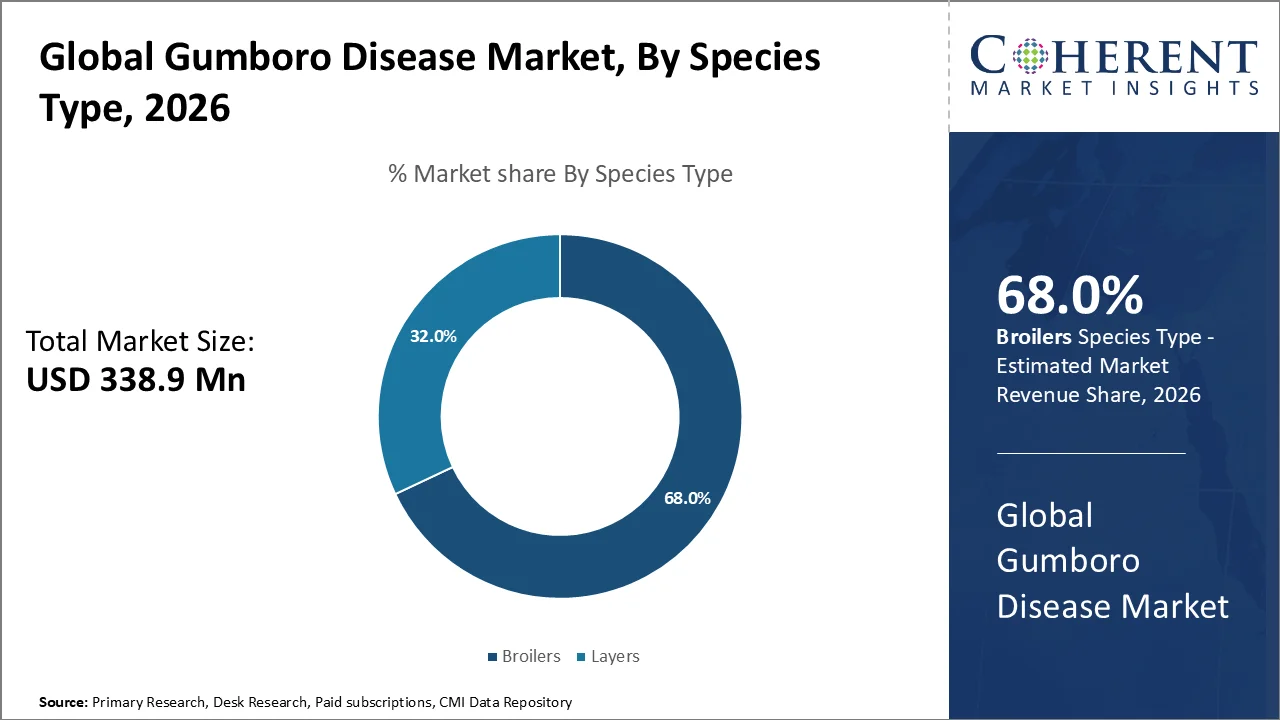
Why are Broilers Acquiring the Largest Share?
On the basis of species type, the broilers segment is projected to account for the largest Gumboro Disease Market share of 68.0% in 2026. The segment’s dominance is owing to the very large commercial broiler population, rapid flock turnover, intensive production systems, and routine requirement for Infectious Bursal Disease vaccination during the early stages of the production cycle.
According to the USDA National Agricultural Statistics Service, April 30, 2026, the U.S. produced 9.40 billion broilers in 2025, an increase of 1% from 2024, while total broiler live-weight production reached 62.2 billion pounds, up 2% year-on-year.
In August 2026, Merck Animal Health announced USDA approval of INNOVAX ND-IBD-ILT, a recombinant poultry vaccine designed to provide protection against Newcastle disease, Infectious Bursal Disease (Gumboro disease), infectious laryngotracheitis, and Marek’s disease through a single hatchery vaccination.
Why are Conventional Vaccines Acquiring the Largest Share?
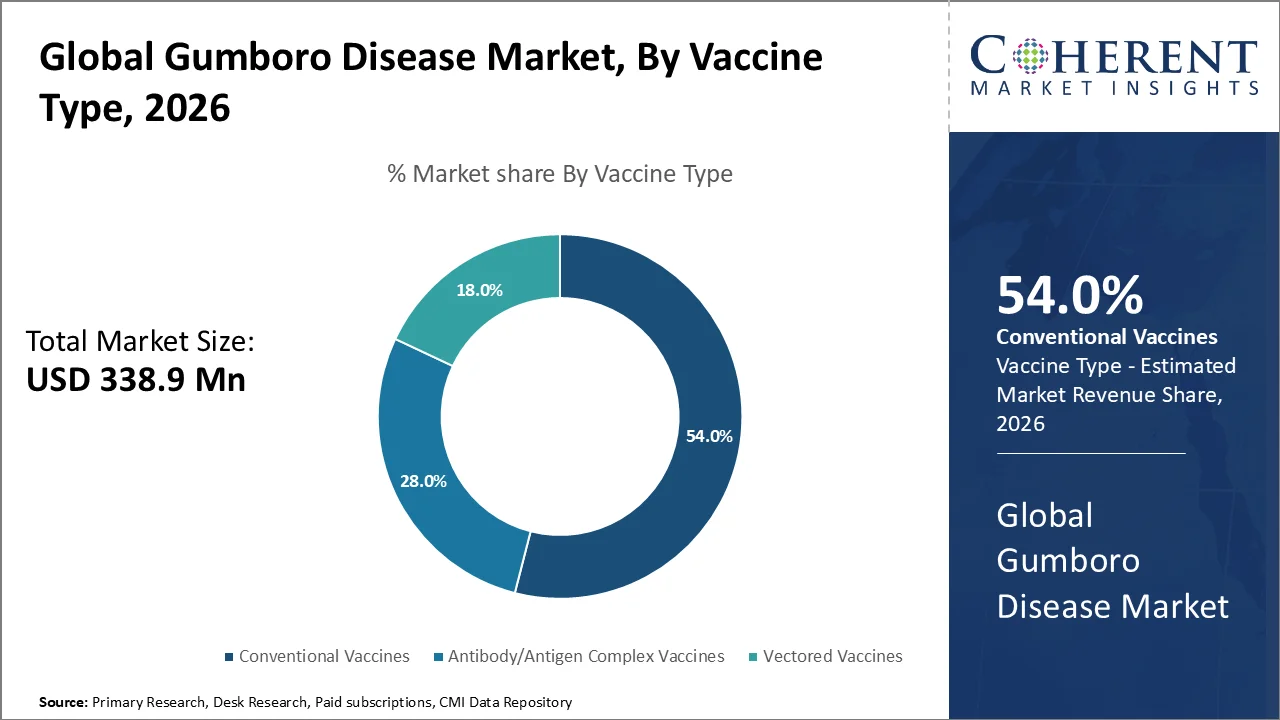
On the basis of vaccine type, the conventional vaccines segment is projected to account for the largest Gumboro Disease Market share of 54.0% in 2026. The segment’s dominance is owing to the established use of live-attenuated and inactivated IBD vaccines, extensive commercial availability, familiarity among poultry producers, and their integration into routine breeder and commercial flock immunization programs.
According to the May 2026 review in Frontiers in Immunology, the established approaches against IBDV are live-attenuated and inactivated vaccines. It notes that live IBD vaccines are available in mild, intermediate and hot/intermediate-plus categories and inactivated vaccines continue to be incorporated into structured poultry immunization programs, particularly for breeder and parent stock.
In July 2026, Zoetis highlighted the continued use of Bursine-2, a monovalent modified-live vaccine against Infectious Bursal Disease (Gumboro disease), as part of strategic poultry vaccination programs.
Gumboro Disease Market Trends
- The increasing genetic diversity and antigenic evolution of IBDV highlight the need for continuous molecular surveillance and updated vaccination strategies. In a 2026 study published in Viruses, researchers analyzed IBDV sequences obtained between 2015 and 2025 and found that multiple viral genotypes are still circulating and evolving.
- Emerging antigenically different strains of IBDV are driving vaccine manufacturers to develop more strain-matched vaccines that provide broader protection. The major driver of antigenic shift was the Q221K mutation in VP2, which highlights the critical necessity of frequent vaccine updates to keep pace with circulating variants.
- Development of next generation DNA and nanoparticle-based vaccines is an important emerging technology trend. Beyond traditional live and inactivated products, newer vaccine platforms hold promise. A VP2 DNA vaccine in lipid nanoparticles given to chickens conferred immune protection against a new variant of IBDV, according to a 2026 publication in Vaccines.
Regional Insights
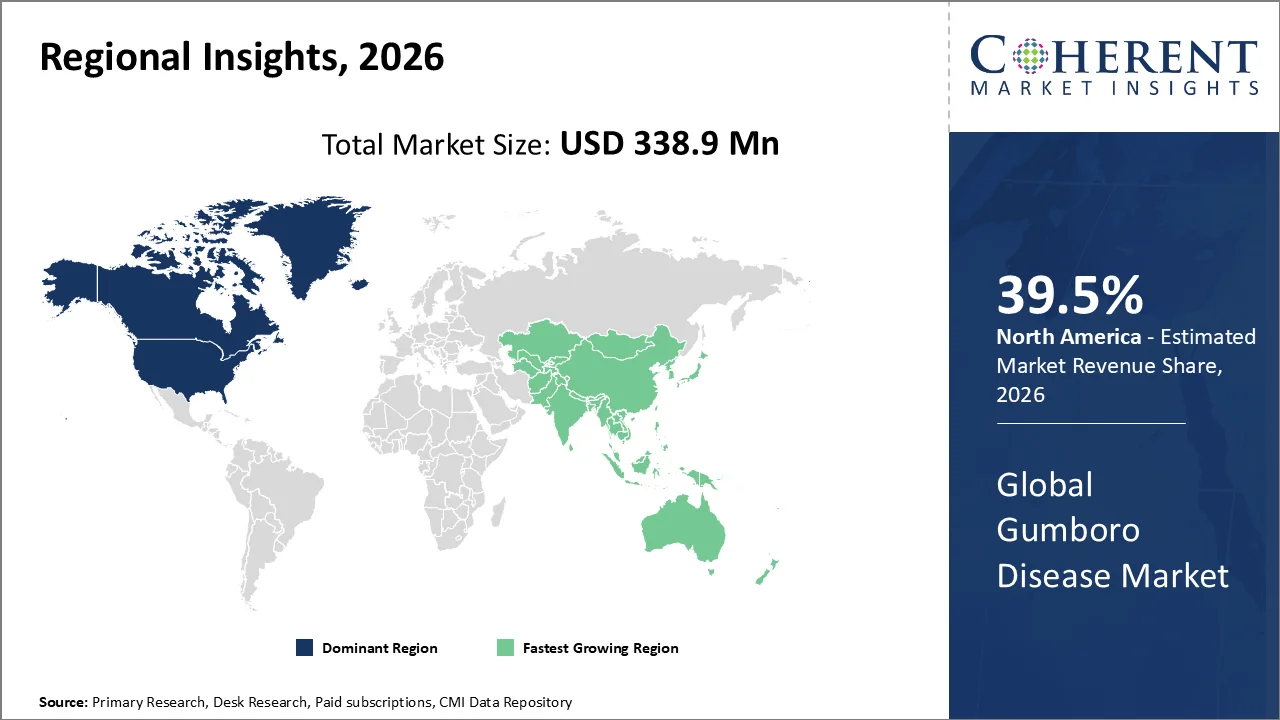
North America Dominates Owing to Established Commercial Poultry Production and Strong Preventive Vaccination Infrastructure
The North America region is expected to account for approximately 39.5% of the Gumboro Disease Market share in 2026. The region’s dominance is supported by large-scale commercial broiler production, highly organized hatchery operations, routine poultry vaccination programs, and the availability of advanced conventional, immune-complex, and recombinant IBD vaccines. Coherent Market Insights identifies North America as the major regional market for Gumboro disease.
According to Agriculture and Agri-Food Canada, updated May 11, 2026, Canada had 235 broiler hatching-egg producers that produced more than 921.7 million broiler hatching eggs in 2025. Canadian broiler hatcheries also placed 870.2 million chicks on chicken operations during 2025, demonstrating the substantial scale of the commercial poultry population requiring structured preventive health and vaccination programs.
Asia Pacific Gumboro Disease Market Trends
Asia Pacific is expected to be the fastest-growing region in the Gumboro Disease Market over the 2026–2033 forecast period. Growth is being supported by rapidly expanding commercial poultry production, increasing vaccination coverage, large broiler and layer populations, and continuing circulation of classical, very virulent, and novel variant IBDV strains, particularly across China, India, and Southeast Asia. This fastest-growth designation is a market-estimation inference based on the region's poultry expansion and disease burden rather than an officially reported regional CAGR.
India’s Department of Animal Husbandry & Dairying, Basic Animal Husbandry Statistics 2025 reported a 4.44% YoY increase in egg production in 2024-25 to 149.11 billion eggs. Commercial poultry accounted for 84.49% of total egg production. The growing commercial poultry base greatly increases the population of layer and breeder birds requiring preventative disease-management programs, including IBD vaccination.
In February 2025, Ceva Santé Animale showcased its new-generation NEXTMUNE Gumboro vaccine in India during the 6th India Poultry Innovation Summit, held in Jaipur on February 10–11, 2025.
Large Commercial Broiler Base and Active Poultry Vaccine Research are Supporting the Gumboro Disease Market in the United States
The U.S. Gumboro Disease Market is growing steadily due to the country’s large commercial broiler industry, a highly organized hatchery vaccination infrastructure, and continuing research for better protection against Infectious Bursal Disease (IBD). The high turnover of young chickens in commercial production systems creates a repeated need for preventive Gumboro vaccination, especially in the hatchery and early-life stages.
The USDA Agricultural Research Service is also conducting an active federal research project focused specifically on enhancing genetic resistance and vaccinal response to control Marek's disease, infectious laryngotracheitis, and infectious bursal disease in chickens.
China Gumboro Disease Market Trends
China is expected to witness strong growth in the Gumboro Disease Market over the forecast period. Growth is owing to rapid expansion of poultry production, a large commercial chicken population, continued circulation of IBDV, and the emergence of variant strains that increase the need for effective surveillance and vaccination programs.
In April 2026 Virology Journal study of commercial and backyard poultry in Shandong Province detected IBDV in 68 bursal samples. Of the newly sequenced viruses, 66 of 68 isolates belonged to the A3 genogroup associated with very virulent IBDV, while two belonged to the A2 variant group.
Who are the Major Companies in Gumboro Disease Industry
Some of the major key players in Gumboro Disease Market are Ceva, ROMVAC Company SA, PTSanbe Farma, Jiangyin Caina Technology co. limited, Cios Co., Salfarm Danmark A/s., Vetbiochem, and others.
Key News
- In February 24, 2025, Boehringer Ingelheim announced the launch of VAXXITEK HVT+IBD+H5, a new trivalent poultry vaccine providing single-shot protection against Gumboro disease (IBD), Marek’s disease, and H5 avian influenza.
- In May 2025, MSD Animal Health announced that the EMA's Committee for Veterinary Medicinal Products issued a positive opinion for INNOVAX ND-IBD-ILT. The single-dose HVT-vector vaccine targets IBD/Gumboro disease, Newcastle disease, infectious laryngotracheitis, and Marek's disease.
Market Report Scope
Gumboro Disease Market Report Coverage
| Report Coverage | Details | ||
|---|---|---|---|
| Base Year: | 2025 | Market Size in 2026: | USD 338.9 Mn |
| Historical Data for: | 2020 To 2024 | Forecast Period: | 2026 To 2033 |
| Forecast Period 2026 to 2033 CAGR: | 8.1% | 2033 Value Projection: | USD 584.6 Mn |
| Geographies covered: |
| ||
| Segments covered: |
| ||
| Companies covered: | Ceva, ROMVAC Company SA, PTSanbe Farma, Jiangyin Caina Technology co. limited, Cios Co., Salfarm Danmark A/s., Vetbiochem, and others. | ||
| Growth Drivers: |
| ||
| Restraints & Challenges: |
| ||
Analyst Opinion
- The Gumboro Disease Market is expected to benefit from increasing focus on rapid disease surveillance and early detection, especially as variant IBDV strains continue to circulate in commercial poultry populations. A June 10, 2026 study in the Japanese Journal of Veterinary Research developed an IBDV screening assay that can generate results in 90 minutes and has 440 fg as detection limit, about 100 times more sensitive than conventional RT-PCR.
- Next-generation recombinant vaccines are likely to change the competitive landscape, as producers are looking for more robust protection against novel IBDV variants, which may not be fully controlled by existing vaccines. On July 11, 2026, a study issued in Veterinary Research found that a new recombinant avian metapneumovirus-vectored vaccine candidate offered complete protection against novel variant IBDV in chickens.
- The market is also expected to grow increasingly in favor of multivalent poultry vaccines, which include Gumboro protection along with other major poultry diseases, thereby increasing hatchery efficiency and reducing the complexity of multiple vaccination procedures. The study published in the Journal of Virology in September 2025 showed that the recombinant rMDV-VP2-HA vaccine candidate provided full protection against very virulent IBDV, H9 avian influenza virus and very virulent Marek’s disease virus in the vaccinated chickens.
Speak to the analyst
Want personalized insights?
Take the findings above to one of our principal consultants, or have the report rebuilt around the segments, geographies and competitors you actually track.
Market Segmentation
- By Species Type (Revenue, USD Mn, 2021-2033)
- Broilers
- Layers
- By Vaccine Type (Revenue, USD Mn, 2021-2033)
- Conventional Vaccines
- Antibody/ Antigen Complex Vaccines
- Vectored Vaccines
- By Region (Revenue, USD Mn, 2021-2033)
- North America
- U.S.
- Canada
- Latin America
- Brazil
- Mexico
- Argentina
- Rest of Latin America
- Europe
- Germany
- U.K.
- France
- Italy
- Spain
- Russia
- Rest of Europe
- Asia Pacific
- China
- India
- Japan
- Australia
- South Korea
- ASEAN
- Rest of Asia Pacific
- Middle East
- GCC Countries
- Israel
- Rest of Middle East
- Africa
- South Africa
- Central Africa
- North Africa
- North America
Sources
Primary Research Interviews
- Poultry vaccine manufacturers and biologics developers
- Poultry veterinarians and animal health specialist
- Commercial broiler and layer farm operators
- Hatchery managers and poultry integrators
- Veterinary vaccine distributors and wholesalers
- Poultry diagnostic laboratory professionals
- Key opinion leaders (KOLs) in avian diseases and IBDV management
Databases
- World Organisation for Animal Health (WOAH)
- Food and Agriculture Organization (FAO/FAOSTAT)
- U.S. Department of Agriculture (USDA – NASS, FAS, ERS, ARS)
- European Medicines Agency (EMA/CVMP)
- Canadian Food Inspection Agency (CFIA)
- India Department of Animal Husbandry & Dairying (DAHD)
- National Bureau of Statistics of China
- OECD-FAO Agricultural Outlook
Magazines
- Poultry World
- WATT Poultry International
- Poultry News
- Poultry Health Today
- Feed & Additive Magazine
Journals
- Poultry Science
- Veterinary Research
- Virology Journal
- Frontiers in Veterinary Science
- Frontiers in Immunology
- Avian Diseases
- Vaccines
- Viruses
Newspapers / Business Media
- Reuters
- Bloomberg
- Financial Times
- The Economic Times
- Business Standard
Associations
- World Organisation for Animal Health (WOAH)
- World Veterinary Poultry Association (WVPA)
- American Association of Avian Pathologists (AAAP)
- World Poultry Science Association (WPSA)
- International Poultry Council (IPC)
- National Chicken Council (NCC)
Public Domain Sources
- Company annual reports and investor presentations
- Veterinary vaccine product catalogs and company websites
- Government poultry production and livestock statistics
- Veterinary vaccine regulatory approval databases
- Poultry disease surveillance and epidemiological reports
- University and veterinary research publications
- Patent databases such as WIPO, USPTO, and Google Patents
- Clinical and field studies related to Infectious Bursal Disease Virus (IBDV)
Proprietary Elements
- CMI Data Analytics Tool
- Proprietary CMI Existing Repository of Information for the Last 10 Years
Get access to 250+ pages report
Every segment, forecast, competitor profile and data table behind the analysis above — available for instant download.
- ESOMAR Member
- ISO 9001:2015 Certified
- D-U-N-S Registered
- GDPR & CCPA Compliant
Missing comfort of reading report in your local language? Find your preferred language:
Transform your Strategy with Exclusive Trending Reports
Frequently Asked Questions
The Gumboro Disease Market is expected to reach USD 584.6 Mn in 2033, compared with USD 338.9 Mn in 2026.
Major players covered in the Gumboro Disease Market include Ceva, ROMVAC Company SA, PT Sanbe Farma, Jiangyin Caina Technology Co. Limited, Cios Co., Salfarm Danmark A/S, Vetbiochem, and others.
The high vaccine development and manufacturing costs and the emergence of new and highly virulent IBDV strains are key challenges hampering market growth.
The market is primarily driven by increasing commercial poultry production and flock sizes, rising prevalence and genetic evolution of Infectious Bursal Disease Virus (IBDV), growing preventive vaccination, and demand for advanced IBD vaccines.
The Gumboro Disease Market is anticipated to grow at a CAGR of 8.1% between 2026 and 2033.
North America is expected to dominate the global Gumboro Disease Market with approximately 39.5% market share in 2026, supported by large-scale poultry production, established hatchery operations, and routine poultry vaccination programs.
Asia Pacific is expected to be the fastest-growing region during the forecast period, supported by expanding commercial poultry production, increasing vaccination coverage, and continued circulation of classical, very virulent, and novel variant IBDV strains.