

Healthcare Interoperability Solutions Market Size and Forecast – 2026 to 2033
The Healthcare Interoperability Solutions Market is estimated to be valued at USD 4.3 Bn in 2026 and is expected to reach USD 11.2 Bn by 2033, exhibiting a compound annual growth rate (CAGR) of 16.2% from 2026 to 2033.
Key Takeaways
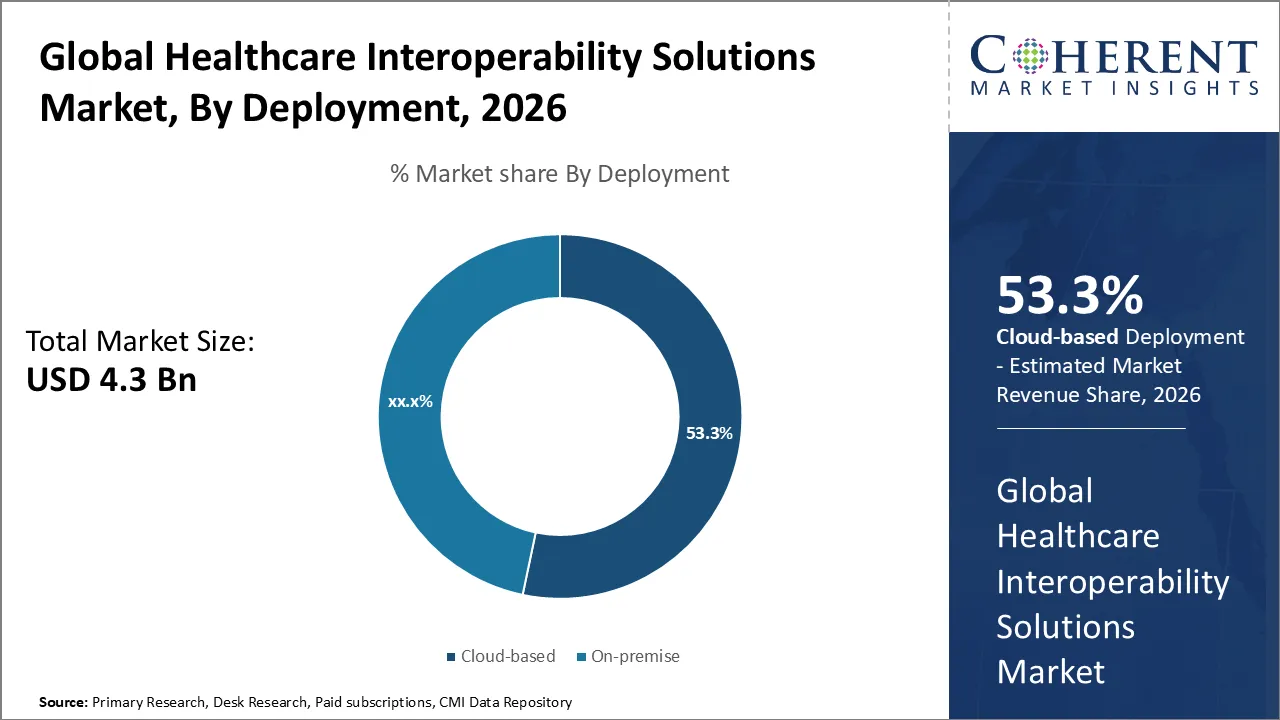
- By Deployment, Cloud-based hold the largest market share of 53.3% in 2026 owing to the real-time data access & seamless information exchange.
- By Level, Foundational expected to hold largest market share of 43.7% in 2026 owing to its need to digitize and connect legacy systems.
- By Type, Solution acquired the prominent market share of 53.8% in 2026 owing to the rising demand for integrated healthcare IT ecosystems.
- By End Use, Healthcare Providers captures the largest market share of 44.8% in 2026 owing to the need for better care coordination.
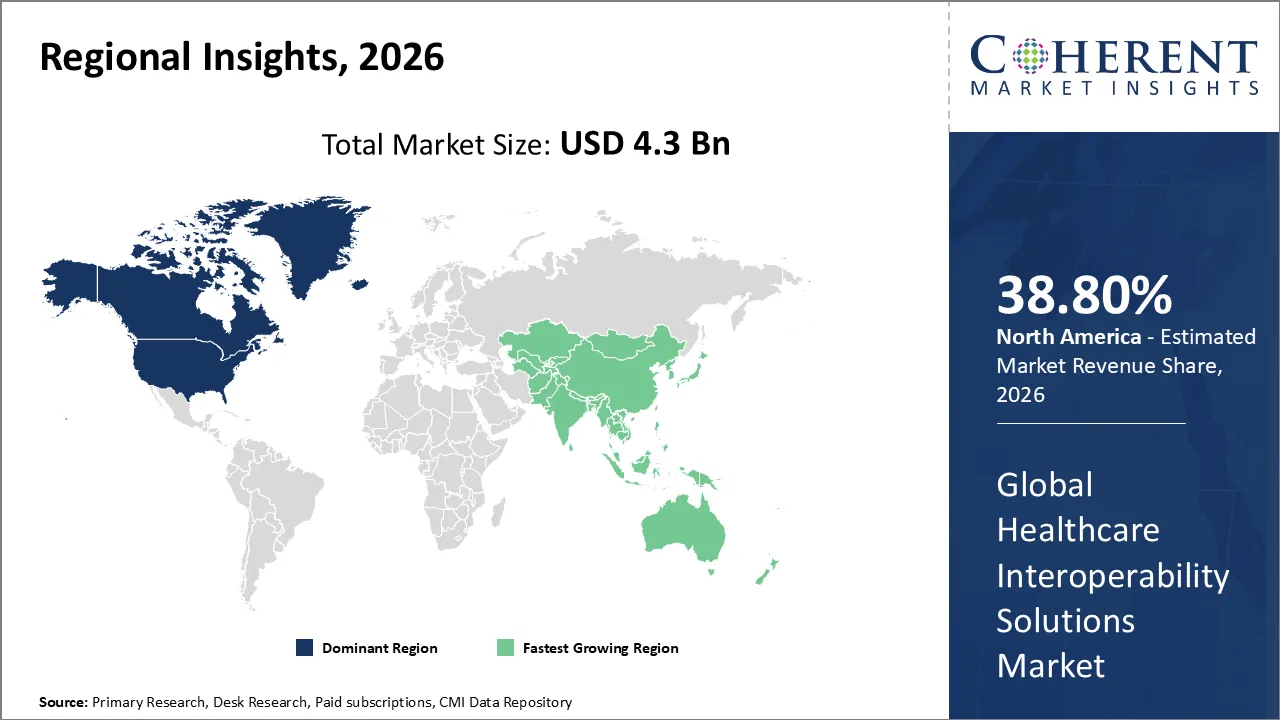
- By Region, North America dominates the overall market with an estimated share of 38.8% in 2026 owing to the strong regulatory framework and government initiatives.
Market Overview
Healthcare systems are steadily expanding the Healthcare Interoperability Solutions Market by prioritizing seamless data exchange across diverse platforms and stakeholders. They are driving growth through widespread adoption of electronic health records, evolving regulatory mandates, and the shift toward value-based care, while actively investing in solutions that improve care coordination and clinical efficiency. Organizations are accelerating integration efforts by adopting cloud-based technologies, health information exchanges, and standardized protocols. At the same time, rising data volumes, expanding telehealth, and a stronger focus on patient-centric care continue to boost demand for interoperable healthcare systems worldwide.
Current Events and their Impact on the Healthcare Interoperability Solutions Market
Current Events | Description and its impact |
Regulatory & Policy Developments |
|
Technological Innovations & Standardization Efforts |
|
Geopolitical and Regional Healthcare Initiatives |
|
Segmental Insights
- Current Industry Events of 2026
- Market Size Estimation
- Regional Breakdown
- Competitive Landscape
- Customer Intelligence
- Segmental Analysis
- Pricing Analysis
- Key Market Drivers, Challenges & Future Trends
- Customized Insights Section
Healthcare Interoperability Solutions Market Insights, By Deployment: Cloud-based contribute the highest share of the market owing to its demand for scalability and cost efficiency.
Cloud-based hold the largest market share of 53.3% in 2026. Healthcare organizations are driving growth in the Healthcare Interoperability Solutions Market by adopting cloud-based solutions that enable real-time access to patient data and seamless information exchange across systems. They use cloud platforms to reduce infrastructure costs, improve scalability, and support remote care delivery. The growing adoption of electronic health records, telehealth services, and connected devices is further accelerating demand. Additionally, providers leverage cloud technologies to meet data-sharing regulations and use advanced analytics to improve decision-making, care coordination, and overall operational efficiency. For instance, in December 2025, Trivitron Healthcare and ResoHealth launched Trivitron Digital.AI, a cloud-based venture to advance AI-enabled, interoperable Smart Hospitals and improve clinical data, efficiency, and digital access in India and emerging markets.
Healthcare Interoperability Solutions Market Insights, By Level: Foundational contribute the highest share of the market owing to its regulatory push for minimum data exchange.
Foundational expected to hold largest market share of 43.7% in 2026. Healthcare organizations are driving growth in the Healthcare Interoperability Solutions Market by using foundational interoperability to enable basic data exchange across fragmented systems. They adopt these solutions to connect legacy systems, share essential patient information, and support the expanding use of electronic health records. Regulatory requirements for minimum data-sharing capabilities further push adoption. Additionally, providers leverage foundational interoperability as a cost-effective approach to improve care coordination, handle rising data volumes, and build a foundation for more advanced and integrated interoperability levels. For instance, in November 2025, Greenlight Health Data Solutions launched the Greenlight Intelligent Health Data Platform, a unified, cloud-ready solution that provides easy EHR access and real-time data collection to support research, healthcare, and insurance insights.
Healthcare Interoperability Solutions Market Insights, By Type: Solution contributes the highest share of the market owing to its shift toward value-based and patient-centric care.
Solution acquired the prominent market share of 53.8% in 2026. Healthcare organizations are driving growth in the Healthcare Interoperability Solutions Market by adopting advanced software to integrate diverse systems and streamline data exchange. Providers invest in interoperability platforms to manage rising data volumes, support value-based care, and improve clinical decision-making. Regulatory requirements and the need for real-time information access further accelerate adoption. Additionally, organizations integrate cloud technologies, analytics, and artificial intelligence to manage data efficiently, enhance care coordination, and achieve better operational efficiency and improved patient outcomes. For instance, in August 2025, Healthmine and Tenasol partnered to deploy AI-driven, automated health actions targeting critical, time-sensitive Star measures.
Healthcare Interoperability Solutions Market Insights, By End Use: Healthcare Providers contribute the highest share of the market owing to its increasing patient volume and data complexity.
Healthcare Providers captures the largest market share of 44.8% in 2026. Healthcare providers are driving growth in the Healthcare Interoperability Solutions Market by actively seeking efficient data sharing and better care coordination across departments and facilities. They adopt interoperability solutions to connect electronic health records, support value-based care, and improve clinical decision-making. Rising patient volumes and increasing data complexity further accelerate adoption. Regulatory requirements and the expansion of telehealth also push providers to invest in interoperable systems that enhance operational efficiency, reduce costs, and deliver more patient-centric and integrated healthcare services.
Regional Insights
North America Healthcare Interoperability Solutions Market Trends
North America dominates the overall market with an estimated share of 38.80% in 2026. Healthcare organizations are driving strong trends in the North America Healthcare Interoperability Solutions Market by adopting advanced digital health technologies and complying with supportive regulations. They are increasingly implementing cloud-based platforms, AI-enabled tools, and FHIR-based standards to enhance real-time data exchange and care coordination. The region is also experiencing growing investments in health information exchanges and API-driven integration. Additionally, stakeholders are advancing value-based care, meeting rising demand for patient-centric services, and fostering continuous innovation to build a more connected and data-driven healthcare ecosystem. For instance, in October 2025, Humana and Providence launched a data exchange initiative using FHIR standards and APIs to enable secure, seamless interoperability and provide clinicians with timely, actionable insights.
Asia Pacific Healthcare Interoperability Solutions Market Trends
Healthcare organizations and governments are driving the evolution of the Asia Pacific Healthcare Interoperability Solutions Market by actively adopting digital health initiatives and standardizing data exchange across healthcare systems. Countries such as China, India, Japan, and Australia are investing in electronic health records and health information exchanges to enhance integrated care delivery and operational efficiency. Providers are increasingly using cloud platforms, telehealth services, and API-based integrations to ensure seamless data flow among hospitals, clinics, and payers, promoting more patient-centric and coordinated healthcare services. For instance, in May 2025, Synapxe launched HealthX Innovation Sandbox 2.0, giving HealthTech startups enhanced access to data and multi-cloud infrastructure to develop and test emerging healthcare technologies.
United States Healthcare Interoperability Solutions Market Trends
Healthcare organizations are shaping the United States Healthcare Interoperability Solutions Market by actively responding to government mandates and regulatory initiatives that promote open data access and secure health information exchange. They are implementing FHIR‑ and API‑based platforms to connect disparate electronic health records, labs, and payer systems, enhancing real-time data sharing. Providers are also integrating cloud technologies, analytics, and AI to support coordinated care, improve clinical decision-making, and meet growing demand for patient-centric services and greater operational efficiency. For instance, in August 2025, The Trump administration launched a digital health initiative to improve interoperability and give patients easier access to their health records through CMS frameworks and personalized tools.
China Healthcare Interoperability Solutions Market Trends
Healthcare providers and authorities are driving the China Healthcare Interoperability Solutions Market through government-led digitization and integration of health information systems. They are building centralized platforms to connect hospitals, clinics, insurers, and pharmacies for real-time patient data exchange. Providers are adopting standards and API-based integration to streamline fragmented IT infrastructures, while investments in electronic health records, telehealth, and cloud-enabled tools enhance coordinated care and operational efficiency across the healthcare ecosystem.
Healthcare Interoperability Solutions Market Trend
Rise of Cloud-Based Interoperability
Healthcare organizations are increasingly adopting cloud-based platforms to enable real-time data access and seamless exchange across hospitals, clinics, and remote care providers. Cloud solutions reduce infrastructure costs, improve scalability, and support integration with telehealth services and connected devices. Providers leverage cloud technologies to enhance operational efficiency, enable advanced analytics, and facilitate compliance with data-sharing regulations, driving faster implementation of interoperable healthcare ecosystems.
Adoption of Standardized Protocols (FHIR & HL7)
Healthcare systems are prioritizing standardized data exchange protocols such as FHIR and HL7 to improve interoperability between diverse electronic health record systems and third-party applications. These standards allow secure and consistent communication of patient data, supporting real-time clinical decision-making, cross-platform integration, and enhanced collaboration among providers, payers, and laboratories, ultimately creating more efficient and connected healthcare networks.
Healthcare Interoperability Solutions Market Opportunity
Integration of Advanced Technologies
There is growing opportunity to integrate AI, machine learning, and predictive analytics into interoperability platforms. Vendors can provide solutions that aggregate data from multiple sources to support clinical decision-making, population health management, and operational efficiency. Real-time insights derived from integrated systems enable providers to enhance patient outcomes, reduce errors, and implement proactive care models, positioning interoperability solutions as central to the modernization of healthcare IT infrastructure.
Market Report Scope
Healthcare Interoperability Solutions Market Report Coverage
| Report Coverage | Details | ||
|---|---|---|---|
| Base Year: | 2025 | Market Size in 2026: | USD 4.3 Bn |
| Historical Data for: | 2020 To 2024 | Forecast Period: | 2026 To 2033 |
| Forecast Period 2026 to 2033 CAGR: | 16.2% | 2033 Value Projection: | USD 11.2 Bn |
| Geographies covered: |
| ||
| Segments covered: |
| ||
| Companies covered: | Orion Health Group Limited, Virtusa Corporation, Jitterbit, Infor Inc., NextGen Healthcare Inc., EPIC Systems Corporation, Allscripts Healthcare LLC, Koninklijke Philips NV, IBM, and Oracle Corporation (Cerner Corporation), among others. | ||
| Growth Drivers: |
| ||
| Restraints & Challenges: |
| ||
Healthcare Interoperability Solutions Market News
- In September 2025, Concord Technologies launched Concord Connect Ignition Program to help healthcare organizations shift from manual document handling to AI-driven, straight-through processing in a unified workflow.
- In February 2025, The World Economic Forum launched the India Digital Health Activator to boost digital health adoption and interoperability through regional hubs and public-private collaboration.
Analyst Opinion (Expert Opinion)
- The Healthcare Interoperability Solutions market is at a critical inflection point where rhetoric about seamless data exchange is finally meeting measurable adoption and tangible clinical impact. Notably, nearly 70% of U.S. hospitals now leverage standardized FHIR‑based APIs for data exchange, demonstrating a clear shift from siloed messaging toward real‑time, standards‑driven integration that underpins operational workflows and analytics capabilities rather than merely satisfying compliance mandates.
- This trend is reinforced by the emergence of modular, API‑centric platforms that unify disparate EHRs, diagnostic systems, and administrative systems into a cohesive data fabric. Institutions processing tens of millions of standardized clinical documents monthly underscore that interoperability is no longer a theoretical construct but the backbone of coordinated care delivery and efficient resource utilization.
- However, notable implementation heterogeneity persists. Large integrated delivery networks and dominant EHR vendors often achieve seamless internal interoperability, while smaller systems struggle with legacy HL7 v2 infrastructures that were never designed for modern API interactions. This dichotomy highlights that the market is not just about deploying technology but resolving deep‑seated architectural and governance challenges. The transition to interoperable operations, therefore, remains as much an organizational transformation as a technology adoption exercise—one that materially impacts clinical outcomes and physician productivity.
Speak to the analyst
Want personalized insights?
Take the findings above to one of our principal consultants, or have the report rebuilt around the segments, geographies and competitors you actually track.
Market Segmentation
- By Deployment
- Cloud-based
- On-premise
- By Level
- Foundational
- Structural
- Semantic
- By Type
- Solution
- Services
- By End Use
- Healthcare Providers
- Healthcare Payers
- Pharmacies
- By Region
- North America
- U.S.
- Canada
- Latin America
- Brazil
- Argentina
- Mexico
- Rest of Latin America
- Europe
- Germany
- U.K.
- Spain
- France
- Italy
- Russia
- Rest of Europe
- Asia Pacific
- China
- India
- Japan
- Australia
- South Korea
- ASEAN
- Rest of Asia Pacific
- Middle East
- GCC Countries
- Israel
- Rest of Middle East
- Africa
- South Africa
- North Africa
- Central Africa
- North America
- Key Players
- Orion Health Group Limited
- Virtusa Corporation
- Jitterbit
- Infor Inc.
- NextGen Healthcare Inc.
- EPIC Systems Corporation
- Allscripts Healthcare LLC
- Koninklijke Philips NV
- IBM
- Oracle Corporation (Cerner Corporation)
Sources
Primary Research interviews
- Interviews with hospital IT managers, CIOs, and healthcare administrators
- Discussions with health information exchange (HIE) coordinators
- Consultations with electronic health record (EHR) software developers
- Interviews with regulatory compliance officers in healthcare organizations
Databases
- PubMed
- ClinicalTrials.gov
- World Health Organization (WHO) Global Health Observatory
- Centers for Disease Control and Prevention (CDC) Data & Statistics
- National Institutes of Health (NIH) Research Portfolio
Magazines
- Healthcare IT News
- Modern Healthcare
- Health Management Technology
- MedTech Insight
Journals
- Journal of the American Medical Informatics Association (JAMIA)
- International Journal of Medical Informatics
- Health Informatics Journal
- BMC Medical Informatics and Decision Making
Newspapers
- The New York Times – Health Section
- The Washington Post – Health Section
- The Guardian – Healthcare Coverage
Associations
- Healthcare Information and Management Systems Society (HIMSS)
- American Medical Association (AMA)
- American Health Information Management Association (AHIMA)
- International Society for Telemedicine & eHealth (ISfTeH)
Public Domain sources
- U.S. Food and Drug Administration (FDA) public reports
- Open Government Data (data.gov) – Health datasets
- World Bank Health Statistics
- Centers for Medicare & Medicaid Services (CMS) public datasets
Proprietary Elements
- CMI Data Analytics Tool
- Proprietary CMI Existing Repository of information for last 8 years
Get access to 250+ pages report
Every segment, forecast, competitor profile and data table behind the analysis above — available for instant download.
- ESOMAR Member
- ISO 9001:2015 Certified
- D-U-N-S Registered
- GDPR & CCPA Compliant
Missing comfort of reading report in your local language? Find your preferred language:
Transform your Strategy with Exclusive Trending Reports
Frequently Asked Questions
The Healthcare Interoperability Solutions Market is estimated to be valued at USD 4.3 Bn in 2026 and is expected to reach USD 11.2 Bn by 2033.
Increasing implementation of Healthcare IT solutions worldwide and funding by government and non-government organizations is fueling growth of the market.
The cloud-based segment is the leading deployment segment in the market.
Lack of interoperability solutions and shortage of skilled healthcare IT professionals are major factors restraining growth of the market.
Major players operating in the market are Orion Health Group Limited, Virtusa Corporation, Jitterbit, Infor Inc., NextGen Healthcare Inc., EPIC Systems Corporation, Allscripts Healthcare LLC, Koninklijke Philips NV, IBM, and Oracle Corporation (Cerner Corporation), among others.