

High Potency Active Pharmaceutical Ingredients Market Size and Trends Forecast – 2026 - 2033
The high potency active pharmaceutical ingredients market is estimated to be valued at USD 39.50 Bn in 2026 and is expected to reach USD 79.95 Bn by 2033, exhibiting a compound annual growth rate (CAGR) of 10.6% from 2026 to 2033.
Key Takeaways of the High Potency Active Pharmaceutical Ingredients Market
- Based on molecule type, the innovative segment is expected to contribute the highest share of the market with 63.5 % in 2026.
- North America is expected to be the largest market for high potency active pharmaceutical ingredients during the forecast period, accounting for over 35.0 % share in 2026.
- Asia Pacific is expected to be the fastest-growing market for high potency active pharmaceutical ingredients, which is expected to exhibit at a CAGR of over 10.0 % during the forecast period.
Market Overview
Global high potency active pharmaceutical ingredients market is expected to grow rapidly over the forecast period driven by the growing demand for oncology and hormonal therapies. Biologics and large molecule drugs will contribute significantly to the market growth. New product innovations and development of antibody drug conjugates targeting specific diseases will open up opportunities in this market.
However, stringent quality regulations imposed by regulatory authorities and supply chain complications related to hazardous nature of high potency active pharmaceutical ingredients (HPAPIs) are likely to restrain market growth.
Current Events and Its Impact
Current Events | Description and its impact |
Geopolitical Trade Policies |
|
Supply Chain Resilience Initiatives |
|
Market Trends
Rising Global Incidence of Cancer
The rising global incidence of cancer is a primary driver for the high potency active pharmaceutical ingredients market, as escalating cancer rates directly amplify demand for targeted oncology therapies reliant on these potent compounds. This growth is fueled by aging populations, lifestyle risk factors (e.g., tobacco, obesity), and environmental exposures, with cancers like breast, lung, and colorectal dominating diagnoses.
For instance, according to an article published by the World Health Organization (WHO), in February 2024, over 35 million new cancer cases are predicted in 2050, a 77% increase from the estimated 20 million cases in 2022. The rapidly growing global cancer burden reflects both population ageing and growth, as well as changes to people’s exposure to risk factors, several of which are associated with socioeconomic development.
- Current Industry Events of 2026
- Market Size Estimation
- Regional Breakdown
- Competitive Landscape
- Customer Intelligence
- Segmental Analysis
- Pricing Analysis
- Key Market Drivers, Challenges & Future Trends
- Customized Insights Section
Segmental Insights
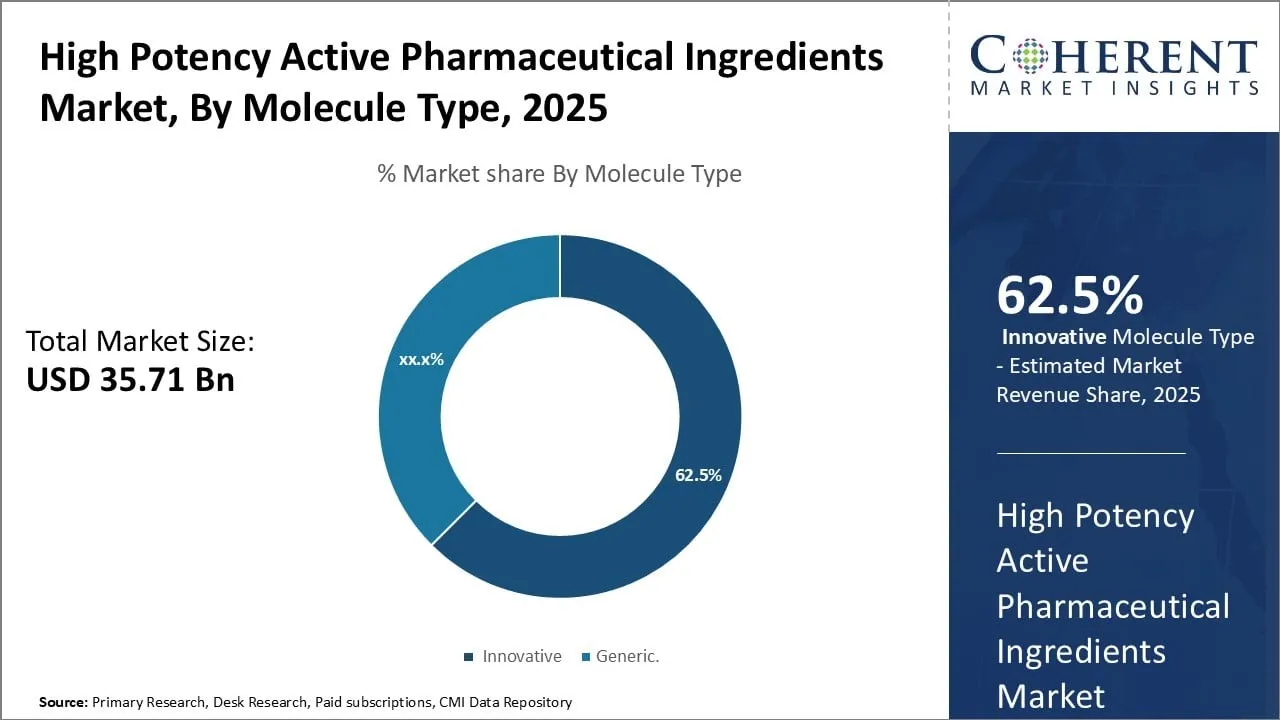
High Potency Active Pharmaceutical Ingredients Market Insights, by Molecule Type: Innovative Sub-Segment Dominates Due to Rising Demand for Targeted Oncology Treatments
Based on molecule type, the innovative segment is expected to contribute the highest share of the market with 63.5% in 2026, owing to the rising demand for targeted oncology treatments, particularly antibody-drug conjugates (ADCs) and next-generation small molecules.
These therapies require high-potency APIs to achieve therapeutic efficacy at low dosages with minimal off-target effects. As pharmaceutical companies increasingly shift toward precision medicine and biologic-drug combinations, the demand for custom, high-potency, and novel active ingredients is accelerating.
Emerging Innovations in the High Potency Active Pharmaceutical Ingredients Market
- Nanotechnology-Based Delivery Systems
- Nanotechnology-based delivery systems have emerged as a transformative innovation in this space. Utilizing nanoparticles, liposomes, and polymeric carriers allows HPAPIs to be delivered more precisely to target tissues. This targeted approach not only enhances drug efficacy but also reduces systemic toxicity, which is a critical concern for highly potent compounds.
- Controlled-Release Formulations
- Advancements in controlled-release formulations are gaining traction. These systems release the HPAPI at a controlled rate, improving patient compliance by reducing dosing frequency and minimizing peak-related side effects.
- Use of Antibody-Drug Conjugates (ADCs)
- The development is the use of antibody-drug conjugates (ADCs), which couple HPAPIs with monoclonal antibodies. This technology enables selective delivery of potent cytotoxic agents directly to cancer cells, sparing healthy tissues. The rise in ADC pipeline candidates and approved products underscores the growing importance of HPAPI technology in oncology.
Impact of AI on the High Potency Active Pharmaceutical Ingredients Market
Artificial Intelligence (AI) is rapidly transforming the pharmaceutical industry, and the high potency active pharmaceutical ingredients market is no exception. HPAPIs, used in treatments such as oncology and hormonal therapies, require meticulous handling and precise formulation due to their potent nature.
- BASF, a chemical giant with a growing footprint in pharmaceutical intermediates and HPAPIs, recently launched an AI-powered platform focused on real-time monitoring and quality control of potent drug substances. Their AI solution utilizes machine vision and data analytics to detect impurities and variances at the microscopic level during production. This innovation ensures higher purity levels and consistency, directly benefiting pharmaceutical companies and patients through increased drug efficacy and safety.
- Recipharm, a contract development and manufacturing organization (CDMO), which employs AI-driven simulations to optimize the encapsulation and delivery mechanisms of HPAPIs. By leveraging machine learning to analyze formulation parameters, Recipharm has improved the predictability of HPAPI stability and bioavailability in oral dosage forms. This advancement reduces costly trial-and-error cycles and accelerates time-to-market for life-saving drugs.
Regional Insights
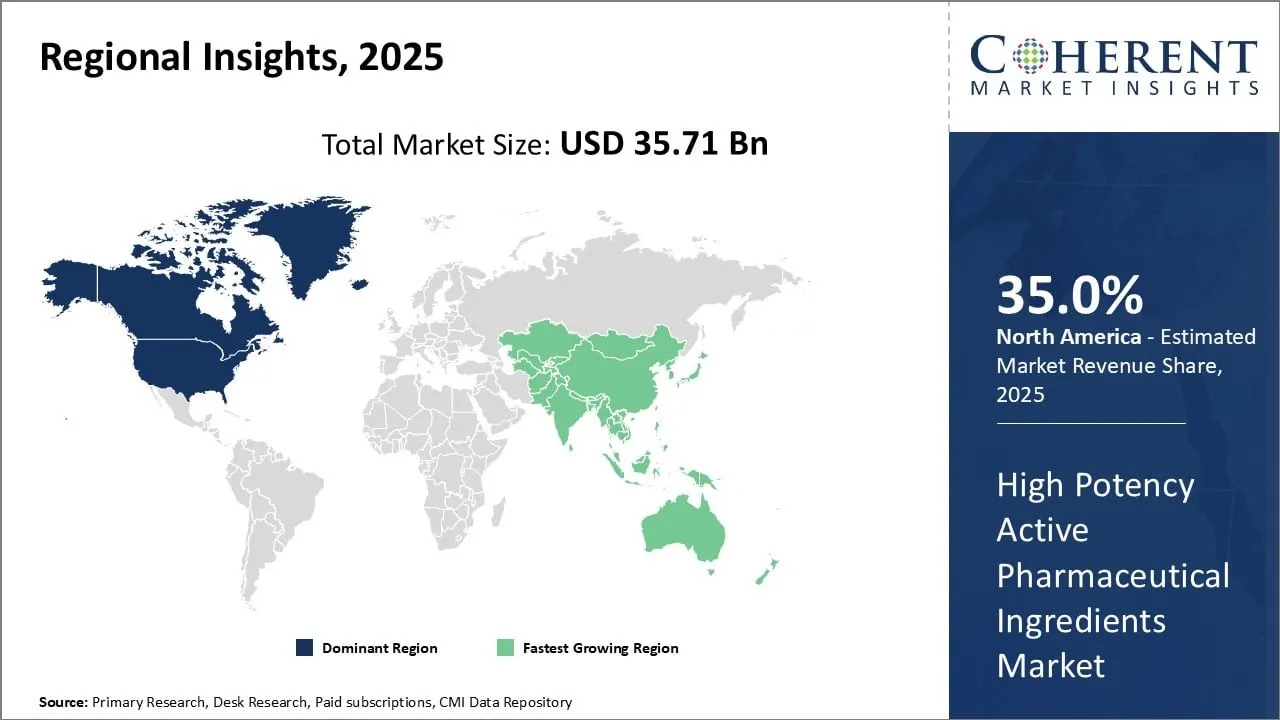
North America High Potency Active Pharmaceutical Ingredients Market Analysis and Trends
North America is expected to be the largest market for high potency active pharmaceutical ingredients during the forecast period, accounting for over 35.0% of the market share in 2026. The market is driven by factors such as increasing research and development (R&D) investments by pharmaceutical companies, development of novel drug molecules, and rising demand for highly effective therapeutic drugs.
For instance, in April 2026, Novartis, a leading global innovative medicines company, announced a planned USD 23 billion investment over 5 years in U.S.-based infrastructure, ensuring all key Novartis medicines for U.S. patients will be made in the U.S. This commitment enables Novartis to expand on its current manufacturing, research and technology presence across the country with 10 facilities, including 7 brand new facilities, creating nearly 1,000 new jobs at Novartis and approximately 4,000 additional U.S. jobs.
Asia Pacific High Potency Active Pharmaceutical Ingredients Market Analysis and Trends
Asia Pacific is expected to be the fastest-growing market for high potency active pharmaceutical ingredients, which is expected to grow at a CAGR of over 10.0% during the forecast period. The Asia Pacific high potency active pharmaceutical ingredients market is witnessing significant growth due to rising demand for oncology and anti-inflammatory drugs.
For instance, China’s "Made in China 2026" biomedical strategy catalyzes innovation, with companies like BeiGene advancing ADC platforms for precision oncology. This national initiative fosters R&D incentives, regulatory reforms, and local manufacturing capacity, accelerating the domestic development of high-potency, innovative therapies.
U.S. High Potency Active Pharmaceutical Ingredients Market Analysis and Trends
The U.S. remains a dominant driver of the market, fueled by strong oncology drug pipelines, substantial biotech investment, and a robust network of CDMOs and CMO partners specializing in high-containment manufacturing. The Food and Drug Administration (FDA) streamlined approval pathways for targeted therapies, including ADCs and immuno-oncology drugs, further incentivize demand for innovative HPAPIs.
The American Cancer Society estimated that in 2026, 2,041,910 new cancer cases and 618,120 cancer deaths are projected to occur in the U.S. The cancer mortality rate continued to decline through 2022, averting nearly 4.5 million deaths since 1991 because of smoking reductions, earlier detection for some cancers, and improved treatment.
Germany High Potency Active Pharmaceutical Ingredients Market Analysis and Trends
Germany plays a pivotal role in Europe’s HPAPI landscape, thanks to its advanced pharmaceutical manufacturing infrastructure, high containment technologies, and strong presence of global CDMOs such as Evonik and Siegfried. Government support for high-value biologics and small molecule research, along with the country’s leadership in oncology and rare disease drug development, is driving demand for both innovative and generic HPAPIs.
India High Potency Active Pharmaceutical Ingredients Market Analysis and Trends
India is emerging as a major supplier of HPAPIs, especially in the generic and off-patent segment, supported by cost-effective manufacturing capabilities and increasing investments in containment technologies. Indian pharma players are upgrading facilities to meet EU and U.S. regulatory requirements, aiming to become global partners in HPAPI outsourcing. Government initiatives under "Pharma Vision 2020" and the PLI scheme are also boosting domestic production of complex APIs, reducing import dependence and enhancing export competitiveness in high-potency drug ingredients.
Pricing Analysis of the High Potency Active Pharmaceutical Ingredients Market
- Pricing by Therapeutic Category
- Oncology drugs: Highest pricing tier (USD 25,000 - USD 500,000/kg) due to complex synthesis, monoclonal antibodies, and ADC components. Examples include Pfizer's antibody-drug conjugates and Roche's targeted therapies.
- Hormonal therapies: Mid-range pricing (USD 15,000 - USD 100,000/kg) including contraceptives and endocrine disorder treatments from companies like Merck & Co.
- Immunosuppressants: Premium pricing (USD 20,000 - USD 150,000/kg) for autoimmune disease treatments from AbbVie and Bristol Myers Squibb
Market Report Scope
High Potency Active Pharmaceutical Ingredients Market Report Coverage
| Report Coverage | Details | ||
|---|---|---|---|
| Base Year: | 2025 | Market Size in 2026: | USD 39.50 Bn |
| Historical Data for: | 2020 To 2024 | Forecast Period: | 2026 To 2033 |
| Forecast Period 2026 to 2033 CAGR: | 10.6% | 2033 Value Projection: | USD 79.95 Bn |
| Geographies covered: |
| ||
| Segments covered: |
| ||
| Companies covered: | Lonza, Novartis International AG, BASF AG, SEQENS, Carbogen Amcis AG, Eli Lilly and Company, Teva Pharmaceutical Industries Ltd, Bristol-Myers Squibb, Pfizer Inc., Roche Diagnostics, Boehringer Ingelheim, Merck & Co, Bayer AG, Ajinomoto Bio-Pharma Services, Cambrex Corporation, Minakem, and Sanofi Aventis | ||
| Growth Drivers: |
| ||
| Restraints & Challenges: |
| ||
High Potency Active Pharmaceutical Ingredients Industry News
- In May 2025, Lonza, one of the world’s largest contract development and manufacturing organizations (CDMOs), announced the launch of its new Design2Optimize platform to enhance process development and manufacturing of small molecule APIs. The platform is based on an optimized design of experiments (DoE), a statistical approach to process and reaction condition optimization.
- In June 2025, BASF opened its new Good Manufacturing Practice (GMP) Solution Center, in Wyandotte, Michigan. This investment underscores the ongoing commitment of BASF to providing innovative solutions in the biopharma and pharmaceutical ingredients industries, including the reliable supply of bioprocessing ingredients and excipients for biopharma applications as well as small molecules.
- In February 2025, in the largest investment into US pharmaceutical manufacturing to date, Eli Lilly will expand its domestic medicine manufacturing capabilities with four new production sites. Through this expansion, Eli Lilly will create more than 3,000 skilled roles for workers across the U.S., with engineering, scientist, operations and lab technician positions all required.
- In May 2025, Teva Pharmaceutical Industries Ltd., is hosted a 2025 innovation & strategy day, to launch the acceleration phase of its “Pivot to Growth” strategy and to discuss portfolio priorities as it evolves into a global biopharmaceutical leader.
Analyst View
- The high potency active pharmaceutical ingredients market growth is primarily driven by escalating global demand for targeted therapies, particularly in oncology, where antibody-drug conjugates and cytotoxic treatments necessitate highly potent ingredients for effective disease targeting. Increasing prevalence of chronic conditions like cancer and hormonal disorders further accelerates adoption, as precision medicine approaches gain traction across therapeutic areas.
- However, significant capital requirements for specialized containment facilities and complex synthesis processes create substantial entry barriers, constraining market expansion. Regulatory hurdles also intensify operational challenges, demanding stringent compliance throughout manufacturing.
- North America maintains dominance in this sector, leveraging advanced biopharmaceutical infrastructure and robust CDMO networks to support complex HPAPI production. Meanwhile, Asia Pacific emerges as the fastest-growing region, fueled by expanding pharmaceutical outsourcing capabilities and rising investments in high-containment manufacturing technologies.
- Continued innovation in synthetic manufacturing techniques offers additional pathways for scalability and efficiency gains across the market. The convergence of therapeutic advancements and manufacturing innovations positions HPAPI capabilities as increasingly central to next-generation drug development pipelines.
Speak to the analyst
Want personalized insights?
Take the findings above to one of our principal consultants, or have the report rebuilt around the segments, geographies and competitors you actually track.
Market Segmentation
- By Molecule Type (Revenue, USD Bn, 2021 - 2033)
- Innovative
- Generic
- By Production Technology (Revenue, USD Bn, 2021 - 2033)
- Chemical Synthesis
- Biotechnology
- By Application (Revenue, USD Bn, 2021 - 2033)
- Oncology
- Hormonal
- Glaucoma
- Others
- By Region (Revenue, USD Bn, 2021 - 2033)
- North America
- U.S.
- Canada
- Latin America
- Brazil
- Argentina
- Mexico
- Rest of Latin America
- Europe
- Germany
- U.K.
- Spain
- France
- Italy
- Russia
- Rest of Europe
- Asia Pacific
- China
- India
- Japan
- Australia
- South Korea
- ASEAN
- Rest of Asia Pacific
- Middle East
- GCC Countries
- Israel
- Rest of Middle East
- Africa
- South Africa
- North Africa
- Central Africa
- North America
- Key Players Insights
- Lonza
- Novartis International AG
- BASF AG
- SEQENS
- Carbogen Amcis AG
- Eli Lilly and Company
- Teva Pharmaceutical Industries Ltd
- Bristol-Myers Squibb
- Pfizer Inc.
- Roche Diagnostics
- Boehringer Ingelheim
- Merck & Co
- Bayer AG
- Ajinomoto Bio-Pharma Services
- Cambrex Corporation
- Minakem
- Sanofi Aventis
Sources
Primary Research Interviews
- Representatives from leading pharmaceutical companies (e.g., Pfizer, Novartis)
- API manufacturing specialists
- regulatory affairs experts
- research scientists in drug development
- Others
Magazines
- Pharmaceutical Technology
- Pharmaceutical Processing World
- Chemical & Engineering News (C&EN)
- Others
Journals
- Journal of Pharmaceutical Sciences
- International Journal of Pharmaceutics
- Journal of Medicinal Chemistry
- Others
Newspapers
- Financial Times (Pharma coverage)
- The Wall Street Journal (Healthcare section)
- STAT News (health-focused)
- Others
Associations
- International Society for Pharmaceutical Engineering (ISPE)
- Pharmaceutical Research and Manufacturers of America (PhRMA)
- European Federation of Pharmaceutical Industries (EFPIA)
- Others
Public Domain Sources
- U.S. Food and Drug Administration (FDA) Databases
- European Medicines Agency (EMA) Reports
- ClinicalTrials.gov
- Others
Proprietary Elements
- CMI Data Analytics Tool – High Potency Active Pharmaceutical Ingredients Market
- CMI Existing Repository of Information for the Last 8 Years
*Definition: High potency active pharmaceutical ingredients (HPAPIs) are pharmaceutical compounds that demonstrate high biological activity at low doses. These active ingredients are particularly effective in the treatment of various medical conditions and are typically used in the development of medications for cancer therapy, hormonal disorders, targeted therapies, and other chronic diseases wherein precision and efficacy are critical.
Get access to 250+ pages report
Every segment, forecast, competitor profile and data table behind the analysis above — available for instant download.
- ESOMAR Member
- ISO 9001:2015 Certified
- D-U-N-S Registered
- GDPR & CCPA Compliant
Missing comfort of reading report in your local language? Find your preferred language:
Transform your Strategy with Exclusive Trending Reports
Frequently Asked Questions
The high potency active pharmaceutical ingredients market is estimated to be valued at USD 39.50 Billion in 2026, and is expected to reach USD 79.95 Billion by 2033.
The CAGR of the high potency active pharmaceutical ingredients market is projected to be 10.6% from 2026 to 2033.
Rising prevalence of cancer and other chronic diseases, increasing production of biologics and targeted therapies, and increased investments by major players are the major factors driving the global high potency active pharmaceutical ingredients market growth.
Stringent regulations for manufacturing APIs, high cost of production, and supply chain issues are the key factors hampering the growth of the global high potency active pharmaceutical ingredients market.
The innovative segment is the leading molecule type segment in the global high potency active pharmaceutical ingredients market.
The major players operating in the global high potency active pharmaceutical ingredients market are Lonza, Novartis International AG, BASF AG, SEQENS, Carbogen Amcis AG, Eli Lilly and Company, Teva Pharmaceutical Industries Ltd, Bristol-Myers Squibb, Pfizer Inc., Roche Diagnostics, Boehringer Ingelheim, Merck & Co, Bayer AG, Ajinomoto Bio-Pharma Services, Cambrex Corporation, Minakem, and Sanofi Aventis.
North America leads the global high potency active pharmaceutical ingredients market in 2026.