

Iv infusion bottles seals and caps Market Analysis and Forecast (2026-2033)
The Iv infusion bottles seals and caps Market is anticipated to grow at a CAGR of 2.6% with a market value of about USD 124.3 Mn in 2026 and is expected to reach around USD 148.2 Mn in 2033. Steady growth is driven by increasing demand for safe and contamination-free drug delivery systems, rising hospital admissions and IV therapies, expansion of pharmaceutical manufacturing, and growing emphasis on regulatory compliance and packaging integrity in healthcare systems.
Key Takeaways
- In terms of product type, Rubber Seals (elastomeric closures) are expected to dominate the market with 52% market share by 2026 owing to their key importance in the packaging of sterile drugs, higher compatibility with biologics, and container closure integrity testing regulations. As per FDA guidance on the Container Closure Systems for Packaging Human Drugs and Biologics, Elastomeric Closures have been widely adopted owing to their sterility and non-contamination properties for parenteral.
- By neck size, the 21-28mm range is expected to have a market share of 50%. The reason for this is that they are highly standardized and used in the production of IV bottles for antibiotics, oncology drugs, anesthesia, and nutrition. This dominance is supported by ISO 8536 series standards, which define requirements for infusion equipment and container compatibility, driving global standardization of neck dimensions in IV drug packaging systems.
- The North America region is estimated to capture the largest market share of 42% of the global market of Iv infusion bottles seals & caps by 2026 owing to higher use of sterile injectables in the region coupled with stringent regulations for packaging of parenteral drug products related to container closure integrity. As per the guidelines by U.S. FDA, container closure systems are crucial for maintaining sterility and stability of drug products; hence, there would be higher penetration of premium quality elastomeric closures in the region.
Expansion of Biologics and Advanced Drug Delivery Systems is Accelerating Market Growth
Innovations in bio-pharmaceuticals, oncological drugs, and specialized drug delivery technologies are changing the packaging demands in the pharmaceutical industry. These drugs require packaging which is very stable and contamination-proof, thus creating the need for rubber stoppers, aluminum closures, and polypropylene caps.
Advanced elastomer compounds and rubber closure coating technologies have increased compatibility with biological drugs while minimizing interactions and extending shelf life. Furthermore, advances in the process of sterile production technology are making possible the mass production of infusion packaging systems with higher safety standards.
The European Medicines Agency (EMA) emphasizes strict requirements for primary packaging materials used in biologics to ensure compatibility and patient safety, further driving innovation in closure systems.
Rising Hospitalization and IV Therapy Adoption is Supporting Market Expansion
Increase in the number of hospitalizations, surgeries, and emergency treatment cases on a worldwide scale will increase the need for intravenous therapy. The requirement for infusion bottles and sealing devices will be enhanced because they play a vital role in administering medications to patients.
The geriatric population is growing, and cases of chronic illnesses are rising, which further increases the utilization of intravenous medications. Hospitals are implementing standard infusion systems to increase efficiency, reduce contamination possibilities, and adhere to global health regulations.
As per the World Bank Health Statistics, healthcare utilization and hospital-based treatments have increased steadily over the last decade, particularly in developing regions, supporting higher demand for IV drug delivery systems.
- Current Industry Events of 2026
- Market Size Estimation
- Regional Breakdown
- Competitive Landscape
- Customer Intelligence
- Segmental Analysis
- Pricing Analysis
- Key Market Drivers, Challenges & Future Trends
- Customized Insights Section
Current Events and Their Impact on the Iv infusion bottles seals & caps Market
Current Event | Description and its Impact |
FDA Strengthening of Container Closure System Requirements (U.S.) |
|
EU Pharmaceutical Packaging Compliance Tightening under GMP and MDR Frameworks |
|
Segmental Insights
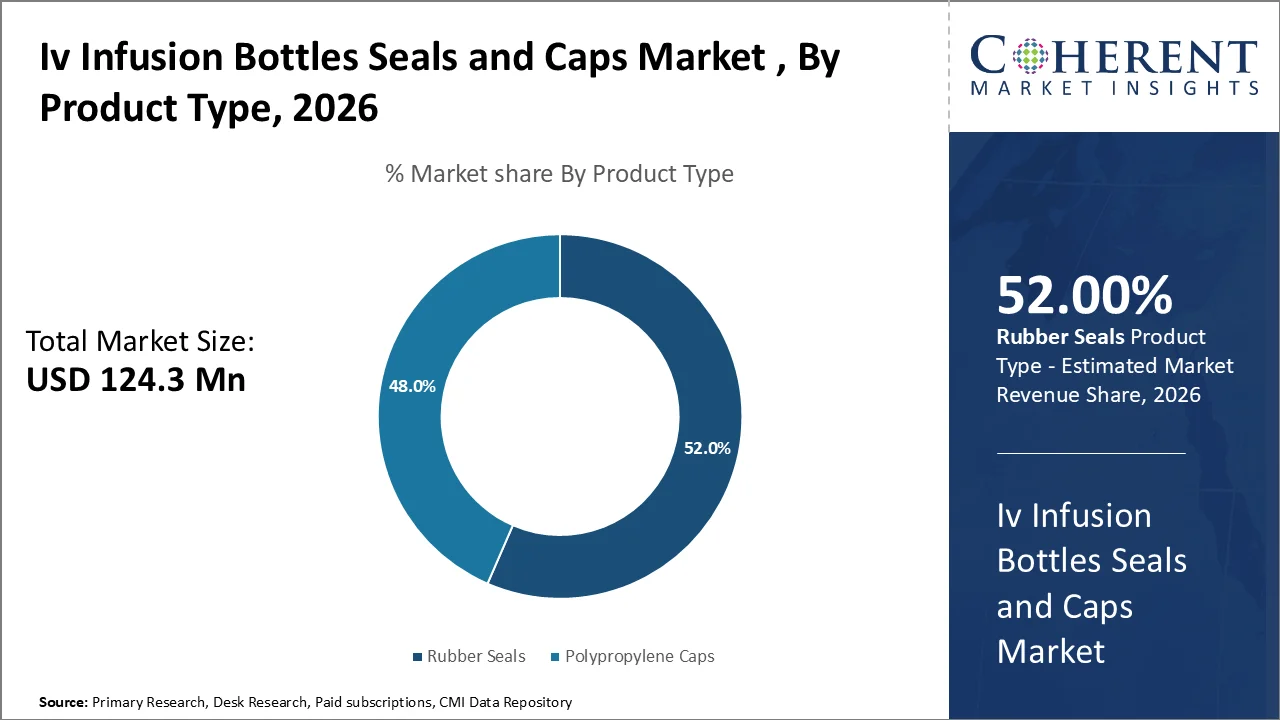
Why is Rubber Seals (Elastomeric Closures) Acquiring the Largest Market Share?
The rubber seals (elastomeric closures) are expected to capture the highest market share in the Iv infusion bottle seals and caps market by 2026, accounting for around 52% of the overall product type segment share. Their dominant position in the market is justified by the fact that rubber seals are necessary for the maintenance of sterility and container-closure integrity of injectables.
The extensive use of these packaging materials has been highly influenced by their biocompatibility, efficient barriers, and their ability to resist sterilization methods including autoclaving and gamma radiation. In addition, regulatory requirements from agencies such as the U.S. FDA and quality standards under USP <381> for elastomeric closures reinforce their necessity in sterile pharmaceutical packaging systems.
Why is the 21–28 mm Neck Size Segment Dominating the Market?
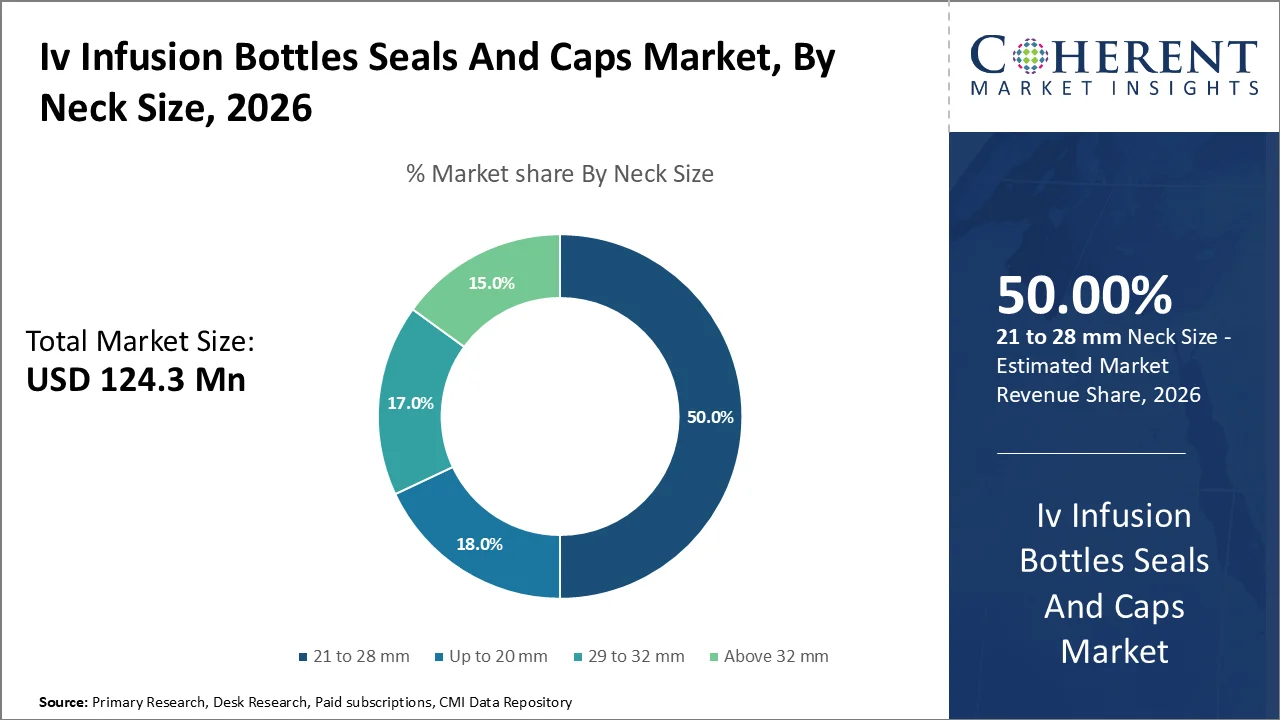
The neck sizes of 21-28 mm are expected to hold the highest market share of around 50% by 2026, due to its being the most standardized neck size for IV infusion bottles that are utilized in pharmaceutical industries across the world. The neck size of 21 to 28 mm is utilized a lot in antibiotics, cancer drugs, anesthetic, and nutritional fluids.
Another reason for the popularity of this neck size is the increasing trend toward intravenous therapy in hospital environments, and the need for universality in automated fill lines and aseptic processing plants. The pharmaceutical industry favors the use of this neck size owing to its excellent balance between stiffness, sealability, and manufacturability.
In March 2025, the International Organization for Standardization (ISO) released ISO 8536-6:2025, which defines updated technical requirements for closures used in infusion bottles, including dimensional, material, and performance specifications for sterile drug container closure systems.
Iv Infusion Bottles Seals and Caps Market Trends
- The increasing demand for sterile injectable pharmaceuticals and biological products is fueling the acceptance of elastomeric closures worldwide. Sterile containers and closures are necessary according to the FDA of the United States to guarantee drug sterility, purity, and safety.
- Biologics and injectable drugs account for a significant share of the global drug development pipeline (often estimated above 40%). The WHO reports an ever-increasing demand for injectable drugs globally, especially within hospitals for the treatment of chronic illnesses or cancer, emphasizing the importance of sterile infusion packing parts.
- The increase in use of IV therapy in hospitals has led to the rising consumption of infusion bottle closures/caps globally. The World Bank Health Indicators show that the utilization of health services and hospital treatment has gradually been on the rise in both developed and developing countries.
Regional Insights
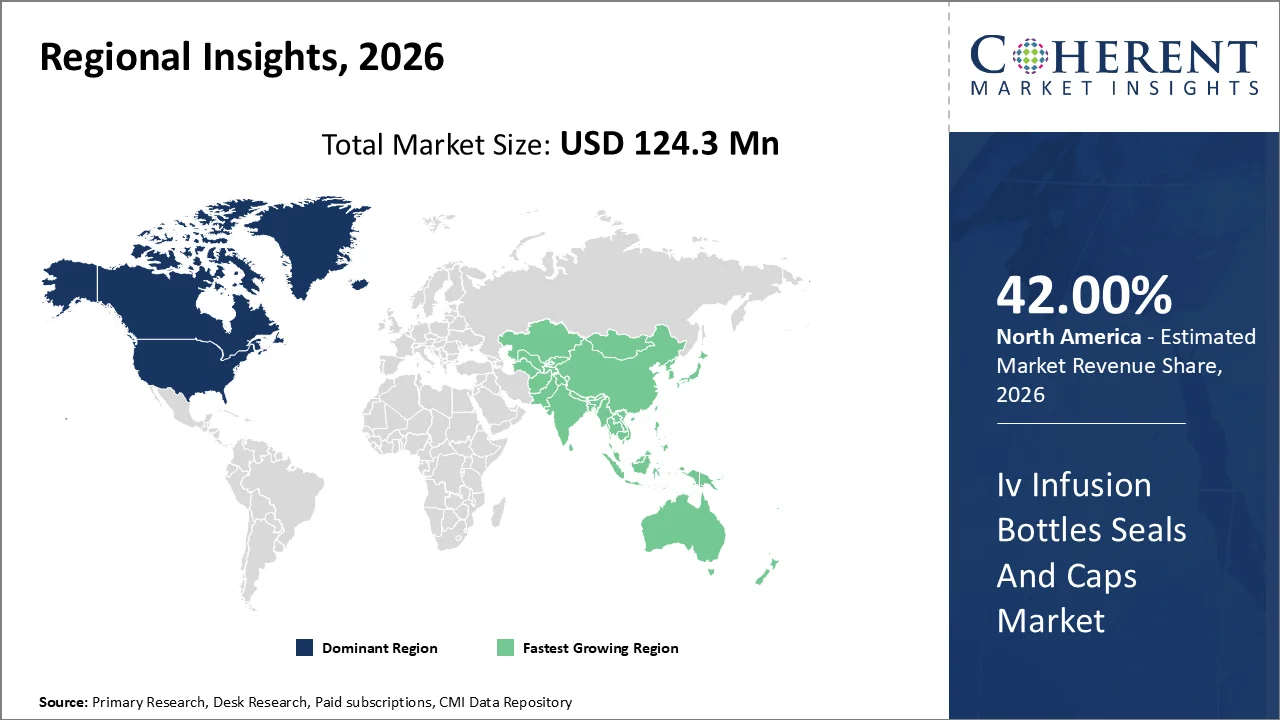
North America dominates owing to high demand for sterile injectable drug packaging and strict regulatory compliance
North America is expected to capture 42% market share in the global Iv infusion bottle seals and caps industry owing to the large consumption of sterile injectable drugs and biologics as well as advanced intravenous infusions at medical facilities and outpatient centers. Also, the region will gain a strong position in the market due to stringent regulations on container closure integrity, extractables & leachable, and parenteral aseptic filling requirements.
In March 2025, West Pharmaceutical Services (U.S.), a leading North American pharmaceutical packaging company, announced continued expansion of its advanced elastomeric closure technologies, including high-purity rubber stoppers designed for biologics and sensitive injectable therapies.
Asia Pacific Iv infusion bottles seals and caps Market Trends
The Asia-Pacific region is anticipated to exhibit the highest growth rate during 2026-2033 due to the swift expansion of the pharmaceutical industry, the development of hospitals, and an increased need for injectable drugs in developing countries like China and India.
China and India are major drivers of regional economic growth because of their mass production of injectable drugs and hospitals. Investments made in pharmaceutical packaging automation and aseptic fill have improved production efficiencies while increasing demand for infusion bottle closures.
In February 2026, pharmaceutical packaging standardization initiatives across Asia Pacific reinforced the use of ISO-aligned infusion bottle systems, particularly 21–28 mm neck size containers, improving compatibility for IV drug manufacturing and aseptic filling operations.
Growing Demand for Sterile Injectable Drugs is Driving the Iv infusion bottles seals and caps Market in the United States
The U.S. Iv infusion bottles seals and caps market is expanding rapidly owing to the high demand for sterile injections, biological products, and intravenous therapies. The USA ranks amongst the countries that provide a high number of injections to patients across the globe due to the advanced healthcare facilities in the country and strict CCI laws set by the FDA.
In January 2025, the U.S. FDA reinforced container closure system requirements for sterile injectable drugs, emphasizing improved testing for sterility assurance, extractables, and leachable in infusion packaging systems. This regulatory tightening is pushing manufacturers to adopt high-performance rubber seals and advanced closure technologies.
Expanding Pharmaceutical Manufacturing is Accelerating the Iv infusion bottles seals and caps Market in China
The China Iv infusion bottles seals and caps market is witnessing rapid expansion because of its significant pharmaceutical manufacturing capability and rising usage of injectables. China is one of the largest manufacturers of generic injectable drugs and IV solutions worldwide, and therefore it plays an important role in the packaging of IV solutions.
In addition, China’s increasing alignment with WHO GMP guidelines for sterile pharmaceutical manufacturing is accelerating the adoption of standardized infusion bottle closure systems, particularly in high-volume injectable drug production facilities.
Who are the Major Companies in Iv Infusion Bottles Seals and Caps Industry
Some of the major key players in Iv Infusion Bottle Seals and Caps are Cardinal Health Inc., Jiangsu changjiang Lids, Taiwan Hon Chuan Enterprise, PrasadMeditech, Winfield Laboratories Inc., Datwyler HoldingAG, Wuxi Qitian Medical Technology Co., Ltd, Medline Industries Inc., RENOLITSE, and B. Braun Medical Inc.
Key News
- In June 2025, Cardinal Health announced the U.S. launch of its new Kendall DL multi-parameter monitoring system, designed to improve hospital workflow efficiency and reduce infection risks through single-patient-use medical components.
- In February 2025, Datwyler expanded its pharmaceutical elastomer closure capabilities, increasing production capacity for high-quality rubber stoppers used in injectable drug packaging and IV infusion systems.
- In May 2025, Cardinal Health strengthened its biopharmaceutical packaging and logistics services (CHPS division) to support drug manufacturers with sterile packaging, labeling, and distribution solutions for injectable therapies.
Market Report Scope
Iv Infusion Bottles Seals and Caps Market Report Coverage
| Report Coverage | Details | ||
|---|---|---|---|
| Base Year: | 2025 | Market Size in 2026: | USD 124.3 Mn |
| Historical Data for: | 2020 To 2024 | Forecast Period: | 2026 To 2033 |
| Forecast Period 2026 to 2033 CAGR: | 2.6% | 2033 Value Projection: | USD 148.2 Mn |
| Geographies covered: |
| ||
| Segments covered: |
| ||
| Companies covered: | Cardinal Health Inc., Jiangsu changjiang Lids, Taiwan Hon Chuan Enterprise, PrasadMeditech, Winfield Laboratories Inc., Datwyler HoldingAG, Wuxi Qitian Medical Technology Co., Ltd, Medline Industries Inc., RENOLITSE, and B. Braun Medical Inc. | ||
| Growth Drivers: |
| ||
| Restraints & Challenges: |
| ||
Analyst Opinion
Market expansion is essentially driven by increasing demand, backed by growing global incidences of chronic diseases and an increasing reliance on IV procedures using hospital equipment.
- Regulatory compliance is another significant structural factor; the stringent guidelines set by the FDA, EMA, and WHO GMP regarding container seal integrity have increased the demand for good quality rubber stoppers and caps.
- Biologicals and injectables for oncology applications are changing the industry landscape due to the need for highly specialized elastomeric closures that ensure sterility, minimal particulate contamination, and optimal chemical resistance.
- The growing trend toward hospitalizations and the administration of IV drugs in critical care units and emergency cases is contributing to the rise in global usage of infusion bottles and closures.
Speak to the analyst
Want personalized insights?
Take the findings above to one of our principal consultants, or have the report rebuilt around the segments, geographies and competitors you actually track.
Market Segmentation
- By Product Type (Revenue, USD Mn, 2021-2033)
- Polypropylene Caps
- Rubber Seals
- By Neck Size (Revenue, USD Mn, 2021-2033)
- Up to 20 mm
- 21 to 28 mm
- 29 to 32 mm
- Above 32 mm
- By Region (Revenue, USD Mn, 2021-2033)
- North America
- U.S.
- Canada
- Latin America
- Brazil
- Mexico
- Argentina
- Rest of Latin America
- Europe
- Germany
- U.K.
- France
- Italy
- Spain
- Russia
- Rest of Europe
- Asia Pacific
- China
- India
- Japan
- Australia
- South Korea
- ASEAN
- Rest of Asia Pacific
- Middle East
- GCC
- Israel
- Rest of Middle East
- Africa
- South Africa
- Central Africa
- North Africa
- North America
Sources
Primary Research Interviews
- Pharmaceutical packaging manufacturers
- IV infusion packaging product managers
- Sterile medical device engineers
- Hospital procurement managers
- Pharmaceutical formulation scientists
- Regulatory compliance specialists (FDA/EMA aligned)
Databases
- U.S. Food and Drug Administration (FDA)
- European Medicines Agency (EMA)
- World Health Organization (WHO)
- International Organization for Standardization (ISO)
- World Bank Health Data
Magazines
- Pharmaceutical Technology
- Medical Packaging News
- Packaging World
- Drug Development & Delivery
- European Pharmaceutical Manufacturer
Journals
- Journal of Pharmaceutical Sciences
- International Journal of Pharmaceutics
- PDA Journal of Pharmaceutical Science and Technology
- AAPS PharmSciTech
- European Journal of Pharmaceutics and Biopharmaceutics
Newspapers
- The Wall Street Journal
- Financial Times
- The New York Times
- Reuters Health News
- Bloomberg Health
Associations
- International Society for Pharmaceutical Engineering (ISPE)
- Parenteral Drug Association (PDA)
- U.S. Pharmacopeia (USP)
- European Federation of Pharmaceutical Industries and Associations (EFPIA)
- World Health Organization (WHO) GMP Committees
Public Domain Sources
- FDA Guidance Documents on Container Closure Systems
- EMA Regulatory Guidelines for Pharmaceutical Packaging
- WHO GMP Guidelines for Sterile Pharmaceutical Products
- ISO Standards (ISO 8536 series for infusion equipment)
- Company Annual Reports and Investor Presentations (West Pharmaceutical Services, Datwyler, B. Braun, Cardinal Health)
Proprietary Elements
- CMI Data Analytics Tool
- Proprietary CMI historical pharmaceutical packaging database (10+ years)
- Internal IV infusion packaging market modeling framework
- Proprietary demand-supply forecasting model for elastomeric closures and infusion caps
Get access to 250+ pages report
Every segment, forecast, competitor profile and data table behind the analysis above — available for instant download.
- ESOMAR Member
- ISO 9001:2015 Certified
- D-U-N-S Registered
- GDPR & CCPA Compliant
Missing comfort of reading report in your local language? Find your preferred language:
Transform your Strategy with Exclusive Trending Reports
Frequently Asked Questions
The Iv infusion bottles seals and caps Market is expected to reach USD 148.2 Mn in 2033, growing from about USD 124.3 Mn in 2026 at a CAGR of 2.6%.
Major players include Cardinal Health Inc., Datwyler Holding AG, B. Braun Medical Inc., Medline Industries Inc., RENOLIT SE, Jiangsu Changjiang Lids, Taiwan Hon Chuan Enterprise, PrasadMeditech, Winfield Laboratories Inc., and Wuxi Qitian Medical Technology Co., Ltd.
High regulatory compliance costs, strict validation requirements for container closure integrity, and volatility in raw material supply (rubber and polymers) are key challenges.
Rising demand for sterile injectable drugs, increasing hospital admissions, growth in IV therapies, and expansion of biologics and oncology treatments are major growth drivers.
North America is expected to dominate the global market, driven by high IV drug consumption and strict regulatory standards for sterile packaging systems.
They are pharmaceutical packaging components used to maintain sterility and container closure integrity of injectable drugs, ensuring safe IV drug delivery.
Rubber seals (elastomeric closures) dominate due to their strong barrier protection, sterilization resistance, and compatibility with biologics.