

Medical Ozone Generator Market Size and Share Analysis: 2026 - 2033
The global medical ozone generator market size is expected to reach approximately USD 1,240 Mn in 2026 and USD 1,938 Mn by 2033, growing at a CAGR of 6.5% throughout the forecast period (2026-2033).
Key Takeaways from the Medical Ozone Generator Market Report
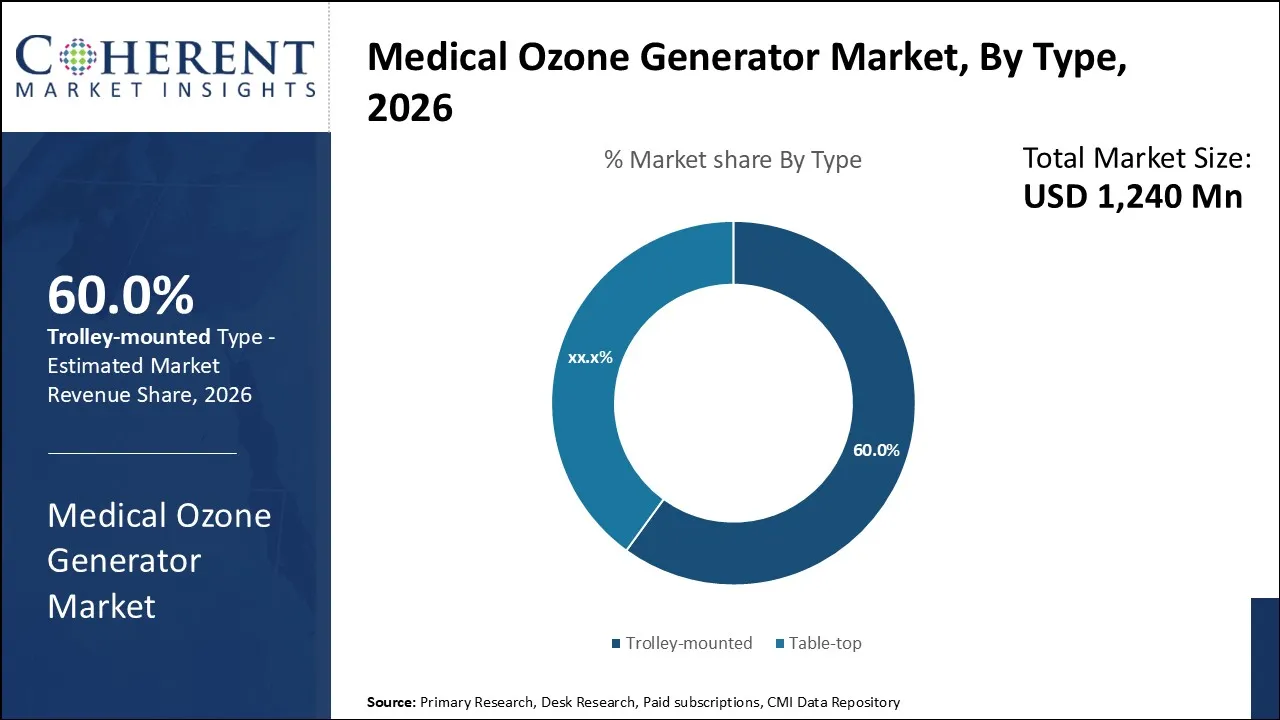
- Trolley-mounted medical ozone generators remain a highly sought-after type, accounting for about 60% of the market share in 2026. This is due to their mobility, versatility, and suitability for use across multiple rooms in hospitals and clinics.
- Hospitals and clinics are expected to remain leading end users of medical ozone generators, accounting for 50% of market revenue in 2026, driven by high device volumes and adoption in comprehensive care.
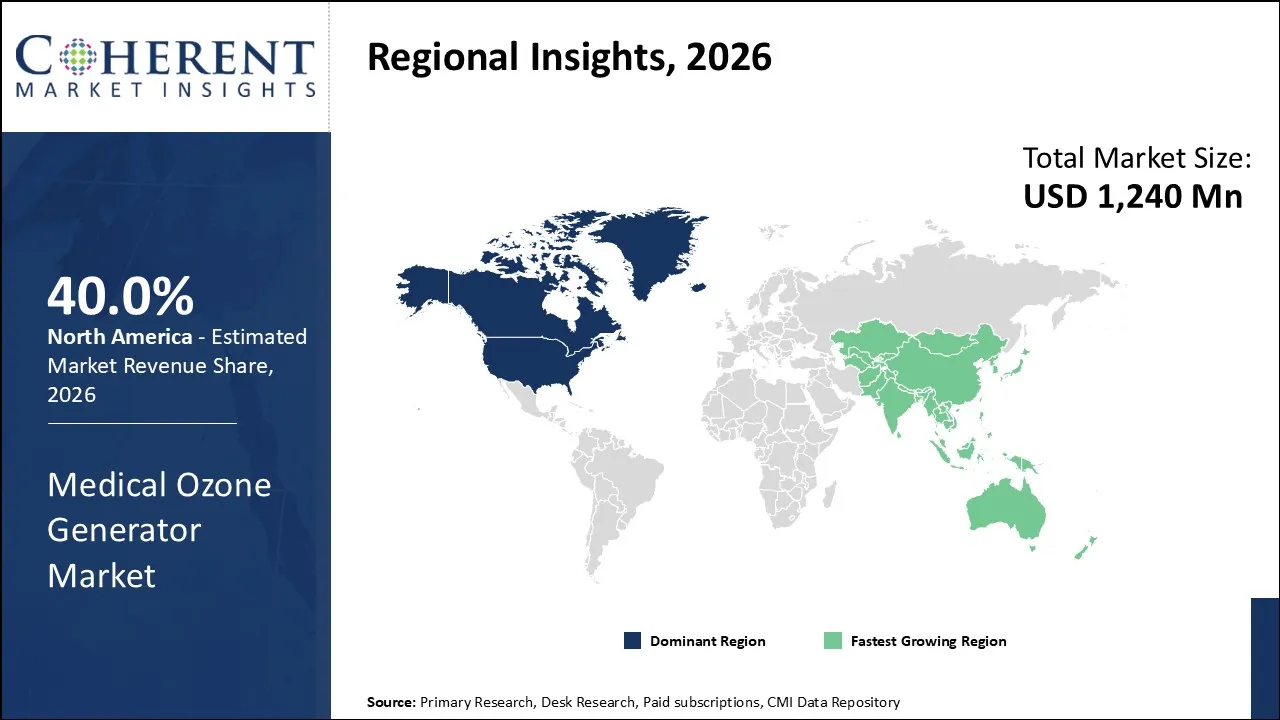
- North America is projected to dominate the global medical ozone generator industry in 2026, with a share of over 40% due to strong adoption of alternative therapies.
Medical Ozone Generator Market Overview
The global medical ozone generator market is projected to grow steadily during the forecast period. This is mostly due to increasing use of ozone therapy in medical applications, especially in wound healing, sterilization, and the management of certain chronic conditions. Rising awareness among healthcare professionals and patients about alternative and complementary therapies, along with advancements in ozone generator technology, also drives market growth.
Medical ozone generators produce controlled, medical-grade ozone for therapeutic use. Ozone therapy is applied in dermatology, wound care, and pain management, including joint and muscle pain. Studies, including systematic reviews indexed in the National Library of Medicine, show that ozone may help in chronic wound healing and can lead to faster recovery when used with standard care. It is also being studied for treating conditions like cancer and AIDS.
Current Events and Their Impact on the Medical Ozone Generator Market
Current Event | Description and its Impact |
Technological Convergence in Medical Devices |
|
Alternative Medicine Integration into Mainstream Healthcare |
|
Segmental Insights
- Current Industry Events of 2026
- Market Size Estimation
- Regional Breakdown
- Competitive Landscape
- Customer Intelligence
- Segmental Analysis
- Pricing Analysis
- Key Market Drivers, Challenges & Future Trends
- Customized Insights Section
Medical Ozone Generator Market Insights, By Type - Trolley-Mounted Ozone Generators Remain Top-Selling Type in the Market
Based on type, trolley-mounted medical ozone generators are expected to lead the market, accounting for a revenue share of 60% in 2026. This is attributable to rising adoption of trolley-mounted medical ozone generators in hospitals, clinics, and ambulatory surgical centers because they offer mobility, versatility, and suitability for use across multiple rooms.
The dominance of trolley-mounted medical ozone generators is further reinforced by their ease of integration into existing medical workflows. Their portable design allows healthcare professionals to deliver ozone therapy efficiently without the need for permanent installation. In addition, rising preference for minimally invasive and supportive therapies in clinical settings is also boosting demand for these adaptable and user-friendly units.
Medical Ozone Generator Market Insights, By End User - Hospitals and Clinics to Remain Leading End Users of Medical Ozone Generators
By end user, hospitals and clinics segment is slated to account for a prominent market share of 50% in 2026. This dominance is mainly due to the increasing adoption of ozone therapy in medical treatments, such as wound healing, infection control, and pain management. These healthcare facilities are the most common places where patients receive ozone therapy.
Hospitals and clinics benefit from having trained medical staff and proper infrastructure to safely use ozone generators, allowing them to provide advanced therapeutic solutions. In addition, growing number of chronic diseases and post-surgical complications is increasing the demand for ozone-based treatments in these healthcare settings, making them the main end users in the medical ozone generator market.
Regional Insights
North America Remains the Market Leader in Medical Ozone Generator Adoption
North America is expected to dominate the global medical ozone generator market, accounting for a share of 40% in 2026. This is mostly due to increasing adoption of ozone therapy in hospitals and clinics, rising prevalence of chronic wounds and infections, and growing awareness of non-invasive treatment options.
Ozone therapy is gaining traction in dental care, dermatology, and orthopedics due to its antibacterial, antiviral, and anti-inflammatory properties. The U.S. and Canada are seeing higher demand for advanced medical ozone generators in outpatient centers and specialized treatment facilities.
Moreover, strong regulatory frameworks and supportive reimbursement policies in North America are encouraging healthcare providers to invest in ozone-based therapeutic equipment. Leading medical device manufacturers are introducing compact, efficient, and hospital-grade ozone generators to meet clinical needs and improve patient outcomes.
Asia Pacific Medical Ozone Generator Market Trends
Asia Pacific is poised to grow during the assessment period. This is attributable to increasing healthcare infrastructure, rising investment in alternative therapies, and growing patient acceptance of ozone-based treatments in countries like China, India, and Japan.
The region is witnessing rapid expansion in dental clinics, physiotherapy centers, and wellness hospitals that use ozone therapy for wound healing, infection control, and pain management. In addition, rising government initiatives to promote non-invasive medical technologies and training programs for ozone therapy practitioners are accelerating market adoption.
Medical Ozone Generator Market Outlook – Country-wise
China Medical Ozone Generator Market Trends
Demand for medical ozone generators in China is expected to grow rapidly during the forecast period. Growth is supported by the use of ozone therapy in dental clinics, wound care centers, and certain minimally invasive treatments. Investments in modern healthcare infrastructure and increasing research on ozone-assisted therapies for chronic conditions and postoperative care are contributing to awareness and adoption of ozone therapy.
United States Medical Ozone Generator Market Forecast
The medical ozone generator market in the United States is expected to experience steady growth during the forecast period. Expansion is fueled by increasing clinical adoption of ozone therapy for pain management, dermatology, and orthopedic applications. Rising demand for outpatient and home-based ozone therapy devices is also contributing to market growth. Furthermore, favorable reimbursement policies, stringent regulatory standards ensuring device safety, and a strong focus on alternative therapies are supporting the wider acceptance of medical ozone generators.
Medical Ozone Generator Industry News
- In January 2026, Medsource Ozone Biomedicals hired Ernst & Young (EY) to explore funding options, potentially raising ₹300–400 crore (~$36–48 M) for growth. The company plans to use the funds to expand production capacity and strengthen its business, with possible future partnerships in healthcare tech.
- In January 2023, Konica Minolta and Tamura TECO jointly developed an affordable ozone generator called BACTECTOR 2.0SC. This cost‑effective product uses controlled low‑concentration ozone to disinfect and help suppress bacteria and viruses.
Market Report Scope
Medical Ozone Generator Market Report Coverage
| Report Coverage | Details | ||
|---|---|---|---|
| Base Year: | 2025 | Market Size in 2026: | USD 1,240 Mn |
| Historical Data for: | 2020 To 2024 | Forecast Period: | 2026 To 2033 |
| Forecast Period 2026 to 2033 CAGR: | 6.5% | 2033 Value Projection: | USD 1,938 Mn |
| Geographies covered: |
| ||
| Segments covered: |
| ||
| Companies covered: | Medozons Ltd., AQUAZONE SYSTEMS & ENGINEERING, Eltech Ozone, Chemtronics, AQUAPURE, MIO International Ozonytron, Herrmann Apparatebau, EVOZONE GmbH, Dr. J. Hänsler GmbH, Aquolab, APOZA Enterprise, W and H Dentalwerk Bürmoos, and Promolife | ||
| Growth Drivers: |
| ||
| Restraints & Challenges: |
| ||
Medical Ozone Generator Market Drivers
Growing Demand for Alternative and Non-Invasive Therapies
Shift towards alternative therapies is a major factor driving growth of medical ozone generator market. Patients and healthcare providers in the contemporary world are increasingly seeking non-drug, minimally invasive treatment options, especially for chronic conditions, wound healing, pain management, and immune support. As a result, ozone therapy is gaining attention as an adjunctive therapy alongside conventional medical treatments, particularly in regions where it is approved and practiced.
Medical Ozone Generator Market Drivers
Rising Prevalence of Chronic Diseases
Conditions such as diabetes, arthritis, cardiovascular disorders, chronic wounds, and infections are increasing globally. For instance, the International Diabetes Federation (IDF) predicts that the global diabetic population could reach 853 million by 2050. This is increasing interest in ozone therapy in integrative and complementary healthcare because of its anti-inflammatory, antimicrobial, and immune-modulating properties. Therefore, the future medical ozone generator market outlook appears promising.
Medical Ozone Generator Market Trends
Integration of Ozone Generators with Digital and IoT Technologies
An emerging trend in the medical ozone generator market is the adoption of advanced technologies. Some manufacturers are starting to incorporate cloud connectivity, remote monitoring, smart dosing, and automation into medical ozone generators. These features can enable better control, therapy customization, and device management.
Medical Ozone Generator Market Trends
Shift Towards Portable Medical Ozone Generators
Portable and user‑friendly ozone systems are gaining popularity, particularly in outpatient clinics and supervised home healthcare settings. These devices enable ozone therapy to be delivered outside traditional hospital environments. This rising trend is expected to drive growth in the medical ozone generator market during the assessment period.
Medical Ozone Generator Market Opportunities
Increasing Incidence of Skin Disorders
Ozone therapy in dermatology is used for a variety of conditions due to its antimicrobial, anti-inflammatory, antioxidant, and wound-healing properties. It is often applied alongside traditional treatments to improve the healing process. A literature review of controlled clinical trials indicates that ozone therapy may provide beneficial effects in certain dermatological conditions when delivered appropriately. Consequently, the rising number of people suffering from skin disorders could contribute to growing demand for medical ozone generators during the forecast period.
Technological Advancements in Ozone Devices
Technological advancements in medical ozone generator technology are improving device safety, dosing precision, ease of operation, and automation. Many newer systems now have digital controls, automated dosing, and IoT‑enabled monitoring for real‑time oversight and predictive maintenance. These features improve usability and operational reliability, supporting broader adoption of ozone generators in healthcare settings and contributing to projected market growth in the coming years.
Analyst Opinion (Expert Opinion)
- The use of medical ozone therapy is growing quickly in regenerative medicine and pain management. Hospitals and clinics treating chronic musculoskeletal disorders have seen a 25–30% faster recovery when ozone injections are used along with regular physiotherapy.
- Ozone generators are driving precision and safety in clinical applications. Modern generators with controlled ozone concentration and flow allow physicians to minimize oxidative stress while maximizing therapeutic benefits. Research from the University of Naples indicates that precise ozone dosages reduce post-treatment inflammation by up to 40% compared with traditional methods, demonstrating that generator technology is a critical determinant of clinical outcomes rather than a generic medical device.
- In dentistry and wound care, ozone therapy is reshaping treatment paradigms. Dental clinics in Italy and Spain report a 50% reduction in bacterial load and accelerated tissue healing using ozone generators for periodontal and root canal procedures. Similarly, burn units in select U.S. hospitals are leveraging ozone-infused dressings for faster wound closure, highlighting the device’s direct impact on procedural efficacy and patient safety.
- The market is increasingly influenced by technological innovation and regulatory alignment. Devices with real-time ozone monitoring and automated safety shutoffs are now standard in over 60% of newly installed clinical units in Europe. Manufacturers such as Fischer Medizinische Geräte and Ozonosan are investing in smart generators that ensure reproducibility and compliance, underlining that equipment sophistication, not just therapy knowledge, is shaping adoption and clinician confidence.
Speak to the analyst
Want personalized insights?
Take the findings above to one of our principal consultants, or have the report rebuilt around the segments, geographies and competitors you actually track.
Medical Ozone Generator Market Segmentation
- By Type Insights ( Revenue, USD Mn, 2020 - 2033)
- Trolley-mounted
- Table-top
- By Application Insights ( Revenue, USD Mn, 2020 - 2033)
- Oncological Treatment
- Dermatological Treatment
- Gastrointestinal Treatment
- Dental Treatment
- Gynecologic Treatment
- Others
- By End User Insights ( Revenue, USD Mn, 2020 - 2033)
- Hospitals and Clinics
- Ambulatory Surgical Centers
- Others
- By Region Insights ( Revenue, USD Mn, 2020 - 2033)
- North America
- U.S.
- Canada
- Latin America
- Brazil
- Argentina
- Mexico
- Rest of Latin America
- Europe
- Germany
- U.K.
- Spain
- France
- Italy
- Russia
- Rest of Europe
- Asia Pacific
- China
- India
- Japan
- Australia
- South Korea
- ASEAN
- Rest of Asia Pacific
- Middle East & Africa
- GCC Countries
- Israel
- Rest of Middle East & Africa
- North America
- Key Players
- Medozons Ltd.
- Eltech Ozone
- AQUAZONE SYSTEMS & ENGINEERING
- Chemtronics
- AQUAPURE
- Herrmann Apparatebau
- MIO International Ozonytron
- EVOZONE GmbH
- Aquolab, APOZA Enterprise
- J. Hänsler GmbH
- W and H Dentalwerk Bürmoos
- Promolife
Sources
Primary Research interviews
- Interviews with industry experts including R&D heads, product managers, and clinical users in hospitals and diagnostic centers
- Insights from procurement managers of medical equipment distributors
- Discussions with biomedical engineers specializing in ozone therapy systems
Databases
- PubMed - biomedical literature and clinical studies
- Scopus - multidisciplinary research abstracts and citations
- ClinicalTrials.gov-registry of ongoing and completed clinical studies involving ozone therapy
- IEEE Xplore - technical papers on medical device technology
Magazines
- Medical Device & Diagnostic Industry (MD+DI)
- Medical Design & Outsourcing
- MedTech Intelligence
- Health Management Technology Magazine
Journals
- Journal of Medical Devices
- Ozone: Science & Engineering
- Journal of Clinical Ozone Therapy
- Annals of Biomedical Engineering
- International Journal of Medical Sciences
Newspapers
- The New York Times — Health Section
- The Guardian — Health & Science
- The Hindu — Health and Technology
- Times of India — Science & Health
Associations
- World Federation of Ozone Therapy (WFOT)
- International Organization for Standardization (ISO) – Technical Committee on Medical Devices
- American Medical Association (AMA) – device safety guidelines
- Association for the Advancement of Medical Instrumentation (AAMI)
Public Domain sources
- U.S. Food and Drug Administration (FDA) device database and approvals
- European Commission — Medical Device Regulations
- World Health Organization (WHO) publications on medical device safety standards
- Government health ministry portals from key markets (e.g., India, UK, Germany)
Proprietary Elements
- CMI Data Analytics Tool
- Proprietary CMI Existing Repository of information for last 8 years
Get access to 250+ pages report
Every segment, forecast, competitor profile and data table behind the analysis above — available for instant download.
- ESOMAR Member
- ISO 9001:2015 Certified
- D-U-N-S Registered
- GDPR & CCPA Compliant
Missing comfort of reading report in your local language? Find your preferred language:
Transform your Strategy with Exclusive Trending Reports
Frequently Asked Questions
The global market is estimated to be valued at USD 1,240Mn in 2026.
The global Medical Ozone Generator Market value is expected to reach USD 1,938 Mn by 2033.
The global market is poised to exhibit a CAGR of 6.5% from 2026 to 2033.
Major growth factors include rising prevalence of cancer and other chronic diseases and increasing number of people suffering from skin conditions.
Restrictions and a ban on the use of ozone and high operational and installation costs of ozone generators.
Some major companies in the Medical Ozone Generator Market include Medozons Ltd., AQUAZONE SYSTEMS & ENGINEERING, Eltech Ozone, Chemtronics, AQUAPURE, MIO International Ozonytron, Herrmann Apparatebau, EVOZONE GmbH, Dr. J. Hänsler GmbH, Aquolab, APOZA Enterprise, W and H Dentalwerk Bürmoos, and Promolife.
North America, with 40% share in 2026, is expected to lead the market during the forecast period.