

Medical Pediatric Bed Market Size and Share Analysis - Growth Trends and Forecasts (2026 - 2033)
The global medical pediatric bed market size is expected to reach approximately USD 13,269.6 Mn in 2026 and USD 21,392.2 Mn by 2033, growing at a CAGR of 7.1% throughout the forecast period (2026-2033).
Key Takeaways from the Medical Pediatric Bed Market Report
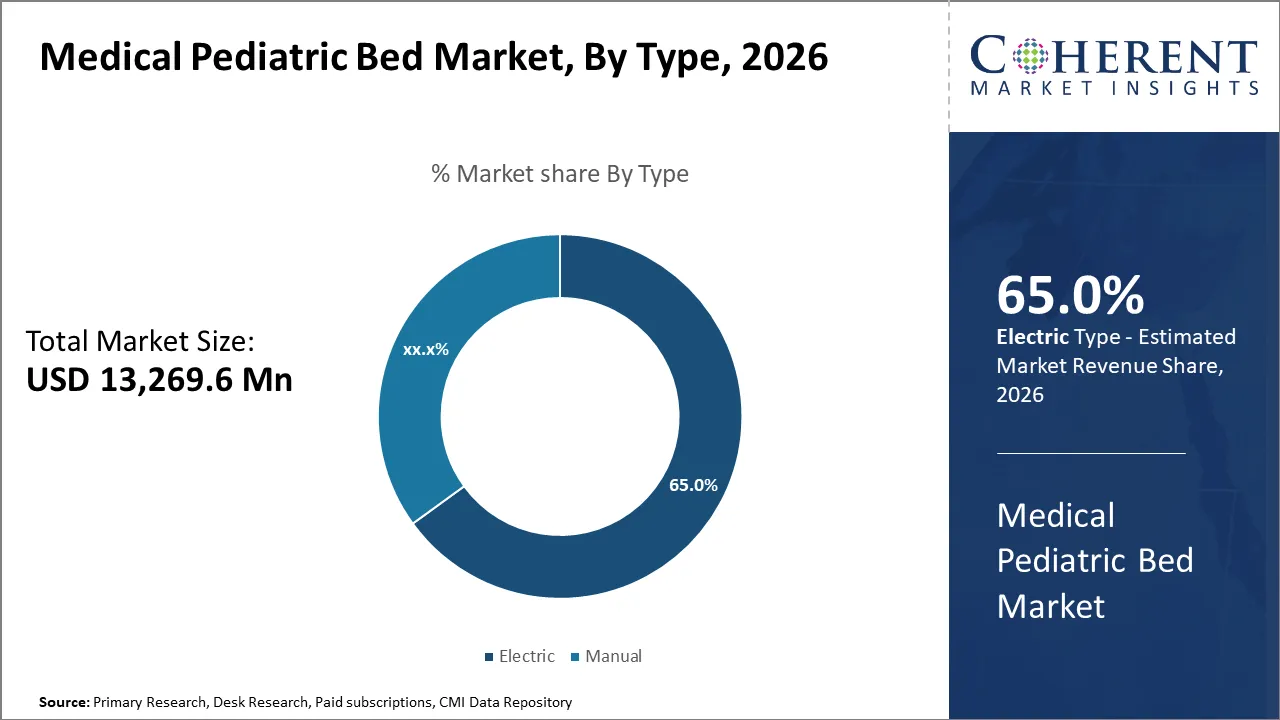
- Electric remain a highly sought-after type, accounting for about 65% of the market share in 2026, owing to improved comfort, reduced physical effort required by caregivers and patient safety.
- Height Adjustable is expected to remain leading segment accounting for 45% in the respiratory disposables market revenue in 2026, as it is widely used in hospitals due to its adjustable height and side-rail safety systems increase their adoption in pediatric ICUs and hospital wards.
- The hospitals segment registered its dominance over the global medical pediatric bed market with share of 60% in 2026, owing to high volume pediatric admissions and high requirement for continuous monitoring and treatment.
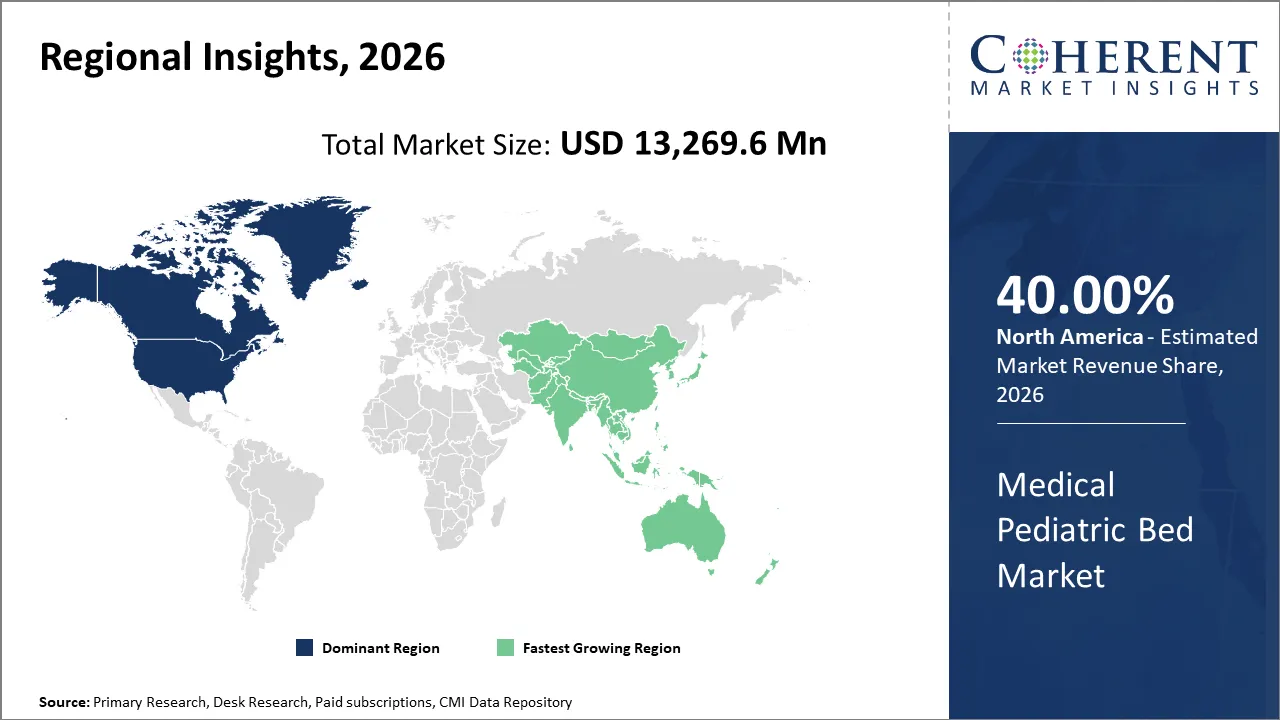
- North America is projected to dominate the global medical pediatric bed market in 2026, with a share of over 40% due to strong presence of leading key players.
Medical Pediatric Bed Market Overview
The medical pediatric bed market is gaining strategic importance globally as the healthcare systems are increasingly focusing on advanced hospital infrastructure, specialized pediatric care, and patient-centered treatments. Overall factors collectively strengthen the market’s strategic momentum within the global medical device and hospital equipment industry.
Current Events and Their Impact
Current Event | Description and its Impact |
Expansion of NICU and Pediatric Hospitals Facilities |
|
Increasing Technology Advancement in Pediatric Beds |
|
Segmental Insights
- Current Industry Events of 2026
- Market Size Estimation
- Regional Breakdown
- Competitive Landscape
- Customer Intelligence
- Segmental Analysis
- Pricing Analysis
- Key Market Drivers, Challenges & Future Trends
- Customized Insights Section
Medical Pediatric Bed Market Insights, By Type - Electric Holds Dominant Bed Type in the Market
Based on type, electric is expected to lead the market, accounting for a revenue share of 65% in 2026. Due to several clinical and operational advantages provided by the electric beds, the demand for it is high over manual bed. Using electronic controls, the electric pediatric beds allow caregivers to easily adjust backrest, height, and leg positions. The advanced motorized controls allow nurses and hospital staff to adjust the bed without manual effort. This minimizes the risk of injury to caregivers and enhance workflow efficiency in hospitals and pediatric wards. Growing adoption of advances healthcare infrastructure by integration of modern safety features supports the segment dominance in the market.
Medical Pediatric Bed Market Insights, By Features - Height Adjustable to Remain Leading Features of Medical Pediatric Bed
By features, height adjustable segment is slated to account for a prominent market share of 45% in 2026. To improve safety, caregiving efficiency, and treatment convenience in pediatric healthcare settings the eight adjustable feature is necessary. Due to height adjustment feature the caregivers are able to lower the bed when child is sleeping or resting, minimizing the risk of accidental falls. Height adjustable feature reduce strain for healthcare staff and better access for medical procedures.
Medical Pediatric Bed Market Insights, By End User - Expanding Pediatric Care Facilities Strengthens Hospital Segment Leadership
Based on end user, hospitals segment led the global medical pediatric bed market with share of 60% in 2026. Due to increasing hospital expenditure and advancement of the hospital infrastructure the hospitals segment led the market. Increasing disposable income and rising hospital admissions for pediatric patients has driven the growth of the market over the forecast period. Newly opened hospitals have dedicated departments such as neonatal care units and Pediatric Intensive Care Units (PICU) that demand for advanced pediatric beds for continuous monitoring and treatment.
For instance, in September 2025, according to the data published by the U.S. Centers for Disease Control and Prevention, the 2024-2025 influenza season in the U.S. resulted in approximately 43 million illnesses and around 560,000 hospitalizations nationwide. About 280 influenza-associated pediatric deaths were recorded during the season, highlighting the significant burden of severe illnesses among children and the demand for hospital-based pediatric monitoring and treatment.
(Source: U.S Centers for Disease Control and Prevention)
Regional Insights
North America Remains the Market Leader in 2026
North America is expected to dominate the global medical pediatric bed market, accounting for a share of 40% in 2026. In the North America region, the hospitals have a well-developed healthcare system with a large number of hospitals, specialized children’s hospitals, and pediatric intensive care units (PICUs). These infrastructures require advanced pediatric beds to ensure effective treatment and patient safety. Higher hospital budgets in the U.S. and Canada enable healthcare institutions to invest in technologically advanced pediatric beds. The North American region has the presence of leading medical bed manufacturers and healthcare equipment companies.
For instance, according to the U.S. National Health Expenditure (NHE) data used by the Centers for Disease Control and Prevention and health statistics agencies, healthcare spending in the U.S. reached approximately USD 5.3 trillion in 2024, representing about 18% of the country’s GDP, and continued to grow into 2025 due to increasing medical service utilization and insurance coverage. The U.S. has the largest healthcare spending of USD 14,800 per capita on healthcare, the highest among OECD countries.
Asia Pacific Medical Pediatric Bed Market Trends
Asia Pacific region is expected to grow at fastest CAGR in the medical pediatric bed market during the forecast period. Many Asia-Pacific countries such as China, India, and Southeast Asian nations are investing heavily in installing advanced healthcare facilities. Increasing launch of new hospitals, pediatric wards, and neonatal intensive care units (NICUs) is increasing the demand for specialized pediatric hospital beds. One of the largest child populations globally is present in the Asia-Pacific region. Due to presence of high number of pediatric patients there is increase in the demand for dedicated pediatric medical equipment and healthcare facilities, including pediatric beds. For instance, in 2026, according to the data published by the UNICEF 2025 regional data, the East Asia Pacific region is home to nearly 40 million children under the age of 18, representing about one-fifth of the world’s children, nearly 14% of the global total. According to the same source, there are 93 million children live in the EAP region.
(Source: UNICEF)
Governments in the Asia Pacific region are increasing healthcare budgets to improve maternal and child healthcare services and implementing healthcare development programs, which supports the adoption of advanced pediatric hospital beds. In Asia Pacific region especially, India has highest incidence of childhood diseases such as congenital disorders, respiratory infections, and malnutrition is increasing hospital admissions among children, thereby driving demand for pediatric beds. Furthermore, expansion of private healthcare services in Asia Pacific region has driven the growth of the market in the region.
Medical Pediatric Bed Market Outlook – Country-wise
U.S. Medical Pediatric Bed Market Forecast
The U.S. country has high healthcare expenditure, advanced healthcare infrastructure, and presence of leading medical device manufacturers, which supports the dominance of the country in the North America. Increasing adoption of the pediatric healthcare facilities across the country has driven the growth of the market. The U.S. spends more on development of healthcare facilities than any other country which promotes the growth of the medical pediatric bed market.
China Medical Pediatric Bed Market Trends
China medical pediatric bed market is driven the by very large population with millions of pediatric patients and strong domestic manufacturing base. Increasing support by government to develop advanced infrastructure in pediatric hospitals as driven the growth of the market. Due to lower labor costs and economies of scale, Chinese manufacturers are able to offer cheap prices, which makes their goods appealing for both domestic and Asian Pacific exports.
Medical Pediatric Bed Market News
- In January 2026, Baxter International Inc., healthcare company has revealed that the Dynamo Series stretcher will soon be available in the U.S. at the 2026 J.P. Morgan Healthcare Conference. The Dynamo Series stretcher was created to enable care teams focus on patient care while reducing their physical and mental strain. The Dynamo Series, the newest addition to Baxter's top line of smart beds, surfaces, and connected care solutions, is designed for use in emergency rooms, surgical settings, and patient transport services.
Market Report Scope
Medical Pediatric Bed Market Report Coverage
| Report Coverage | Details | ||
|---|---|---|---|
| Base Year: | 2025 | Market Size in 2026: | USD 13,269.6 Mn |
| Historical Data for: | 2020 To 2024 | Forecast Period: | 2026 To 2033 |
| Forecast Period 2026 to 2033 CAGR: | 7.1% | 2033 Value Projection: | USD 21,392.2 Mn |
| Geographies covered: |
| ||
| Segments covered: |
| ||
| Companies covered: | Meditek Engineers, Tychemed, HARD Manufacturing Company, Inc., Sigma-Care Development Co., Ltd., PARAMOUNT BED CO., LTD., Stiegelmeyer GmbH & Co. KG, Saikang Medical, Guangdong Pigeon Medical Apparatus Co., Ltd. , Savion Industries, Nitrocare, MESPA, Hebei Jiede Medical Equipment Co., Ltd., Zhangjiagang Medi Medical Equipment Co., ltd., BiHealthcare (Zhangjiagang Braun Industry Co., Ltd.), Schröder Health Projects, Linet, Invacare Corporation, Medline Industries Inc., and Stryker Corporation. | ||
| Growth Drivers: |
| ||
| Restraints, Challenges & Opportunities: |
| ||
Market Dynamics
Medical Pediatric Bed Market Drivers
Increasing Incidence of Preterm Birth Admissions
Rising number of preterm births admission leads to increased hospital admissions in neonatal and pediatric intensive care units (PICUs and NICUs). Preterm babies require extended hospital stays for monitoring and supportive care. Hence, due to expansion of neonatal and pediatric care units and rising focus on infant safety & clinical outcomes, the medical pediatric bed market grows rapidly over the forecast period. For instance, according to the data published by the World Health Organization, it has been estimated that about 13.4 million babies took birth preterm globally, which equals around 1 in 10 births worldwide.
Medical Pediatric Bed Market Trends
Increasing Adoption of Adjustable & Electric Beds
As hospitals look to improve ease of utilization for clinical staff and comfort for patients electric and semi‑electric pediatric beds are becoming more prevalent. Advanced multi‑function electric bed models are capturing higher growth share due to which manual beds remain in demand in cost‑constrained markets.
Emphasis on Infection Control, Hygiene, & Materials
The key priority in pediatric ward is to reduce infection risks due to which the key players in the market are adopting the usage of the antimicrobial and easy‑to‑clean materials. Durable and lightweight materials like aluminium frames or hybrid constructions are trending for better mobility and affordable prices.
Medical Pediatric Bed Market Opportunities
Expansion of Healthcare Infrastructure & Increasing Focus on Pediatric Patient Safety & Comfort
Rising government initiatives and funding activities for developing pediatric hospitals has created significant opportunity for the growth of the medical pediatric bed market in the near future. The government is highly focused in investing in developing advanced version of healthcare system to meet the rising demand for quality pediatric care. For instance, in May 2025, The Kinder Foundation has donated USD 150 million to The University of Texas MD Anderson Cancer Center, world-renowned institution dedicated to cancer patient care and Texas Children’s Hospital. With the primary goal of ending childhood cancer, the transformative donation establishes Kinder Children's Cancer Center, a collaborative venture between UT MD Anderson and Texas Children's.
Analyst Opinion (Expert Opinion)
- According to the expert’s opinion pediatric healthcare infrastructure expansion drives the market growth. The increasing establishment of pediatric healthcare facilities, particularly in emerging markets, remains a primary growth catalyst for the medical pediatric bed market. As hospitals and pediatric wards expand, the demand for adjustable beds to cater to neonates and children rises steadily.
- Increasing technological advancements in pediatric beds enhance demand and drives the growth of the market. The growing adoption of advanced pediatric beds featuring smart safety controls, adjustable heights, and integration with monitoring systems is strengthening baseline demand. Healthcare providers are increasingly opting for these specialized beds to enhance patient care and safety, especially in critical care units.
- Emerging market healthcare investments boost long-term demand. The increasing investments in healthcare infrastructure and pediatric healthcare in emerging economies, such as Asia Pacific and Latin America, are accelerating market growth. Expanding healthcare funding, along with the rise of new pediatric facilities, is anticipated to drive the demand for modern medical pediatric beds in these regions.
- Focus on pediatric care and safety fuels technological advancements has driven the market growth. The increasing focus on improving pediatric care quality, alongside increasing investments in healthcare technology, is expanding the application scope of pediatric beds. The rising demand for beds with advanced safety features, such as anti-entrapment mechanisms and integrated monitoring, is creating additional opportunities for manufacturers in the sector.
Speak to the analyst
Want personalized insights?
Take the findings above to one of our principal consultants, or have the report rebuilt around the segments, geographies and competitors you actually track.
Market Segmentation
- By Type ( Revenue, US$ Mn, 2020 - 2033)
- Electric
- Manual
- By Features Insights (Revenue, US$ Mn, 2020 - 2033)
- Height Adjustable
- Fixed Height
- Trendelenburg
- By End User Insights ( Revenue, US$ Mn, 2020 - 2033)
- Hospitals
- Nursing Home
- Homecare
- By Region Insights ( Revenue, US$ Mn, 2020 - 2033)
- North America
- U.S.
- Canada
- Latin America
- Brazil
- Argentina
- Mexico
- Rest of Latin America
- Europe
- Germany
- U.K.
- Spain
- France
- Italy
- Russia
- Rest of Europe
- Asia Pacific
- China
- India
- Japan
- Australia
- South Korea
- ASEAN
- Rest of Asia Pacific
- Middle East & Africa
- GCC Countries
- Israel
- Rest of Middle East & Africa
- North America
- Key Players
- Meditek Engineers
- Tychemed
- HARD Manufacturing Company, Inc.
- Sigma-Care Development Co., Ltd.
- PARAMOUNT BED CO., LTD.
- Stiegelmeyer GmbH & Co. KG
- Saikang Medical
- Guangdong Pigeon Medical Apparatus Co., Ltd.
- Savion Industries
- Nitrocare
- MESPA
- Hebei Jiede Medical Equipment Co., Ltd.
- Zhangjiagang Medi Medical Equipment Co., ltd.
- BiHealthcare (Zhangjiagang Braun Industry Co., Ltd.)
- Schröder Health Projects
- Linet
- Invacare Corporation
- Medline Industries Inc.
- Stryker Corporation
Sources
Primary Research interviews
- Interviews with Pediatric Heads and Healthcare Managers to understand safety features, pediatric bed requirements, and design needs for neonatal and pediatric care.
- Insights from procurement and supply chain managers on purchasing trends, supplier reliability, pricing, and adoption factors for pediatric beds.
- Discussions with pediatricians and hospital equipment specialists to assess usage trends, quality standards, and safety features in pediatric beds for ICUs and general wards.
Databases
- PubMed — Biomedical and life sciences research on pediatric care and bed safety features.
- Web of Science — Research publications on pediatric medical devices, hospital infrastructure, and healthcare innovations.
- ClinicalTrials.gov — Registry of clinical trials involving pediatric healthcare and medical devices for child care.
- Scopus — Multidisciplinary scientific literature on pediatric healthcare technologies and hospital equipment.
Magazines
- Pediatric Nursing
- Medical Design & Outsourcing
- Hospitals & Health Networks
- Healthcare Design Magazine
- MedTech Innovator
- Healthcare Technology News
Journals
- Pediatric Critical Care Medicine
- Journal of Healthcare Engineering
- Journal of Pediatric Surgery
- Journal of Hospital Infection
- Journal of Pediatric Nursing
- Journal of Medical Engineering & Technology
Newspapers
- The New York Times — Health & Science Section
- The Guardian — Science and Healthcare
- The Hindu — Healthcare & Pediatrics
- The Economic Times — Healthcare & Technology
- Reuters — Medical Device and Pediatric Healthcare News
Associations
- American Academy of Pediatrics (AAP)
- International Pediatric Association (IPA)
- Society of Pediatric Nurses (SPN)
- International Society of Pediatric Surgery (ISPS)
- European Society for Pediatric Research (ESPR)
Public Domain Sources
- U.S. Food and Drug Administration (FDA) — Pediatric medical device regulations and safety standards.
- European Medicines Agency (EMA) — Pediatric healthcare product guidelines.
- World Health Organization (WHO) — Pediatric care and healthcare infrastructure reports.
- Central Drugs Standard Control Organization (CDSCO), India — Pediatric medical device regulations and safety standards.
Proprietary Elements
- CMI Data Analytics Tool
- Proprietary CMI Existing Repository of Information for the Last 8 Years
Get access to 250+ pages report
Every segment, forecast, competitor profile and data table behind the analysis above — available for instant download.
- ESOMAR Member
- ISO 9001:2015 Certified
- D-U-N-S Registered
- GDPR & CCPA Compliant
Missing comfort of reading report in your local language? Find your preferred language:
Transform your Strategy with Exclusive Trending Reports
Frequently Asked Questions
The global market is estimated to be valued at USD 13,269.6 Mn in 2026.
The global medical pediatric bed market value is expected to reach USD 21,392.2 Mn by 2033.
The global market is poised to exhibit a CAGR of 7.1% from 2026 to 2033.
Major growth factors include increasing incidence of preterm birth admissions
Electric type medical pediatric bed dominates the market.
Some major companies in the Meditek Engineers, Tychemed, HARD Manufacturing Company, Inc., Sigma-Care Development Co., Ltd., PARAMOUNT BED CO., LTD., Stiegelmeyer GmbH & Co. KG, Saikang Medical, Guangdong Pigeon Medical Apparatus Co., Ltd. , Savion Industries, Nitrocare, MESPA, Hebei Jiede Medical Equipment Co., Ltd., Zhangjiagang Medi Medical Equipment Co., ltd., BiHealthcare (Zhangjiagang Braun Industry Co., Ltd.), Schröder Health Projects, Linet, Invacare Corporation, Medline Industries Inc., and Stryker Corporation.
North America, with 40% share in 2026, is expected to lead the market during the forecast period.