

Natural Fragrance Ingredients Market Size and Share Analysis - 2026 To 2033
The global natural fragrance ingredients market is estimated to be valued at approximately USD 6.1 Bn in 2026 and is projected to grow at a compound annual growth rate (CAGR) of 8.2% during the forecast period (2026–2033), reaching USD 10.6 Bn by 2033. This is attributable to growing consumer preference for clean-label and natural personal care and cosmetic products.
Key Takeaways from the Natural Fragrance Ingredients Market Report
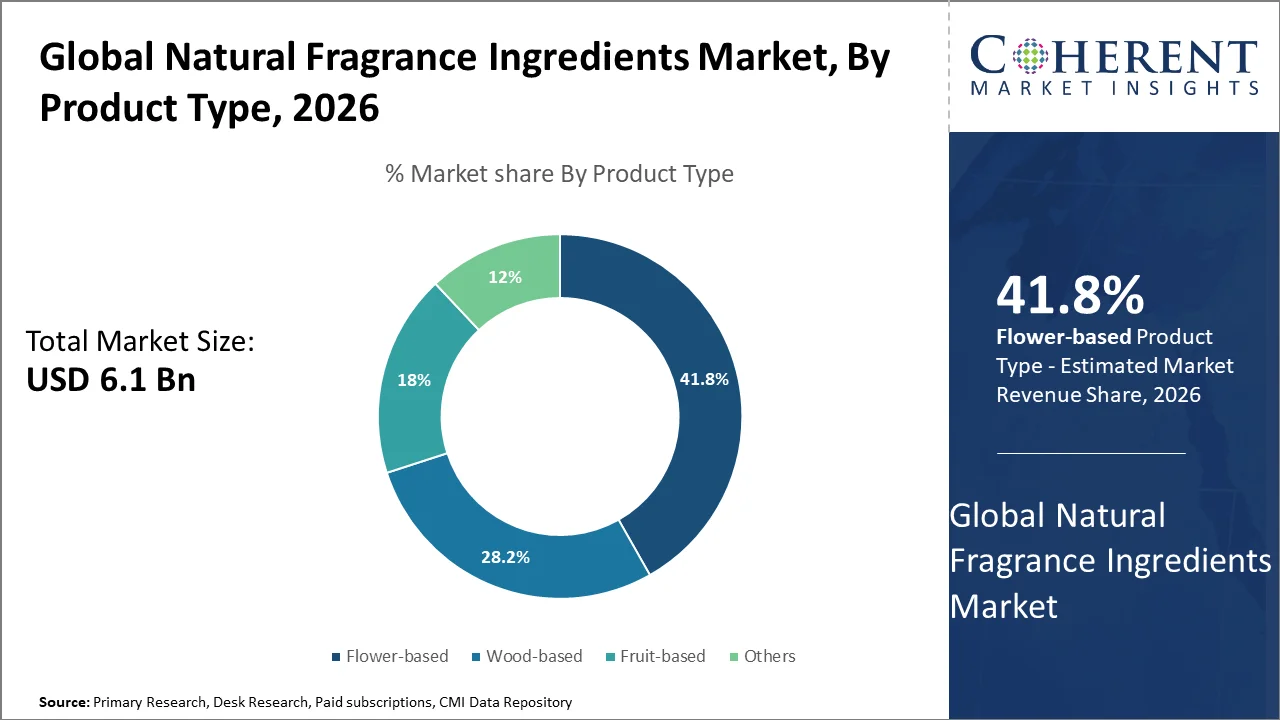
- Flower-based fragrance ingredients are expected to lead the market with a share of 41.8% in 2026 due to extensive use of rose, jasmine, lavender, and other floral extracts in perfumes, cosmetics, and personal care products. For example, IFRA reports that around 90,000 hectares of land globally are dedicated to fragrance crops such as lavender and rose, supporting the availability of floral fragrance ingredients.
- Cosmetics & toiletries are set to account for the largest revenue share of 35.7% in 2026, owing to high consumption of natural fragrances in skincare, haircare, deodorants, and personal care products. For example, a 2025 NSF survey found that 74% of consumers consider organic ingredients important in personal care products, highlighting rising demand for natural ingredients in skincare, cosmetics, soaps, and shampoos.
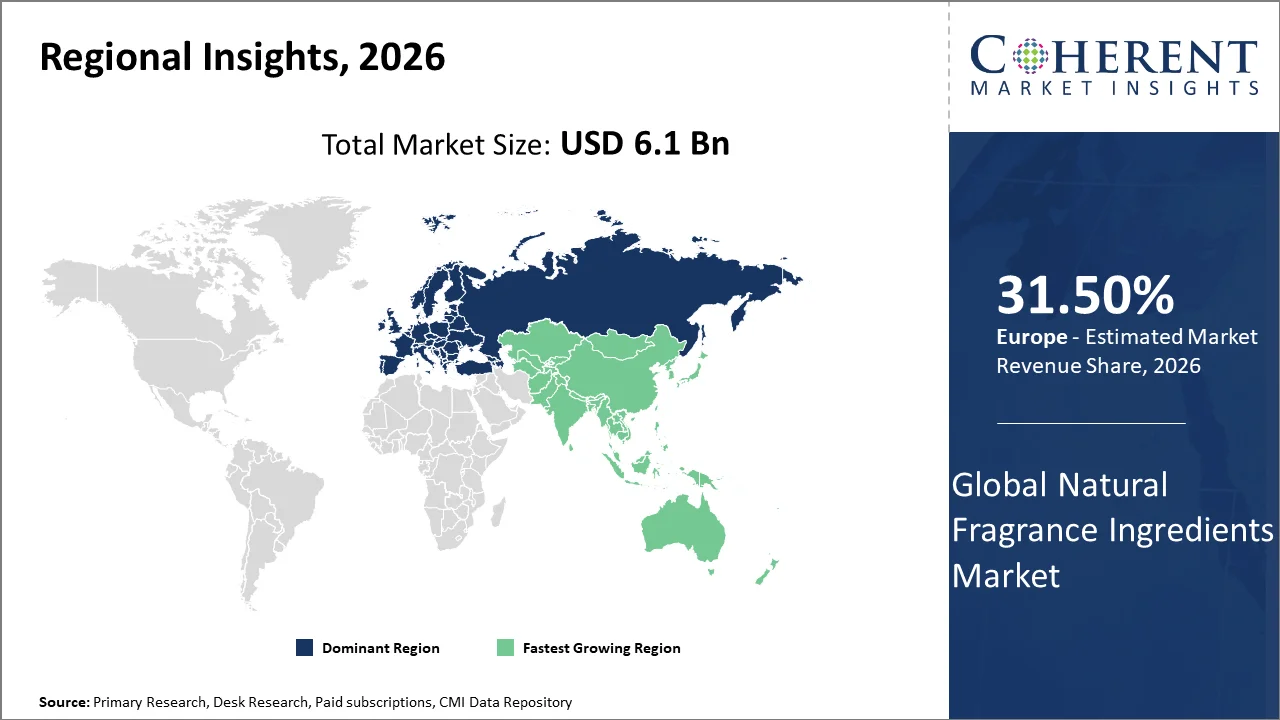
- Europe is projected to dominate the global natural fragrance ingredients industry with a share of 31.50% in 2026 due to presence of leading fragrance manufacturers, high demand for premium natural perfumes, stringent regulations promoting natural ingredients as well as strong cosmetics industry. For example, Europe’s cosmetics industry recorded €104 Bn in retail sales in 2024, driving demand for natural fragrance ingredients in personal care products.
- Asia Pacific, registering a CAGR of 9.2%, is anticipated to emerge as the fastest-growing market for natural fragrance ingredients during the forecast period, thanks to expanding cosmetics and personal care industries, increasing demand for natural and clean-label products as well as abundant availability of botanical raw materials in nations like China, India, Indonesia, and Japan.
Natural Fragrance Ingredients Market Overview
The global natural fragrance ingredients market is projected to grow steadily during the forecast period. This growth is primarily driven by increasing consumer preference for natural and sustainable personal care and cosmetic products, rising demand for sustainable and plant-based ingredients, and growing awareness of the potential health concerns associated with synthetic fragrances. Expanding applications of natural fragrance ingredients across perfumes, skincare, home care, and aromatherapy products are also boosting market growth.
Natural fragrance ingredients are derived from natural sources such as fruits, flowers, herbs, spices, woods, and resins. They are widely used in perfumes, essential oils, deodorants, soaps, detergents, hair care products, and other personal care products. These ingredients are valued for their pleasant aroma, plant-based origin, and compatibility with the growing demand for clean-label and sustainable products.
Natural fragrance ingredients are increasingly being incorporated into cosmetics, personal care, and household products as manufacturers respond to changing consumer preferences. This is expected to support growth of the natural fragrance ingredients market during the forecast period.
Growing consumer interest in wellness and aromatherapy is creating new growth opportunities for the natural fragrance ingredients market. Increasing awareness of mental well-being and self-care is set to drive demand for essential oils and natural aromatic ingredients used in aromatherapy, home fragrances, and personal care products during the forthcoming period.
Growth of premium and personalized fragrances is expected to boost sales of natural fragrance ingredients during the forecast period. Consumers are showing greater interest in unique, premium, and personalized fragrance experiences. This, is turn, is encouraging fragrance manufacturers to develop innovative blends using floral, fruit, spice, and botanical-based ingredients.
Expansion of natural beauty and organic product markets is forecast to open new growth opportunities for natural fragrance ingredients market players during the forthcoming period. Cosmetics and toiletry brands are reformulating products to meet demand for vegan, cruelty-free, and naturally sourced ingredients.
For instance, in May 2025, Unilever announced an £80 million investment to build a new fragrance facility in the UK featuring advanced R&D laboratories, AI-enabled formulation technologies as well as robotics. The investment is expected to accelerate fragrance innovation and increase demand for high-quality and sustainable natural fragrance ingredients used in personal care and home care products.
Segmental Insights
Which Product Type Dominates the Global Natural Fragrance Ingredients Market?
Flower-Based Fragrance Ingredients Hold More Than Two-Fifths of the Market Share
According to Coherent Market Insights’ natural fragrance ingredients market analysis, flower-based segment is slated to lead the market, accounting for a revenue share of 41.8% in 2026. This dominance can be attributed to widespread use of floral extracts such as rose, jasmine, lavender, ylang-ylang, and neroli in perfumes, personal care products, cosmetics, and aromatherapy.
Flower-ingredients are valued for their rich aroma, consumer preference for natural and premium fragrances, and compatibility with clean-label and sustainable product formulations. Rising demand for botanical ingredients in the beauty and wellness industries as well as increasing adoption of natural fragrances by premium perfume brands is also expected to boost growth of the flower-based segment during the forecast period.
Leading fragrance manufacturers are expanding their floral ingredient portfolios to meet growing demand for innovative scent solutions. For example, in March 2024, The ingredient supports the development of premium fragrances and personal care products, highlighting continued innovation in floral fragrance solutions.
- Current Industry Events of 2026
- Market Size Estimation
- Regional Breakdown
- Competitive Landscape
- Customer Intelligence
- Segmental Analysis
- Pricing Analysis
- Key Market Drivers, Challenges & Future Trends
- Customized Insights Section
Which Application Accounts for the Largest Natural Fragrance Ingredients Market Share?
Cosmetics & Toiletries Account for Over One-Third of Market Revenue in 2026
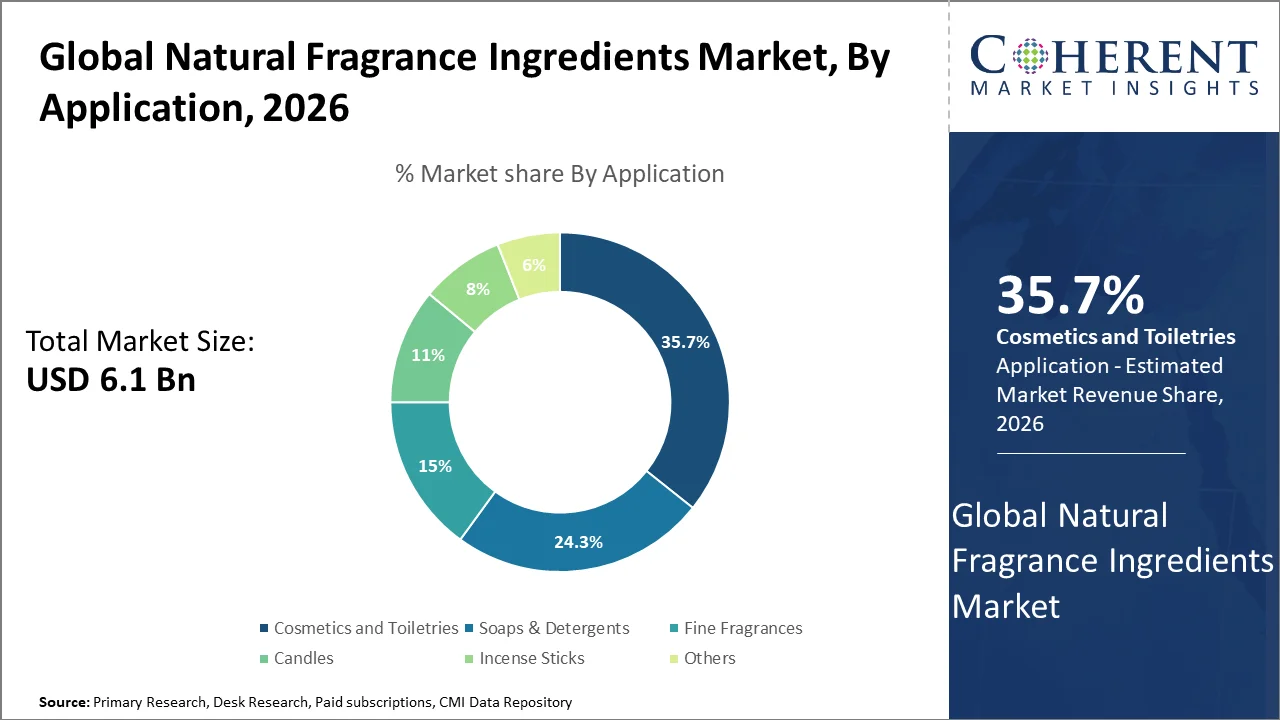
Based on application, cosmetics & toiletries segment is projected to account for the largest revenue share of 35.7% in 2026. This is mostly due to rising consumer preference for natural and clean-label personal care products. Likewise, increasing demand for botanical and plant-derived fragrances in skincare, haircare, and beauty products is set to boost segment growth during the forthcoming period.
Manufacturers are increasingly adopting natural fragrance ingredients to meet consumer demand for cleaner formulations and address growing concerns related to skin sensitivity, allergies, and environmental sustainability. In addition, expansion of premium and organic cosmetics brands continues to support the adoption of natural fragrance ingredients across the global cosmetics and toiletries industry.
Cosmetics manufacturers are also investing in naturally derived ingredients to develop more sustainable beauty products. For example, in 2024, L’Oréal expanded its Green Sciences initiatives to develop bio-based ingredients for cosmetic formulations, reflecting the industry’s growing shift toward sustainable and natural ingredient solutions.
Natural Fragrance Ingredients Market Growth Drivers
Rising Demand for Clean-Label and Natural Products
Growing consumer preference for clean-label, plant-based, and transparent formulations is increasing the use of natural fragrance ingredients in perfumes, cosmetics, and personal care products. Consumers in the contemporary world are increasingly shifting away from synthetic fragrances and seeking products containing botanical extracts, essential oils, and naturally derived scent profiles. This trend is expected to drive growth of the natural fragrance ingredients market during the forecast period.
Natural Fragrance Ingredients Market Opportunities
Expanding Applications in Cosmetics and Personal Care
Increasing adoption of natural fragrance ingredients in cosmetics and personal care products is expected to create lucrative growth opportunities during the forecast period. The skincare, haircare, and beauty industries are experiencing steady global expansion, which is driving demand for botanical and wellness-focused formulations. Natural fragrances are increasingly used to enhance product appeal and meet consumer preferences for clean-label, sustainable, and plant-based personal care products.
Natural Fragrance Ingredients Market Trends
Shift Towards Sustainability and Eco-Friendly Ingredients
Rising demand for sustainable and ethically sourced fragrance ingredients is a key market trend. Companies are increasingly focusing on sustainable extraction methods and responsible sourcing of natural raw materials. This transition toward renewable, biodegradable, and responsibly sourced fragrance ingredients due to growing environmental awareness and sustainability concerns is expected to support market growth in the coming years.
For example, The company aims to responsibly source 100% of its key natural Perfumery & Beauty ingredients by 2030 and is developing upcycled and bio-based solutions to reduce resource use as well as lower environmental impact.
Current Events and Their Impact on the Natural Fragrance Ingredients Market
Current Event | Description and its Impact |
IFRA Advances 52nd Amendment to Fragrance Safety Standards (2026) |
|
EU Deforestation Regulation (EUDR) Nears Implementation (2026) |
|
Regional Insights
Europe Remains ate the Epicenter of Natural Fragrance Ingredients Market Growth
Europe is expected to lead the global natural fragrance ingredients market, accounting for a 31.50% share in 2026. This dominance can be attributed to presence of leading fragrance manufacturers, high demand for premium natural perfumes and cosmetics as well as increasing consumer preference for sustainably sourced and plant-based fragrance ingredients. Growing investments in sustainable fragrance innovation are also supporting market expansion.
Sustainability remains a key trend in the European fragrance industry. According to Givaudan, its Fine Fragrance business recorded 18.3% like-for-like sales growth in 2025, reflecting continued demand for premium fragrances and ongoing investments in natural and responsibly sourced ingredients. As a result, the Europe natural fragrance ingredients market outlook remains optimistic.
Asia Pacific Emerges as the Fastest-Growing Natural Fragrance Ingredients Market
Asia Pacific natural fragrance ingredients market is expected to witness the highest CAGR of 9.2% during the forecast period. The growth is mostly due to rising demand for natural cosmetics and personal care products, expanding beauty and fragrance industries, increasing disposable incomes, and growing preference for clean-label and botanical ingredients across the region
Rapid expansion of the cosmetics industry across nations like South Korea, China, and is fueling demand for natural fragrance ingredients. According to the The continued growth of beauty product exports is driving higher demand for natural fragrance ingredients used in skincare, haircare, and perfumes.
Natural Fragrance Ingredients Market Outlook – Country-wise
U.S. Natural Fragrance Ingredients Market Trends
The United States is projected to remain a key market for natural fragrance ingredients during the assessment period. This is mostly due to rising demand for clean-label beauty and personal care products, increasing consumer preference for plant-based and organic ingredients, and the growing popularity of aromatherapy and wellness-focused products.
For example, the U.S. personal care products industry generated USD 495.6 billion in total economic output in 2024. This reflects strong demand for cosmetics and personal care products that use natural fragrance ingredients. Continuous product innovation by fragrance and cosmetics companies is also expected to support market growth.
France Natural Fragrance Ingredients Market Forecast
The natural fragrance ingredients market in France is anticipated to grow rapidly during the assessment period. This is attributable to the country's strong perfume manufacturing industry, increasing focus on premium and luxury fragrances, growing adoption of sustainably sourced botanical ingredients as well as rising investments in natural fragrance innovation by leading perfume houses.
For example, France's cosmetics industry exported €22.5 billion worth of products in 2024. This shows the country's strong perfume and fragrance manufacturing base as well as supports demand for natural fragrance ingredients.
Who are the Major Companies in the Natural Fragrance Ingredients Market?
Some of the major players in natural fragrance ingredients market are Givaudan S.A, Symrise A.G, International Flavors & Fragrances Inc., Takasago International Corporation, Mane S.A, Sensient Technologies Corporation, Fermenich International S.A., and BASF S.E.
Key Strategies Adopted by Industry Players
Leading manufacturers of natural fragrance ingredients are adopting various organic and inorganic strategies to boost their revenue as well as gain a competitive edge in the industry. These include new product launches, increasing investments in R&D, acquisitions, partnerships, collaborations, mergers, and distribution agreements. Companies are also expanding their production capacities, strengthening their global distribution networks, sourcing sustainable raw materials, and focusing on innovation to meet the growing demand for clean-label and eco-friendly fragrance ingredients.
- In June 2026, BASF Aroma Ingredients launched Micadelva, a new citrus fragrance ingredient. Micadelva was developed as a non-allergenic alternative to orange terpenes for use in fragrance products.
- In June 2026, IFF launched SENSORA, a patent-pending pro-fragrance technology platform. SENSORA uses light-activated technology to release fragrance over time in home, fabric, and personal care products.
- In June 2026, Givaudan launched Scentaurus Aquamelon, a new fragrance precursor for hair care. The new ingredient helps provide a longer-lasting fresh scent on hair after washing and drying.
- In September 2025, Givaudan Fragrance Ingredients launched Labdanum Absolute SIGNature, a new natural fragrance ingredient. The ingredient was developed to provide a unique scent profile while supporting more sustainable sourcing.
Market Report Scope
Natural Fragrance Ingredients Market Report Coverage
| Report Coverage | Details | ||
|---|---|---|---|
| Base Year: | 2025 | Market Size in 2026: | USD 6.1 Bn |
| Historical Data for: | 2020 To 2024 | Forecast Period: | 2026 To 2033 |
| Forecast Period 2026 to 2033 CAGR: | 8.2% | 2033 Value Projection: | USD 10.6 Bn |
| Geographies covered: |
| ||
| Segments covered: |
| ||
| Companies covered: | Givaudan S.A, Symrise A.G, International Flavors & Fragrances Inc., Takasago International Corporation, Mane S.A, Sensient Technologies Corporation, Fermenich International S.A., and BASF S.E. | ||
| Growth Drivers: |
| ||
| Restraints & Challenges: |
| ||
Analyst Opinion (Expert Opinion)
- Demand is shifting toward plant-based ingredients. Consumers increasingly prefer fragrances made from natural sources because they are seen as more transparent and environmentally friendly. This is encouraging manufacturers to expand their portfolios of essential oils, botanical extracts, and other natural ingredients.
- Transparency of natural ingredients has become a competitive advantage. The 2025 IFRA Transparency List consists of 3,691 fragrance ingredients out of which 1,021 are classified as Natural Complex Substances (NCSs). This signifies the industry’s increased emphasis on the documentation and identification of natural fragrance ingredients.
- Sustainability has become a major business consideration. Businesses are now making efforts to adopt sustainable farming practices and form long-term associations with suppliers to ensure a steady supply of natural fragrance ingredients. Improved supply chain strengthens the ingredient supply and helps achieve sustainability objectives.
Speak to the analyst
Want personalized insights?
Take the findings above to one of our principal consultants, or have the report rebuilt around the segments, geographies and competitors you actually track.
Market Segmentation
- By Product Type (Revenue, USD Bn, 2021-2033)
- Wood-based
- Flower-based
- Fruit-based
- Others
- By Application (Revenue, USD Bn, 2021-2033)
- Soaps & Detergents
- Cosmetics and Toiletries
- Fine Fragrances
- Candles
- Incense Sticks
- Others
- By Region Insights (Revenue, USD Bn, 2021-2033)
- North America
- U.S.
- Canada
- Latin America
- Brazil
- Argentina
- Mexico
- Rest of Latin America
- Europe
- Germany
- U.K.
- Spain
- France
- Italy
- Russia
- Rest of Europe
- Asia Pacific
- China
- India
- Japan
- Australia
- South Korea
- ASEAN
- Rest of Asia Pacific
- Middle East
- GCC Countries
- Israel
- Rest of Middle East
- Africa
- South Africa
- North Africa
- Central Africa
Sources
Primary Research interviews
- Manufacturers of natural fragrance ingredients
- Essential oil producers
- Raw material suppliers and distributors
- Cosmetic and personal care product manufacturers
- Fragrance houses
- Industry experts and consultants
- Regulatory professionals
- Senior executives (CEOs, VPs, Product Managers, Marketing Managers)
Databases
- Eurostat
- UN Comtrade Database
- FAOSTAT
- ITC Trade Map
- OECD Data
- World Bank Open Data
- UNCTADstat
Magazines:
- Perfumer & Flavorist
- Cosmetics & Toiletries
- Happi Magazine
- Personal Care Magazine
- BeautyMatter
Journals
- Journal of Essential Oil Research
- Flavour and Fragrance Journal
- Industrial Crops and Products
- Journal of Applied Research on Medicinal and Aromatic Plants
- Molecules
Newspapers
- Financial Times
- The Wall Street Journal
- The Economic Times
- Business Standard
- The Hindu BusinessLine
Associations
- International Fragrance Association (IFRA)
- International Organization of the Flavor Industry (IOFI)
- European Federation of Essential Oils (EFEO)
- American Herbal Products Association (AHPA)
- Cosmetics Europe
- ASEAN Cosmetics Association
Public Domain sources
- World Health Organization (WHO)
- Food and Agriculture Organization (FAO)
- United Nations (UN)
- World Trade Organization (WTO)
- European Commission
- U.S. Food and Drug Administration (FDA)
- European Chemicals Agency (ECHA)
- U.S. Department of Agriculture (USDA)
Proprietary Elements
- CMI Data Analytics Tool
- Proprietary CMI Existing Repository of information for last 10 years
Get access to 250+ pages report
Every segment, forecast, competitor profile and data table behind the analysis above — available for instant download.
- ESOMAR Member
- ISO 9001:2015 Certified
- D-U-N-S Registered
- GDPR & CCPA Compliant
Missing comfort of reading report in your local language? Find your preferred language:
Transform your Strategy with Exclusive Trending Reports
Frequently Asked Questions
Natural fragrance ingredients are aromatic substances obtained from plants, flowers, fruits, spices, woods, and resins through physical processes such as steam distillation or cold pressing. They are widely used in perfumes, cosmetics, personal care, and household products.
The global market is estimated to be valued at USD 6.1 Bn in 2026.
The global Natural Fragrance Ingredients Market value is expected to reach USD 10.6 Bn by 2033.
The global market is poised to exhibit a CAGR of 8.2% from 2026 to 2033.
Major growth factors include rising consumer demand for natural and clean-label products, increasing preference for sustainable and plant-based ingredients, growing use of natural fragrances in personal care, cosmetics, and household products, and stricter regulations on synthetic chemicals.
Flower-based fragrance ingredients are expected to lead the market with a share of 41.8% in 2026.
Cosmetics and toiletries account for the largest market share because natural fragrances are increasingly used in skincare, haircare, deodorants, soaps, and other personal care products