

Neuropeptide Y Acetate Market Size and Forecast — 2026 - 2033
The Global Neuropeptide Y Acetate Market size is estimated to be valued at USD 142.3 million in 2026 and is expected to reach USD 256.7 million by 2033, exhibiting a compound annual growth rate (CAGR) of 9.0% from 2026 to 2033.
Overview
Neuropeptide Y acetate is a synthetic form of a naturally occurring neuropeptide involved in regulating appetite, stress response, cardiovascular function, and neurological signaling. The product is primarily used in biomedical research, drug discovery, and experimental therapeutic studies. It is supplied in highly purified forms for laboratory use and is employed to study metabolic disorders, neurological conditions, and neuroendocrine pathways. In some cases, it supports early-stage pharmaceutical development.
Key Takeaways
The Synthetic Neuropeptide Y Acetate product type dominates with a 65% market share, propelled by advancements in synthetic chemistry enabling high purity and scalability.
Pharmaceutical Research remains the largest application segment, accounting for over 40% of overall market revenue, reflecting the substantial demand from neuropharmacological studies.
North America holds the largest industry share owing to robust funding, strong pharmaceutical infrastructure, and leading biopharma companies.
Asia Pacific is the fastest-growing regional market, driven by expanding research capabilities and favorable governmental biotech policies, reflecting a CAGR outperformance relative to other regions.
Neuropeptide Y Acetate Market Segmentation Analysis
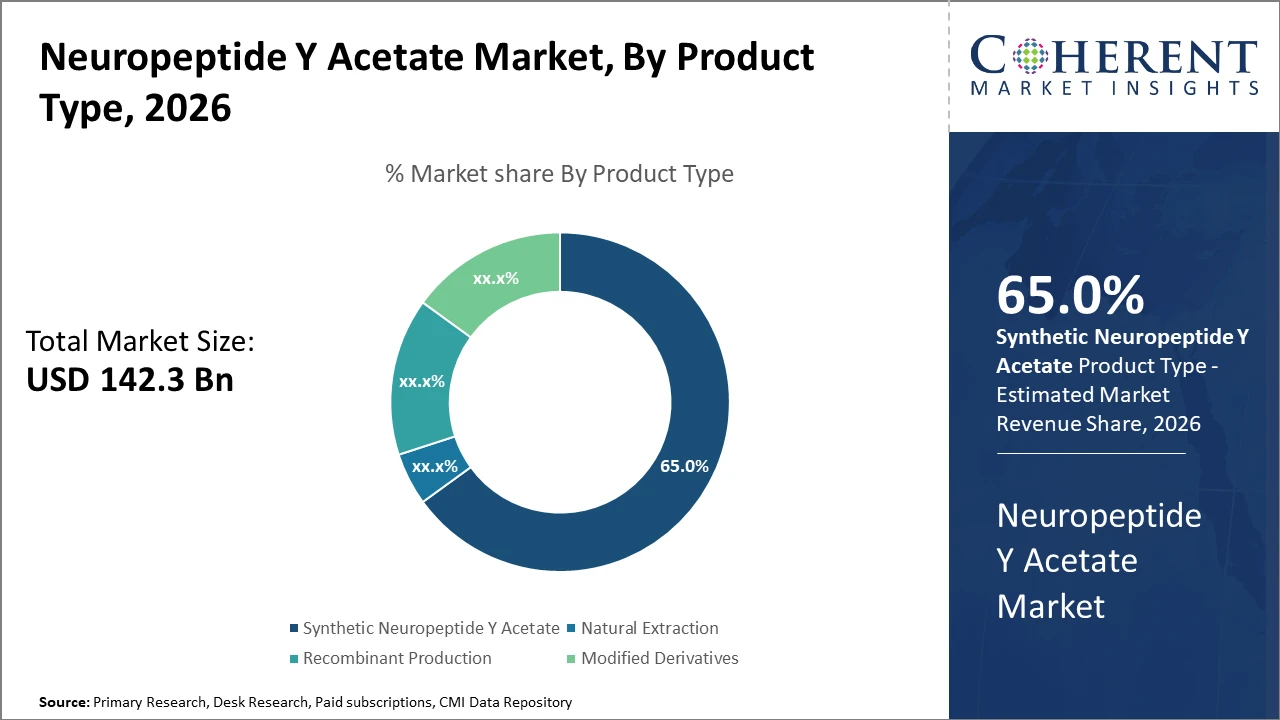
Neuropeptide Y Acetate Market Insights, By Product Type
Synthetic Neuropeptide Y Acetate dominates the market share at 65%. Synthetic variants lead due to scalability, higher purity levels, and consistency in bioactivity, making them ideal for pharmaceutical research and clinical applications. The fastest growing subsegment is Modified Derivatives, fueled by increasing demand for customized peptide analogues with enhanced stability and receptor selectivity, offering tailored therapeutic benefits. Natural Extraction subsegment caters to niche markets where biologically derived peptides are preferred but remains limited by high production costs and lower yields. Recombinant Production, though smaller, is gaining traction, driven by biotechnological advancements enabling cost-effective peptide generation in microbial systems.
Neuropeptide Y Acetate Market Insights, By Application
Pharmaceutical Research dominates the market share at over 40%. This segment’s growth is propelled by extensive usage of Neuropeptide Y Acetate in neuropharmacological studies and preclinical testing, where peptide functionality insights are critical. The fastest growing segment is Therapeutic Development, propelled by an increasing number of clinical trials targeting obesity, anxiety, and cardiovascular disorders using Neuropeptide Y analogues, expanding the market scope. Diagnostics applications focus on biomarker research and assay development, experiencing steady growth due to advancements in detection technologies.
Neuropeptide Y Acetate Market Insights, By End-User
Academic and Research Institutions dominate the market share due to large-scale investigational and exploratory studies requiring Neuropeptide Y Acetate. The fastest growing end-user segment is Biotechnology Companies engaged in exploratory drug development and commercialization activities aiming for next-generation peptide therapeutics. CROs are expanding service portfolios to include custom synthesis and testing services, capturing growing outsourcing demand, while Hospitals are mainly end-users in diagnostic applications with relatively limited but growing consumption due to personalized medicine initiatives. The diversified end-user base underscores varied demand drivers and business growth opportunities across the Neuropeptide Y Acetate market.
Neuropeptide Y Acetate Market Trends
Market trends for Neuropeptide Y Acetate emphasize growing integration of nano-carrier technologies, improving pharmacological efficacy and safety profiles as identified in studies published in 2025 and 2026.
Additionally, the trend towards sustainable peptide manufacturing has gained momentum, with manufacturers worldwide adopting green chemistry protocols, further bolstering regulatory and customer acceptance.
Emerging use cases outside traditional neuroscience domains, especially in metabolic and cardiovascular indications, are reshaping market dynamics and creating new revenue streams.
Neuropeptide Y Acetate Market Insights, By Geography
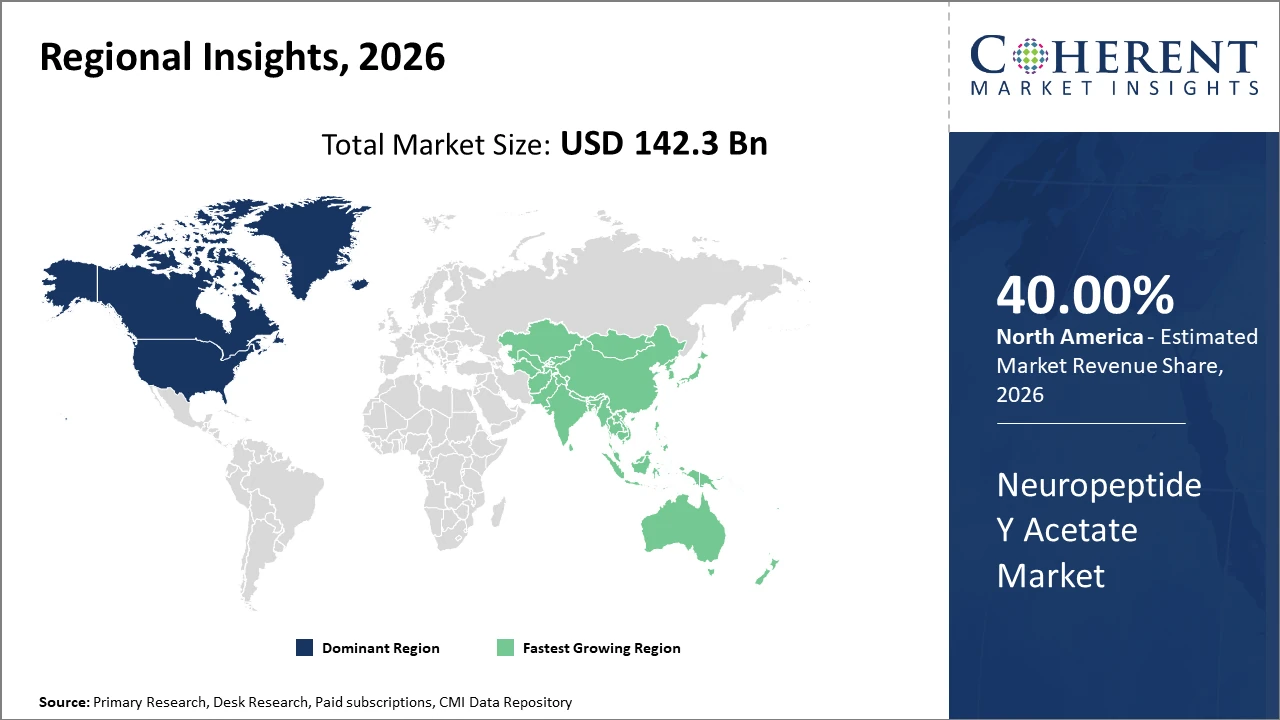
North America Neuropeptide Y Acetate Market Analysis and Trends
In North America, the dominance in the Neuropeptide Y Acetate market stems from extensive investments in biotech infrastructure, leading pharmaceutical research centers, and government-backed initiatives enhancing neuropeptide research. The region commands over 40% industry share, supported by companies such as Thermo Fisher Scientific and Bachem with strong manufacturing and distribution networks. Regulatory support and a growing pipeline of neuropeptide-based drugs underscore North America as the cornerstone of market revenue.
Asia Pacific Neuropeptide Y Acetate Market Analysis and Trends
Meanwhile, the Asia Pacific exhibits the fastest growth with a CAGR surpassing 11%. Factors such as expanding biotech hubs in China and India, increased R&D spending, and supportive national biotech policies have propelled demand significantly. Companies like China Peptides Co., Ltd., and GenScript Biotech Corporation play a pivotal role in scaling production and extending market reach. The evolving research landscape, focused on cost-effective peptide solutions and diagnostic advancements, fuels this rapid expansion.
Neuropeptide Y Acetate Market Outlook for Key Countries
USA Neuropeptide Y Acetate Market Analysis and Trends
The USA’s Neuropeptide Y Acetate market is driven by sophisticated pharmaceutical R&D ecosystems, with substantial increases in NIH funding for neurodegenerative disease research between 2024 and 2026. Leading players based in the USA have pioneered peptide synthesis automation and proprietary purification technologies, significantly improving product quality and availability. This has attracted multiple biopharma firms to utilize Neuropeptide Y Acetate in advanced therapeutic pipelines, resulting in over 25% market revenue growth in 2025.
China Neuropeptide Y Acetate Market Analysis and Trends
China’s burgeoning biotech manufacturing sector and increasing government support for peptide-based drug development characterize its market scenario. Initiatives such as the “Made in China 2025” have boosted local production capacity by more than 30% within 2024-2026, reducing dependence on imports. Market players like China Peptides Co., Ltd. and GenScript have led expansions in peptide catalogues and custom peptide synthesis services, capturing both domestic and export markets, reflecting a robust growth trajectory and emerging innovation hubs.
Analyst Opinion
Within the supply-side dynamics, production capacity for synthetic peptides, including Neuropeptide Y Acetate, has increased by approximately 18% year-over-year between 2024 and 2026, enabling manufacturers to meet rising demand across pharmaceutical and research applications. For instance, advancements in solid-phase peptide synthesis techniques have reduced production cycle times by 20%, improving output.
On the demand front, neurological disease research funding surged by over 12% globally in 2025, directly fueling increased procurement of Neuropeptide Y Acetate as a research reagent and therapeutic candidate across academic and private sectors. Laboratories and biopharma companies involved in neurodegenerative disease studies have expanded peptide usage by 15% since 2024.
Micro-indicators such as pricing elasticity have revealed stable price growth with an average annual increase of 3.5% seen in key markets during 2024-2026, due to controlled supply and increased production costs linked to high-grade raw materials and purity requirements. However, technological innovations continue to offset these impacts by enhancing cost efficiency.
Finally, nano-scale indicators focusing on import-export trade flows indicate that Asia-Pacific countries, especially India and China, increased their Neuropeptide Y Acetate import volume by 22% between 2024 and 2026, reflecting growing research infrastructure and manufacturing hubs in the region. This trend underscores the expanding global market penetration and rising market revenue from emerging regions.
- Current Industry Events of 2026
- Market Size Estimation
- Regional Breakdown
- Competitive Landscape
- Customer Intelligence
- Segmental Analysis
- Pricing Analysis
- Key Market Drivers, Challenges & Future Trends
- Customized Insights Section
Market Scope
| Report Coverage | Details | ||
|---|---|---|---|
| Base Year: | 2025 | Market Size in 2026: | USD 142.3 billion |
| Historical Data for: | 2020 To 2024 | Forecast Period: | 2026 To 2033 |
| Forecast Period 2026 to 2033 CAGR: | 9.0% | 2033 Value Projection: | USD 256.7 billion |
| Geographies covered: |
| ||
| Segments covered: |
| ||
| Companies covered: | Lonza Group AG, Biomatik Corporation, American Peptide Company, PolyPeptide Group, Creative BioMart, New England Peptide, PeptaNova GmbH, Almac Group, Marek Biotech Ltd., Abgent Inc. | ||
| Growth Drivers: |
| ||
Neuropeptide Y Acetate Market Growth Factors
The increased prevalence of neurological and metabolic disorders acts as a primary market revenue driver, with global cases rising approximately 10% annually, spurring demand for Neuropeptide Y Acetate in therapeutic development. Another critical growth factor is advances in peptide synthesis technologies, which have reduced production time and costs by around 20% from 2024 to 2026, enabling wider accessibility. Furthermore, expanding research grants and government initiatives worldwide have improved laboratory capabilities, facilitating increased consumption of Neuropeptide Y Acetate in diagnostics and preclinical studies. Lastly, growing collaborations between biopharma companies and research institutions have enhanced R&D productivity, accelerating market growth strategies and the adoption of innovative Neuropeptide Y Acetate formulations.
Neuropeptide Y Acetate Market Development
Throughout the 2020–2024 period, suppliers such as Sigma-Aldrich (Merck), Bachem, and Phoenix Pharmaceuticals expanded the availability of Neuropeptide Y (NPY) and related research-grade peptide compounds, supporting preclinical and translational studies into appetite regulation, stress response, metabolic disorders, and neurological diseases. These high-purity peptides have been critical tools for academic and pharmaceutical researchers investigating NPY signaling pathways and their therapeutic relevance.
From 2021 onward, the rapid clinical success of peptide analogs for obesity—most notably GLP-1 receptor agonists such as semaglutide and next-generation candidates like retatrutide—highlighted the central role of NPY-mediated feeding pathways, accelerating broader interest in appetite-modulating neuropeptides. This wave of metabolic therapeutics reinforced NPY’s importance as an upstream regulator of hunger and energy balance, shaping future drug discovery strategies for obesity and related metabolic diseases.
Key Players
Leading Companies of the Market
Lonza Group AG
Biomatik Corporation
American Peptide Company
PolyPeptide Group
Creative BioMart
New England Peptide
Almac Group
Marek Biotech Ltd.
Abgent Inc.
Competitive strategies of these market players include: Bachem Holding AG’s recent expansion into automated peptide synthesizer integration has boosted their production efficiency by 25%, while GenScript Biotech Corporation’s strategic partnerships in Asia-Pacific have expanded market penetration, contributing to a revenue increase of over 15% in 2025. Thermo Fisher Scientific’s focus on proprietary purification processes has led to enhanced product purity and customer retention, steering significant growth in pharmaceutical applications.
Neuropeptide Y Acetate Market Future Outlook
Future development in the Neuropeptide Y Acetate Market is expected to focus on translational research and potential therapeutic applications. Improved peptide stabilization techniques and targeted delivery systems may enable progression from research tools to clinical candidates. Growing interest in neuro-metabolic disorders and stress-related conditions is likely to sustain demand. As peptide-based therapeutics gain regulatory and commercial traction, neuropeptide Y acetate is expected to play a supportive role in drug discovery and early-stage development programs.
Neuropeptide Y Acetate Market Historical Analysis
The Neuropeptide Y Acetate Market has historically been driven by academic and pharmaceutical research into neuroendocrine signaling pathways. Initially isolated and characterized for its role in appetite regulation and stress response, neuropeptide Y became a key molecule in neuroscience and metabolic research. Early usage was limited to laboratory studies due to challenges in synthesis, stability, and delivery. Advances in peptide synthesis and purification gradually improved availability and consistency, enabling broader experimental use. Over time, interest expanded into cardiovascular, psychiatric, and metabolic disorder research, positioning neuropeptide Y acetate as an important research-grade product.
Sources
Primary Research Interviews:
Neuroscientists
Pharmacologists
metabolic researchers
academic investigators
biotech researchers
Databases:
NIH Neuroscience Data
PubChem
OECD Science Data
ClinicalTrials.gov
Magazines:
Nature Neuroscience News
Drug Discovery Today
Science Translational Medicine
BioWorld
Genetic Engineering News
Journals:
Neuropeptides Journal
Journal of Neuroscience
Brain Research
Endocrinology
Molecular Psychiatry
Newspapers:
The Guardian (Science)
Reuters Health
Financial Times (Research)
The New York Times (Neuroscience)
Bloomberg Science
Associations:
Society for Neuroscience
International Society for Neurochemistry
Endocrine Society
NIH
European Neuroscience Association
Get access to 250+ pages report
Every segment, forecast, competitor profile and data table behind the analysis above — available for instant download.
- ESOMAR Member
- ISO 9001:2015 Certified
- D-U-N-S Registered
- GDPR & CCPA Compliant
Missing comfort of reading report in your local language? Find your preferred language:
Transform your Strategy with Exclusive Trending Reports
Frequently Asked Questions
The leading companies include Bachem Holding AG, GenScript Biotech Corporation, Thermo Fisher Scientific Inc., and China Peptides Co., Ltd., all of whom have strong manufacturing capacities and innovative product portfolios driving significant market share.
The market size is projected to grow from USD 142.3 million in 2026 to USD 256.7 million by 2033, exhibiting a CAGR of 9.0% driven by increasing demand in pharmaceutical and diagnostic applications.
The Pharmaceutical Research sector represent the largest end users, accounting for the majority of market consumption and rapid growth due to expanding neurochemical and metabolic disorder research.
The market will witness deeper penetration of innovative delivery systems, eco-friendly synthesis technologies, and diversified therapeutic indications, particularly in obesity and neurodegenerative diseases.
Competition is driven by technological innovation around peptide synthesis and purification, with challenges including high production costs and regulatory compliance increasingly shaping market dynamics.
Leading companies utilize strategic partnerships, R&D collaborations, and automation integration to enhance scale and supply chain efficiency, alongside region-specific market entry tactics tailored to local biotech ecosystems.