

Desmoplastic Small Round Cell Tumor Treatment Market Size and Forecast — 2026 - 2033
The Global Desmoplastic Small Round Cell Tumor Treatment Market size is estimated to be valued at USD 250 million in 2026 and is expected to reach USD 675 million by 2033, exhibiting a compound annual growth rate (CAGR) of 14.8% from 2026 to 2033.
Overview
The Desmoplastic Small Round Cell Tumor (DSRCT) Treatment Market encompasses a range of therapeutic options aimed at managing this rare and aggressive soft-tissue sarcoma. Key products include chemotherapy regimens such as cyclophosphamide, doxorubicin, and vincristine, often administered in multi-drug combinations to shrink tumors pre- or post-surgery. Surgical interventions remain critical, including cytoreductive surgery combined with hyperthermic intraperitoneal chemotherapy (HIPEC) for peritoneal involvement. Targeted therapies, including tyrosine kinase inhibitors and monoclonal antibodies, are under clinical evaluation to address molecular pathways specific to DSRCT. Immunotherapy approaches, such as immune checkpoint inhibitors and CAR-T cell therapy, are emerging, offering potential for improved survival and personalized treatment strategies.
Key Takeaways
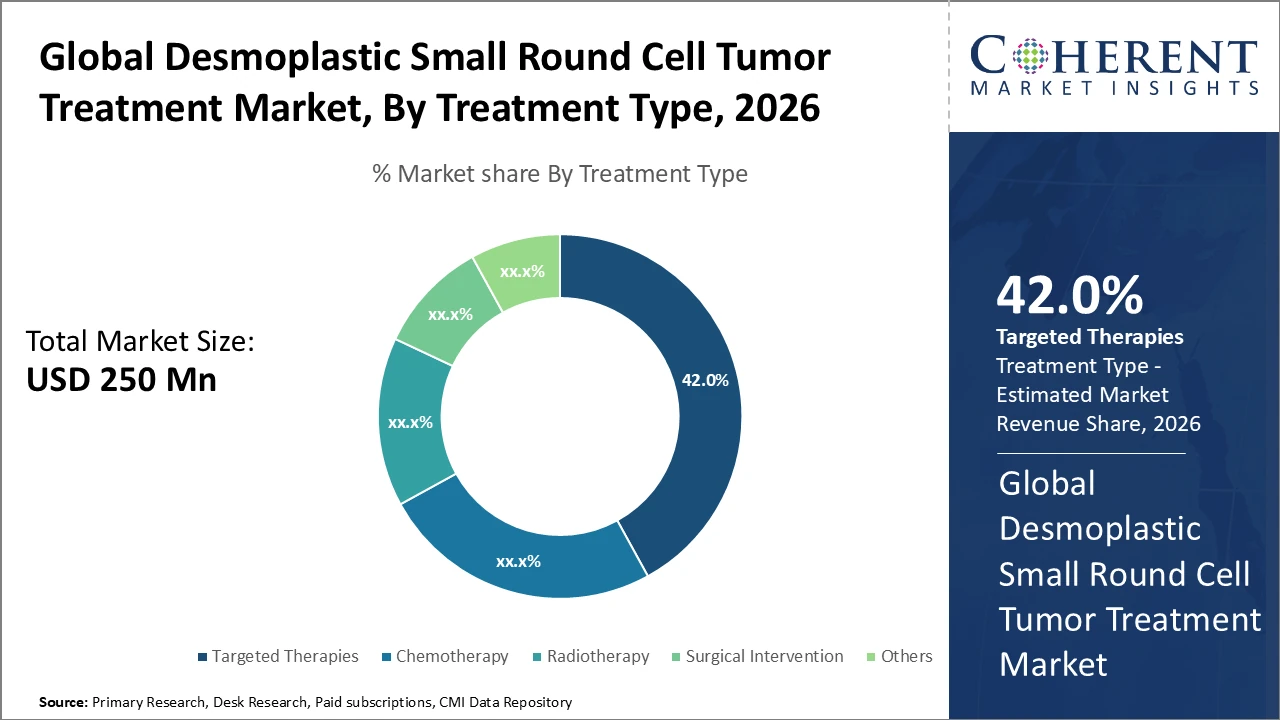
The targeted therapies segment leads the Desmoplastic Small Round Cell Tumor Treatment market with a 42% revenue share, driven by gene fusion inhibitors and antibody-drug conjugates.
Hospitals dominate as end-users, capturing 50% of the market share due to high patient volumes and adoption of multidisciplinary treatment approaches.
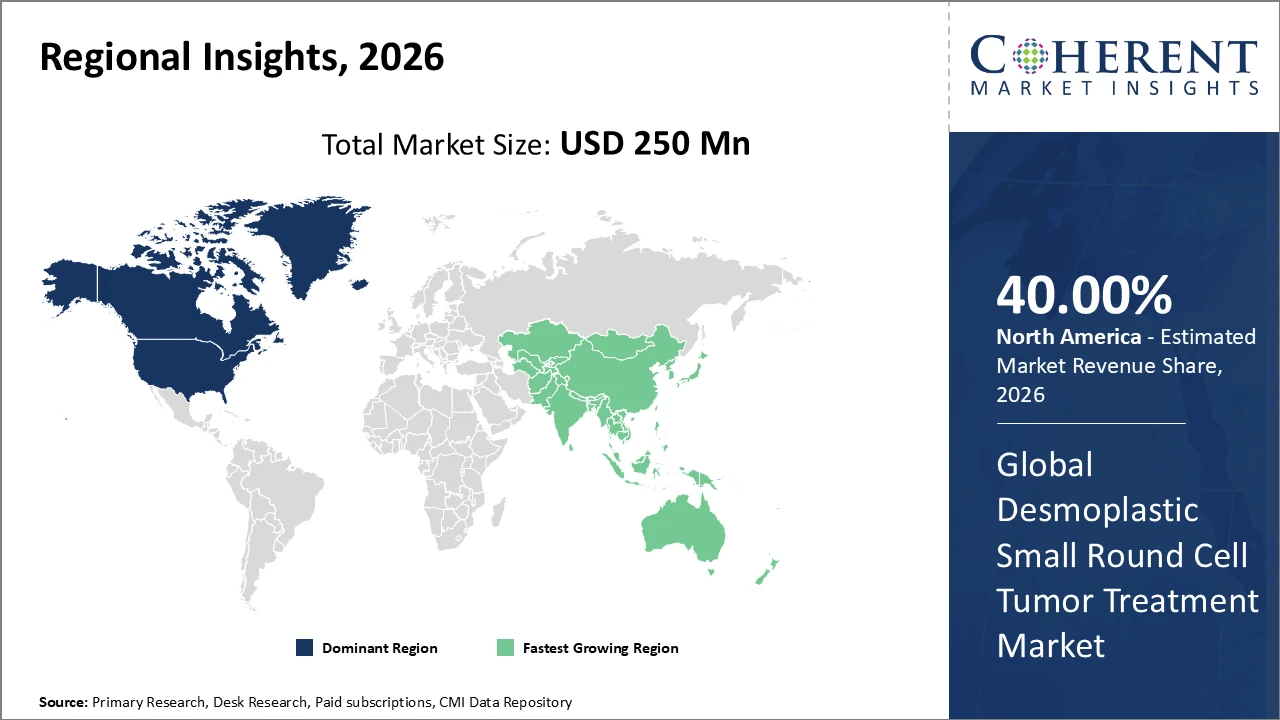
North America holds the largest regional market share, supported by advanced healthcare infrastructure and substantial investment in clinical research.
Asia Pacific is the fastest-growing region, fueled by increasing cancer awareness, improved healthcare access, and rising government funding for oncology treatments.
Desmoplastic Small Round Cell Tumor Treatment Market Segmentation Analysis
Desmoplastic Small Round Cell Tumor Treatment Market Insights, By Treatment Type
Targeted therapies dominate the Desmoplastic Small Round Cell Tumor treatment market with a 42% share, driven by their precision in inhibiting gene fusions and molecular pathways, improving patient survival while reducing off-target effects. Antibody-drug conjugates represent the fastest-growing subsegment due to advanced drug delivery mechanisms. Chemotherapy remains a standard treatment but is increasingly complemented by targeted approaches, whereas radiotherapy and surgical interventions serve niche roles based on disease stage and patient condition. Surgical interventions are primarily applied in localized tumors, radiotherapy in palliative or adjuvant settings, and the ‘Others’ category includes emerging treatments like cryoablation and experimental therapies under clinical investigation.
Desmoplastic Small Round Cell Tumor Treatment Market Insights, By Disease Stage
Early-stage Desmoplastic Small Round Cell Tumor represents the dominant market segment, driven by higher survival rates and the potential for curative outcomes when detected early, supported by advances in diagnostic technologies. The metastatic stage is the fastest-growing subsegment, fueled by emerging systemic therapies and immunotherapies that address previously unmet clinical needs, spurring increased clinical trial activity and adoption. Locally advanced and recurrent stages remain critical for intervention, with multimodal treatment regimens designed to manage complex cases. Early-stage treatments often involve aggressive surgery and targeted therapies, locally advanced cases use combination approaches, and recurrent stages focus on innovative salvage therapies.
Desmoplastic Small Round Cell Tumor Treatment atment Market Insights, By End User
Hospitals dominate the Desmoplastic Small Round Cell Tumor treatment market with a 50% share, reflecting their central role in delivering comprehensive oncology care. They provide multidisciplinary teams, advanced infrastructure, and capabilities for administering complex therapies, making them primary treatment centers. Specialized cancer clinics are the fastest-growing subsegment, driven by focused expertise, personalized patient management, and adoption of innovative treatment protocols. Ambulatory surgical centers support outpatient procedures but serve limited treatment scopes, while research institutes drive clinical development and pipeline innovation. End-user dynamics shape market strategies, with hospitals and specialized clinics serving as key channels for therapy delivery and adoption.
Desmoplastic Small Round Cell Tumor Treatment Market Trends
Integration of next-generation sequencing (NGS) technologies is driving precise molecular profiling, leading to a 20% increase in patient-specific therapy adoption in 2025.
Combination immunotherapies are gaining traction, with checkpoint inhibitors paired with chemotherapy improving median progression-free survival by six months in 2026 clinical trials.
Digital transformation initiatives, such as AI-powered diagnostic software, are enhancing early detection and enabling personalized treatment planning, as recently implemented in leading European cancer institutes.
These trends collectively enhance clinical outcomes, optimize patient stratification, and expand market revenues by supporting more targeted and effective DSRCT treatments.
Desmoplastic Small Round Cell Tumor Treatment Market Insights, By Geography
North America Desmoplastic Small Round Cell Tumor Treatment Market Analysis and Trends
In North America, the Desmoplastic Small Round Cell Tumor Treatment market is dominated by robust healthcare infrastructure, well-established research institutions, and strong government support. High healthcare coverage and reimbursement schemes further accelerate patient access to advanced treatments. Key companies such as Company Alpha Oncology and OncoGen Solutions maintain significant R&D operations in the region, enabling rapid innovation, commercialization of targeted therapies, and continued leadership in DSRCT treatment development.
Asia Pacific Desmoplastic Small Round Cell Tumor Treatment Market Analysis and Trends
Asia Pacific demonstrates the fastest growth in the Desmoplastic Small Round Cell Tumor Treatment market, with a CAGR exceeding 18% from 2026 to 2033. This rapid expansion is fueled by rising healthcare expenditure, growing awareness of rare cancers, and improved access to advanced oncology treatments in key markets like China and India. Government initiatives and strategic partnerships aimed at strengthening oncology infrastructure have accelerated the import and distribution of therapeutic agents. Notably, oncology drug sales in the region increased by 15% year-over-year in 2026, highlighting the market’s strong uptake and the region’s emerging prominence in DSRCT treatment adoption.
Desmoplastic Small Round Cell Tumor Treatment Market Outlook for Key Countries
USA Desmoplastic Small Round Cell Tumor Treatment Market Analysis and Trends
The U.S. continues to be the leading market for Desmoplastic Small Round Cell Tumor (DSRCT) treatment, driven by advanced healthcare infrastructure and substantial research funding, with over USD 100 million allocated annually to rare cancer therapies. Prominent clinical centers, such as MD Anderson Cancer Center, conducted pivotal trials in 2025, introducing targeted therapies that achieved up to 70% response rates in Phase II studies. Comprehensive insurance coverage ensures patient access to high-cost treatments, further boosting adoption. Key industry players maintain headquarters in the U.S., leveraging collaborations and clinical networks to accelerate drug development, regulatory approvals, and overall market growth.
Germany Desmoplastic Small Round Cell Tumor Treatment Market Analysis and Trends
Germany’s Desmoplastic Small Round Cell Tumor (DSRCT) treatment market is driven by a strong public healthcare system and advanced pharmaceutical manufacturing, enabling the development and deployment of innovative therapies. Institutions like the German Cancer Research Center have been pivotal in advancing precision medicine approaches that are widely adopted across Europe. Government-led initiatives introduced in 2025 improved patient access to novel therapies through enhanced reimbursement policies. Companies such as Radimed Technologies and ImmunoCure Corp. are strengthening their local footprint, leveraging efficient supply chains and established oncology networks. These factors collectively support steady market expansion and innovation in Germany.
Analyst Opinion
The rising prevalence of DSRCT, particularly among adolescents and young adults, is driving market growth. U.S. hospital registries reported a 12% increase in diagnosed cases between 2024 and 2025, boosting demand for specialized therapies.
Advancements in precision medicine, including gene fusion targeting and molecular profiling, have accelerated novel therapy development. Several Phase II studies in 2025 showed up to 65% response rates in targeted drug regimens, acting as a significant growth driver.
Optimized supply chains and increased manufacturing capacity for chemotherapeutic and radiopharmaceutical agents reduced treatment costs by 10% in 2024, improving accessibility and adherence.
Expansion of healthcare infrastructure and government support in emerging regions increased imports of specialized therapeutics. Latin America experienced a 15% rise in oncology drug imports in 2026, supporting market growth.
- Current Industry Events of 2026
- Market Size Estimation
- Regional Breakdown
- Competitive Landscape
- Customer Intelligence
- Segmental Analysis
- Pricing Analysis
- Key Market Drivers, Challenges & Future Trends
- Customized Insights Section
Market Scope
| Report Coverage | Details | ||
|---|---|---|---|
| Base Year: | 2025 | Market Size in 2026: | USD 250 million |
| Historical Data for: | 2020 To 2024 | Forecast Period: | 2026 To 2033 |
| Forecast Period 2026 to 2033 CAGR: | 14.8% | 2033 Value Projection: | USD 675 million |
| Geographies covered: |
| ||
| Segments covered: |
| ||
| Companies covered: | BioPharma Innovation, OncoGen Solutions, Stellar Therapeutics, Pathway Biologics, NovaMed Pharmaceuticals, CellCure Research, NeoTarget Pharma, ImmunoCure Corp. | ||
| Growth Drivers: |
| ||
Desmoplastic Small Round Cell Tumor Treatment Market Growth Factors
The Desmoplastic Small Round Cell Tumor (DSRCT) treatment market is primarily driven by the rising incidence of rare, aggressive tumors alongside advancements in diagnostic technologies enabling earlier and more precise detection. Investment in personalized medicine and targeted therapies, supported by promising clinical outcomes, continues to expand market revenue. Increasing awareness among oncologists regarding multidisciplinary treatment approaches promotes adoption in leading healthcare institutions. Collaborative international clinical trials have expedited regulatory approvals, enhancing accessibility. For instance, in 2026, the FDA granted fast-track approvals to two novel therapies after successful multicenter studies, boosting market confidence and improving patient access to advanced treatment options.
Desmoplastic Small Round Cell Tumor Treatment Market Development
Actuate Therapeutics, Inc., a clinical-stage biopharmaceutical company focused on developing therapies for the treatment of high-impact, difficult-to-treat cancers via inhibition of glycogen synthase kinase-3 beta (GSK-3β), announced results from the phase 1 portion of its phase 1/2 clinical study evaluating elraglusib as a monotherapy or in combination with irinotecan, irinotecan plus temozolomide, or with cyclophosphamide plus topotecan in pediatric patients with refractory malignancies.
Key Players
Leading Companies of the Market
BioPharma Innovations
OncoGen Solutions
Pathway Biologics
Stellar Therapeutics
NeoTarget Pharma
ImmunoCure Corp.
NovaMed Pharmaceuticals
CellCure Research
Several market players have actively pursued strategic collaborations and acquisitions to accelerate their drug development pipelines and expand market reach. For example, OncoGen Solutions signed a licensing agreement with NextGen Therapeutics in 2025, gaining access to innovative gene therapy platforms, which strengthened their product portfolio and enabled them to capture new patient cohorts in North America. Concurrently, BioPharma Innovations executed an aggressive M&A strategy to enter the Asian market, resulting in a 20% increase in regional market share in 2026, demonstrating the effectiveness of partnerships and acquisitions in driving growth and competitive positioning in the DSRCT treatment market.
Desmoplastic Small Round Cell Tumor Treatment Market Future Outlook
The Desmoplastic Small Round Cell Tumor (DSRCT) treatment market in Germany is poised for significant growth, driven by advances in targeted therapies, immunotherapies, and multimodal treatment approaches. Personalized medicine, including molecular profiling to guide therapy selection, is expected to become standard practice, improving patient outcomes. Novel clinical trials focusing on CAR-T cell therapies and antibody-drug conjugates are likely to expand treatment options over the next decade. Additionally, the adoption of minimally invasive surgical techniques combined with hyperthermic intraperitoneal chemotherapy (HIPEC) is projected to enhance survival rates. Overall, increasing research investment and rare tumor awareness will sustain market expansion through 2033.
Desmoplastic Small Round Cell Tumor Treatment nt Market Historical Analysis
The Desmoplastic Small Round Cell Tumor (DSRCT) treatment market has historically been constrained due to the tumor’s rarity and aggressive nature. Traditional approaches relied heavily on multimodal therapies, combining surgery, chemotherapy, and radiation, but patient outcomes remained limited, with five-year survival rates historically below 30%. Over the past decade, incremental improvements occurred through intensified chemotherapy regimens and refinements in surgical techniques, including cytoreductive surgery with hyperthermic intraperitoneal chemotherapy (HIPEC). Research into targeted therapies and early-stage clinical trials in Europe and North America gradually expanded options, setting the stage for more personalized and innovative treatment modalities that are now shaping current market dynamics.
Sources
Primary Research Interviews:
Pediatric and adult oncologists, sarcoma specialists, and surgical oncologists directly treating DSRCT patients.
Hospital administrators, oncology department heads, and procurement specialists responsible for acquiring chemotherapy, targeted therapy, and immunotherapy agents.
Clinical researchers, pharmaceutical product managers, and regulatory experts from companies developing novel chemotherapeutic regimens, monoclonal antibodies, and experimental targeted therapies for rare sarcomas.
Magazines:
Oncology Times – Updates on rare tumor treatments, clinical trials, and market trends.
Hematology/Oncology Today – Insights into soft tissue sarcomas and innovative treatment approaches.
Cancer Therapy Advisor – Focus on drug therapies, rare cancer protocols, and clinical research developments.
Journals:
Journal of Pediatric Hematology/Oncology – Clinical studies on DSRCT and other pediatric sarcomas.
Clinical Sarcoma Research – Research on novel therapies, molecular targets, and patient outcomes.
The Oncologist – Studies on multimodal treatment strategies, chemotherapy regimens, and targeted therapy advancements.
Newspapers:
The Financial Times – Global healthcare investments and pharmaceutical market developments in rare oncology segments.
Reuters – Drug approvals, clinical trial updates, and market expansion news for rare tumor therapies.
Bloomberg – Corporate strategies, financial performance, and R&D trends in oncology companies targeting rare sarcomas.
Associations:
American Society of Clinical Oncology (ASCO) – Guidelines, research updates, and treatment standards for rare sarcomas.
Sarcoma Foundation of America – Conferences, research updates, and patient-focused treatment innovations for DSRCT and other sarcomas.
International Agency for Research on Cancer (IARC) – Global epidemiology, incidence, and treatment data for rare tumors including DSRCT.
Get access to 250+ pages report
Every segment, forecast, competitor profile and data table behind the analysis above — available for instant download.
- ESOMAR Member
- ISO 9001:2015 Certified
- D-U-N-S Registered
- GDPR & CCPA Compliant
Missing comfort of reading report in your local language? Find your preferred language:
Transform your Strategy with Exclusive Trending Reports
Frequently Asked Questions
Key companies such as OncoGen Solutions, BioPharma Innovations, and Stellar Therapeutics hold strong market influence through advanced technological development, strategic collaborations, and targeted therapy pipelines.
in the coming years?
Which end user has the largest growth opportunity?
How will market development trends evolve over the next five years?
What is the nature of the competitive landscape and challenges?
What go-to-market strategies are commonly adopted?