Nurse Call System Market Analysis & Forecast: 2026-2033

The Nurse Call System Market is estimated to be valued at USD 2.5 Bn in 2026 and is expected to reach USD 4.81 Bn by 2033, growing at a compound annual growth rate (CAGR) of 9.8% from 2026 to 2033.
The nurse call system market is advancing significantly, driven by the rising demand for digital-first communication and integrated patient safety frameworks in the healthcare sector. The growing consumer awareness regarding patient-centric care and a strategic shift from traditional wired buzzers to IP based wireless platforms are expected to propel market growth over the forecast period. The modern nurse call systems are integrated with Electronic Health Records (EHR) and mobile devices. This makes these systems a vital component in modern hospital and long-term care facility management.
The industry is entering a transformative period owing to the use of advanced IoT-enabled sensors, a surge in the geriatric population requiring continuous monitoring, and the integration of Aritfciall Intelligence (AI) for predictive fall detection and workflow optimization. These advancements enhance the response time, staff efficiency, and data-driven accountability of healthcare providers.
|
Current Event |
Description and the Impact |
|
Global Healthcare Digitalization Trends |
|
|
Impact of Global Workforce Challenges in Healthcare |
|
|
Regional Healthcare Infrastructure Investments in Asia-Pacific |
|
Uncover macros and micros vetted on 75+ parameters: Get instant access to report
AI is transforming the market for nurse call systems by moving away from traditional hardware and toward dynamic, data-driven communication hubs. Its primary goal is to alleviate staff shortages and combat alarm fatigue through intelligent triage. These systems utilize Natural Language Processing (NLP) and machine learning to classify patient requests based on urgency. It assists them to automatically direct routine needs to support staff while escalating critical medical alerts to registered nurses. In addition, AI also facilitates predictive patient monitoring. By connecting to electronic health records (EHRs) and computer vision sensors, these systems can predict falls or clinical deterioration before they happen. The healthcare facilities are moving toward IP-based integrated platforms that provide automated documentation and real-time location services (RTLS).
For instance, in May 2023, West-Com Nurse Call Systems and Vitalchat have teamed up to offer virtual care solutions powered by artificial intelligence. These solutions are designed to cater to the needs and demands of patients, caregivers, providers, and IT leaders in hospital systems and other healthcare facilities across the nation.
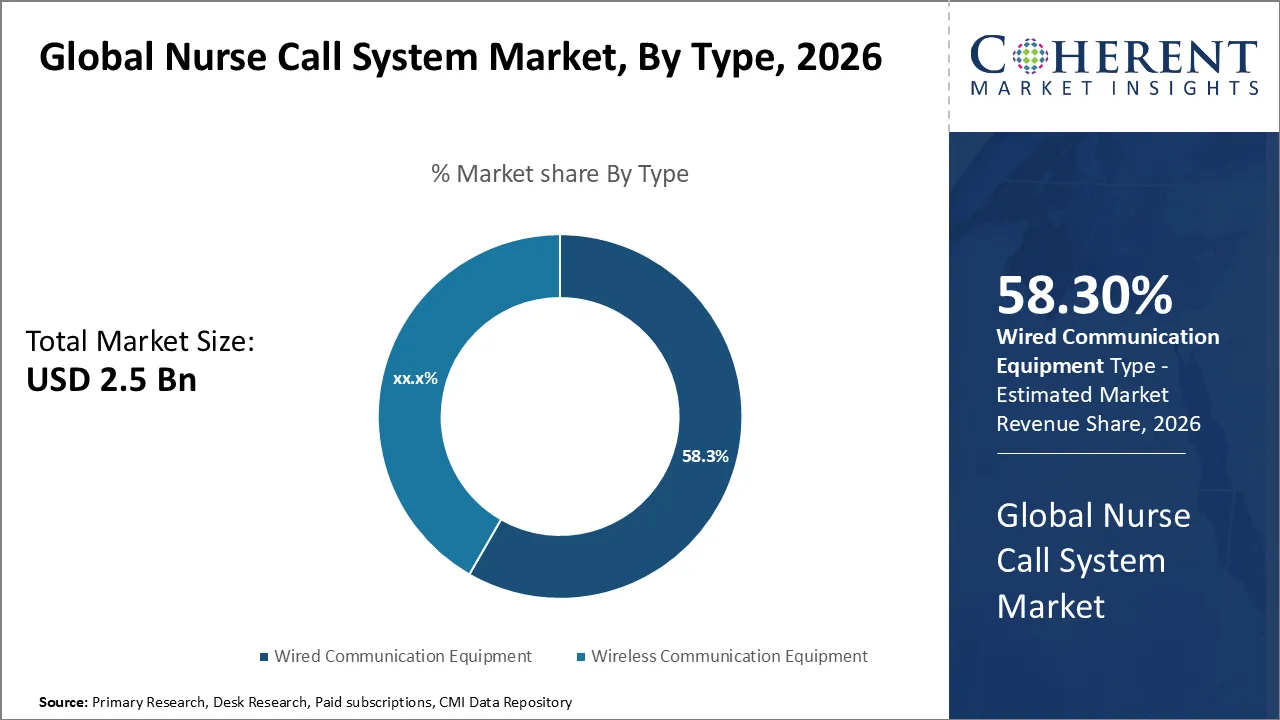
In terms of type, the wired communication equipment segment contributes the highest share of 58.30% in 2026 of the market. The wired systems are immune to signal interference from other medical electronics and do not suffer from signal dropouts within large hospital infrastructures. This reliability is the main reason many regulatory bodies prefer wired installations for critical care environments. While installation expenses for hardwiring are more than wireless setups, the low maintenance requirements make it a cost-effective long-term investment. The modern wired systems have evolved to utilize internet protocol infrastructure to integrate seamlessly with a hospital’s broader network.
For instance, in May 2025, RF Technologies released Enterprise 8.0, featuring wired nurse call integration designed to adapt to emerging technologies. This solution assists in managing communication systems by providing a single software package that oversees all wired and wireless senior living assets.
In terms of service model, the nurse call buttons segment contributes the highest share of 37.60% in 2026 of the market. The growth is owing to its essential role in the healthcare environment. These devices provide a direct tactile interface for patients to request immediate assistance via wall-mounted units or bedside pendants. Their simplicity and reliability in emergency situations where complex interfaces might fail a patient is also contributing to the growth in the market. The demand for physical buttons is strong in emerging economies and geriatric care settings. The nurse call button plays a failsafe function in facilitating communication between patients and staff in clinical settings. The steady replacement cycle of these units ensures a consistent revenue stream for manufacturers.
In terms of end user, the hospitals segment contributes the highest share of 73.20% in 2026 of the market. This dominance is fueled by high patient volumes and the rising need to manage nursing shortages through technological efficiency. The hospitals are adopting cutting-edge nurse call systems to improve patient satisfaction scores by reducing response times. Furthermore, the trend toward smart hospitals has turned these systems into sophisticated workflow engines that integrate with electronic health records. These institutions possess the large-scale budgets required for the adoption of high-end integrated solutions. These institutions possess the large-scale budgets required for the adoption of high-end integrated solutions. The continuous need for infrastructure upgrades in trauma centers and emergency rooms drives steady growth. The hospital is the primary driver for innovation and high-volume procurement within the healthcare technology sector.
For instance, in June 2024, the Orlando Health Dr. P. Phillips Hospital introduced a novel nurse call system aimed at improving communication and patient care. The remote panel provides patients with three additional buttons to request assistance, alongside the standard nurse button.
To learn more about this report, Download Free Sample
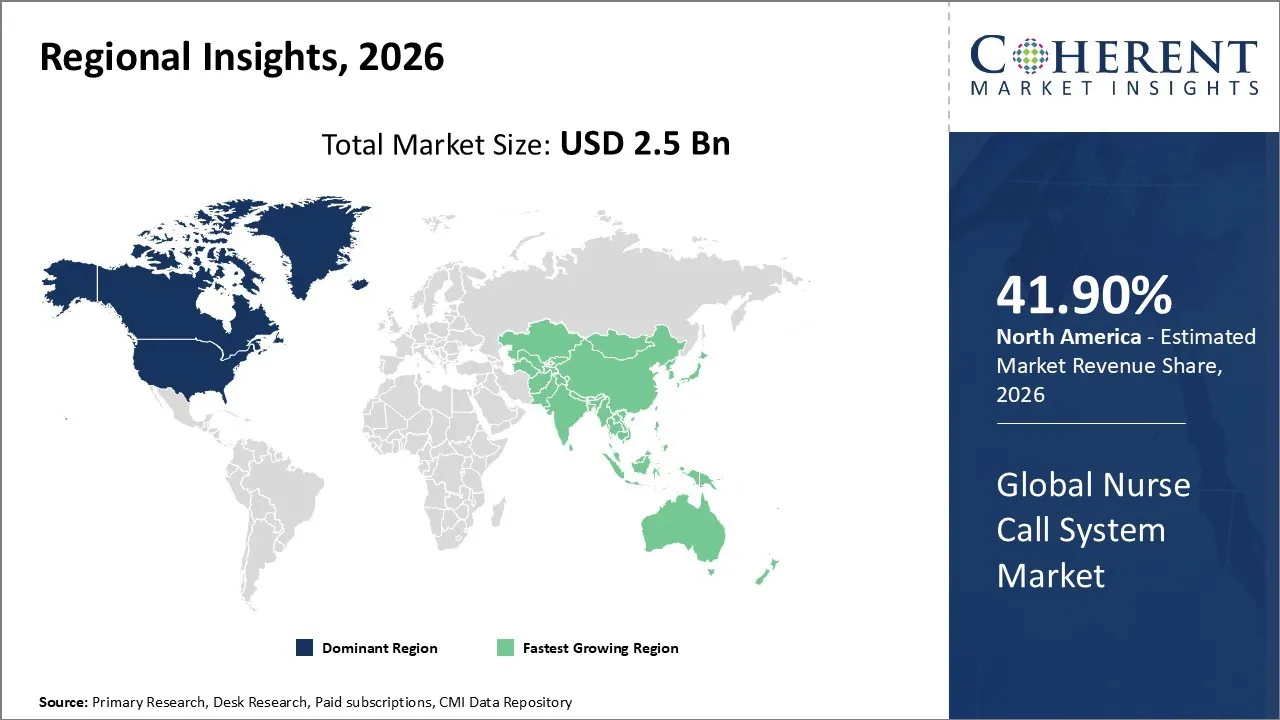
North America is the leading region in the global nurse call system market and will account for a 41.90% share in 2026. The growth can be attributed to several factors, including the aging population, the rising prevalence of chronic diseases, and the necessity for enhanced communication between patients and caregivers. The US is at the forefront of this regional market. The cutting-edge healthcare infrastructure, high levels of digitization in hospitals, and strict safety regulations drive this growth.
Other factors driving the growth in the region include the rapid integration of nurse call systems with hospital IT infrastructures, such as Electronic Health Records (EHRs), Real-Time Location Systems (RTLS), and mobile devices. This integration helps to reduce alarm fatigue and improve workflow efficiency by directing calls to caregivers' mobile devices. The market is evolving from basic audio-visual call buttons to sophisticated, integrated communication platforms that support two-way, IP-based voice communication and fall detection.
The leading companies in the region, including Ascom, Rauland (Ametek), Baxter International (Hillrom), Critical Alert, and Stanley Healthcare, are concentrating on strategic partnerships and product innovations aimed at enhancing patient safety and operational productivity.
For instance, in July 2023, the Lifeline Senior Living division of Connect America has announced a partnership with Amazon's Alexa Smart Properties. This collaboration aims to develop a voice-enabled resident safety system designed to enhance senior care in Assisted and Independent Living communities throughout North America.
The Asia Pacific region is the fastest growing market for nurse call system. The growth can be attributed to countries like Japan, China, and South Korea. These nations are witnessing an increasing aging population as well as a rise in chronic diseases. Consequently, the need for efficient, automated communication between patients and caregivers has become a top priority for healthcare providers. China is at the forefront in the regional market due to substantial government investments in hospital infrastructure and the digital transformation of its healthcare system. India is emerging as the fastest-growing nation owing to a booming private healthcare sector and a nationwide push for Smart Hospital initiatives.
The modern nurse call systems in the region are implementing Internet of Things (IoT) capabilities, Real-Time Location Systems (RTLS), and mobile application integration. This enables nursing staff to remotely manage alerts and patient data. By integrating these systems, alarm fatigue is reduced, and response times are enhanced. The market is anticipated to progress from basic alert buttons to more sophisticated, data-driven platforms designed to enhance patient safety and streamline workflow efficiency. The rise of specialized elderly care facilities and the increasing adoption of cloud-based healthcare solutions is likely to propel the Asia Pacific region to the forefront of the global nurse call system industry.
The US is at the forefront of the nurse call system market. The growth is due to an aging population, an increasing prevalence of chronic diseases, and a heightened need for enhanced patient safety. The key trends influencing the market include the integration of nurse call systems with Electronic Health Records (EHR) and Real-Time Location Systems (RTLS). They are aimed at reducing response times and minimizing alarm fatigue. In addition, the market is substantially impacted by government mandates focused on improving patient care quality, particularly in hospitals and growing long-term care facilities. The major industry players, such as Hill-Rom (Baxter), Rauland (AMETEK), Ascom, and Honeywell, are concentrating on AI-driven analytics, mobile integration, and voice-activated technologies to improve care delivery.
For instance, in June 2023, Cornell Communications unveiled its innovative usage of a Multimedia Engine to substantially enhance the value and utility of nurse call systems for senior care homes.
China is rapidly becoming the fastest-growing market for nurse call systems. This growth can be attributed to substantial government investment in smart hospital infrastructure, as well as the rising prevalence of chronic diseases. The key trends include the integration of artificial intelligence, real-time location services (RTLS), and mobile app connectivity. The goal is to improve the effectiveness of communication between patients and healthcare personnel. The domestic manufacturers are becoming competitive by offering cost-effective, scalable, and sophisticated solutions that are widely adopted in both tier-1 and developing tier-2/3 city hospitals.
| Report Coverage | Details | ||
|---|---|---|---|
| Base Year: | 2025 | Market Size in 2026: | USD 2.5 Bn |
| Historical Data for: | 2020 To 2024 | Forecast Period: | 2026 To 2033 |
| Forecast Period 2026 to 2033 CAGR: | 9.8% | 2033 Value Projection: | USD 4.81 Bn |
| Geographies covered: |
|
||
| Segments covered: |
|
||
| Companies covered: |
Ascom Holding AG, Rauland-Borg Corporation, Hill-Rom Holdings, Inc., Cornell Communications, Inc., Jeron Electronic Systems, Inc., Tyco SimplexGrinnell, TekTone Sound & Signal Mfg., Inc., Vigil Health Solutions, Inc., Critical Alert Systems, LLC, Stanley Healthcare, Caretronic d.o.o., SIDDHANT MEDICAL ENGINEERING, FORBIX SEMICON, Crest Healthcare, Curbell Medical Products, Austco Healthcare Limited |
||
| Growth Drivers: |
|
||
| Restraints & Challenges: |
|
||
Uncover macros and micros vetted on 75+ parameters: Get instant access to report
The increasing demand for enhanced patient safety and high-quality clinical care is the primary driver of the growth in the nurse call system market. The healthcare providers are transitioning from basic signaling devices to integrated communication hubs to eliminate critical delays in treatment. These modern systems significantly bolster safety by facilitating instant and categorized communication, which allows nursing staff to prioritize life-threatening emergencies over routine requests. Furthermore, the integration of specialized features like fall detection sensors and wander management for high-risk patients directly reduces the incidence of hospital-acquired injuries. These systems ensure strict accountability and regulatory compliance by providing a digital audit trail of every appetite interaction.
For instance, in December 2025, Sage launched Sage Skilled, a new solution designed for skilled nursing facilities. This innovative system offers a wireless-first nurse call capability, delivers real-time insights, and integrates workflows to improve care delivery.
The Nurse Call System Market is witnessing steady expansion driven by growing demand for efficient patient-staff communication across healthcare facilities. Industry reports highlight increasing adoption of advanced nurse call solutions, including IP-enabled, wireless, and mobile-integrated systems, which enhance workflow efficiency and clinical responsiveness. Hospitals remain the primary end users, while long-term care centers and assisted living facilities are emerging as significant growth segments due to aging populations and the need for continuous patient monitoring.
Regional trends indicate that North America leads the market, supported by advanced healthcare infrastructure, strict patient safety regulations, and widespread technology integration. Asia Pacific is emerging as a rapidly growing market, fueled by healthcare modernization, increasing facility investments, and rising patient populations.
Technology segmentation shows integrated communication systems gaining prominence for electronic interoperability, while wireless and mobile solutions are increasingly preferred for installation flexibility. Basic button-based setups continue to maintain adoption in cost-sensitive regions. Operational data indicate that facilities deploying advanced nurse call systems experience improved staff response times, optimized workflow, and enhanced patient care delivery.
Overall, the market is evolving from traditional alert mechanisms to essential healthcare communication platforms. Continuous technological upgrades, demographic pressures, and expanding healthcare infrastructure support ongoing adoption and underscore the critical role of nurse call systems in modern clinical and long-term care environments.
Definition: The nurse call system market is a global sector within the healthcare technology industry that provides communication platforms to link patients with their caregivers. The market comprises various hardware and software solutions like traditional button-based alarms, mobile integrated systems, and sophisticated IP based networks. The market has transitioned toward smart hospital integrations where nurse call systems act as a central hub for medical data. These systems now routinely interface with electronic health records and real-time location services to track staff response times and prioritize patient requests automatically. The growth of this industry is owing to an aging population, a critical shortage of nursing staff, and a shift toward data-driven clinical workflows. As a result, the industry is instrumental in modernizing healthcare infrastructure, ensuring patient safety, speeding up response times, and optimizing operational workflows in hospitals and long-term facilities.
Share
Share
About Author
Manisha Vibhute is a consultant with over 5 years of experience in market research and consulting. With a strong understanding of market dynamics, Manisha assists clients in developing effective market access strategies. She helps medical device companies navigate pricing, reimbursement, and regulatory pathways to ensure successful product launches.
Missing comfort of reading report in your local language? Find your preferred language :
Transform your Strategy with Exclusive Trending Reports :
Frequently Asked Questions
Joining thousands of companies around the world committed to making the Excellent Business Solutions.
View All Our Clients
 Schedule a meeting with report Author