

Poultry Vaccine Market Size and Trends 2026-2033
Poultry Vaccine Market is estimated to be valued at USD 2,391.3 Mn in 2026 and is expected to reach USD 4,124.9 Mn in 2033, exhibiting a compound annual growth rate (CAGR) of 8.1% from 2026 to 2033.
Key Takeaways
- Based on Region, North America is expected to dominate the market with 41.5%, owing to the increase in zoonotic diseases across the United States.
- Based on Disease, the Bronchitis segment is expected to dominate the market with 36.5%, owing to the increase in incidences of infectious bronchitis.
- Based on Technology, the Live Attenuated Vaccines segment is expected to lead the market, due to its widespread applications.
Market Overview
The global poultry vaccine market is experiencing strong growth due to the increase in the incidence of zoonotic diseases and the increasing poultry population around the world. Furthermore, a rise in demand for safe and effective vaccines and favorable initiatives taken by several government agencies and animal associations are expected to boost the growth of the market.
Current Events and Their Impacts
Current Events | Description and its impact |
Technological Advancements and Corporate Strategies |
|
Technological Innovations in Vaccine Development |
|
Export Analysis of Poultry Vaccine
Between October 2023 and September 2024 (TTM), the world imported a total of 2,241 poultry vaccine shipments. These were supplied by 131 exporters and delivered to 145 global buyers, reflecting a 12% increase compared to the previous 12-month period. In September 2024 alone, 183 shipments were imported—representing a 41% year-over-year increase from September 2023.
- Current Industry Events of 2026
- Market Size Estimation
- Regional Breakdown
- Competitive Landscape
- Customer Intelligence
- Segmental Analysis
- Pricing Analysis
- Key Market Drivers, Challenges & Future Trends
- Customized Insights Section
Segmental Insights
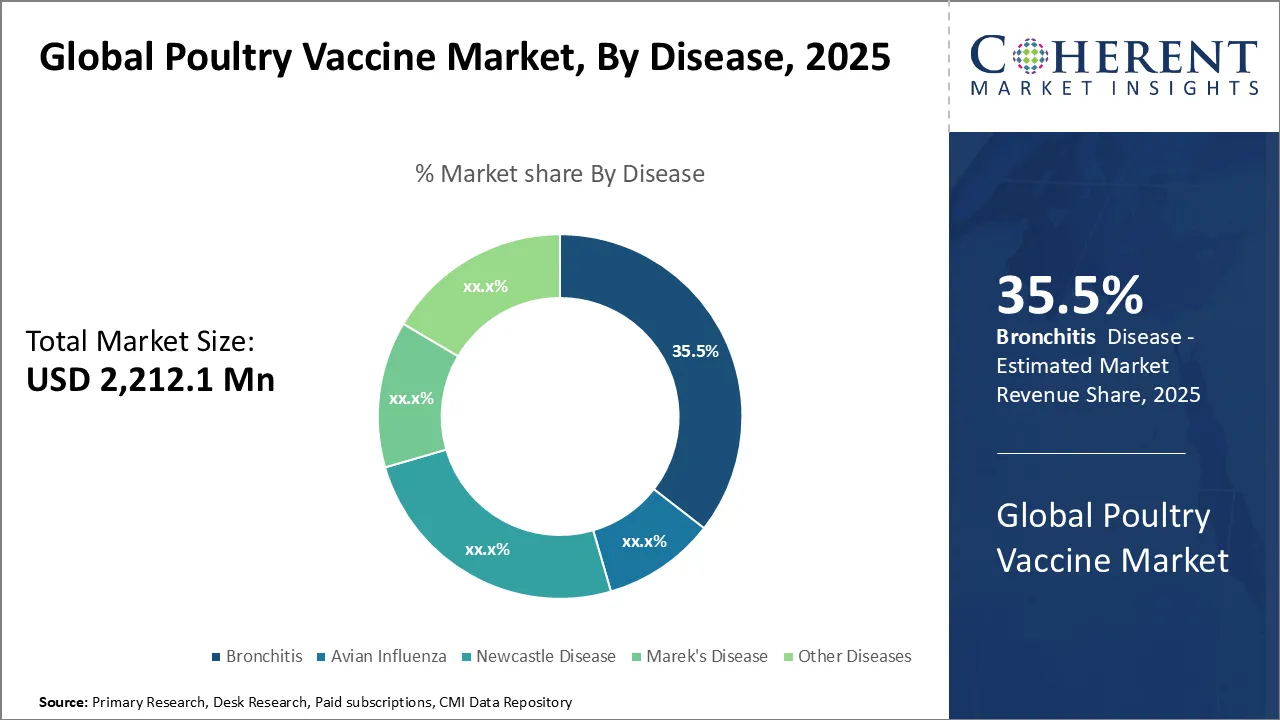
Poultry Vaccine Market Insights, By Disease
The Bronchitis Segment is Growing Due to The Increase in Incidences of Infectious Bronchitis
The market is segmented into Bronchitis, Avian Influenza, Newcastle disease, Marek's Disease, and Other Diseases. Out of which, the Bronchitis Segment is expected to dominate the poultry vaccine market with a share of 36.5% in 2026, and this is attributed to the increase in the burden of bronchitis. Infectious bronchitis is a common, highly contagious disease that affects poultry animals. It is a very common disease and has high morbidity. For instance, Boehringer Ingelheim has introduced HatchPak IB H120™ NeO, a freeze-dried live attenuated virus vaccine containing the H120 strain. It is designed for the active immunization of day-old chicks to help reduce infections caused by the Massachusetts serotype of the Infectious Bronchitis virus. However, the Avian Influenza Segment is also expected to witness robust growth shortly, and this is owing to the increase in the burden of avian diseases. Avian influenza or bird flu refers to the disease caused by infection with avian (bird) influenza (flu) Type A viruses.
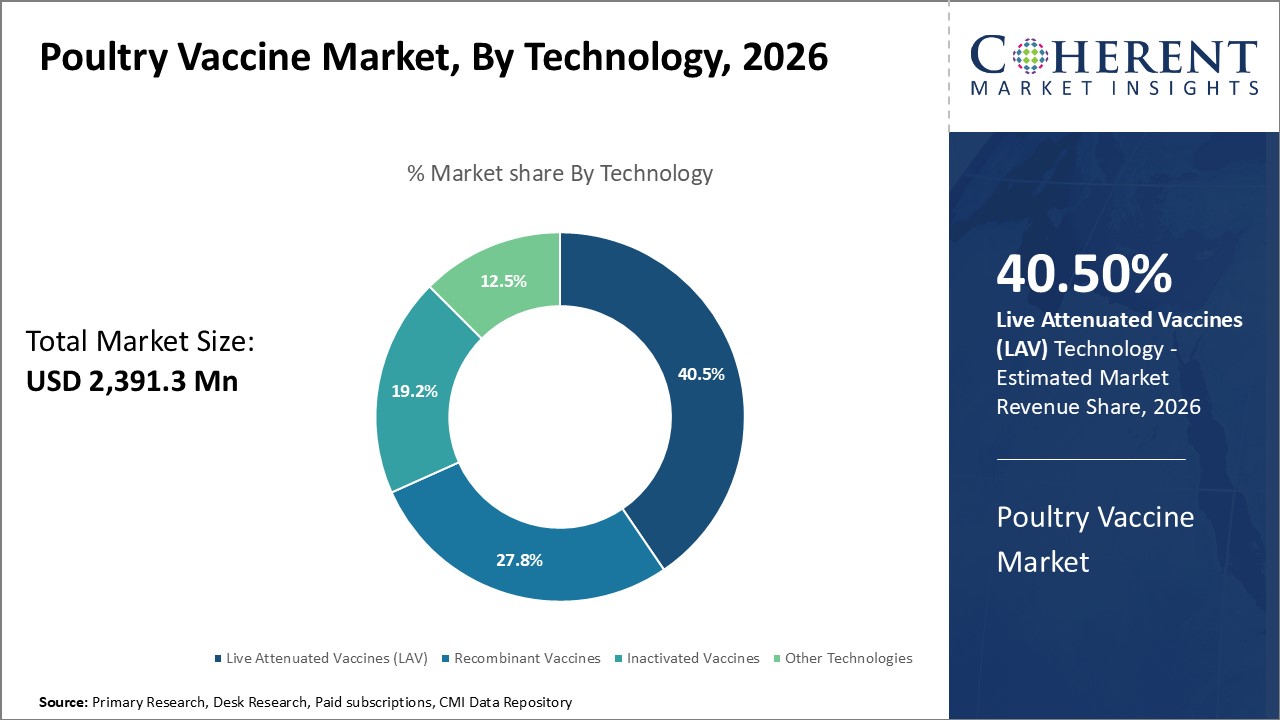
Poultry Vaccine Market Insights, By Technology
The Live Attenuated Vaccines Is Growing Due to Its Widespread Applications
The poultry vaccine market is segmented into Live Attenuated Vaccines (LAV), Recombinant Vaccines, Inactivated Vaccines, and Other Technologies. Out of which, the Live Attenuated Vaccines (LAV) Segment is expected to dominate the market over the forecast period, and this is attributed to the increase in usage of live attenuated vaccines. Live attenuated vaccines (LAV) are being widely applied to vaccination programs. For instance, in January 2026, the USDA gave approval to import a live Avian Metapneumovirus (aMPV) vaccine, Vaxxon®SHS. The vaccine provides enhanced protection against respiratory disease in chickens. The Recombinant Vaccines Segment is also expected to witness significant growth shortly and this is owing to the increase in demand for recombinant vaccines. Recombinant viruses were employed as bivalent, live-virus vaccines to immunize chickens against avian influenza.
Regional Insights
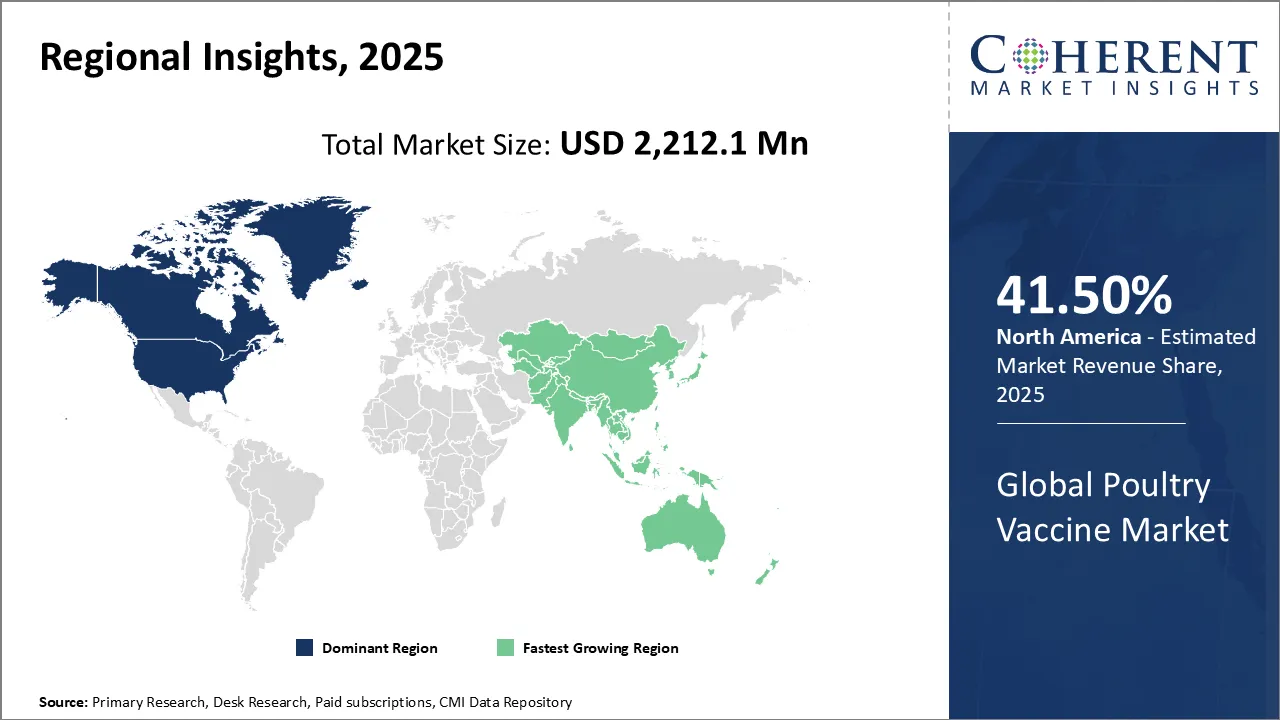
North America Poultry Vaccine Market Trends
Among regions, North America is expected to gain the highest share in the market , over the forecast period, owing to the increasing incidences of zoonotic diseases and favorable initiatives taken by government agencies and animal associations in the region. Growth is supported by rising poultry consumption and the intensification of commercial farming, where maintaining flock health is critical. Technological advancements, like recombinant and vector vaccines, offer broader protection and ease of administration—for instance, in-ovo and spray-delivered vaccines reduce labor costs and improve coverage. Government support for disease control programs and partnerships with biotech firms also play a key role, encouraging innovation and wider vaccine adoption across the poultry production chain.
U.S. Poultry Vaccine Market Trends
The U.S. is the largest market for poultry vaccines in North America. The growth here is driven by a wide variety of factors, including stringent regulations laid by the USDA, biosecurity protocols, and the adoption of vector vaccines. For instance, in May 2026, the USDA approved a new vaccine for avian influenza. The vaccine is developed in collaboration with U.S. biotech firms.
Canada Poultry Vaccine Market Trends
Canada also follows the United States. It is the second-largest market for poultry vaccines. The market in the country is shaped by the programs laid forward by the government and the rise in zoonotic diseases. There is also a rise in the demand for organic poultry and good production standards is also fueling the adoption of advanced vaccines. For instance, in June 2026, Canada announced its plans to purchase avian influenza vaccines to curb the threat of H5N1 in poultry.
Asia Pacific Poultry Vaccines Market Trends
Asia Pacific is also expected to witness robust growth in the global poultry vaccine market due to the rising incidence of diseases in poultry, increasing demand to secure food sources, and favorable initiatives taken by the government in this region. For instance, according to the National Centre for Disease Control (NCDC), more than 75% of emerging and re-emerging infections are zoonotic, and new pathogens (viruses) continue to emerge and spread across countries. This is further accelerating the poultry vaccine market demand.
China Poultry Vaccine Market Trends
China acquires the prominent share in the Asia Pacific region. It is largely driven by the immunization programs carried by the government, mandatory vaccinations, technical advancements, etc.
India Poultry Vaccine Market Trends
India is the second- largest market for poultry vaccines in Asia Pacific. The Indian market is primarily driven by the rise in prevalence of diseases, particularly the Newcastle and Infectious Bursal diseases. For instance, in July 2026, ICAR- National Institute of Veterinary Epidemiology and Disease Informatics developed a new-gen poultry vaccine for Marek’s disease. It was launched in Hyderabad, Telangana. Such developments are accelerating the poultry vaccine market growth in India.
Market Report Scope
Poultry Vaccine Market Report Coverage
| Report Coverage | Details | ||
|---|---|---|---|
| Base Year: | 2025 | Market Size in 2026: | USD 2,391.3 Mn |
| Historical Data for: | 2020 To 2024 | Forecast Period: | 2026 To 2033 |
| Forecast Period 2026 to 2033 CAGR: | 8.1% | 2033 Value Projection: | USD 4,124.9 Mn |
| Geographies covered: |
| ||
| Segments covered: |
| ||
| Companies covered: | Zoetis Inc., Merck & Co. Inc., Elanco, Ceva Santé Animale, Boehringer Ingelheim, Biovac, Hester Biosciences Limited, Dechra Pharmaceuticals PLC, Venky’s Limited, and Phibro Animal Health Corporation, among others. | ||
| Growth Drivers: |
| ||
| Restraints & Challenges: |
| ||
Market Dynamics
Poultry Vaccine Market Trends
Increase in demand for safe vaccines poultry vaccine worldwide is expected to provide significant growth opportunities for players in the poultry vaccine market. For instance, with the increase in prevalence or incidence of poultry and zoonotic diseases, the demand for safe and effective vaccines is also increasing worldwide. In December 2022, Hester Biosciences signed an agreement to obtain indigenous technology, to develop and commercialize a poultry low-pathogenic avian influenza. Hester acquired the technology from the Indian Council of Agricultural Research-National Institute of High Security Animal Diseases (ICAR-NIHSAD).
Favorable initiatives taken by government agencies, such as animal associations, are expected to provide significant growth opportunities for players in the global poultry vaccine market. For instance, World Health Organization (WHO) has identified antimicrobial resistance as a public health threat. Many public health bodies and veterinary regulatory agencies, such as the Committee for Medicinal Products for Veterinary Use (CVM, P), are responsible for implementing the European Union’s One Health Action Plan against antimicrobial resistance by deploying several policies of the Veterinary Medicines Regulation. This, in turn, is driving the poultry vaccine market growth.
A rise in focus on vaccine development
Over the years, the poultry vaccines market has evolved rapidly in terms of product development. Players in the market, as well as researchers and new vaccine companies, are focusing on developing and launching safe and effective vaccines in the market. Researchers at the Pirbright Institute have developed a new method of genetically-modified vaccines to protect against infectious bursal disease (IBD), avian influenza, and Newcastle disease. This trend is expected to continue over the forecast period, driving the poultry vaccine market share.
An increase in the use of biotechnologies
The poultry industry has leveraged biotechnologies to improve the safety and convenience of avian vaccination. The vector technology scheme/plan is expected to play an important role in delivering the active component of the vaccine to the animal. For instance, Merial's VAXXITEK HVT + IBD is one of the leading vector vaccines, available in about 75 countries worldwide. The development of new technologies will stimulate the development of improved products to protect against dangerous strains of the virus. This trend is also expected to continue the market growth during the forecast period.
Poultry Vaccine Market Drivers
The rise in the burden of zoonotic diseases to driving market growth
One of the key factors expected to augment the growth of the global poultry vaccine market during the forecast period is the rise in the incidence of zoonotic diseases worldwide. For instance, zoonosis comprises a large percentage of all newly identified infectious diseases and many existing ones. According to the World Health Organization (WHO), there are over 150 zoonotic diseases around the world, which are transmitted to humans by both wild and domestic animal populations, 13 of which are responsible for 2.2 million deaths per year. This, in turn, is expected to increase demand for poultry vaccines, driving the growth of the market.
Poultry population to propel market growth
Another factor which is driving the growth of the global poultry vaccine market is the increasing poultry population around the world. With the increase in poultry population, the risk of zoonotic diseases as well as the demand for safe and effective poultry vaccines is also increasing rapidly. For instance, the number of chickens worldwide has more than doubled since 1990, according to the Food and Agriculture Organization (FAO) of the United Nations. The number of chickens, which was 14.38 billion in 2000, reached 25.9 billion in 2019. The largest share of this presence belongs to Asia, a country. This is, in turn is also driving the market growth.
Key Developments
- In July 2025, Square Pharmaceuticals in Bangladesh launched Volva. It is a suite of poultry vaccines from Boehringer Ingelheim. The introduction of Volvac is anticipated to enhance farm-level immunity, and improve egg production quality.
- In October 2022, Zoetis expanded its poultry vaccine portfolio with the introduction of Poulvac Procerta HVT-IBD-ND, a recombinant vector vaccine that provides early/robust protection against Marek’s, infectious bursal, and Newcastle disease viruses with one dose.
- In April 2022, Elanco, in collaboration with Ginkgo Bioworks, launched a new animal healthcare company called BiomEdit to develop drugs, nutritional products, and disease-monitoring methods for livestock. The new firm hopes to address antibiotic resistance and improve sustainability.
Analyst Viewpoint
- The poultry vaccine market is not just driven by innovation, it is driven by need and urgency. With diseases like Newcastle disease and avian influenza is harming the poultry economy across continents and regions.
- Live attenuated vaccines are particularly used to curb the outbreak of Newcastle disease, it remains dominant, however a heavy reliance on such traditional vaccines is unsustainable. There is a lack in the adoption of recombinant vaccines. These vaccines have the capability of offering a durable immunity. One other dynamic that is often overlooked is the fragmentation of the cold chain infrastructure in the market. This poses as a bottleneck.
Market Segmentation
- Global Poultry Vaccine Market, By Disease (Revenue, USD Mn, 2021 - 2033)
- Bronchitis
- Avian Influenza
- Newcastle disease
- Marek's Disease
- Other Diseases
- Global Poultry Vaccine Market, By Technology (Revenue, USD Mn, 2021 - 2033)
- Live Attenuated Vaccines (LAV)
- Recombinant Vaccines
- Inactivated Vaccines
- Other Technologies
- Global Poultry Vaccine Market, By Geography (Revenue, USD Mn, 2021 - 2033)
- North America
- U.S.
- Canada
- Latin America
- Brazil
- Argentina
- Mexico
- Rest of Latin America
- Europe
- Germany
- U.K.
- Spain
- France
- Italy
- Russia
- Rest of Europe
- Asia Pacific
- China
- India
- Japan
- Australia
- South Korea
- ASEAN
- Rest of Asia Pacific
- Middle East
- GCC Countries
- Israel
- Rest of Middle East
- Africa
- South Africa
- North Africa
- Central Africa
- North America
- Key Player Insights (Revenue, USD Mn, 2021 - 2033)
- Zoetis Inc.
- Merck & Co. Inc.
- Elanco
- Ceva Santé Animale
- Boehringer Ingelheim
- Biovac
- Hester Biosciences Limited
- Dechra Pharmaceuticals PLC.
- Venky’s Limited
- Phibro Animal Health Corporation
Sources
Primary Research Interviews
- Industry experts from poultry health companies
- Veterinary doctors and livestock consultants
- Poultry farm owners and managers
- Regional distributors and wholesalers of poultry vaccines
Databases
- World Bank Data
- UN Comtrade Database
- FAO (Food and Agriculture Organization of the United Nations) Statistics
Magazines
- Poultry World
- World Poultry
- Poultry International
- The Poultry Site Magazine
Journals
- Avian Diseases
- Journal of Veterinary Science & Technology
- Poultry Science
- Veterinary Microbiology
Newspapers
- The Hindu – Business Line (Agriculture & Livestock section)
- The Economic Times – Agriculture section
- The New York Times – Food & Agriculture updates
- The Times of India – Business & Livestock Reports
Associations
- World Organisation for Animal Health (WOAH / OIE)
- Indian Veterinary Association (IVA)
- American Association of Avian Pathologists (AAAP)
- All India Poultry Breeders Association (AIPBA)
- European Poultry Vaccination Association (EPVA)
Public Domain Sources
- FAO publications on animal health and biosecurity
- WHO reports on zoonotic and poultry-related diseases
- USDA Animal and Plant Health Inspection Service (APHIS) reports
- Ministry of Fisheries, Animal Husbandry & Dairying (India)
- CDC reports related to avian influenza and poultry vaccination
*Definition: Vaccines help to prevent any particular disease by boosting the bird’s immune system to produce antibodies, which in turn, fight against a variety of organisms and diseases. helpsbirdsy vaccine helps birds develop immunity protects them against diseases.
Get access to 250+ pages report
Every segment, forecast, competitor profile and data table behind the analysis above — available for instant download.
- ESOMAR Member
- ISO 9001:2015 Certified
- D-U-N-S Registered
- GDPR & CCPA Compliant
Missing comfort of reading report in your local language? Find your preferred language:
Transform your Strategy with Exclusive Trending Reports
Frequently Asked Questions
The Poultry Vaccine Market is estimated to be valued at USD 2,391.3 Mn in 2026, and is expected to reach USD 4,124.9 Mn by 2033.
The CAGR of the Poultry Vaccine Market is projected to be 8.1% from 2026 to 2033.
An increase in the incidence of zoonotic diseases and an increasing population around the world are fueling the market.
The Bronchitis disease segment is the leading disease segment in the market.
High cost of animal testing and veterinary services and usage of counterfeit products/medicine are major factors restraining the market.
Major players operating in the market are Zoetis Inc., Merck & Co. Inc., Elanco, Ceva Santé Animale, Boehringer Ingelheim, Biovac, Hester Biosciences Limited, Dechra Pharmaceuticals PLC, Venky’s Limited, and Phibro Animal Health Corporation, among others.