
all report title image

Preclinical Assets Market Analysis & Forecast: 2026-2033
Preclinical Assets Market, By Service ( Bioanalysis and DMPK studies  (In vitro, In-vivo), Toxicology Testing (GLP, Non-GLP), compound management (Process R&D, Custom Synthesis, Asymmetric Synthesis & Others (Scale-up, cGMP, etc.), Safety Pharmacology, Others(Chemistry, etc.)), By Model type (Patient Derived Organoid (PDO) Model, Patient derived xenograft model), By End user (Biopharmaceutical Companies, Government Institutes &  Others (Academic and Research institutes) ), By Geography (North America, Latin America, Europe, Asia Pacific, Middle East, and Africa)

  • Published In : 27 Mar, 2026
  • Code : CMI5326
  • Page number :152
  • Formats :
      Excel and PDF :
  • Industry : Pharmaceutical
  • Historical Range : 2020 - 2024
  • Forecast Period : 2026 - 2033

Preclinical Assets Market Size and Forecast: 2026-2033

The Preclinical Assets Market is estimated to be valued at USD 6.8 Bn in 2026 and is expected to reach USD 9.2 Bn by 2033, exhibiting a compound annual growth rate (CAGR) of 8.6% from 2026 to 2033.

Key Takeaways

  • By Service, Toxicology Testing hold the largest market share of 42.2% in 2026 owing to the regulatory requirements and safety standards.
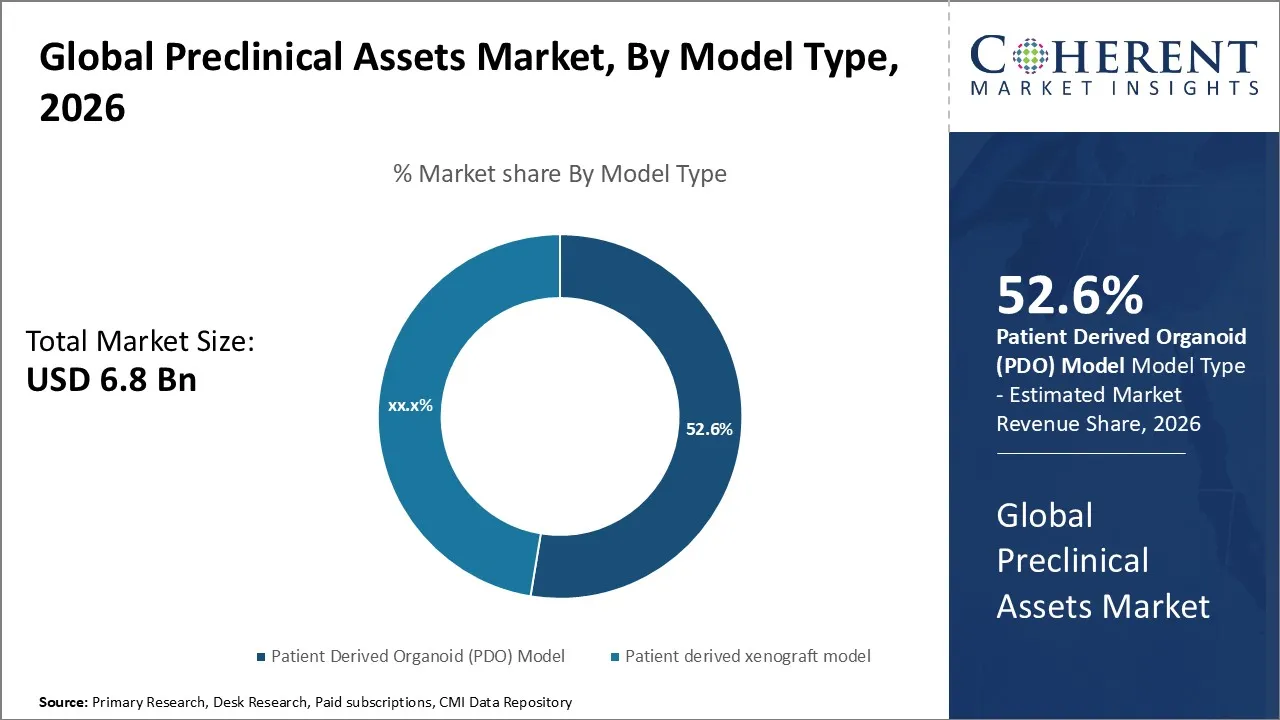
  • By Model Type, Patient Derived Organoid (PDO) Model expected to hold the largest market share of 52.6% in 2026 owing to its high biological relevance and predictive power.
  • By End User, Biopharmaceutical Companies acquired the prominent market share of 38.8% in 2026 owing to the expanding R&D investments & pipeline complexity.
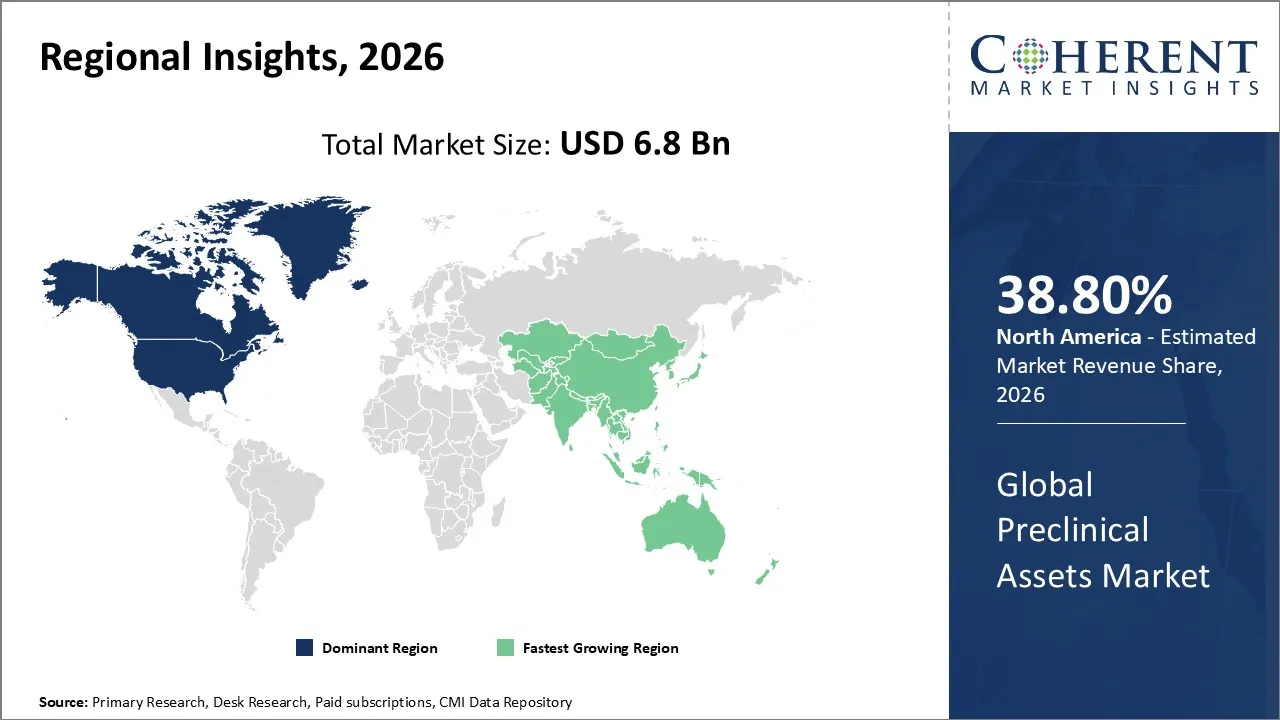
  • By Region, North America dominates the overall market with an estimated share of 38.8% in 2026 owing to the established & advanced research infrastructure.

Market Overview

The preclinical assets market provides services, models, and technologies that support early-stage drug development by assessing safety, efficacy, and pharmacokinetics before clinical trials. It covers toxicology testing, patient-derived organoids, animal models, in vitro and in silico platforms, and contract research organization services. Pharmaceutical and biotech companies drive growth through increased R&D investment, adoption of advanced preclinical models, compliance with regulatory standards, and focus on personalized and precision medicine.

Current Events and their Impact on the Preclinical Assets Market

Current Events

Description and its impact

Regulatory and Policy Developments in Major Regions

  • Description: EU Implementation of New Preclinical Data Transparency Rules
  • Impact: Increased compliance costs may drive demand for advanced data management and preclinical validation services; could delay asset progression timelines.
  • Description: US FDA’s Accelerated Approval Pathway Adjustments
  • Impact: Incentivizes early-stage innovation and may boost investments in preclinical assets focused on breakthrough therapies.

Geopolitical Tensions and Trade Policies

  • Description: US-China Trade Restrictions on Biotech Components
  • Impact: Disruptions in supply chains for preclinical research tools and reagents; may increase costs and bottlenecks for global preclinical asset development.
  • Description: Brexit-Driven Regulatory Divergence in UK and EU
  • Impact: Creates uncertainty in cross-border asset development and may necessitate region-specific preclinical validation strategies, impacting timelines and budgets.

Technological Advances in Preclinical Research

  • Description: Integration of AI and Machine Learning in Drug Candidate Screening
  • Impact: Improves speed and accuracy of preclinical asset validation, increasing the attractiveness and valuation of such assets.
  • Description: Rise of Organoid and Microphysiological Systems (MPS)
  • Impact: Advances in in vitro modeling reduce reliance on animal testing, expanding opportunities for innovative preclinical assets and related service providers.

Uncover macros and micros vetted on 75+ parameters: Get instant access to report

Segmental Insights

Preclinical Assets Market By Model Type

To learn more about this report, Download Free Sample

Preclinical Assets Market Insights, By Model Type - Patient Derived Organoid (PDO) Model contribute the highest share of the market owing to its growth in drug discovery & development needs.

Patient Derived Organoid (PDO) Model expected to hold the largest market share of 52.6% in 2026. The preclinical assets market increasingly adopts patient-derived organoid (PDO) models because they closely mimic human tissue architecture and genetic profiles, offering highly predictive insights into drug responses. Biopharmaceutical companies employ PDOs to assess efficacy and safety more effectively, advancing precision medicine efforts. Improvements in 3D culture techniques, biobanking, and integration with omics technologies strengthen their applications, while ethical concerns and the limitations of traditional models prompt researchers to rely on PDOs for personalized and translational studies. For instance, in April 2025, Tempus AI has launched Tempus Loop, a platform that leverages patient data—clinical records, test results, and treatment outcomes—along with patient-derived organoid (PDO) models to improve the identification and validation of cancer drug targets.

Preclinical Assets Market Insights, By Service - Toxicology Testing contribute the highest share of the market owing to its ethical and social pressures.

Toxicology Testing hold the largest market share of 42.2% in 2026. The preclinical assets market sees increasing demand for toxicology testing as companies aim to ensure drug safety and meet regulatory requirements before clinical trials. Pharmaceutical and biotechnology firms use these tests to detect potential adverse effects early, minimizing late-stage failures. Innovations in in vitro, in silico, and high-throughput screening improve predictive accuracy, while ethical concerns promote alternatives to animal testing. The expanding pipeline of novel therapies and complex biologics also drives the widespread adoption of comprehensive toxicology assessment platforms. For instance, in July 2025, Biocytogen Pharmaceuticals announced an upgrade to its preclinical division, expanding its portfolio of genetically engineered animal models and enhancing its services with efficacy studies, PK/PD analysis, biomarker evaluation, and non-GLP toxicology testing.

Preclinical Assets Market Insights, By End User - Biopharmaceutical Companies contribute the highest share of the market owing to its outsourcing to accelerate time‑to‑market

Biopharmaceutical Companies acquires the prominent market share of 38.8% in 2026. Biopharmaceutical companies expand the preclinical assets market by growing their R&D pipelines and implementing efficient methods to assess safety and efficacy before clinical trials. They rely more on specialized preclinical platforms and CROs to access advanced models, skilled expertise, and infrastructure, while cutting costs and speeding up development timelines. The development of complex biologics, cell and gene therapies, and personalized medicine further increases demand, as companies utilize predictive preclinical models and comprehensive testing platforms to drive innovation and meet regulatory requirements.
Regional Insights

Preclinical Assets Market By Regional Insights

To learn more about this report, Download Free Sample

North America Preclinical Assets Market Trends

North America dominates the overall market with an estimated share of 38.80% in 2026. The North American preclinical assets market grows steadily, supported by advanced research infrastructure, a strong presence of pharmaceutical and biotechnology companies, and established contract research organizations. Companies in the region adopt innovative models, such as organoids, in silico platforms, and high-throughput screening, to enhance drug development efficiency. Regulatory backing, a skilled workforce, and collaborations between industry and academic institutions further drive expansion. The increasing focus on precision medicine, complex biologics, and personalized therapies shapes market trends and boosts demand for advanced preclinical assets. For instance, in January 2026, NAMSA, a global provider of medical device testing, clinical research, and regulatory consulting, announced that it has completed the acquisition of Labcorp’s Early Development medical device testing business.

Asia Pacific Preclinical Assets Market Trends

The Asia Pacific preclinical assets market is growing as pharmaceutical and biotechnology companies ramp up R&D activities across the region. Improving research infrastructure, wider adoption of advanced preclinical models, and the expansion of contract research organizations drive this growth. Governments promote innovation through supportive regulations and funding initiatives. Companies increasingly implement organoids, in silico platforms, and high-throughput screening to streamline drug development. The rising focus on emerging therapies, personalized medicine, and strategic collaborations further boosts demand for advanced preclinical assets.

United States Preclinical Assets Market Trends

The United States preclinical assets market grows steadily as pharmaceutical and biotechnology companies expand operations and leverage well-established research infrastructure. Companies adopt innovative models, such as patient-derived organoids, in silico simulations, and high-throughput screening, to enhance drug development efficiency. Leading contract research organizations and a skilled scientific workforce enable faster and more reliable preclinical studies. Government regulations and initiatives promote innovation, while increasing focus on complex biologics, precision medicine, and personalized therapies drives greater demand for advanced preclinical assets nationwide.

India Preclinical Assets Market Trends

The India preclinical assets market is growing as pharmaceutical and biotechnology companies ramp up early-stage research and drug development efforts. Companies implement advanced preclinical models, such as organoids, in vitro systems, and in silico platforms, to enhance efficiency and minimize development risks. Expanding research infrastructure, a larger pool of skilled scientists, and the rise of contract research organizations support this growth. Government initiatives and favorable regulations promote innovation, while increasing focus on personalized medicine and novel therapies boosts demand for advanced preclinical assets nationwide.

End-user Feedback and Unmet Needs in the Preclinical Assets Market

  • Demand for Predictive and Human-Relevant Models: End-users seek models that accurately replicate human biology to improve drug response predictions. They emphasize patient-derived organoids, 3D cultures, and advanced in silico platforms. Improved translational relevance helps reduce late-stage failures, enabling more confident decisions in early-stage drug development.
  • Need for Faster and Scalable Testing: Researchers require preclinical assets that deliver rapid, high-throughput results without compromising accuracy. Scalability is critical to support large compound libraries and diverse therapeutic pipelines. Automation and integrated analytics are increasingly necessary to optimize workflows and accelerate preclinical study timelines.
  • Cost-Effective Alternatives to Animal Testing: Many end-users highlight the high costs and ethical concerns associated with animal models. They seek validated in vitro or computational alternatives that maintain predictive reliability, reduce regulatory hurdles, and align with growing ethical and sustainability standards in preclinical research.

Preclinical Assets Market Trend

Adoption of Advanced Preclinical Models

Companies increasingly use patient-derived organoids, 3D cell cultures, and in silico platforms to replicate human physiology more accurately. These models improve predictive outcomes, reduce late-stage failures, and accelerate drug development. The trend emphasizes integrating high-throughput screening and multi-omics data to enhance translational relevance and support personalized medicine initiatives.

Expansion of Contract Research Organizations (CROs)

Biopharmaceutical firms are outsourcing preclinical studies to CROs to access specialized expertise, advanced infrastructure, and scalable testing solutions. CROs enable faster execution of toxicology, pharmacology, and bioanalytical studies while reducing costs. Partnerships with CROs also facilitate global research collaboration and access to diverse preclinical assets, driving market growth.

Preclinical Assets Market Opportunity

Adoption of Advanced Models and Technologies

Emerging models such as patient-derived organoids, organ-on-chip systems, 3D cultures, and in silico platforms offer highly predictive insights. There is an opportunity for companies to develop and commercialize these models, integrating automation, AI, and high-throughput screening to improve preclinical efficiency and reduce late-stage failures. Providing reliable, human-relevant platforms can address unmet needs in drug evaluation and precision medicine.

Market Report Scope

Preclinical Assets Market Report Coverage

Report Coverage Details
Base Year: 2025 Market Size in 2026: USD 6.8 Bn
Historical Data for: 2020 To 2024 Forecast Period: 2026 To 2033
Forecast Period 2026 to 2033 CAGR: 8.6% 2033 Value Projection: USD 9.2 Bn
Geographies covered:
  • North America: U.S. and Canada
  • Latin America: Brazil, Argentina, Mexico, and Rest of Latin America
  • Europe: Germany, U.K., Spain, France, Italy, Russia, and Rest of Europe
  • Asia Pacific: China, India, Japan, Australia, South Korea, ASEAN, and Rest of Asia Pacific
  • Middle East: GCC Countries, Israel, and Rest of Middle East
  • Africa: South Africa, North Africa, and Central Africa
Segments covered:
  • By Service: Bioanalysis and DMPK studies (In vitro, In-vivo), Toxicology Testing (GLP, Non-GLP), compound management (Process R&D, Custom Synthesis, Asymmetric Synthesis & Others (Scale-up, cGMP, etc.), Safety Pharmacology, Others (Chemistry, etc.)
  • By Model type: Patient Derived Organoid (PDO) Model, Patient derived xenograft model
  • By End user: Biopharmaceutical Companies, Government Institutes &  Others (Academic and Research institutes)
Companies covered:

Eurofins Scientific, ICON plc, WuXi AppTec, Viroclinics Xplore, Medpace, Inc., Charles River Laboratories., Pharmatest Services, PPD Inc., SGS SA (SGS), Intertek Group plc, Labcorp Drug Development, Laboratory Corporation of America, Inc., Crown Bioscience, Comparative Biosciences, Inc., TCG Lifesciences Private Limited., Shanghai Medicilon Inc., Domainex, Absorption Systems, AmplifyBio, and IQVIA

Growth Drivers:
  • Rising Pharmaceutical and Biotech R&D
  • Regulatory and Ethical Considerations
Restraints & Challenges:
  • High Costs of Advanced Preclinical Platforms
  • Access to Quality Biological Samples

Uncover macros and micros vetted on 75+ parameters: Get instant access to report

Preclinical Assets Market News

  • In March 2026, Enodia Therapeutics announced it had acquired Sec61-based discovery and development assets from Kezar Life Sciences, Inc. This acquisition strengthens Enodia’s ability to study Sec61 selectivity mechanisms, enhancing biological and translational insights to accelerate progress toward key clinical milestones.

Analyst Opinion (Expert Opinion)

  • The preclinical assets market is at a pivotal inflection point, driven by evolving industry expectations and deep scientific shifts rather than simple volume growth. Sponsors are no longer satisfied with legacy animal models that fail to predict human outcomes; this is evidenced by the Patient‑Derived Organoid (PDO) model commanding a dominant share of preclinical model demand, illustrating the premium placed on human‑relevant systems that better capture tissue complexity and genetic heterogeneity in oncology and rare disease research. PDOs are increasingly integrated with multi‑omics and high‑content screening, reflecting a broader transition toward mechanistic, data‑rich preclinical paradigms that directly inform clinical hypotheses and patient stratification strategies.
  • At the same time, toxicology testing stands out as an essential, non‑negotiable service, underpinning regulatory submissions with comprehensive safety datasets; its role is emphasized by regulatory bodies demanding detailed safety profiles before clinical entry for every investigational new drug. Outsourcing to specialist CROs has become strategic rather than transactional, as biopharma and biotech firms leverage external expertise to manage complexity in biologics, cell and gene therapies, and precision medicines. This externalization trend highlights a structural shift: preclinical assets are becoming integral enablers of portfolio risk management and clinical readiness, not just support functions.

Market Segmentation

  • By Service
    • Bioanalysis and DMPK studies
      • In vitro
      • In-vivo
    • Toxicology Testing
      • GLP
      • Non-GLP
    • compound management
      • Process R&D
      • Custom Synthesis
      • Asymmetric Synthesis & Others (Scale-up, cGMP, etc.)
    • Safety Pharmacology
    • Others (Chemistry, etc.)
  • By Model type
    • Patient Derived Organoid (PDO) Model
    • Patient derived xenograft model
  • By End user
    • Biopharmaceutical Companies
    • Government Institutes
    • Others (Academic and Research institutes)
  • By Regional Insights
    • North America
      • U.S.
      • Canada
    • Latin America
      • Brazil
      • Argentina
      • Mexico
      • Rest of Latin America
    • Europe
      • Germany
      • U.K.
      • Spain
      • France
      • Italy
      • Russia
      • Rest of Europe
    • Asia Pacific
      • China
      • India
      • Japan
      • Australia
      • South Korea
      • ASEAN
      • Rest of Asia Pacific
    • Middle East
      • GCC Countries
      • Israel
      • Rest of Middle East
    • Africa
      • South Africa
      • North Africa
      • Central Africa
  • Key Players Insights
    • Eurofins Scientific
    • ICON plc
    • WuXi AppTec
    • Viroclinics Xplore
    • Medpace, Inc.
    • Charles River Laboratories.
    • Pharmatest Services
    • PPD Inc.
    • SGS SA (SGS)
    • Intertek Group plc
    • Labcorp Drug Development
    • Laboratory Corporation of America, Inc.
    • Crown Bioscience
    • Comparative Biosciences, Inc.
    • TCG Lifesciences Private Limited.
    • Shanghai Medicilon Inc.
    • Domainex
    • Absorption Systems
    • AmplifyBio
    • IQVIA

Sources

Primary Research interviews

  • Key opinion leaders in preclinical research
  • Heads of R&D at biotechnology and pharmaceutical companies
  • Lab managers and directors of preclinical testing facilities
  • Preclinical study coordinators and animal model specialists

Databases

  • PubMed
  • ClinicalTrials.gov
  • Embase
  • Scopus
  • Web of Science
  • BioMed Central

Magazines

  • Genetic Engineering & Biotechnology News
  • The Scientist
  • Laboratory Equipment Magazine
  • Drug Discovery & Development Magazine

Journals

  • Nature Reviews Drug Discovery
  • Journal of Pharmacology and Experimental Therapeutics
  • Toxicology and Applied Pharmacology
  • European Journal of Pharmaceutics and Biopharmaceutics
  • ACS Chemical Neuroscience

Newspapers

  • The New York Times – Science Section
  • The Guardian – Science Section
  • Financial Times – Life Sciences Coverage
  • Science Daily News Updates

Associations

  • Society of Toxicology (SOT)
  • American Association for Laboratory Animal Science (AALAS)
  • International Society for Stem Cell Research (ISSCR)
  • Biotechnology Innovation Organization (BIO)

Public Domain sources

  • U.S. Food and Drug Administration (FDA) reports
  • European Medicines Agency (EMA) publications
  • World Health Organization (WHO) research reports
  • National Institutes of Health (NIH) datasets

Proprietary Elements

  • CMI Data Analytics Tool
  • Proprietary CMI Existing Repository of information for last 8 years

Share

Share

About Author

Vipul Patil is a dynamic management consultant with 6 years of dedicated experience in the pharmaceutical industry. Known for his analytical acumen and strategic insight, Vipul has successfully partnered with pharmaceutical companies to enhance operational efficiency, cross broader expansion, and navigate the complexities of distribution in markets with high revenue potential.

Missing comfort of reading report in your local language? Find your preferred language :

Frequently Asked Questions

The Preclinical Assets Market is estimated to be valued at USD 6.8 Bn in 2026 and is expected to reach USD 9.2 Bn by 2033.

The global preclinical assets market is estimated to surpass USD 9.2 Bn by 2033.

Major players operating in the market include Eurofins Scientific, ICON plc, WuXi AppTec, Viroclinics Xplore, Medpace, Inc., Charles River Laboratories., Pharmatest Services, PPD Inc., SGS SA (SGS), Intertek Group plc, Labcorp Drug Development, Laboratory Corporation of America, Inc., Crown Bioscience, Comparative Biosciences, Inc., TCG Lifesciences Private Limited., Shanghai Medicilon Inc., Domainex, Absorption Systems, AmplifyBio, and IQVIA.

Among Services, Toxicology Testing segment generated significant revenue, owing to increasing launch of new toxicology tests by the key market players.

Increasing number of growth strategies such as test/service launch and acquisition by the key market players is expected to drive growth of the market over the forecast period.

The market is estimated to exhibit a CAGR of 8.6% over the forecast period.

Among region, North America is expected to witness significant growth over the forecast period, owing to increasing number of inorganic strategies such as acquisition by the key market players.

Select a License Type

EXISTING CLIENTELE

Joining thousands of companies around the world committed to making the Excellent Business Solutions.

View All Our Clients
trusted clients logo
© 2026 Coherent Market Insights Pvt Ltd. All Rights Reserved.