

Herceptin Biosimilar Market Size and Share Analysis - Growth Trends and Forecasts (2026 - 2033)
The Herceptin Biosimilar market is anticipated to grow at a CAGR of 9.7% with USD 5.27 Bn in 2026 and is expected to reach USD 10.07 Bn in 2033. This strong growth trend is fueled by multiple factors, such as the rising incidence of HER2-positive cancers (1.2 million) especially breast and colorectal cancer and the expanding use of biosimilars, which offer a more cost-effective alternative to original biologic therapies.
Key Takeaways
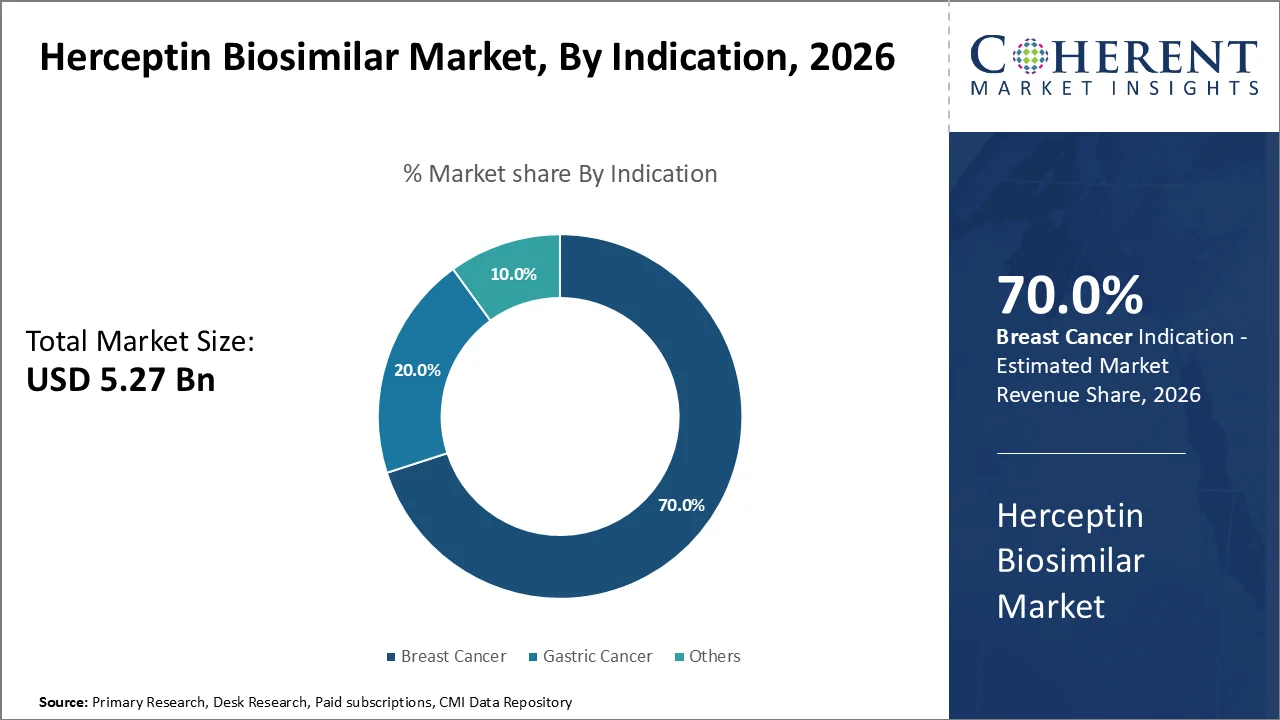
- Breast cancer is expected to account the largest share of 70% in 2026, because HER2-positive breast cancer is much more common than HER2-positive gastric cancer or other indications. HER2 overexpression occurs in approximately 15–20% of gastric cancer patients.
- Hospitals will dominate with 60% in 2026, hospitals and clinics are the primary centers for cancer diagnosis, treatment, and administration of complex biologics like Herceptin biosimilars. Over 80% of complex cancer therapies in Europe and North America are administered in hospitals and tertiary care centers in 2025. In Slovenia (2025), the University Medical Centre of Ljubljana received 69.3% of all tertiary care funding, illustrating that large hospitals are the main points of care for high-complexity treatments like Herceptin.
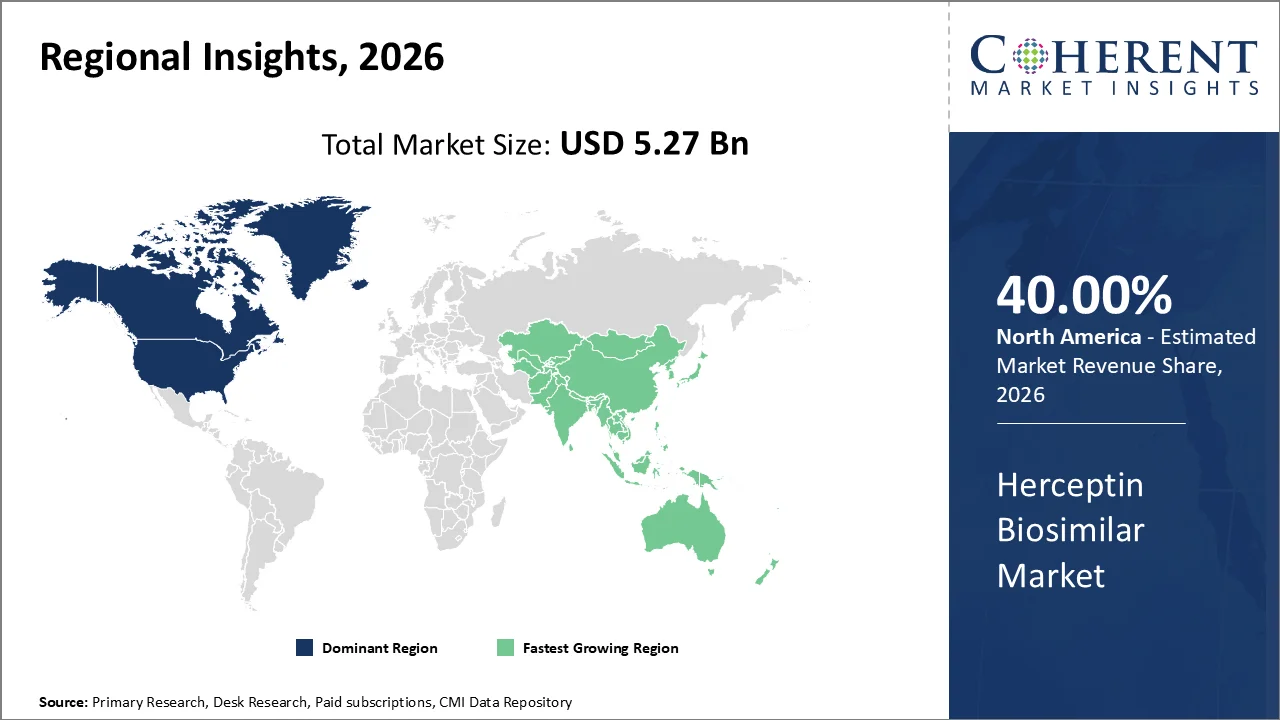
- North America is expected to acquire the dominant share of 40% in 2026, Strong healthcare infrastructure in the region. The U.S. alone reported approximately 300,000 new breast cancer cases in 2025, with 15–20% being HER2-positive.
Segmental Insights
Why is Breast Cancer Acquiring the Largest Market Share?
Breast cancer is projected to account for the largest share of indication in 2026, representing approximately 70% of the total volume. As HER2-positive breast cancer is common globally and trastuzumab is proven effective, it is broadly used. According to the World Health Organization (WHO), reports about 2.3 million new breast cancer cases each year, making it the most diagnosed cancer among women globally.
The dominance of breast cancer in the Herceptin biosimilar market is further supported by the fact that approximately 15-20% of all breast cancer cases are HER2-positive, showing a major patient population requiring targeted therapy.
- Current Industry Events of 2026
- Market Size Estimation
- Regional Breakdown
- Competitive Landscape
- Customer Intelligence
- Segmental Analysis
- Pricing Analysis
- Key Market Drivers, Challenges & Future Trends
- Customized Insights Section
Hospital holds the Largest Market Share
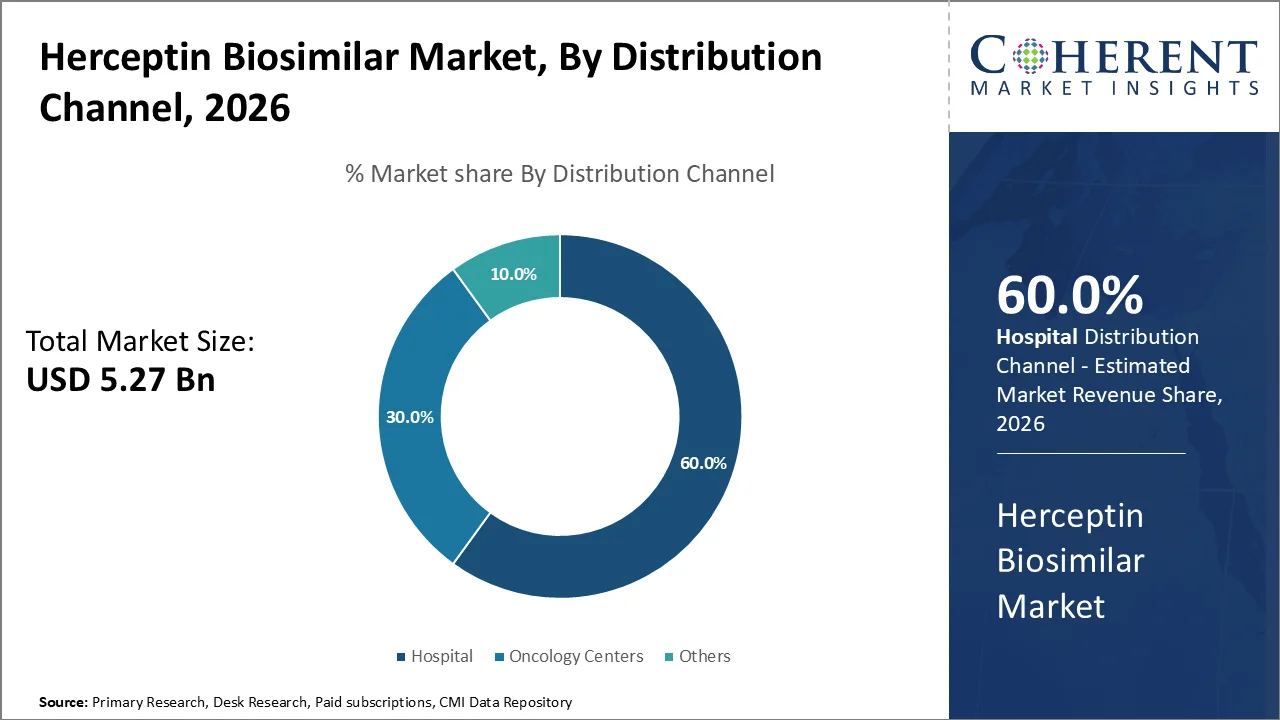
Based on distribution channel, hospital dominates the market, accounting for a significant 60% share in 2026, primarily owing to their established infrastructure, broad patient base, as well as overall treatment capabilities. Hospitals, particularly large tertiary care institutions, serve as primary points of care for cancer patients owing to their multidisciplinary approach, availability of advanced diagnostic tools, as well as access to various specialized therapies.
Tertiary II hospitals accounted for 81.7% of the total budget allocated by the Health Insurance Institute, with 69.3% of this funding directed to the University Medical Centre of Ljubljana, supporting the central role of well-resourced institutions in delivering comprehensive cancer care.
This means hospitals can easily use Herceptin biosimilars to treat HER2-positive breast cancer and other HER2-related tumors. For example, well-known hospitals like the Mayo Clinic and the National Cancer Institute (NCI) use biosimilars like Herceptin because they work as well as the original drug and cost less, helping more patients get the cancer care they need.
Cell Line Development Technologies is transforming the Herceptin Biosimilar Industry
Advanced Chinese Hamster Ovary (CHO) cell line development remains the industry standard for trastuzumab biosimilar production, leveraging gene editing and metabolic engineering to optimize productivity and quality. Leading adopters include Celltrion (Herzuma®) with CHO-DG44 lines, Pfizer/Mylan (Ogivri®) using optimized glycosylation CHO cells, and Samsung Bioepis (Ontruzant®) employing proprietary CHO-K1 expression systems.
The adoption of these advanced CHO technologies has majorly improved manufacturing efficiency and product consistency. Trastuzumab biosimilar titers have increased to 3–5 g/L from 1–2 g/L in earlier systems, manufacturing costs have dropped by 30–40%, and critical quality attributes now achieve >95% similarity, ensuring reliable therapeutic performance.
Transient Gene Expression Systems: A major breakthrough in Herceptin Biosimilar
Advanced transient gene expression platforms are increasingly used for rapid clone screening and early-stage process development. Key adopters include Amgen (Kanjinti), which uses ExpiCHO systems for accelerated clone selection, and Biocon/Mylan, which employs HEK293 transient systems for fasten early development.
These systems have majorly shortened development timelines by 6–12 months as well as allow rapid screening of over 1,000 clones compared with 100–200 in traditional methods, enabling faster identification of high-performing candidates.
Current Events and Their Impact
Current Event | Description and its Impact |
FDA Biosimilar Guidance Update (2025) |
|
European Commission Price Negotiation Policies (2026) |
|
Herceptin Biosimilar Market Trends
- Biosimilars are being used more instantly, as well as in well-established markets, they are expected to be used by 40–50% of patients by 2028.
- Herceptin biosimilars cost 20–35% less than the original drug, which is encouraging healthcare providers to use them.
- Regulatory Harmonization: Streamlined approval processes across major markets are reducing time-to-market and development costs.
- Interchangeability Focus: High emphasis on achieving interchangeable status to enhance market access as well as physician confidence.
Regional Insights
North America dominates owing to its extensive enterprise digitization initiatives
North America account 40% market share in 2026, owing primarily to the presence of a highly developed healthcare infrastructure, stringent regulatory frameworks, and an increasing prevalence of HER2-positive breast cancer which necessitates advanced therapeutic options such as biosimilars. In 2026, it is estimated that there will be 321,910 new cases of female breast cancer. The breast cancer subtype HR+/HER2- is the most common subtype with an age-adjusted rate of 92.9 new cases per 100,000 women, based on 2019–2023 cases.
For example, the U.S. Food and Drug Administration (FDA) has been highly proactive in creating streamlined regulatory pathways for biosimilars, leading to earlier market entry and broader acceptance among oncologists as well as healthcare providers. The FDA approved biosimilars like Ogivri and Herzuma, making cheaper alternatives to the original Herceptin available to more patients.
Asia Pacific Herceptin Biosimilar Market Trends
The Asia-Pacific region is poised to be the fastest-growing region through 2026-2033, expanding at a CAGR of approximately 7.5%. Countries such as India, China, South Korea, Japan, Australia, etc., have shown remarkable government and institutional support in biosimilar development through enhanced regulatory pathways as well as financial incentives. India’s Department of Biotechnology as well as China’s National Medical Products Administration have streamlined biosimilar approval procedures, which facilitates faster market entry for Herceptin biosimilars.
The National Biopharma Mission (NBM), a ₹1,500 crore joint initiative of the DBT and the World Bank. It focuses on accelerating the transition of biopharmaceuticals from discovery research to early-stage development. The mission is a major driver in achieving India’s vision of a USD150 billion biotechnology industry, fostering deep collaboration between industry as well as academia.
The World Health Organization (WHO) highlights the rising incidence of breast cancer in Asia Pacific, which has prompted multiple public health initiatives expanding access to advanced therapies, including biosimilars. Another major driver in Asia Pacific is the escalating number of local pharmaceutical companies investing heavily in biosimilar R&D, such as Biocon in India as well as Celltrion in South Korea.
Expansive Oncology Treatment Centers is Accelerating the Herceptin Biosimilar Market Demand in United States
the U.S. subsegment contributes the highest share in the Herceptin biosimilar market within the region primarily due to its advanced healthcare infrastructure, expansive oncology treatment centers, and well-established regulatory pathways that facilitate the entry and adoption of biosimilars.
The US Food and Drug Administration (FDA) has been proactive in streamlining biosimilar approvals, escalating physician and patient trust in biosimilar products such as Herceptin biosimilars.
Additionally, the U.S. has a large patient base affected by HER2-positive breast cancer, which is a key indication for trastuzumab (Herceptin). The high prevalence of breast cancer in the U.S., as reported by the American Cancer Society, affects approximately 280,000 women annually, making a considerable demand for targeted therapies, including biosimilars.
China Herceptin Biosimilar Market Trends
China contributes the highest share in the Herceptin biosimilar market in Asia Pacific owing to its robust regulatory framework as well as established manufacturing capabilities that have positioned the country as a biosimilar powerhouse. The National Medical Products Administration (NMPA) has streamlined approval processes for biosimilars, making a conducive environment for domestic and international manufacturers.
Shanghai Henlius Biotech's trastuzumab biosimilar, which received NMPA approval, exemplifies China's leadership in this space, demonstrating the country's capability to develop and commercialize complex oncology biosimilars.
The inclusion of biosimilar trastuzumab in China's National Reimbursement Drug List has significantly enhanced patient accessibility, fueling adoption across tier-one as well as tier-two cities. China's vast healthcare infrastructure, comprising over 35,000 hospitals as well as a escalating network of cancer treatment centers, provides extensive distribution channels for Herceptin biosimilars.
Who are the Major Companies in Herceptin Biosimilar Industry
Some of the major key players in Herceptin Biosimilar market include, Amgen Inc., AryoGen Biopharma, Biocon Limited, Celltrion Inc., Pfizer Inc., Merck & Co., Inc., Accord Healthcare Ltd, Gedeon Richter Plc, Genor Biopharma Company Ltd, Mabion SA, Mylan N.V, Roche Holding AG and Samsungbioepis Co., Ltd.
Key News
- In January 2026, Biocon Biologics Ltd. (BBL), a fully integrated global biosimilars company and subsidiary of Biocon Ltd. released three new oncology biosimilars, further strengthening its comprehensive cancer portfolio. The company will also highlight its plans to integrate as a wholly owned subsidiary of Biocon Limited and the vital role of biosimilars in expanding access to affordable medicines at the 44th Annual J.P. Morgan Healthcare Conference in San Francisco.
- In October 2025, Teva Pharmaceuticals International GmbH, a subsidiary of Teva Pharmaceutical Industries Ltd., entered into a license agreement with Prestige Biopharma, for the commercialization of Tuznue® (trastuzumab), a biosimilar to Herceptin®, across a majority of European markets.
Market Report Scope
Herceptin Biosimilar Market Report Coverage
| Report Coverage | Details | ||
|---|---|---|---|
| Base Year: | 2025 | Market Size in 2026: | USD 5.27 Bn |
| Historical Data for: | 2020 To 2024 | Forecast Period: | 2026 To 2033 |
| Forecast Period 2026 to 2033 CAGR: | 9.7% | 2033 Value Projection: | USD 10.07 Bn |
| Geographies covered: |
| ||
| Segments covered: |
| ||
| Companies covered: | Amgen Inc., AryoGen Biopharma, Biocon Limited, Celltrion Inc., Pfizer Inc., Merck & Co., Inc., Accord Healthcare Ltd, Gedeon Richter Plc, Genor Biopharma Company Ltd, Mabion SA, Mylan N.V, Roche Holding AG and Samsungbioepis Co,.Ltd. | ||
| Growth Drivers: |
| ||
| Restraints & Challenges: |
| ||
Analyst Opinion
- The Herceptin biosimilar market is driven by urgent medical need, not just regulatory trends. In 2025, over 1.2 million new HER2-positive breast cancer cases were diagnosed globally, many lacking availabilities to affordable biologics.
- Regulatory support is accelerating adoption. China and India’s priority approval pathways in 2025 lower time-to-market by up to 12 months, allowing faster patient access and expanding market penetration.
- Competition is intensifying, but this benefits patients. Teva launched Tuznue® in Europe, and Biocon introduced three new cancer biosimilars. This makes treatment more affordable and pushes smaller companies to focus on better quality and efficiency.
- Hospitals and tertiary care centers remain the backbone of demand. Over 80% of complex-treatment budgets in leading European hospitals in 2025 were directed to high-complexity therapies, reinforcing their central role in biosimilar distribution.
Speak to the analyst
Want personalized insights?
Take the findings above to one of our principal consultants, or have the report rebuilt around the segments, geographies and competitors you actually track.
Market Segmentation
- By Indication
- Breast Cancer
- Gastric Cancer
- Others
- By Distribution Channel
- Hospitals
- Oncology Centers
- Others
- Global Herceptin Biosimilar Market, By Region
- North America
- U.S.
- Canada
- Latin America
- Brazil
- Mexico
- Argentina
- Rest of Latin America
- Europe
- Germany
- U.K.
- France
- Italy
- Spain
- Russia
- Rest of Europe
- Asia Pacific
- China
- India
- Japan
- Australia
- South Korea
- ASEAN
- Rest of Asia Pacific
- Middle East
- GCC
- Israel
- Rest of Middle East
- Africa
- South Africa
- Central Africa
- North Africa
- North America
- Key Players
- Amgen Inc.
- AryoGen Biopharma
- Biocon Limited
- Celltrion Inc.
- Pfizer Inc.
- Merck & Co., Inc.
- Accord Healthcare Ltd
- Gedeon Richter Plc
- Genor Biopharma Company Ltd
- Mabion SA
- Mylan N.V
- Roche Holding AG
- Samsungbioepis Co., Ltd.
Sources
Primary Research Interviews
- Biosimilar manufacturers and developers
- Oncologists and healthcare professionals
- Regulatory affairs specialists
- Healthcare payers and insurance providers
- Others
Databases
- IQVIA Global Pharmaceutical Database
- FDA Orange Book Database
- EMA European Public Assessment Reports (EPAR)
- Others
Magazines
- BioPharma Dive
- Pharmaceutical Executive
- BioWorld Intelligence
- Generics and Biosimilars Initiative (GaBI) Journal
- Others
Journals
- Nature Biotechnology
- Journal of Oncology Practice
- BioDrugs - Clinical Immunotherapeutics
- Others
Newspapers
- Financial Times (Healthcare Section)
- The Wall Street Journal (Biotech Coverage)
- Reuters Health News
- Bloomberg Healthcare
- Others
Associations
- Biosimilars Council
- European Medicines Agency (EMA)
- Food and Drug Administration (FDA)
- International Generic and Biosimilar Medicines Association (IGBA)
- Others
Public Domain Sources
- ClinicalTrials.gov
- WHO Global Health Observatory
- National Cancer Institute (NCI) databases
- European Centre for Disease Prevention and Control (ECDC)
- Others
Proprietary Elements
- CMI Data Analytics Tool, Proprietary CMI Existing Repository of information for last 10 years
Get access to 250+ pages report
Every segment, forecast, competitor profile and data table behind the analysis above — available for instant download.
- ESOMAR Member
- ISO 9001:2015 Certified
- D-U-N-S Registered
- GDPR & CCPA Compliant
Missing comfort of reading report in your local language? Find your preferred language:
Transform your Strategy with Exclusive Trending Reports
Frequently Asked Questions
The Herceptin Biosimilar market is expected to reach USD 10.07 Billion in 2033.
Herceptin is administered intravenously and can lead to serious side effects such as pulmonary toxicity and embryo-fetal toxicity which is a key factor hampering growth of the market.
Robust product pipeline, approval of new Herceptin biosimilar drugs by key companies, strategic mergers and acquisitions by key players, and the increasing incidence of cancers such as breast cancer and gastric cancer are the factors driving the global herceptin biosimilar market growth.
The Herceptin Biosimilar market is anticipated to grow at a CAGR of 9.7% between 2026 and 2033.
Among regions, North America is expected to account for a largest market share in the global Herceptin Biosimilar market over the forecast period.
OGIVRI is highly similar to Herceptin, and is backed by an oncology biosimilars company you can trust. OGIVRI is highly similar to Herceptin®, and is backed by an oncology biosimilars company you can trust.
Herceptin is a monoclonal antibody used to treat patients suffering from metastatic (spread) breast cancer and gastric cancers. Hereceptin is used as part of chemotherapy regimen for adjuvant treatment of lymph-node positive, HER2/neu protein positive breast cancer.