

Pulmonary Surfactant Market Size and Forecast – 2026 to 2033
The Pulmonary Surfactant Market is estimated to be valued at USD 723.2 Mn in 2026 and is expected to reach USD 947.8 Mn by 2033, exhibiting a compound annual growth rate (CAGR) of 7.2% from 2026 to 2033.
Key Takeaways
- By Type, Animal Derived Surfactant hold the largest market share of 52.2% in 2026 owing to the superior clinical efficacy.
- By Drug Type, Poractant alfa expected to hold largest market share of 42.2% in 2026 owing to its strong clinical outcomes in neonatal RDS.
- By Indications, Respiratory Distress Syndrome (RDS) acquired the prominent market share of 36.7% in 2026 owing to the high incidence of preterm births.
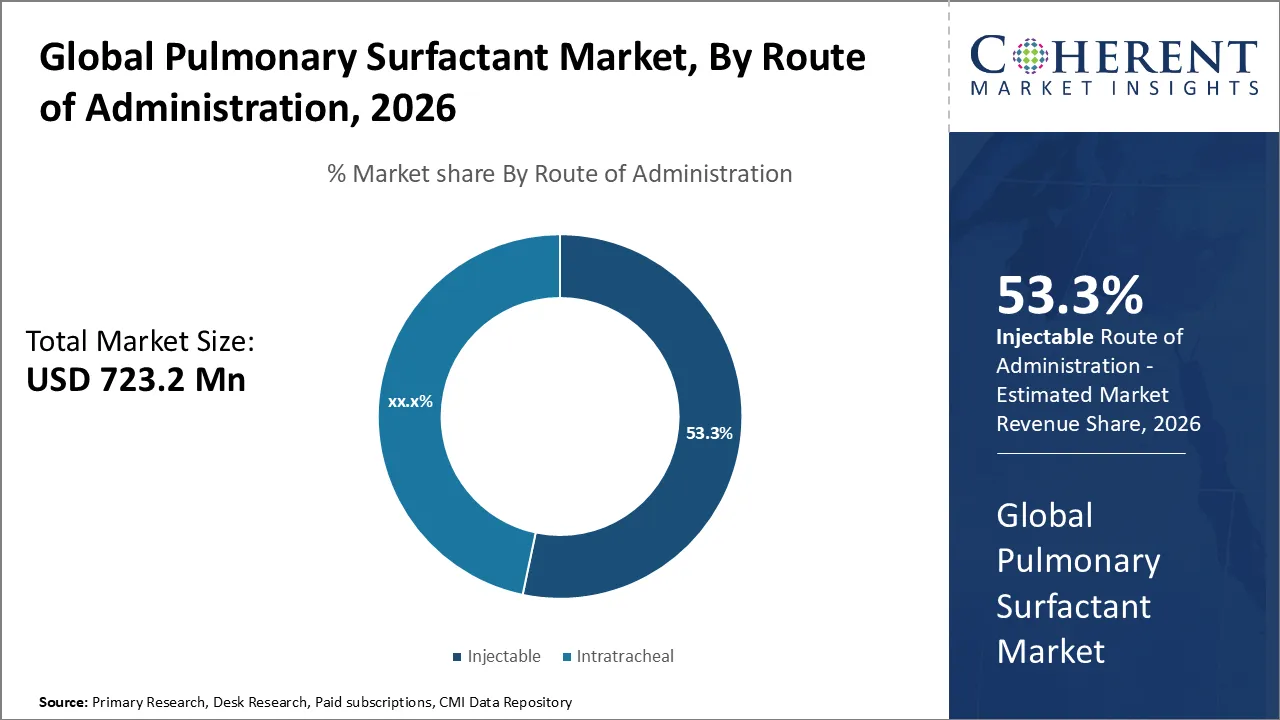
- By Route of Administration, Injectable captures the largest market share of 53.3% in 2026 owing to its gold standard route for surfactant delivery.
- By Distribution Channel, Hospital Pharmacies hold the largest market share of 37.7% in 2026 owing to the hospital-based administration requirement.
- By Region, North America dominates the overall market with an estimated share of 38.8% in 2026 owing to the advanced neonatal healthcare infrastructure.
Market Overview
The rising incidence of respiratory distress syndrome, particularly among preterm infants, drives the pulmonary surfactant market, while healthcare systems continue to expand neonatal intensive care infrastructure worldwide. Healthcare providers are increasing awareness, enabling early diagnosis, and following strong clinical guidelines to boost surfactant therapy adoption. Clinicians widely use animal-derived products such as Poractant alfa due to their proven efficacy. Additionally, advancements in minimally invasive administration techniques and improving healthcare access in emerging economies further accelerate market growth, while ongoing research enhances treatment outcomes.
Current Events and their Impact
Current Events | Description and its impact |
Regulatory Approvals and Policy Updates |
|
Technological Innovations and Research Advances |
|
Epidemiological Trends and Healthcare Demand |
|
Segmental Insights
- Current Industry Events of 2026
- Market Size Estimation
- Regional Breakdown
- Competitive Landscape
- Customer Intelligence
- Segmental Analysis
- Pricing Analysis
- Key Market Drivers, Challenges & Future Trends
- Customized Insights Section
Pulmonary Surfactant Market Insights, By Route of Administration - Injectable contribute the highest share of the market owing to its immediate and targeted drug delivery
Injectable captures the largest market share of 53.3% in 2026. The pulmonary surfactant market depends on injectable formulations because direct intratracheal administration delivers the drug rapidly and precisely to the lungs. Clinicians use this method to achieve immediate therapeutic effects, which are essential for treating respiratory distress syndrome in preterm infants. Physicians prefer injectables for their reliable clinical performance, alignment with standard NICU protocols, and suitability for minimally invasive techniques. The growth of neonatal intensive care units and the requirement for on-site hospital administration continue to strengthen the widespread use of injectable surfactants globally. For instance, AlveoGene, a company developing inhaled gene therapies for rare respiratory diseases, has launched after securing seed funding from Oxford Science Enterprises, Harrington Discovery Institute at University Hospitals, and Old College Capital, the University of Edinburgh’s venture fund.
Pulmonary Surfactant Market Insights, By Type - Animal Derived Surfactant contribute the highest share of the market owing to its high prevalence of neonatal respiratory distress syndrome (RDS)
Animal Derived Surfactant hold the largest market share of 52.2% in 2026. Animal-derived surfactants drive the pulmonary surfactant market by closely mimicking natural human lung surfactant, which enables effective reduction of alveolar surface tension and supports rapid clinical improvement. Physicians actively prefer these therapies to manage respiratory distress syndrome in preterm infants, relying on strong clinical evidence and established treatment protocols. Clinicians use products such as Poractant alfa for consistent outcomes, while expanding neonatal care facilities and rising institutional deliveries continue to drive demand across global healthcare systems.
Pulmonary Surfactant Market Insights, By Drug Type - Poractant alfa contribute the highest share of the market owing to its high phospholipid concentration advantage
Poractant alfa expected to hold largest market share of 42.2% in 2026. Poractant alfa propels the pulmonary surfactant market by rapidly and reliably improving lung function in preterm infants with Respiratory Distress Syndrome. Its higher phospholipid content and optimized dosing enable faster stabilization and reduce the need for repeat treatments. Physicians actively choose it for its robust clinical evidence, compatibility with modern minimally invasive administration techniques, and proven safety. Expanding neonatal care units and rising hospital deliveries continue to drive its widespread adoption across developed and emerging healthcare systems.
Pulmonary Surfactant Market Insights, By Indications - Respiratory Distress Syndrome (RDS) contribute the highest share of the market owing to its surfactant deficiency is the root cause
Respiratory Distress Syndrome (RDS) acquired the prominent market share of 36.7% in 2026. The prevalence of respiratory distress syndrome drives the pulmonary surfactant market as it primarily affects preterm and low-birth-weight infants who lack sufficient natural surfactant. Healthcare providers actively administer exogenous surfactants to prevent respiratory failure. Increased awareness among clinicians, improvements in prenatal care, and the expansion of neonatal intensive care units enable timely diagnosis and treatment. These combined efforts maintain strong demand for surfactant therapies across both developed and emerging healthcare systems. InnAccel has introduced SAANS, the world’s first portable, infrastructure-independent neonatal CPAP system, designed to support breathing in critically ill neonates with Respiratory Distress Syndrome (RDS) in resource-limited settings and during transport.
Pulmonary Surfactant Market Insights, By Distribution Channel - Hospital Pharmacies contribute the highest share of the market owing to its growth of neonatal intensive care units
Hospital Pharmacies hold the largest market share of 37.7% in 2026. Hospital pharmacies drive the pulmonary surfactant market by providing immediate access to surfactants for critically ill preterm infants. They actively manage controlled storage, maintain cold-chain conditions, and enable safe, timely administration within neonatal intensive care units. Clinicians depend on hospital pharmacies for bulk procurement, efficient distribution, and strict adherence to treatment protocols. The growth of NICUs, rising hospital deliveries, and increased awareness of surfactant therapy continue to strengthen hospital pharmacies’ role in ensuring consistent access and effective management of respiratory distress in newborns.
Regional Insights
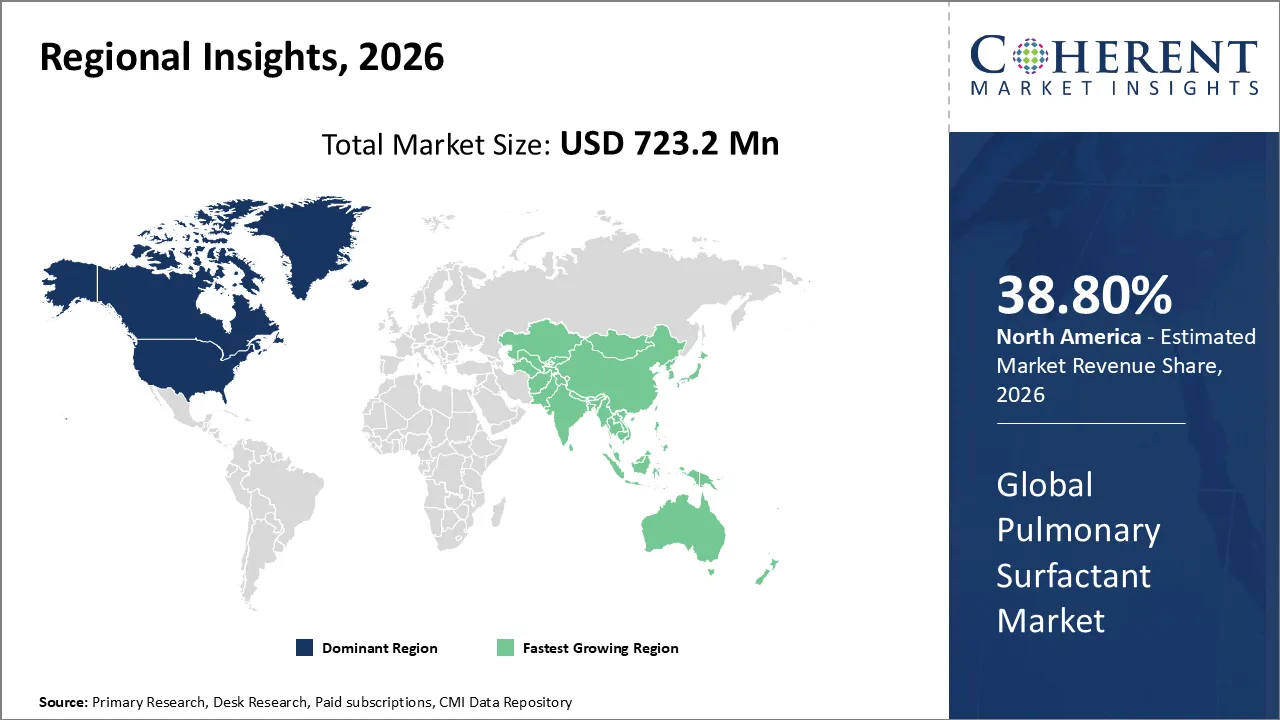
North America Pulmonary Surfactant Market Trends
North America dominates the overall market with an estimated share of 38.80% in 2026. Advanced neonatal care infrastructure and widespread adoption of evidence-based treatment protocols drive the North America pulmonary surfactant market. Hospitals increasingly use minimally invasive surfactant administration techniques, enhancing outcomes for preterm infants with respiratory distress. Leading pharmaceutical companies actively ensure product availability, while strong healthcare funding and reimbursement systems support extensive use. Clinicians’ growing awareness, along with expanding NICU capacities and early diagnosis programs, continues to boost demand, establishing North America as a leading region for innovation and adoption in surfactant therapy. For instance, Discovery Laboratories has launched Surfaxin (lucinactant) Intratracheal Suspension to prevent respiratory distress syndrome (RDS) in premature infants at high risk.
Asia Pacific Pulmonary Surfactant Market Trends
Increasing preterm birth rates and growing awareness of neonatal respiratory care drive the expansion of the Asia Pacific pulmonary surfactant market. Governments and healthcare providers actively invest in advanced NICU infrastructure, improving access to surfactant therapy in urban and semi-urban hospitals. Physicians use proven animal-derived and synthetic surfactants to treat respiratory distress in newborns, while minimally invasive administration techniques gain adoption. Rising institutional deliveries, expanding hospital networks, and enhanced training for neonatal care professionals continue to boost demand across the region. For instance, Vygon Group has introduced Surfcath, a specialized catheter for administering surfactant via the LISA method to treat preterm infants with Respiratory Distress Syndrome (RDS).
United States Pulmonary Surfactant Market Trends
Hospitals and NICUs drive growth in the United States pulmonary surfactant market by adopting advanced neonatal care practices and evidence-based treatment protocols. Clinicians increasingly implement minimally invasive surfactant administration techniques to enhance outcomes for preterm infants with respiratory distress. Leading pharmaceutical companies actively maintain consistent product availability, while robust healthcare funding and reimbursement policies enable broad access. Expanding NICU capacities, early diagnosis initiatives, and rising awareness among healthcare professionals continue to boost adoption, establishing the U.S. as a leading market for innovation and effective neonatal respiratory care.
China Pulmonary Surfactant Market Trends
Rising preterm births and growing awareness of neonatal respiratory care drive the expansion of the China pulmonary surfactant market. Hospitals and neonatal intensive care units actively invest in advanced infrastructure and staff training, improving access to both animal-derived and synthetic surfactants. Clinicians increasingly apply minimally invasive administration techniques to enhance outcomes for newborns with respiratory distress. Government initiatives, increasing institutional deliveries, and expanding hospital networks continue to boost surfactant adoption, establishing China as a rapidly developing market for neonatal respiratory therapies and advanced neonatal care.
Market Dynamics
Pulmonary Surfactant Market Trend
Rising Preterm Births Driving Demand
The increasing incidence of preterm and low-birth-weight infants globally fuels demand for pulmonary surfactants. Hospitals are expanding neonatal intensive care units to manage respiratory complications effectively. Early diagnosis and timely surfactant administration are becoming standard practice, prompting hospitals and clinicians to adopt both animal-derived and synthetic surfactants to reduce mortality and improve neonatal outcomes across diverse healthcare settings.
Shift Toward Minimally Invasive Administration
Clinicians are increasingly adopting minimally invasive surfactant delivery techniques such as LISA and MIST. These methods reduce the need for mechanical ventilation, lower complication risks, and enhance patient outcomes. The trend encourages pharmaceutical companies to develop formulations compatible with these techniques, allowing hospitals to integrate surfactant therapy seamlessly into modern NICU protocols while improving safety and treatment efficiency.
Pulmonary Surfactant Market Opportunity
Development of Minimally Invasive Delivery Systems
There is a strong opportunity to innovate with less invasive administration techniques, such as LISA and MIST, which reduce mechanical ventilation reliance. Companies can design surfactant formulations compatible with these approaches, improving patient safety, clinical outcomes, and adoption rates. Hospitals increasingly prefer these methods for fragile preterm infants, providing a strategic avenue for product differentiation and technological advancement in neonatal care.
Market Report Scope
Pulmonary Surfactant Market Report Coverage
| Report Coverage | Details | ||
|---|---|---|---|
| Base Year: | 2025 | Market Size in 2026: | USD 723.2 Mn |
| Historical Data for: | 2020 To 2024 | Forecast Period: | 2026 To 2033 |
| Forecast Period 2026 to 2033 CAGR: | 7.2% | 2033 Value Projection: | USD 947.8 Mn |
| Geographies covered: |
| ||
| Segments covered: |
| ||
| Companies covered: | Boehinger Ingelheim, AbbVie Inc, Chiesi Farmaceutici, ONY Biotech Inc., Lyomark Pharma, Abbott, Aviva Systems Biology Corporation, Windtree Therapeutics, Inc, Tekzima (Noargen), Biomatik, Nanjing Norris Pharm Technology, Reddot Biotech | ||
| Growth Drivers: |
| ||
| Restraints & Challenges: |
| ||
Pulmonary Surfactant Market News
- In February 2026, Savara Inc. announced that the FDA has accepted the BLA for MOLBREEVI, a therapy for autoimmune PAP, citing data showing improvements in pulmonary gas transfer, quality of life, and key clinical symptoms of this rare lung disease.
Analyst Opinion (Expert Opinion)
- The pulmonary surfactant market is at a critical inflection point shaped by evolving clinical evidence and unmet therapeutic needs rather than mere volume growth. Comparative outcomes from randomized and real‑world studies indicate that, while animal‑derived surfactants such as poractant alfa and beractant show similar primary safety outcomes, subtle differences in clinical practice are influencing product preference and cost dynamics in NICUs. For instance, meta‑analyses and retrospective data suggest that poractant alfa is associated with reduced odds of mortality compared with some alternatives, particularly when higher initial doses are used, and may reduce the need for repeat dosing and ventilator support, which affects both clinical workload and resource utilization.
- Administration strategies are now increasingly anchored around minimizing invasiveness. Network meta‑analyses demonstrate that techniques such as thin‑catheter surfactant delivery significantly lower intubation rates and composite outcomes like bronchopulmonary dysplasia compared with conventional methods, reshaping institutional protocols and increasing demand for compatible surfactant formulations.
Speak to the analyst
Want personalized insights?
Take the findings above to one of our principal consultants, or have the report rebuilt around the segments, geographies and competitors you actually track.
Market Segmentation
- By Type
- Synthetic Pulmonary Surfactant
- Animal Derived Surfactant
- By Drug Type
- Poractant alfa
- Lucinactant
- Calfactant
- By Indications
- Respiratory Distress Syndrome (RDS)
- Respiratory Infections
- Obstructive lung Diseases
- Others (chronic lung disease of prematurity, and surfactant protein-B deficiency)
- By Route of Administration
- Intratracheal
- Injectable
- By Distribution Channel
- Hospital Pharmacies
- Retail Pharmacies
- Online Pharmacies
- By Regional Insights
- North America
- U.S.
- Canada
- Latin America
- Brazil
- Argentina
- Mexico
- Rest of Latin America
- Europe
- Germany
- U.K.
- Spain
- France
- Italy
- Russia
- Rest of Europe
- Asia Pacific
- China
- India
- Japan
- Australia
- South Korea
- ASEAN
- Rest of Asia Pacific
- Middle East
- GCC Countries
- Israel
- Rest of Middle East
- Africa
- South Africa
- North Africa
- Central Africa
- North America
- Key Players Insights
- Boehinger Ingelheim
- AbbVie Inc
- Chiesi Farmaceutici
- ONY Biotech Inc.
- Lyomark Pharma
- Abbott
- Aviva Systems Biology Corporation
- Windtree Therapeutics, Inc
- Tekzima (Noargen)
- Biomatik
- Nanjing Norris Pharm Technology
- Reddot Biotech
Sources
Primary Research interviews
- Interviews with neonatologists, NICU directors, respiratory therapists, and hospital pharmacists involved in surfactant therapy delivery (qualitative insights on clinical use and unmet needs).
Databases
- PubMed articles on surfactant therapy and neonatal RDS clinical outcomes.
- NCBI Bookshelf entries on pulmonary surfactant biology and RDS management.
Magazines
- Pediatric Research summaries on evolution of surfactant therapy and clinical practice perspectives.
Journals
- Journal of Maternal Fetal and Neonatal Medicine reviews on surfactant therapy trends and practice debates.
- Pediatric Drugs comparative studies on animal‑derived vs synthetic surfactants.
- ScienceDirect seminars on neonatal surfactant applications beyond RDS.
Newspapers
- Relevant health and medical coverage from major newspapers (e.g., The New York Times, The Guardian, The Times of India) on neonatal care advancements and respiratory therapies.
Associations
- Canadian Paediatric Society recommendations on neonatal surfactant therapy guidelines.
- Policy statements from neonatal and pediatric respiratory associations (e.g., American Academy of Pediatrics, European Consensus Guidelines).
Public Domain sources
- Open‑access clinical reviews and guidelines on surfactant replacement therapy detailing indications, administration practices, risks, and outcomes.
- Government or WHO publications on neonatal respiratory distress and surfactant deployment strategies.
Proprietary Elements
- CMI Data Analytics Tool, and Proprietary CMI Existing Repository of information for last 8 years
Get access to 250+ pages report
Every segment, forecast, competitor profile and data table behind the analysis above — available for instant download.
- ESOMAR Member
- ISO 9001:2015 Certified
- D-U-N-S Registered
- GDPR & CCPA Compliant
Missing comfort of reading report in your local language? Find your preferred language:
Transform your Strategy with Exclusive Trending Reports
Frequently Asked Questions
The Pulmonary Surfactant Market is estimated to be valued at USD 723.2 Mn in 2026 and is expected to reach USD 947.8 Mn by 2033.
Major players operating in the market include Boehinger Ingelheim, AbbVie Inc, Chiesi Farmaceutici, ONY Biotech Inc., Lyomark Pharma, Abbott, Aviva Systems Biology Corporation, Windtree Therapeutics, Inc, Tekzima (Noargen), Biomatik, Nanjing Norris Pharm Technology, Reddot Biotech
Among type, Animal derived surfactant segment generated significant revenue, owing to increasing preferences for treatment of respiratory distress syndrome.
Increasing preference of animal derived surfactant for the treatment of respiratory distress syndrome is driving the growth of pulmonary surfactant market growth during the forecast period.
The market is estimated to exhibit a CAGR of 7.2% over the forecast period.
Among regions, North America is expected to witness significant growth over the forecast period, owing to increasing prevalence of respiratory infections in the U.S.