

Small Animal Imaging Market Size and Forecast: 2026 - 2033
The Small Animal Imaging Market is estimated to be valued at USD 2.23 Bn in 2026 and is expected to reach USD 2.98 Bn by 2033, exhibiting a compound annual growth rate (CAGR) of 7.65% from 2026 to 2033.
Key Takeaways
- By Product Type, MRI Systems hold the largest market share of 35.7% in 2026 owing to the expansion of preclinical research & drug discovery.
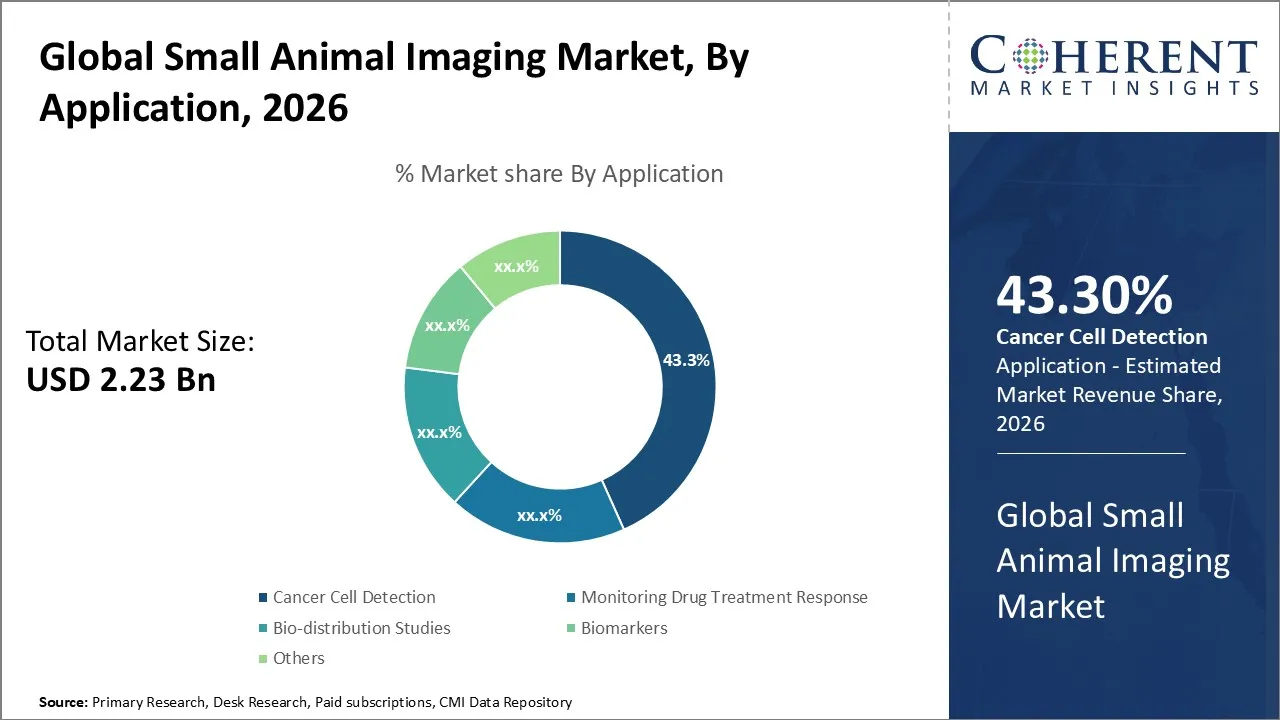
- By Application, Cancer Cell Detection expected to hold largest market share of 43.3% in 2026 owing to its rising global cancer prevalence & oncology research.
- By End User, Biotechnology and Pharmaceutical Companies acquired the prominent market share of 34.4% in 2026 owing to its accelerated drug discovery and development.
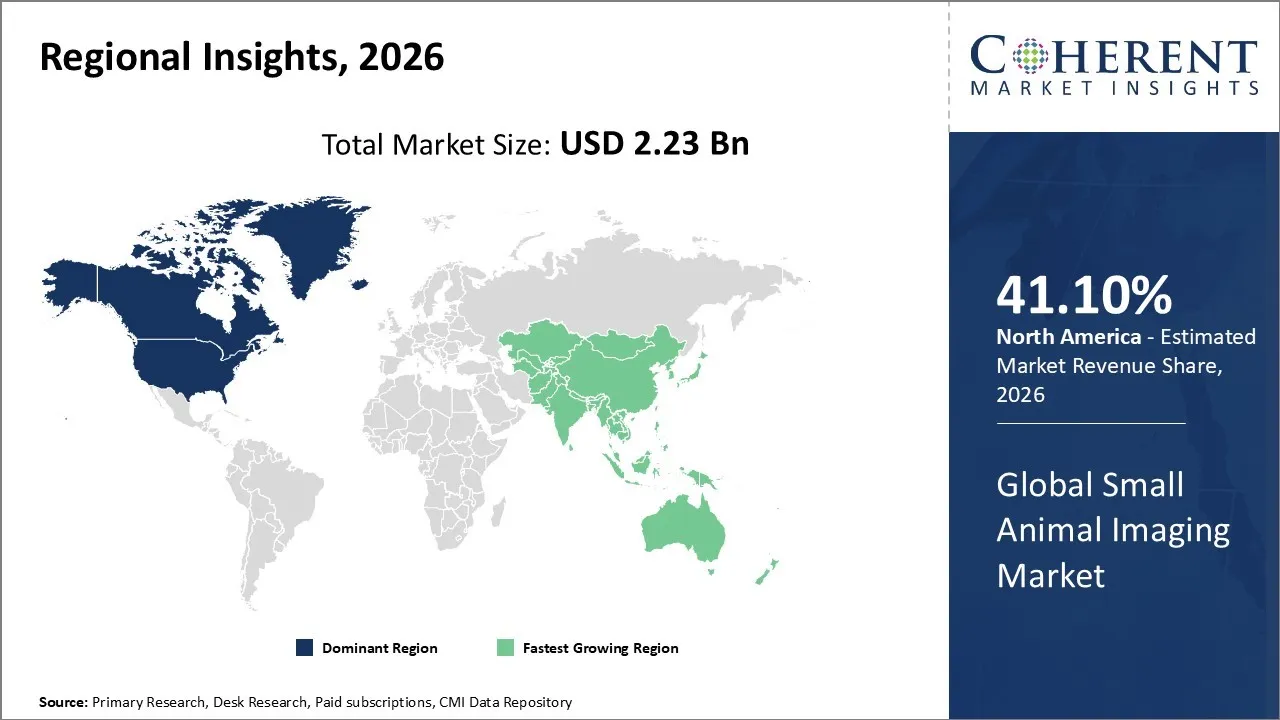
- By Region, North America dominates the overall market with an estimated share of 41.1% in 2026 owing to the strong government & institutional research funding.
Market Overview
The small animal imaging market actively supports preclinical research by allowing researchers to non-invasively visualize biological processes in living animal models. It plays a vital role in drug discovery, disease modeling, and translational research, particularly in oncology, neurology, and cardiovascular studies. Growing pharmaceutical and biotechnology research activity, continuous advancements in imaging technologies such as MRI, PET, CT, and optical imaging, and rising demand for longitudinal and ethically responsible studies drive market growth across academic, industrial, and research institutions worldwide.
Current Events and Its Impact on the Small Animal Imaging Market
Current Events | Description and its impact |
Technological Advancements in Imaging Modalities |
|
Geopolitical and Regulatory Landscape |
|
Competitive and Industry Trends |
|
Segmental Insights
- Current Industry Events of 2026
- Market Size Estimation
- Regional Breakdown
- Competitive Landscape
- Customer Intelligence
- Segmental Analysis
- Pricing Analysis
- Key Market Drivers, Challenges & Future Trends
- Customized Insights Section
Small Animal Imaging Market Insights, By Application - Cancer Cell Detection contribute the highest share of the market owing to its technological advancements in imaging modalities
Cancer Cell Detection expected to hold largest market share of 43.3% in 2026. Cancer cell detection actively drives the small animal imaging market by allowing researchers to accurately identify, monitor, and analyze tumors at both early and advanced stages in preclinical models. Scientists use advanced imaging techniques to examine tumor growth, metastatic behavior, and treatment response in real time. Growing emphasis on oncology drug development, wider adoption of molecular and functional imaging probes, and rising demand for non-invasive, high-sensitivity tools to support targeted therapy research continue to boost adoption across pharmaceutical, biotechnology, and academic research environments. For instance, in December 2025, USC’s Keck School of Medicine researchers have engineered next-generation CAR T cells that more safely and effectively attack cancer in mice, targeting hard-to-detect tumors while reducing toxic side effects.
Small Animal Imaging Market Insights, By Product Type - MRI Systems contribute the highest share of the market owing to its increased research funding & infrastructure investment
MRI Systems hold the largest market share of 35.7% in 2026. MRI systems actively drive the small animal imaging market by delivering superior soft-tissue contrast, high spatial resolution, and detailed anatomical and functional information for preclinical research. They enable researchers to conduct longitudinal, non-invasive studies, making it easier to track disease progression and treatment response over time. Growing adoption of MRI in neuroscience, oncology, and cardiovascular research, combined with advancements in high-field magnets, faster scanning techniques, and enhanced image analysis software, continues to increase demand across research institutions and pharmaceutical laboratories.
In June 2025, S.L. Raheja Hospital introduced AI-enabled Digital Positron Emission Tomography–Computed Tomography (Digital PET-CT) scanning along with 3-Tesla Magnetic Resonance Imaging (3T MRI) services.
Small Animal Imaging Market Insights, By End User - Biotechnology and Pharmaceutical Companies contribute the highest share of the market owing to its rising preclinical R&D investment
Biotechnology and Pharmaceutical Companies acquired the prominent market share of 34.4% in 2026. Biotechnology and pharmaceutical companies actively drive the small animal imaging market by leveraging advanced imaging technologies to speed up drug discovery and preclinical testing. They use non-invasive imaging to assess drug efficacy, track disease progression, and validate biomarkers in real time. Increasing focus on personalized medicine, translational research, and complex disease modeling fuels the demand for high-resolution, longitudinal studies. Continued investment in cutting-edge modalities, adoption of AI-powered analysis, and collaboration with research institutions further strengthen the use of small animal imaging systems across the industry. For instance, in April 2024, Charles River Laboratories has launched the Alternative Methods Advancement Project (AMAP) to reduce animal testing in drug discovery by incorporating alternatives to animal models into its nonclinical research services.
Regional Insights
North America Small Animal Imaging Market Trends
North America dominates the overall market with an estimated share of 41.10% in 2026. Robust research infrastructure and active pharmaceutical and biotechnology efforts are driving dynamic growth in the North American small animal imaging market. Researchers increasingly adopt advanced imaging modalities, such as MRI, PET, CT, and optical systems, for preclinical studies in oncology, neuroscience, and cardiovascular research. Expanding government and institutional funding, along with a focus on translational and personalized medicine, is enhancing imaging capabilities. Collaborations among research centers, CROs, and technology providers continue to accelerate innovation, adoption, and integration of high-resolution, non-invasive imaging solutions throughout the region. For instance, Esaote North America, Inc. has launched the Magnifico™ Vet MRI system, a veterinary-focused imaging solution that allows quick, efficient scans of animals of all sizes.
Asia Pacific Small Animal Imaging Market Trends
Growing investments in pharmaceutical and biotechnology research and the development of advanced preclinical infrastructure are actively expanding the Asia Pacific small animal imaging market. Researchers increasingly adopt MRI, PET, CT, and optical imaging systems to meet rising demand for non-invasive studies in oncology, neuroscience, and cardiovascular research. Government initiatives supporting innovation, along with increasing collaborations among academic institutions, CROs, and industry players, are improving access to cutting-edge technologies and driving the integration of high-resolution, longitudinal imaging solutions throughout the region. For instance, in February 2024, Tata Trusts opened India’s first state-of-the-art Small Animal Hospital in Mumbai’s Mahalaxmi, spanning 98,000 sq. ft. over five floors with over 200 beds.
United States Small Animal Imaging Market Trends
Extensive pharmaceutical and biotechnology research, along with well-established preclinical facilities, is actively advancing the United States small animal imaging market. Researchers increasingly use high-resolution MRI, PET, CT, and optical imaging systems to conduct studies in oncology, neurology, and cardiovascular diseases. Strong government funding, including support from the NIH, drives innovation and expands infrastructure. Collaborations among academic institutions, CROs, and industry leaders accelerate technology adoption, while the growing focus on translational research and personalized medicine promotes the widespread integration of sophisticated, non-invasive imaging solutions across the country. For instance, Ghent University spin-off MOLECUBES launched dedicated small-animal scanners—the β-CUBE (PET), X-CUBE (CT), and γ-CUBE (SPECT). The compact β-CUBE (54 cm³) enables bench-top imaging of mice and rats, with the first units installed at the University of Pennsylvania’s Small Animal Imaging Facility.
China Small Animal Imaging Market Trends
China is actively expanding its small animal imaging market through significant investments in pharmaceutical and biotechnology research and the development of advanced preclinical infrastructure. Researchers increasingly use MRI, PET, CT, and optical imaging systems to conduct studies in oncology, neurology, and cardiovascular diseases. Government initiatives promoting innovation and R&D, combined with collaborations among academic institutions, CROs, and industry players, enhance access to state-of-the-art imaging solutions. These efforts are driving the widespread adoption of high-resolution, non-invasive, and longitudinal imaging capabilities throughout the region.
Small Animal Imaging Market Trend
Growing Adoption of Multimodal Imaging Systems
Researchers increasingly prefer multimodal imaging platforms, such as PET/MRI, SPECT/CT, and optical/MRI combinations, to capture both anatomical and functional data simultaneously. This trend improves the accuracy of preclinical studies, allowing detailed evaluation of disease progression, therapeutic response, and molecular pathways. End-users benefit from integrated systems that reduce experimental time, enhance data correlation, and provide comprehensive insights into complex disease models, making multimodal platforms a key driver of market innovation.
Expansion of Preclinical Research in Oncology and Neuroscience
Oncology and neuroscience research heavily rely on small animal imaging for tumor detection, neurodegenerative disease modeling, and drug testing. The rising focus on understanding complex diseases at cellular and molecular levels has increased demand for high-resolution, non-invasive imaging techniques. Researchers require longitudinal imaging to monitor disease progression and treatment efficacy, making small animal imaging essential for translational research and early-stage therapeutic evaluation.
Small Animal Imaging Market Opportunity
Growth in Oncology and Precision Medicine Research
The increasing focus on targeted therapies, immunotherapies, and personalized medicine drives demand for small animal imaging in oncology research. Imaging systems allow researchers to monitor tumor growth, metastasis, and treatment response in vivo, supporting biomarker discovery and drug efficacy evaluation. Expanding preclinical oncology programs and translational research initiatives provide opportunities for vendors to introduce advanced imaging modalities and molecular probes that deliver precise, non-invasive, and longitudinal insights into therapeutic performance.
Market Report Scope
Small Animal Imaging Market Report Coverage
| Report Coverage | Details | ||
|---|---|---|---|
| Base Year: | 2025 | Market Size in 2026: | USD 2.23 Bn |
| Historical Data for: | 2020 To 2024 | Forecast Period: | 2026 To 2033 |
| Forecast Period 2026 to 2033 CAGR: | 7.65% | 2033 Value Projection: | USD 2.98 Bn |
| Geographies covered: |
| ||
| Segments covered: |
| ||
| Companies covered: | Bruker, Aspect Imaging Ltd, TriFoil Imaging, LI-COR, Inc., FUJIFILM Holdings Corporation, Promega Corporation, Siemens Healthineers, Hallmarq Veterinary Imaging, Analytik Jena GmbH, Mediso Ltd., iThera Medical GmbH, MILabs B.V., Heska Corporation, Miltenyi Biotech GmbH, and PerkinElmer, Inc. | ||
| Growth Drivers: |
| ||
| Restraints & Challenges: |
| ||
Small Animal Imaging Market News
- In January 2025, Veheri has launched Veheri Diagnostics, providing veterinarians with comprehensive teleradiology and teleneurology reporting services along with access to smart diagnostic tools.
Analyst Opinion (Expert Opinion)
- The current trajectory of the Small Animal Imaging market reflects more than just quantitative expansion; it underscores a substantive shift in how preclinical research is conducted globally. A marked increase in multimodal imaging adoption—with hybrid PET/MRI installations expanding by nearly 28% and digital AI-assisted analytics adoption rising roughly 31%—signals that the research community is prioritizing precision and data depth over incremental hardware upgrades. This trend demonstrates that end users are increasingly valuing integrated imaging platforms that can simultaneously deliver functional, anatomical, and molecular insights, rather than siloed modality outputs.
- From an application standpoint, oncology and longitudinal disease modeling dominate usage, with imaging biomarkers integrated into an estimated 46% of preclinical oncology trials, emphasizing the indispensability of imaging platforms in validating therapeutic mechanisms and treatment responses. Beyond oncology, imaging’s role in neurodegenerative and cardiovascular research has expanded meaningfully, reflecting its utility in complex biological systems analysis and not merely drug efficacy snapshots.
- However, the market’s advancement is tempered by structural cost barriers. A sizable fraction of smaller academic laboratories—nearly 28% in emerging economies—continues to favor refurbished systems due to prohibitive capital and maintenance expenses, impeding assimilation of cutting-edge modalities and analytics tools. This cost-driven dichotomy results in a bifurcated ecosystem where top-tier institutions pursue high-resolution, AI-integrated imaging, while resource-constrained labs make do with legacy platforms.
- Overall, the Small Animal Imaging market is no longer a peripheral segment of preclinical research; it has become a central pillar in translational science. Its future will hinge not only on technological breakthroughs but also on how cost structures, regional funding environments, and cross-disciplinary collaborations evolve to democratize access to high‑fidelity imaging across the global research community.
Speak to the analyst
Want personalized insights?
Take the findings above to one of our principal consultants, or have the report rebuilt around the segments, geographies and competitors you actually track.
Market Segmentation
- By Product Type
- Optical Imaging Systems
- Bioluminescence/Fluorescence Imaging Systems
- Standalone Fluorescence Imaging Systems
- X-Ray/Optical Imaging Systems
- Nuclear Imaging Systems
- Micro-PET (Positron Emission Tomography) Systems
- Micro-SPECT (Single-Photon Emission Computed Tomography) Systems
- Trimodality (SPECT/PET/CT) Systems
- MRI (Magnetic Resonance Imaging) Systems
- Ultrasound Systems
- CT (Computed Tomography) Systems
- Others
- Optical Imaging Systems
- By Application
- Monitoring Drug Treatment Response
- Bio-distribution Studies
- Cancer Cell Detection
- Biomarkers
- Others
- By End User
- Biotechnology and Pharmaceutical Companies
- Academic/ Research Institutes
- Others
- By Regional Insights
- North America
- U.S.
- Canada
- Latin America
- Brazil
- Argentina
- Mexico
- Rest of Latin America
- Europe
- Germany
- U.K.
- Spain
- France
- Italy
- Russia
- Rest of Europe
- Asia Pacific
- China
- India
- Japan
- Australia
- South Korea
- ASEAN
- Rest of Asia Pacific
- Middle East
- GCC Countries
- Israel
- Rest of Middle East
- Africa
- South Africa
- North Africa
- Central Africa
- North America
- Key Players Insights
- Bruker
- Aspect Imaging Ltd, TriFoil Imaging
- LI-COR, Inc.
- FUJIFILM Holdings Corporation
- Promega Corporation
- Siemens Healthineers
- Hallmarq Veterinary Imaging
- Analytik Jena GmbH
- Mediso Ltd.
- iThera Medical GmbH
- MILabs B.V.
- Heska Corporation
- Miltenyi Biotech GmbH
- PerkinElmer, Inc.
Sources
Primary Research interviews
- Interviews with radiologists and veterinarians specializing in small animal care
- Discussions with imaging device manufacturers and distributors
- Insights from academic researchers in veterinary imaging
- Feedback from laboratory animal facility managers
Databases:
- PubMed
- Scopus
- Web of Science
- Embase
- ClinicalTrials.gov
Magazines
- Veterinary Practice News
- DVM360
- Veterinary Imaging Journal
- Today's Veterinary Business
Journals
- Journal of Veterinary Internal Medicine
- Veterinary Radiology & Ultrasound
- Frontiers in Veterinary Science
- American Journal of Veterinary Research
- Journal of Small Animal Practice
Newspapers
- The Veterinary Record
- Vet Times
- Animal Health News
Associations
- American Veterinary Medical Association (AVMA)
- European Society of Veterinary Imaging (ESVI)
- World Small Animal Veterinary Association (WSAVA)
- International Veterinary Radiology Association (IVRA)
Public Domain sources
- U.S. Food & Drug Administration (FDA)
- European Medicines Agency (EMA)
- World Health Organization (WHO) veterinary reports
- Government publications on animal healthcare and imaging
Proprietary Elements
- CMI Data Analytics Tool
- Proprietary CMI Existing Repository of information for last 8 years
Get access to 250+ pages report
Every segment, forecast, competitor profile and data table behind the analysis above — available for instant download.
- ESOMAR Member
- ISO 9001:2015 Certified
- D-U-N-S Registered
- GDPR & CCPA Compliant
Missing comfort of reading report in your local language? Find your preferred language:
Transform your Strategy with Exclusive Trending Reports
Frequently Asked Questions
The Small Animal Imaging Market is estimated to be valued at USD 2.23 Bn in 2026 and is expected to reach USD 2.98 Bn by 2033.
Rising number of cases of chronic diseases such as cancer, diabetes, etc. as well as rapid research and development activities for the development of novel small animal imaging products are expected to drive the market growth over the forecast period.
North America holds the largest market share in the market.
Major factors hampering growth of the market include high device development cost for small animal imaging equipment and stringent regulatory scenario pertaining to the small animal imaging market
Major players operating in the market include Bruker, Aspect Imaging Ltd, TriFoil Imaging, LI-COR, Inc., FUJIFILM Holdings Corporation, Promega Corporation, Siemens Healthineers, Hallmarq Veterinary Imaging, Analytik Jena GmbH, Mediso Ltd., iThera Medical GmbH, MILabs B.V., Heska Corporation, Miltenyi Biotech GmbH, and PerkinElmer, Inc.