Discount sale is live
all report title image

Super Absorbent Polymers Market Analysis & Forecast: 2025-2032

Super Absorbent Polymers Market, By Type (Sodium Polyacrylate Poly Acrylamide Co-polymer, and Others), By Application (Disposable Diapers, Adult Inconsistence products, Feminine Hygiene Products, and Others), By Geography (North America, Latin America, Europe, Asia Pacific, Middle East & Africa)

  • Published In : 26 Dec, 2025
  • Code : CMI4651
  • Pages :132
  • Formats :
      Excel and PDF
  • Industry : Polymers and Resins
  • Historical Range: 2020 - 2024
  • Forecast Period: 2025 - 2032

Super Absorbent Polymers (SAP) Market Size and Forecast – 2025 to 2032

Global super absorbent polymers (SAP) market size is expected to reach USD 14.39 Bn by 2032, from USD 9.26 Bn in 2025, exhibiting a compound annual growth rate (CAGR) of 6.5% during the forecast period.

Key Takeaways

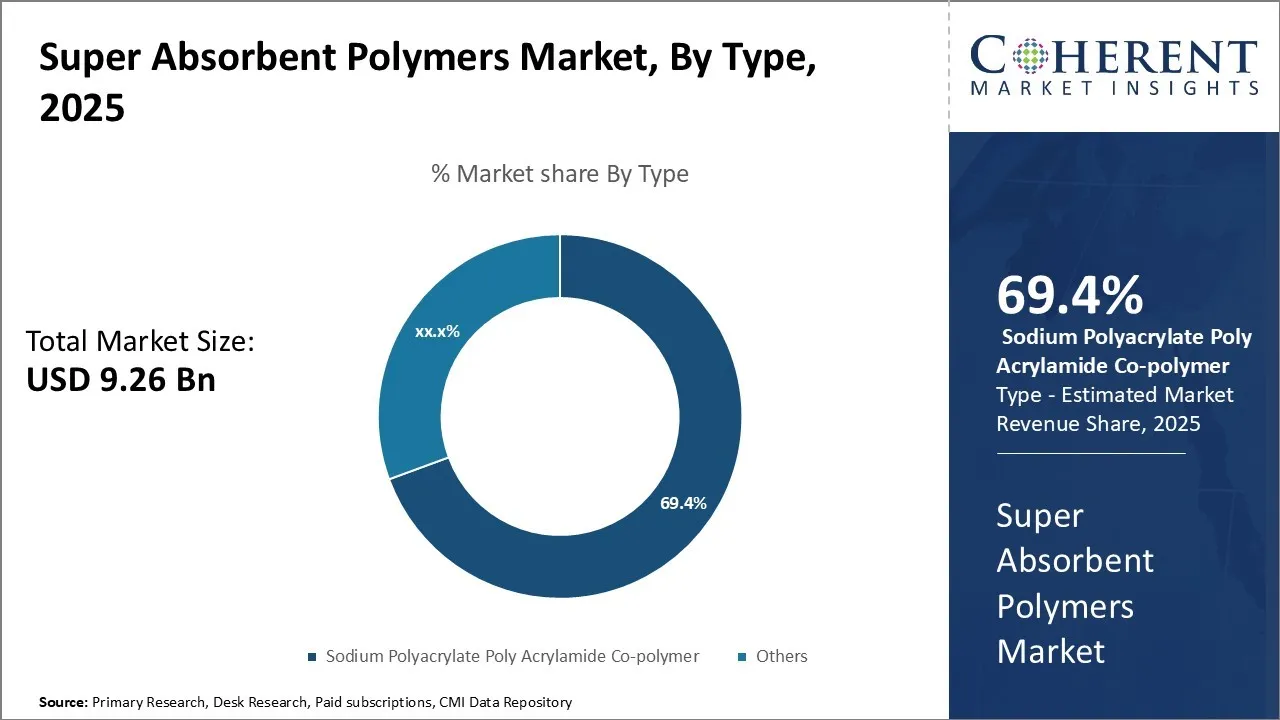
  • By Type, Sodium Polyacrylate Poly Acrylamide Co-polymer hold the largest market share of 69.4% in 2025 owing to the surging demand for personal hygiene products.
  • By Application, Femine Hygiene Products expected to hold largest market share in 2025 owing to the rising feminine hygiene awareness & health education.
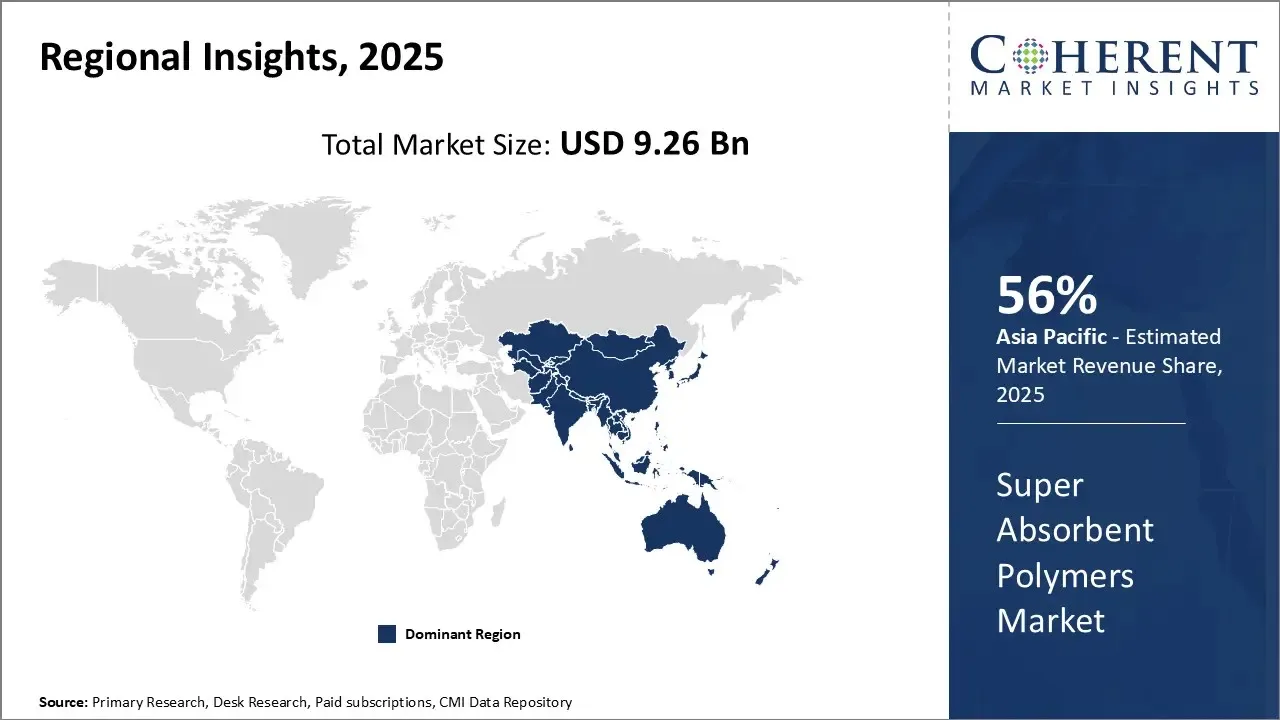
  • By Region, Asia Pacific dominates the overall market with an estimated share of 56% in 2025 owing to the large & growing population with rising urbanization.

Market Overview

The Super Absorbent Polymers (SAP) market is rapidly expanding as consumers and industries increasingly demand products for personal hygiene, agriculture, and healthcare. Manufacturers leverage polymers like sodium polyacrylate and polyacrylamide copolymers for their outstanding liquid absorption and retention capabilities. Rising hygiene awareness, growing disposable incomes, and urbanization, along with innovations in SAP formulations, actively drive adoption worldwide. Emerging regions are also contributing to growth as they adopt modern hygiene products and water-efficient solutions in agriculture

Current Events and Its Impact on the Super Absorbent Polymers (SAP) Market

Current Events

Description and its impact

Geopolitical Tensions and Trade Policies

  • Description: U.S.-China Trade Relations and Tariff Adjustments
  • Impact: Potential disruptions in raw material supply chains for SAP manufacturing, increased costs due to tariffs impacting Asian and North American markets.
  • Description: Russia-Ukraine Conflict Impact on Energy Supply
  • Impact: Rising energy prices may increase production costs for SAP manufacturers reliant on petrochemical feedstocks, affecting pricing and margins globally.

Raw Material Availability and Pricing

  • Description: Volatility in Petrochemical Feedstock Prices
  • Impact: Fluctuations in acrylic acid and sodium polyacrylate prices, primary raw materials for SAP, directly affecting manufacturing costs and product pricing.
  • Description: Expansion of Bio-based Raw Material Research
  • Impact: Development and gradual commercialization of bio-based SAPs could alter market dynamics by introducing sustainable alternatives, affecting demand for petrochemical-based SAPs.

Regulatory and Environmental Policies

  • Description: Stricter Environmental Regulations on Disposable Hygiene Products in Europe and North America
  • Impact: Could limit or reshape demand for certain SAP-based products, pushing manufacturers toward greener alternatives.
  • Description: Incentives for Sustainable Product Development in Asia
  • Impact: Government subsidies and mandates encouraging development of eco-friendly SAPs, accelerating market shift in key growth regions.

Uncover macros and micros vetted on 75+ parameters: Get instant access to report

Segmental Insights

Super Absorbent Polymers Market By Type

To learn more about this report, Download Free Sample

Super Absorbent Polymers (SAP) Market Insights, By Type - Sodium Polyacrylate Poly Acrylamide Co-polymer contribute the highest share of the market owing to its distribution & retail expansion

Sodium Polyacrylate Poly Acrylamide Co-polymer hold the largest market share of 69.4% in 2025. Consumers and industries are driving the demand for sodium polyacrylate–polyacrylamide copolymers in the Super Absorbent Polymers (SAP) market due to their excellent water absorption and retention, which make them vital for personal hygiene, agriculture, and medical applications. Increased focus on convenience and hygiene, combined with advancements in polymer technology, boosts their performance and attractiveness. Companies are also expanding their use in soil moisture management, improving access to hygiene products in emerging markets, and developing innovative, high-efficiency solutions, further accelerating adoption across industries.
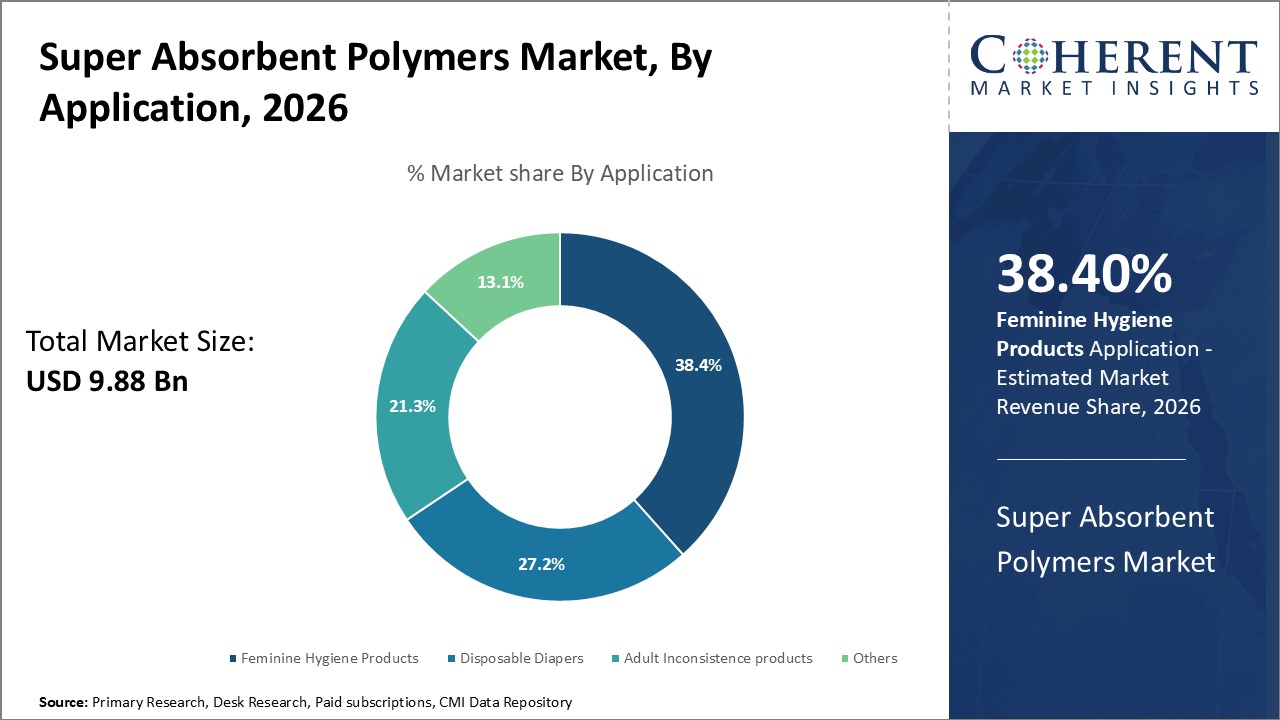
Super Absorbent Polymers (SAP) Market Insights, By Application - Femine Hygiene Products contribute the highest share of the market owing to its distribution expansion & accessibility

Increasing awareness of menstrual health and hygiene is driving women to adopt reliable, high-performance feminine hygiene products, boosting demand for Super Absorbent Polymers (SAP). Consumers actively choose SAP-based pads, liners, and tampons for their comfort, discretion, and superior leak protection. Urbanization, lifestyle changes, and rising disposable incomes further fuel consumption, while manufacturers continue to innovate with thinner, more absorbent, and eco-friendly designs, encouraging wider adoption in both emerging and developed markets. 
Regional Insights

Super Absorbent Polymers Market By Regional Insights

To learn more about this report, Download Free Sample

Asia Pacific Super Absorbent Polymers (SAP) Market Trends

Asia Pacific dominates the overall market with an estimated share of 56% in 2025. Rising demand for personal hygiene products, including baby diapers, adult incontinence items, and feminine care products, is driving trends in the Asia Pacific Super Absorbent Polymers (SAP) market. Manufacturers are actively developing high-performance, eco-friendly SAP formulations to satisfy consumer expectations for comfort and sustainability. Expanding urbanization, higher disposable incomes, and growing hygiene awareness are influencing purchasing behaviors, while farmers and agricultural businesses increasingly adopt SAPs for soil moisture retention and water-efficient farming, establishing a notable growth trend across the region. For instance, Bharat Petroleum Corporation Limited (BPCL) has dispatched the first consignment of indigenous super absorbent polymer (SAP) from its propylene derivatives complex at Kochi Refinery.

North America Super Absorbent Polymers (SAP) Market Trends

Strong demand from the personal hygiene and healthcare sectors is driving the North American Super Absorbent Polymers (SAP) market, as consumers actively seek high-quality, reliable products. Manufacturers are advancing SAP technologies to improve absorption, comfort, and eco-friendly features, addressing sustainability concerns. The region is also expanding SAP use in medical applications such as wound care and surgical products. Rising hygiene awareness, an aging population, and well-established distribution networks further accelerate adoption and encourage continuous innovation in this mature market. For instance, in October 2024, BASF’s Petrochemicals division has upgraded its Superabsorbent Polymers (SAP) plant in Freeport, Texas, after a $19.2 million investment to boost production and optimize processes.

China Super Absorbent Polymers (SAP) Market Trends

Strong consumption of personal hygiene products, especially baby diapers, adult incontinence items, and feminine care products, is driving the rapid expansion of China’s Super Absorbent Polymers (SAP) market. Manufacturers are actively producing high-performance, cost-effective, and environmentally friendly SAPs to satisfy both domestic demand and export opportunities. Urbanization, rising disposable incomes, and increased health and hygiene awareness are shaping consumer choices. At the same time, farmers and agricultural businesses are increasingly adopting SAPs for soil moisture retention and water-efficient farming, boosting market growth in China.

United States Super Absorbent Polymers (SAP) Market Trends

High demand for personal hygiene, healthcare, and adult incontinence products is driving the United States Super Absorbent Polymers (SAP) market. Manufacturers are actively developing advanced SAP formulations that deliver superior absorption, comfort, and eco-friendly features to meet consumer expectations. Increasing hygiene awareness, an aging population, and strong retail and distribution networks are promoting widespread adoption. At the same time, growing use of SAPs in medical and specialty applications, such as wound care and surgical products, is creating new opportunities and fostering innovation in the U.S. market. For instance, in July 2024, ZymoChem has launched BAYSE™, the world’s first scalable, 100% bio-based, biodegradable Super Absorbent Polymer (SAP).

End-user Feedback and Unmet Needs in the Super Absorbent Polymers (SAP) Market

  • Hygiene Product Performance: End-users seek SAPs that offer superior absorption, reduced leakage, and enhanced comfort in diapers, adult incontinence products, and feminine hygiene items. There is growing demand for SAPs that maintain dryness longer while being skin-friendly and minimizing irritation, indicating gaps in softness, odor control, and quick absorption properties.
  • Sustainability and Biodegradability: Consumers increasingly demand eco-friendly SAPs derived from renewable resources or biodegradable polymers. Current SAPs often rely on non-renewable, synthetic sources, creating disposal and environmental concerns. End-users are looking for products that combine high performance with environmental responsibility, reflecting a strong unmet need for greener alternatives in daily hygiene applications.
  • Industrial Applications Efficiency: In agriculture, water retention, and packaging, end-users highlight inconsistent absorption rates and swelling capacities of current SAPs. They require materials that maintain structural integrity under varying conditions and offer predictable performance. There’s an unmet need for SAPs tailored for specific industrial environments with enhanced reliability and adaptability.

Super Absorbent Polymers (SAP) Market Trend

Rising Demand in Hygiene Products

SAPs are increasingly used in diapers, adult incontinence products, and feminine hygiene items due to their superior absorption and dryness retention. Consumer preference for comfort, leak protection, and skin-friendliness is driving innovation in SAP formulations. Manufacturers are focusing on softer textures, improved odor control, and fast absorption to enhance user experience. This trend highlights continuous product development tailored to evolving hygiene standards and lifestyle needs globally.

Sustainability and Eco-Friendly Initiatives

Environmental concerns are pushing the SAP market toward biodegradable and bio-based polymers. Companies are investing in renewable resources to produce SAPs that reduce ecological impact. End-users are showing preference for products that combine high performance with sustainability. Innovations in compostable SAPs for hygiene and agricultural applications are becoming central to market strategies, reflecting a broader industry shift toward greener and more socially responsible materials.

Market Report Scope

Super Absorbent Polymers (SAP) Market Report Coverage

Report Coverage Details
Base Year: 2024 Market Size in 2025: USD 9.26 Bn
Historical Data for: 2020 To 2024 Forecast Period: 2025 To 2032
Forecast Period 2025 to 2032 CAGR: 6.5% 2032 Value Projection: USD 14.39 Bn
Geographies covered:
  • North America: U.S. and Canada
  • Latin America: Brazil, Argentina, Mexico, and Rest of Latin America
  • Europe: Germany, U.K., Spain, France, Italy, Russia, and Rest of Europe
  • Asia Pacific: China, India, Japan, Australia, South Korea, ASEAN, and Rest of Asia Pacific
  • Middle East: GCC Countries, Israel,  and Rest of Middle East
  • Africa: South Africa, North Africa, and Central Africa 
Segments covered:
  • By Type: Sodium Polyacrylate Poly Acrylamide Co-polymer, and Others 
  • By Application: Disposable Diapers, Adult Inconsistence products, Feminine Hygiene Products, and Others
Companies covered:

Nippon Shokubai Co. Ltd., Evonik Industries AG, BASF SE, Yixing Danson Technology, Kao Corporation, Sumitomo Seika Chemicals Co. Ltd, San-Dia Polymers Global Co. Ltd., Sanyo Chemicals Industries, Formosa Plastics Corporation, and LG Chemicals Ltd.

Growth Drivers:
  • Growing demand from baby diaper market
  • Growing hygiene products industry
  • Stringent government regulations about sanitary napkins
Restraints & Challenges:
  • High manufacturing costs
  • Stringent environmental regulations

Uncover macros and micros vetted on 75+ parameters: Get instant access to report

Super Absorbent Polymers (SAP) Market News

  • In July 2025, Ontex Group NV is advancing its sustainability efforts by introducing bio-based superabsorbent polymers (bioSAP) in its diapers, initially in selected products.
  • In August 2024, Nippon Shokubai has approved an investment to build a superabsorbent polymer (SAP) plant at PT. Nippon Shokubai Indonesia with a 50,000-ton annual capacity.

Analyst Opinion (Expert Opinion)

  • The current Super Absorbent Polymers (SAP) market no longer warrants commentary as a generic growth story — it has entered a phase of structural bifurcation between entrenched core hygiene demand and emergent performance‑driven niches, and this should dominate any credible analyst opinion.
  • The hygiene sector remains the unquestioned linchpin of SAP demand. Personal hygiene applications still command the vast majority of global SAP consumption, with diapers alone historically absorbing roughly two‑thirds of total polymer volume. Beyond diapers, adult incontinence and feminine hygiene together constitute a substantial share, reflecting demographic realities such as aging populations and rising hygiene expectations across developed and emerging markets alike. This concentration underscores an inelastic demand structure: even modest shifts in product design that increase SAP content per unit can meaningfully lift polymer off‑take without any expansion in unit sales, reinforcing pricing power for high‑performing grades.
  • However, raw material dynamics complicate this apparent stability. A significant proportion of manufacturers report pronounced volatility in acrylic acid and related feedstock costs, which materially compresses margins and incentivizes vertical integration or bilateral contracts with petrochemical suppliers. These pressures, coupled with capital intensity inherent to SAP production, are constraining capacity roll‑outs and intensifying competitive stratification among incumbents.
  • Sustainability narratives are no longer peripheral — they are commercially material. A discernible shift toward bio‑based or biodegradable SAP formulations is evident in new product pipelines, with a non‑trivial minority of launches positioned around reduced environmental impact. Yet innovation here remains a double‑edged sword: performance trade‑offs relative to established synthetic grades continue to dampen rapid substitution, and regulatory certification cycles extend go‑to‑market timelines.
  • Geographically, the Asia‑Pacific region has asserted dominance in both volume and incremental capacity announcements, outpacing Western markets in both hygiene and agricultural SAP demand growth. North America’s aging demographic supports robust adult hygiene SAP uptake, but unit adoption growth in baby diapers is plateauing, signalling that future volume expansion will depend on product premiumization and adjacent applications, not just broader consumption.
  • Agricultural adoption, while still a relatively small share of total SAP usage, is one of the few areas where polymer demand correlates directly with external utility drivers such as water scarcity and agronomic efficiency. Reports suggest notable improvements in soil moisture retention and crop yield outcomes where SAPs are deployed, particularly in arid regions. If this adoption trajectory continues, agriculture — once dismissed as a marginal use case — could evolve into a meaningfully diversified demand pillar.

Market Segmentation

  • By Type
    • Sodium Polyacrylate
    • Poly Acrylamide Co-polymer
    • Others
  • By Application
    • Disposable Diapers
    • Adult Inconsistence products
    • Feminine Hygiene Products
    • Others
  • Regional Insights (Revenue, USD Bn, 2020 - 2032)
    • North America
      • U.S.
      • Canada
    • Latin America
      • Brazil
      • Argentina
      • Mexico
      • Rest of Latin America
    • Europe
      • Germany
      • U.K.
      • Spain
      • France
      • Italy
      • Russia
      • Rest of Europe
    • Asia Pacific
      • China
      • India
      • Japan
      • Australia
      • South Korea
      • ASEAN
      • Rest of Asia Pacific
    • Middle East
      • GCC Countries
      • Israel
      • Rest of Middle East
    • Africa
      • South Africa
      • North Africa
      • Central Africa
  • Key Players Insights
    • Nippon Shokubai Co. Ltd.
    • Evonik Industries AG
    • BASF SE
    • Yixing Danson Technology
    • Kao Corporation
    • Sumitomo Seika Chemicals Co. Ltd
    • San-Dia Polymers Global Co. Ltd.
    • Sanyo Chemicals Industries
    • Formosa Plastics Corporation
    • LG Chemicals Ltd.

Sources

Primary Research interviews

  • Industry experts and professionals in SAP manufacturing
  • Key executives of SAP production companies
  • Distributors and suppliers of raw materials for SAP
  • End-users in hygiene products, agriculture, and medical sectors

Databases

  • Scopus
  • Web of Science
  • ScienceDirect
  • PubChem
  • Chemical Abstracts Service (CAS)

Magazines

  • Chemical & Engineering News
  • Polymer Technology Magazine
  • Hydrogel World Magazine
  • Adhesives & Sealants Industry Magazine

Journals

  • Journal of Applied Polymer Science
  • Polymer International
  • Macromolecular Materials and Engineering
  • International Journal of Biological Macromolecules

Newspapers

  • The Chemical Engineer (online section)
  • The Times of India – Business/Industry sections
  • The Wall Street Journal – Materials & Chemicals section
  • Financial Times – Chemicals/Materials section

Associations

  • American Chemical Society (ACS)
  • Society of Plastics Engineers (SPE)
  • European Polymer Federation (EPF)
  • International Society for Hydrocolloids

Public Domain sources

  • U.S. Food & Drug Administration (FDA) reports
  • European Chemicals Agency (ECHA) publications
  • World Bank and UN industrial reports
  • Patent databases (USPTO, WIPO)

Proprietary Elements

  • CMI Data Analytics Tool
  • Proprietary CMI Existing Repository of information for last 8 years

Share

Share

About Author

Yash Doshi is a Senior Management Consultant. He has 12+ years of experience in conducting research and handling consulting projects across verticals in APAC, EMEA, and the Americas.

He brings strong acumen in helping chemical companies navigate complex challenges and identify growth opportunities. He has deep expertise across the chemicals value chain, including commodity, specialty and fine chemicals, plastics and polymers, and petrochemicals. Yash is a sought-after speaker at industry conferences and contributes to various publications on topics related commodity, specialty and fine chemicals, plastics and polymers, and petrochemicals.

Missing comfort of reading report in your local language? Find your preferred language :

Frequently Asked Questions

The Super Absorbent Polymers Market is estimated to be valued at USD 9.26 Bn in 2025, and is expected to reach USD 14.39 Bn by 2032.

High manufacturing costs and stringent environmental regulations are the key factors hampering the growth of the global super absorbent polymers (SAP) market.

Growing demand from baby diaper market, growing hygiene products industry and stringent government regulations about sanitary napkins are the major factors driving the global super absorbent polymers (SAP) market growth.

The disposable diapers segment is the leading application segment in the global super absorbent polymers (SAP) market.

The major players operating in the global super absorbent polymers (SAP) market are Nippon Shokubai Co. Ltd., Evonik Industries AG, BASF SE, Yixing Danson Technology, Kao Corporation, Sumitomo Seika Chemicals Co. Ltd, San-Dia Polymers Global Co. Ltd., Sanyo Chemicals Industries, Formosa Plastics Corporation, and LG Chemicals Ltd.

Asia Pacific leads the global super absorbent polymers (SAP) market.

The CAGR of the Super Absorbent Polymers Market is projected to be 6.5% from 2025 to 2032.

Select a License Type

EXISTING CLIENTELE

Joining thousands of companies around the world committed to making the Excellent Business Solutions.

View All Our Clients
trusted clients logo
© 2025 Coherent Market Insights Pvt Ltd. All Rights Reserved.