

Thermoformed Plastics Market Size and Share Analysis – 2026 to 2033
Thermoformed Plastics Market is estimated to be valued at USD 14.49 Bn in 2026 and is expected to reach USD 17.94 Bn in 2033, exhibiting a compound annual growth rate (CAGR) of 3.1% from 2026 to 2033.
Key Takeaways
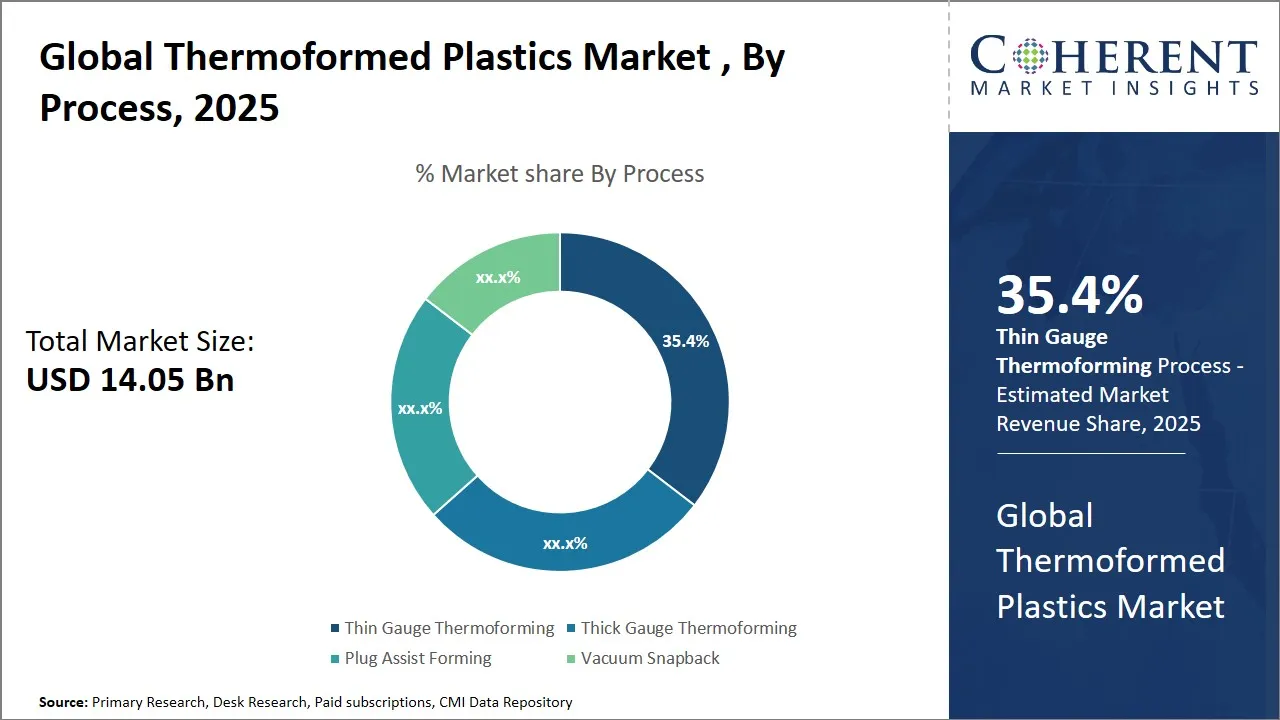
- Based on Process, Thin Gauge Thermoforming Segment is expected to dominate the global market over the forecast period with 36.4% market share. This is due to the growing demand for this process for producing medical device packaging trays in the healthcare industry.
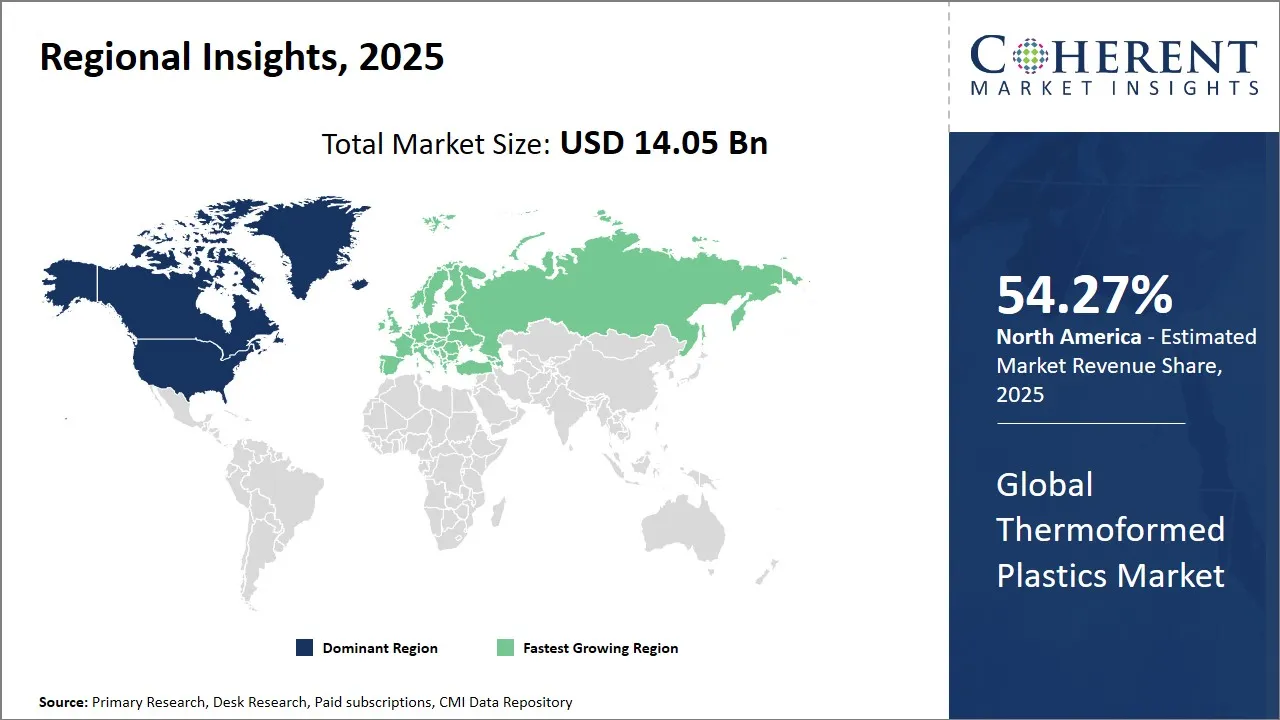
- North America is expected to dominate the market with 54.27% market share. This is due to the high usage of plastics across automotive, packaging, electrical &electronics, and consumer good appliances.
- Europe is expected to hold around 17.51% shares in the global market in 2026. This is owing to rapid urbanization and digitalization.
Market Overview
The thermoformed plastics market has shown steady expansion in recent years, driven by the increasing demand for lightweight, durable, and cost-effective packaging solutions across various industries. Growing usage in sectors including food and beverages, healthcare, automotive, and electronics are driving the growth. As these sectors look for materials that provide design freedom, high performance, and recyclability. The market will continue to drive strong momentum over the forecast period, driven by advances in sustainable materials, better thermoforming processes, and increasing demand for efficient, environmentally friendly packaging solutions.
Current Events and Its Impact on Thermoformed Plastics Market
Current Events | Description and its impact |
Adoption of Recycled Content Thermoforming in Mass Production |
|
Interpack 2025 – Düsseldorf, Germany |
|
Global Thermoformed Plastics Market Drivers
- Growing demand for food and beverage sector to augment market growth
Thermoformed plastics are used for improved shelf life, secure seals, and quality designs of food packaging. Polyethylene and polypropylene thermoformed molded packaging containers that are widely used for food packaging application. Packaging products produced by using thermoformed plastics are some tubs, blister packages, and clamshells.
For example, in March 2025, Placon launched its Fresh'n clear Dip Cup packaging—created for ready-to-eat dips and snack foods—utilizing at least 10% recycled PET thermoformed containers. The crystal-clear cups provide secure sealing, long shelf life, and enhanced aesthetic beauty to meet grab-and-go consumption trends in retail.
- Rising demand from medical sector to propel market growth
They are widely used in medical device packaging trays. Thermoformed plastics are gaining demand due to their cost-effectiveness and negligible packaging waste. They enhance the overall quality of medical goods and can be customized to offer packaging solutions, which are air-tight, anti-bacterial, and durable. These products offer protection against infections. Moreover, they are chemical resistant and transparent, thus allow widespread usage in laboratories and hospitals.
Global Thermoformed Plastics Market Opportunities
Growing popularity of thick gauge thermoforms to offer profitable market opportunities. Thick gauge thermoforms are sturdy and rigid enclosures that can be used to pack electronic equipment. They are used in a wide variety of products such as medical device packaging trays, front and rear bumpers and interior trim components for heavy trucks, enclosures for treadmills and weights, cowlings, dash components, and fenders in the agricultural sector and cab interiors and engine covers in the construction equipment industry. Growing number of merger and acquisition in the market is expected provide significant growth opportunities.
Global Thermoformed Plastics Market Trends
- Sustainable thermoformed plastics is a new trend
Key players in the market are adopting various strategies to develop sustainable thermoformed plastics. This is expected to fuel market growth. For instance, in March 2023, Neste and ILLIG have joined together in an attempt to promote more sustainable thermoformed packaging options. Using case studies to showcase how renewable and recycled materials can serve as drop-in solutions in demanding applications, the companies recreate value chains on a small scale for demonstration purposes.
- Current Industry Events of 2026
- Market Size Estimation
- Regional Breakdown
- Competitive Landscape
- Customer Intelligence
- Segmental Analysis
- Pricing Analysis
- Key Market Drivers, Challenges & Future Trends
- Customized Insights Section
Segmental Insights
Thermoformed Plastics Market Insights, By Process
Thin Gauge Thermoforming is expected to dominate the global market over the forecast period. Growth is attributed by growing demand for this process for producing medical device packaging trays in the healthcare industry. Plug Assist Forming segment is also expected to witness significant growth in the near future and this is owing to the growing demand for this process for manufacturing food packaging materials.
Thermoformed Plastics Market Insights, By Product
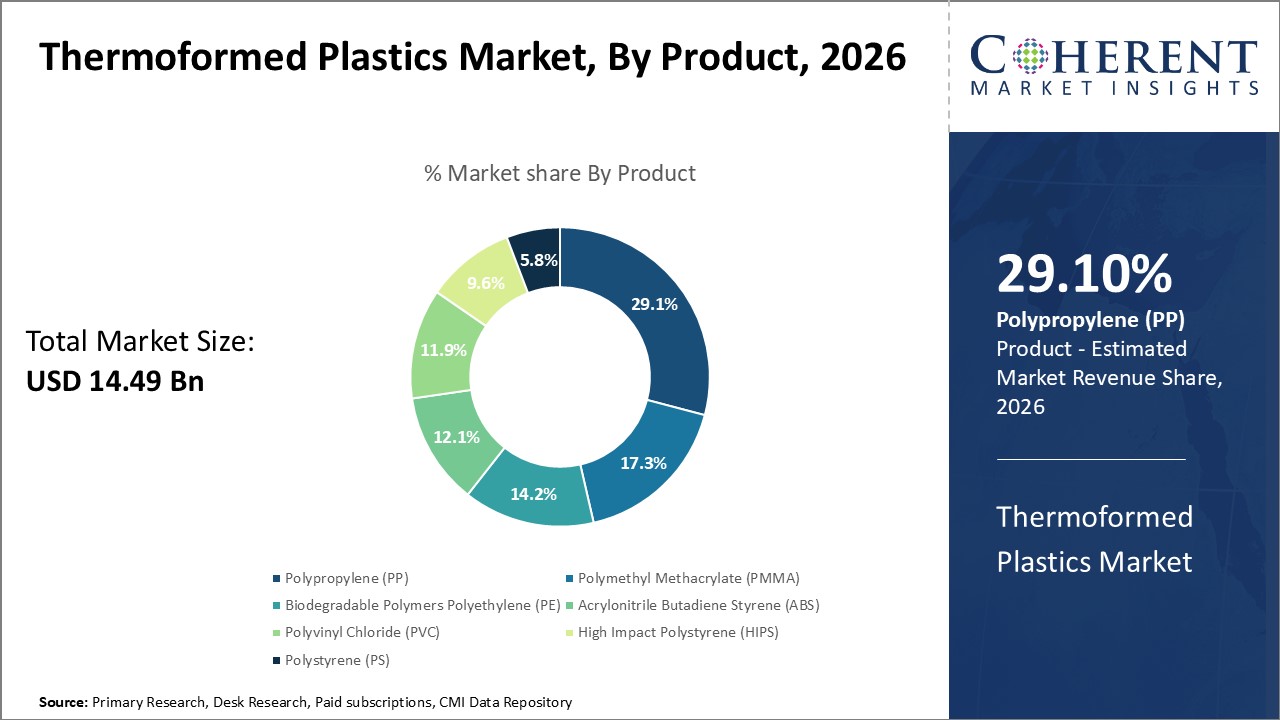
Based on Product, the market is segmented into Polymethyl Methacrylate (PMMA), Bio-degradable Polymers Polyethylene (PE), Acrylonitrile Butadiene Styrene (ABS), Polyvinyl Chloride (PVC) High Impact Polystyrene (HIPS), and Polystyrene (PS) Polypropylene (PP). Out of which, Polypropylene is expected to dominate the global market over the forecast period.
Growth is attributed by growing demand for this material for producing food packaging products such as trays, cups, margarine tubs, disposable products, sandwich packs, microwaveable containers, and beverage glasses. Polymethyl Methacrylate (PMMA) segment is also expected to witness significant growth in the near future and this is owing to their high surface hardness, light transmission, extended service life, high resistance to UV light and weathering properties.
Thermoformed Plastics Market Insights, By Application
Based on Application, the market is segmented into Healthcare & Medical, Food Packaging, Healthcare & Medical, Automotive Construction, and Consumer Goods & Appliances. Out of which, Food Packaging is expected to dominate the global market over the forecast period. Growth is attributed by growing usage of thermoformed plastic for packaging of vegetables, fruits, confectionery products, prepared meals, poultry, meat, and fish. Healthcare & Medical segment is also expected to witness significant growth in the near future and this is owing to the increasing use of thermoformed plastics medical trays, medical devices, pharmaceutical packaging, procedure trays, and protective packaging.
Regional Insights
North America Thermoformed Plastics Market Analysis and Trend
North America is expected to dominate the global thermoformed plastics market over the forecast period owing to the high usage of plastics across automotive, packaging, electrical &electronics, and consumer good appliances. PP is widely used plastics in labeling, textiles, packaging, automotive, stationery, and reusable containers of various types in the region.
Asia Pacific Thermoformed Plastics Market Analysis and Trend
Asia Pacific is another key region for thermoformed plastics market due to rapid industrialization and urbanization. Moreover, growing population is also playing a major role in the overall development of regional market.
Thermoformed Plastics Market Dominating Countries
United States Thermoformed Plastics Market Analysis and Trend
The U.S. is ahead in the thermoformed plastics market because of its superior manufacturing base, adoption of advanced technology, and high demand from the food packaging, automotive, and healthcare sectors. Strong regulations related to hygiene and product safety also push innovation in materials and production processes, which would make the country stay ahead.
Germany Thermoformed Plastics Market Analysis and Trend
Germany leads the European market due to its emphasis on precision engineering and high production quality. The highly developed automotive and industrial sectors of the country drive the need for long-lasting and customized thermoformed plastic parts, while the drive towards sustainability promotes the use of recyclable and bio-based plastic materials.
China Thermoformed Plastics Market Analysis and Trend
China has quickly become a global player in the industry of thermoformed plastics due to cheap production, a large supply base, and increasing domestic demand. Its electronics and packaging industries are expanding rapidly, and government incentives for manufacturing make the nation extremely competitive in the world.
India Thermoformed Plastics Market Analysis and Trend
India is an emerging force in the market, driven by growth in food packaging, pharmaceuticals, and consumer goods. As infrastructure and industrialization continue to expand, so does the need for affordable, high-volume plastic solutions, making India a key growth region for thermoformed products.
Japan Thermoformed Plastics Market Analysis and Trend
Japan’s dominance stems from its focus on innovation and quality. Japan healthcare and electronics sectors create demand for highly precise and reliable thermoformed components. Additionally, Japan invests heavily in eco-friendly materials and efficient manufacturing processes, supporting long-term market leadership.
Market Report Scope
Thermoformed Plastics Market Report Coverage
| Report Coverage | Details | ||
|---|---|---|---|
| Base Year: | 2025 | Market Size in 2026: | USD 14.49 Bn |
| Historical Data for: | 2020 To 2024 | Forecast Period: | 2026 To 2033 |
| Forecast Period 2026 to 2033 CAGR: | 3.1% | 2033 Value Projection: | USD 17.94 Bn |
| Geographies covered: |
| ||
| Segments covered: |
| ||
| Companies covered: | Pactiv LLC, Sonoco Products Company, CM Packaging, Placon, and Genpak LLC | ||
| Growth Drivers: |
| ||
| Restraints & Challenges: |
| ||
Global Thermoformed Plastics Market: Key Developments
- In April 2024, Plastiform and its Texas subsidiary Precision Formed Plastics were acquired by Nefab Group, adding its thermoformed cushioning and recycled-plastic solutions portfolio. The acquisition bolstered Nefab's presence in North America and its capabilities in sustainable, protective packaging for high-value industrial products.
- In February 2024, Amcor announced new automated, state-of-the-art thermoforming lines at its facility in Oshkosh, Wisconsin, particularly to meet increased demand in the pharmaceutical and medical packaging segment.
Analyst View
- The market for thermoformed plastics exhibits strong momentum fueled by increasing demand from automotive, healthcare, and packaging industries. Increasing demand for lightweight, resistant packaging solutions, especially for food and beverages, is a key growth driver. The push toward weight reduction by the automotive industry for better fuel economy hugely supports market growth as thermoformed parts substitute conventional materials in interior and exterior uses.
- Sustainability issues pose both challenges and opportunities in this environment. While green regulations on single-use plastics pose market restraints, they also spur innovation toward biodegradable and recyclable thermoformed products. Producers are increasingly investing in next-generation recycling technology and bio-based materials to respond to these regulatory headwinds. However, the growing consumer and regulatory push for plastic alternatives such as paper-based and compostable materials poses a significant threat to thermoformed plastics, potentially reducing demand in key packaging segments.
- The medical industry is one such area that stands out especially as a very promising option, with increased demand for medical device packaging and disposable medical devices driving market demand. Cost efficiency and design flexibility of thermoforming processes offer comparative superiority over other manufacturing processes.
- North America is the leading market, fueled by mature packaging and automotive industries and strong food safety regulation demanding top-notch packaging solutions. But Asia-Pacific is the quickest-growing region, driven by quick industrialization, growing middle-class population, and rising consumer goods demand in China and India.
Market Segmentation
- Global Thermoformed Plastics Market, By Product (Revenue, USD Bn, 2021 - 2033)
- Polymethyl Methacrylate (PMMA)
- Bio-degradable Polymers Polyethylene (PE)
- Acrylonitrile Butadiene Styrene (ABS)
- Polyvinyl Chloride (PVC) High Impact Polystyrene (HIPS)
- Polystyrene (PS) Polypropylene (PP)
- Global Thermoformed Plastics Market, By Process (Revenue, USD Bn, 2021 - 2033)
- Plug Assis Forming
- Thick Gauge Thermoforming
- Thing Gauge Thermoforming
- Vacuum Snapback
- Global Thermoformed Plastics Market, By Application (Revenue, USD Bn, 2021 - 2033)
- Healthcare & Medical
- Food Packaging
- Electrical & Electronics
- Automotive Construction
- Consumer Goods & Appliances
- Global Thermoformed Plastics Market, By Region (Revenue, USD Bn, 2021 - 2033)
- North America
- U.S.
- Canada
- Latin America
- Brazil
- Argentina
- Mexico
- Rest of Latin America
- Europe
- Germany
- U.K.
- Spain
- France
- Italy
- Russia
- Rest of Europe
- Asia Pacific
- China
- India
- Japan
- Australia
- South Korea
- ASEAN
- Rest of Asia Pacific
- Middle East
- GCC Countries
- Israel
- Rest of Middle East
- Africa
- South Africa
- North Africa
- Central Africa
- Company Profiles
- Pactiv LLC
- Sonoco Products Company
- CM Packaging
- Placon
- Genpak LLC
Sources
Primary Research Interviews
- Thermoforming equipment manufacturers
- Plastic material suppliers and distributors
- Food packaging industry executives
- Automotive component manufacturers
- Others
Databases
- Plastics Industry Trade Association Database
- Global Trade Information Services (GTIS)
- Euromonitor International Database
- IBISWorld Industry Research Database
- Others
Magazines
- Plastics Technology Magazine
- Packaging World Magazine
- Modern Plastics Worldwide
- Thermoforming Magazine
- Others
Journals
- Journal of Applied Polymer Science
- Polymer Engineering & Science
- Packaging Technology and Science
- Others
Newspapers
- Financial Times
- The Wall Street Journal
- Reuters Business News
- Bloomberg Industry News
- Others
Associations
- Society of Plastics Engineers (SPE)
- Plastics Industry Association (PLASTICS)
- European Association of Plastics Recycling and Recovery Organizations (EPRO)
- Thermoforming Division of SPE
- Others
Public Domain Sources
- U.S. Environmental Protection Agency (EPA) reports
- European Chemicals Agency (ECHA) publications
- United Nations Industrial Development Organization (UNIDO) data
- World Bank industrial statistics
- Others
Proprietary Elements
- CMI Data Analytics Tool
- Proprietary CMI Existing Repository of information for last 8 years
*Definition: Thermoforming plastics are manufactured from thermoforming process. It is a simple and economical way of making plastic components which can be used in a wide variety of sectors. The process mainly involves the heating of sheets of plastic until they become malleable and can be molded into various shapes and sizes. This method is highly reliable and provides a cost-effective way of manufacturing plastic parts, particularly for larger components.
Get access to 250+ pages report
Every segment, forecast, competitor profile and data table behind the analysis above — available for instant download.
- ESOMAR Member
- ISO 9001:2015 Certified
- D-U-N-S Registered
- GDPR & CCPA Compliant
Missing comfort of reading report in your local language? Find your preferred language:
Transform your Strategy with Exclusive Trending Reports
Frequently Asked Questions
The Thermoformed Plastics Market size is estimated to be valued at USD 14.49 Bn in 2026, and is expected to reach USD 17.94 Bn by 2033.
The CAGR of the global Market is projected to be 3.1% from 2026 to 2033.
Growing demand for food and beverage sector and rising demand from medical sector are fuelling growth of the market.
Limited recyclability of certain thermoformed plastics and environmental concerns over plastic waste are key factors hampering the market’s growth.
Major players include Pactiv LLC, Amcor plc, Sonoco Products Company, Berry Global Inc., and D&W Fine Pack.
North America is expected to lead the global market due to strong demand in packaging, automotive, and healthcare sectors.
The Thin gauge thermoforming segment is the leading component segment in the market.