

Vein Finder Market Size and Forecast — 2026-2033
The Global Vein Finder Market size is estimated to be valued at USD 281.8 million in 2026 and is expected to reach USD 460 million by 2033, exhibiting a compound annual growth rate (CAGR) of 8.4% from 2026 to 2033.
Overview
Vein finder devices are noninvasive visualization tools that assist clinicians in locating peripheral veins for venipuncture, cannulation, and IV access, reducing failure rates and patient discomfort. Product types include infrared (NIR) transillumination systems, near-infrared vein-imaging cameras with real-time projection, augmented-reality overlays integrated with tablets, and simple LED-based transilluminators for pediatrics and neonatology. Devices vary from handheld portable units to cart-mounted imaging systems with depth estimation and vessel mapping software. Key product features include adjustable illumination, contrast enhancement algorithms, multi-depth imaging modes, battery operation for field use, and disposable-friendly sterile draping.
Key Takeaways
Near-Infrared (NIR) technology dominates the vein finder market segment, accounting for over 56% industry share due to superior imaging clarity and adaptability across patient profiles. Portable devices are the leading product subsegment with 49% market revenue, reflecting growing preference for mobility and ease of use.
Hospitals remain the primary end-user segment, constituting 61% of usage, driven by an increase in inpatient procedures and chronic disease management requiring efficient vascular access tools.
North America leads regional revenue contribution with a prominent market share of approximately 38% due to advanced healthcare infrastructure and wide adoption of cutting-edge vein finder technologies.
Asia Pacific presents the highest CAGR, attributed to expanding healthcare awareness and supportive government policies promoting medical device adoption.
Vein Finder Market Segmentation Analysis
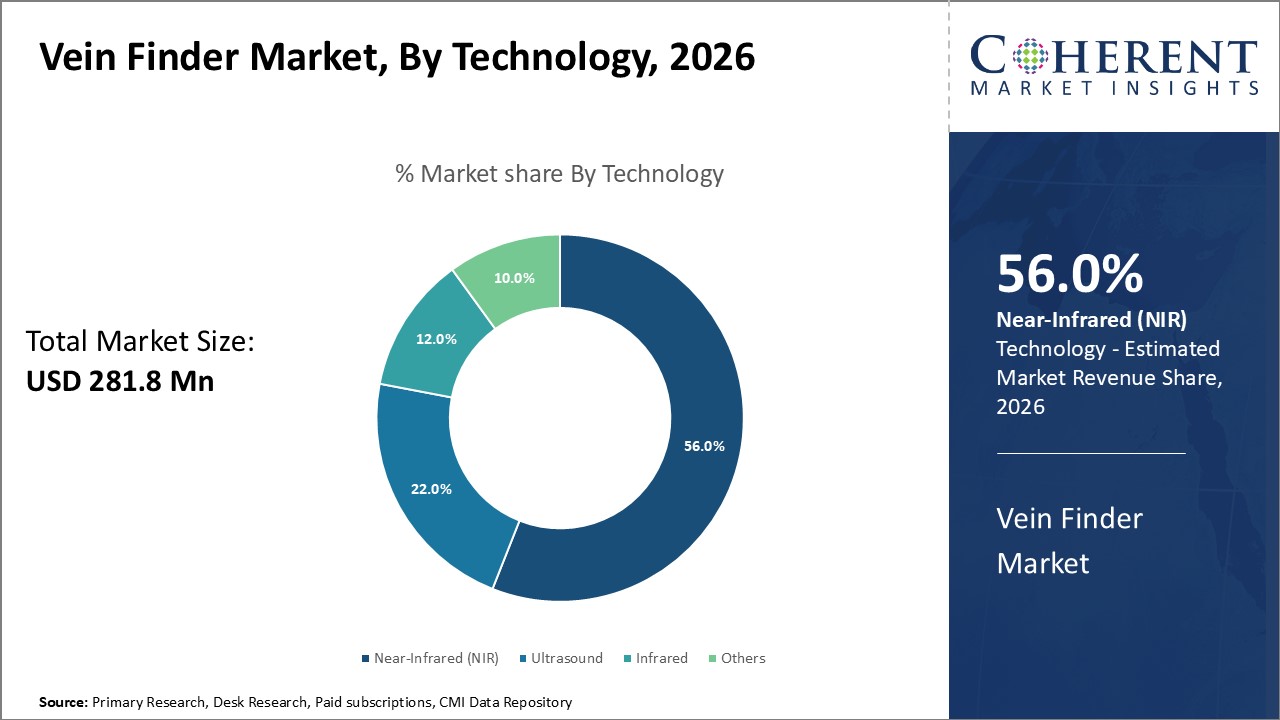
Vein Finder Market Insights, By Technology
Near-Infrared (NIR) dominates the market share. NIR technology leads due to its superior imaging capabilities and non-invasive nature, which provides more accurate visualization, particularly beneficial in complex clinical cases. The fastest growing subsegment is Ultrasound technology, which is gaining rapid traction for its ability to provide deeper vessel imaging and real-time guidance in difficult venous access, especially in geriatric care. Infrared technology still holds relevance in select ambulatory settings due to cost advantages.
Vein Finder Market Insights, By Product
Portable Devices are dominating the market share. Portable vein finders have surged due to their convenience, battery-powered operation, and adaptability for use in emergency and outpatient scenarios. The fastest growing segment is Wearable Devices, which promise continuous monitoring capabilities and are increasingly integrated with mobile health applications. Handheld devices remain popular in clinical settings for ease of use, whereas standalone units are used mostly in diagnostic centers with stricter imaging requirements. Others include bespoke devices for veterinary or experimental uses.
Vein Finder Market Insights, By End-User
Hospitals dominate the industry share. Hospitals possess the highest demand, driven by the high volume of inpatient procedures requiring efficient vascular access. The fastest growing subsegment is Homecare, catalyzed by an increasing shift toward outpatient care and chronic disease management at home, facilitated by portable and wearable vein finder devices. Diagnostic centers maintain steady demand mainly for pre-operative assessments, while ambulatory surgical centers grow moderately due to rising minor surgical procedures performed in outpatient environments. Others include veterinary clinics and research institutions.
Vein Finder Market Trends
The vein finder market has witnessed rapid technological evolution, particularly through enhanced real-time imaging and AI-powered diagnostics that streamline vascular access.
For example, U.S. hospitals employing these innovations in 2026 reported a 26% increase in procedural success rates, underscoring the importance of integrating advanced tech into vein visualization tools.
Furthermore, the trend toward portable and wearable devices is transforming market dynamics by enabling point-of-care applications in home care and ambulatory settings. In Japan and South Korea, the uptake of such devices surged by nearly 31% in 2025, driven by aging populations and rising demand for home-based care.
Regionally, North America retains dominance, accounting for approximately 38% of the total vein finder market share, supported by a well-established healthcare ecosystem, extensive R&D investments, and favorable reimbursement policies.
The presence of key market players like Becton Dickinson and Medtronic significantly strengthens this leadership.
Meanwhile, Asia Pacific emerges as the fastest-growing region with a CAGR exceeding 9% attributed to expanding healthcare infrastructure, increasing chronic disease prevalence, and government initiatives propelling medical device adoption.
Countries like India and China contribute robustly due to growing middle-class healthcare spending and burgeoning private healthcare networks.
Vein Finder Market Insights, By Geography
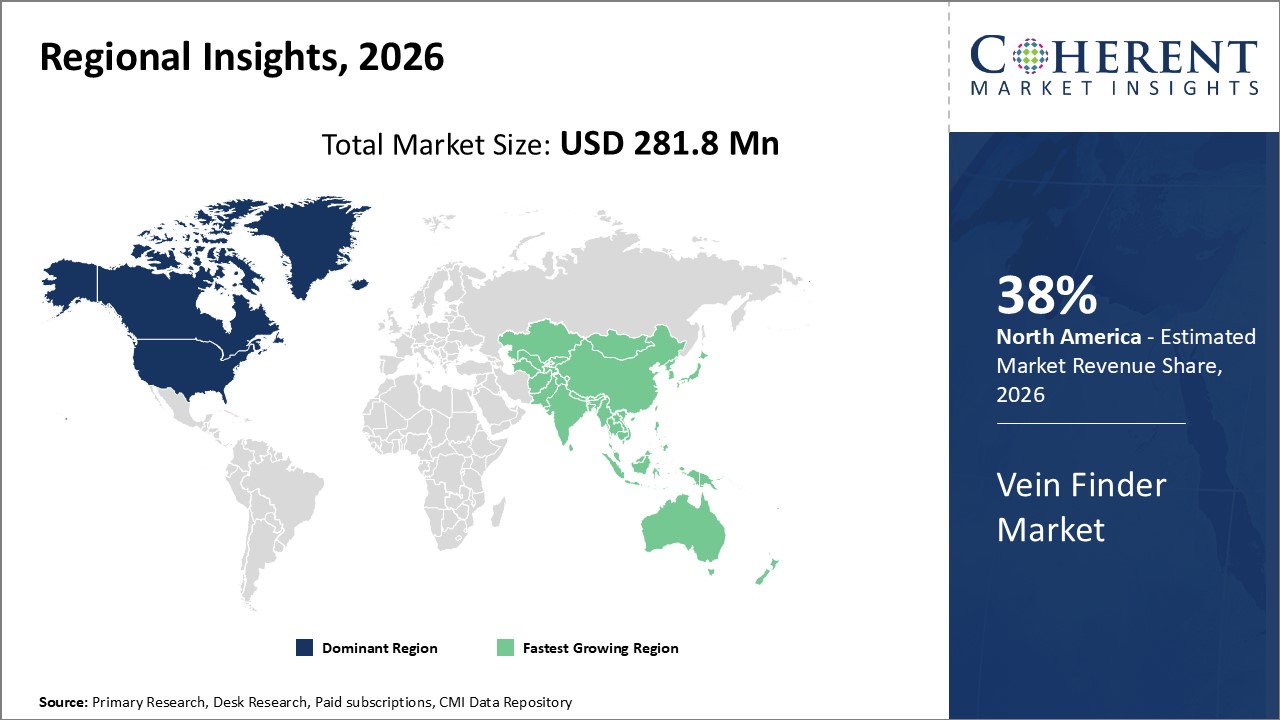
North America Vein Finder Market Analysis and Trends
In North America, the vein finder market dominance stems from sophisticated healthcare infrastructure and rapidly adopting cutting-edge vein finder technologies optimized for emergency, oncology, and pediatric care. The U.S. alone accounts for about 85% of the North American market share, fueled by rising hospital investments in advanced diagnostic tools and the extensive presence of leading manufacturers such as Accuvein Inc. This region's regulatory clarity and comprehensive insurance coverage significantly stimulate vein finder deployment in clinical settings.
Asia Pacific Vein Finder Market Analysis and Trends
Meanwhile, the Asia Pacific exhibits the fastest growth, driven by a rising elderly population and increasing incidence of chronic illnesses like diabetes and cancer. Rising healthcare expenditure in countries like India, which has witnessed a 30% spike in device purchases in 2026, propels this growth. Government reforms enhancing healthcare access and reimbursement policies have further supported market expansion. Key players are strategically entering this region through local partnerships and distribution alliances to capture burgeoning market opportunities.
Vein Finder Market Outlook for Key Countries
USA Vein Finder Market Analysis and Trends
The U.S. vein finder market is a critical contributor to the overall market revenue, with significant adoption of technologically advanced devices powered by AI and NIR imaging. Market leaders such as Becton Dickinson and Medtronic have spearheaded product innovation, launching vein finder models that decreased venipuncture failure rates by 20% in leading cancer centers across the country in 2026. The presence of a robust healthcare infrastructure and favorable reimbursement policies form a conducive environment for sustained market growth.
India Vein Finder Market Analysis and Trends
India’s vein finder market growth is fueled by increasing investment in healthcare infrastructure, combined with rising incidences of chronic diseases, such as diabetes, which affected over 74 million people nationally in 2025. The adoption of advanced portable devices is rapidly increasing, led by regional market players and supported by favorable government initiatives aiming to expand healthcare accessibility.
Analyst Opinion
Enhanced Precision and Accuracy Are Driving Device Adoption: The market analysis reveals a substantial increase in the use of vein finders equipped with real-time imaging and AI-powered vein detection algorithms. In 2025, device accuracy improvements led to a 16% reduction in unsuccessful venipuncture attempts in major hospitals in the U.S. This advancement is crucial for critical care units, where precision can mitigate complications.
Integration of Portable and Wearable Technology Significantly Expands Market Reach: The emergence of compact, battery-operated vein finders has extended usage beyond hospitals to outpatient clinics and homecare settings. Recent sales figures from 2026 indicate a 22% year-over-year growth in portable vein finder adoption across Europe, highlighting a shift toward patient-centric care and point-of-care diagnostics.
Demand-Side Indicators Reflect Rising Incidence of Chronic Diseases: Increased prevalence of diabetes and obesity has led to difficult vascular access cases. In 2025 alone, diabetes affected over 537 million adults globally per data from reputable health organizations, emphasizing the need for efficient vein visualization solutions that reduce complications during injections and infusions.
Market Growth Supported by Expanding Use Cases Across Medical Specialties: Beyond phlebotomy, vein finder devices are gaining traction in pediatrics, oncology, and geriatrics due to their minimally invasive nature. A large cancer treatment center in Canada reported a 11% rise in using vein finders for chemotherapy administration in 2026, signaling broader clinical adoption.
- Current Industry Events of 2026
- Market Size Estimation
- Regional Breakdown
- Competitive Landscape
- Customer Intelligence
- Segmental Analysis
- Pricing Analysis
- Key Market Drivers, Challenges & Future Trends
- Customized Insights Section
Market Scope
| Report Coverage | Details | ||
|---|---|---|---|
| Base Year: | 2025 | Market Size in 2026: | USD 281.8 million |
| Historical Data for: | 2020 To 2024 | Forecast Period: | 2026 To 2033 |
| Forecast Period 2026 to 2033 CAGR: | 8.4% | 2033 Value Projection: | USD 460 million |
| Geographies covered: |
| ||
| Segments covered: |
| ||
| Companies covered: | Becton Dickinson and Company, NIRVision Systems Inc., Accuvein Inc., Franklin Technologies Inc., Christie Medical Holdings Inc., Medtronic plc, GE Healthcare, Siemens Healthineers, Mindray Medical International Limited, Sonosite Inc., AngioDynamics Inc. | ||
| Growth Drivers: |
| ||
Vein Finder Market Growth Factors
Rising Patient Awareness for Better Medical Outcomes: Increasing patient preference for minimally invasive procedures has intensified demand for vein finder devices, especially in developed countries where patient experience is a priority. A 2026 survey indicated more than 65% of patients in North American hospitals favored devices that reduce multiple puncture attempts. Technological Advancements Enhancing Device Accuracy and Usability: Continuous R&D efforts have yielded devices with superior imaging and adaptability to various skin tones, a longstanding market challenge. For instance, integration of multispectral imaging improved vascular visualization in darker skin by 20%, as per clinical trials conducted in 2025.
Government initiatives to improve healthcare access have led to increased purchases of vein finder devices in the Asia Pacific, especially India and China, where annual sales surged by 28% in 2026, supported by reimbursement policies. Increasing Prevalence of Chronic and Geriatric Patients: As aging populations grow, so does the demand for efficient vascular access tools, especially for oncology and dialysis treatments. The Asia Pacific region's aging demographic is expected to contribute significantly to the market revenue through 2033.
Vein Finder Market Development
In June 2023, Merz Aesthetics entered into an exclusive U.S. distribution partnership with AccuVein for the AV500 vein visualization device, marking a strategic expansion into advanced vascular imaging solutions that enhance aesthetic procedure safety. The partnership enables Merz to integrate real-time, infrared-based vein mapping into its portfolio of injectables and aesthetic practice tools, helping clinicians reduce bruising, improve injection accuracy, and enhance overall patient comfort. The AV500, known for its lightweight design, portability, and precise vein illumination capabilities, has become increasingly valuable in aesthetic medicine as patient expectations for both safety and cosmetic outcomes continue to rise.
In April 2022, ImmunoTek Bio Centers became the first plasma collection network to implement VeinViewer® vein visualization technology across its donation centers, marking a major advancement in donor experience and operational safety. The adoption of VeinViewer®, a near-infrared imaging system that projects a real-time map of veins onto the skin, helps clinicians identify optimal venipuncture sites with greater precision, reducing the risk of multiple sticks, improving procedural efficiency, and enhancing donor comfort—critical factors in high-volume plasma collection workflows.
Key Players
Leading Companies of the Market
Becton Dickinson and Company
NIRVision Systems Inc.
Accuvein Inc.
Franklin Technologies Inc.
Christie Medical Holdings Inc.
Medtronic plc
GE Healthcare
Siemens Healthineers
Mindray Medical International Limited
Sonosite Inc.
AngioDynamics Inc.
Among the competitive strategies, Accuvein Inc. has aggressively expanded through acquisitions, acquiring small regional players to bolster its distribution network, increasing its market penetration by 18% in 2025. Similarly, Becton Dickinson has focused on product innovation, launching AI-integrated vein finder models that improved clinical outcomes and boosted user preference in the U.S. oncology sector by 12% in the same year.
Vein Finder Market Future Outlook
Future developments will center on intelligence, integration, and predictive capability. Vein finders will increasingly incorporate AI models trained to predict access difficulty (vein fragility, collapse risk) and recommend optimal cannulation sites and angles, potentially interfacing with ultrasound for hybrid imaging in deep or ambiguous cases. Multifunction devices combining NIR projection with compact ultrasound probes could provide clinicians a single tool for both superficial mapping and depth-resolved guidance. Wearable vein-mapping aids and infusion-site planning software embedded in EHR workflows will facilitate continuity of care and documentation. Miniaturization and cost-reduction of optics and sensors will enable broader deployment in low-resource settings and home health, improving IV success rates in community care.
Vein Finder Market Historical Analysis
Vein finder technologies have progressed from simple bright-field transillumination to advanced near-infrared (NIR) imaging, projection systems, and handheld digital devices that integrate sophisticated image-processing algorithms. The early clinical impetus was practical: reduce multiple venipuncture attempts in children, the elderly, and patients with difficult access (obesity, IV drug use, chemotherapy). Initial transilluminators were low-cost and limited in depth penetration; the adoption of NIR imaging in the 2000s allowed visualization of subcutaneous hemoglobin contrast at clinically useful depths and enabled projected vein maps directly onto the skin. Improvements in sensor sensitivity, low-power LEDs, battery technology, and ergonomics broadened device use into emergency departments, oncology infusion centers, blood-draw stations, and home-health nursing.
Sources
Primary Research Interviews:
Emergency nurses
Infusion center managers
Biomedical imaging engineers
Pediatric clinicians
Databases:
PubMed
FDA device listings
WHO Essential Medical Devices resources
ClinicalTrials.gov
Magazines:
Nursing Times
Medical Devices & Surgical Technology
Imaging Technology News
Modern Healthcare
Journals:
Journal of Vascular Access
British Journal of Nursing
Journal of Infusion Nursing
IEEE Transactions on Medical Imaging
Newspapers:
The Guardian (Health)
The New York Times (Science)
Financial Times (Healthcare)
The Hindu (Medical)
Associations:
Association for Vascular Access (AVA)
Infusion Nurses Society (INS)
World Health Organization (WHO)
American Nurses Association (ANA)
Get access to 250+ pages report
Every segment, forecast, competitor profile and data table behind the analysis above — available for instant download.
- ESOMAR Member
- ISO 9001:2015 Certified
- D-U-N-S Registered
- GDPR & CCPA Compliant
Missing comfort of reading report in your local language? Find your preferred language:
Transform your Strategy with Exclusive Trending Reports
Frequently Asked Questions
The dominant players include Becton Dickinson and Company, Accuvein Inc., and NIRVision Systems, which have solidified their market positions through continuous innovation and expanded global distribution.
The market size is projected to reach USD 460 million by 2033 from USD 281.8 million in 2026, showcasing a CAGR of 8.4%, driven by technology advancements and increasing healthcare demands.
Hospitals remain the largest end-user segment with 60% market share, but home care and ambulatory surgical centers show rapid growth potential due to the rise in portable vein finding solutions.
Market trends will focus on AI integration, portable and wearable technologies, and augmented reality applications, enhancing device efficacy and user-friendliness across clinical settings.
The competitive landscape is marked by innovation-driven strategies and collaborations. Key challenges include device cost, limitations in imaging darker skin tones, and regulatory compliance across regions.
Companies adopt product innovation, strategic acquisitions, and expansion into emerging markets as key growth strategies to enhance global market share and cater to diverse healthcare settings.