Adult Spinal Deformity Market Analysis & Forecast: 2026-2033

Adult spinal deformity market is estimated to be valued at USD 2,815 Mn in 2026 and is expected to reach USD 3,910.8 Mn by 2033, exhibiting a compound annual growth rate (CAGR) of 4.8% from 2026 to 2033.
Rising prevalence of degenerative spinal conditions and an aging global population are driving the growth of the adult spinal deformity market. The awareness among individuals about the importance of early diagnosis and surgical correction for the deformity is increasing, thus fueling the spinal deformity market. Moreover, the advancements in spinal fixation and fusion devices are propelling the spinal deformity market. In addition to this, the increasing expenditure on healthcare in the developed nations is positively impacting the growth of the spinal deformity market.
|
Current Events |
Description and its impact |
|
Aging Demographics and Healthcare Infrastructure Evolution |
|
|
Advanced Surgical Technology Integration |
|
Uncover macros and micros vetted on 75+ parameters: Get instant access to report
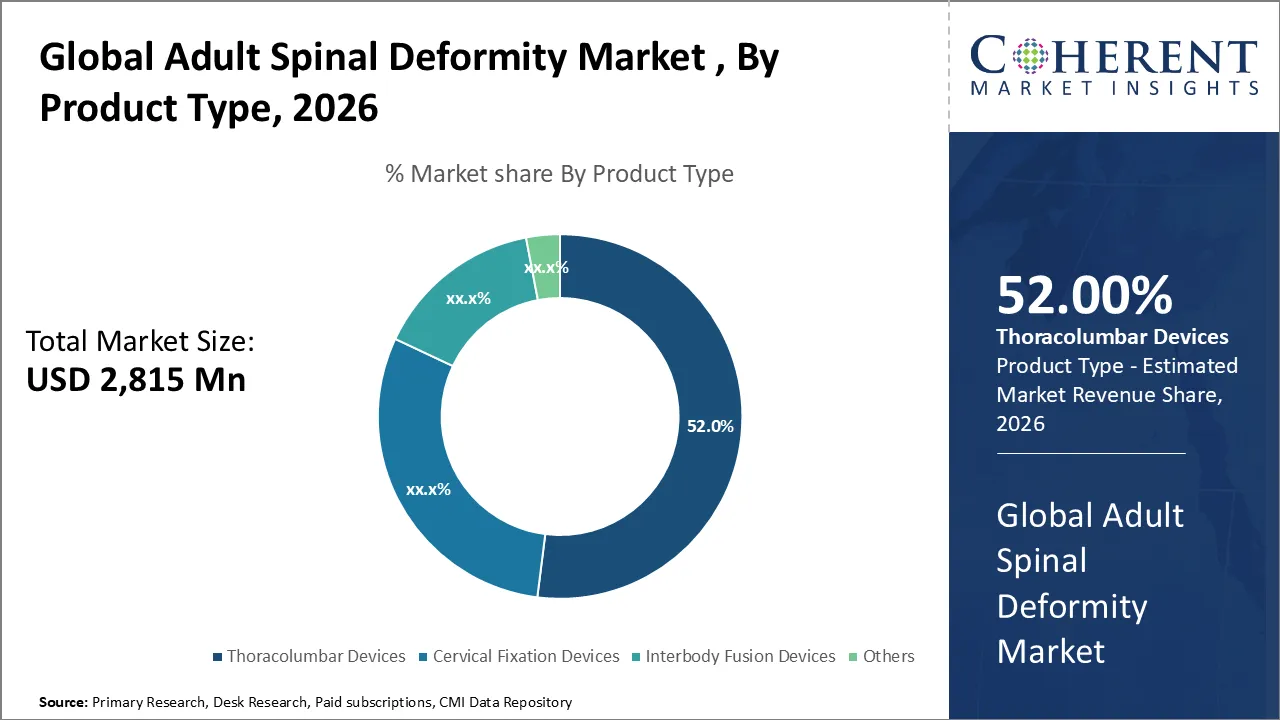
By product type, the thoracolumbar fixation devices segment is estimated to contribute the highest market share of 52% in 2026. These devices see a wide application for adult spinal deformity surgeries, particularly multilevel corrective and complex spinal alignments. Their anatomical design is proven to offer stability and is therefore preferred by surgeons in long-segment fusions and deformity corrections.
For instance, in July 2025, Spinal Resources Inc. announced the publication of pivotal findings on a novel patient‑specific Bezier parametric curve rod platform designed for thoracolumbar fusion in adult spinal deformity cases.
In terms of application, the degenerative disc disease segment is estimated to contribute the highest market share of 47% in 2026. Degenerative conditions are among the most common causes of adult deformity of the spine, followed by high annual numbers of interventions. Fusion and fixation of the spine are common procedures performed for relief of chronic pain, restoration of alignment, and improvement of quality of life. Demand has been high due to increased awareness among patients and healthcare providers regarding early intervention and corrective surgeries.
For instance, in December 2025, Companion Spine announced that the U.S. Food and Drug Administration (FDA) granted Premarket Approval (PMA) to its DIAM™ Spinal Stabilization System for the treatment of moderate to severe primary low back pain caused by degenerative disc disease (DDD).
In terms of end user, the hospitals & specialty clinics segment is estimated to contribute the highest market share of 62% in 2026. This is due to the fact that most of the adult spinal deformity surgery requires and is afforded by advanced surgical facilities and expertise, which are offered by and available at hospitals as well as specialty clinics. Complex reconstruction and long segment fusion are not performed at ambulatory surgery centers.
For instance, in January 2025, Texas Children’s Hospital expanded its Scoliosis and Spinal Deformity Program to serve more patients in West Houston and surrounding communities, enabling specialized spine care within a larger hospital setting.
To learn more about this report, Download Free Sample
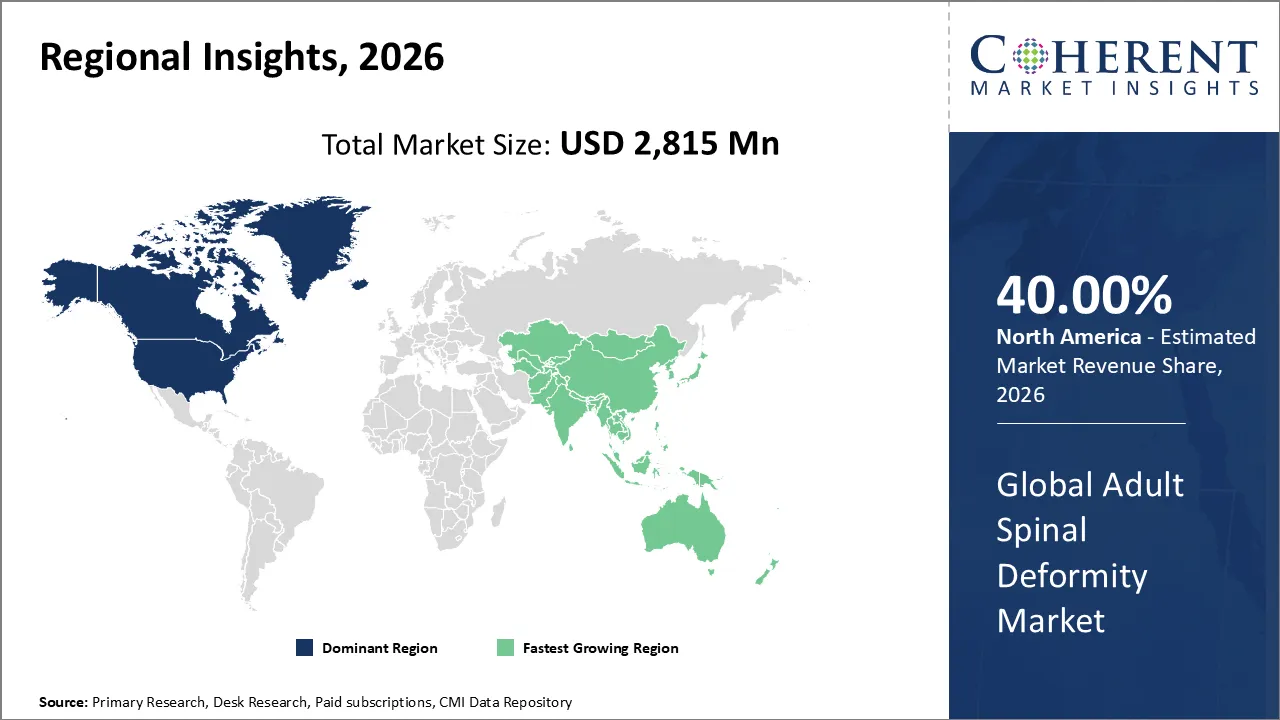
North America is expected to dominate the adult spinal deformity market in 2026, with an estimated market share of 40%. Advanced healthcare infrastructure, huge adoption of minimally invasive spine surgery, availability of all major medical device companies, and reimbursing policies for spinal deformity treatments are some of the factors contributing to the market growth in this region.
For instance, in March 2025, Mayo Clinic expanded its Adult Spinal Deformity Program, adding state-of-the-art operating suites and specialized spine teams to increase access to complex deformity surgeries. The expansion enables the hospital to treat more patients with advanced thoracolumbar fixation and corrective procedures, highlighting how North American hospitals and specialty clinics are strengthening infrastructure to meet growing demand.
The Asia Pacific region is anticipated to be the fastest-growing market for adult spinal deformity in 2026, driven by rising prevalence of degenerative spine conditions, increasing healthcare expenditure, expanding hospital networks, and growing awareness of corrective surgical options. Countries like China, India, and Japan are investing in modern spine care facilities and advanced surgical technologies to meet the rising demand.
For instance, in September 2025, Fortis Healthcare launched a dedicated Spine Deformity Center in Bangalore, featuring advanced thoracolumbar and cervical fixation systems, navigation-assisted surgery, and multidisciplinary teams. The center is designed to provide complex adult spinal deformity care and reduce surgical risks, reflecting how hospitals in Asia Pacific are rapidly expanding specialized spine services.
The adult spinal deformity market in the United States is observing rapid growth based on the extensive use of modern spinal fixation and fusion, high patient awareness of spinal deformity conditions, and well-developed healthcare reimbursement structures. The United States has consistently led the global markets for spinal fusion and deformity correction.
For instance, in January 2025, NewYork‑Presbyterian Hospital opened the Och Spine Center at Hudson Yards in New York City — a state‑of‑the‑art facility providing comprehensive outpatient and surgical spine services, including deformity correction and advanced imaging diagnostics.
The adult spinal deformity market in China is expanding rapidly due to the increased investment in the infrastructure of the healthcare sector. The increasing incidence of degenerative spinal diseases is a chief driver for the market. The market for spinal fusion devices in China is also estimated to have a bright future due to the rising number of procedures. Additionally, China represents an opportunity for the development of spinal deformity products.
For instance, in October 2025, Chinese medical experts showcased new spinal endoscopic surgical technology (UBD) at a major conference in Shanghai, designed to reduce incision size and improve outcomes in complex spine surgeries.
| Report Coverage | Details | ||
|---|---|---|---|
| Base Year: | 2025 | Market Size in 2026: | USD 2,815 Mn |
| Historical Data for: | 2020 To 2024 | Forecast Period: | 2026 To 2033 |
| Forecast Period 2026 to 2033 CAGR: | 4.8% | 2033 Value Projection: | USD 3,910.8 Mn |
| Geographies covered: |
|
||
| Segments covered: |
|
||
| Companies covered: |
NuVasive, Inc., Stryker, B. Braun Melsungen AG, Zimmer Biomet, Globus Medical, Orthofix Medical Inc., Abbott, RTI Surgical, Boston Scientific Corporation, and SeaSpine. |
||
| Growth Drivers: |
|
||
| Restraints & Challenges: |
|
||
Uncover macros and micros vetted on 75+ parameters: Get instant access to report
The rising number of cases related to degenerative spine conditions, scoliosis, and deformities in the aging global population is fueling the market for adult spinal deformity. The increasing need for surgical correction in adults struggling with pain and mobility issues is augmenting the acceptance levels for spinal fixation and fusion products. Moreover, MIs in spine surgery, navigating spine surgery, and customized spine products have added to their adoption in hospitals and specialty clinics.
Opportunities in the market are provided through the development of innovative and advanced spinal implants. Motion-preserving devices and the development of minimally invasive surgical options also provide opportunities for the market. With the expansion of hospitals and specialty centers for adult spinal deformity programs, they can increase their patient base and provide overall treatment for complex conditions. Emerging markets in the Asia Pacific provide opportunities for market expansion with the influx of investments in the healthcare industry, awareness of corrective surgery options, and the adoption of advanced technologies in the spinal industry.
The adult spinal deformity market is evolving rapidly, driven primarily by surgical complexity and technological innovation rather than sheer patient numbers. The adoption rate for advanced fixation and fusion technologies is shifting towards the hospital and specialty centers due to the focus on quality outcomes.
Innovation is a central force shaping the landscape. Minimally invasive procedures, navigation-assisted systems, and patient-specific implants are redefining surgeon preference. Products aimed at enhancing procedural accuracy while reducing complications, such as modular thoracolumbar rods and motion-preserving devices, have come to the fore. Hospitals that have managed to integrate these technologies are emerging as centers of excellence in the management of spinal deformities.
Geographically, North America leads as a primary market because of its well-developed healthcare infrastructure and established surgical facilities, although the market in Asia-Pacific is turning out to be highly favorable for the adoption of advanced spine technologies. Hospitals in this region have begun to establish spine centers, indicating an imminent shift in market dynamics.
End-user behavior is also transforming. Surgeons are preferring procedures that have short recovery periods and are free from complications after surgery; this has led to a rise in demand for next-generation implants and surgical equipment. The end-user market is shifting from generic implants that cater to all users to very specialized implants, thus forcing manufacturers to innovate.
Overall, the adult spinal deformity market is transitioning into a highly specialized, technology-driven sector. Success is increasingly depended on innovation, precision surgical solutions, and the ability of hospitals and clinics to deliver efficiently and safely in complex care.
Share
Share
Komal Dighe is a Management Consultant with over 8 years of experience in market research and consulting. She excels in managing and delivering high-quality insights and solutions in Health-tech Consulting reports. Her expertise encompasses conducting both primary and secondary research, effectively addressing client requirements, and excelling in market estimation and forecast. Her comprehensive approach ensures that clients receive thorough and accurate analyses, enabling them to make informed decisions and capitalize on market opportunities.
Joining thousands of companies around the world committed to making the Excellent Business Solutions.
View All Our Clients