

Laser Resurfacing Devices Market Size and Forecast — 2026-2033
The Global Laser Resurfacing Devices Market size is estimated to be valued at USD 1.48 billion in 2026 and is expected to reach USD 2.61 billion by 2033, exhibiting a compound annual growth rate (CAGR) of 8.5% from 2026 to 2033.
Overview
Laser resurfacing devices are dermatological systems used for skin rejuvenation, scar treatment, wrinkle treatment, and pigmentation correction through controlled ablation or thermal remodeling of skin layers. These products are primarily categorized into ablative lasers (such as CO₂ and Er: YAG lasers) and non-ablative lasers (such as Nd:YAG, diode, and fractional lasers). Advanced systems integrate dual-wavelength or hybrid laser technologies to balance efficacy with reduced downtime.
Modern laser platforms offer precise energy delivery, real-time skin temperature monitoring, and customizable spot sizes for various aesthetic procedures. Portable, clinic-based, and multi-application devices are available, often paired with cooling mechanisms to enhance patient comfort. AI-assisted energy calibration and pulse-control systems are increasingly incorporated to improve safety and treatment uniformity.
Key Takeaways
The fractional laser resurfacing segment holds the highest market share, evidencing robust demand due to superior efficacy and reduced downtime.
Dermatology clinics dominate end-user segments with the largest industry share, driven by expanding service portfolios and patient influx.
In terms of application, acne scar treatment is the fastest-growing subsegment, reflecting rising dermatological needs globally.
Regionally, North America leads the Laser Resurfacing Devices market share with significant contributions from innovative product launches and investment in healthcare infrastructure.
Meanwhile, the Asia Pacific is the fastest-growing region with an elevated CAGR propelled by increasing aesthetic awareness and growing middle-class spending.
Laser Resurfacing Devices Market Segmentation Analysis
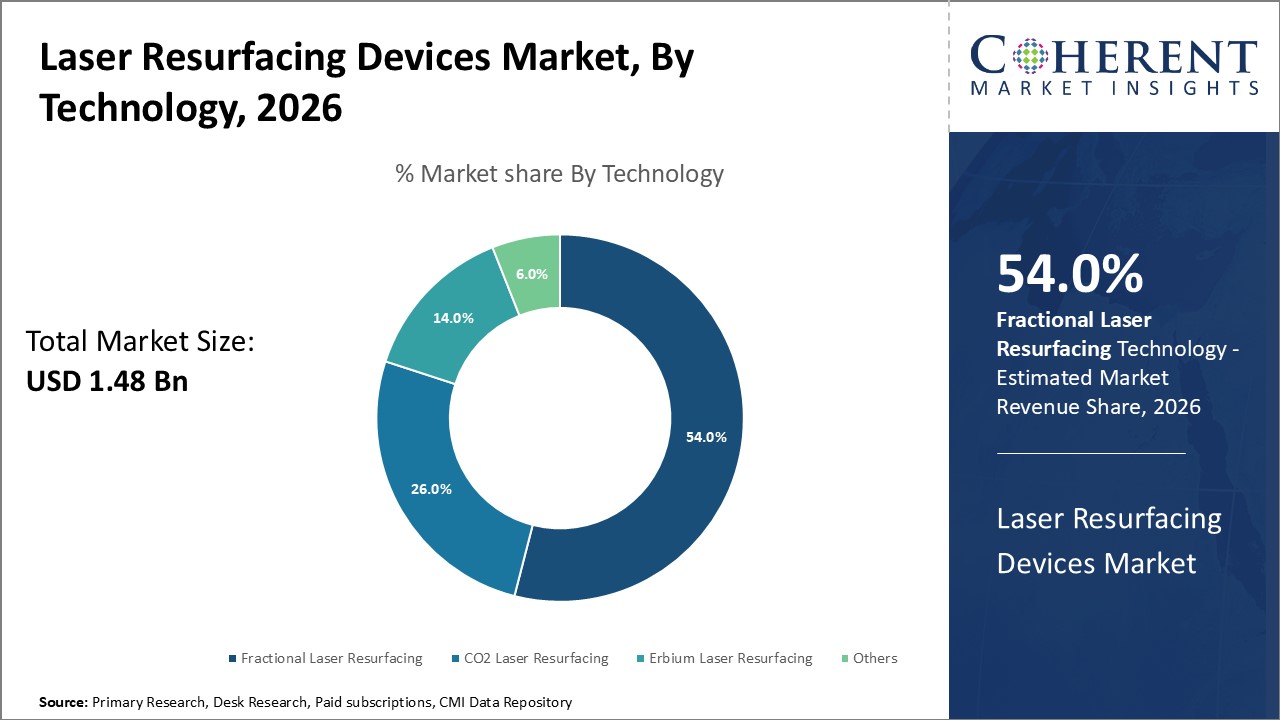
Laser Resurfacing Devices Market Insights, By Technology
Fractional Laser Resurfacing dominates with a market share of 54%, owing to its high efficacy combined with lower recovery times compared to traditional ablative lasers. This technology divides the laser beam into thousands of microscopic treatment zones, facilitating deeper penetration while preserving surrounding tissue. The fastest-growing subsegment is Erbium Laser Resurfacing, favored for its precision and minimal thermal damage, making it the preferred choice for patients with sensitive skin or darker skin tones. The CO2
Laser Resurfacing Devices Market Insights, By End User
Dermatology Clinics dominate the market share, accounting for over 45%, largely due to their specialization in skin treatments, advanced practitioner expertise, and diversified treatment offerings. These clinics rapidly adopt new technologies and protocols, driving both market growth and refined treatment standards. Hospitals maintain a presence predominantly for medically indicated resurfacing and combined therapies, but face slower procedural volume growth due to the elective nature of many treatments. Medical Spas represent the fastest-growing subsegment, growing at more than 11% annually, as these facilities attract younger demographics seeking minimally invasive cosmetic procedures in relaxing, non-clinical environments.
Laser Resurfacing Devices Market Insights, By Application
Wrinkle Reduction holds the largest market share, attributed to the high demand from the aging population seeking to combat fine lines and skin laxity. Devices used for this application focus on stimulating collagen production and skin tightening with proven clinical efficacy. Acne Scar Treatment is the fastest-growing segment, recording above 14% annual growth as acne remains a prevalent condition worldwide, particularly among younger populations, thus expanding treatment volumes.
Laser Resurfacing Devices Market Trends
Market trends in laser resurfacing devices highlight the increasing convergence of technologies to improve treatment precision and patient outcomes.
The adoption of fractional laser systems continues to gain momentum due to their ability to treat various skin conditions effectively with minimal side effects. For instance, clinics employing fractional laser resurfacing reported a 30% growth in procedural efficacy ratings in 2025 versus conventional laser treatments.
Additionally, AI-powered systems are now being piloted, optimizing laser parameters for individual skin profiles, which is a transformative leap, enhancing device utility.
Meanwhile, rising aesthetic consciousness among younger demographics and men is reshaping demand patterns, expanding the target audience beyond traditional boundaries.
Laser Resurfacing Devices Market Insights, By Geography
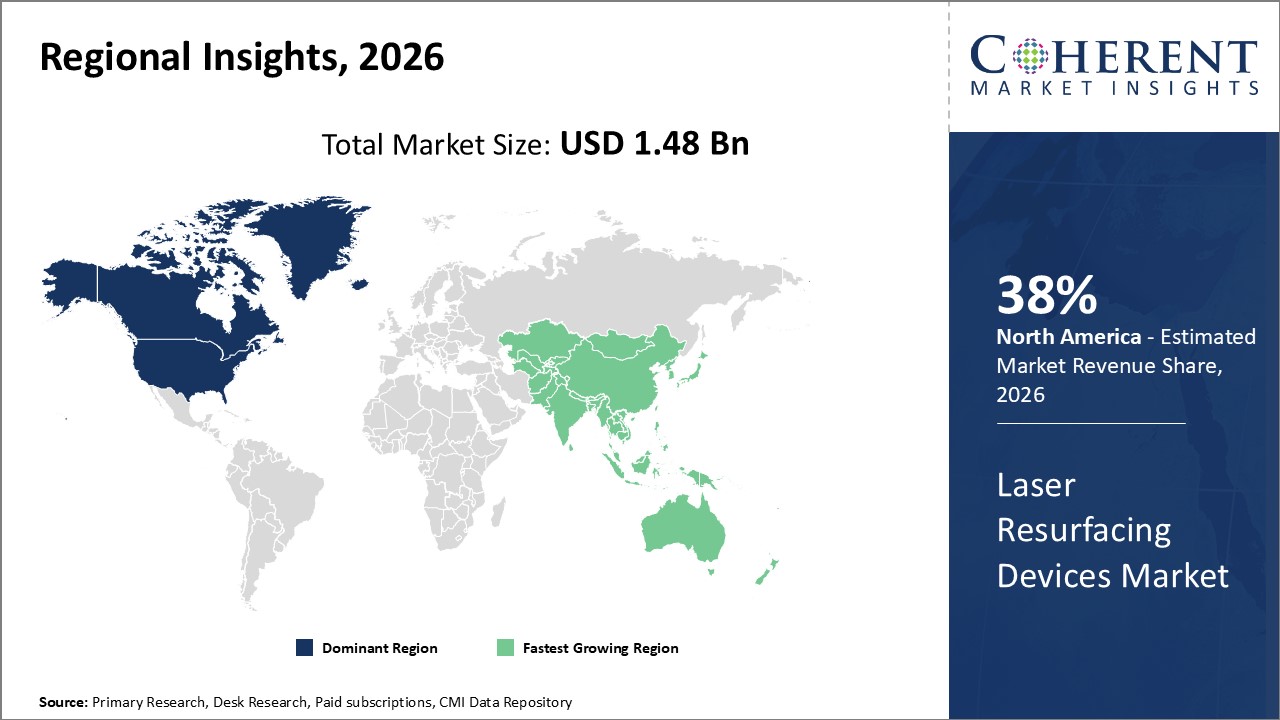
North America Laser Resurfacing Devices Market Analysis and Trends
North America is the dominating region, accounting for approximately 38% of the Laser Resurfacing Devices market share, attributed to its well-developed healthcare infrastructure, high patient awareness, and fast adoption of advanced technologies. The robust presence of key market companies and continuous FDA approvals contribute to this dominance.
Asia Pacific Laser Resurfacing Devices Market Analysis and Trends
Asia Pacific emerges as the fastest-growing region, exhibiting a CAGR exceeding 10% since 2023, driven largely by increasing disposable incomes, expanding medical spa networks, and government initiatives supporting healthcare innovation. The rising middle-class population in countries like China and India significantly fuels this growth trajectory.
Laser Resurfacing Devices Market Outlook for Key Countries
USA Laser Resurfacing Devices Market Analysis and Trends
The USA market remains a major contributor to the Laser Resurfacing Devices revenue, supported by advanced healthcare delivery systems and the highest number of outpatient dermatological procedures worldwide. In 2025, clinical adoption increased by over 20% due to favorable insurance reimbursement and growing consumer demand for cosmetic procedures. Syneron Candela and Lumenis are pivotal players with flagship fractional CO2 lasers, leading to a combined market share exceeding 30%. The commercialization of AI-enhanced devices in late 2023 also positioned the USA as a launchpad for next-gen technologies, driving sustained business growth.
China Laser Resurfacing Devices Market Analysis and Trends
China’s market has expanded rapidly in recent years, propelled by government policies encouraging medical device innovations and private sector investments. The rise of aesthetic medicine clinics correlates directly with a 25% increase in laser resurfacing procedures between 2023 and 2025. Local companies, alongside multinational enterprises, focus on affordable device models tailored for the extensive patient base. The increased focus on urban middle-class consumers and government schemes for dermatological healthcare have created fertile conditions for growth, positioning China as a key growth driver in Asia Pacific.
Analyst Opinion
Increasing Adoption of Fractional Laser Technology: The surge in fractional laser devices is a key quantitative indicator bolstering market size, with over 61% of laser resurfacing device revenue attributed to fractional technology by 2025. For example, data from dermatology clinics in the U.S. show a 35% increase in fractional laser treatments between 2023 and 2025, validating the shift toward device efficiency and precision.
Rising Demand in Dermatological Treatments: Laser resurfacing devices have witnessed a 21% rise in procedural volume in Asia Pacific in 2025 alone, fueled by growing cases of acne scars and pigmentation disorders. This demand-side driver emphasizes dermatology clinics’ role in expanding market share, reinforced by pricing strategies that balance affordability and premium service.
Regulatory Approvals and Innovation Pipelines: The output of newly approved laser devices increased by 19% globally in 2023, spurred by streamlined FDA and CE clearance processes. Key product launches with enhanced wavelength control expanded applications in the esthetic segment, contributing to revenue growth and competitive market dynamics.
Increasing Outpatient Procedures and Non-invasive Treatment Preferences: The outpatient procedural rate for laser resurfacing rose by 28% between 2023 and 2026 in North America, reflecting a patient preference for lower downtime treatments. This micro-indicator highlights the expanding market scope beyond traditional hospital settings towards clinics and day centers.
- Current Industry Events of 2026
- Market Size Estimation
- Regional Breakdown
- Competitive Landscape
- Customer Intelligence
- Segmental Analysis
- Pricing Analysis
- Key Market Drivers, Challenges & Future Trends
- Customized Insights Section
Market Scope
| Report Coverage | Details | ||
|---|---|---|---|
| Base Year: | 2025 | Market Size in 2026: | USD 1.48 billion |
| Historical Data for: | 2020 To 2024 | Forecast Period: | 2026 To 2033 |
| Forecast Period 2026 to 2033 CAGR: | 8.5% | 2033 Value Projection: | USD 2.61 billion |
| Geographies covered: |
| ||
| Segments covered: |
| ||
| Companies covered: | Syneron Candela, Lumenis Ltd., Alma Lasers, Cutera, Inc., Fotona d.o.o., Sciton, Inc., Lutronic Corporation, Quanta System, Palomar Medical Technologies, Bausch Health Companies, El.En. S.p.A., Lasering USA. | ||
| Growth Drivers: |
| ||
Laser Resurfacing Devices Market Growth Factors
The increasing prevalence of skin disorders such as acne scars, hyperpigmentation, and photoaging remains a prominent market growth driver, supported by dermatological clinics reporting a 15% increase in patient visits for these conditions over the last two years. Technological advancements in laser precision and wavelength tunability have expanded device applicability across diverse skin types and conditions, improving treatment efficacy and patient satisfaction. Growing awareness and demand for minimally invasive aesthetic procedures are further stimulating market revenue, with medical spas and outpatient facilities now accounting for 40% of total procedural volumes globally. Furthermore, favorable government regulations promoting innovation and faster approvals accelerate product launches, which directly enhance the competitive market landscape.
Laser Resurfacing Devices Market Development
In April 2026, Spectra Medical India Pvt. Ltd. (in collaboration with Italy’s Eufoton S.r.l.) launched the EndoliftX® treatment in India, introducing the Italian-made non-surgical aesthetic laser technology for the first time in the Indian market. The system uses ultra-fine optical micro-fibers to deliver laser energy beneath the skin surface, aimed at skin tightening, fat reduction, and body/face contouring with minimal downtime and discomfort.
In October 2026, Cynosure Lutronic, Inc. introduced the eCO2 3D fractional CO₂ laser system, a next-generation platform designed to redefine skin resurfacing with improved versatility, precision, and efficiency. The device features a 40 W power system, three interchangeable spot sizes (120 µm, 300 µm, 500 µm) and dual delivery modes (static & dynamic) under the company’s patented Controlled Chaos™ technology, enabling treatment ranges from gentle texture refinement to aggressive wrinkle correction in one machine.
Key Players
Leading companies of the market include:
Syneron Candela
Lumenis Ltd.
Alma Lasers
Cutera, Inc.
Fotona d.o.o.
Sciton, Inc.
Quanta System
Palomar Medical Technologies
Bausch Health Companies
El.En. S.p.A.
Lasering USA
Competitive strategies include Syneron Candela’s expansion of its fractional CO2 platforms into emerging markets, resulting in a 13% revenue increase in EMEA during 2025. Alma Lasers implemented a strategic merger with a medical device distributor in Asia Pacific, improving regional supply chain efficiency and boosting market penetration by 19%. Lumenis launched a new line of dual-wavelength devices in 2025, enhancing versatility and leading a market share increase of 8% in North America.
Laser Resurfacing Devices Market Future Outlook
The market’s future outlook remains robust, underpinned by continuous innovation in laser wavelengths, pulse control, and AI-assisted treatment customization. The increasing preference for combination therapies, including microneedling and radiofrequency-laser systems, will broaden treatment applications. Growing male patient participation and expanding middle-class affordability in emerging economies will further stimulate demand. Manufacturers focusing on portable, user-friendly devices and teledermatology integration are likely to gain a competitive edge. Overall, the sector is expected to record steady mid-to-high single-digit growth through the early 2030s.
Laser Resurfacing Devices Market Historical Analysis
The Laser Resurfacing Devices Market has grown consistently, supported by the surge in aesthetic procedures and technological advances in dermatologic lasers. Historically, the market transitioned from invasive ablative lasers to fractionated and non-ablative systems that minimized downtime and improved safety profiles. Rising consumer interest in anti-aging treatments, acne scar correction, and skin rejuvenation during the 2010s spurred clinic adoption. Rapid expansion of medical spas and dermatology centers globally further contributed to market growth, though regulatory challenges and high device costs limited adoption in certain regions.
Sources
Primary Research Interviews:
Dermatologists
Cosmetic Surgeons
Aesthetic Clinic Owners
Biomedical Engineers
Laser Device Specialists
Databases:
PubMed
ClinicalTrials.gov
FDA Device Database
Magazines:
Dermatology Times
Modern Aesthetics
Medical Device Network
Aesthetic Surgery Journal News
Journals:
Lasers in Surgery and Medicine
Journal of Cosmetic Dermatology
Dermatologic Surgery
Journal of Laser Applications
Newspapers:
The New York Times (Health & Wellness)
The Guardian (Science)
The Hindu (Health)
Financial Times (Health Tech)
Associations:
American Society for Dermatologic Surgery (ASDS)
International Society for Laser Surgery & Medicine (ISLSM)
American Academy of Dermatology (AAD)
Get access to 250+ pages report
Every segment, forecast, competitor profile and data table behind the analysis above — available for instant download.
- ESOMAR Member
- ISO 9001:2015 Certified
- D-U-N-S Registered
- GDPR & CCPA Compliant
Missing comfort of reading report in your local language? Find your preferred language:
Transform your Strategy with Exclusive Trending Reports
Frequently Asked Questions
Leading companies include Syneron Candela, Lumenis Ltd., Alma Lasers, Cutera, Inc., and Fotona d.o.o., among others noted for technological innovation and extensive market reach.
The market size is projected to reach USD 2.61 billion by 2033, indicating steady growth driven by increasing demand for advanced skin resurfacing treatments.
Dermatology clinics present the largest growth opportunity due to expanding patient pools and the integration of advanced laser technologies.
Market trends will emphasize hybrid laser technologies, AI integration for personalized treatments, and broader demographic acceptance expanding the market horizon.
The landscape is highly competitive with focus on innovation, regulatory approvals, and geographic expansions. Challenges include reimbursement issues and high initial device costs restricting access in some regions.
Strategies include mergers and acquisitions, regional partnerships for distribution, and aggressive product innovation to cater to diverse patient needs.