Dental 3d Printing Devices Market Analysis & Forecast: 2026-2033

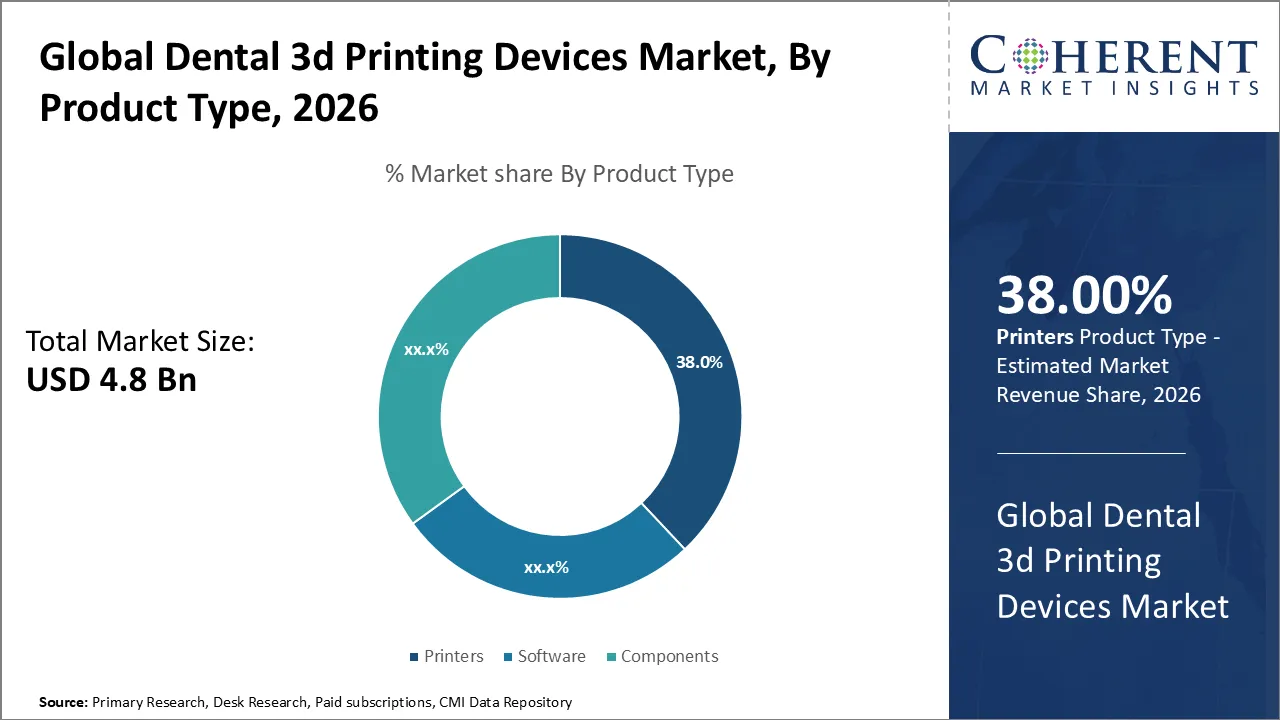
Dental 3D printing devices market is estimated to be valued at USD 4.8 Bn in 2026 and is expected to reach USD 17.8 Bn by 2033, exhibiting a compound annual growth rate (CAGR) of 20.4% from 2026 to 2033.
The rising use of digital dental solutions and the advent of dental 3D printing are the primary reasons impacting the dental 3D printing market positively. Dental 3D printing helps to offer accurate results, quick dental prosthetics production, and cost-effectiveness. Additionally, this process allows for personalized orthodontic appliances, dental crowns, bridges, or dental surgical guides.
|
Current Events |
Description and its impact |
|
Technological Advancement and AI Integration |
|
|
Economic Pressures and Healthcare Spending |
|
Uncover macros and micros vetted on 75+ parameters: Get instant access to report
The dental industry in 2026 is undergoing a shift due to the adoption of latest technology in 3D printing.
In the dental sector, 3D printing is technically known by the range of solutions that allow it to rapidly produce dental crowns, dental bridges, orthodontic aligners, dental guides, dental implants, and other dental prosthetics. This has made it highly feasible and common for dental labs, dental clinics, and dental hospitals to consider 3D printing solutions in order to increase turnaround times, improve patient outcomes, and optimize customized dental solutions.
The increasing demand for personalized dental care and awareness of digital dentistry, along with CAD/CAM technologies, is driving the adoption of dental 3D printing. The focus towards sustainability is also increasing, wherein resins and metal powders are currently being developed with lower waste and higher material utilization rate.
For instance, in February 2025, 3D Systems unveiled the NextDent® 300 MultiJet 3D printer with multi‑material capabilities to produce fully cured, monolithic dentures and other dental appliances, improving lab efficiency and patient delivery times. This system boosts productivity and streamlines dental lab workflows.
By product type, the printers segment is expected to contribute the highest share of 38% in 2026, due to growing demand for hardware that drives dental restoration, orthodontic production, and rapid fabrication of crowns, bridges, and implants. Printers remain the core of dental 3D printing workflows, supporting clinics and laboratories in creating accurate, customized prosthetics with great efficiency.
For instance, in September 2025, PioCreat launched the PioNext Mini Dental 3D Printer, a compact chairside device capable of printing crowns in about 10 minutes. This innovation exemplifies the increasing demand for precise, high-speed printers in dental clinics, reducing treatment turnaround times and streamlining operations.
On the basis of technique, the Stereo Lithography Apparatus (SLA) 3D Printing segment is expected to hold the largest market share of 37% in 2026, followed by other 3D Printing, Computer-Aided Design (CAD) Printing, and Digital Light Processing (DLPS) 3D Printing. SLA 3D Printing technique is widely adopted in dental laboratories and clinics due to its high accuracy, fine surface finish, and fast turnaround time.
For instance, in February 2025, 3D Systems showcased the NextDent® 300 MultiJet 3D Printer, supporting SLA and multi-material printing for high-precision dentures and aligners. This technology enhances efficiency and ensures accurate, patient-specific dental restorations.
On the basis of Application Type, the Orthopedic Implants segment is expected to hold the largest market share of 39% in 2026. This is attributed to the popularity of clear aligners, personalized orthopedic implants, and various other dental prosthetics. This is because of the rising demand for precise dental solutions.
For instance, in March 2025, SprintRay introduced its Midas Digital Press 3D Printer and dual-resin kits at IDS 2025, designed to produce customized implants, crowns, and aligners efficiently in high volumes. This highlights the trend of mass adoption of orthopedic and restorative dental devices.
On the basis of End User, the Dental Clinics segment share is estimated to lead the market with 55% by 2026, attributed to the large volume of prosthesis, orthodontics, and patient-specific restorations. Dental Clinics will also use in-house 3D Printing possibility in order to reduce the time and reliance on third-party laboratories.
For instance, in October 2025, Formlabs Dental received FDA 510(k) clearance for its Premium Teeth Resin, enabling dental clinics to 3D print temporary crowns, bridges, and veneers on-site. This adoption of in-clinic printing workflows demonstrates why dental clinics dominate the end-user segment.
To learn more about this report, Request Free Sample
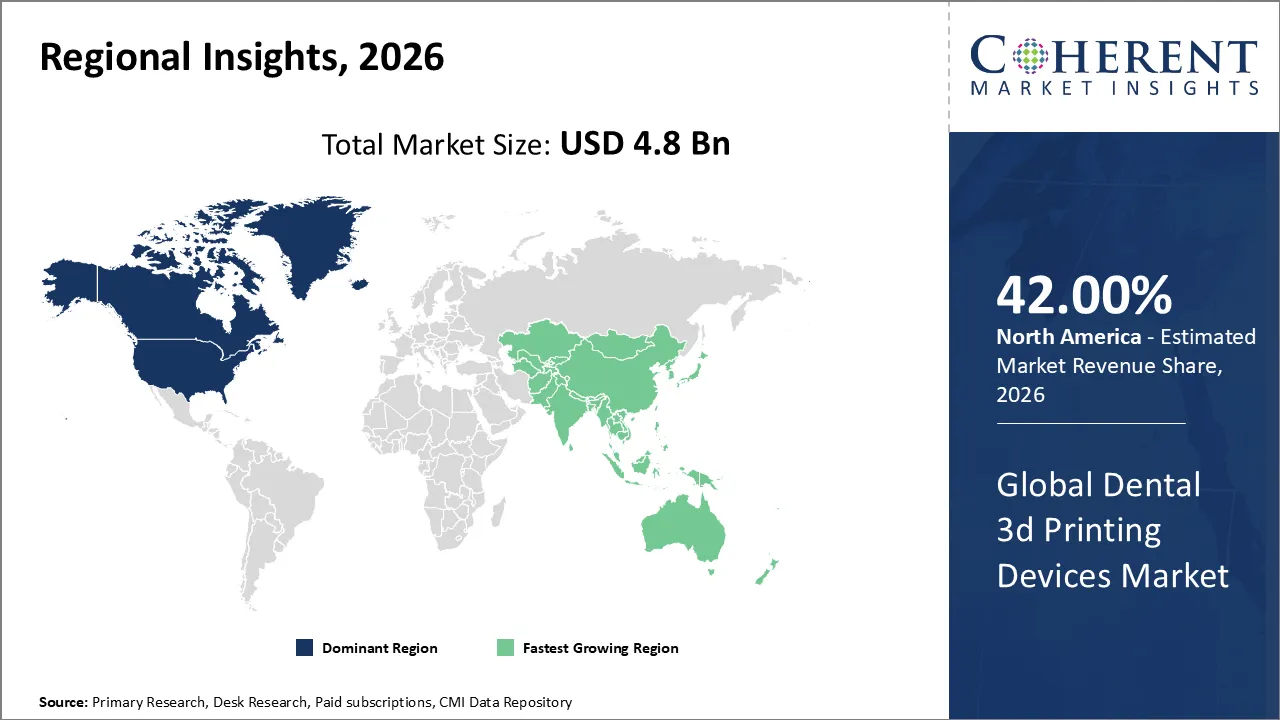
North America is expected to lead the dental 3D printing devices market in 2026 with a market share of 42%. The expansion of the dental 3D printing device market in the North American region can be found to be led by factors such as the popular use of cutting-edge dental technology, popularity of 3D printers for the manufacturing process, dental practices and laboratories, and a well-established healthcare infrastructure.
For instance, in February 2025, 3D Systems launched its NextDent® 300 MultiJet 3D Printer in the U.S., enabling dental labs and clinics to produce multi-material dentures, crowns, and aligners efficiently. This product exemplifies how North America continues to lead in adoption of cutting-edge dental 3D printing solutions.
The Asia Pacific market for dental 3D printing devices is expected to grow at the highest rate due to the rising awareness levels about digital dentistry procedures, increased expenditures on dental healthcare, large population base, and rising number of dental clinics in the Asia Pacific countries of China, India, Japan, and South Korea. Indigenous manufacturers in the market offer an economical and local alternative to the current 3D dental printing solutions.
For instance, in September 2025, PioCreat introduced the PioNext Mini Dental 3D Printer at the Moscow Dental Expo, a compact printer designed for chairside applications that is also being rolled out in Asia. This product supports rapid fabrication of crowns, aligners, and prosthetics, catering to the growing demand for affordable and precise dental 3D printing solutions in the region.
The U.S. dental 3D printing market is booming, driven by the adoption of advanced digital solutions in dentistry, established dental clinics and laboratories, and many prominent 3D printer companies. The demand for customized dental crowns, bridges, aligners, and surgical guides is triggering a huge demand for dental 3D printers.
For instance, in March 2025, Argen USA partnered with Rapid Shape to bring advanced dental 3D printing solutions (including the PRO 20 and D50 systems) to North American dental laboratories.
China's rapidly growing dental market is one of the key drivers of 3D printing adoption, driven by rising awareness of digital dentistry, growing dental healthcare expenditure, and the rise in modern dental clinics. Local players have contributed economical 3D printing solutions for mass adoption in orthodontics, prosthetics, and implants.
For instance, in September 2025, PioCreat introduced the PioNext Mini Dental 3D Printer, a compact chairside printer capable of producing crowns and aligners quickly. Its rollout in China is supporting local dental clinics with precise, affordable, and patient-specific dental solutions, aligning with the country’s focus on modernizing healthcare infrastructure and digital dentistry capabilities.
| Report Coverage | Details | ||
|---|---|---|---|
| Base Year: | 2025 | Market Size in 2026: | USD 4.8 Bn |
| Historical Data for: | 2020 To 2024 | Forecast Period: | 2026 To 2033 |
| Forecast Period 2026 to 2033 CAGR: | 20.4% | 20323 Value Projection: | USD 17.8 Bn |
| Geographies covered: |
|
||
| Segments covered: |
|
||
| Companies covered: |
Stratasys Ltd., 3D Systems, Inc., Desktop Metal, Inc., DWS S.r.l., Align Technology, Inc., Formlabs Inc., Prodways Group, Nikon SLM Solutions AG, Carbon, Inc., and EOS GmbH. |
||
| Growth Drivers: |
|
||
| Restraints & Challenges: |
|
||
Uncover macros and micros vetted on 75+ parameters: Get instant access to report
The increasingly popular trend of digital dentistry is an important factor that propels the dental 3D printing market forward. Dental practices and dental labs are increasingly adopting 3D printing solutions for the fabrication of customized crowns and bridges, aligners, implants, and surgical guides. This capability to provide a fully customized service to the patients can further help to improve the level of patient satisfaction and the quality of the outcomes. Apart from that, the combination of 3D printing/CAD/CAM technology and intraoral scanners makes the processes of digital dentistry more economical for dentists.
The dental 3D printing devices market has clearly crossed the threshold from early adoption to operational necessity. The defining characteristic of the current market is not expansion in numbers, but the depth of integration within dental workflows. Dental laboratories increasingly rely on 3D printing as the default manufacturing method for models, aligners, surgical guides, and provisional restorations. What was once positioned as a complementary technology is now replacing traditional casting and milling processes in daily production environments.
Material innovation is another structural factor influencing the market. Resin systems are developing in a way that goes beyond simple model printing and advances into clinically proven applications such as crowns, dentures, and guides for surgery. Also, the applications of metal 3D printing are becoming strategic in terms of implants and strong restorations, especially in larger laboratories that are looking for consistency and reproducibility. This portfolio approach of materials is creating a broader clinical utility of 3D printing systems.
Overall, the dental 3D printing market is turning out to be a technology segment driven by the adoption of dental work-flows. Technologies that are not proven to harbor immediate clinical benefits and are not digitally integrated are bound to be relegated to the background. Technologies that can find a fundamental place in the dental work-flow are the ones that will shape the next generation of market leaders.
Share
Share
Komal Dighe is a Management Consultant with over 8 years of experience in market research and consulting. She excels in managing and delivering high-quality insights and solutions in Health-tech Consulting reports. Her expertise encompasses conducting both primary and secondary research, effectively addressing client requirements, and excelling in market estimation and forecast. Her comprehensive approach ensures that clients receive thorough and accurate analyses, enabling them to make informed decisions and capitalize on market opportunities.
Joining thousands of companies around the world committed to making the Excellent Business Solutions.
View All Our Clients