Forging Market Analysis & Forecast: 2026-2033

Forging Market Size and Forecast – 2026 – 2033
The Global Forging Market size is estimated to be valued at USD 38.5 billion in 2026 and is expected to reach USD 56.2 billion by 2033, exhibiting a compound annual growth rate (CAGR) of 5.6% from 2026 to 2033.
Global Forging Market Overview
The forging market is driven by rising demand from automotive, aerospace, construction, oil & gas, power generation, and industrial machinery sectors, where forged components are preferred for high strength, durability, fatigue resistance, and reliability. Growing vehicle production, increasing use of lightweight forged aluminum parts, and expansion of electric mobility are supporting demand for precision-forged components. Infrastructure development and energy projects are also boosting the need for forged shafts, gears, valves, flanges, and fasteners. Additionally, advancements in closed-die forging, automation, CNC machining, and heat treatment are improving production efficiency, dimensional accuracy, and material performance, further supporting market growth.
Key Takeaways
Closed Die Forging dominates the Forging Market with nearly 48% industry share because of its high precision, superior mechanical strength, and extensive use in lightweight automotive and industrial components. Press Forging is the fastest-growing product segment, supported by increasing aerospace manufacturing demand.
Stainless Steel leads the material segment with approximately 39% market share due to its corrosion resistance, durability, and widespread application in oil & gas, industrial machinery, and construction sectors. Titanium is the fastest-growing material segment driven by rising aerospace and defense applications.
Asia Pacific holds the largest regional market share owing to rapid industrialization, infrastructure expansion, and strong automotive manufacturing activities across China and India.
The Middle East & Africa region is witnessing the fastest growth, registering a CAGR above 8%, supported by expanding construction projects, industrial investments, and energy infrastructure development.
North America remains a significant market due to continuous investments in aerospace, defense, industrial automation, and advanced manufacturing technologies.
Forging Market Segmentation Analysis
To learn more about this report, Request Free Sample
Forging Market Insights, By Product Type
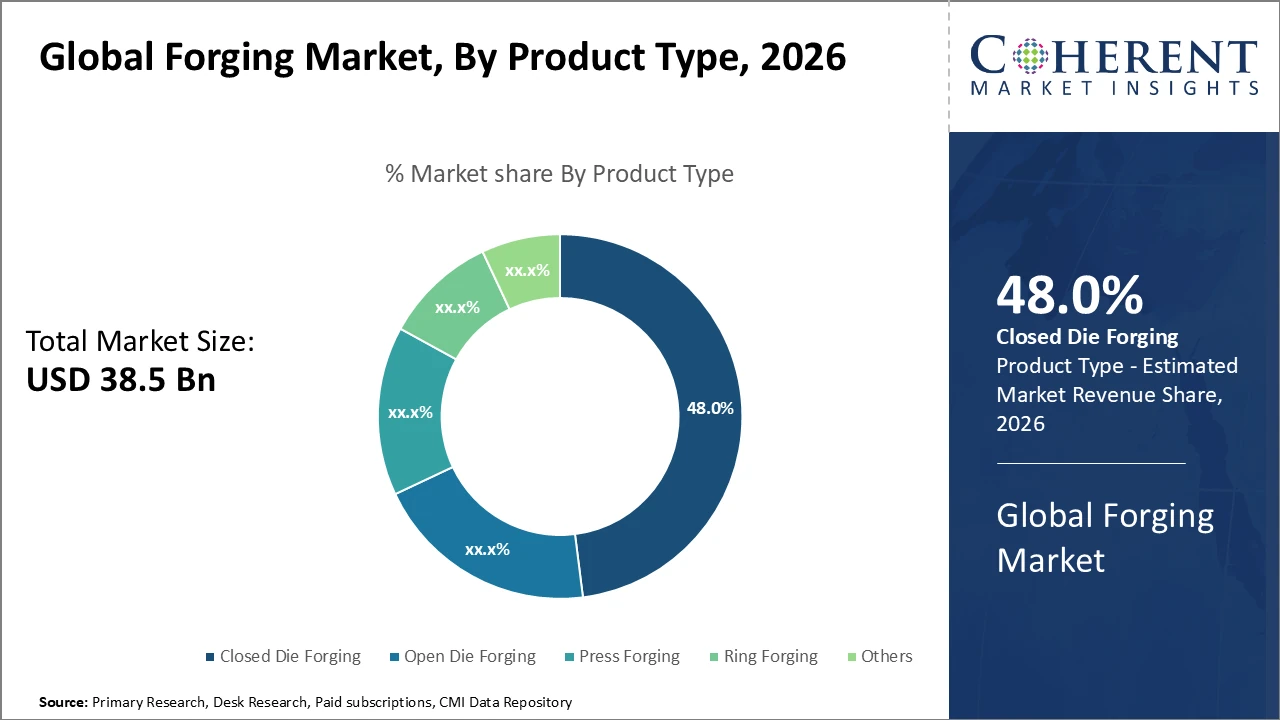
Closed Die Forging dominates the Forging Market with approximately 48% share due to its ability to produce complex, high-precision components with excellent repeatability and structural strength. The process is extensively utilized across automotive and aerospace industries for manufacturing lightweight aluminum and titanium parts that improve fuel efficiency and performance. Press Forging is the fastest-growing segment, supported by rising demand for high-strength structural components in aerospace and electric vehicle applications. Open Die Forging continues serving heavy machinery and infrastructure sectors requiring large customized forged products with superior mechanical properties. Ring Forging maintains stable growth for bearings and industrial ring components, while specialty forging methods address niche industrial manufacturing requirements globally.
Forging Market Insights, By Material
Stainless Steel dominates the Forging Market with nearly 39% share because of its exceptional corrosion resistance, durability, and versatility across demanding industrial applications. Stainless steel forgings are widely utilized in oil & gas, marine, chemical processing, and heavy industrial equipment sectors where long-term performance is critical. Carbon steel continues to maintain strong demand due to its cost-effectiveness and broad use in construction and general engineering applications. Aluminum forging is the fastest-growing material segment, driven by rising electric vehicle and aerospace production requiring lightweight, fuel-efficient components. Titanium forgings are also expanding rapidly in aerospace and defense industries owing to their superior strength-to-weight ratio, heat resistance, and advanced structural performance.
Forging Market Insights, By End Use Industry
Automotive dominates the Forging Market with approximately 42% share due to extensive use of forged components in engines, transmissions, suspension systems, chassis structures, and electric vehicle platforms requiring lightweight yet durable materials. The aerospace segment is the fastest-growing application area, supported by rising aircraft production, increasing global air travel demand, and defense modernization programs requiring high-performance titanium and superalloy forged components. Oil & gas remains a major sector utilizing corrosion-resistant stainless-steel forgings for drilling equipment and pipeline infrastructure. Heavy machinery and construction industries continue depending on forged components for strength and wear resistance, while railways and power generation sectors demand specialized custom-forged industrial solutions worldwide.
Forging Market Trends
The Forging Market is increasingly adopting advanced technologies such as digital forging, automation, and additive manufacturing integration to improve precision, customization, and production efficiency for complex industrial components.
Sustainability initiatives including renewable energy usage, material recycling, and energy-efficient forging systems are reducing environmental impact and operational costs across forging facilities worldwide.
Rising demand from electric vehicle manufacturers for lightweight forged aluminum and high-strength alloy components is significantly accelerating market growth and driving innovation in advanced forging materials and processes.
Forging Market Insights, By Geography
To learn more about this report, Request Free Sample
Asia Pacific Forging Market Analysis and Trends
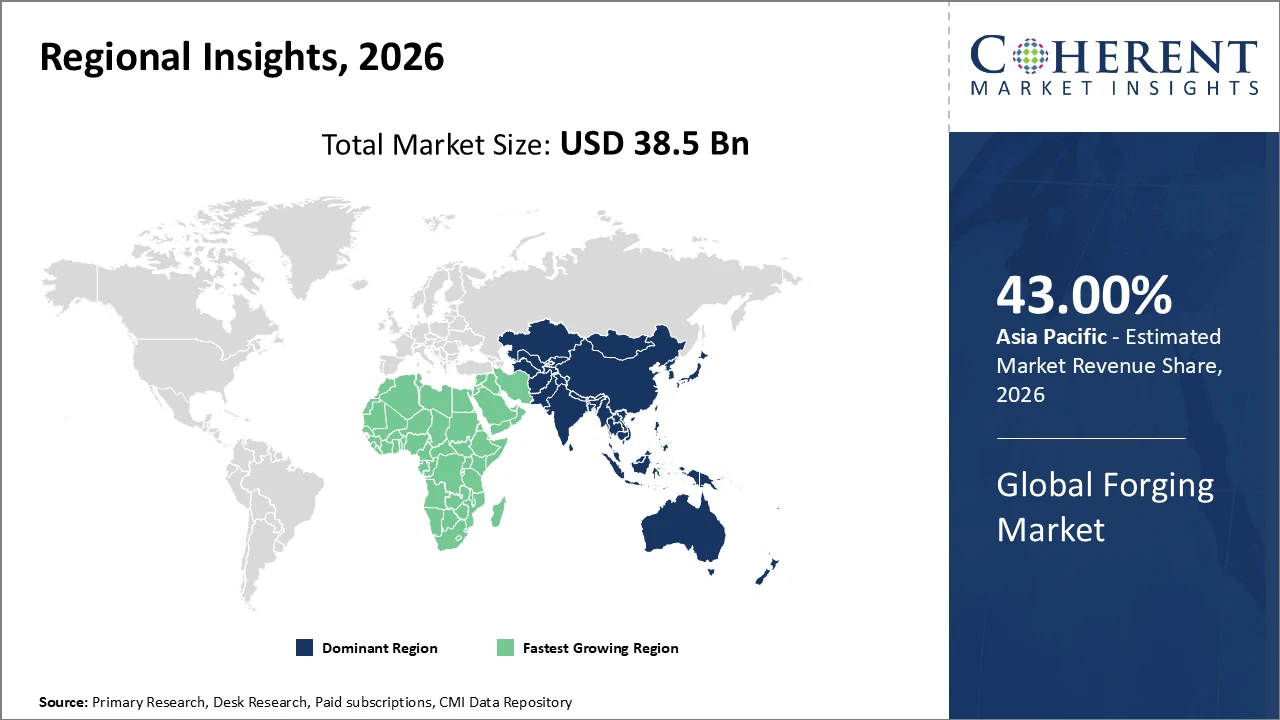
Asia Pacific dominates the Forging Market with more than 43% global market share, supported by rapid industrialization, expanding automotive manufacturing, and large-scale infrastructure development activities across major economies. Countries such as China and India are major contributors due to increasing electric vehicle production, strong construction growth, and rising industrial machinery demand. Government initiatives promoting manufacturing expansion and infrastructure modernization further strengthen regional market growth. Forging companies across the region are investing heavily in advanced production technologies, automation systems, and lightweight alloy forging capabilities to meet evolving automotive and aerospace requirements. The region also benefits from cost-effective labor availability, expanding export activities, and growing industrial supply chain integration.
Middle East & Africa Forging Market Analysis and Trends
The Middle East & Africa region is witnessing the fastest growth in the Forging Market, registering a CAGR exceeding 8% during the forecast period. This growth is primarily driven by large-scale infrastructure developments, industrial expansion, and major oil & gas projects across countries such as Saudi Arabia and the United Arab Emirates. Increasing government investments in transportation networks, energy facilities, and construction activities are significantly boosting demand for durable forged components. Additionally, rising foreign direct investment and industrial diversification initiatives are encouraging global forging manufacturers to establish regional production facilities. Growing demand from heavy machinery, construction, and energy sectors continues creating substantial long-term market opportunities across the region.
Forging Market Outlook for Key Countries
USA Forging Market Analysis and Trends
The United States remains a critical market within the global Forging Market, supported by strong aerospace, defense, automotive, and industrial manufacturing sectors. The country accounted for nearly 25% of North America’s forging market revenue in 2025, driven by increasing defense expenditures and initiatives promoting domestic production of strategic industrial components. Rising aircraft manufacturing and modernization of defense equipment continue generating strong demand for high-performance forged alloys and precision-engineered parts. Companies such as Howmet Aerospace and Timken are advancing innovative forging technologies that enhance mechanical strength, material durability, and performance of aerospace-grade and automotive forged components.
Germany Forging Market Analysis and Trends
Germany’s Forging Market remains one of the strongest in Europe, supported by its advanced automotive, industrial machinery, and engineering sectors. The country accounts for nearly 20% of Europe’s forging market share due to high demand for precision-engineered forged components used in automotive manufacturing, renewable energy systems, and heavy industrial equipment. Increasing focus on closed-die forging and stainless-steel applications continues driving technological advancement and product quality improvements. Government initiatives promoting Industry 4.0 adoption and smart manufacturing technologies are enhancing production efficiency and automation across forging facilities. Major companies such as thyssenkrupp continue strengthening Germany’s global competitiveness through innovation and advanced forging solutions.
Analyst Opinion
Forging manufacturers, particularly in Asia Pacific, are significantly expanding production capacities through new facility investments and automation technologies, reducing delivery lead times and strengthening supply capabilities for aerospace and industrial applications.
The automotive industry continues driving major forging demand, especially for lightweight aluminum and titanium forged components used in electric vehicles to improve fuel efficiency, structural strength, and regulatory compliance.
Infrastructure megaprojects across the Middle East & Africa are accelerating demand for forged construction and industrial machinery components, increasing regional imports and manufacturing activities.
Rising raw material prices, particularly for nickel and chromium used in stainless steel forgings, are influencing pricing trends and shifting competitive advantages toward vertically integrated forging companies with stronger supply chain control.
Market Scope
| Report Coverage | Details | ||
|---|---|---|---|
| Base Year: | 2025 | Market Size in 2026: | USD 38.5 billion |
| Historical Data for: | 2020 To 2024 | Forecast Period: | 2026 To 2033 |
| Forecast Period 2026 to 2033 CAGR: | 5.6% | 2033 Value Projection: | USD 56.2 billion |
| Geographies covered: |
|
||
| Segments covered: |
|
||
| Companies covered: | Bharat Forge Ltd., Amtek Auto Ltd., Schuler Group, The Timken Company, Howmet Aerospace Inc., ThyssenKrupp AG, Aichi Steel Corporation | ||
| Growth Drivers: |
|
||
Uncover macros and micros vetted on 75+ parameters: Get instant access to report
Forging Market Growth Factors
The Forging Market is driven by rising demand for high-performance and lightweight components across automotive, aerospace, construction, and industrial machinery sectors. Growing electric vehicle production is significantly increasing adoption of forged aluminum and specialty alloy components that enhance structural strength and fuel efficiency. Expansion of the aerospace and defense industries is further accelerating demand for titanium and advanced forged materials capable of withstanding extreme operating conditions. Additionally, infrastructure development and industrialization in Asia Pacific and the Middle East are boosting consumption of heavy machinery forgings. Technological advancements including precision closed-die forging, automation, and AI-based process optimization are improving production efficiency, product quality, and manufacturing throughput globally.
Forging Market Development
In May 2026, ZJK Industrial Co., Ltd. launched next-generation cold forging dies for chamfered screws. The upgraded design enhances production efficiency, lowers costs, improves precision, and ensures consistent product quality for applications in AI infrastructure, consumer electronics, electric vehicles, aerospace, and other advanced technologies.
Key Players
Leading Companies of the Market
Bharat Forge Ltd.
Amtek Auto Ltd.
Schuler Group
The Timken Company
Howmet Aerospace Inc.
ThyssenKrupp AG
Aichi Steel Corporation
Leading companies in the Forging Market are increasingly adopting mergers, acquisitions, and digital transformation strategies to strengthen competitive positioning and expand global market presence. Howmet Aerospace enhanced its aerospace forging capabilities through acquisition of a specialty forging company in 2025, improving its market share within high-performance aerospace components. At the same time, Bharat Forge invested heavily in Industry 4.0-enabled manufacturing technologies, including IoT-integrated process monitoring and automated forging systems, significantly improving production efficiency, operational control, and product quality across its global forging facilities.
Forging Market Future Outlook
The Forging Market is expected to witness steady growth driven by increasing demand for durable, lightweight, and high-strength metal components across automotive, aerospace, industrial machinery, and renewable energy industries. Rising electric vehicle production and aircraft manufacturing are accelerating adoption of advanced forged aluminum and titanium components that improve fuel efficiency and structural performance. Technological advancements such as automated forging systems, AI-enabled process monitoring, and Industry 4.0 integration are enhancing production efficiency and reducing operational costs. Asia Pacific is projected to remain the dominant regional market due to rapid industrialization, while North America and Europe continue emphasizing sustainable forging technologies and precision engineering applications.
Forging Market Historical Analysis
The Forging Market has historically grown in parallel with industrialization, infrastructure expansion, and advancements in heavy manufacturing industries worldwide. Early demand was primarily driven by automotive and railway sectors requiring durable forged metal components with superior mechanical strength and fatigue resistance. Over time, technological advancements in closed-die forging, precision forging, and automated manufacturing significantly improved production efficiency and product quality. Aerospace, defense, oil & gas, and industrial machinery sectors further accelerated market expansion through increasing adoption of lightweight and high-performance forged alloys. Asia Pacific emerged as a major manufacturing hub due to rapid industrial growth, while Europe and North America focused on advanced precision forging and sustainable production technologies.
Sources
Primary Research Interviews:
Forging plant managers, metallurgical engineers, automotive component manufacturers, aerospace production specialists, and industrial machinery executives utilizing forged components for high-strength engineering applications.
Supply chain executives, steel and alloy manufacturers, forging equipment suppliers, and procurement specialists responsible for sourcing raw materials, forging presses, dies, and heat treatment technologies.
Market analysts, R&D directors, and regulatory experts involved in precision forging innovation, lightweight alloy development, automated forging systems, and sustainable manufacturing technologies.
Magazines:
Forging Magazine – Updates on forging technologies, metal forming innovations, and industrial manufacturing trends.
Metalworking World Magazine – Insights into industrial machinery, forging automation, and precision engineering developments.
Modern Metals – Coverage of metal processing technologies, forging equipment advancements, and steel industry trends.
Journals:
Journal of Materials Processing Technology – Research on metal forming, forging processes, and manufacturing optimization techniques.
International Journal of Advanced Manufacturing Technology – Studies focused on precision forging, automation, and industrial production innovations.
Metallurgical and Materials Transactions – Research on alloy performance, heat treatment technologies, and forged material properties.
Newspapers:
Financial Times – Coverage of industrial manufacturing investments, automotive production trends, and global steel industry developments.
Reuters – Reporting on forging industry expansions, automotive component manufacturing, and industrial equipment investments.
Bloomberg – Insights into mergers, acquisitions, raw material pricing, and strategic developments among global forging companies.
Associations:
Forging Industry Association – Industry standards, market research, and technological advancements in forging manufacturing.
American Society for Metals – Research updates, metallurgical innovations, and developments in advanced forging materials.
European Forging Association – Conferences, sustainability initiatives, and precision forging technology developments across Europe.
Share
Share
Vidyesh Swar is a seasoned Consultant with a diverse background in market research and business consulting. With over 6 years of experience, Vidyesh has established a strong reputation for his proficiency in market estimations, supplier landscape analysis, and market share assessments for tailored research solution. Using his deep industry knowledge and analytical skills, he provides valuable insights and strategic recommendations, enabling clients to make informed decisions and navigate complex business landscapes.

Credibility and Certifications

860519526


9001:2015
27001:2022


Need a Custom Report?
We can customize every report - free of charge - including purchasing stand-alone sections or country-level reports
Customize NowJoining thousands of companies around the world committed to making the Excellent Business Solutions.
View All Our Clients