Functional 3d Printed Market Analysis & Forecast: 2026-2033

Functional 3d Printed Market Size and Forecast – 2026 – 2033
The Global Functional 3D Printed Market size is estimated to be valued at USD 12.6 billion in 2026 and is expected to reach USD 32.4 billion by 2033, exhibiting a compound annual growth rate (CAGR) of 14.2% from 2026 to 2033.
Global Functional 3d Printed Market Overview
Functional 3D printed products refer to additively manufactured components that are designed for direct use rather than prototyping. These products include medical implants, surgical guides, prosthetics, functional mechanical parts, and customized devices produced with performance-grade materials. The focus is on durability, precision, and application-specific functionality. In healthcare and industrial settings, functional 3D printing enables customization, rapid production, and complex geometries that are difficult to achieve with traditional manufacturing.
Key Takeaways
Significant market share resides within the Fused Deposition Modeling (FDM) segment, driven by its versatility and cost-effectiveness across consumer and industrial applications.
Polymers dominate the material segment, with healthcare pioneers exploiting biocompatible polymers to revolutionize prosthetics and implants, forecasting expansive growth.
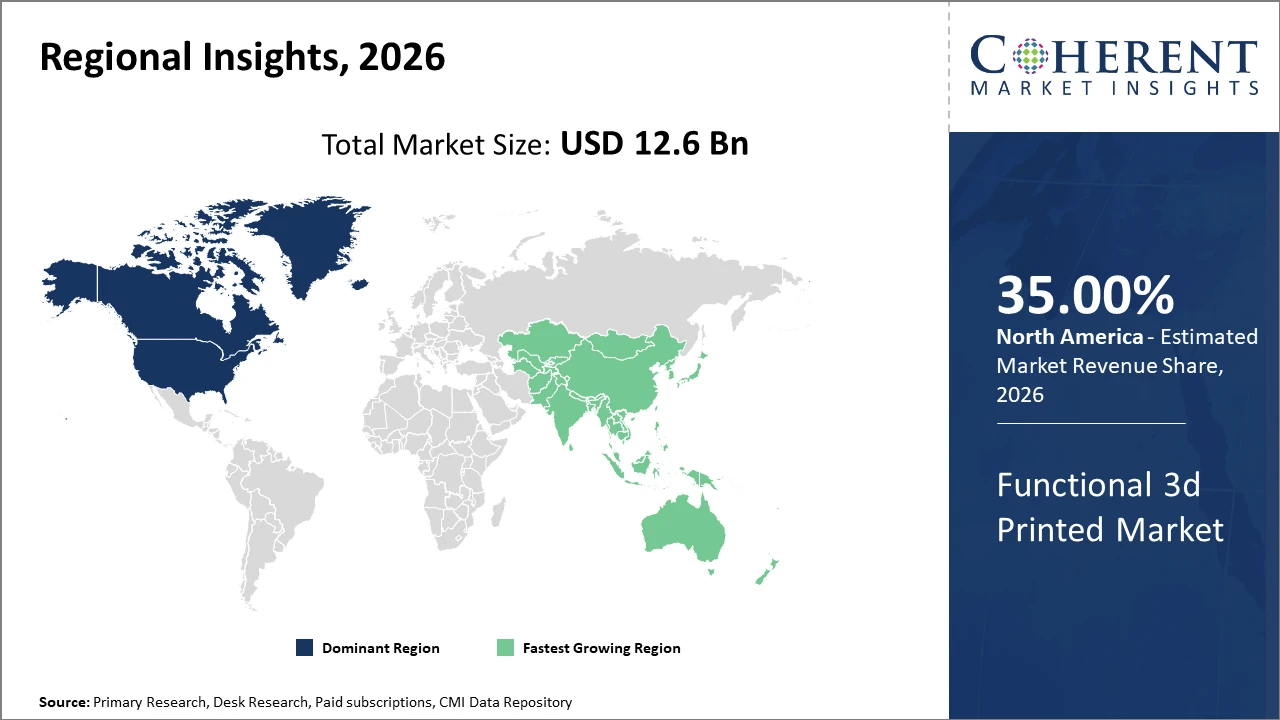
Regionally, North America leads market share by 35% , attributed to robust infrastructure, research focus, and governmental support, particularly in the United States, which is home to several key market players.
Asia Pacific displays the highest CAGR, propelled by rapid industrialization, government incentives, and increasing manufacturing automation in countries like China and India.
Functional 3d Printed Market Segmentation Analysis
To learn more about this report, Request Free Sample
Functional 3d Printed Market Insights, By Printing Technology
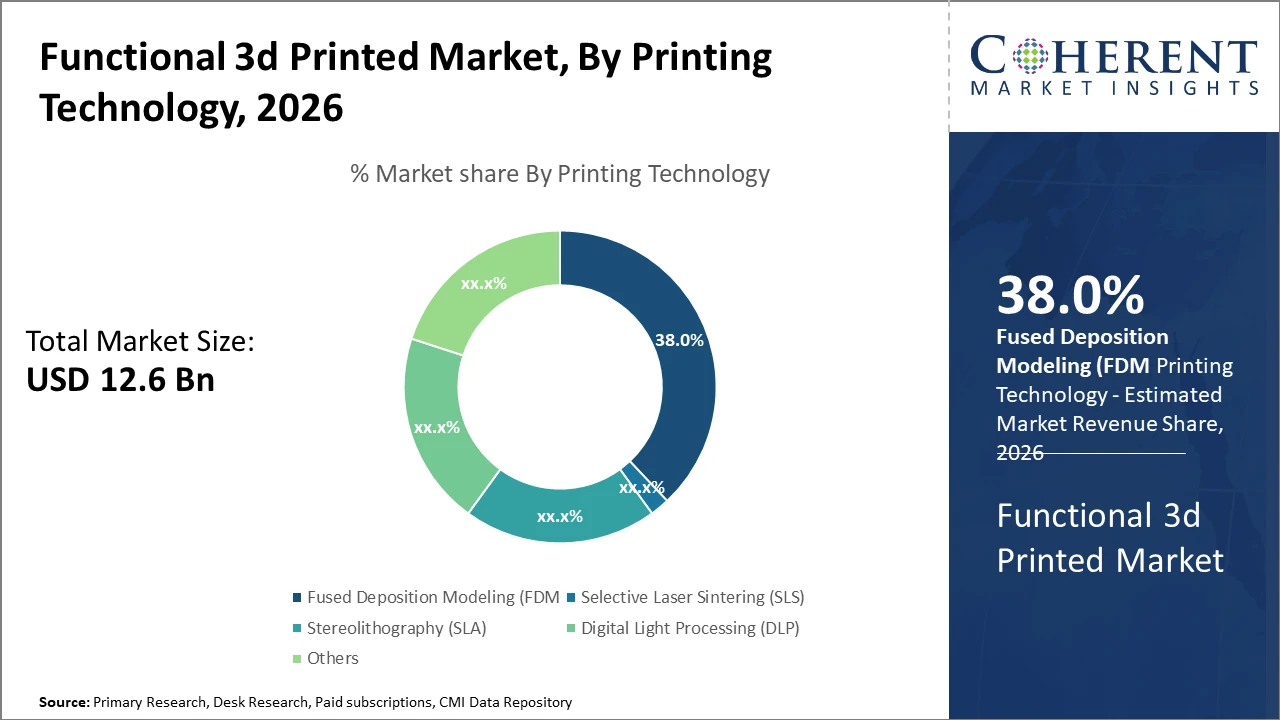
Fused Deposition Modeling (FDM) dominates the market share due to its cost-effectiveness and adaptability across a wide range of industries, including automotive and consumer goods. FDM’s ability to print durable thermoplastics with relative ease has solidified its presence. The fastest-growing subsegment is Selective Laser Sintering (SLS), favored mainly in aerospace and medical applications for its ability to produce high-strength, complex geometries without support structures. SLA and DLP offer high-accuracy resin-based printing, excelling in dental and jewelry applications but holding moderate shares in functional 3D printing.
Functional 3d Printed Market Insights, By Material Type
Polymers command the largest market share owing to their versatility, biocompatibility, and cost advantages, which make them indispensable in healthcare and consumer sectors. Metal materials, however, are the fastest-growing subsegment driven by aerospace and automotive demand for high-performance components with exceptional strength-to-weight ratios. Ceramics are used primarily in electronics and medical implants for their heat resistance and bioinertness, maintaining steady but smaller market shares. Composites, integrating fibers into polymer matrices, are gaining traction due to enhanced mechanical properties and tailored functionality.
Functional 3d Printed Market Insights, By End-User Industry
Automotive dominates due to the increasing demand for lightweight parts and custom tooling, supported by substantial R&D activities aiming to reduce vehicle emissions and improve performance. Healthcare is the fastest-growing segment, with advancements in personalized implants, prosthetics, and surgical tools fueling its expansion. Aerospace, while smaller in volume, shows rapid growth driven by stringent safety standards and the need for lightweight, high-strength materials. Consumer goods leverage 3D printing for customization and rapid prototyping. Industrial applications focus on machinery components and tooling, whereas others encompass education and research sectors, witnessing progressive adoption.
Functional 3d Printed Market Trends
The market is experiencing accelerated adoption of multi-material and hybrid additive manufacturing techniques.
This trend, prominent in aerospace and healthcare applications by 2026, facilitates the production of complex parts that combine toughness, flexibility, and lightweight properties in a single build, boosting operational efficiency and cost-effectiveness.
Furthermore, the rise of localized production hubs has enhanced supply chain resilience, illustrated by a 15% increase in region-specific print centers in 2025 in Asia Pacific and North America.
Sustainability initiatives, primarily driven by EU regulations and North American corporate governance, have catalyzed material recycling and bio-based polymer development, crucial in reducing environmental footprints.
Functional 3d Printed Market Insights, By Geography
To learn more about this report, Request Free Sample
North America Functional 3d Printed Market Analysis and Trends
In North America, the dominance in the market is sustained by strong investments in R&D, widespread industrial adoption, and robust policy support. The United States leads with approximately 40% market share, driven by aerospace giants and healthcare innovators leveraging functional 3D printing. High adoption rates of cutting-edge materials and technology platforms by leading market players amplify regional industry trends and revenue growth.
Asia Pacific Functional 3d Printed Market Analysis and Trends
Meanwhile, the Asia Pacific exhibits the fastest growth with a CAGR exceeding 16%, fueled by rapid industrialization in China and India, aggressive government incentives, and a growing base of startups and SMEs embracing functional 3D printing for specialized manufacturing. Enhanced infrastructure and expanding consumer electronics and automotive sectors are the primary growth drivers.
Functional 3d Printed Market Outlook for Key Countries
USA Functional 3d Printed Market Analysis and Trends
The USA’s market benefits from substantial investments in additive manufacturing technology, with government funding exceeding USD 200 million annually since 2024 toward enhancing industrial 3D printing capabilities. Boeing and Lockheed Martin have fully integrated functional 3D printed components into their aircraft manufacturing, reducing production time by up to 25%. The presence of significant market companies and technology innovators reinforces the country’s leadership in shaping industry trends and growth strategies.
China Functional 3d Printed Market Analysis and Trends
China’s market shows remarkable growth due to its expanding manufacturing ecosystem and focused investments in industrial 3D printing technologies. Initiatives such as “Made in China 2025” have incentivized adoption in automotive and consumer goods sectors, leading to an estimated 30% increase in functional printing production between 2024 and 2026. Leading local companies have also forged partnerships with global technology providers, accelerating technology transfer and market revenue expansion.
Analyst Opinion
Market share is heavily influenced by the rapid scaling of production capacities in North America and Asia Pacific. Manufacturers have increased their operational throughput by an average of 18% annually since 2024, responding to growing demand for customized, complex components. For instance, increased capacity utilization in 2025 led to a 20% year-over-year revenue surge among key manufacturing hubs.
Pricing dynamics have stabilized due to maturing supply chains and material innovations. The availability of high-performance polymers and metal alloys at reduced costs contributed to a 12% reduction in average component price in 2025, boosting adoption in price-sensitive industries like automotive. This pricing trend has stimulated market growth and expanded use cases in mass production scenarios.
Import-export fluctuations in raw materials, particularly specialized powders and resins, have created nuanced market growth challenges yet opened diverse regional demand patterns. The Asia Pacific region saw a 25% spike in imports of 3D printing materials in 2026, driven by rapid industrialization in countries such as India and China, illustrating the demand-side impetus driving market expansion.
Micro-indicators reveal a rising number of patents in functional 3D printing materials and processes, which increased by 22% between 2024 and 2026. This surge signals intensifying innovation and is anticipated to create new market segments, with a significant impact on the market size and revenue in forthcoming years.
Market Scope
| Report Coverage | Details | ||
|---|---|---|---|
| Base Year: | 2025 | Market Size in 2026: | USD 12.6 billion |
| Historical Data for: | 2020 To 2024 | Forecast Period: | 2026 To 2033 |
| Forecast Period 2026 to 2033 CAGR: | 14.2% | 2033 Value Projection: | USD 32.4 billion |
| Geographies covered: |
|
||
| Segments covered: |
|
||
| Companies covered: |
|
||
| Growth Drivers: |
|
||
Uncover macros and micros vetted on 75+ parameters: Get instant access to report
Functional 3d Printed Market Growth Factors
The expansion of the Functional 3D Printed Market is propelled by the surging demand for lightweight yet durable components across the aerospace and automotive sectors. Material innovations, especially the development of biocompatible polymers and high-strength metal alloys, have unlocked new application avenues in healthcare and industrial goods. Integration of automation and Artificial Intelligence (AI) in printing workflows optimized efficiency and reduced lead times, accelerating market growth. Additionally, government incentives supporting additive manufacturing adoption in major economies such as the U.S. and China have catalyzed investment and infrastructure development, amplifying industry size and market revenue streams.
Functional 3d Printed Market Development
In 2024, Israel announced the launch of a national Institute for 3D-Printed Organs and AI-Driven Medicine, aimed at accelerating breakthroughs in regenerative medicine, bioprinting, and data-driven healthcare. The institute brings together academia, hospitals, and technology companies to integrate artificial intelligence with advanced 3D bioprinting, supporting the development of functional organs, personalized implants, and predictive medical models to address organ shortages and improve clinical outcomes.
In 2024, Xenia launched Xecarb® PA12-CF-ST, a high-performance carbon-fiber-reinforced PA12 3D-printing filament engineered for demanding industrial applications. The new material combines high stiffness, dimensional stability, and thermal resistance with good processability, making it suitable for aerospace, automotive, and tooling components where lightweight structures and mechanical strength are critical.
Key Players
Leading Companies of the Market
EOS GmbH
3D Systems Corporation
Stratasys Ltd.
SLM Solutions Group AG
HP Inc.
Prodways Group
Renishaw plc
Materialise NV
GE Additive
Desktop Metal Inc.
Competitive strategies center around innovation-driven market expansion, evidenced by EOS GmbH’s launch of a new metal 3D printing platform in 2025 that enhanced production speed by 30%, leading to a 15% revenue increase in the following year. Similarly, HP Inc. aggressively pursued strategic partnerships with automotive manufacturers in 2026, culminating in a 25% increase in global market share within a year.
Functional 3d Printed Market Future Outlook
The future outlook for the functional 3D printed market is highly positive, driven by the transition from prototyping to full-scale functional manufacturing. Continued innovation in multi-material printing, higher-speed printers, and improved quality control systems is expected to expand adoption across mission-critical applications. Industries are increasingly leveraging functional 3D printing to reduce supply chain complexity, enable on-demand production, and support lightweight, high-performance designs. The integration of artificial intelligence, digital twins, and automation into additive manufacturing workflows is likely to further enhance reliability and scalability. As sustainability concerns grow, functional 3D printing’s ability to reduce material waste and energy consumption is expected to strengthen its long-term market position.
Functional 3d Printed Market Historical Analysis
The functional 3D printed market has evolved significantly from its early origins in rapid prototyping during the late 1980s and 1990s, when additive manufacturing technologies were primarily used for visual models and design validation rather than end-use products. Early limitations in material strength, dimensional accuracy, and surface finish restricted broader industrial adoption. Over the past two decades, advances in printing technologies such as selective laser sintering, fused deposition modeling, and stereolithography, along with the development of high-performance polymers, metals, and composites, have transformed 3D printing into a viable method for producing functional components. Industries such as aerospace, healthcare, automotive, and industrial manufacturing increasingly adopted functional 3D printing for customized parts, tooling, implants, and low-volume production. The shift toward digital manufacturing and mass customization further strengthened the market’s foundation.
Sources
Primary Research Interviews:
Additive manufacturing engineers
product designers
industrial manufacturers
healthcare device developers
materials scientists
Databases:
Wohlers Report
ISO Additive Manufacturing Standards
OECD Manufacturing Data
SmarTech Analysis
Magazines:
3D Printing Industry
Additive Manufacturing Magazine
TCT Magazine
Manufacturing Today
IndustryWeek
Journals:
Additive Manufacturing Journal
Rapid Prototyping Journal
Materials Today
Journal of Manufacturing Processes
Advanced Engineering Materials
Newspapers:
Financial Times (Manufacturing)
The Wall Street Journal (Industry)
Reuters Technology
Bloomberg Manufacturing
The Guardian (Technology)
Associations:
ASTM International (Additive Manufacturing)
Additive Manufacturing Users Group (AMUG)
SME
ISO
Share
Share
Komal Dighe is a Management Consultant with over 8 years of experience in market research and consulting. She excels in managing and delivering high-quality insights and solutions in Health-tech Consulting reports. Her expertise encompasses conducting both primary and secondary research, effectively addressing client requirements, and excelling in market estimation and forecast. Her comprehensive approach ensures that clients receive thorough and accurate analyses, enabling them to make informed decisions and capitalize on market opportunities.

Credibility and Certifications

860519526


9001:2015

27001:2022


Need a Custom Report?
We can customize every report - free of charge - including purchasing stand-alone sections or country-level reports
Customize NowJoining thousands of companies around the world committed to making the Excellent Business Solutions.
View All Our Clients