Grain Storage Silo Market Analysis & Forecast: 2026-2033

Grain Storage Silo Market Size and Forecast – 2026 – 2033
The Global Grain Storage Silo Market size is estimated to be valued at USD 5.10 billion in 2026 and is expected to reach USD 7.1 billion by 2033, exhibiting a compound annual growth rate (CAGR) of 6.3% from 2026 to 2033.
Global Grain Storage Silo Market Overview
Grain storage silos are large, engineered structures designed to store bulk grains such as wheat, maize, rice, barley, and oilseeds while preserving quality and minimizing losses. They are made from steel, concrete, or metal alloys and include aeration systems, temperature monitoring, fumigation units, and automated unloading mechanisms. The market covers flat-bottom silos, hopper-bottom silos, and farm or commercial-scale silos widely used in agriculture, grain processing, and food industries to ensure efficient, hygienic, and long-term storage.
Key Takeaways
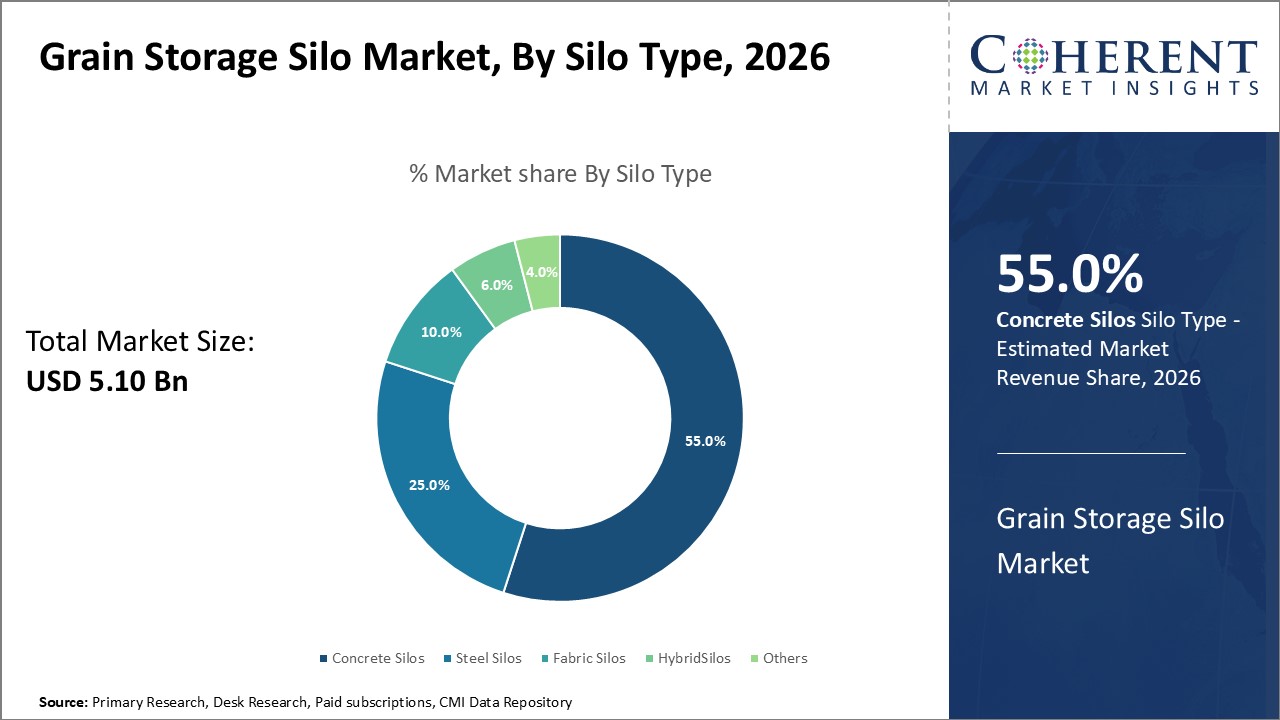
Steel silos dominate the silo type segment with a 55% market share, driven by durability and cost-effectiveness, while fabric silos show the fastest growth due to ease of installation and scalability.
Large capacity silos (>20,000 tons) lead in market revenue, supported by rising demand from industrial and biofuel sectors, whereas medium capacity silos experience rapid adoption in emerging agricultural regions.
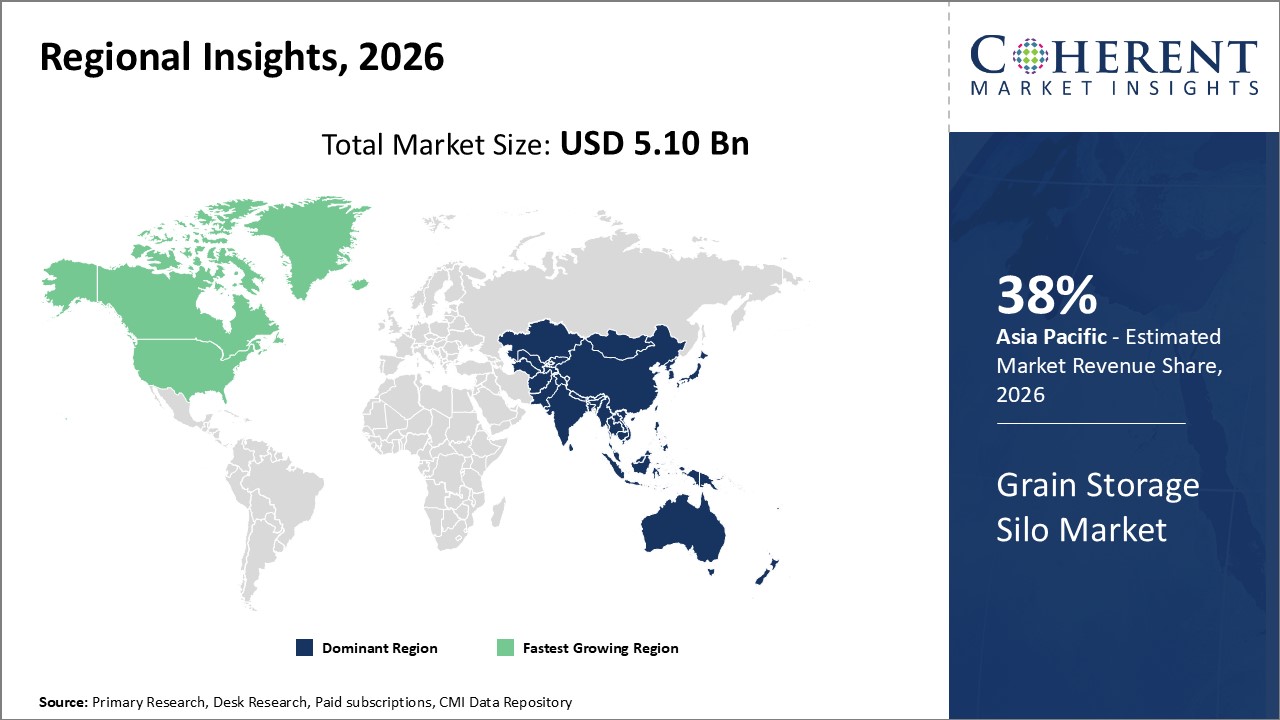
Asia Pacific leads in regional market size, accounting for nearly 38% of industry share, propelled by expanding agricultural output and investments in grain infrastructure in China and India.
North America exhibits the highest CAGR due to technology integration and ongoing government support, reflective of a mature market ecosystem emphasizing modernization and sustainability.
Grain Storage Silo Market Segmentation Analysis
To learn more about this report, Request Free Sample
Grain Storage Silo Market Insights, By Silo Type
Steel Silos dominate the market share with 55%. Steel silos benefit from superior structural strength and corrosion resistance, making them the preferred choice for large-scale commercial storage, especially in North America and Europe. Technological innovations in galvanization and protective coatings further enhance their lifespan. Fabric silos, however, are the fastest-growing subsegment due to their cost-effectiveness, ease of installation, and flexibility, which suits small- to medium-sized farms and regions with variable storage needs such as Southeast Asia. Concrete Silos offer longevity and thermal insulation advantages, primarily utilized in industrial and biofuel sector storage where temperature control is critical. Hybrid Silos combine benefits from steel and concrete elements providing balanced performance, though still emerging in market share.
Grain Storage Silo Market Insights, By Capacity
Large Capacity silos hold dominant industry shares, favored in industrial-grade applications and large-scale farming operations, especially in exporting countries like the USA and Brazil. Their ability to store bulk volumes efficiently supports streamlined logistics and cost management, vital for export-driven business growth. Medium Capacity silos are the fastest-growing subsegment, witnessing rising adoption fueled by the expansion of commercial farming in emerging economies such as India and China. These silos provide a balance between scalability and capital investment requirements.
Grain Storage Silo Market Insights, By Application
Agricultural Produce Storage dominates with the largest market share, driven by global food grain production growth and post-harvest management demands. This segment includes cereals, pulses, and oilseeds, emphasizing preserving quality and minimizing losses. The Biofuel Sector Storage is the fastest-growing application, reflecting global shifts towards renewable energy sources. Countries with bioethanol production, such as the USA and Brazil, have seen this segment expand rapidly, supported by governmental clean energy policies. Industrial Raw Material Storage caters to grain-derived products used in manufacturing sectors, while Animal Feed Storage is growing steadily due to increases in livestock farming, especially in Asia Pacific.
Grain Storage Silo Market Trends
The Grain Storage Silo Market trend prominently features the integration of digital technologies such as IoT sensors and automated control systems that have enhanced grain quality management and inventory tracking.
For instance, recent implementations in the U.S. and Germany have reported operational efficiency improvements by 20-26%, affirming these technologies’ impact.
Another trend is the surge in demand for eco-friendly silo solutions, especially in the EU and China, where regulatory frameworks incentivize green infrastructure investments, resulting in increased adoption of energy-efficient aeration technology by 31% in 2025.
Grain Storage Silo Market Insights, By Geography
To learn more about this report, Request Free Sample
Asia Pacific Grain Storage Silo Market Analysis and Trends
Regional market dominance is held by Asia Pacific, accounting for 38% of the Grain Storage Silo Market share due to comprehensive government programs supporting agricultural modernization in China and India.
North America Grain Storage Silo Market Analysis and Trends
Meanwhile, North America represents the fastest-growing region with a CAGR of approximately 7.4%, influenced by the rise in precision farming and smart silo technologies. The mature agricultural export hubs in the U.S. and Canada benefit from robust infrastructure investments and policy support, which reinforce market leadership.
Grain Storage Silo Market Outlook for Key Countries
USA Grain Storage Silo Market Analysis and Trends
The U.S. market for grain storage silos remains a cornerstone of North America’s agricultural infrastructure, buoyed by vast grain production and export activity. In 2025, U.S. grain exports surpassed 55 million metric tons, necessitating expansion in silo storage capacity. Leading companies like AGI and Brock Grain Systems have implemented advanced smart silo systems aligned with the country’s precision agriculture trends, substantially improving operational throughput and grain preservation. Government agricultural subsidies and technology grants further propel silo upgrades, reinforcing growth trajectories.
India Grain Storage Silo Market Analysis and Trends
India’s market is witnessing accelerated growth driven by initiatives such as the National Food Security Mission and increasing farmer incomes. The demand for medium and large-capacity silos is expanding to accommodate the surging production of rice and wheat. Companies like Sukup Manufacturing and Martin Silo have established manufacturing bases and regional offices to cater to local customization requirements. The emphasis on reducing post-harvest losses in the Indian market — which currently amounts to approximately 10-15% of output — has intensified demand for durable and technologically advanced storage solutions.
Analyst Opinion
The surge in global grain production, particularly in staple crops like wheat and corn, is a critical demand-side driver. In 2025, global grain output increased by 4.8% year-on-year, prompting an upward shift in grain storage infrastructure investments. Notably, regions with high agricultural exports saw capacity expansions exceeding 9% annually, reflecting direct market growth correlations.
Technological advancements in silo design, specifically advancements in aeration and temperature control systems, are enabling prolonged grain preservation, reducing spoilage rates by up to 16% as observed in recent trials across Southeast Asia. This micro-indicator reinforces the increasing preference for technologically superior silos, directly impacting market size.
The pricing dynamics of raw materials, such as steel and concrete, influence the cost structure of silo manufacturing. Steel prices, for example, dropped by approximately 7% in 2023 due to supply chain recalibrations, boosting production capacity across several key manufacturing hubs and enabling competitive pricing strategies—an essential supply-side market growth indicator.
The diversification of grain storage applications beyond traditional agriculture, including biofuel production and livestock feed storage, expands market scope. In 2025, demand for grain storage facilities catering to bioenergy sectors rose by 13%, reinforcing the market’s broadening revenue base and dynamic growth forecast.
Market Scope
| Report Coverage | Details | ||
|---|---|---|---|
| Base Year: | 2025 | Market Size in 2026: |
USD 5.10 billion |
| Historical Data for: | 2020 To 2024 | Forecast Period: | 2026 To 2033 |
| Forecast Period 2026 to 2033 CAGR: | 6.3% | 2033 Value Projection: |
USD 7.1 billion |
| Geographies covered: |
|
||
| Segments covered: |
|
||
| Companies covered: | AGI, Sukup Manufacturing Co., Martin Silo Co., Brock Grain Systems, Chief Agromarketing LLC, DMC Grain Systems, Bühler Group, Cimbria, GSI Group, Ltd., Penta Engineering | ||
| Growth Drivers: |
|
||
Uncover macros and micros vetted on 75+ parameters: Get instant access to report
Grain Storage Silo Market Growth Factors
The Grain Storage Silo Market growth is predominantly driven by several key factors. First, escalating global food demand necessitates enhanced grain preservation infrastructure, with the UN projecting a 11% rise in grain consumption by 2030. Second, government subsidies and policies encouraging local production and storage securitize investments in storage silos, especially in North America and Asia Pacific. Apart from this, the integration of automation and digital monitoring systems optimizes inventory management, reducing losses and operational costs significantly—as evidenced by a 15% reduction in spoilage reported across large commercial silos in Europe in 2025. Lastly, climate change-induced weather variability increases the need for more robust storage solutions to prevent crop quality degradation, driving investments towards advanced silo types with adapted material and design features.
Grain Storage Silo Market Development
In 2026, China increased its national grain stockpiling budget, directing additional funds toward expanding storage capacity and upgrading aging infrastructure. The investment supported the country’s strategic food-security objectives by enhancing reserve stability and improving regional warehousing efficiency.
In late 2025, the USDA launched its USD 140 million Commodity Storage Assistance Program, aimed at rebuilding and upgrading grain bins damaged by storms and structural failures. The initiative provided critical support to U.S. farmers, helping restore storage resilience and protect harvested commodities.
In 2023, Crover introduced its robotic grain-monitoring technology, featuring autonomous devices capable of collecting real-time temperature, moisture, and spoilage data inside silos. The innovation reduced grain losses, improved quality management, and marked a significant leap in modern grain-storage monitoring systems.
Key Players
Leading Companies of the Market
AGI
Sukup Manufacturing Co.
Martin Silo Co.
Brock Grain Systems
Chief Agromarketing LLC
DMC Grain Systems
Bühler Group
Cimbria
GSI Group, Ltd.
Penta Engineering
AGI recently integrated IoT-enabled smart silo systems, resulting in a 21% increase in operational efficiency reported in mid-2025, reflecting its competitive market strategy to differentiate through innovation. Similarly, Sukup Manufacturing expanded its steel silo production capacities by 16% in late 2023, capitalizing on raw material cost reductions, thus strengthening its market share. Meanwhile, Martin Silo has been focusing on custom engineering solutions addressing regional climate challenges, which has enhanced its presence in the Asia Pacific market.
Grain Storage Silo Market Future Outlook
The grain storage silo market is expected to grow steadily due to rising grain production, climate-change–driven storage challenges, and the global push to curb food wastage. Digital silos equipped with IoT sensors, remote condition monitoring, and automated unloading systems will become mainstream as precision agriculture expands. Emerging economies in Asia and Africa are likely to deploy large-scale silo infrastructure under government food security programs. Sustainability pressures will also drive demand for silos made with recyclable materials, energy-efficient ventilation, and solar-powered systems. Additionally, the growth of grain-based biofuel industries and increasing export demand will further accelerate silo installations over the next decade.
Grain Storage Silo Market Historical Analysis
Historically, the market has grown alongside global agricultural expansion and modernization. For decades, traditional storage methods such as warehouses, barns, and open stockpiles dominated, particularly in developing countries, but these methods led to high post-harvest losses due to moisture, pests, and inconsistent handling. As global food security concerns intensified and grain trading volumes rose, governments and agribusinesses increasingly invested in steel silos, concrete silos, and automated bulk storage solutions. From the early 2000s onward, grain exporters like the U.S., Canada, Russia, Australia, and Argentina also upgraded their silo infrastructure to meet international standards and reduce logistics bottlenecks. Technological upgrades such as aeration systems, temperature monitoring, and fumigation control improved grain quality preservation, making modern silos a central asset in supply chain efficiency.
Sources
Primary Research Interviews:
Grain Storage Engineers
Agronomists
Post-Harvest Technologists
Grain Traders
Silo Manufacturers
Databases:
FAO Grain Data
USDA Grain Storage Reports
World Bank Agri Logistics Data
UN Comtrade Cereals
Magazines:
World Grain
Milling & Grain
Feed & Grain Magazine
AgriBusiness Global
Grain Journal
Journals:
Journal of Stored Products Research
Postharvest Biology and Technology
Agricultural Systems
Food Control
Journal of Agricultural Engineering
Newspapers:
Reuters Agriculture
Financial Times (Commodities)
The Economic Times (Agriculture)
The Guardian (Food Systems)
Bloomberg Agri News
Associations:
Grain Elevator and Processing Society (GEAPS)
International Association for Cereal Science
American Society of Agricultural Engineers
Grain Farmers Associations
European Flour Millers Association
Share
Share

Credibility and Certifications

860519526


9001:2015

27001:2022


Need a Custom Report?
We can customize every report - free of charge - including purchasing stand-alone sections or country-level reports
Customize NowJoining thousands of companies around the world committed to making the Excellent Business Solutions.
View All Our Clients